
At a glance
How the ekiden relay grew from an old post-road name into Hakone’s New Year race, why a cloth sash makes running a team burden, and where to watch.
- An ekiden is a long-distance road relay in stages, and runners pass a cloth sash, the tasuki, instead of a baton.
- The modern ekiden began in 1917 with a Yomiuri-organized relay of over 500 kilometers from Kyoto to Tokyo.
- The Hakone Ekiden, first held in 1920, runs between Ōtemachi in Tokyo and Lake Ashi every January 2 and 3.
- Hakone has ten stages over two days, about 217 kilometers in all, more than five marathons.
- Stage 5 climbs to roughly 870 meters, and a runner who dominates it is called yama no kami, god of the mountain.
In most countries, distance running means the marathon. In Japan it means the ekiden, a road relay in which a team of runners covers anything from a few dozen to more than two hundred kilometers, passing not a baton but a cloth sash called a tasuki. Every year on January 2 and 3, university students run from central Tokyo to Lake Ashi in the Hakone mountains and back, and a large share of the country watches every step on television. This is an introduction to what an ekiden is, why it grips the Japanese public, how the Hakone Ekiden became part of the New Year holiday, and how to see one for yourself.
01A Relay Run with a Sash
The format is simple. A course is divided into stages, called ku. Each stage is run by one athlete, who hands the tasuki to the next runner at a relay station (chūkeisho). Stages vary in length from a few kilometers to more than twenty, and they are run on ordinary public roads that are closed or controlled for the day. The team’s total time decides the result.
What separates an ekiden from a track relay is scale and terrain. The Hakone course is about 217 kilometers, more than five marathons, and takes two days. Along the way there are flat city boulevards, a wind-blown stretch of Pacific coast, a punishing mountain climb and a descent that wrecks the legs. Coaches assign runners to stages according to their strengths, and the order of a team’s lineup is one of the most discussed subjects in Japanese sports media in late December.
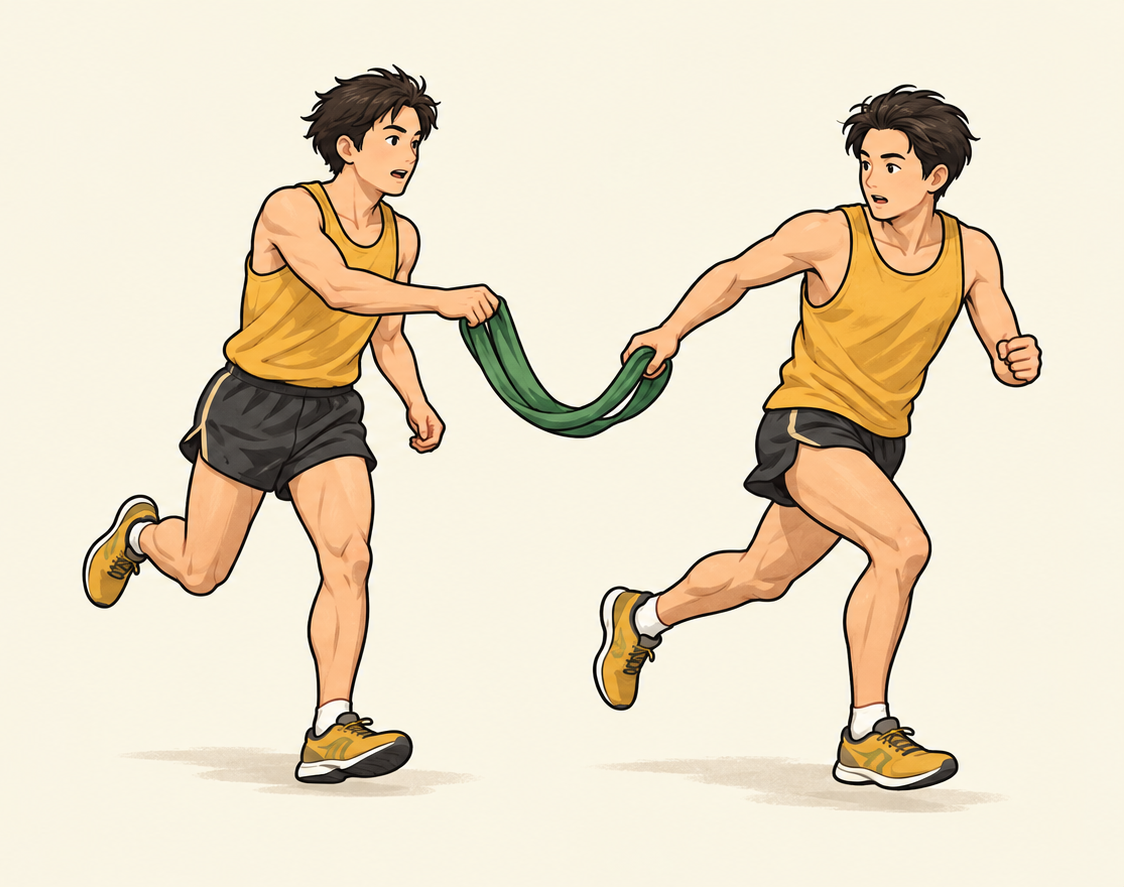
Then there is the tasuki itself. It is a band of cloth printed with the team’s name, worn diagonally over one shoulder and across the body to the opposite hip. At the relay station the runner pulls it off, often in the final hundred meters, and stretches out an arm to put it in a teammate’s hand. By the end of a race it is soaked with sweat from every runner who has worn it. Because it is a physical object carried by the whole team, the phrase tasuki o tsunagu, "to keep the sash connected," has passed into everyday Japanese as a way of talking about handing on work or responsibility from one person or generation to the next.
- 1
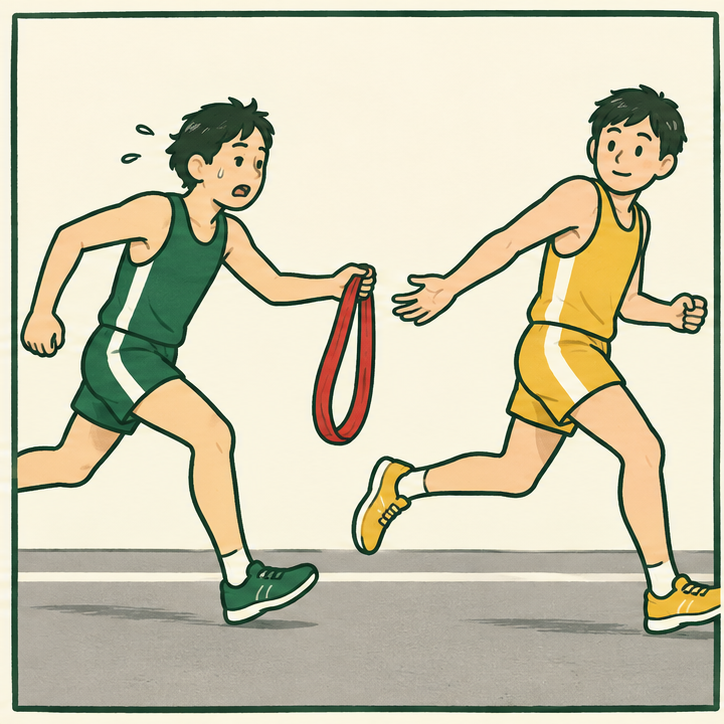 The incoming runner takes off the sash; the next runner reaches back.
- 2
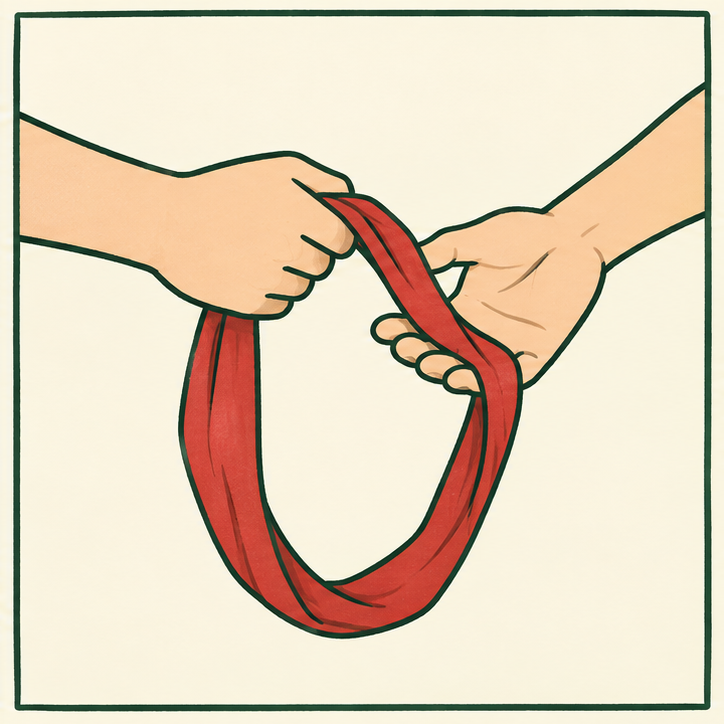 The same cloth sash passes from one hand to the next.
- 3
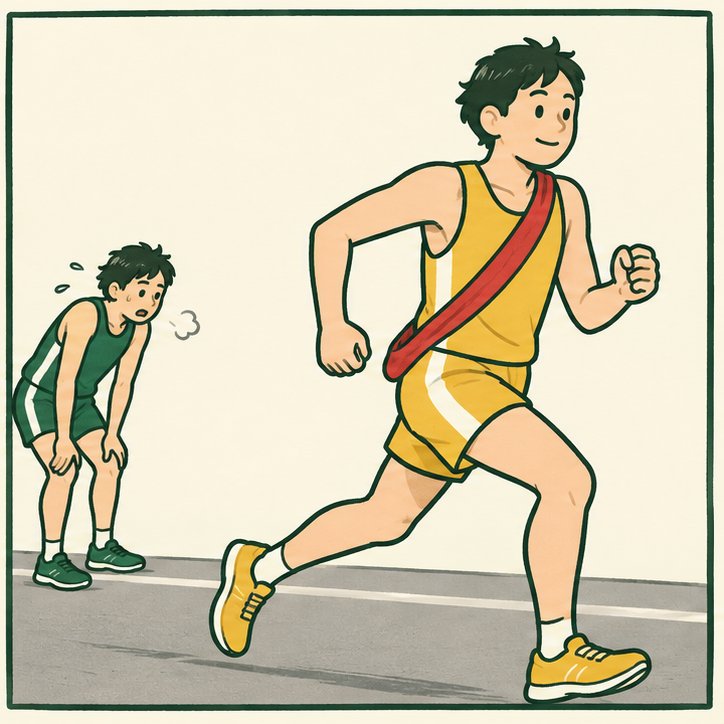 The new runner sets off with the sash slung from shoulder to hip as the last one slows.
02A Name from the Old Post Roads
The word ekiden combines the characters for "station" and "transmit." It refers to the post-station system that Japan’s early state built in imitation of Tang China, under which horses and couriers were kept at intervals along official highways to carry government dispatches from stage to stage. In the Edo period (1603–1868), runners known as hikyaku carried letters and parcels in relays along the Tōkaidō, the great road between Edo and Kyoto with its fifty-three post towns.
The modern sport began in 1917. To mark fifty years since Tokyo became the capital, the Yomiuri newspaper organized a relay along the Tōkaidō from the Sanjō Bridge in Kyoto to Shinobazu Pond in Ueno, Tokyo, a distance of over 500 kilometers split into twenty-odd stages and run day and night over three days. Two teams took part, representing the Kantō and Kansai regions. The anchor of the Kantō team was Kanakuri Shisō, Japan’s first Olympic marathoner, who is remembered as the father of Japanese marathon running. The name "ekiden" for the event is generally credited to Toki Zenmaro, head of the Yomiuri’s city news department, working with Takeda Chiyosaburō, vice president of the Japan Amateur Athletic Association; they borrowed it from the ancient post system. Monuments at both ends of that route now mark the birthplace of the ekiden.
The idea caught on quickly. Within a few years schools, towns and regions all over Japan were organizing their own relays.
03The Hakone Ekiden
The most famous of them all is the Tokyo–Hakone Round-Trip College Ekiden Race, known simply as Hakone. It too came from Kanakuri. Around 1919 he and others dreamed of sending a team of runners across the United States, and they wanted a race that would train athletes to run long distances day after day. The first Hakone Ekiden was held in February 1920 with just four schools: Waseda, Keiō, Meiji and the Tokyo Higher Normal School, which won. The transcontinental run never happened, but Hakone has been held almost every year since.
The race now takes place on January 2 and 3. On the first day, the outward leg (ōro) starts in front of the Yomiuri Shimbun building in Ōtemachi, in the heart of Tokyo’s business district. It runs south through relay stations at Tsurumi, Totsuka, Hiratsuka and Odawara, then climbs into the mountains to finish at Lake Ashi: five stages. On the second day, the return leg (fukuro) retraces the route back to Ōtemachi in another five. Ten stages in total, each around twenty kilometers, about 217 kilometers in all.
- 1Ōtemachistart, Yomiuri Shimbun building
- 2Tsurumirelay station
- 3Totsukarelay station
- 4Hiratsukarelay station
- 5Odawararelay station; the fifth stage climbs from here
- 6Lake Ashifinish; the fifth stage tops out at roughly 870 m
The outward leg on January 2 runs from Ōtemachi to Lake Ashi in five stages; on January 3 the return leg retraces the route, ten stages and about 217 km in all.
Two stages have their own mythology. The fifth is the mountain climb. From Odawara the road rises through the hot-spring town of Hakone-Yumoto and up National Route 1 to a high point of roughly 870 meters before dropping down to the lake. A runner who dominates this stage is called yama no kami, "god of the mountain." The title has gone to Imai Masato of Juntendō University, Kashiwabara Ryūji of Tōyō University and Kamino Daichi of Aoyama Gakuin. Kashiwabara ran the fifth stage four years in a row from 2009 to 2012, and Tōyō won three titles in that span. The sixth stage, the next morning, is the same mountain in reverse: a fast, steep descent that punishes the quadriceps and knees. The second stage, the longest flat stretch of the first day, is known as the hana no niku, "the flower of stages," because teams put their best runners there.
The rule that produces the most drama is the kuriage start, or early start. If a team falls too far behind the leader, its next runner cannot wait at the relay station. When the time limit expires, he must set off wearing a substitute sash in white and yellow stripes, and the team’s own tasuki is no longer carried to the finish. Television cameras linger on these moments: the next runner looking back down the road, his teammate sprinting into view, the official signal, and the gap of a few meters by which the sash failed to connect. For the runner who arrives too late, it is the worst way a race can end.
Entry is hard-won. The top ten teams from the previous year keep their places; everyone else must compete for the remaining spots in a qualifying race each October in Tachikawa, west Tokyo, where each school fields a squad in a half marathon and the combined times of its top ten finishers decide who goes through. A combined team of strong runners from schools that did not qualify usually brings the field to twenty-one. Hakone is formally a regional event, run by the Kantō intercollegiate athletics federation, and only universities in the Kantō region can enter. The one exception was the 100th race in 2024, when the qualifier was opened to schools nationwide and thirteen places were on offer, making a field of twenty-three with no combined team; in the end every qualifier was still a Kantō school.
The race has survived interruption. It was suspended during the Pacific War, apart from a 1943 edition run between Yasukuni Shrine and Hakone Shrine, and resumed in 1947. In recent years the dominant team has been Aoyama Gakuin, which under coach Hara Susumu won its first title in 2015 and has won many more since (in 2026 it took a third straight title in record time, its ninth overall), with a relaxed team culture and training methods that broke the hold of older powers. Komazawa, Tōyō and Waseda have been its strongest rivals.
04Why Japan Watches
Television made Hakone a national event. Nippon TV has broadcast the race live from start to finish since 1987, more than ten hours over the two days, and in the Kantō region its ratings have usually run between about 25 and 30 percent in recent years (as of 2025), topping 30 percent on both days in 2019. For many families New Year looks like this: a bowl of ozōni soup, a lacquered box of holiday food, and the television on all morning as students run along the coast and up into the mountains.
Part of the appeal is timing. Japan stops for the first days of January, families gather, and Hakone fills the hours in the same way the end-of-year song contest on NHK or the first shrine visit does. Part of it is the route, which runs through places every Japanese viewer knows: Tokyo, Yokohama, the Shōnan coast, the castle town of Odawara, the Hakone hot springs, and on a clear day Mount Fuji behind the runners. And part of it is that the runners are students, not professionals. Each has at most four chances. The senior’s last run, the freshman’s debut and the comeback from injury all come with a story, and the broadcast tells them.
The deepest appeal is the structure of the race. One runner’s collapse costs the whole team; one runner’s heroic stage can save it. Viewers are watching responsibility as much as speed, and the idea of carrying something for others, and of not letting your teammates down, has strong resonance in Japanese life. Alumni loyalty adds to it. Graduates tune in to cheer for their old school, and a strong showing at Hakone is widely believed to boost applications the following spring, which is why many private universities invest heavily in their distance programs, recruit top high-school runners, and in some cases bring in student-athletes from Kenya.
Hakone has critics. Some argue that it concentrates Japanese distance running on one regional college race, so that many runners peak at twenty-one and drift away after graduation, to the cost of the national marathon program. The burden of the mountain stage on young bodies is a recurring debate. Others point out that most of Japan’s leading marathoners came through Hakone. Around 2020, when nearly every runner in the field wore the same brand of carbon-plated racing shoe, the story made headlines in the running press worldwide, a sign of how much weight this student race carries.
05Ekiden Season
Hakone is the peak of a season that lasts all winter. Men’s university running has three major ekiden: Izumo in Shimane Prefecture in October, short and fast; the All-Japan University Ekiden in November, from Atsuta Shrine in Nagoya to Ise Shrine; and Hakone in January. Winning all three in one season, the "triple crown," is a rare feat.
Corporate teams, which employ most of Japan’s top distance runners, compete on New Year’s Day in the New Year Ekiden in Gunma Prefecture. Women’s corporate teams race in Miyagi Prefecture in November, and university women have their own national championship in the autumn and the Mount Fuji Women’s Ekiden on December 30. In December the national high-school championships are run through the streets of Kyoto, starting and finishing at the Nishikyōgoku athletics stadium; the boys’ race has seven stages and is exactly a marathon long. In January come the inter-prefectural ekiden, a women’s race in Kyoto and a men’s race in Hiroshima, in which junior-high, high-school, college and corporate runners join forces to represent their home prefectures.
Below the elite level, ekiden are everywhere: neighborhood relays, company relays, school sports days. Many Japanese adults remember wearing a tasuki as children. The format has traveled abroad as well. The IAAF (now World Athletics) held four World Road Relay Championships between 1992 and 1998, and "ekiden" is now the word English-speaking runners use for any long road relay.
| When | Race | Where |
|---|---|---|
| October | Izumo (university men) | Shimane |
| November | All-Japan University Ekiden | Atsuta Shrine to Ise Shrine |
| November | Women’s corporate teams | Miyagi |
| December | National high-school championships | Kyoto |
| December 30 | Mount Fuji Women’s Ekiden | — |
| New Year’s Day | New Year Ekiden (corporate) | Gunma |
| January 2–3 | Hakone | Ōtemachi–Lake Ashi |
| January | Inter-prefectural ekiden | Women Kyoto, men Hiroshima |
From Izumo in October to the inter-prefectural races in January, ekiden fill the winter; Izumo, the All-Japan University Ekiden and Hakone are the three major men’s university races.
Fiction has helped spread the sport’s mystique. Miura Shion’s novel Run with the Wind (Kaze ga tsuyoku fuiteiru, 2006) follows ten students at a small university who decide, almost from nothing, to make it to Hakone. It became a film and an anime series and is for many readers outside Japan the first introduction to the race.
06Watching an Ekiden in Person
If you are in Tokyo over New Year, the start and finish in Ōtemachi draw the biggest crowds: the gun goes at 8 a.m. on January 2, and on January 3 the teams come home from around midday. The streets around the Yomiuri building fill up, so arrive an hour or two early. For a calmer view, stand anywhere along National Route 15 or Route 1. First come police vehicles, then the television trucks, then the runners, each followed by a car carrying his coach, who shouts encouragement through a loudspeaker. Teams are spread out, so at any one spot the procession lasts around an hour.
Volunteers and sponsors hand out small paper flags, and the crowd waves them as runners pass. Stay on the sidewalk, keep your hands behind the barrier, and do not lean into the road for a photo or chase after a runner. They pass at under three minutes per kilometer and are gone in seconds, which is why many spectators watch the live stream on their phones at the same time to see where the runner in front of them stands in the race.
For the atmosphere of the mountain, go to Hakone. On the fifth stage, around Hakone-Yumoto, Miyanoshita and Kowakien, the road is steep and twisting and the runners slow enough that you can see their faces. Lake Ashi draws large crowds both for the first-day finish and the second-day start, and the Hakone Ekiden Museum by the lake displays team sashes, uniforms and photographs of famous moments.
If you visit at another time of year, catch one of the other races: the high-school championship in Kyoto in late December, or the All-Japan University Ekiden finishing near Ise in November. Even a few minutes by the roadside will show you the moment that defines the sport: a runner tearing the sash from his shoulder at the relay station, reaching out to place it in his teammate’s hand, and collapsing as the next runner is already gone.