
At a glance
Why a kendo hit needs spirit, sword and body together, how bamboo sparring grew out of Edo fencing halls, and how iaido practices the solitary draw.
- A kendo match has only four legal targets: men (head), kote (wrist), dō (torso) and tsuki (throat thrust).
- A valid strike needs spirit, sword and body together plus alert zanshin afterwards; a celebratory fist pump can cost a point.
- From the eighteenth century, the Jikishinkage and Nakanishi Ittō schools sparred in armor with bamboo swords, the root of modern kendo.
- The eighth-dan exam usually has a pass rate under one percent; candidates must wait ten years after seventh dan and be at least 46.
- Iaido has no opponent; each kata breaks into four phases: nukitsuke, kirioroshi, chiburi and nōtō.
Walk past a Japanese school gym on a weekday evening and you may hear something that sounds like a fight: the crack of bamboo on lacquer, the slap of bare feet on wood, and voices shrieking a single word over and over. This is kendo, the sport-cum-discipline that turned samurai swordsmanship into something you can practice safely against a live opponent. A point in kendo is decided in a fraction of a second, but referees judge more than contact; they judge the state of the person delivering it. Its quieter sibling, iaido, has no opponent at all, just one person in a pleated skirt drawing a sword, cutting the air, and sheathing it again with total precision. This piece explains what kendo practitioners are actually trying to do, where the art came from, why so many Japanese keep at it into old age, and how iaido fits alongside it.
01What You Are Watching
A kendo match takes place on a polished wooden court 9 to 11 meters on a side. Two competitors in full armor face each other with shinai, swords made of bamboo. There are only four legal targets: men, the top of the head; kote, the forearm or wrist; dō, the side of the torso; and tsuki, a thrust to the throat. Thrusts are usually banned in matches for junior-high-school students and younger because they are dangerous.
Most competitive matches are best of three points, called sanbon shōbu, and typically last five minutes. If time runs out with one fighter a single point up, that point wins. If the score is level, the match goes into extension, and the first point decides it. Three referees stand around the court, each holding one red and one white flag. A point counts only when at least two raise their flags for the same competitor.
Newcomers watching their first tournament are often baffled. A fighter clearly hits his opponent’s helmet, and nobody raises a flag. The reason is that kendo has a demanding definition of a valid strike, yūkō datotsu. The blow must land with the top third of the shinai, on the side representing the blade’s cutting edge, on a proper target. The striker must shout the name of the target as he hits it, a long, piercing "Meeen!" His front foot must stamp down at the same instant. And afterwards he must stay alert and ready to respond, passing through and turning to face his opponent in a posture called zanshin, the "remaining mind." Japanese kendo teachers sum up the ideal as ki-ken-tai no itchi: spirit, sword and body arriving together.
- 1TargetOne of four: men, kote, dō, tsuki
- 2ShinaiTop third, on the cutting-edge side
- 3ShoutName the target as you strike
- 4StampFront foot stamps at the same instant
- 5ZanshinStay alert and ready afterwards
The elements must arrive together, followed by zanshin; miss one and the flags stay down.
A lucky touch, a strike followed by a slump, or a celebratory fist pump can all mean no point. Celebrating can even get a point already awarded taken away. All of this follows from the art’s guiding fiction, that the shinai is a real sword. A grazing touch with a real blade is not a killing blow, and a swordsman who turns away to celebrate may be cut down by the man he thought he had beaten. So kendo players do not cheer. At the end of a match both return to their starting lines, crouch, sheathe their swords in a symbolic gesture, step back, and bow.
02Armor, Bamboo and the Shout
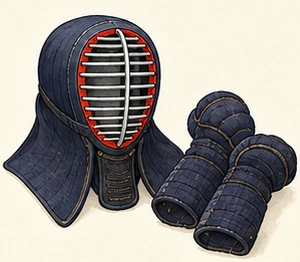
Kendo armor, called bōgu, has four parts. The men is a helmet with a steel grille over the face and padded flaps protecting the shoulders. The kote are thick padded gauntlets. The dō is a chest protector, traditionally of bamboo strips under lacquer, now often of plastic. The tare is a padded apron protecting the hips and groin, with a cloth name tag showing the wearer’s name and club. Underneath, practitioners wear a heavy cotton jacket and a dark blue hakama, the wide, pleated trousers of the samurai, and go barefoot. As of 2026, a beginner’s set of armor costs tens of thousands of yen; hand-stitched sets can run to more than a million. After a few years of summer training, armor acquires a smell that every kendo player knows and nobody else wants to.
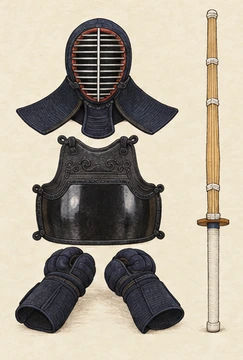
Men, dō and kote (the tare apron is not shown), with a shinai on the right.
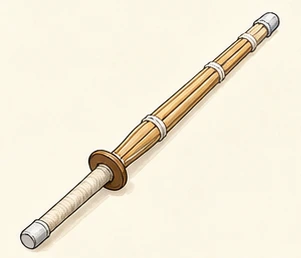
A shinai: four bamboo staves bound with leather and cord, with a leather cap at the tip.
The shinai is made of four bamboo staves bound together with leather and cord, with a leather cap at the tip. A string runs along one side, standing for the back of the blade, so that the opposite side represents the edge. An adult man’s shinai may be no longer than 120 centimeters and must weigh at least 510 grams; a woman’s must weigh at least 440 grams. Bamboo splinters, and a cracked shinai can send a sliver through the gaps in a face grille, so players check their shinai constantly and take them apart to sand or replace staves.
What startles most visitors is the noise. A kendo tournament is louder than a basketball game, because everyone is yelling. This shout, kiai, is partly a rule requirement and partly a weapon: it projects intent, unsettles the opponent and drives the body forward. Between experienced fighters, much of the contest happens before anyone strikes, in a tense standoff where the two adjust their distance by centimeters and test each other with voice and the tip of the sword. The exchange that follows can be over in less than a second.
03From Wooden Swords to Bamboo: An Edo-Period Invention
Until well into the Edo period, samurai learned swordsmanship within schools, ryū, by practicing kata: prearranged sequences of attack and defense performed with a partner, using wooden swords or live blades. Kata teach timing and form, but they cannot be fought for real. A wooden sword can kill.
The long peace of the Edo period (1603–1868) changed what swordsmanship was for. Samurai no longer went to war, and fencing became part of a gentleman’s education. In the early eighteenth century, Naganuma Shirōzaemon Kunisato of the Jikishinkage school developed protective armor and bamboo swords so that students could strike one another at full force. Around the 1750s, Nakanishi Chūzō Tsugutake of the Nakanishi branch of the Ittō school adopted the same approach, and the method of free sparring with shinai, shinai uchikomi geiko, began to spread. Its appeal was obvious. You could test yourself against a resisting opponent, and practice became exciting enough to draw students in large numbers, including commoners.
By the early nineteenth century Edo was full of fencing halls. Three of them became famous as the "three great dojo": the Gembukan of Chiba Shūsaku, who taught the Hokushin Ittō school; the Shigakukan of Momonoi Shunzō, of the Kyōshin Meichi school; and the Renpeikan of Saitō Yakurō, of the Shintō Munen school. Chiba is often credited with streamlining instruction, cutting away mystical jargon and organizing techniques so that students progressed quickly. Sakamoto Ryōma, the restless reformer of the 1860s, trained at a Chiba family dojo.
In 1856, as foreign warships pressed on Japan, the shogunate opened the Kōbusho, a military training institute where sparring with shinai was central. Then the Meiji Restoration abolished the samurai class, and an 1876 edict banned the wearing of swords in public. Fencing lost its social base almost overnight. Some unemployed swordsmen staged paid public bouts, gekken kōgyō; the best known organizer was Sakakibara Kenkichi, a former shogunal retainer. The shows were a brief craze. What saved swordsmanship was the police. During the Satsuma Rebellion of 1877, a sword-wielding unit recruited from the Tokyo police fought in close combat, by most accounts most famously at Tabaruzaka, and the government concluded that sword training still had value. The police took up fencing, and they remain one of kendo’s strongholds today.
04The Butokukai, Defeat, and Building People
In 1895 the Dai Nippon Butokukai, the Greater Japan Martial Virtue Society, was founded in Kyoto to promote and standardize the martial arts nationwide. It was based in the grounds of Heian Shrine, where it completed its training hall, the Butokuden, in 1899. In 1912 it established a common set of kata agreed on by the major schools. Known today as Nihon kendō kata, it consists of ten forms, seven with the long sword and three with the short sword, and every kendo grading still includes them. Around the same period the word kendō, "the way of the sword," replaced older terms such as gekken and kenjutsu.
Kendo entered the school curriculum and, in the 1930s and early 1940s, became part of the militarist education system. After Japan’s defeat in 1945, the American-led occupation dissolved the Butokukai and banned martial arts in schools. Kendo’s advocates brought it back in stages, first, in 1950, as a sanitized sport called shinai kyōgi with modified equipment and rules, then in its own form. The All Japan Kendo Federation was founded in 1952, and kendo returned to schools as physical education.
In 1975 the federation published a statement of the "concept of kendo": that kendo is a way to discipline the human character through the application of the principles of the sword. The sentence hangs on the wall of many dojo. It explains why kendo players speak of it as a path rather than a sport. Winning matters, but etiquette, posture and decades of continuous practice are the point. Since 2012, martial arts have been a compulsory part of physical education in Japanese junior high schools, with schools choosing among judo, kendo, sumo and others; kendo is a common choice, generally thought to be among the most widely adopted along with judo.
05Grades: Sitting Exams at Eighty
Kendo ranks run from kyū grades for beginners to dan grades from first to eighth. First dan is open from the age of 13. After that, each grade requires a waiting period that grows longer as you rise, one year before second dan, two before third, and so on, until a seventh dan must wait ten years, and be at least forty-six, to attempt eighth. Above and alongside the dan grades are three teaching titles, renshi, kyōshi and hanshi, which recognize character and understanding as well as skill.
- 11st danFrom age 13
- 22nd dan1 year after 1st
- 33rd dan2 years after 2nd
- 44th to 7th danLonger waits each time
- 58th dan10 years after 7th, age 46 or over; pass rate below one percent
Each grade has a waiting period that grows as you rise; eighth dan requires ten years at seventh and an age of at least forty-six.
The eighth-dan examination is often called the hardest test in Japan. It is held in Tokyo and Kyoto, and the pass rate is usually below one percent. Most candidates are in their fifties or sixties, and some try twenty or thirty times. Examiners do not care how many matches you win. In a short bout, they look for posture, presence and timing at a level that takes a lifetime to reach. Kendo players like to say that the young strike fast and the old strike right. In many dojo the most respected person in the room is a white-haired teacher whose movements look almost lazy, and whose teenage opponents find themselves hit on the head before they have seen him move.
As of March 2025, about 2.08 million people were registered with the All Japan Kendo Federation as holding a kendo dan grade, and practitioners range from preschoolers to people in their nineties. Police officers and prison guards train in kendo as part of their jobs, and police fighters dominate the national championships. The International Kendo Federation organizes a World Kendo Championship, held since 1970, and kendo has sizeable followings in South Korea, the United States, Brazil and Europe.
06Iaido: Drawing Against an Invisible Opponent
If kendo made the sword something you could fight with safely, iaido preserved the part of swordsmanship that could never be sparred: the instant draw. Iai assumes a sudden attack. You are kneeling formally and the man across from you reaches for his sword, or you are walking and someone closes in from behind. The aim is to draw and cut in a single motion, faster than the attacker can act.
Tradition names Hayashizaki Jinsuke Shigenobu, a swordsman of Dewa province in northern Japan in the late sixteenth century, as the founder of iai. He is said to have received the art after a period of devotions at a local shrine, and a shrine dedicated to him still stands in Murayama, Yamagata Prefecture. Much of his story is legend, but nearly every iai lineage traces itself back to him. The most widely practiced schools today are Musō Jikiden Eishin-ryū, which was preserved in the Tosa domain on Shikoku, and its offshoot Musō Shinden-ryū; others include Tamiya-ryū and Hōki-ryū.
Each iaido kata breaks down into four phases. Nukitsuke is the draw and first cut together. Kirioroshi is the finishing downward cut. Chiburi is a sharp flick or swing that symbolically shakes blood from the blade. Nōtō returns the sword to the scabbard. Many kata begin from seiza, the formal kneeling posture; some from tatehiza, a half-kneeling position associated with armored warriors; others standing. The practitioner faces empty air but must see the imagined enemy clearly, and the eyes, breathing and sword tip all have to agree about where he is. Spectators often compare iaido to dance. Practitioners will tell you that the hardest part is the ending: guiding the sword tip into the mouth of the scabbard without looking, without hurrying, and without a wasted movement.
- 1
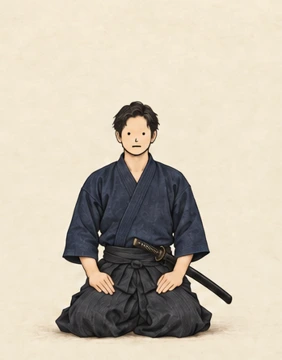 Start: many kata begin from seiza, with the sword in its scabbard.
- 2
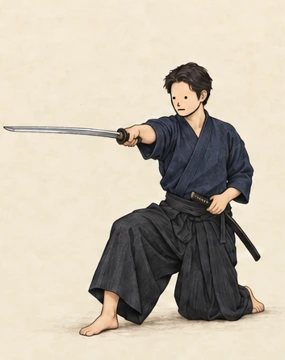 Nukitsuke: drawing and cutting in one motion.
- 3
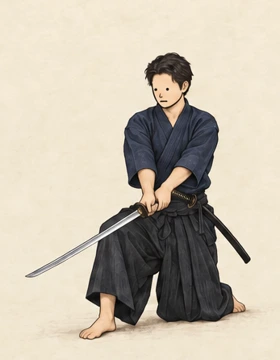 Kirioroshi: the finishing downward cut with both hands.
- 4
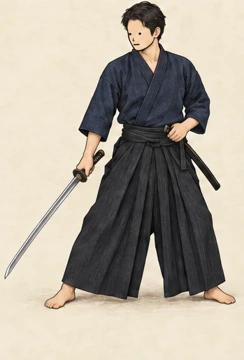 Chiburi: a swing that symbolically shakes blood from the blade.
- 5
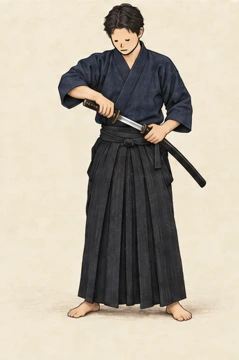 Nōtō: guiding the tip back into the scabbard without looking.
Beginners use an iaitō, an unsharpened practice sword made of alloy with roughly the weight and balance of a real one. Senior practitioners may use a live blade. A related practice, tameshigiri, involves cutting rolled, soaked straw mats with a real sword to test the angle and line of the cut. It is often done alongside iaido but is not part of it.
Organisationally, kendo and iaido are close cousins. The All Japan Kendo Federation has an iaido division, and in 1969 it created a standard set of forms that practitioners of any school could learn, known as seitei iai. It began with seven forms and has since grown to twelve. Candidates for federation iaido grades perform these standard forms alongside those of their own school. Many kendo players take up iaido as they age, because it needs no opponent and no jumping, yet demands the same concentration and posture. Other bodies, such as the All Japan Iaido Federation, run their own gradings.
07Seeing and Trying Kendo in Japan
The biggest event of the year is the All Japan Kendo Championship, held on November 3, Culture Day, at the Nippon Budōkan in Tokyo. The men’s tournament is held on the same day as the All Japan Women’s Kendo Championship, each with 64 competitors representing the 47 prefectures, and as of 2026 the federation streams the matches live online; NHK has broadcast the championship on television in the past. For atmosphere and history, go to Kyoto in early May, when the All Japan Kendo Enbu Taikai, a demonstration tournament, fills the Butokuden for four days. By reported counts (not confirmed as of 2026), several thousand swordsmen take part each year, every one holding at least sixth dan and a teaching title, many of them elderly. They take turns demonstrating in pairs, and there are iaido and jōdō (short staff) demonstrations too. The wooden Butokuden, built in 1899, stands a short walk west of Heian Shrine and can be admired from outside on ordinary days.
Several companies and dojo offer kendo experience sessions for visitors. Typically you are lent a uniform and a shinai, taught how to bow, grip and move your feet, and allowed to strike a target; some let you put on armor and trade a few blows. If you already practice kendo, bring your armor and grading certificate and contact a local club or regional federation in advance. Most dojo welcome visiting players. Shoes come off at the entrance, and you bow toward the front of the hall when you enter and leave. Training begins and ends with everyone kneeling in seiza, a moment of silent meditation, and a formal bow, and partners bow to each other before and after every exchange. In kendo this etiquette is part of the training, as much as the strikes are.