
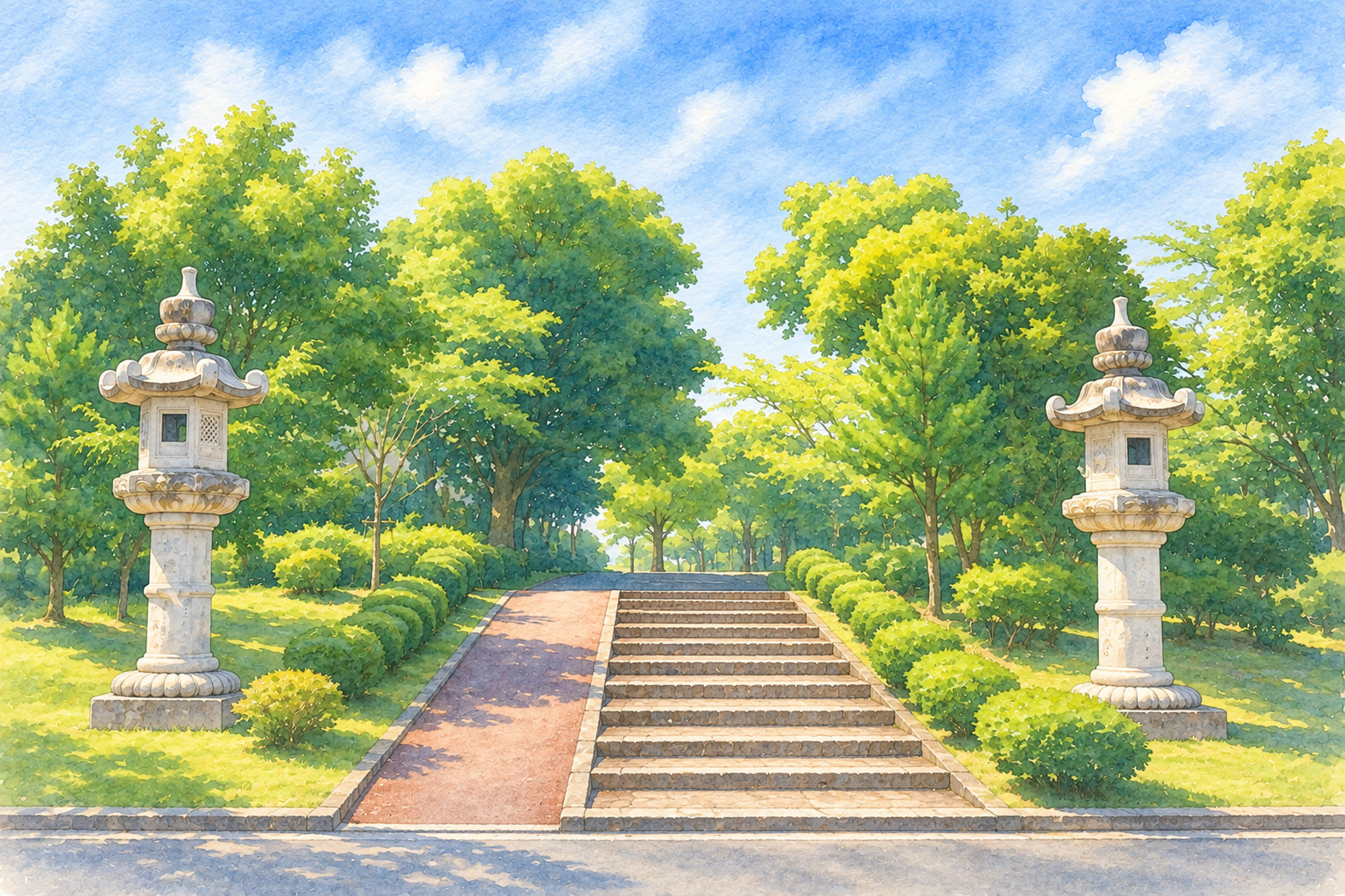
Tabaruzaka is a sloping road over low hills in Ueki, Kita Ward, Kumamoto City, a little over 10 kilometers northwest of Kumamoto Castle. From March 4 to 20, 1877, during the Satsuma Rebellion, government troops fought the Satsuma army of Saigō Takamori here for seventeen days and nights. It was among the bloodiest and most decisive actions of the war. The hilltop is now a memorial park with a museum and a restored bullet-scarred storehouse.
01A Road to Kumamoto Castle
The slope is part of an old road from Takase, near present-day Tamana, to the castle town of Kumamoto. It climbs about 1.5 kilometers in a series of bends, sunk between earth banks and overhung by woods. In 1877 it was the only route by which artillery and supply wagons could reach Kumamoto from the north, which made it the key to the campaign.
In February 1877 Saigō led the Satsuma army north and laid siege to Kumamoto Castle, held by government forces. Relief columns coming south from Fukuoka had to force the northern road, and the Satsuma troops dug in at Tabaruzaka and at Kichiji Pass nearby to stop them. Earlier, in late February, a regiment under Nogi Maresuke had lost its colors in a night fight near Ueki.
02The Battle of March 1877
From March 4 the government army attacked the slope again and again. It had more men and far more ammunition, but the Satsuma defenders held trenches along the top and repeatedly broke attacks with sword charges. Spring rain turned the road to mud. In response the government formed a "Drawn-Sword Unit" of police officers chosen for their swordsmanship, many of them said to be former Aizu samurai. Gunfire was so heavy, the story goes, that bullets collided in midair, and fused pairs of bullets are displayed in the museum as evidence.
On March 20 government troops broke through on a flank under cover of rain and the Satsuma army withdrew. Casualties on both sides ran into the thousands. In mid-April a government force that had landed to the south broke through to Kumamoto Castle and lifted the siege. The Satsuma army fell back across southern Kyūshū, and the war ended in September when Saigō died at Shiroyama in Kagoshima. The folk song "Tabaruzaka" still recalls the fighting in the rain.
03Tabaruzaka Today
The park at the top of the slope holds a memorial to the war dead and the Tabaruzaka Satsuma Rebellion Museum run by Kumamoto City, which shows excavated bullets, weapons, and accounts of the battle. The bullet-scarred storehouse in the park is a reconstruction of a farmhouse storehouse riddled during the fighting, not the original. The road itself still follows its old course. In 2013 Tabaruzaka and the surrounding battlefields were designated part of a National Historic Site covering sites of the Satsuma Rebellion.