
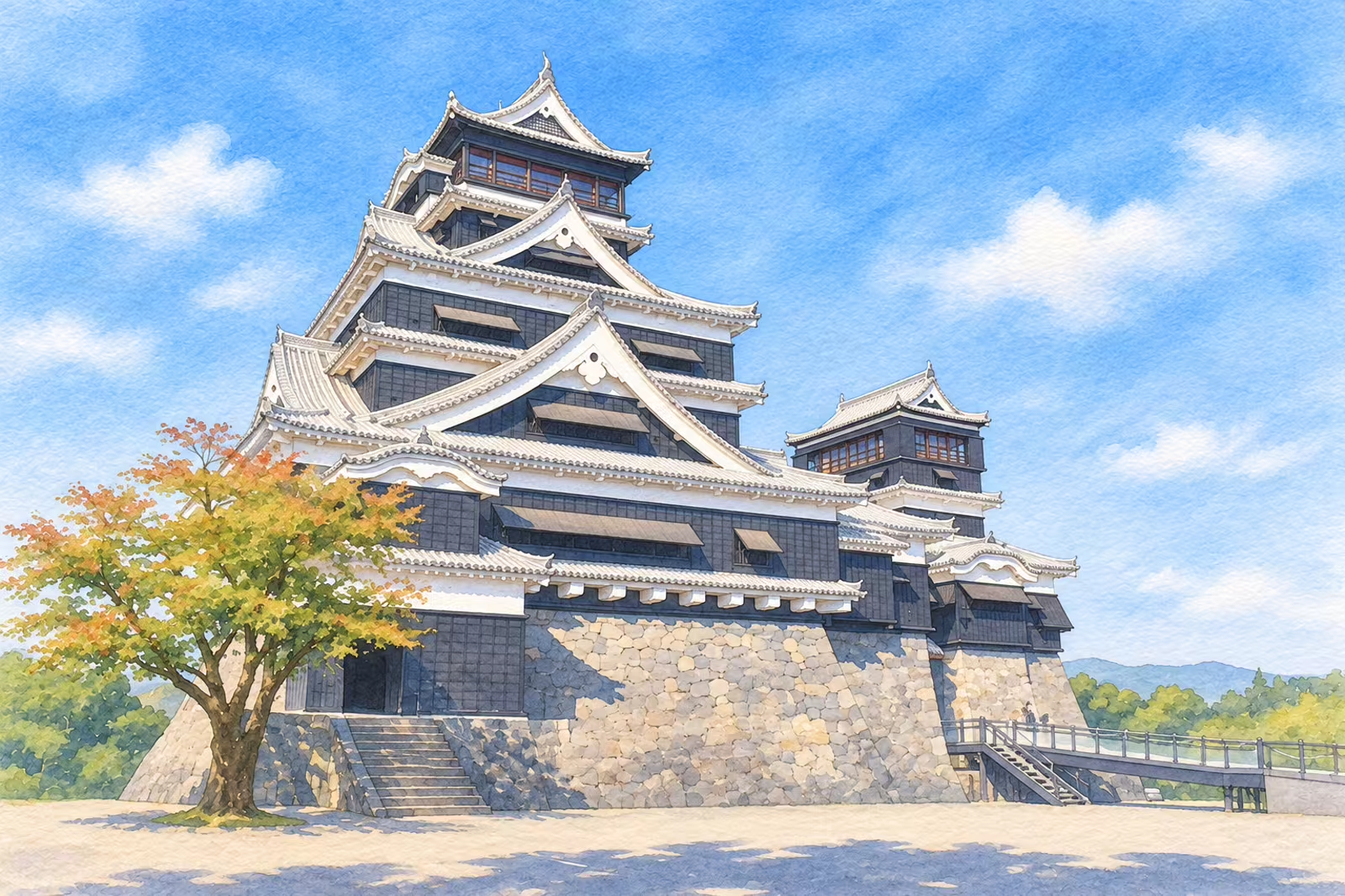
Kumamoto Castle stands on the Chausu-yama hills in the center of Kumamoto City, Kumamoto Prefecture. Built by Katō Kiyomasa in the early 17th century, it is famous for its scale and its steeply curving stone walls, and it is often counted with Himeji and Ōsaka among Japan’s three great castles. In 1877 it withstood a siege of about 50 days during the Satsuma Rebellion. The 2016 Kumamoto earthquakes left it badly damaged, and repairs are still under way.
01Katō Kiyomasa and the Hosokawa
After Toyotomi Hideyoshi granted Kiyomasa the northern half of Higo Province, Kiyomasa enlarged the existing Kumamoto fortification, then written with different characters, into a new castle. It is generally thought to have been largely complete by 1607, when the place name also took its present written form. Its stone walls rise gently at the base and grow almost vertical toward the top, a profile popularly called musha-gaeshi, "warrior repeller." The Katō were removed after two generations, and in 1632 Hosokawa Tadatoshi took over Kumamoto. The Hosokawa ruled Higo from here until the Meiji Restoration, roughly 240 years.
02The Satsuma Rebellion
In the early Meiji period the castle became the headquarters of an imperial army garrison. In the second month of 1877 Saigō Takamori led the Satsuma army north. A few days before the siege began, the main keep and the honmaru palace were destroyed in a fire whose cause remains unclear. The garrison under Tani Tateki held out for about 50 days, and the Satsuma forces never took the castle before government relief troops broke the siege. The failure stalled the Satsuma advance and made the castle’s strength widely known.
03What remains today
Kumamoto Castle is a Special Historic Site. More than ten Edo-period structures, including turrets such as the Uto Turret, gates and long walls, survive and are designated Important Cultural Properties. The large and small keeps were reconstructed in reinforced concrete in 1960, and part of the honmaru palace was rebuilt in wood around 2008.
The earthquakes of April 2016 brought down large stretches of stone wall and caused collapses and damage among the Important Cultural Property buildings. The Iidamaru Five-Story Turret stayed standing on a single corner column of stones, an image that was widely shared at the time. The keep reopened in 2021 after repairs, but the walls and other buildings must be dismantled and reset stone by stone, and as of the 2020s full restoration was expected to take until the 2050s.
Kumamoto Castle
01The castle on the hill
Kumamoto Castle stands on a low plateau called Chausuyama in the middle of Kumamoto city, on the island of Kyūshū. The ground falls away to the east and south toward the Tsuboi and Shirakawa rivers, and to the west toward the Iseri. From the top of the main keep you can see the ring of the Aso volcano to the east on a clear day and the rounded summit of Mount Kinpō to the west. Below lies the grid of the old castle town.
What a visitor sees today is the product of three distinct moments. The first is the building campaign of the warlord Katō Kiyomasa in the decades around 1600. The second is February 1877, when fire destroyed the keeps and the castle then withstood a siege of more than fifty days during the Satsuma Rebellion. The third began in April 2016, when two strong earthquakes shook down large stretches of stone wall, and a repair program expected to take decades got under way.
The castle is large. Its outer circuit ran for around five kilometers, and in its prime it held two keeps, dozens of yagura (turrets used as lookouts and storehouses), and more than twenty gates. The site is a national Special Historic Site, and thirteen of its surviving Edo-period buildings are designated Important Cultural Properties. People often list it with Ōsaka and Nagoya as one of Japan’s "three great castles," a popular ranking rather than any official one.
02Before Kiyomasa
There were fortifications on the plateau long before Kiyomasa. In the Muromachi period a local family, the Ideta, built a stronghold called Chiba Castle at the eastern end of the hill. Later, in the age of warring states, Kanokogi Chikakazu built another fort on the southern slopes called Kumamoto, written with a character meaning "corner" or "recess" (隈本). The Jō family later held it. Place names such as Chibajō-machi and Furushiro preserve the memory of these earlier sites.
In 1587 Toyotomi Hideyoshi, the general who reunified Japan, conquered Kyūshū and gave the province of Higo to his follower Sassa Narimasa. Narimasa pushed through a land survey too quickly and the local warrior families rose against him. The revolt took a coalition of neighboring lords to suppress, and in 1588 Hideyoshi ordered Narimasa to commit suicide for mismanagement. Hideyoshi then split Higo in two. The northern half went to Katō Kiyomasa, the southern half to Konishi Yukinaga. Kiyomasa arrived at Kumamoto in 1588 as a lord of about 195,000 koku (a koku being the measure of rice used to rate a domain’s yield).
03Katō Kiyomasa
Kiyomasa was born in 1562 in Nakamura in Owari province, the same village as Hideyoshi, and his mother is said to have been related to Hideyoshi’s mother. He was raised in Hideyoshi’s household and made his name at the Battle of Shizugatake in 1583, as one of the "Seven Spears of Shizugatake," the young retainers singled out for valor.
The defining experience of his career was Hideyoshi’s invasion of Korea in the 1590s. Kiyomasa led one of the vanguard divisions and campaigned deep into the peninsula. In the winter of 1597–98 he was trapped in the half-finished fortress of Ulsan by a Ming Chinese and Korean army. With food and water running out, his men are said to have eaten paper and wall plaster and drunk horse blood until a relief force broke the siege. It is often suggested that Ulsan shaped the way he later built Kumamoto, with its many wells and its emphasis on holding out.
He was also a builder of dikes and canals. In Higo he reworked the courses of the Shirakawa, Midorikawa and Kikuchi rivers, raised embankments and opened new rice land. Many water-control works across Kumamoto Prefecture are still attributed to him, and people in Kumamoto have called him "Seishoko-san," an affectionate form of his name, for four centuries.
After Hideyoshi’s death in 1598, Kiyomasa’s long feud with the administrator Ishida Mitsunari drew him to Tokugawa Ieyasu’s side. During the Sekigahara campaign of 1600 he fought in Kyūshū, attacking Konishi Yukinaga’s lands around Uto. Konishi was executed after the battle, and Kiyomasa received almost all of Higo, apart from the Kuma district and the Amakusa islands, bringing him to more than 500,000 koku.
04Building the new castle
Kiyomasa began improving the old fort soon after he arrived, but the great work of building a new castle is generally placed in the Keichō era, roughly from around 1600 to about 1607. He moved the heart of the castle up onto the high ground of the plateau and enclosed both of the older sites within a single sprawling complex. According to tradition, when the castle was finished he replaced the character for "corner" in the name with the character for "bear" (熊), and Kumamoto has been written that way ever since.
The plan centers on the honmaru, the inner citadel holding the keeps and the lord’s palace, surrounded by a series of enclosures: the Ninomaru and Sannomaru, and smaller compounds such as the Iidamaru, Sukiyamaru, Nishidemaru and Takenomaru, each separated from the next by walls and ditches. Kiyomasa exploited every change of level in the plateau, so that from below the inner citadel rises in tier after tier of stone.
At the same time he laid out the castle town. He reworked the Shirakawa and Tsuboi rivers so that the Shirakawa ran past the castle’s southeast like an outer moat, and he set aside quarters for merchants and craftsmen. The street pattern of central Kumamoto still follows much of that plan.
05The walls that throw back warriors
The castle is best known for its stone walls. They start at a gentle slope and curve steadily upward until they are almost vertical at the top, a profile likened to an opened fan. The steep curve gave the walls the nickname mushagaeshi, "warrior-repelling": an attacker who started climbing would find the wall leaning out over him by the time he neared the top.
The walls are not all of one date. Some sections use rougher stones at a gentler angle, the earlier style. Others have carefully dressed blocks, corners built with long rectangular stones laid alternately lengthwise and crosswise, and a much steeper rise, the later style. The best place to see the difference is the Niyō no Ishigaki, the "two-style wall," where a gentler older wall and a steeper later addition stand side by side. The older part is generally attributed to Kiyomasa’s time and the newer to his son Tadahiro or the Hosokawa lords who followed.
The castle is said to have had about 120 wells. A popular story holds that the tatami mats in the palace were stuffed with dried taro stems and that dried gourd was mixed into the plaster of the walls so that the garrison could eat them in a siege. No contemporary record supports these tales, but they are told all over Kumamoto.
Another nickname is Ginnan-jō, "Ginkgo Castle," from the tradition that Kiyomasa planted ginkgo trees for their edible nuts. The great ginkgo beside the keep is the castle’s emblem. The original burned in 1877; the tree you see is a second-generation ginkgo that grew in its place.
06The keeps and the palace
The main keep has three roofs on the outside but six floors within, plus a basement. The smaller keep, attached to its west side, has two outer roofs over four floors and a basement. Their black-boarded lower walls and stacked gables make the pair look heavy and solid. The small keep was added after the main one, though exactly when is debated, and an Edo-period chronicle even claims it was brought from Uto Castle.
Beside the keeps stood the Honmaru Goten, the palace where the lord lived, governed and received guests. Its finest room is the Shōkun-no-ma, decorated with paintings of Wang Zhaojun, a Han-dynasty Chinese court lady sent to marry a nomad king. Kumamoto has a long-standing story that Kiyomasa built this room to shelter Toyotomi Hideyori, Hideyoshi’s heir, in an emergency, and that "Shōkun" was a pun on shōgun. This is a later legend, not a documented fact.
The palace was built across a gap between two walls. Underneath runs a dark stone passage, the Kuragari Gomon, through which visitors still climb up into the inner citadel.
07The Hosokawa centuries
Kiyomasa died in 1611, at the age of 50 by Japanese reckoning, shortly after escorting Hideyori to a meeting with Ieyasu at Nijō Castle in Kyoto. His son Katō Tadahiro succeeded him, but in 1632 the shogunate confiscated Tadahiro’s domain and the Katō line in Higo came to an end.
That same year Hosokawa Tadatoshi was transferred from Kokura to Kumamoto with a domain of 540,000 koku. According to a later story, on entering the castle he bowed toward Kiyomasa’s grave at Honmyō-ji temple and announced that he was taking charge of the castle in Kiyomasa’s place. Whether or not that happened, the Hosokawa did maintain respect for Kiyomasa’s memory throughout their rule.
The Hosokawa held Kumamoto until the end of the Edo period, repairing and extending Kiyomasa’s work; the steeper half of the two-style wall is often credited to them. Tadatoshi invited the swordsman Miyamoto Musashi to Kumamoto in 1640, and Musashi spent his last years there, writing The Book of Five Rings. In the eighteenth century the lord Hosokawa Shigekata reformed the domain’s finances and founded the domain school Jishūkan, giving Kumamoto a reputation for learning.
08Army garrison and the Shinpūren
After the Meiji Restoration of 1868 the castle became a base of the new national army. In 1871 a regional garrison command, the Chinzei Chindai, was established in Kumamoto; renamed the Kumamoto Chindai in 1873, it soon moved its headquarters into the inner citadel and was responsible for the defense of Kyūshū. Many turrets and gates were pulled down in the early Meiji years.
In October 1876 a group of conservative former samurai known as the Shinpūren, "League of the Divine Wind," who opposed the government’s Westernizing policies, attacked the garrison at night. They killed the garrison commander Taneda Masaaki and the prefectural governor Yasuoka Ryōsuke before being crushed within a day. The rising was the first of a series of samurai revolts in western Japan.
09The siege of 1877
In February 1877 Saigō Takamori, a hero of the Restoration who had broken with the government, marched north from Kagoshima at the head of the Satsuma samurai. The Satsuma Rebellion had begun, and Kumamoto stood squarely in the army’s path.
The garrison commander was Tani Tateki, with Kabayama Sukenori as chief of staff. Among the junior officers were Kodama Gentarō and Kawakami Sōroku, both later famous generals. The defenders, soldiers and police together, numbered around four thousand. The rebels are usually estimated at thirteen to fourteen thousand at the outset.
On February 19, before the rebels arrived, fire broke out in the inner citadel. Both keeps and the palace burned to the ground, along with part of the stored provisions. The cause has never been settled. Some think the defenders burned the buildings themselves to clear fields of fire and deny the enemy a target; others suggest an accident or arson by Satsuma sympathisers.
The assault began on 21–February 22. The garrison was made up largely of conscripts, commoners whom the Satsuma samurai held in contempt, but they held the walls. Unable to storm the castle, the rebels settled into a blockade. Meanwhile government armies fought their way south, and the bitter battle at the pass of Tabaruzaka, north of the city, ended with the government breakthrough on March 20. In mid-April a detachment led by Yamakawa Hiroshi, part of the army advancing from the south, was the first to break through to the castle, and the siege was lifted after more than fifty days. Japanese accounts usually date this to April 14.
Saigō is supposed to have said that he was beaten not by the government’s army but by Kiyomasa. The line is widely quoted but has no reliable source. What is clear is that the time and men the rebels spent at Kumamoto cost them the war. Saigō died at Shiroyama in Kagoshima that September.
The castle remained army ground. In 1888 the Kumamoto garrison became the Sixth Division, which stayed until Japan’s defeat in 1945.
10Protection and rebuilding
After the war the site was gradually opened to the public. It was designated a national Special Historic Site in 1955, and its surviving buildings were designated Important Cultural Properties.
The most important survivor is the Uto Yagura, the largest remaining turret. It has three outer roofs over five floors plus a basement, the size of a keep at a lesser castle, and it is sometimes called the "third keep." It was long said to have been moved here from Konishi Yukinaga’s Uto Castle, hence the name, but a dismantling repair in 1927 found no sign that it had been moved, and the story is now generally discounted. It escaped the 1877 fire and survives from the early Edo period. In recent years it has been undergoing a full dismantling repair.
In 1960 the city rebuilt the two keeps in reinforced concrete, matching their exterior to old photographs and plans and fitting the inside as a museum. From the 1990s onward the city reconstructed a series of buildings in timber using traditional methods: gates and turrets in the Nishidemaru, the five-story turret of the Iidamaru, and finally, in 2008, the main halls of the Honmaru Goten palace, completed as part of the castle’s 400th anniversary program, with the Shōkun-no-ma’s paintings recreated.
11The 2016 earthquakes
On the night of April 14, 2016 and again in the early hours of April 16, two powerful earthquakes struck the Kumamoto area. The second measured magnitude 7.3. The town of Mashiki recorded the maximum intensity of 7 on the Japanese scale in both.
The castle suffered its worst damage since 1877. All thirteen Important Cultural Property buildings were damaged; the East and North Eighteen-Bay Turrets collapsed together with the high walls beneath them, and the corridor turret attached to the Uto Yagura also fell. Around thirty percent of the stone walls needed repair, and some fifty sections collapsed outright. Roof tiles cascaded off the keeps and some of the ridge ornaments fell. The image that circulated around the world was the Iidamaru five-story turret, its supporting wall almost entirely gone, balanced on a single column of corner stones. People called it the "miracle single-column wall." The Inui turret in the Nishidemaru, itself a modern reconstruction, was held up in much the same way.
The city adopted a long-term restoration plan. The guiding rule is to recover the original stones, number them, record where each came from and set them back in place. Tens of thousands of stones had fallen. The main keep was repaired first, as a symbol of recovery, with strengthened earthquake resistance, and its interior reopened in 2021. The remaining turrets and walls are still being restored one by one; the city’s plan sets the early 2050s as the target for completing the whole program. An elevated walkway was built so that visitors can see the site while work continues.
12A walk through the castle
Coming up from the south, you pass through the broad grounds of the Ninomaru area with walls lining the edge of the plateau. Heading toward the inner citadel, look for the Iidamaru five-story turret; its moment balanced on one corner of stone has become part of the castle’s story.
Around the inner citadel, look up at the curve of the walls as they steepen toward the top. Find the two-style wall and compare the Katō and Hosokawa work for yourself.
The keeps are the 1960 concrete rebuild, but most of the stonework they stand on is original. From the top you can look out over the city and toward the mountains. The ginkgo beside them is the tree that regrew after 1877. The palace is a modern timber reconstruction, and the dark passage of the Kuragari Gomon runs beneath it.
The Uto Yagura stands to the northwest of the keeps, its stacked roofs visible from far off, and it is one of the castle’s most important original buildings. Along the paths you will also pass the long plastered wall known as the Nagabei, and buildings and walls wrapped in scaffolding and covers. The rows of numbered stones laid out on the ground are the ones recovered after the earthquake, waiting to be returned to their places one by one.