
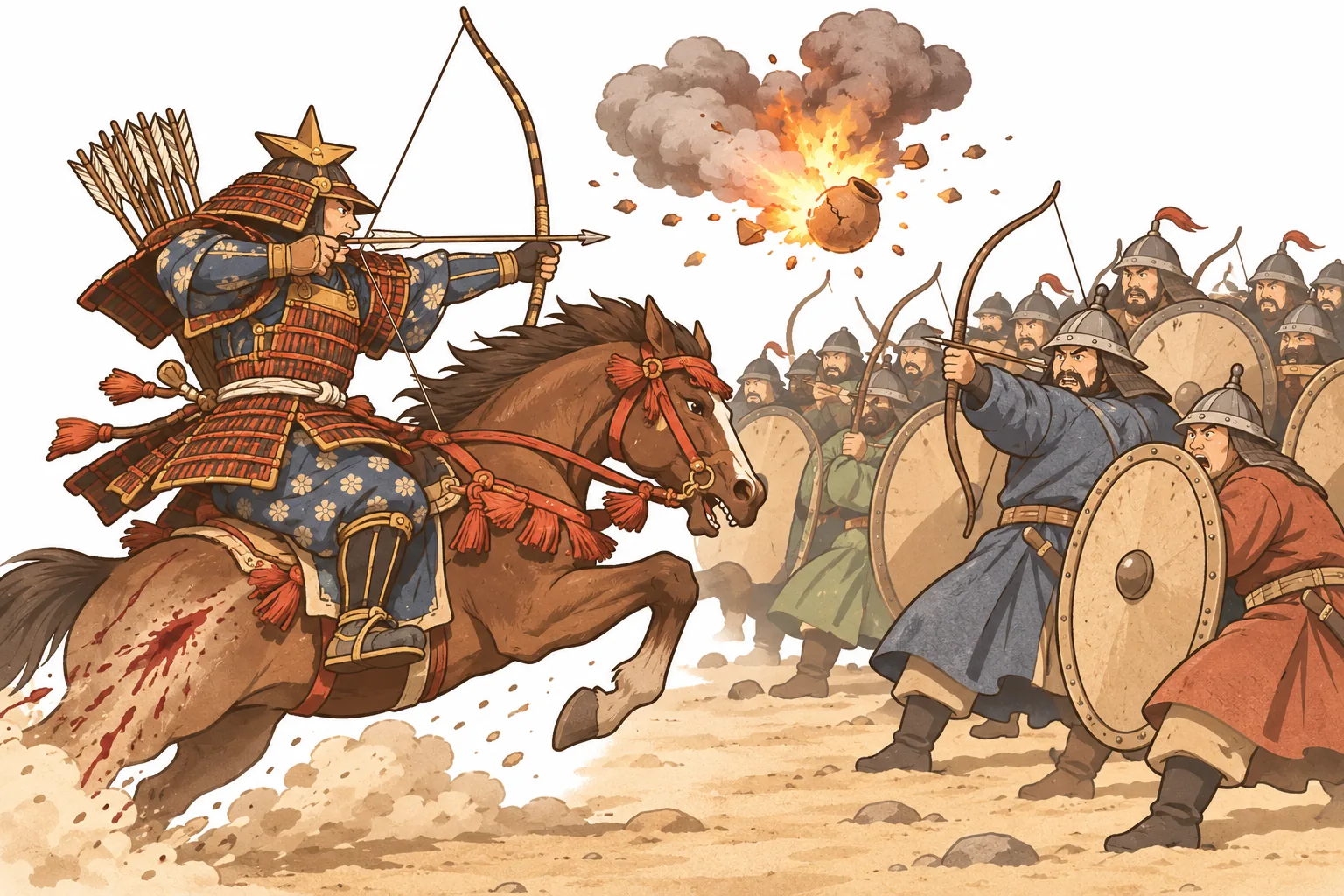
At a glance
Samurai went from mounted archers to salaried officials before Meiji Japan dissolved the class, while “bushido” was largely shaped by later writers.
- Samurai comes from the verb saburau, to wait upon a noble, and first meant attendants of fairly low rank.
- Minamoto no Yoritomo became shogun in 1192, and from then until the return of power in 1867 Japan’s real rulers were mostly warrior houses.
- The key skill of early warriors was mounted archery, the 'way of bow and horse'; Edo-period samurai were required to wear a long and short sword pair.
- Bushido was never a written code; its best-known version is Nitobe Inazō’s Bushido, written in English in 1899.
- With the 1876 sword ban and the end of stipends, samurai lost their status, occupation, income and symbols.
The samurai is the most recognizable figure Japan has ever produced: shaved pate and topknot, two swords at the hip, loyalty unto death. That image captures one slice of a history that runs for roughly seven hundred years. The first samurai were mounted archers working for aristocrats in the provinces. Their descendants seized political power and held it from the late twelfth century to 1867. For the last two and a half centuries of that span they fought almost no wars at all, and served instead as salaried administrators. Then the Meiji government, led largely by former samurai, abolished the class within a decade. Bushido, "the way of the warrior," has a stranger history still: the word was rare while samurai were actually fighting, and the version most people know today was written in English, in 1899, by a Japanese Quaker. This is an introduction to who the samurai were, how they fought and lived, what bushido does and does not mean, and where you can still meet them in Japan.
01Servants Who Became Rulers
The word samurai comes from the verb saburau, "to wait upon" or "to attend." In the Heian period (794–1185) it described men who served in the households of the imperial family and the court nobility, and it carried no particular glamour. The more formal term, bushi, simply means "military man." The two words came to overlap, and in modern Japanese they are used almost interchangeably, but the etymology is a useful reminder: the samurai began as hired help.
Their rise came out of a vacuum. By the tenth century the conscript army of the old imperial legal system had withered, and the court in Kyoto had little direct means of enforcing order in the provinces. Local landholders, estate managers, and minor aristocrats sent out from the capital who chose to stay put began to arm their households. They trained in horseback archery, gathered retainers, and formed warrior bands bound together by kinship and service. When Taira no Masakado rose in rebellion in the Kantō plain in 939, and Fujiwara no Sumitomo raided the Inland Sea around the same time, the court put them down by commissioning other warriors of exactly the same kind.
Two lineages with imperial blood came to lead these bands: the Taira (also called Heike) and the Minamoto (Genji). In the second half of the twelfth century Taira no Kiyomori used military force and marriage alliances with the imperial house to become the most powerful man in Japan. In 1180 Minamoto no Yoritomo, an exile in Izu, raised an army against the Taira. The resulting Genpei War ended in 1185 at the sea battle of Dan-no-ura, where the Taira were destroyed. Yoritomo did something new: instead of ruling through the court in Kyoto, he built a separate warrior government in Kamakura, and in 1192 took the title sei-i taishōgun, "barbarian-subduing generalissimo," shortened to shogun. From then until 1867, with interruptions, Japan was governed by warriors, while the emperor kept the ceremonial authority that legitimized them.
The relationship between the Kamakura shogunate and its vassals was described as go-on and hōkō, "favor" and "service." The shogun confirmed a warrior’s rights to his land, or granted new land; in return the warrior guarded Kyoto and Kamakura in peacetime and fought when called. It was a transaction, and land was the currency. The phrase isshokenmei, "staking one’s life on a single place," originally described a warrior’s devotion to his holding; it survives in the modern isshōkenmei, "with all one’s might," which Japanese schoolchildren hear constantly. When the Mongols invaded northern Kyūshū in 1274 and 1281, local warriors fought hard, but because the enemy was foreign there was no conquered land to hand out afterward. After the first invasion one Higo warrior, Takezaki Suenaga, traveled all the way to Kamakura to press his claim in person, and came home with a land stewardship; he later commissioned the illustrated Mongol Invasion Scrolls to record his battles and his petition. Loyalty was real, but it came with a ledger, and later idealizations tend to leave the ledger out.
02Bow, Horse, and Sword
Ask people what a samurai fought with and they will say the sword. For the early samurai the answer was the bow. Warrior skill was described as kyūba no michi, "the way of bow and horse." The great armor of the late Heian and Kamakura periods, the ō-yoroi, is boxy and asymmetrical, with broad shoulder plates that hang like shields, because it was designed for a rider who needed both hands free to draw.
The best-loved scene in The Tale of the Heike, the great war epic of the Genpei conflict, is an archery shot. At the battle of Yashima in 1185, the Taira set a fan on a pole at the prow of a boat and dared the Minamoto to hit it. A young rider named Nasu no Yoichi urged his horse into the surf and shot it down, and both armies cheered. Whether it happened exactly like that is unknowable, but the story shows what audiences considered the high point of a warrior’s life.
Battles of this era had their own etiquette. A warrior might ride forward and announce his name and lineage, a practice called nanori, and seek an opponent of matching rank. Heads taken in combat were carried back and inspected by commanders, because they were the evidence on which rewards depended. This emphasis on individual display has often been compared to European chivalry, but its practical purpose was simpler: a deed that nobody saw was a deed nobody would pay for.
| Sword | When | How it was worn | Purpose |
|---|---|---|---|
| Tachi | Late Heian | Slung from the belt, edge down | Slashing from horseback |
| Uchigatana | 15th–16th centuries | Thrust through the sash, edge up | Drawn and used in one movement |
| Daishō | Edo period | A long and a short sword together | Badge of samurai status |
The edge-down tachi suited horseback fighting, the edge-up uchigatana the age of infantry; in the Edo period the long-and-short daishō became the badge of samurai status.
The sword changed with the battlefield. The tachi that took shape in the late Heian period was long and deeply curved, and was slung from the belt with the edge facing down, suited to slashing from horseback. As infantry came to dominate in the fifteenth and sixteenth centuries, warriors switched to the uchigatana, which was thrust through the sash edge-up so that it could be drawn and used in one movement; this is the weapon Westerners call the katana. In the Edo period samurai were required to wear a long and a short sword together, the daishō, and the pair became the badge of samurai status. Japanese blades are famous for their folded steel, the wavy temper line called hamon along the edge, and their elegant curve, and many are designated National Treasures. On an actual battlefield, though, spears, arrows, and later guns killed far more men than swords did.
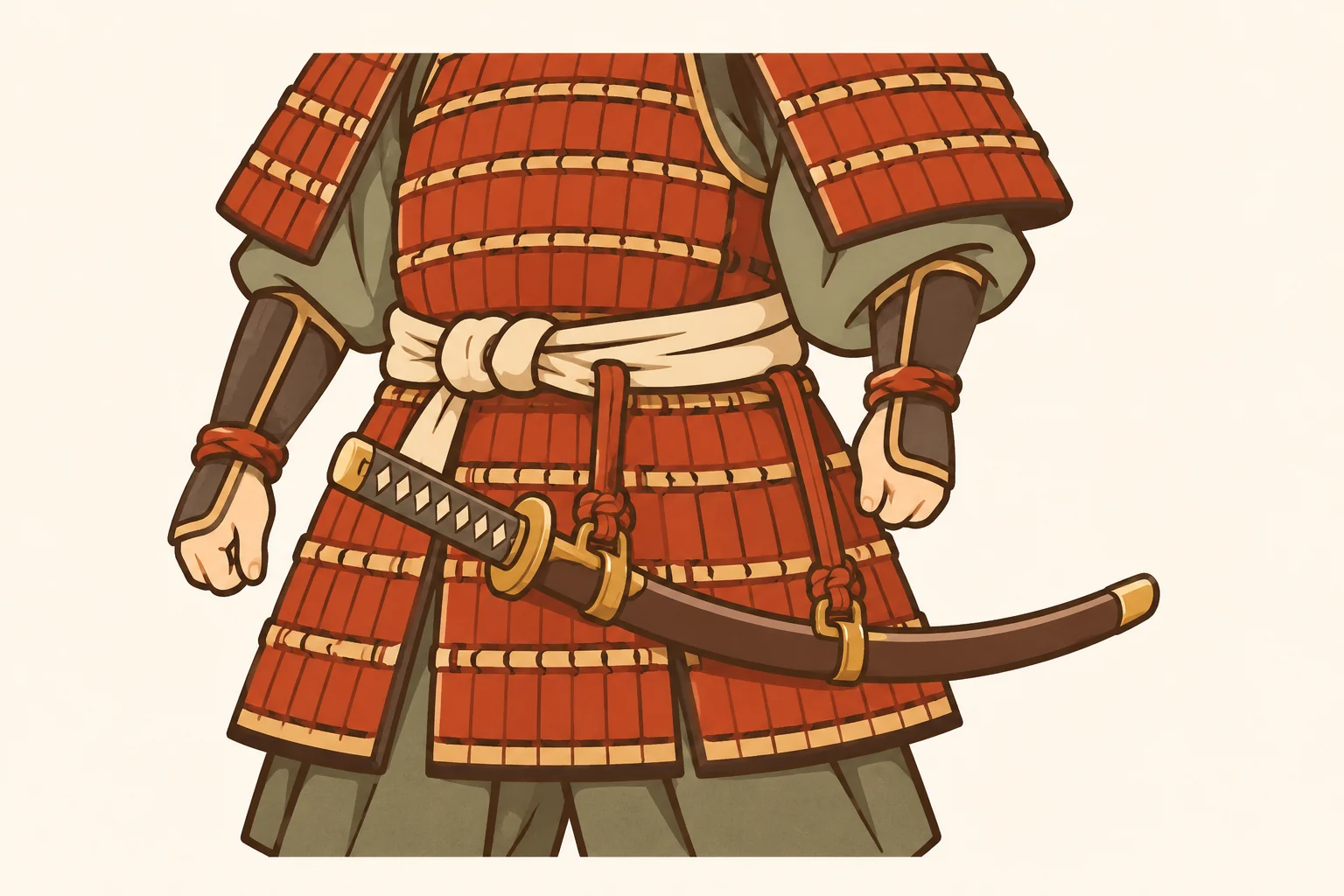
Late Heian to Kamakura: the tachi was slung from the belt, edge down, suited to slashing from horseback.
After the Ōnin War broke out in Kyoto in 1467, central authority collapsed and Japan entered the Sengoku, or "Warring States," period, when regional lords called daimyo fought each other for more than a century. Armies grew enormous, and their backbone was the ashigaru, foot soldiers recruited from farmers and the lower ranks, who fought in massed formations with long pikes. In 1543 a ship carrying Portuguese traders drifted ashore on the island of Tanegashima, and the matchlock arquebus came with it. Japanese smiths were soon producing copies in large numbers. At the battle of Nagashino in 1575 the combined forces of Oda Nobunaga and Tokugawa Ieyasu used massed guns against the army of the Takeda clan, traditionally said to be strong in cavalry, and the battle is often treated as the moment warfare changed, although historians now doubt the famous story of three ranks firing in rotating volleys. The Sengoku period was also the most socially fluid era of samurai history. Toyotomi Hideyoshi, who finished the work of unifying Japan, was born into a commoner family in Owari province.
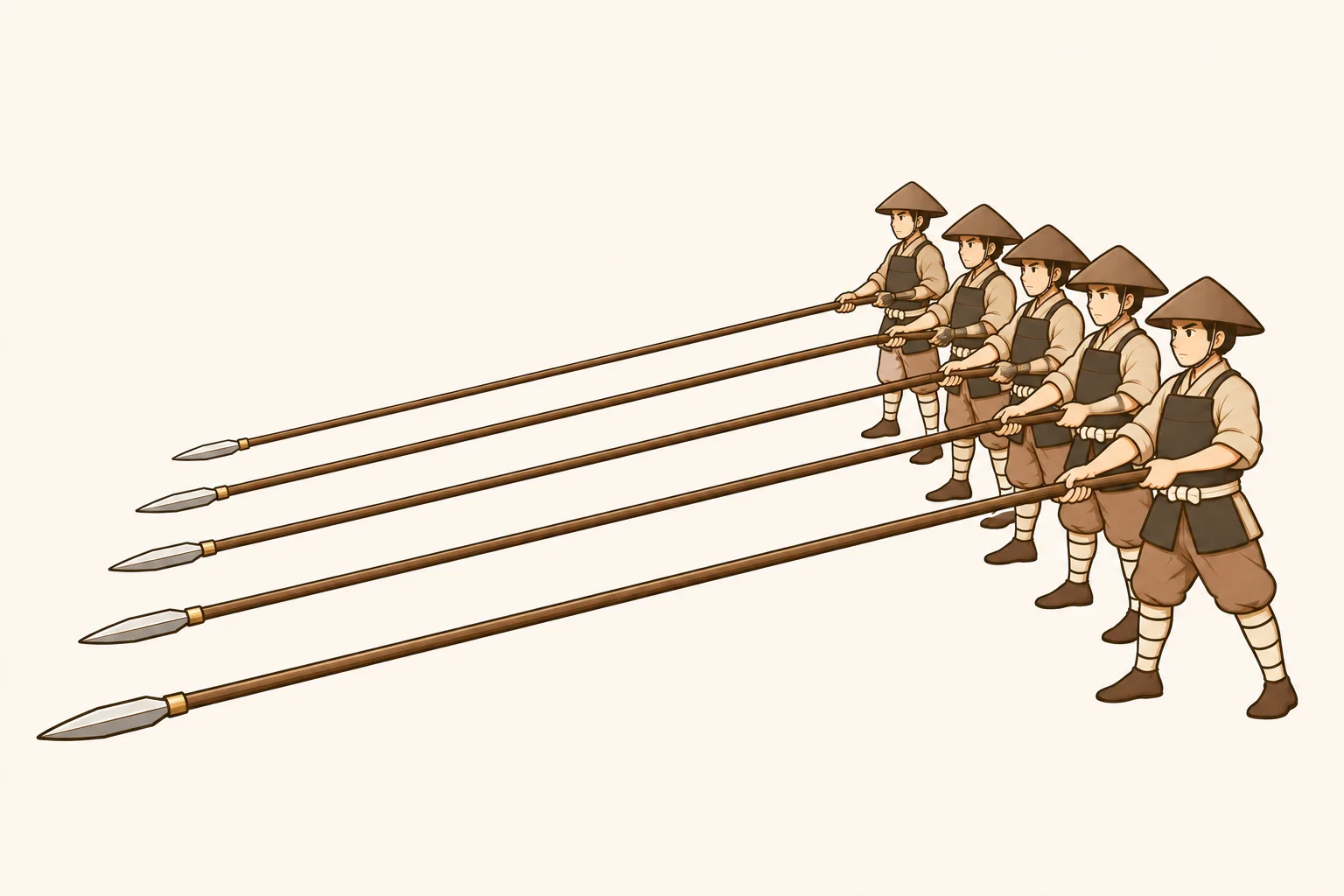
In the Sengoku period the backbone of armies was the ashigaru, foot soldiers fighting in massed formations with long pikes.
03Warriors Without a War
The end of the civil wars did not free the samurai. It froze them. In 1588 Hideyoshi ordered the "sword hunt," confiscating weapons from farmers, and his policies separated warriors from the land, moving them off their villages and into the castle towns of their lords. When Tokugawa Ieyasu won the battle of Sekigahara in 1600 and established his shogunate in Edo (modern Tokyo) in 1603, he inherited a society of hereditary status groups: samurai, peasants (hyakushō), and townspeople (chōnin). The familiar Confucian formula of four ranks, samurai, farmers, artisans, and merchants, was an ideal; no legal hierarchy separated the last three. Samurai and their families made up roughly 6 to 7 percent of the population. As a rule only they could wear two swords in public and use a surname officially, though a few village headmen and favored merchants received the privilege by special grant, and they held a theoretical right to cut down a commoner who insulted them, known as kirisute gomen. In practice the conditions were strict: by most accounts a samurai who used it had to report to the authorities and face an inquiry, and could be punished if he could not justify himself. The right was rarely used.
From the fall of Ōsaka Castle in 1615 to the middle of the nineteenth century, Japan fought no major wars. The samurai became an armed class with nothing to fight. They were paid stipends according to their family’s rank, usually measured in rice, which they converted to cash through brokers. Their actual work was administrative: running domain finances, keeping records, policing towns, supervising public works. Domains founded schools where samurai boys studied the Confucian classics, calligraphy, etiquette, and arithmetic alongside swordsmanship, spear, and archery. Swordsmanship split into many schools and turned from a battlefield skill into a discipline practiced in the training hall, with an emphasis on mental composure. Modern kendo and iaido grew out of this world.
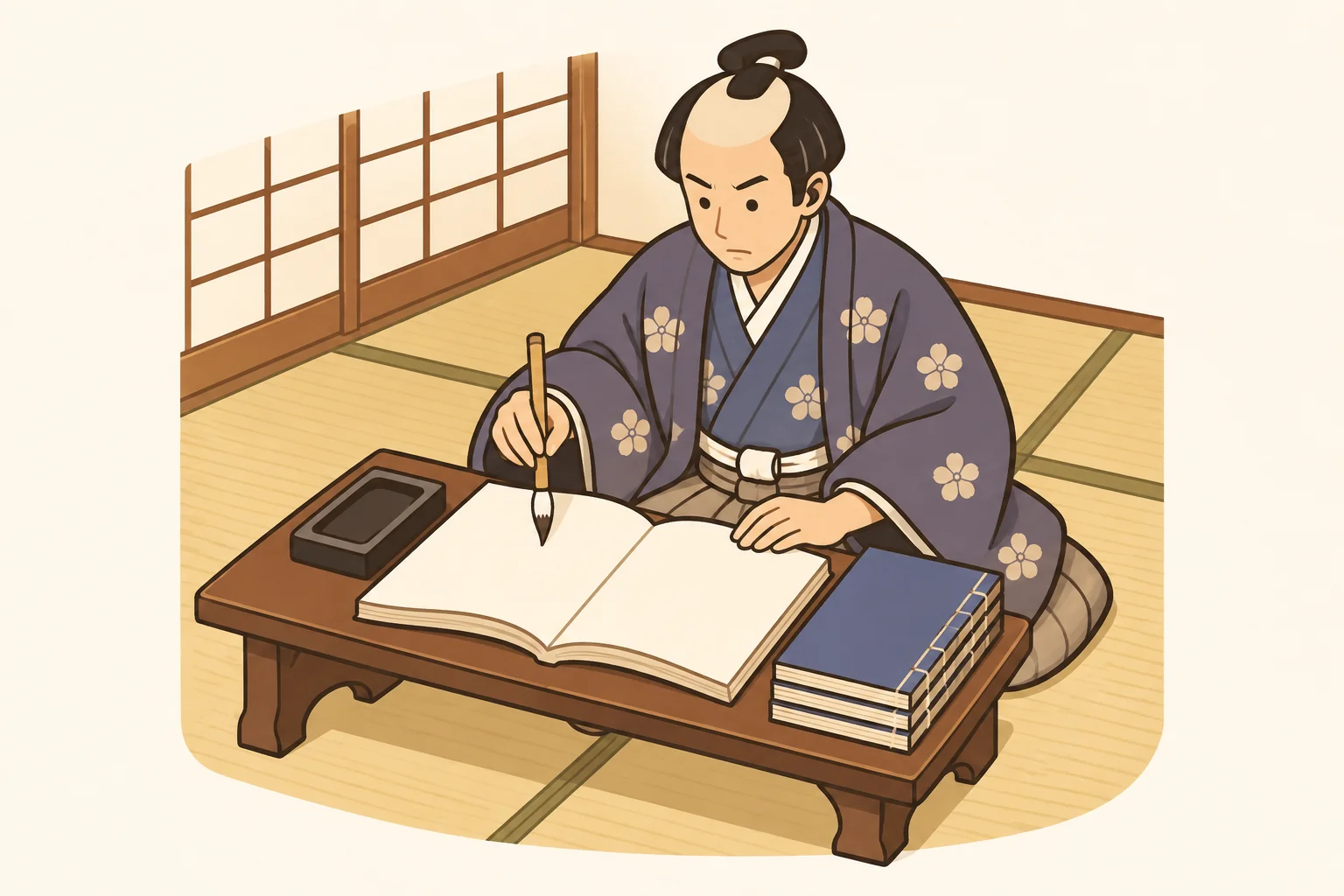
Their actual work was administrative: domain finances, records, policing and public works.
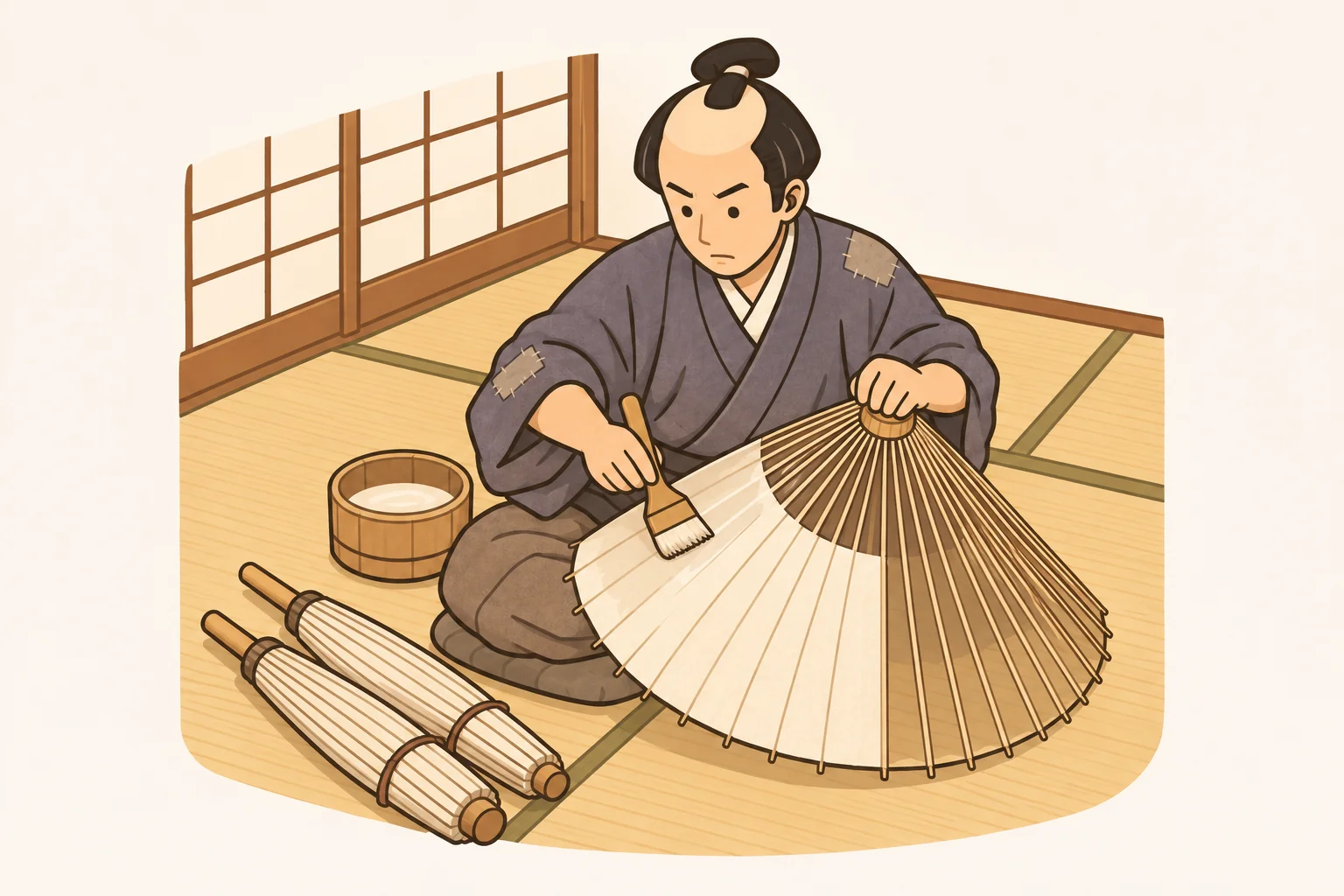
With stipends fixed and prices rising, some lower-ranking samurai households made umbrellas to make ends meet.
The shogunate kept the daimyo on a short leash. The Laws for the Military Houses forbade them to repair castles or arrange marriages without permission. From 1635 the system of alternate attendance, sankin-kōtai, required each lord to spend every other year in Edo and to leave his wife and heir there permanently, as hostages in all but name. Daimyo processions with hundreds or thousands of retainers moved constantly along the highways, the post towns along the way prospered, and Edo swelled into one of the largest cities in the world.
For many lower-ranking samurai, long peace meant slow impoverishment. Stipends were fixed while prices rose. Borrowing from merchants against future rice income became routine, and some samurai households made umbrellas, wove hats, or bred goldfish to make ends meet. A samurai without a lord was a rōnin, a "wave man," drifting; some taught in private schools or ran fencing halls, others fell into hard times. The dignity of the class and the reality of its members’ lives were often far apart.
The most famous samurai story of all comes from this peaceful era. In 1701, in a corridor of Edo Castle, Asano Naganori, lord of the small domain of Akō, drew his sword and wounded Kira Yoshinaka, the senior official responsible for court ceremonial. Drawing a blade inside the castle was a grave crime. Asano was ordered to commit seppuku the same day and his domain was confiscated, while Kira went unpunished. In the winter of the following year, on the fourteenth day of the twelfth month by the old calendar (which fell in early 1703 by the Western one), a band of Asano’s former retainers led by his chief counselor Ōishi Yoshio broke into Kira’s mansion, killed him, and carried his head to their lord’s grave at Sengaku-ji temple. The shogunate debated their fate for weeks and finally ordered 46 of them to commit seppuku. Opinion was divided even then: some praised their loyalty, while some Confucian scholars argued that they had broken the law. The story became theater almost immediately. Kanadehon Chūshingura, first staged for the puppet theater in 1748 and soon adapted for kabuki, remains one of the most performed works in Japan, and the "Chūshingura" story still turns up on television around the end of every year.
04The Invention of Bushido
Many people assume the samurai followed a written code called bushido, the way medieval knights are imagined to have followed a code of chivalry. No such code existed. The word bushidō begins to appear in writing around the late sixteenth and early seventeenth centuries, and even in the Edo period it was not especially common; people more often spoke of shidō, "the way of the gentleman-warrior," or simply of how a samurai ought to behave. Individual clans and domains had their own house rules, which did not agree with one another.
In the seventeenth century the military scholar Yamaga Sokō offered a Confucian answer to an awkward question. If the samurai no longer fought, and did not farm, make things, or trade, why did they exist? His answer was that the samurai’s job was to be a moral example for the other three classes: self-disciplined, correct in conduct, and acutely sensitive to shame. This was an ethic for officials in peacetime.
A very different voice came from the Saga domain in Kyūshū. In the early eighteenth century Yamamoto Tsunetomo, a retainer who had become a monk after his lord’s death, talked at length to a younger samurai named Tashiro Tsuramoto, who recorded the conversations as Hagakure, "Hidden by Leaves." Its most famous line declares that the way of the samurai is found in death: a samurai should live each day as if already dead, and when faced with a choice between life and death, choose death, so that he will never act from hesitation or disgrace. Hagakure circulated only in manuscript within Saga during the Edo period and had little influence outside it. It became widely read only in the twentieth century. Much of it, incidentally, is practical advice about grooming, conversation, and office politics.
The bushido the world knows best comes from a book written in English. In 1899, while recovering from illness in the United States, the educator Nitobe Inazō wrote Bushido: The Soul of Japan. It was published in Philadelphia, and because the first edition bears the date 1900, both years are cited for it. He explained in the preface that the book began about ten years earlier with a question from the Belgian jurist Émile de Laveleye, who was astonished to hear that Japanese schools taught no religion and asked how moral education was possible without it. Nitobe’s answer was that bushido filled that role. He organized it into virtues: rectitude, courage, benevolence, politeness, sincerity, honor, loyalty, and self-control, and compared each one to European chivalry, Christianity, and classical philosophy. Nitobe was himself a Christian, a Quaker married to an American woman, and his bushido is idealized, at times closer to a Victorian gentleman than to a medieval warrior. Critics have long faulted it as unhistorical, and by one account Japanese scholars were already criticizing it when it first appeared. But the timing was perfect. Japan had just defeated China in 1895 and would defeat Russia in 1905, and Western readers wanted to understand the new power. The book was translated into many languages, and Nitobe noted in a later preface that President Theodore Roosevelt had read it and handed out several dozen copies to friends. Nitobe later served as an under-secretary-general of the League of Nations, and his portrait appeared on the 5,000-yen note from 1984 to 2004.
Inside Japan, bushido became national ideology at the very moment the samurai ceased to exist. The army and the schools tied it to loyalty to the emperor, and in the wars of the 1930s and 1940s it was used to demand that soldiers fight to the death rather than surrender, at a terrible cost in lives. After 1945 the word carried a heavy shadow. Today, when Japanese people invoke bushido, they usually mean something more modest: perseverance, playing by the rules, taking responsibility, losing without excuses. The national baseball team is branded "Samurai Japan," and athletes talk about samurai spirit in interviews. The usage is proud and a little self-mocking, and it has nothing to do with battlefields.
05Seppuku
No part of samurai culture shocks outsiders more than seppuku, ritual suicide by cutting the abdomen. The colloquial word harakiri, "belly cutting," is understood in Japan but considered somewhat crude; seppuku is the formal reading of the same two characters reversed. Accounts of warriors cutting their bellies appear in the war tales of the late Heian and Kamakura periods, usually when a warrior was defeated or surrounded and wanted to avoid capture. In the Sengoku period it also became an honorable way to end a conflict. In 1582, when Toyotomi Hideyoshi besieged Takamatsu Castle in Bitchū, the castle’s commander Shimizu Muneharu rowed out on a small boat and cut his belly before Hideyoshi’s witnesses, in exchange for the lives of the roughly 5,000 people inside. In 1591 the tea master Sen no Rikyū died by seppuku on Hideyoshi’s orders.
In the Edo period seppuku became a formal punishment reserved for samurai, regarded as more honorable than beheading. It had an elaborate protocol. The condemned man, dressed in white, knelt on white cloth with a short blade on a stand before him. Beside him stood a second, the kaishakunin, who beheaded him with a single stroke as the blade entered his abdomen, sparing him a prolonged death. By the mid-Edo period the cut was often only symbolic. The condemned reached for the blade, or sometimes for a fan placed in its stead, and the second struck at that moment.
Why the belly? The usual explanation is that the abdomen was considered the seat of the self and of one’s true intentions, and cutting it open displayed one’s sincerity. Japanese idiom still links the belly to hidden thoughts: a scheming person is haraguroi, "black-bellied," and talking frankly is "opening the belly." The explanation is widely repeated, though whether it explains the origin of the practice is uncertain. Seppuku was abolished as a legal punishment in 1873, but it did not vanish from the national imagination. When the Emperor Meiji died in 1912, General Nogi Maresuke and his wife took their own lives to follow him. In 1970 the novelist Mishima Yukio, after haranguing soldiers from a balcony at the Self-Defense Forces headquarters in Ichigaya, Tokyo, committed seppuku in the commandant’s office, an act that stunned Japan and fixed the word in the world’s vocabulary once again.
06How the Samurai Abolished Themselves
The samurai class was dismantled by samurai. The men who overthrew the Tokugawa shogunate in 1867–68 were mostly middle- and low-ranking samurai from the domains of Satsuma and Chōshū in the southwest: Saigō Takamori, Ōkubo Toshimichi, Kido Takayoshi. Once in power, they concluded that a modern state could not afford a hereditary warrior caste, and took its privileges away one by one.
In 1869 the domains returned their lands and people to the emperor, and former samurai were reclassified as shizoku, "warrior families," while the daimyo and court nobles became a new peerage. In 1871 the domains themselves were abolished and replaced by prefectures, and the government announced that men were free to cut off their topknots and go without swords. The conscription law of 1873 made military service an obligation for commoners too, ending the samurai monopoly on fighting. In 1876 came the final blows. The Sword Abolition Edict banned the wearing of swords by anyone but soldiers, police, and other uniformed officials, and the government commuted the remaining stipends into a one-time issue of interest-bearing bonds. Status, profession, income, and symbol had all been taken away.
- 1868Boshin War
- 1869Samurai reclassified as shizoku
- 1871Domains abolished; men free to cut topknots and go without swords
- 1873Conscription law
- 1876Sword Abolition Edict; stipends commuted into bonds
- 1877Satsuma Rebellion
From reclassification as shizoku in 1869 to the sword ban and the end of stipends in 1876, status, profession, income and symbol were taken away one by one.
Many former samurai had no idea how to make a living. Shizoku no shōhō, "samurai business," became a joke for ventures run by proud amateurs that quickly went bust. Many others moved smoothly into the new army, the police, schools, and the bureaucracy, and a large share of modern Japan’s officials, intellectuals, and entrepreneurs came from samurai families. The angriest took up arms. The largest uprising was the Satsuma Rebellion of 1877, led by Saigō Takamori himself, which was crushed by a conscript army made up largely of commoners. Saigō died at Shiroyama in Kagoshima that September. He remains one of the most beloved figures in Japanese history, and his bronze statue in Ueno Park in Tokyo, which shows him in a plain robe walking his dog, may be the samurai that visitors to Japan see first.
The losing side had its own tragedies. In the Boshin War of 1868–69, a unit of teenage samurai from Aizu called the Byakkotai, the "White Tiger Force," saw smoke over their castle town, and a group of them killed themselves on the hill of Iimoriyama believing the castle had fallen; it had not. Women of Aizu fought with halberds. In Kyoto the Shinsengumi, a pro-shogunate police force, had earned a fearsome reputation in the street fighting of the 1860s, and its leaders, Kondō Isami and Hijikata Toshizō, are now the heroes of countless novels, TV dramas, and anime. Just as the real samurai left the stage, their second life in fiction began.
07Where to Meet the Samurai Today
The most direct way into the samurai world is a castle. Of the many castles you will see in Japan, most are concrete reconstructions; only 12 keeps survive from the Edo period or earlier, and five of them, at Himeji, Matsumoto, Hikone, Inuyama, and Matsue, are designated National Treasures. Himeji, called the White Heron Castle for its tiers of white plaster, became one of Japan’s first World Heritage Sites in 1993. Walking up to the keep you will notice how the path twists back on itself and how the gates narrow as you climb, every turn a place where defenders could rain fire on attackers. Matsumoto’s black-lacquered keep stands against the snow peaks of the Northern Alps, and at Inuyama you can step out onto the top-floor balcony above the Kiso River. In these original keeps you take off your shoes, and the stairs are so steep they feel like ladders, which was the point.
Samurai neighborhoods survive too. Kakunodate in Akita is lined with black-walled samurai houses and weeping cherry trees, at their best in late April. The Nagamachi district of Kanazawa keeps its earthen walls and narrow lanes, and the Nomura family residence there has a small, intensely composed garden you can sit beside. Hagi, in Yamaguchi, was the castle town of the Chōshū domain; the tiny schoolroom where Yoshida Shōin taught many of the future leaders of the Meiji Restoration still stands. In Chiran, in Kagoshima, seven gardens along a street of samurai houses are open to visitors, and one of them borrows a nearby peak, Mount Hahagadake, as its backdrop. Most of these houses are modest in size, a quiet reminder that the typical samurai lived a careful, constrained life.
For swords and armor, start at the Tokyo National Museum in Ueno, where the galleries for Japanese swords rotate a selection of blades that often includes National Treasures. The Japanese Sword Museum in Ryōgoku is devoted entirely to blades. When you look at a sword, follow the hamon along the edge and move your head slightly to watch the light shift across the steel; this is what connoisseurs spend hours on. The Bizen Osafune Sword Museum in Okayama sits in a district that has been home to swordsmiths for centuries, and it sometimes hosts forging demonstrations by working smiths. Japan still regulates blades strictly: smiths must be licensed, each smith’s annual output is reportedly capped, and every real sword must be registered. What souvenir shops sell are usually unsharpened replicas, and you should check your own country’s rules before carrying one home.
Some places bring samurai back into the streets. In the Sōma area of Fukushima, the Sōma Nomaoi festival, moved from late July to late May in 2024 because of the summer heat (and still held in late May as of 2026), puts hundreds of riders in armor and banners on horseback, racing across a field and scrambling to catch sacred flags fired into the air. At Sengaku-ji in Tokyo’s Takanawa district, the graves of the Akō ronin draw a steady stream of visitors lighting incense, and the Gishi-sai festival is held every December 14. Nikkō Tōshōgū, the shrine to Tokugawa Ieyasu, shows the victor’s taste for gilded excess, and at Sekigahara there is a museum where you can stand on the ground where the armies deployed in 1600.
Finally, there are the films. Kurosawa Akira’s Seven Samurai (1954), in which farmers hire masterless samurai to defend their village, was remade as the Western The Magnificent Seven. His Yojimbo and Sanjuro gave the world the scruffy, lethal ronin. Yamada Yōji’s The Twilight Samurai (2002) shows a low-ranking retainer in the last years of the shogunate, widowed, in debt (as the story is usually told, from paying for his late wife’s medicine and funeral), and doing piecework to support his two daughters and his aging mother. The samurai on screen are rarely the samurai of history, the ones who argued over land, filed petitions, drew stipends, and kept accounts. Both belong to what Japanese people mean when they say samurai.
Many of the martial arts still practiced in Japan, among them kendo, iaido, kyudo, and aikido, trace parts of their lineage to samurai training, each with its own halls and etiquette.