
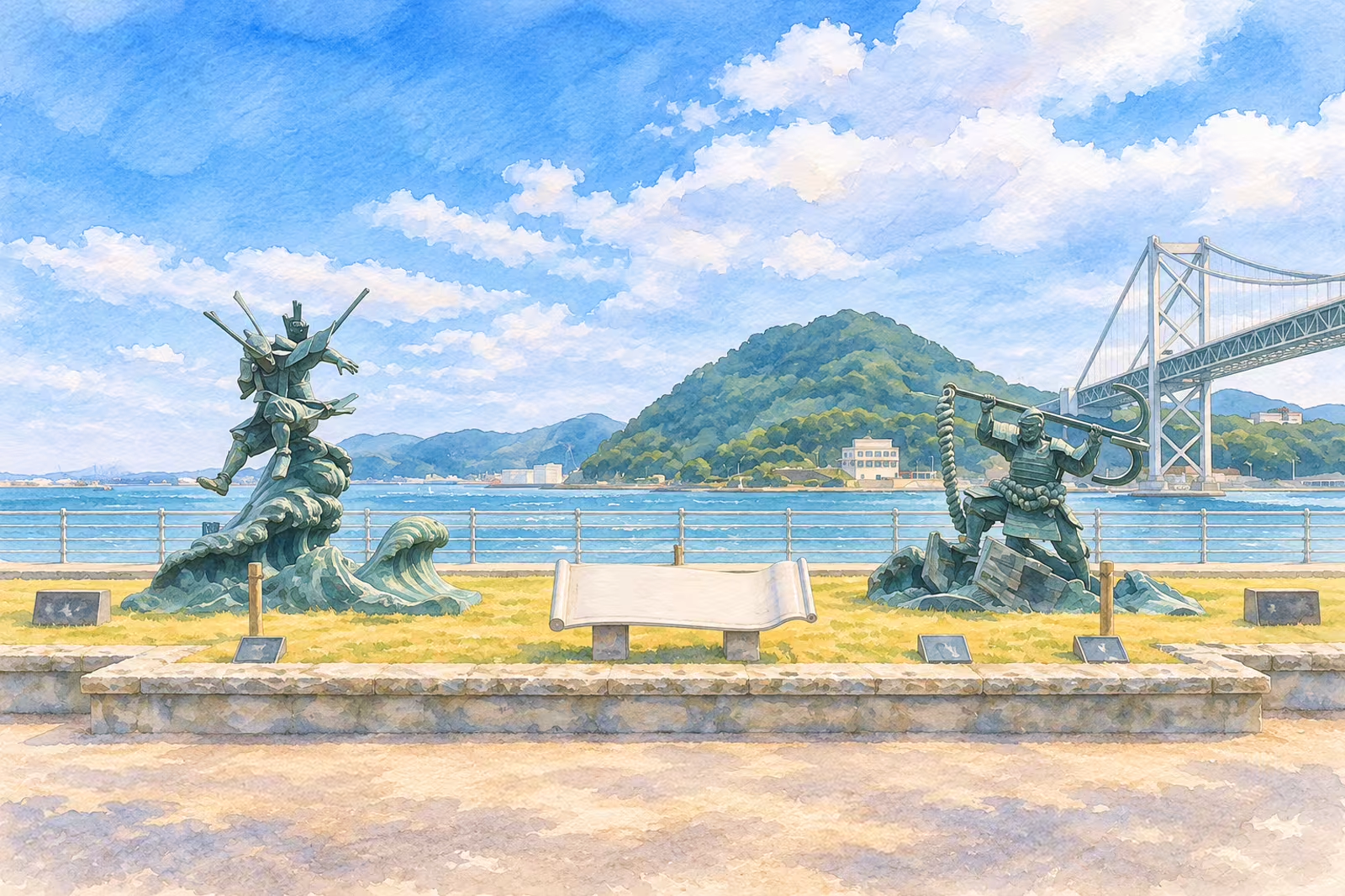
Dan-no-ura is the stretch of coast on the Honshū side of the Kanmon Strait, in the eastern part of Shimonoseki, Yamaguchi Prefecture. In 1185 the final battle of the Genpei War was fought on these waters. The Taira house was destroyed, and the child Emperor Antoku drowned. At its narrowest point, Hayatomo-no-seto, the strait is only about 700 meters wide, with fast tidal currents; the Kanmon Bridge now spans it overhead.
01The battle of 1185
In the third month of 1185, a Minamoto fleet under Minamoto no Yoshitsune met the Taira fleet led by Taira no Munemori and Taira no Tomomori. The Taira had already lost at Ichi-no-tani and Yashima and had fallen back to Hikoshima at the western end of the strait. The fighting began in the morning and at first went the Taira’s way, but the battle turned in the afternoon. A widely repeated modern explanation holds that a change in the tidal current decided the outcome. Some historians dispute this and point instead to Minamoto numbers and the defection of part of the Taira fleet.
When defeat was certain, according to The Tale of the Heike and other accounts, Antoku’s grandmother Taira no Tokiko, known as the Nii-no-Ama, leapt into the sea holding the emperor. He was six years old (eight by traditional count). The sacred sword, one of the three imperial regalia, went down with them and was never recovered. Antoku’s mother, Kenreimon’in Taira no Tokuko, also jumped but was pulled from the water; she later became a nun at Jakkō-in in Ōhara, north of Kyoto. Tomomori drowned himself, and Munemori was captured and later executed. The victory left Minamoto no Yoritomo’s regime in Kamakura dominant across Japan.
02What can be seen today
A sea battle leaves no walls or earthworks, so what remains is the strait itself and later memorials. Mimosusogawa Park, beneath the Kanmon Bridge, has a monument marking the old battlefield and statues of Yoshitsune leaping across boats and Tomomori carrying an anchor, both erected in the 2000s.
A short way west, Akama Jingū enshrines Emperor Antoku. It began as the Buddhist temple Amida-ji and became a Shinto shrine after the separation of Buddhism and Shinto in the early Meiji period. Its buildings burned in the 1945 air raids; the vermilion Suitenmon gate, modeled on a palace beneath the sea, and the main halls are postwar reconstructions. The grounds hold the Shichimori-zuka graves of the Taira, the setting of the ghost story of Hōichi the Earless, and beside the shrine is Antoku’s official tomb, maintained by the Imperial Household Agency.
Dan-no-ura (and Akama Jingū)
01The Strait in Front of You
Stand on the shore at Dan-no-ura, on the eastern edge of Shimonoseki in Yamaguchi Prefecture, and you are looking across the Kanmon Strait, the narrow channel that separates Honshū, Japan’s main island, from Kyūshū to the south. The far shore, about 650 meters away at the narrowest point, is Moji in the city of Kitakyūshū. Above you runs the Kanmon Bridge, opened in 1973; below you, cargo ships push through a current that reverses direction with the tide and at its peak runs at around ten knots, close to twenty kilometers an hour. You can see it from the bank: the water moves like a river.
On this stretch of water, on the twenty-fourth day of the third month of Genryaku 2 (the Taira, refusing to recognize the new era name, still called it Juei 4), which corresponds to April 25, 1185, in the Julian calendar, the Minamoto and Taira clans fought the last battle of a five-year civil war. The Taira lost. Their leading men drowned themselves one after another. A boy emperor, Antoku, eight years old by the traditional Japanese count and six by ours, was carried into the sea by his grandmother. One of the three imperial regalia, the sacred sword, sank with them and was never recovered.
The Taira (also called the Heike, using the Sino-Japanese reading of their name) had dominated the imperial court for a generation. Their fall at Dan-no-ura cleared the way for Minamoto no Yoritomo’s government at Kamakura, the first of the warrior regimes that would rule Japan in one form or another until 1868. The battle is also the emotional climax of The Tale of the Heike (Heike monogatari), the great medieval war narrative chanted for centuries by blind lute-playing monks, and much of how Japanese people picture the day comes from that text.
A short walk west along the shore is Akama Jingū, the Shinto shrine dedicated to the drowned emperor, with its red-and-white gate built to look like an undersea palace. Between the shrine and the battlefield shore, nearly every story about the end of the Heike, historical and legendary, has a place to stand.
02The Rise of the Taira
The Taira were a warrior lineage descended from the Emperor Kanmu. In the mid-twelfth century their head, Taira no Kiyomori, made himself the most powerful man in the capital, Kyoto. He emerged victorious from two short, sharp conflicts in the capital, the Hōgen Disturbance of 1156 and the Heiji Disturbance of 1159, in the second of which he defeated Minamoto no Yoshitomo, father of Yoritomo and Yoshitsune. In 1167 Kiyomori became Grand Minister of State, the highest office at court. His relatives filled the court ranks and controlled estates across the country, and The Tale of the Heike puts in the mouth of one of them the boast that anyone who was not a Taira was hardly human.
Kiyomori married his daughter Tokuko to Emperor Takakura. In 1178 she bore a son, and in 1180 Kiyomori forced Takakura to abdicate in favor of the infant, who became Emperor Antoku. Kiyomori was now the emperor’s grandfather, the classic route to power at the Heian court.
That same year, a disaffected imperial prince, Mochihito, called on the Minamoto to rise against the Taira. Minamoto no Yoritomo, who had been living in exile in Izu since his father’s defeat, raised troops in the east; his cousin Minamoto no Yoshinaka rose in the mountains of Kiso. The fighting that followed is known as the Genpei War, after the Sino-Japanese readings of the two clan names.
03Flight from the Capital
Kiyomori died of fever in 1181, and leadership passed to his son Munemori, who proved less capable. In 1183 Yoshinaka crushed a Taira army at Kurikara Pass and advanced on Kyoto. That summer the Taira abandoned the capital, taking with them the four-year-old Antoku, his mother Tokuko (by now known as Kenreimon’in), and the three imperial regalia: the mirror, the jewel and the sword that legitimate emperors were expected to possess.
The retired emperor Go-Shirakawa, who had stayed behind, responded by placing another of Takakura’s young sons on the throne as Emperor Go-Toba. For two years Japan had two emperors, and the one in Kyoto had been enthroned without the regalia. Recovering them became one of the court’s main demands on the Minamoto.
The Taira regrouped in the west, where their long involvement in Inland Sea trade and piracy suppression had given them loyal fleets. They made their headquarters at Yashima, on the island of Shikoku.
04Yoshitsune’s Campaign
The Minamoto first had to deal with each other. Yoshinaka’s troops behaved badly in Kyoto, and Yoritomo sent his younger half-brothers Noriyori and Yoshitsune to remove him. Early in 1184 they defeated Yoshinaka, who was killed in Ōmi Province.
A few weeks later Yoshitsune attacked the Taira at Ichi-no-tani, near modern Kōbe. The Tale of the Heike has him leading horsemen down a cliff so steep that only deer used it, falling on the Taira camp from behind. Whatever the precise route, the Taira lost heavily and withdrew to Yashima.
Noriyori then led the main Minamoto army west along the Honshū coast toward Kyūshū, intending to cut the Taira off from their supporters there, but he was short of ships and supplies and his progress was slow. In the second month of 1185 Yoshitsune crossed to Shikoku in a storm with a handful of ships and took Yashima by surprise from the landward side. The Taira fled to their boats. This is the battle of the famous episode in which the archer Nasu no Yoichi, on horseback in the surf, shot a fan off the mast of a Taira boat.
With Shikoku lost, the Taira retreated to the far western end of the Inland Sea and based themselves on Hikoshima, an island at the western mouth of the Kanmon Strait. Behind them was Kyūshū, but Noriyori’s army now held its northern coast. The strait was where they would have to fight.
05The Fleets
Two main sources describe the battle. Azuma kagami, a chronicle compiled by the Kamakura government a century later, is brief and fairly sober. The Tale of the Heike is vivid and detailed, but it is a literary work shaped by generations of performers.
Azuma kagami gives the Minamoto more than 840 ships against some 500 for the Taira. The Tale of the Heike inflates this to over 3,000 against over 1,000. Many of the Minamoto ships came from Inland Sea fleets that had recently changed sides, notably the navy of Kumano under its intendant Tanzō and the Iyo fleet of Kōno Michinobu. Yoshitsune was a cavalry commander, and it was these defectors who made a naval battle possible for him.
The real commander on the Taira side was Taira no Tomomori, Kiyomori’s fourth son and Munemori’s younger brother, regarded as the clan’s best soldier. According to The Tale of the Heike, the Taira divided their fleet into three squadrons, and the vessels carrying the emperor and the court ladies sailed among them.
Visitors are often told that the tide decided the battle. In this version, the morning current flowed east, carrying the Taira forward from Hikoshima; around midday it turned, and the Minamoto swept down on the Taira with the current behind them. The theory was put forward by the historian Kuroita Katsumi in the early twentieth century and remains popular, but later work has largely abandoned it. The maritime historian Kanazashi Shōzō, recalculating the tides, concluded that the battle fell during a neap tide and that across the wider parts of the strait the current would have run at only about one knot, too weak to decide anything.
06The Day of Battle
Azuma kagami records that on the twenty-fourth the two sides met on the sea at Dan-no-ura, at Akamagaseki in Nagato Province, and that by noon the Taira were beaten. The Tale of the Heike begins the fighting at dawn.
Two episodes from the Heike account are widely repeated. One is the defection of Taguchi Shigeyoshi, a Taira general from Awa in Shikoku, who went over to the Minamoto mid-battle and, the story goes, told them which ships carried the emperor and the clan leaders. The Taira had planned to disguise the imperial vessel and hide their commanders among ordinary warships, and his betrayal undid the plan. The other is Yoshitsune’s order to shoot the oarsmen and helmsmen of the Taira boats, normally left alone as non-combatants, which left the Taira ships drifting. How far either story reflects what actually happened is debated. Some historians point out that the Taira could have shot Minamoto oarsmen just as easily; others think the oarsmen died incidentally as warriors boarded each other’s ships, not as a deliberate tactic.
As the battle turned, Tomomori came aboard the emperor’s ship. In the Heike he tells the frightened ladies that they will soon be meeting some remarkable men from the east, and then sets to cleaning the ship himself, throwing debris overboard so that nothing unseemly would be found by the enemy.
07The Drowning of the Emperor
The best-known passage in The Tale of the Heike follows. Taira no Tokiko, Kiyomori’s widow, known by her court rank as the Nun of the Second Rank (Nii no Ama), saw that all was lost. She put on a dark nun’s robe, tucked the jewel under her arm, thrust the sword into her sash, and took the little emperor in her arms. He asked where she was taking him. She told him to bow to the east in farewell to the Great Shrine of Ise, and then to the west, toward the Pure Land of Amida Buddha, and to recite the Buddha’s name. Then she told him that there was a capital beneath the waves as well, and she went into the sea with him.
Antoku is generally regarded as the only Japanese emperor to have died in battle. His mother, Kenreimon’in, also jumped, but a Minamoto soldier hooked her by the hair with a rake and dragged her back aboard. She later became a nun and lived out her life at Jakkō-in, a small convent in Ōhara north of Kyoto. The Tale of the Heike ends with the retired emperor Go-Shirakawa visiting her there, and with her death.
The three regalia met different fates. The chest holding the mirror stayed on the ship and was recovered. The box containing the jewel floated and was fished out. The sword went down with the Nun of the Second Rank and was never found, despite searches ordered by the court. The sword kept at the palace was in any case considered a stand-in for the original held at Atsuta Shrine near Nagoya, and the court eventually adopted a replacement, but the loss weighed on contemporaries, and some medieval writers linked it to the decline of imperial authority.
08The End of the Clan
Many of the Taira followed their emperor into the water. Two of Kiyomori’s brothers, Norimori and Tsunemori, slung anchors over their armor and jumped hand in hand. A cluster of younger Taira, among them Sukemori, Arimori and Yukimori, drowned together.
The Heike gives the fiercest end to Taira no Noritsune, governor of Noto. He hunted for Yoshitsune across the decks; Yoshitsune leaped nimbly to another boat to escape him, the origin of the later legend of Yoshitsune’s "eight-boat leap." Unable to catch him, Noritsune seized two Minamoto warriors who rushed him, the brothers Aki no Tarō and Aki no Jirō, clamped one under each arm, and jumped into the sea with them.
Tomomori, having watched the emperor and his kinsmen go, said that he had seen all there was to see. He put on two suits of armor for weight and jumped hand in hand with his foster-brother Ienaga. Later dramatists embellished his death: in the eighteenth-century puppet and kabuki play Yoshitsune and the Thousand Cherry Trees, Tomomori drowns lashed to a ship’s anchor, and that theatrical image is the one the statue at Dan-no-ura follows.
The clan head, Munemori, did not share this dignity. He and his son Kiyomune hesitated, were pushed or fell overboard, stayed afloat, and were pulled out and captured. They were taken to Kamakura, then sent back toward Kyoto, and killed on the way in Ōmi Province on the twenty-first day of the sixth month: Munemori at Shinohara, Kiyomune nearby at Noji. Other survivors, such as Tokiko’s brother Taira no Tokitada, were exiled.
09After the Victory
The victor of Dan-no-ura did not prosper. Yoritomo resented Yoshitsune’s acceptance of court titles without his permission and listened to reports from his retainer Kajiwara Kagetoki about his brother’s arrogance. Yoshitsune was refused entry to Kamakura and left waiting at Koshigoe, outside the town, where tradition says he wrote a letter pleading his loyalty. It made no difference.
The brothers became open enemies. Yoshitsune fled north to the protection of Fujiwara no Hidehira in Ōshū, the far northeast. After Hidehira’s death, his son Yasuhira, under pressure from Yoritomo, attacked Yoshitsune in 1189, and Yoshitsune killed himself at his residence at Koromogawa. Yoritomo destroyed the Ōshū Fujiwara the same year, and in 1192 he was appointed shogun.
The Taira had been warriors too, but they had ruled by marrying into the imperial family and occupying court offices. The government that Yoritomo built at Kamakura was something new: a warrior administration that sat alongside the court rather than inside it. Dan-no-ura is where that path opened.
10From Amida-ji to Akama Jingū
According to local tradition, fishermen recovered the emperor’s body and it was buried on the shore. In 1191 the court ordered a tomb built and a memorial hall raised over it, to be maintained as a temple under imperial patronage. That temple came to be called Amida-ji; it began as a Pure Land temple and later passed to the Shingon school. For nearly seven hundred years its Buddhist priests performed memorial rites for the emperor and for the Taira dead.
In the early Meiji period (1868–1912), the new government ordered the separation of Shinto and Buddhism, and Amida-ji was abolished and its memorial hall became a shrine. It was established as Akamagū in 1875 and in 1940 was raised to the highest government rank and renamed Akama Jingū.
An American air raid on Shimonoseki in July 1945 burned every building of the shrine, and what you see today is a postwar reconstruction. The main sanctuary was rebuilt first, by 1949. The Suitenmon, the gate facing the strait, was begun in 1957 and completed in 1958: a white arched base topped by a vermilion upper story, modeled on the Dragon King’s palace beneath the sea. It was registered as a national Tangible Cultural Property in 2018. The worship hall and corridors followed in 1965. The design answers the Nun of the Second Rank’s last words: if there is a capital under the waves, the drowned emperor should have a palace there.
Next to the shrine is the Amida-ji Mausoleum of Emperor Antoku, administered by the Imperial Household Agency. Other places across Japan, from the mountains of Shikoku and Kyūshū to the island of Iōjima south of Kagoshima, claim that Antoku survived the battle and lived out his life in hiding, and several have their own "tombs." In the Meiji era the government designated the Shimonoseki site as the official one.
11The Seven Mori Mound and the Former Emperor’s Festival
Behind the main shrine, in the shade of trees, is a row of weathered stone monuments known as the Shichimorizuka, the "Mound of the Seven Mori," usually explained as a reference to Taira clan members whose names end in -mori. The memorial names fourteen people in two rows, among them Tomomori and the Nun of the Second Rank. The stones are said to have been gathered here from scattered spots nearby. No one can say whether any remains lie beneath them; it is a place of memorial rather than a grave in the modern sense.
Every year from May 2 to 4 the shrine holds the Sentei-sai, the Former Emperor’s Festival; the anniversary of Antoku’s death, originally the twenty-fourth day of the third lunar month, was fixed at May 2 after Japan adopted the Western calendar. The best-known part, on May 3, is a procession of women dressed as high-ranking courtesans of the Edo period, walking in tall clogs with a slow, swinging, outward-stepping gait and crossing a temporary arched bridge to worship at the shrine. The shrine’s own account is that court ladies who survived the battle were helped by the townspeople and made a living selling wildflowers to boatmen in the harbor, and that every year on the anniversary they dressed in their finest and came to pray. A popular variant says some of them were reduced to working as courtesans. Both are legend.
12The Heike Crabs
The waters around Dan-no-ura are home to a small crab whose shell is marked with ridges and grooves that look remarkably like a scowling human face. People here call it the Heike crab, and local lore says the crabs are the angry spirits of the drowned Taira warriors.
The crab became a famous example in science. In 1952 the British biologist Julian Huxley suggested that fishermen, unwilling to eat crabs that looked like samurai, had thrown them back for centuries, so that the most face-like crabs survived to breed: a case of unintentional artificial selection. Carl Sagan retold the idea in his 1980 television series and book Cosmos, and it reached millions. Most biologists now doubt it. The ridges reflect the attachment points of muscles inside the shell and appear in related species that no one associates with ghosts, and the crab is too small to be worth eating, so throwing it back or keeping it would have made little difference. The crab is also found well beyond the strait, across the Inland Sea and elsewhere; it is the name, rather than the species, that belongs to Dan-no-ura.
13Hōichi the Earless
Inside the grounds of Akama Jingū is a small hall, the Hōichi-dō, containing a seated wooden figure of a blind monk holding a lute. This is Hōichi the Earless, known outside Japan through the version Lafcadio Hearn published in 1904 as the opening story of Kwaidan.
In Hearn’s telling, Hōichi is a blind musician living at Amida-ji, famous for his recitation of The Tale of the Heike and especially of the battle of Dan-no-ura. One night a samurai summons him to perform for a noble household. He is led to what seems a great mansion and sings before an audience of court ladies who weep at his performance. This continues night after night, until the temple servants follow him in the rain and find him sitting alone among the Taira graves, playing to a crowd of ghost fires.
The priest realizes that the dead Taira have claimed him. He paints the text of a sutra over Hōichi’s entire body to make him invisible to the spirits and tells him to sit silently whatever happens. When the samurai comes that night, he can see nothing of Hōichi but his ears, which the priest forgot to cover. He tears them off to take back as proof he obeyed his orders. Hōichi survives, the ghosts never return, and he becomes famous as "Hōichi the Earless."
Hearn drew on an earlier Japanese source, generally identified as a tale in Gayū kidan, a collection of strange stories printed in 1782; his wife Setsu is said to have retold it to him from memory. The Hōichi-dō itself dates from 1957, and its camphor-wood figure is by the sculptor Oshida Masao. Whether a real Hōichi ever lived is unknown. The story rests, though, on a real tradition: blind lute-playing monks, the biwa hōshi, were the main performers of The Tale of the Heike in medieval Japan, and it was through them that the drowning at Dan-no-ura became a story every Japanese listener knew.
14A Walk Through the Site
Begin at Akama Jingū. Before going through the Suitenmon, turn and look at the strait; this is the shore the old temple faced, and the stretch of sea from which the Taira dead are said to have been brought ashore.
The main hall is dedicated to Antoku. The shrine’s treasure house holds objects connected with the Taira, including illustrated panels telling the story of Antoku and the battle, portraits of members of the clan, and the Nagato-bon, an early manuscript version of The Tale of the Heike. The Nagato-bon and the shrine’s medieval documents are designated Important Cultural Properties; the manuscript was damaged in the 1945 air raid. The displays change.
Walk to the left and back from the main hall to find the Hōichi-dō, and beyond it the stones of the Shichimorizuka and the gate of the imperial mausoleum, which can only be viewed from outside.
From the shrine, a walk of a quarter of an hour or so east along the coastal road brings you to Mimosusogawa Park. This is where the strait is narrowest and the current fastest, and it is generally taken as the heart of the battlefield. The park has a statue of Yoshitsune in mid-leap and one of Tomomori hoisting an anchor over his head, a stone commemorating Antoku’s drowning, and another inscribed with a death poem traditionally attributed to the Nun of the Second Rank.
The replica cannons lined up in the same park belong to a different story. In 1863 and 1864 the Chōshū domain fired on foreign ships passing through this strait, provoking retaliation by Western fleets in what became known as the Shimonoseki campaign. Nearly seven centuries after the Taira, the same water again saw fighting that changed the direction of Japan.
Beside the park is the entrance to the Kanmon pedestrian tunnel, which lets you walk under the strait to Moji on the Kyūshū side. Somewhere above you, as you cross, is the water where the Heike went down.