
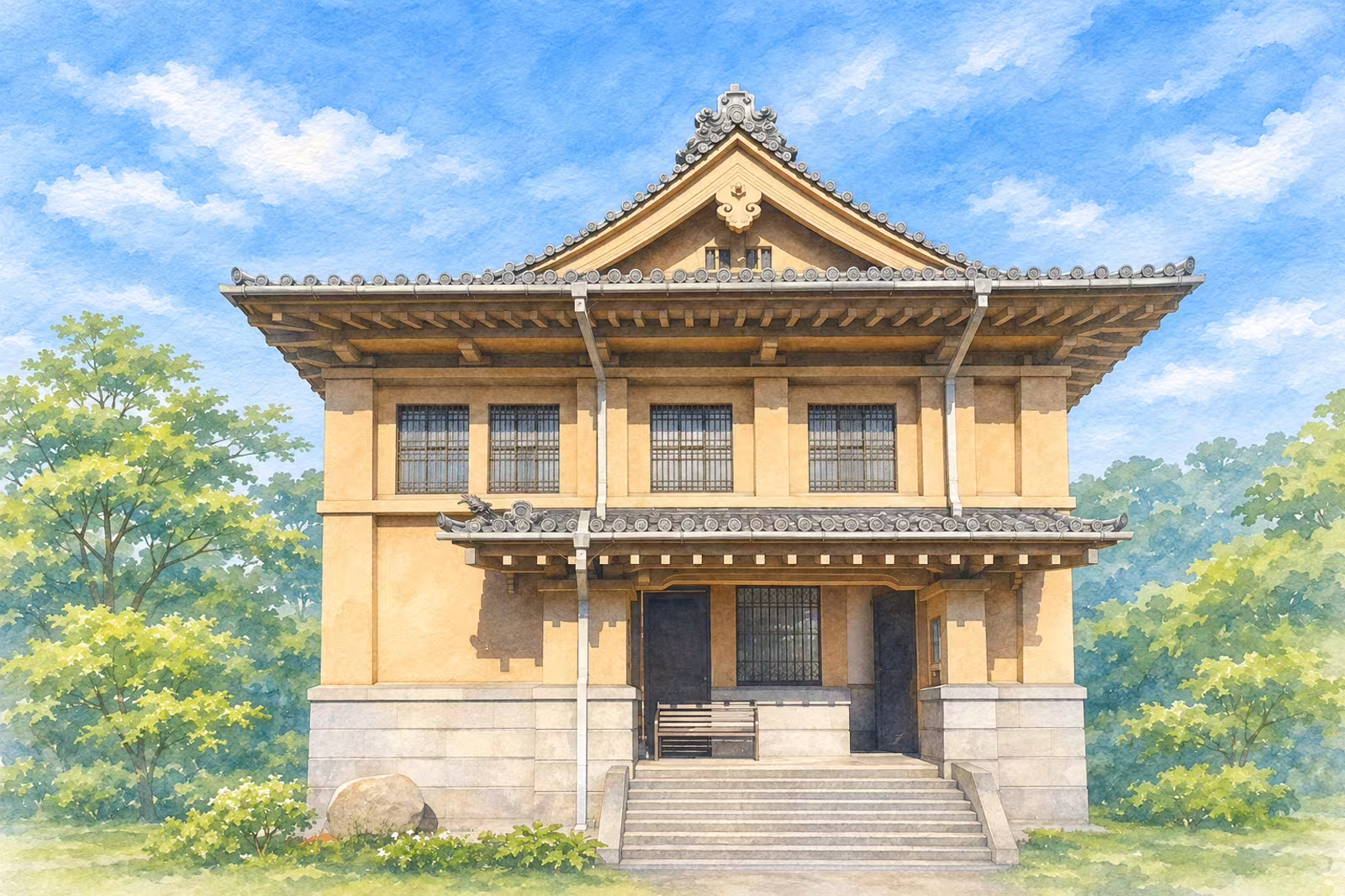
Shunpanrō is a long-established inn and fugu (pufferfish) restaurant in Amidaji-chō, Shimonoseki, Yamaguchi Prefecture, standing beside Akama Jingū and overlooking the Kanmon Strait. In 1895 it hosted the peace talks that ended the First Sino-Japanese War. The resulting treaty is generally called the Treaty of Shimonoseki in English; in Chinese it is the Treaty of Maguan, and in Japanese the Shimonoseki Treaty or the Japan–Qing Peace Treaty. The adjacent Sino-Japanese Peace Memorial Hall recreates the conference room with the original furniture.
01From clinic to inn
The site began as a clinic opened by the physician Fujino Genyō on part of the former grounds of the temple Amida-ji. After his death his widow, Fujino Michi, turned it into an inn and restaurant in the 1880s; the name Shunpanrō is said to have been chosen by Itō Hirobumi. Fugu was banned in Yamaguchi Prefecture at the time, and it is generally believed that Itō, after eating it here, helped bring about the lifting of the ban in 1888. The inn has called itself the first licensed fugu restaurant ever since.
02The 1895 peace talks
War broke out between Qing China and Japan in 1894 over influence in Korea, and Qing forces suffered repeated defeats on land and sea. In March 1895 the Qing court sent Li Hongzhang as plenipotentiary, accompanied by his son Li Jingfang. They met the Japanese plenipotentiaries Itō Hirobumi and Mutsu Munemitsu at Shunpanrō seven times. On March 24 a young Japanese man, Koyama Toyotarō, shot and wounded Li as he returned to his lodgings at Injō-ji temple, and Japan then agreed to an armistice. Afterwards Li reportedly avoided the main road and used a narrow hillside lane, now known as the Li Hongzhang Path.
The treaty was signed on April 17. Qing China recognized the independence of Korea, ceded the Liaodong Peninsula, Taiwan and the Penghu Islands, agreed to pay an indemnity of 200 million taels of silver, and opened Shashi, Chongqing, Suzhou and Hangzhou to trade. Soon afterwards Russia, Germany and France intervened, and Japan returned Liaodong in exchange for a further 30 million taels. The two countries remember the treaty very differently. In China it is widely regarded as a symbol of national humiliation and marks the start of some 50 years of Japanese rule in Taiwan. In Japan it is more often seen as the moment Japan joined the great powers and began its overseas expansion.
03What can be seen today
The original inn building burned in the air raids of 1945; the present Shunpanrō was rebuilt in 1985 and is still in business. The city of Shimonoseki opened the memorial hall next door in 1937, and its reinforced concrete building survived the war. Inside are the tables, chairs and inkstands used during the talks, together with calligraphy by Itō, Li and others. The Li Hongzhang Path still leads up to the inn.