
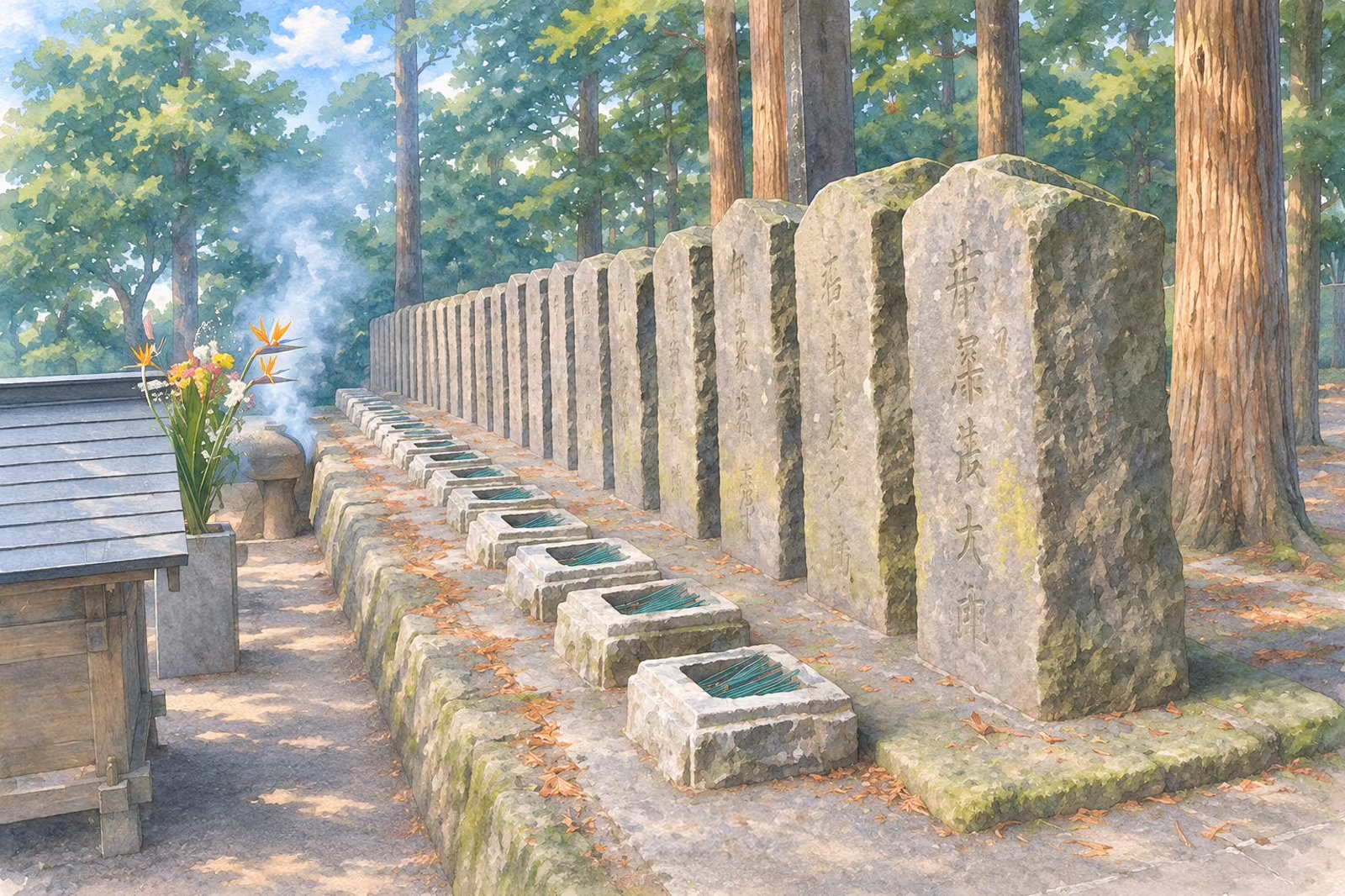
Mount Iimori is a small hill northeast of the old castle town of Aizuwakamatsu in Fukushima Prefecture, about 300 meters above sea level, with a view across to Tsuruga Castle. In 1868, during the Boshin War, members of one unit of the Byakkotai, Aizu’s corps of teenage samurai, killed themselves here, and theirs is one of the most often retold stories of the Bakumatsu era. The hill holds the graves of the nineteen and several memorials, and on its slope stands the Sazaedō, a Buddhist hall more than seventy years older than the war.
01The Byakkotai and Mount Iimori in 1868
In the spring of 1868 Aizu reorganized its forces by age to face the new government, and sons of samurai families aged sixteen and seventeen by traditional count became the Byakkotai, or "White Tiger Corps." The unit tied to Mount Iimori was the Second Squad of samurai-rank members. In the eighth lunar month of that year, government troops broke through the Bonari Pass and approached the Aizu basin. The squad was sent to Tonoguchihara, east of the town, where it was defeated and scattered. Some members escaped through the tunnel of the Tonoguchi irrigation channel to Mount Iimori.
From the hillside they saw the castle town in smoke and flames. In the usual telling, twenty of them concluded that the castle had fallen and took their own lives; in fact it held out for about another month. Other accounts say they debated what to do and chose death to avoid capture. The dead are generally given as nineteen, though some researchers think a few died elsewhere and were later counted with the group. The only boy who was revived, Iinuma Sadakichi, gave testimony late in life that became the main source for what happened.
02Graves and Memorials
It is said that the bodies were at first not allowed to be buried and were later laid to rest by local people. From the mid-Meiji period the grave site was built up in stages into today’s row of nineteen headstones, and the stone stairway up the hill dates from the early twentieth century. Nearby are graves for Byakkotai members who died elsewhere and a memorial to the boys killed in the Aizu War. In 1928 the city of Rome presented an ancient Roman column, which stands on the hill; part of its inscription is said to have been chiseled off after World War II. Another memorial was donated by a German diplomat in the 1930s. The monuments show how later eras borrowed the story.
03The Sazaedō and the Tonoguchi Channel
The Sazaedō, formally the Entsū Sansōdō of the former Shōsō-ji temple, was built in 1796 by the monk Ikudō. It is a hexagonal three-level wooden hall with two spiral ramps inside, so that people going up never meet those coming down. It is said to have once held thirty-three images of Kannon. The hall is an Important Cultural Property. The Tonoguchi channel was dug in the early Edo period, and the tunnel outlet at the foot of the hill marks the Byakkotai’s line of retreat.
Mount Iimori (Byakkotai sites)
01A Hill Within Sight of the Castle
Iimoriyama is a small, rounded hill on the northeastern edge of Aizu-Wakamatsu, in Fukushima Prefecture. It stands about 314 meters above sea level but not far above the surrounding plain, and the name is usually explained as "heaped rice," from its resemblance to a full bowl. From the terrace halfway up, you can look southwest across the city to Tsuruga Castle (also called Wakamatsu Castle), the seat of the Aizu domain, a little under three kilometers away.
That sightline is the reason the hill is famous. On a single day in the autumn of 1868, twenty teenage soldiers of the Aizu domain climbed this slope, looked toward the castle, and decided to die. Nineteen did. The story of these boys, members of a unit called the Byakkotai, or "White Tiger Force," became one of the best-known episodes in modern Japanese history, and the hill became its shrine.
Before 1868, though, Iimoriyama was already a place people visited. A Buddhist temple, Shōsō-ji, stood on its slopes with a hall to the goddess Benzaiten, and pilgrims came to walk through one of the strangest wooden buildings in Japan, the spiral hall now called the Sazaedō. To understand what you see here, it helps to keep two stories in mind: what happened on October 8, 1868, and how that event was retold, monumentalized and argued over in the century and a half since.
02Aizu and the Boshin War
The Aizu domain was ruled by the Matsudaira, a cadet branch of the Tokugawa house founded by Hoshina Masayuki, half-brother of the third shogun. Its house code bound the lords to serve the shogunate above all. In the 1860s the ninth lord, Matsudaira Katamori, accepted the post of Protector of Kyoto, policing the imperial capital with forces that included the Shinsengumi. In doing so he earned the bitter enmity of the Chōshū domain, whose radicals he had driven out of the city.
When civil war broke out in January 1868 with the Battle of Toba-Fushimi, the shogun’s side lost. The war that followed, called the Boshin War after the zodiac name of the year, pitted the new imperial government, led by Satsuma and Chōshū, against domains still loyal to the old order. Katamori withdrew to Aizu and offered submission, but the new government demanded his head or something close to it. The northern domains formed an alliance partly to plead for Aizu, and when that alliance crumbled during the summer, Aizu stood nearly alone.
That spring Aizu had reorganized its army by age into four corps named after the guardian beasts of the four directions in Chinese cosmology. Men of fifty and over formed the Genbutai (Black Tortoise), those of thirty-six to forty-nine the Seiryūtai (Azure Dragon), those of eighteen to thirty-five the Suzakutai (Vermilion Bird), and boys of sixteen and seventeen, along with some fifteen-year-olds who overstated their age, the Byakkotai (White Tiger). Each corps was further divided by rank. The Byakkotai were meant as a reserve and as guards for the lord, not as front-line troops.
03The Fight at Tonokuchihara
On August 21 by the old lunar calendar (October 6, 1868), government troops broke through the Bonari Pass southeast of Aizu and advanced rapidly on the castle town. Most of Aizu’s seasoned troops were away guarding the domain’s other borders. Lord Katamori moved to a field headquarters at Takizawa, just below Iimoriyama, and units that had been held back were sent east to block the road at Tonokuchihara, near the shore of Lake Inawashiro.
Among them was the Second Samurai Company of the Byakkotai, some thirty-seven boys under their commander Hinata Naiki. They marched out on the 22nd, spent a cold, rainy night in the open with little food, and lost their commander, who went to look for provisions and did not return to them. On the morning of the 23rd the government forces attacked. The boys fought, but against modern rifles and artillery the line broke and the company scattered.
A group of twenty survivors, led by older boys such as Shinoda Gisaburō, tried to make their way back to the castle. To avoid enemy troops they used the tunnel of the Tonokuchi irrigation canal, which carried water from Lake Inawashiro through Iimoriyama to the fields around Wakamatsu. The tunnel is about 150 meters long. Wading through waist-deep water in the dark, they came out at the foot of the hill and climbed to its southwestern slope.
04The Decision
What the twenty saw from the slope on August 23 (October 8, 1868) was the castle town burning. Government troops had poured into Wakamatsu that morning, families of samurai who could not reach the castle had killed themselves in their homes, and smoke hung over the area around the keep.
The best-known version of what followed is that the boys mistook the smoke for the castle itself burning, concluded that the castle had fallen and their lord was dead, and chose to follow him in death. This is the version taught for generations. The one survivor, Iinuma Sadakichi, gave a different account, most fully in a memoir he wrote in 1902: the boys could see that the castle still stood, and some argued for fighting their way back into it, but with the town full of enemy soldiers they judged that they would be captured along the way, and capture was a disgrace they would not accept. They decided to die where they were.
Either way, they killed themselves on the hillside with swords and daggers, some helping one another. Nineteen died.
05The Survivor
Iinuma Sadakichi, who had cut his throat, was still breathing. He was fifteen by Japanese reckoning, and tall enough to have added a year to his age when he enlisted. In the usual telling he was found by Hatsu, wife of the Aizu retainer Inde Shinzō; some accounts say another village woman found him first and handed him to her care. He was hidden near Shiokawa and treated by doctors.
After the war Sadakichi was for a time taken in by Narasaki Raizō, a samurai of Chōshū, Aizu’s bitterest enemy. He later took the name Iinuma Sadao, entered the technical school of the Ministry of Public Works in 1872, and spent his career as a telegraph engineer in Niigata, Hiroshima, Tokyo, Sapporo and elsewhere. During the Sino-Japanese War of 1894–95 he served at Imperial General Headquarters on military telegraphs with the rank of army captain. He ended his career as a senior telegraph official in Sendai, died there in 1931, and was buried at the temple Rinnō-ji in Sendai. For most of his life he said very little in public about Iimoriyama. Being the boy who lived, in a story increasingly told as the tale of a whole company that chose death together, was not a comfortable position. In 1957 a gravestone for him was set up on Iimoriyama near the graves of the nineteen; hair and teeth said to be his are kept there.
06The Bodies and the Graves
Tsuruga Castle held out under siege for a month and surrendered on September 22 (November 6, 1868). By then the era name had been changed to Meiji.
For some time after the war the victors did not allow the Aizu dead to be buried, and bodies lay where they had fallen, including those of the boys on Iimoriyama. About three months after the battle, Yoshida Isoji, headman of the nearby village of Takizawa, quietly buried some of the bodies with other villagers at the temple Myōkoku-ji at the foot of the hill and on Iimoriyama itself. He was arrested by government troops and released once it was clear he had acted on his own. Machino Mondo, the Aizu officer charged with keeping order in postwar Wakamatsu, then negotiated official permission, and the scattered remains were gathered into a burial ground on the hill.
A communal grave was built there in 1883, and the row of nineteen individual gravestones you see today was erected in 1890. In 1900 gravestones were added for thirty-one other Byakkotai members who died in other battles of the war. Memorial ceremonies are held at the graves each spring and autumn, with students and townspeople performing poetry recitation and sword dances.
07How the Story Spread
At first the story was a local Aizu memory, and a painful one, since Aizu had been branded an "enemy of the court." It became a national story in the middle and later Meiji period, as the government built an ideology of loyalty to the emperor and needed models of self-sacrifice. Boys who had died for their lord fit that need well, and in the retelling Aizu’s loyalty to the shogun could be recast as loyalty in the abstract, cleansed of its political content.
In 1884 Sahara Morizumi wrote a classical Chinese poem, Byakkotai, for the seventeenth-year memorial of the nineteen; it became a standard of shigin (chanted poetry) and is still performed with sword dances. Books on the nineteen followed, among them Munekawa Toraji’s Aizu Byakkotai jūkyūshi den (Lives of the Nineteen of the Aizu Byakkotai), published in 1926 and revised by Yamakawa Kenjirō the next year. Several songs titled Byakkotai appeared from the late Meiji period on; one from 1937, with lyrics by Shimada Kin’ya and music by Koga Masao, spread across the country, and films, stage plays and rōkyoku (narrative ballads) told the story again and again.
In prewar schools the Byakkotai were held up as a model of youthful loyalty and courage. Ethics textbooks told their story, and school groups came to Iimoriyama to pay respects. It was in this period that the version in which the boys died believing the castle had fallen hardened into the standard account, while Iinuma’s more complicated account was rarely mentioned.
08Gifts from Rome and Germany
Two monuments on the hill show how far the story traveled. The first, known as the monument presented by the city of Rome, is an ancient Roman column erected in 1928 and usually described as a gift from Mussolini. Its origins were odd. Shimoi Harukichi, a Japanese writer living in Italy, told the mayor of Wakamatsu that Mussolini had been moved by the story and wished to send a monument. Historians believe no such plan existed at first, but once the news appeared in the papers, prominent figures such as Shidehara Kijūrō and Yamakawa Kenjirō backed the project, the Foreign Ministry approached the Italian side, and the column duly arrived. After the Second World War, the American occupation authorities ordered its inscription removed; it is said to have been restored later.
In 1935 Hasso von Etzdorf, a secretary at the German embassy in Tokyo, visited Iimoriyama and was so moved that he later donated a monument in a personal capacity. After the war the occupation authorities ordered the inscription removed and the monument destroyed, but the caretaker of the graves hid it. It was set up again in 1953, and in 1955 a new inscription, different from the original, was carved.
By the 1930s, then, the Byakkotai had become more than an Aizu memory. They had been drawn into a language of sacrifice shared by Japan, Italy and Germany.
09Retelling After 1945
After the war the language of dying for the nation was discredited, but the Byakkotai story did not fade. It was retold as a tragedy of youth and of war, and as the story of Aizu’s suffering. Novels, films and television dramas returned to it, among them Nippon Television’s year-end historical drama Byakkotai in 1986.
Iinuma’s testimony gained new attention as historians reexamined the common account, arguing that the boys chose death knowing their situation rather than through a simple mistake. Local guides today usually present both versions. The memory of the war also shaped relations between Aizu-Wakamatsu and Hagi, the old Chōshū castle town; proposals of reconciliation between the two cities have been discussed for decades, and Aizu has been in no hurry to accept.
At the foot of the hill, a privately run Byakkotai Memorial Museum displays belongings of the boys and related material, and a moving walkway now carries visitors partway up the slope.
10The Sazaedō
A little below the graves stands a hexagonal wooden tower 16.5 meters tall, registered as the Former Shōsō-ji Sansōdō, formally the Entsū Sansōdō, and popularly the Sazaedō, or "turban-shell hall," after its spiral shape. It was built in 1796, to a design attributed to the temple’s priest, Ikudō.
Inside, there are no stairs. A single wooden ramp climbs clockwise to the top, crosses a small bridge, and a second ramp descends counterclockwise to an exit at the back. The two paths form a double helix and never meet, so a visitor going up never passes one coming down. The main image was Amida, and thirty-three images of Kannon, the bodhisattva of compassion, were originally installed along the ramp, so that one circuit of the hall equaled a pilgrimage to the thirty-three temples of western Japan.
In the early Meiji years, in the wave of anti-Buddhist destruction that followed the forced separation of Buddhism and Shinto, Shōsō-ji was abolished and the Kannon images were removed; plaques depicting the "Twenty-Four Paragons of Filial Piety of the Imperial Court" were later hung in their place. The hall has been privately owned ever since and was designated an Important Cultural Property of Japan in 1995. It has nothing to do with the Byakkotai, but it is a reminder that for Wakamatsu people the hill was a familiar place of worship and outing long before 1868.
11Walking the Hill
From the base you climb a long flight of stone steps, or take the paid moving walkway. On the terrace you reach the row of nineteen graves, with incense and flowers almost always in front of them. To one side stand the graves of the thirty-one, and nearby the memorial grave of Iinuma Sadakichi.
A short walk farther on is the spot where the boys died, marked by a statue of a boy shading his eyes and looking toward the castle. Stand here and look for the white keep in the distance; this is the view that decided their fate. Nearby is a stone carved with Sahara Morizumi’s poem.
Close by are the Roman column and Etzdorf’s German monument, and a memorial to the Aizu women who died in the war. Going down, you pass the Sazaedō, the Ugajin-dō, a small hall enshrining images of the nineteen, and the Itsukushima Shrine, successor to the old Benzaiten hall.
Finally, at the foot of the hill, look for the mouth of the Tonokuchi canal tunnel. Water still flows out of it. This is where the twenty boys emerged in 1868 before climbing the slope above.