
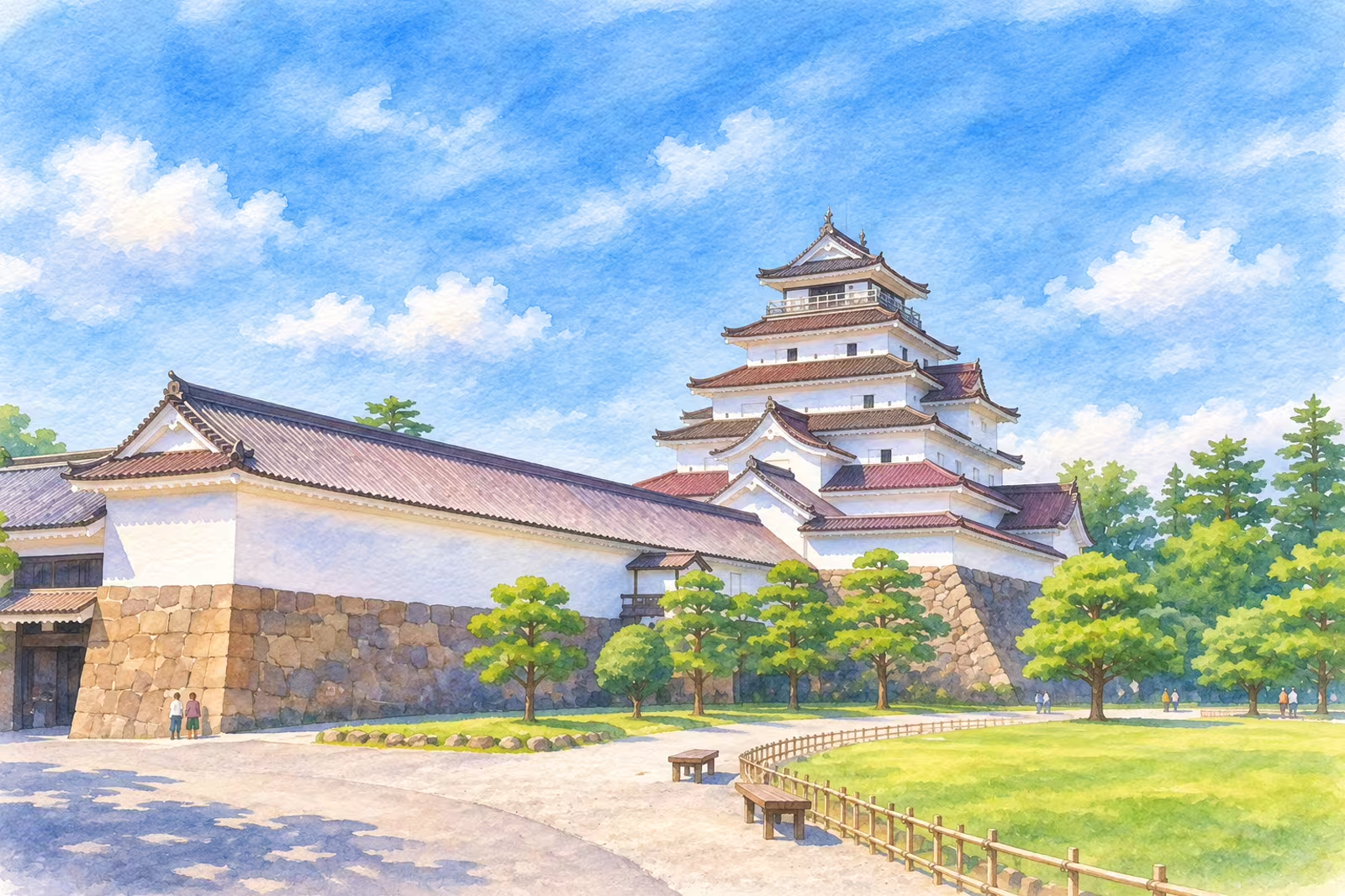
Tsuruga Castle stands in the center of Aizuwakamatsu in Fukushima Prefecture; its formal name is Wakamatsu Castle. From the Muromachi period it was the seat of power in the Aizu region, and in the Edo period it was home to the Matsudaira lords of the Aizu domain. In 1868, during the Boshin War, Aizu held out here for about a month before surrendering, which made it one of the best-known castles of the Bakumatsu era. The present keep is a twentieth-century reconstruction; the grounds are a National Historic Site.
01From Kurokawa to Tsuruga
According to the usual account, Ashina Naomori built a residence here in 1384, called Kurokawa Castle, and the Ashina ruled Aizu from it for some two hundred years. In 1589 Date Masamune defeated them at the Battle of Suriagehara and moved in, but the next year Toyotomi Hideyoshi reorganized the northern provinces and gave Aizu to Gamō Ujisato. Ujisato rebuilt the castle on a large scale, completed a seven-story keep in 1593, and renamed it Tsuruga; the town below changed its name from Kurokawa to Wakamatsu.
Uesugi Kagekatsu, the Gamō family again, and the Katō family followed as lords. An earthquake in 1611 damaged the keep, and around 1639 Katō Akinari rebuilt it with five stories, the form it kept until the end of the Edo period. In 1643 Hoshina Masayuki received Aizu; his descendants took the name Matsudaira and ruled the domain thereafter.
02Siege and Demolition
In 1862 the lord Matsudaira Katamori became Protector of Kyoto and in that post made bitter enemies of the Chōshū domain. After the Battle of Toba-Fushimi in 1868, Aizu became a principal target of the new government. Late in the eighth lunar month, government troops broke into the castle town; the Byakkotai suicides on Mount Iimori happened at this time. The castle held out under artillery fire for about a month and surrendered late in the ninth month. Accounts say the keep was badly damaged but did not fall. In 1874 the Meiji government pulled down the keep and turrets, leaving the stone walls and moats. The site became a National Historic Site in 1934.
03What Can Be Seen Today
The current keep, completed in 1965, is reinforced concrete; its exterior reproduces the late-Edo five-story keep, and it houses a museum of Aizu history. In 2001 the Hoshii Turret and the southern corridor building were rebuilt in traditional timber. In 2011 the keep was re-roofed in red tiles, following records that late-Edo Aizu used red-glazed tiles to resist the cold. The stone walls, moats, and layout are original, the walls mostly from the Gamō and Katō periods. The Rinkaku teahouse in the grounds is linked by tradition to Sen no Shōan, said to have been sheltered by Gamō Ujisato; it was moved out in the Meiji period and returned in 1990.
Tsuruga Castle (Aizu-Wakamatsu)
01The Castle in Front of You
Tsuruga Castle sits on flat ground in the southeast of the Aizu Basin, in what is now Aizu-Wakamatsu, Fukushima Prefecture. It does not crown a mountain. Its strength came from broad moats and tall stone walls, and from its position at the center of a basin ringed by mountains. Locals call it Tsuruga-jō or simply Tsuruga, "Crane Castle"; its official designation as a National Historic Site is Wakamatsu-jō Ato, "the site of Wakamatsu Castle." Older names include Kurokawa Castle and Aizu Castle.
The five-story keep you see today is a reinforced-concrete reconstruction from 1965, which houses a local history museum. Its red-brown roof tiles, restored in 2011, make it unlike any other castle keep in Japan. The stone walls and moats, by contrast, are largely what stood here in the Edo period (1603–1868).
For most Japanese visitors the castle means one thing: the Boshin War of 1868, when the domain of Aizu held this castle for about a month against the armies of the new imperial government, and when a band of teenage soldiers, the Byakkotai or "White Tiger Force," took their own lives on a hill overlooking the town. That story is at the end of a long history, and it makes more sense once you know how Aizu got there.
02The Ashina and Kurokawa
The site’s history is usually traced to 1384, when Ashina Naomori is said to have built a residence here called Higashi-Kurokawa-kan. The Ashina were a branch of the Miura warrior family from Sagami Province (modern Kanagawa) who had held lands in Aizu since the Kamakura period (1185–1333). Over the following centuries they became the dominant power in the region, and under Ashina Moriuji in the sixteenth century they reached their height. Their seat, Kurokawa Castle, and the town around it were the ancestors of today’s city.
After Moriuji the family suffered a run of early deaths among its heirs. It finally adopted Ashina Yoshihiro, a son of the Satake lord Satake Yoshishige from Hitachi Province to the south. The choice split the Ashina retainers and gave an opening to an ambitious young neighbor to the north.
03Date Masamune’s Brief Possession
That neighbor was Date Masamune, the "one-eyed dragon." In 1589 he crushed Yoshihiro at the Battle of Suriagehara at the foot of Mount Bandai. Yoshihiro fled back to Hitachi and Ashina rule in Aizu ended. Masamune moved his headquarters into Kurokawa Castle and, for a moment, controlled most of southern Tōhoku (northeastern Japan).
He had, however, defied Toyotomi Hideyoshi, the warlord who by then dominated Japan and had forbidden private wars between lords. When Hideyoshi besieged the Hōjō at Odawara in 1590, Masamune arrived late and had to submit. He kept his life and his family lands but was stripped of Aizu. Hideyoshi himself came to Kurokawa that summer to settle the new order in the north, an operation known as the Ōshū Shioki, the "disposition of the northern provinces."
04Gamō Ujisato Builds a Crane Castle
Hideyoshi gave Aizu to Gamō Ujisato. Born in Hino in Ōmi Province (modern Shiga), Ujisato had been sent as a boy hostage to Oda Nobunaga, who was so impressed that he married him to one of his daughters. Moving from Matsusaka in Ise, Ujisato received a domain in Aizu first assessed at about 420,000 koku (a koku was the rice measure used to rate a domain’s wealth), later raised to around 920,000. He was meant to be Hideyoshi’s watchman over Masamune and the other northern lords.
Ujisato remade both the castle and the town. He renamed Kurokawa "Wakamatsu," a name usually linked to a grove called Wakamatsu no Mori near his home in Hino. He laid out separate districts for samurai and townspeople, brought in merchants and craftsmen, and encouraged lacquerware and sake brewing; Aizu lacquer traditionally traces its growth to his patronage.
In 1592 he began major construction, and in 1593 a seven-story keep was completed. He named the castle Tsuruga-jō. The crane is generally explained by the Gamō family crest and by Ujisato’s childhood name, Tsuruchiyo. The keep is often described as the first full-scale castle keep in eastern Japan.
Ujisato was also a devoted tea man, counted among the "Seven Disciples" of the tea master Sen no Rikyū. When Hideyoshi ordered Rikyū to commit suicide in 1591, Ujisato sheltered Rikyū’s son Sen Shōan in Aizu. Shōan was later pardoned and returned to Kyoto, where the Sen family was revived. The tea house Rinkaku in the castle grounds is traditionally said to have been built by Shōan for Ujisato.
Ujisato died in Fushimi in 1595, aged forty by Japanese reckoning. His farewell poem, in which blossoms that would fall in their own time are hurried away by an impatient spring mountain wind, is still often quoted.
05Uesugi Kagekatsu and the Road to Sekigahara
Ujisato’s heir, Gamō Hideyuki, was young, and the family was troubled by internal disputes. In 1598 Hideyoshi moved him to Utsunomiya and gave Aizu to Uesugi Kagekatsu, with a vast domain of 1.2 million koku.
Kagekatsu and his chief retainer Naoe Kanetsugu found Tsuruga Castle cramped and began a new castle at Kōzashi, northwest of the town. They also repaired roads and built up their forces. Tokugawa Ieyasu, the strongest of the regents after Hideyoshi’s death in 1598, demanded an explanation. Kanetsugu’s defiant reply, known as the Naoe-jō (Naoe Letter), is famous, though how much of the surviving text is genuine is still debated. In 1600 Ieyasu marched north to punish the Uesugi; on the way he learned that Ishida Mitsunari had raised an army in the west, turned back, and won the Battle of Sekigahara. The Uesugi never fought at Sekigahara itself, but afterward they were reduced to 300,000 koku at Yonezawa, and the Kōzashi castle was never finished.
06Earthquake, the Katō, and a Five-Story Keep
Gamō Hideyuki, who had sided with Ieyasu, returned to Aizu in 1601 with 600,000 koku. In 1611 a major earthquake struck Aizu and badly damaged the keep, which is said to have tilted. Hideyuki died soon after, and when his son Tadasato died in 1627 without an heir, Gamō rule in Aizu came to an end.
Next came Katō Yoshiaki, one of the "Seven Spears of Shizugatake," Hideyoshi’s famous young warriors, with 400,000 koku. His son Katō Akinari carried out a major rebuilding, and in 1639 he replaced the damaged seven-story tower with a five-story one and strengthened the outer defenses, including the Kita-demaru and Nishi-demaru, the projecting northern and western enclosures. The outline of the keep and the defensive layout you see today largely date from his work. Akinari, however, fell out with his senior retainer Hori Mondo, who left the domain with his family in a scandal known as the Aizu Disturbance, and in 1643 the Katō surrendered Aizu.
07Hoshina Masayuki and the House Code
In 1643 Hoshina Masayuki was given Aizu with 230,000 koku. Masayuki was an unacknowledged son of the second shogun, Tokugawa Hidetada, raised in the Hoshina family of Takatō in Shinano. His half-brother, the third shogun Iemitsu, came to trust him deeply and on his deathbed asked him to guide the young fourth shogun, Ietsuna. Masayuki spent long years in Edo at the center of government.
In 1668 he issued a fifteen-article house code for Aizu. Its first article told the domain to serve the shogun’s house with single-minded loyalty, and said that if a future lord ever wavered, his retainers need not follow him. The code shaped Aizu for two centuries, with consequences that played out in 1868. From the third lord, Masakata, the family took the name Matsudaira and the Tokugawa hollyhock crest, and became known as the Aizu Matsudaira.
Aizu was known for disciplined schooling. Its domain academy, the Nisshinkan, was one of the most famous in Japan, and samurai boys were brought up under a short code of conduct whose last line, roughly "What must not be done must not be done," is still quoted in the city.
08Matsudaira Katamori and Kyoto
The ninth lord, Matsudaira Katamori, was born into a branch family in Mino and adopted into Aizu. In 1862 the shogunate asked him to take the new post of Kyoto Shugoshoku, Protector of Kyoto, responsible for order in the imperial capital at a time of assassinations and unrest. Some of his advisers warned that accepting would be like carrying firewood into a fire. Katamori accepted, citing the house code.
In Kyoto, Aizu oversaw the Shinsengumi, the notorious police force, and in 1864 drove Chōshū troops from the palace gates in the Kinmon Incident. Katamori won the trust of Emperor Kōmei and the lasting hatred of Chōshū. When the shogun returned power to the court in 1867 and the Satsuma and Chōshū camp seized control of the new government, Aizu’s position collapsed. After the defeat of shogunate forces at Toba-Fushimi in January 1868, Aizu was branded an enemy of the court. Katamori returned home and offered submission, but the new government demanded harsh terms. The northern domains, failing to win leniency for Aizu, formed the Ōuetsu Reppan Dōmei, an alliance of northern domains, and the war moved north.
09The Siege of 1868
In the late summer of 1868 government armies converged on Aizu. On the 21st day of the 8th month they broke through at Bonari Pass and moved on Wakamatsu far faster than expected. Early on the 23rd (October 8 in the Western calendar) the alarm bell rang in the town, and soldiers, women, the elderly and children crowded into the castle.
That day twenty members of the Byakkotai’s Second Samurai Company, boys of sixteen and seventeen, fell back from defeat at Tonokuchihara to Iimoriyama, a hill northeast of the castle. Seeing smoke and flames over the town, they took their own lives; nineteen died. The standard account says they believed the castle had already fallen. The one survivor, Iinuma Sadakichi, became the main source for the story, and some readers of his later testimony argue that the boys knew the castle still stood and chose death over capture. On the same day, the family of the senior retainer Saigō Tanomo, along with other samurai households, killed themselves at home.
Outside the walls, a group of women including Nakano Takeko fought alongside the soldiers with naginata, the long-bladed polearm; Takeko was shot and killed near Namidabashi bridge. Inside, Yamamoto Yae cut her hair, wore men’s clothes and fought with a Spencer repeating rifle. She later became Niijima Yae, wife of Niijima Jō, founder of Dōshisha in Kyoto.
The besiegers placed artillery on Odayama, a hill southeast of the castle, and shelled it from above. The keep and other buildings were hit again and again. Defenders smothered incoming shells with wet blankets, and the wounded filled the main halls. Outlying positions fell, and neighboring domains surrendered one by one.
On the 22nd day of the 9th month (November 6, 1868), Aizu surrendered in a ceremony outside the castle’s northern approach, and Katamori and his son came out. By tradition, Aizu retainers cut the red carpet used at the ceremony into pieces and kept them, calling it the "cloth of tears of blood." Katamori was confined, and the domain was reduced and moved to Tonami at the northern tip of Honshū, where its people endured years of cold and hunger.
10Ruin and Reconstruction
After the Restoration the castle passed to the army. In 1874 the battered keep and the other buildings were torn down, leaving only stone walls and moats. The poet Doi Bansui, who visited on a school trip, is generally thought to have drawn on these ruins, along with Sendai Castle in his home town, when he wrote the lyrics of the song Kōjō no Tsuki ("Moon over the Ruined Castle"). A monument to the song stands south of the Rinkaku tea house.
The site was designated a National Historic Site in 1934. In 1965, with large donations from local people, the keep was rebuilt in reinforced concrete to its old exterior. In 2001 the Hoshii Yagura (a provisions turret) and the Minami Hashiri Nagaya (a long defensive storehouse) were rebuilt with traditional timber methods. In 2011 the keep’s roof was re-tiled with red glazed tiles like those it had at the end of the Edo period. Glazed red tiles were used here because ordinary tiles cracked in Aizu’s hard winters.
11Walking the Grounds
Enter from the north through the Kita-demaru. This enclosure was designed so that anyone approaching was exposed to fire from three sides, and it saw hard fighting in 1868. Walking in toward the main enclosure you pass immense, steep walls, often counted among the finest stonework in Tōhoku.
The keep’s base is built of rough, unworked stones, a technique called nozura-zumi, generally attributed to Ujisato’s time. Inside the keep, displays cover the Ashina, Gamō and Matsudaira eras and the Boshin War. From the top floor you can look southeast to Odayama, where the guns stood, and northeast toward Iimoriyama.
South of the keep stand the rebuilt Hoshii Yagura and Minami Hashiri Nagaya, where you can see a traditional castle building’s timber interior. East of the keep is the tea house Rinkaku. It was moved out of the castle in the Meiji era and preserved by the Morikawa family, then returned to the grounds in 1990. In spring the moats and enclosures are lined with cherry blossoms.