
At a glance
How tree sap becomes a lacquered bowl, how maki-e gold and raden shell inlay are made, and how to choose and care for real urushi.
- Urushi is the sap of the lacquer tree; a tree must grow about ten years before tapping and yields only around 200 grams a season.
- Lacquer does not dry by evaporation: an enzyme uses moisture and oxygen to harden it, so it cures in a humid cupboard.
- Lacquered burial goods from the Kakinoshima site in Hokkaidō date to about 9,000 years ago, among the oldest lacquer objects known.
- Wajima ware claims more than a hundred steps, and a bowl can take half a year or more to make.
- Most urushi used in Japan is imported from China; domestic lacquer is only a few percent, much of it Jōbōji lacquer from Iwate.
Order miso soup almost anywhere in Japan and it arrives in a lidded wooden bowl, black outside and red within, light enough to lift with one hand and cool enough to hold even when the soup is scalding. The coating on that bowl is urushi, the sap of a tree, painted on in many thin layers and left to harden in a damp room. The same material covers samurai armor, temple pillars, writing boxes and tea caddies, and it is the ground on which Japanese craftsmen developed maki-e, pictures made of gold powder, and raden, inlays of iridescent shell. From the late seventeenth century English simply called lacquer and lacquerware "japan." This is an introduction to what urushi is, why it was so valuable, how a piece is made, and how to look at, buy and live with it on a trip to Japan.
01A Sap That Hardens in the Damp
Urushi comes from the lacquer tree, Toxicodendron vernicifluum, a relative of poison ivy that grows across China, Korea and Japan. Cut the bark and a milky, grayish sap beads up along the wound. Exposed to air, it darkens to brown and then nearly black.
Harvesting it is a specialist trade. The tapper, called an urushi-kaki, works a tree from early summer into autumn, returning every few days to cut a fresh horizontal groove a little above the last one and scraping the beads of sap into a small wooden pail with a spatula. A tree needs about ten years of growth before it can be tapped, and a full season yields only around 200 grams, roughly a cupful. In the usual Japanese method the tree is then felled, and new shoots grow from the stump.
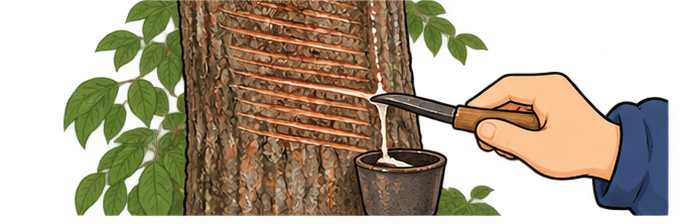
Horizontal cuts are added along the trunk and the milky sap is scraped into a small pail.
Like its cousin poison ivy, raw urushi causes a fierce, itching rash. Nearly every lacquer artist has suffered it, and many say their skin grows more tolerant over the years. Fully cured lacquer, by contrast, is inert and safe; the same substance that blisters the hands becomes one of the best surfaces ever devised for something you put to your mouth.
The strangest thing about urushi is how it dries. Paint dries as a solvent evaporates. Urushi cures through a chemical reaction driven by an enzyme, laccase, in the sap, which pulls in oxygen and needs moisture in the air to work. Put a lacquered bowl somewhere hot and dry and it will stay tacky; put it in a warm, humid cabinet and it will harden. Every workshop has a curing cupboard, the urushi-buro, lined with wood and dampened with water to keep the humidity around 70 to 80 percent. Japan’s sticky rainy season, miserable for most people, is the lacquerer’s favorite time of year.
Most urushi used in Japan today is imported from China. Domestic production supplies only a few percent, and much of that comes from around Ninohe in Iwate Prefecture, where the local Jōbōji lacquer has a reputation for fineness and strength. In 2015 the Agency for Cultural Affairs notified local authorities that, from fiscal 2018, the restoration of National Treasure and Important Cultural Property buildings should in principle use domestic urushi (press reports cite work at sites such as Nikkō Tōshōgū and the Konjikidō of Chūson-ji), which has given tappers steady demand and drawn a small number of young people into the work.
02Why Lacquer Mattered
Cured urushi is hard, waterproof, and resistant to acids, alkalis, heat and rot. Before plastics, nothing else could make a wooden bowl hold hot soup and rice every day for decades without warping, staining or growing mold. Japan has always had abundant timber, and before ceramics became common in ordinary homes, much everyday tableware was lacquered wood. The habit of drinking miso soup from a lacquered wooden bowl, lifted to the lips, survives because it works: wood and lacquer conduct heat slowly, so the bowl stays comfortable in the hands.
The material is ancient here. Lacquered burial goods from the Kakinoshima site in Hakodate, Hokkaidō, have been dated to about 9,000 years ago, among the oldest lacquer objects known anywhere, and Jōmon-period sites have produced red-lacquered combs and bowls. In the seventh and eighth centuries, as Buddhist culture flourished, the techniques of Tang China poured in, and the Shōsōin, the imperial storehouse at Tōdai-ji in Nara, still preserves lacquered boxes, instruments and sword scabbards from that period, some imported and some made in Japan.
What makes good lacquer beautiful is its depth. A fine black surface does not glare like glass; it looks more like still water, with light seeming to sit beneath it. The novelist Tanizaki Jun’ichirō argued in his 1933 essay In Praise of Shadows that lacquer was meant to be seen in dim candlelight, where gold decoration flickers out of the darkness and you cannot see the bottom of the soup in a black bowl. Japanese owners also say lacquer improves with use. A new piece can look slightly hard; after years of handling and wiping, the surface becomes more translucent, and red lacquer brightens noticeably.
When Portuguese traders reached Japan in the mid-sixteenth century, lacquer was one of the things they took home, and the Dutch East India Company carried on the trade after them. Europeans fell for it. Just as porcelain became "china," lacquerware became "japan," and "japanning" came to mean the European imitation finishes used on furniture, tin trays and later bicycles. Marie Antoinette assembled one of the finest collections of Japanese lacquer boxes in Europe.
03How a Bowl Is Made
A lacquered object is built in three stages: the core, the foundation, and the finishing coats.
The core, called kiji, is usually wood. Bowls are turned on a lathe from zelkova or horse chestnut; boxes and trays are usually joined from cypress and similar woods, and some accounts add magnolia (hō). Cores can also be made of woven bamboo, layered cloth, or paper. Whatever the material, it must be thoroughly seasoned, or it will crack under the lacquer years later.
The foundation is where quality is decided, and Wajima, on the Noto Peninsula in Ishikawa Prefecture, is famous for doing it best. Wajima craftsmen first glue strips of hemp cloth over the rim and other edges likely to be knocked. Then they mix raw lacquer with jinoko, a powder made from a local diatomaceous earth that has been baked and ground. Its tiny porous grains soak up the lacquer and lock into a hard, resilient layer. The mixture is spatulaed on, cured, ground smooth with whetstones, and applied again, each layer with a finer powder than the one before.
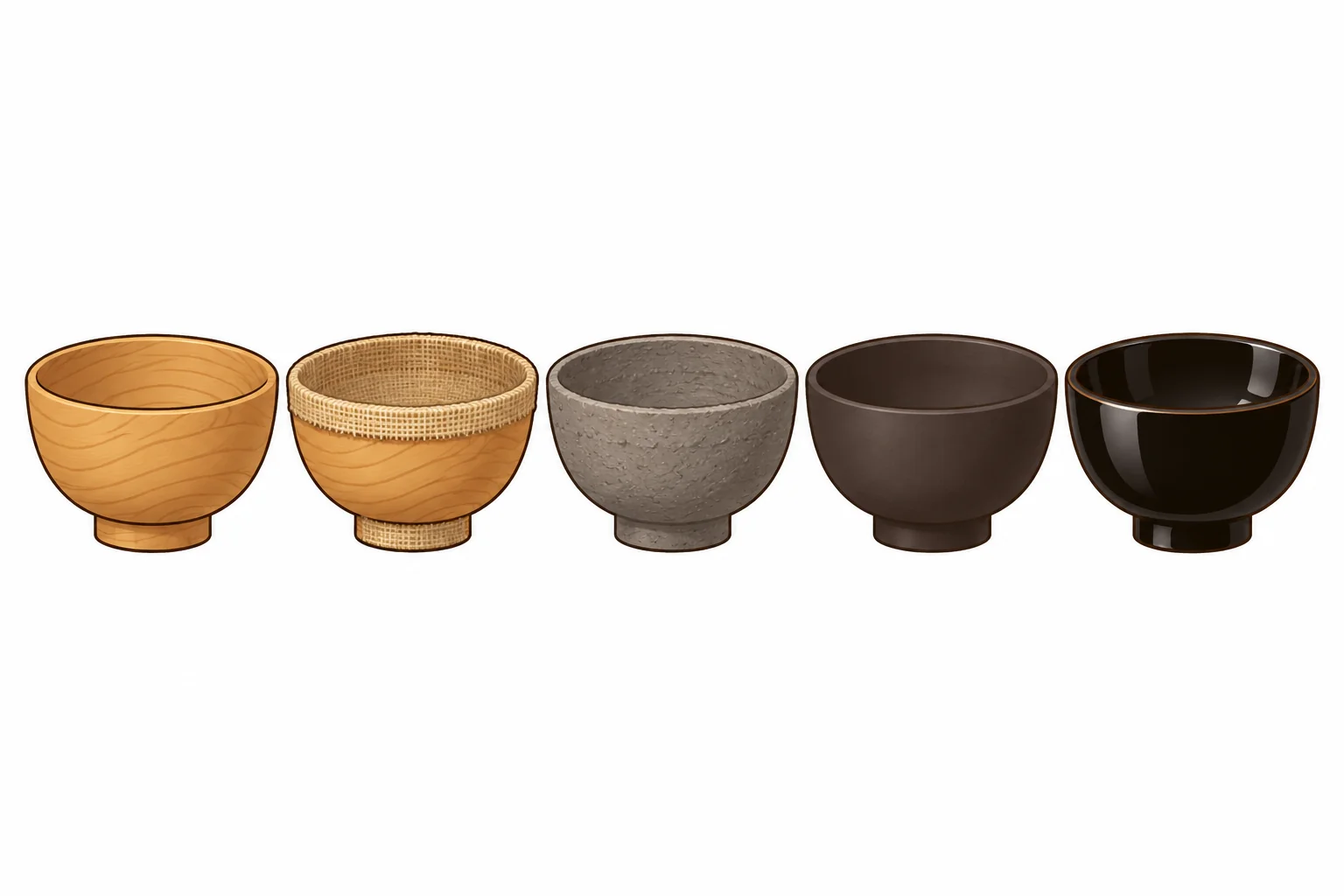
Process samples of one bowl: bare wood, cloth reinforcement, jinoko ground, middle coat and top coat (illustration).
Only then come the middle and top coats. The middle coats are polished with charcoal. The final coat must be brushed on in a dust-free room in a single pass; a speck of dust means sanding back and starting again. Lacquer brushes are made of human hair set the full length of a wooden handle, and when the tip wears down the brushmaker shaves back the wood like sharpening a pencil. Wajima ware claims more than a hundred steps, and a bowl can take half a year or more from raw wood to finished piece, which is why, as of the mid-2020s, a good one costs tens of thousands of yen.
- 1
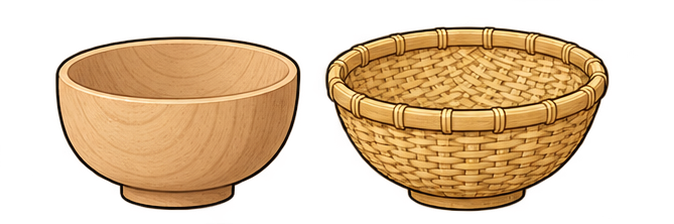 The core: bowls are usually turned on a lathe; woven bamboo and other bodies are also used.
- 2
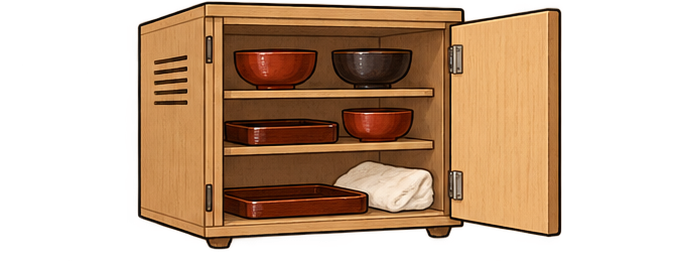 The curing cupboard: each layer goes into a humid cupboard to harden fully.
- 3
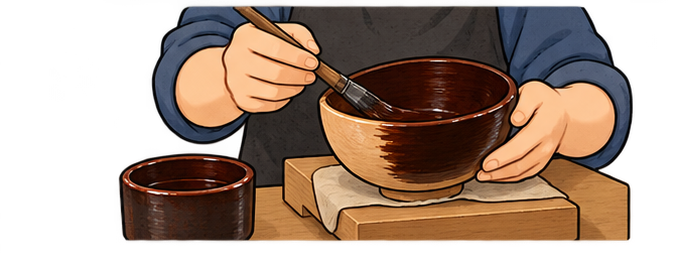 Top coat: the final layer is brushed on in a single pass.
The top coat can be left as brushed, a finish called nuritate with a soft, slightly satin glow, or it can be polished in the technique called roiro: rubbed with charcoal, then fine powders, and finally the bare palm, until it shines like a black mirror.
04Maki-e: Pictures in Gold Powder
Maki-e, literally "sprinkled picture," is the technique most people mean when they think of fine Japanese lacquer. The artist draws a design in wet lacquer on a finished surface, then sprinkles gold or silver powder over it through a fine bamboo tube or with a soft brush. The powder sticks only where there is lacquer; the rest is brushed away. Once cured, the metal is held in place for good.
There are three basic variations. In hira maki-e, "flat maki-e," the sprinkled design is sealed with a thin coat of lacquer and lightly polished, sitting barely above the surface. In togidashi maki-e, "polished-out maki-e," the whole surface is coated over in black after sprinkling, burying the design, and then ground back down until the gold reappears, perfectly level with the lacquer around it, so it seems to float inside the black. In taka maki-e, "raised maki-e," the design is first built up with lacquer mixed with charcoal or clay powder, so that rocks, waves and branches stand out in relief. Fine pieces combine all three, often with tiny squares of cut gold foil, kirikane, set in among them.
- 1
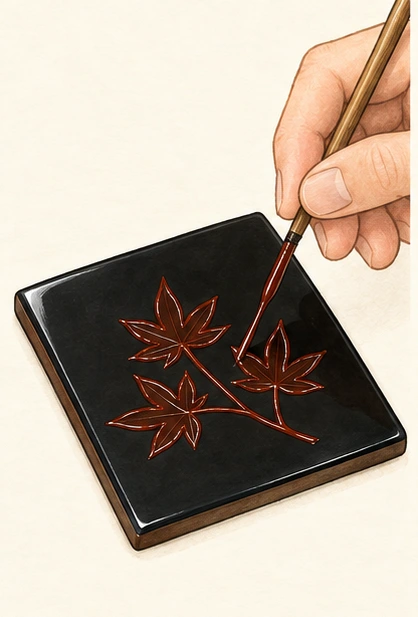 The design is drawn in lacquer on the finished surface.
- 2
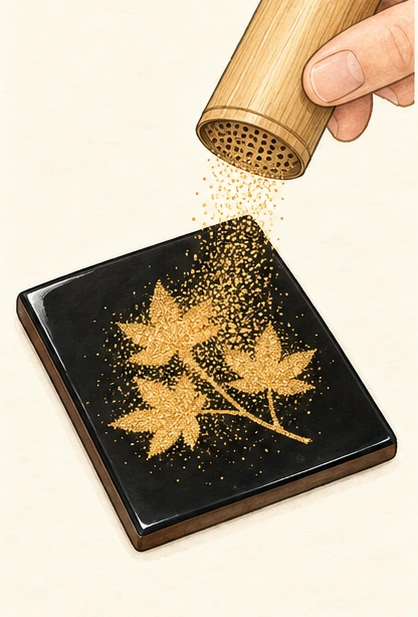 While the lacquer is still wet, gold powder is sprinkled over it.
- 3
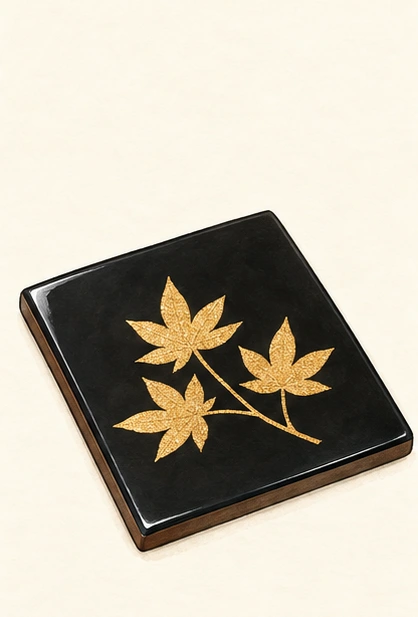 Once cured, loose powder is brushed away and gold remains only on the design.
- 4
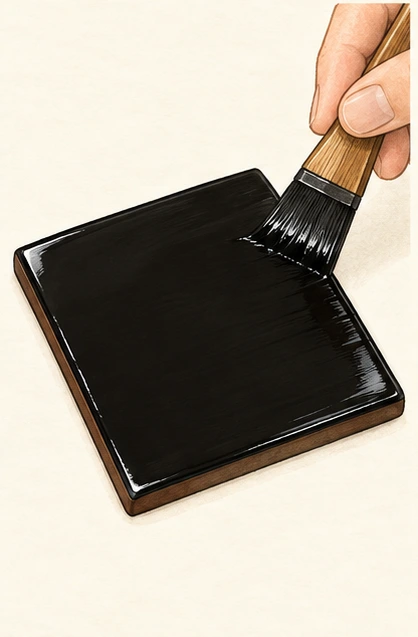 For togidashi, the whole surface is coated in black, burying the design.
- 5
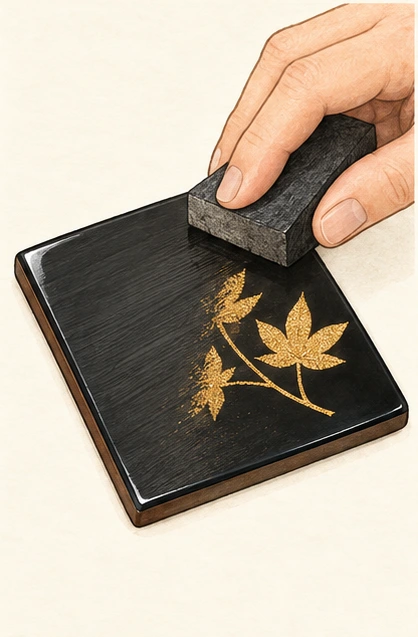 Grinding back brings the gold out again, level with the surrounding lacquer.
An early form of the technique appears on a Tang-style sword scabbard in the Shōsōin. By the Heian period (794–1185) maki-e had matured into the art of the court, covering writing boxes, cosmetic boxes and sutra cases with autumn grasses, streams and images from classical poetry. At the Konjikidō, the Golden Hall of Chūson-ji in Hiraizumi, whose ridgepole was raised in 1124, the altar platforms are encrusted with maki-e and shell inlay inside a building covered in gold leaf.
| Technique | After sprinkling | Design and surface |
|---|---|---|
| Hira maki-e | Sealed with a thin coat and lightly polished | Barely above the surface |
| Togidashi maki-e | Coated over in black, then ground back until the gold reappears | Perfectly level |
| Taka maki-e | Design first built up with lacquer mixed with charcoal or clay powder | Stands out in relief |
The three differ in whether the design sits above the surface or level with it.
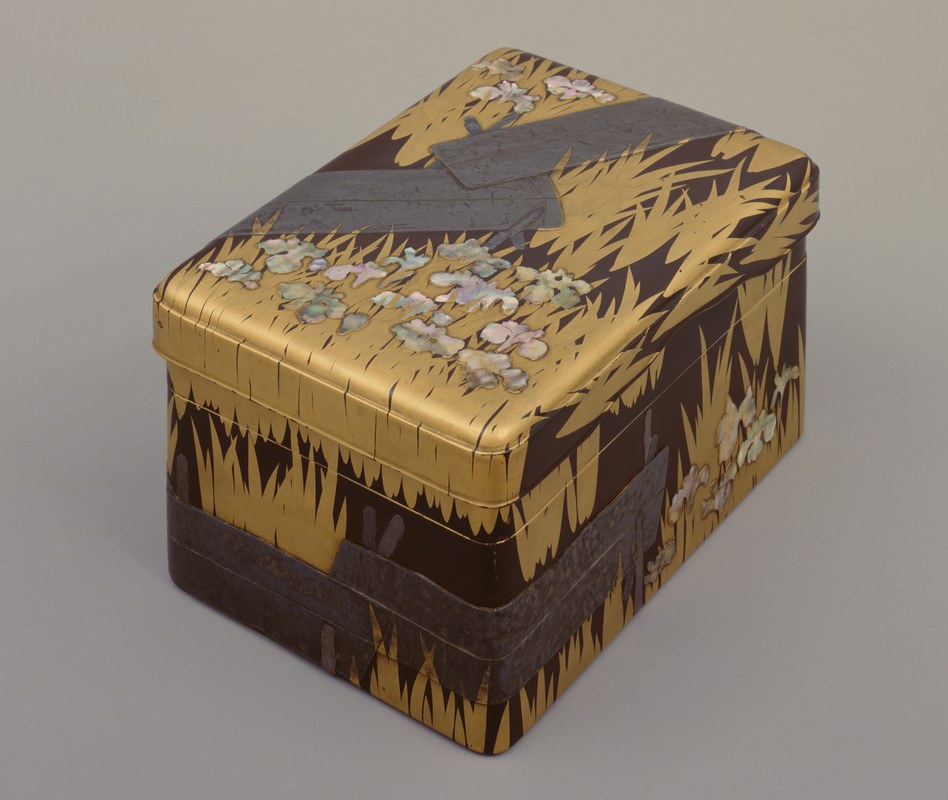
The age of Hideyoshi brought a bolder look, and it carried into the early seventeenth century. At Kōdai-ji in Kyoto, founded in 1606 by Toyotomi Hideyoshi’s widow Nene in his memory, the mausoleum is decorated in what is now called Kōdai-ji maki-e: broad areas of flat gold autumn grasses on black, quick and confident. In the early Edo period the artist Hon’ami Kōetsu designed the Boat Bridge Writing Box, its lid swelling into a high dome crossed by a dark band of lead representing a bridge, with lines of poetry in letters cut from sheet silver. It is a National Treasure at the Tokyo National Museum, and it looks startlingly modern. Ogata Kōrin’s Yatsuhashi Writing Box, with its irises and plank bridge in gold, lead and shell, is another. This line of design later became known as the Rinpa school.
Under the Tokugawa shoguns, maki-e became a marker of rank. A daimyo’s daughter went to her marriage with a full set of matching lacquered furnishings. The most famous, the Hatsune trousseau made for Chiyohime, daughter of the third shogun Iemitsu, is at the Tokugawa Art Museum in Nagoya. On a smaller scale, the inrō, the little stacked medicine cases samurai and merchants hung from the sash, became miniature showpieces of maki-e. In the nineteenth century Shibata Zeshin used lacquer almost as a painter’s medium, and his work won admirers at the international exhibitions of the Meiji era.
05Raden: The Light of Shell
Raden is the art of setting mother-of-pearl, the iridescent inner layer of seashells, into lacquer. Japanese craftsmen have favored two shells. Yakōgai, the great green turban snail of the warm seas around Okinawa and Amami, gives a cool silvery green. Abalone, awabi, is brighter, flashing pink, blue and violet.
The shell can be thick or thin. Thick shell is cut with saws and files and set into channels carved into the lacquer, then coated and ground flush. Thin shell, shaved until light passes through it, can be cut with a knife or punched into tiny shapes, laid onto the surface, covered with lacquer, and polished until it shows again. Either way, the effect depends on movement. Tilt the piece and a petal that looked white turns green, then pink. No pigment can do that.
- 1
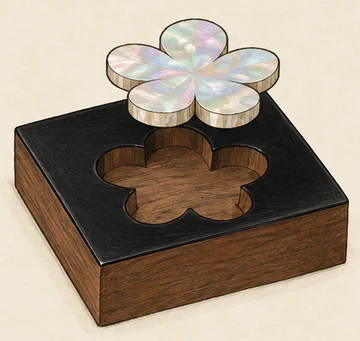 Thick shell is cut to shape to match a channel carved in the lacquer.
- 2
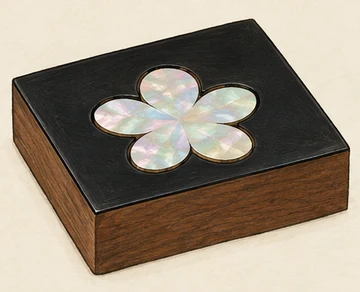 It is set into the channel, then coated and ground flush.
- 3
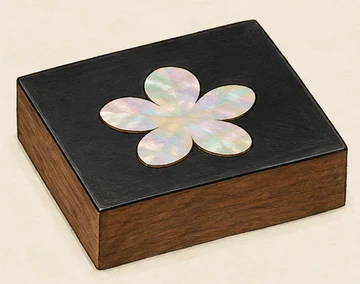 Thin shell is laid directly onto the surface.
- 4
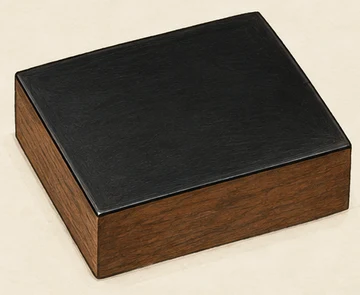 Lacquer is applied over it, covering the shell.
- 5
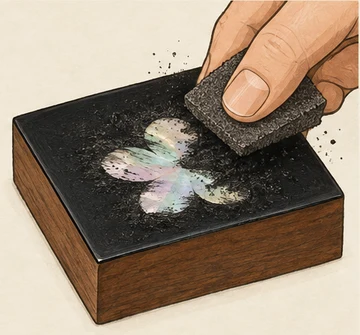 Polishing brings the shell back into view.
- 6
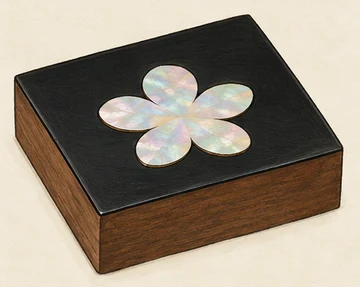 The shell sits flush and changes color as the piece is tilted.
The most famous piece of raden in Japan is a musical instrument: the five-stringed biwa lute of red sandalwood in the Shōsōin, the only ancient five-stringed biwa to survive anywhere, its body inlaid with flowers, birds and a camel-riding musician in turban shell and tortoiseshell. It is generally thought to have been made in Tang China and brought to Japan in the eighth century. In the Heian and Kamakura periods raden and maki-e were often used together, and Kamakura-period saddles and cosmetic boxes inlaid with shell are among the treasures of the age. The Ryūkyū Kingdom, in what is now Okinawa, had its own strong tradition of raden using local turban shell, much of it sent as tribute to China and Japan.
06Regional Styles
Nearly every region of Japan has its own lacquerware, and more than twenty are designated traditional crafts by the national government. They look remarkably different from one another.
Wajima ware is the byword for durability. Also in Ishikawa, Yamanaka ware is known for its woodturning: bowls turned so thin they glow when held to the light, sometimes ringed with fine decorative grooves. Echizen ware from Fukui has a long history and is now the main supplier of lacquered tableware to restaurants and inns. Aizu ware from Fukushima grew under the patronage of the local lords in the Edo period and is known for red lacquer with gold floral designs.
Tsugaru ware from Hirosaki in Aomori is nicknamed baka-nuri, "fool’s lacquering," because of the absurd number of steps: layer upon layer of different colors is applied over a textured ground and then ground back to reveal mottled patterns that resemble marble or feathers. Kamakura-bori, from Kamakura near Tokyo, reverses the usual order, carving the design into the wood first and then lacquering it, in imitation of the carved lacquer imported from Song and Yuan China. Negoro ware, named for Negoro-ji temple in Wakayama, was originally the monks’ everyday tableware: red lacquer over black. Over years of use the red wears through on the rims and handles and the black shows beneath, and this accidental patina so appealed to tea masters that later craftsmen began imitating it on purpose. Kyoto lacquer is prized for refined maki-e.
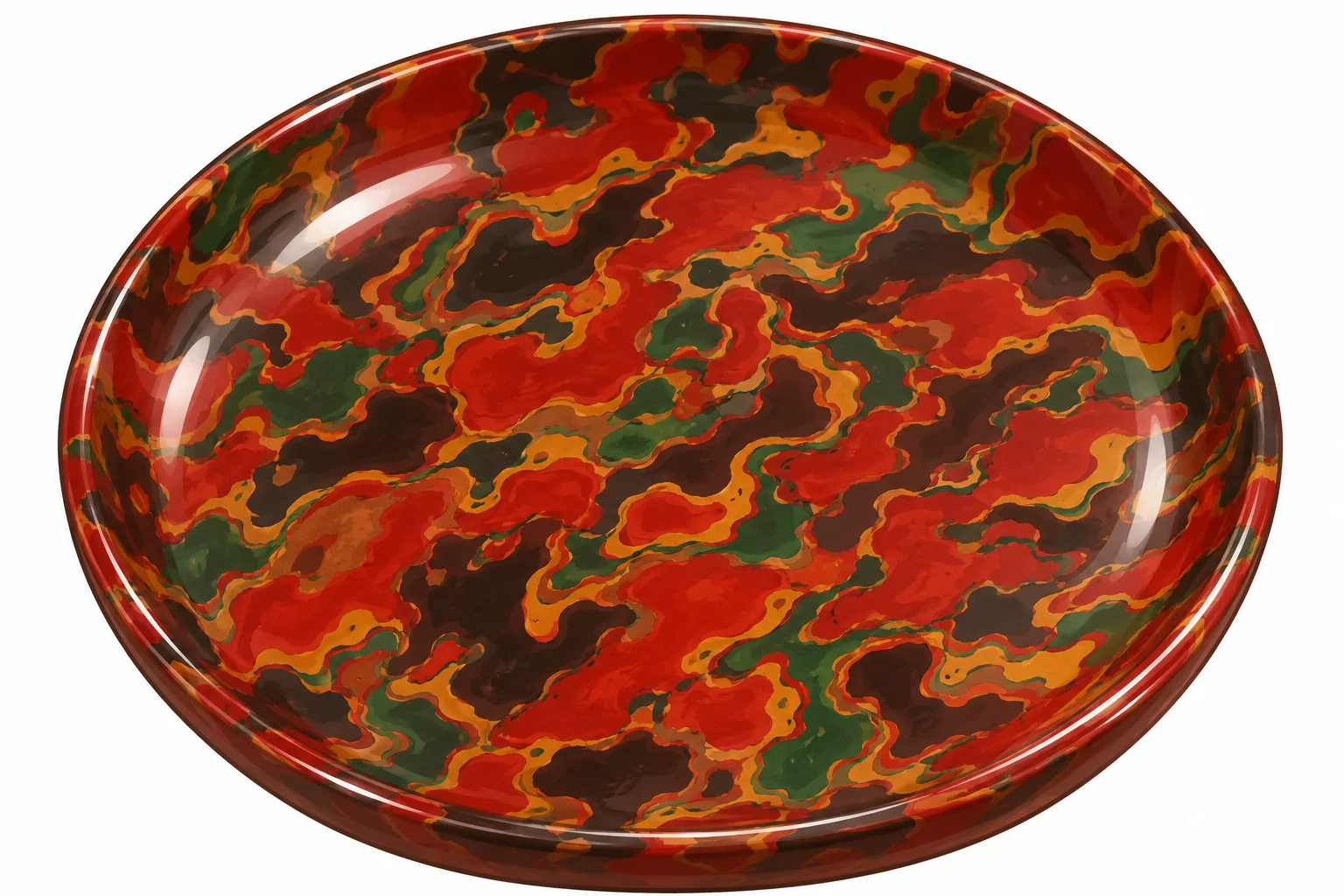
Close-up of Tsugaru lacquer: mottled patterns ground out of many layers of coloured lacquer (illustration).
Lacquer also lies behind kintsugi, the repair of broken ceramics. The pieces are glued and gaps filled with urushi, and the seams are dusted with gold, using exactly the same principle as maki-e.
07Seeing, Buying and Using Lacquer in Japan
For the finest maki-e and raden, the Tokyo National Museum usually has lacquer on display in its permanent galleries, and the Kyoto National Museum and the Tokugawa Art Museum in Nagoya show important pieces regularly. Each autumn the Nara National Museum holds its Shōsōin Exhibition, displaying a rotating selection of the storehouse’s treasures; lines can be long, and the lacquer is worth the wait. In Hiraizumi you can see the Konjikidō through glass, and at Kōdai-ji in Kyoto the maki-e of the mausoleum is visible inside.
To see lacquer being made, Wajima is the obvious destination, with the Ishikawa Wajima Urushi Art Museum and many workshops. The Noto Peninsula earthquake on January 1, 2024, hit the town hard; fire destroyed the area around the famous morning market, and as of 2026 many workshops were still rebuilding; press reports put the district’s production capacity at only 60 to 70 percent of its pre-quake level. Aizu-Wakamatsu and Yamanaka Onsen also have workshops that welcome visitors, and many offer short maki-e sessions: in an hour or two you draw a design on a lacquered plate or pair of chopsticks, sprinkle the gold yourself, and take the piece home once it has cured.
When buying, know what you are looking at. The glossy "lacquer" bowls in supermarkets and hundred-yen shops are almost always plastic or composite cores with a polyurethane finish. They are practical, but they are not urushi. Genuine pieces are labeled tennen urushi (natural lacquer) or hon-urushi, and the label will name the wood. Real lacquer has a softer, deeper shine and feels lighter in the hand. Prices reflect the work: as of the mid-2020s, a proper Wajima soup bowl starts around ten to twenty thousand yen, while good lacquered chopsticks can be had for a few thousand.
Living with lacquer is easier than people expect. Wash it in warm water with a soft cloth and a little mild detergent, and dry it straight away. Keep it out of the dishwasher and microwave, don’t leave it soaking, and keep it out of strong sunlight, since ultraviolet light is the one thing urushi cannot withstand; it fades and turns brittle. The best care is daily use. Japanese families often keep a good soup bowl for twenty or thirty years, and when the surface finally wears thin, it can be sent back to the workshop to be relacquered.