
At a glance
Kimono had no pockets, so Edo people hung medicine cases from their sashes: how netsuke and inrō worked, why they were carved so finely, and how they went abroad.
- A netsuke is a small carved toggle at the end of a cord that catches on the top edge of the sash, often only about an inch and a half long.
- A sagemono set has three parts: the hanging container, a sliding ojime bead, and the netsuke at the top.
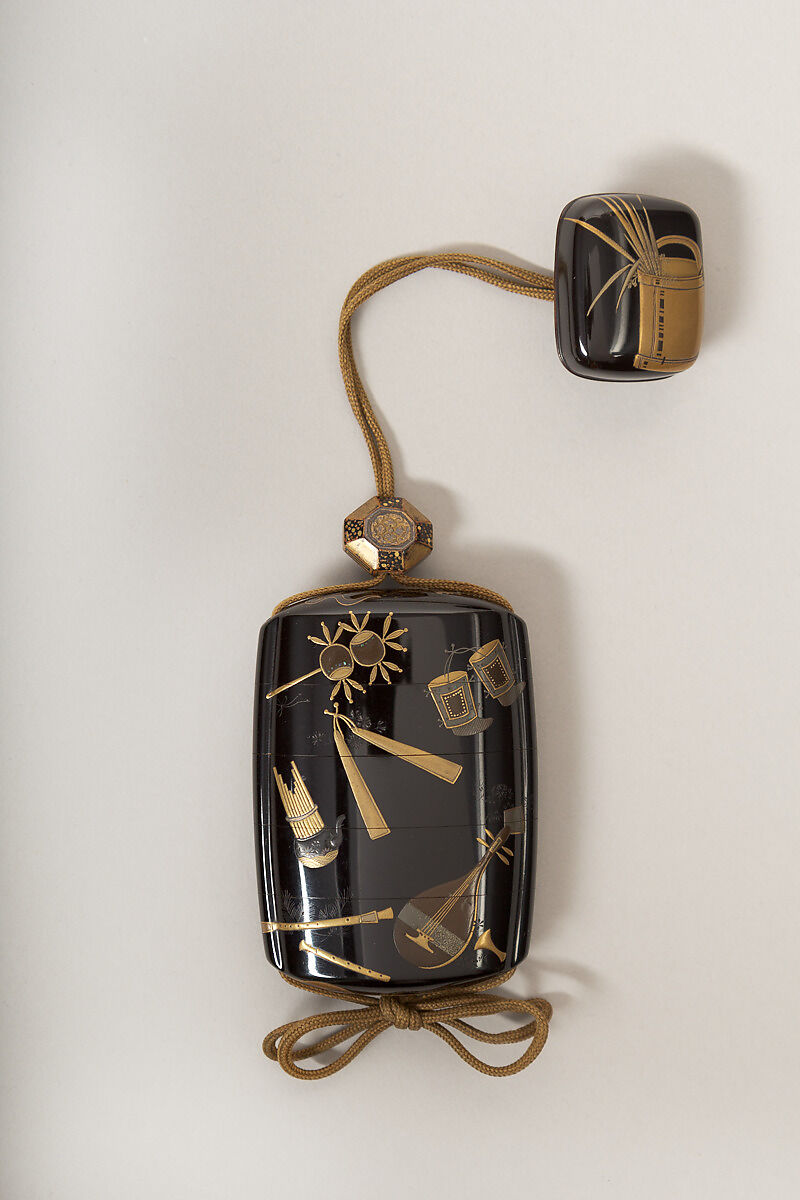
- An inrō is a lacquer case of three to five stacked compartments, usually decorated in maki-e and often used for medicine in the Edo period.
- In 1781 the Sōken kishō listed more than fifty netsuke carvers, giving the craft its first roster of masters.
- After men switched to Western dress in the Meiji era, netsuke flowed abroad; the largest collections are now outside Japan.
A kimono has no pockets. For more than two centuries, Japanese men solved the problem by hanging small boxes and pouches from their sash on a silk cord, anchored by a carved toggle called a netsuke. These toggles are often only an inch and a half long, yet a single one might hold a sleeping rat with its tail curled under its feet, a grinning Daoist immortal, or a chestnut splitting open to show a grub inside. The most prized of the hanging containers was the inrō, a stack of tiny lacquered compartments decorated in gold. This is the story of how the set worked, why ordinary accessories became objects of obsessive craftsmanship, how they ended up in museum cases from London to Los Angeles, and how to look at them when you meet one.
01How the Set Hung from the Sash
Traditional Japanese dress, from the kosode robe of the medieval period to the kimono of today, has sleeves that can hold a handkerchief but no sewn-in pockets. Anything a man needed to carry during the day, such as money, tobacco, a flint, or medicine, went into a container that hung from the sash (obi). The Japanese call these hanging things sagemono, literally "hanging objects."
A complete sagemono had three parts joined by one cord. At the bottom hung the container itself: an inrō, a tobacco pouch, a purse, or a yatate, a portable brush-and-ink case. Above it, threaded on the cord, sat a sliding bead called an ojime, which could be pushed down to cinch the container shut. The cord then passed up behind the sash and over its top edge, where it ended in the netsuke. Because the netsuke was too bulky to slip through the gap between sash and body, it caught on the upper edge and held the whole assembly at the wearer’s hip.
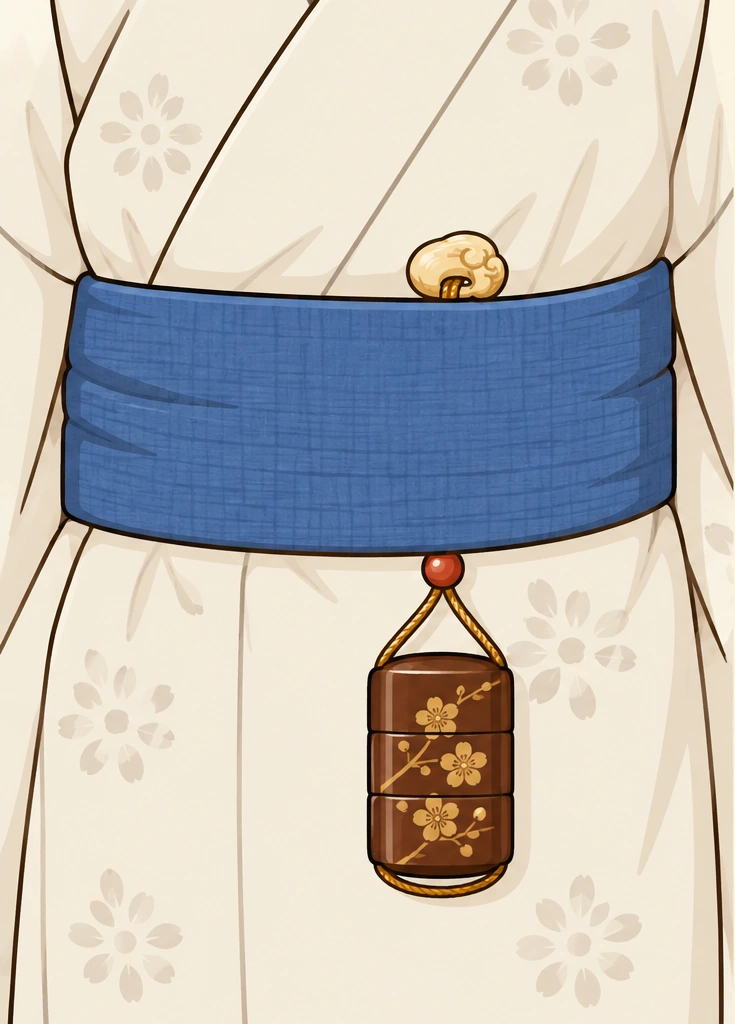
The netsuke catches on the top of the sash; the cord runs down behind it to the ojime and inrō.
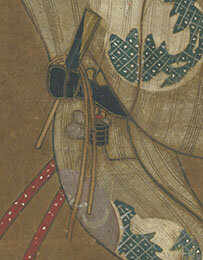
Detail of a 17th-century folding screen: hanging objects at a man’s waist.National Museum of Japanese History, Screen of Circle Dancing and Merrymaking, left screen, detail (17th century)
That function set the rules of the form. A netsuke needed holes for the cord, known as himotōshi. It could have no sharp points or thin projecting parts, which would snag on silk, jab the hand, or snap off. It had to be tough, because it was handled constantly and rubbed against the sash every day. And it had to be the right size: big enough to hold, small enough not to look clumsy. These constraints produced the compact, rounded shapes that make netsuke so satisfying to hold in a closed hand.
02The Inrō: A Stack of Lacquer Boxes
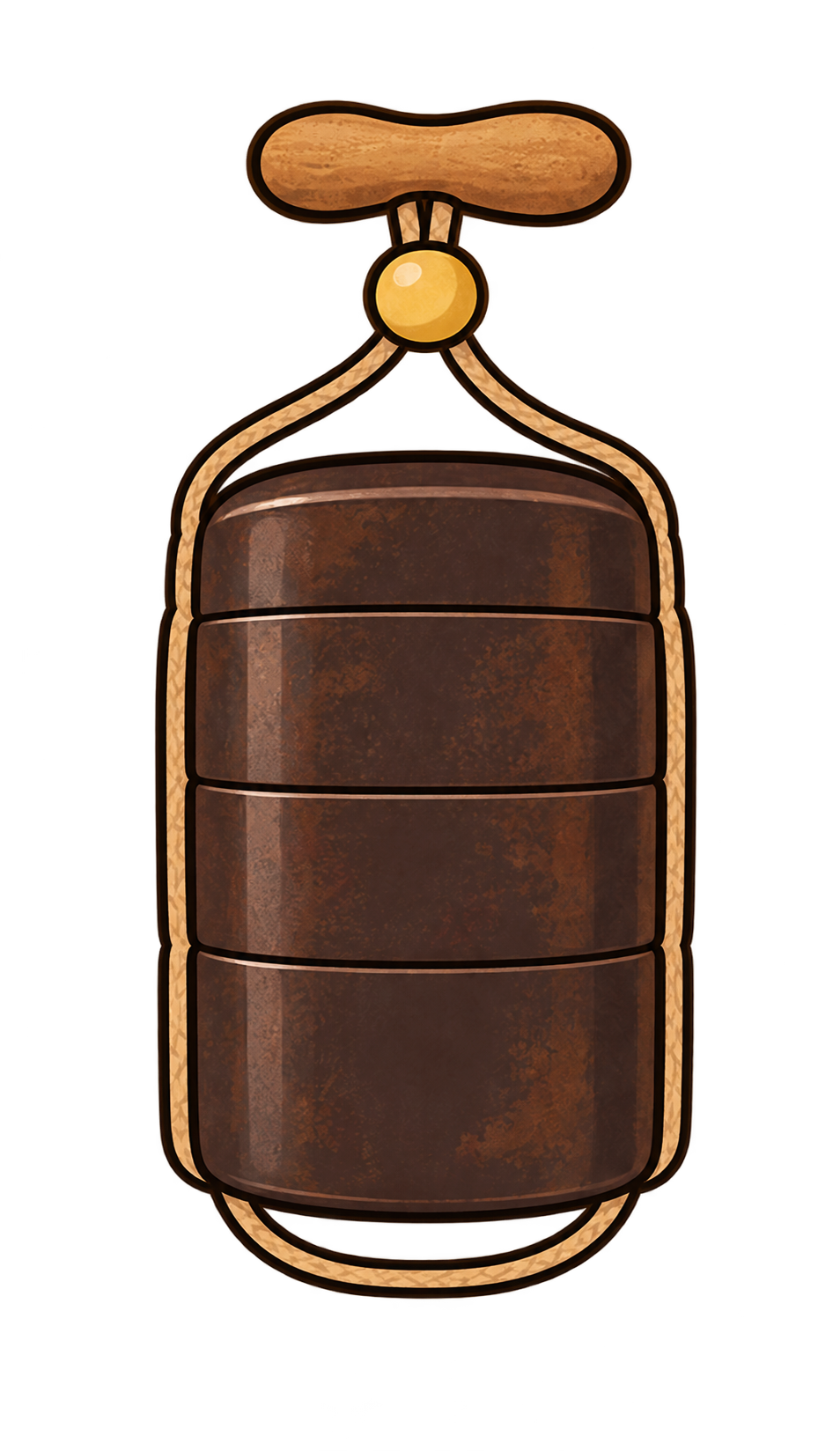
The inrō was the aristocrat of the sagemono. It is a flat, roughly oval or rectangular case, usually made of three to five compartments (dan) that fit snugly on top of one another, plus a lid. Each compartment is a separate little box. A cord runs through channels down both sides of the stack, under the base, and back up, so that the whole thing holds together when the ojime is slid down. To open it, you slide the bead up, loosen the cord, and pull the compartments apart one by one.
- 1
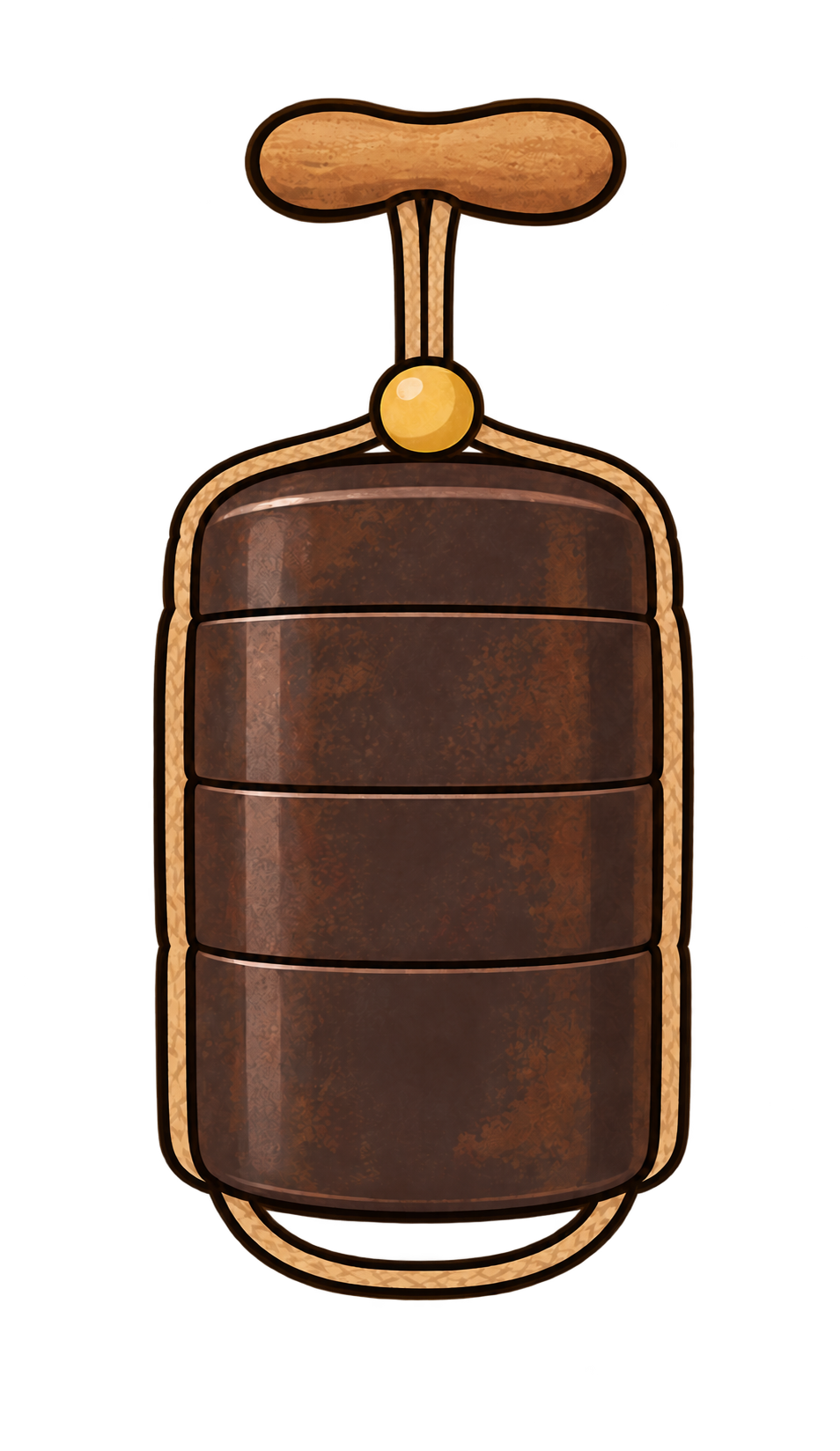 With the ojime pushed down, the cord is tight and the tiers stay closed.
- 2
 Slide the ojime up to loosen the cord.
- 3
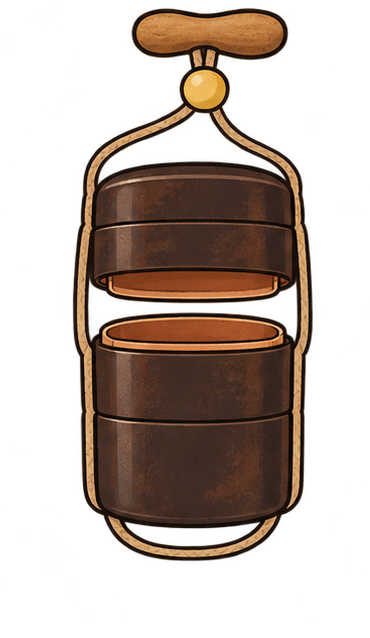 The tiers stay on the cord and can be pulled apart one by one.
The name means something like "seal basket," and the usual explanation is that the case first held a personal seal and red seal paste. The stacked form has Chinese antecedents and reached Japan from Ming China in the Muromachi period, and from about that time the Japanese began to use it for medicine, each tier holding a different pill or powder. In an age before pharmacies on every corner, a traveler or an official on a long day could take out a remedy without going home. During the Edo period (1603–1868) the inrō became a fashion, worn more and more as an ornament, sometimes with nothing inside at all.
What made the inrō precious, though, was its surface. Most were lacquerware decorated in maki-e, a technique in which gold and silver powders are sprinkled onto wet lacquer to build up pictures, often enriched with inlaid mother-of-pearl, gold foil, or thin metal sheets. On a surface the size of a playing card, a lacquerer might paint a full landscape that continues around the back, or a hawk on a snow-laden pine. The shogunate and the domain lords kept hereditary lacquer workshops; the Kajikawa and Kōma families served the Tokugawa house for generations and are known above all for their inrō.
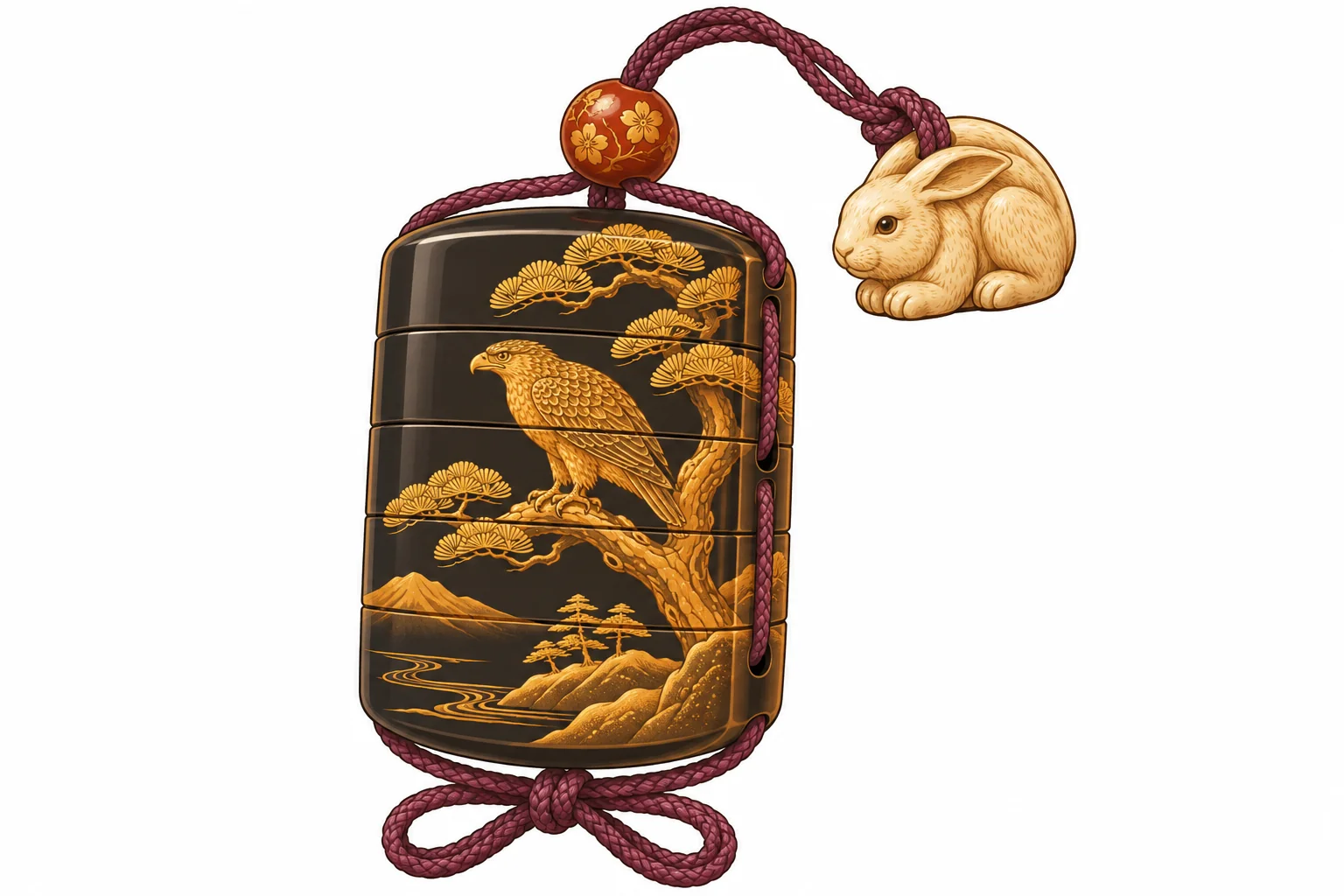
An Edo maki-e inrō showing its stacked sections and cord channels, with ojime bead and netsuke above (illustration).
For a samurai in formal dress, the inrō was one of the few places besides his swords where he could show wealth and taste. As merchants in Edo, Ōsaka, and Kyoto grew rich, they joined in, and a fashionable man would match inrō, ojime, and netsuke in theme and material, so that the three pieces at his hip formed a small, coordinated collection. In the nineteenth century the lacquer artist Shibata Zeshin (1807–1891) brought a painter’s wit to the inrō, and his pieces remain among the most sought-after today.
03Shapes and Materials
Collectors sort netsuke into a handful of types. The best known is katabori, sculpture in the round: an animal, a figure, or a small scene meant to be turned in the hand and seen from every side. Manjū netsuke are flat, round discs named after the bun-shaped sweet, carved in relief on one or both faces. A hollow, openwork variety of the manjū is called ryūsa, said to have been devised by an Edo woodturner named Ryūsa. Kagamibuta, or "mirror-lid" netsuke, consist of a shallow bowl, usually of ivory or wood, fitted with a metal disc on top; the metalwork was often done by craftsmen who also made sword fittings. Sashi netsuke are long and stick-like and were thrust down behind the sash. There are also miniature masks of Noh and kyōgen characters, called men netsuke.
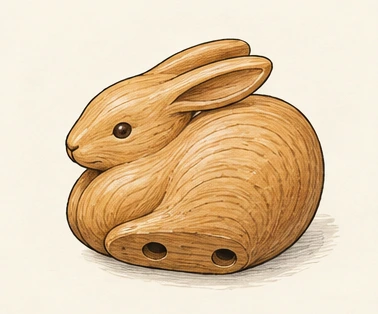
Katabori: carving in the round, a compact rabbit with cord holes underneath.
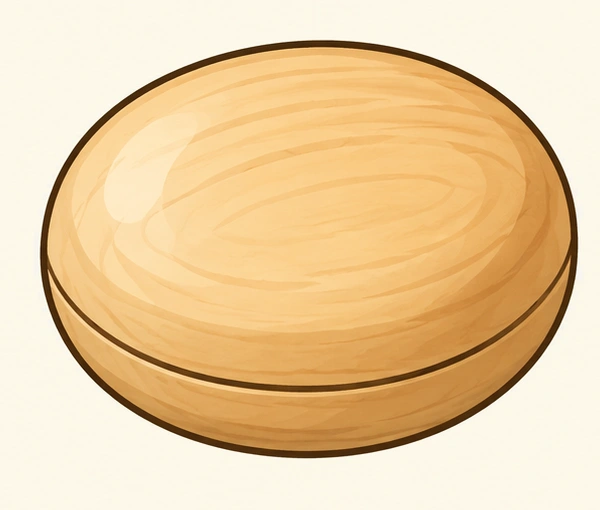
Manjū netsuke: a flat round disc named after the bun-shaped sweet.
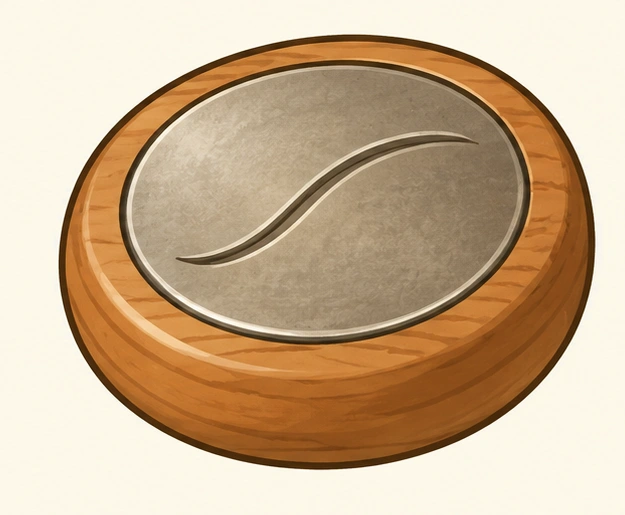
Kagamibuta: a bowl-shaped base fitted with a metal disc lid.
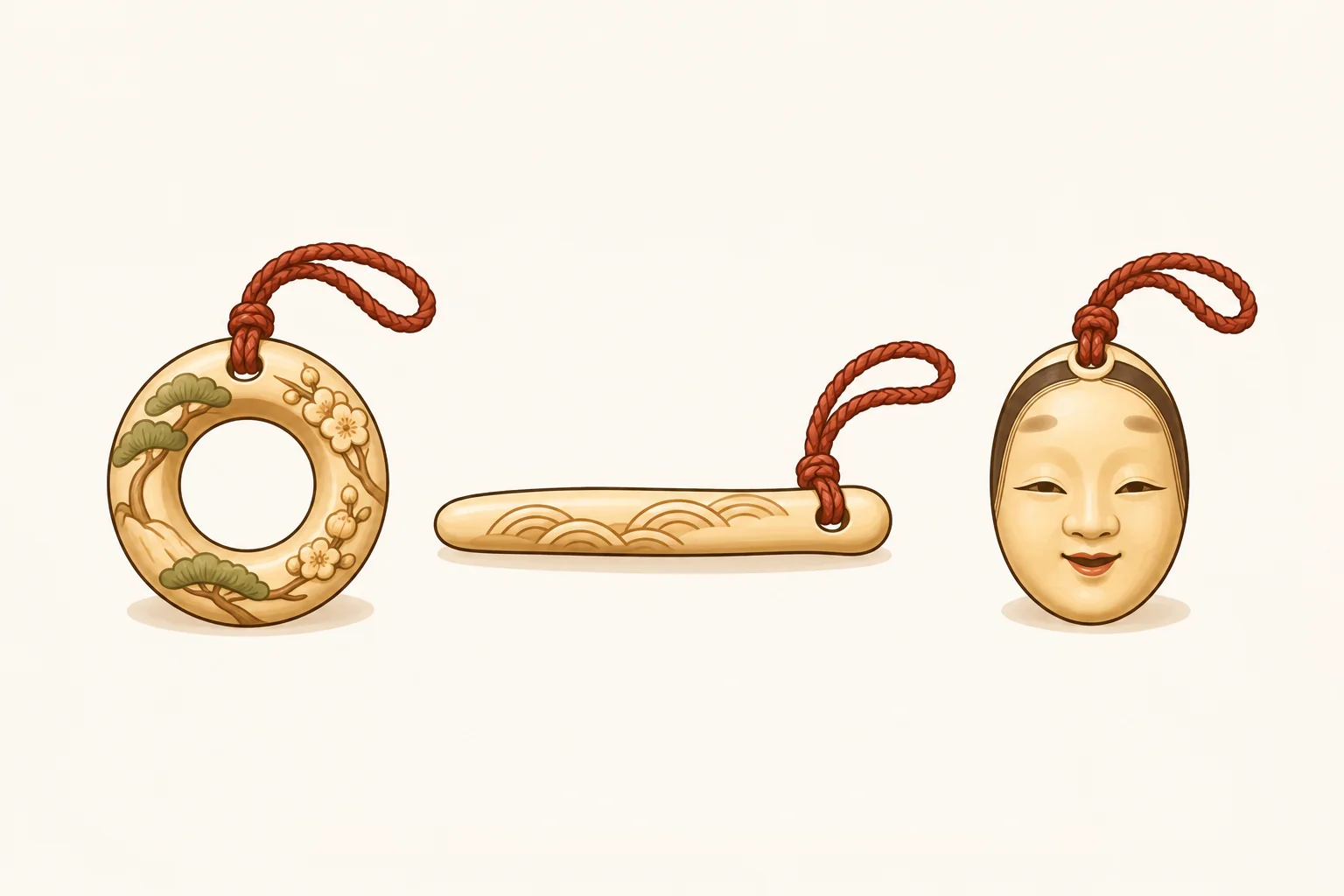
Three netsuke types: the hollow ryūsa, the long stick-like sashi netsuke and the men netsuke mask.
Early netsuke were mostly wood, and Japanese boxwood (tsuge) remained a favorite because its tight grain takes fine detail such as individual hairs and develops a warm sheen with handling. Elephant ivory had to be imported from abroad, by one account mostly through the China trade, and, by the later eighteenth century, was the dominant material for luxury pieces: pale, smooth, and ideal for crisp carving. Carvers also used ebony, stag antler, boar tusk, whale and walrus tooth, coral, amber, porcelain, lacquer, metal, and even fruit stones. Each material has its own character. Boxwood feels warm and homely; ivory is cool and precise; antler is porous and streaked, and carvers often let that texture stand for weathered wood or rocks on a beach.
The essential skill was compactness. A good netsuke tucks the legs, tail, and ears of an animal inside the outline of its body. A rat curls into a ball with its tail wrapped around and pinned under a paw; a cat turns to lick its back so that head and spine form one continuous curve. That made the piece durable and pleasant to hold. Many carvers finished the underside as carefully as the top, so that turning a netsuke over reveals paw pads, a signature, and cord holes hidden cleverly in a gap between a leg and the body.
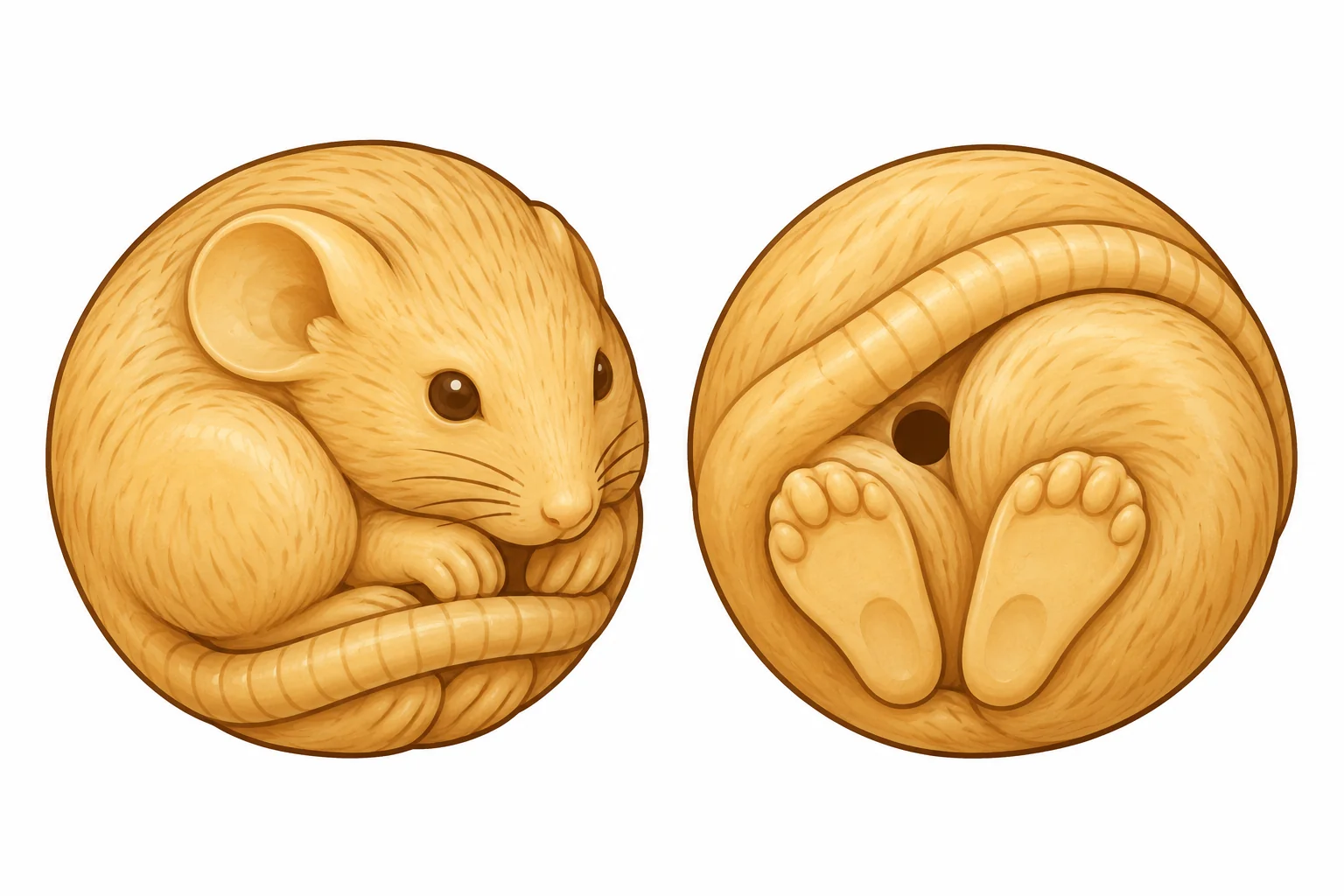
A curled-up rat netsuke shown from the front and from below, with carved paws underneath (illustration).
04Carvers and Subjects
Netsuke became widespread in the late seventeenth century, and by the eighteenth there were specialist carvers. In 1781 an Ōsaka sword-fittings dealer named Inaba Tsūryū published Sōken kishō, a book on sword ornaments that included a section listing more than fifty netsuke carvers by name. It is the earliest roster of the craft, and it gave collectors a canon to chase.
Kyoto and Ōsaka were the early centers. Yoshimura Shūzan of Ōsaka, who died in 1776, is remembered for painted figures of immortals and demons carved from old cypress wood. Tomotada of Kyoto became famous for recumbent oxen with every rib and tendon shown, and so many fakes bear his name that "Tomotada" on a netsuke is almost a warning sign. His contemporaries Okatomo and Masanao specialized in animals. Later, in nineteenth-century Ōsaka, Kaigyokusai Masatsugu carved with a near-microscopic precision. In Ise, a school of carvers working under the name Masanao made realistic boxwood frogs and small creatures. Toyomasa of Tanba Sasayama was known for dragons and animals, and in the mountain town of Takayama, Matsuda Sukenaga developed ittōbori, a faceted style carved from local yew wood that exploits its red heartwood and pale sapwood.
The subjects cover nearly everything. The twelve animals of the zodiac were the bestsellers, since many people liked to wear their birth sign. Beyond animals, insects, fish, shells, fruit, and vegetables, there were countless figures from Chinese and Japanese legend: the eccentric monks Kanzan and Jittoku, the toad immortal Gama Sennin, the demon-queller Shōki chasing a terrified little oni, the Seven Gods of Good Fortune. Street life appears too: blind masseurs, peddlers, sumo wrestlers, a man in mid-yawn. Humor runs through the whole tradition. A kappa water sprite gets its hand caught in a clam; an octopus wraps itself around a pearl diver; a snake slides through the eye socket of a skull. A man might unhook his netsuke and pass it across the table at a drinking party, and the joke or the pun in the carving was part of the conversation.
05After the Kimono: The Journey West
The Meiji Restoration of 1868 ended the world netsuke were made for. Men in government and business adopted Western suits, which have pockets, and the 1876 edict banning the public wearing of swords sent the related metal crafts into decline as well. Inrō and netsuke poured out of Japanese households at exactly the moment Europe and America were falling for all things Japanese. Dealers and travelers shipped them by the crate to London, Paris, and New York, where collectors prized them as sculpture you could hold in your palm. Some carvers began working purely for export, producing larger and more elaborate pieces that were never meant to be worn.
As a result, many of the largest netsuke collections are outside Japan. The British Museum, the Victoria and Albert Museum, and the Los Angeles County Museum of Art all hold substantial collections, by some descriptions running into the thousands of pieces, and the Walters Art Museum in Baltimore is also said to hold netsuke. In 2010 the British potter Edmund de Waal published The Hare with Amber Eyes, which follows 264 netsuke bought in Paris in the 1870s by his relative Charles Ephrussi. The collection moved to the family palace in Vienna, was hidden from the Nazis by a maid who slipped pieces into her mattress, and eventually went to Tokyo with de Waal’s great-uncle before passing to the author. The book became a bestseller and introduced netsuke to readers who had never heard the word.
In Japan, interest revived after the Second World War. Prince Takamado and Princess Hisako built a well-known collection of about 500 contemporary netsuke. The prince died in 2002, and the collection has since passed to the Tokyo National Museum by donation and deposit; as of 2026, pieces from it still rotate through a dedicated Takamado Collection Room. Living carvers work in boxwood, antler, mammoth ivory, and new materials, with subjects ranging from traditional zodiac animals to modern whimsy. And the word itself survives in daily life: the small charms Japanese people hang from phones, keys, and bags are still called netsuke.
06Where and How to Look
In Tokyo, the Tokyo National Museum’s main building regularly shows older netsuke and inrō in Room 10, devoted to ukiyo-e and costume, while the Takamado Collection Room next door shows contemporary pieces, so the two can be compared side by side; displays rotate through the year. In Kyoto, the Kyoto Seishu Netsuke Art Museum, just east of Mibu-dera Temple, is one of the few museums in Japan devoted entirely to netsuke. It focuses on contemporary work and occupies the former Kanzaki family residence, a city-designated cultural property: the house of a gōshi, a rural gentry family, that combines features of a samurai residence and a Kyoto townhouse, said to date from the Edo period, and is worth seeing in its own right. Regional museums and the collections of former daimyo families often show inrō alongside armor and formal clothing.
Netsuke reward close looking, and a small magnifying glass is not an eccentric thing to bring. Start with the silhouette: is it compact and complete? Then walk around the case to see each side. Look at the carving of fur, scales, and fabric folds, and at the eyes, which are often inlaid with horn, ebony, or tortoiseshell. Find the underside if the display allows, where the cord holes and signature usually sit. The honey-colored patina on old ivory and boxwood comes from generations of handling, and collectors value it highly. With inrō, notice how many shades of gold the lacquerer used, whether the design runs unbroken across the seams between compartments, and whether the picture continues around the back.
Antique shops and flea markets sell netsuke too, including Kyoto’s Kōbō-san market at Tō-ji Temple on the 21st of each month (still held as of 2026). New carvings and reproductions mix freely with old pieces, and anything made of elephant ivory is subject to endangered-species trade rules that make it difficult or illegal to bring home to many countries, so ask about the material before you buy. For most visitors, though, the best experience is free: bending down in front of a museum case to see how a rat no bigger than a thumb has its tail wrapped neatly around its body, exactly so it would not catch on a silk sash.