
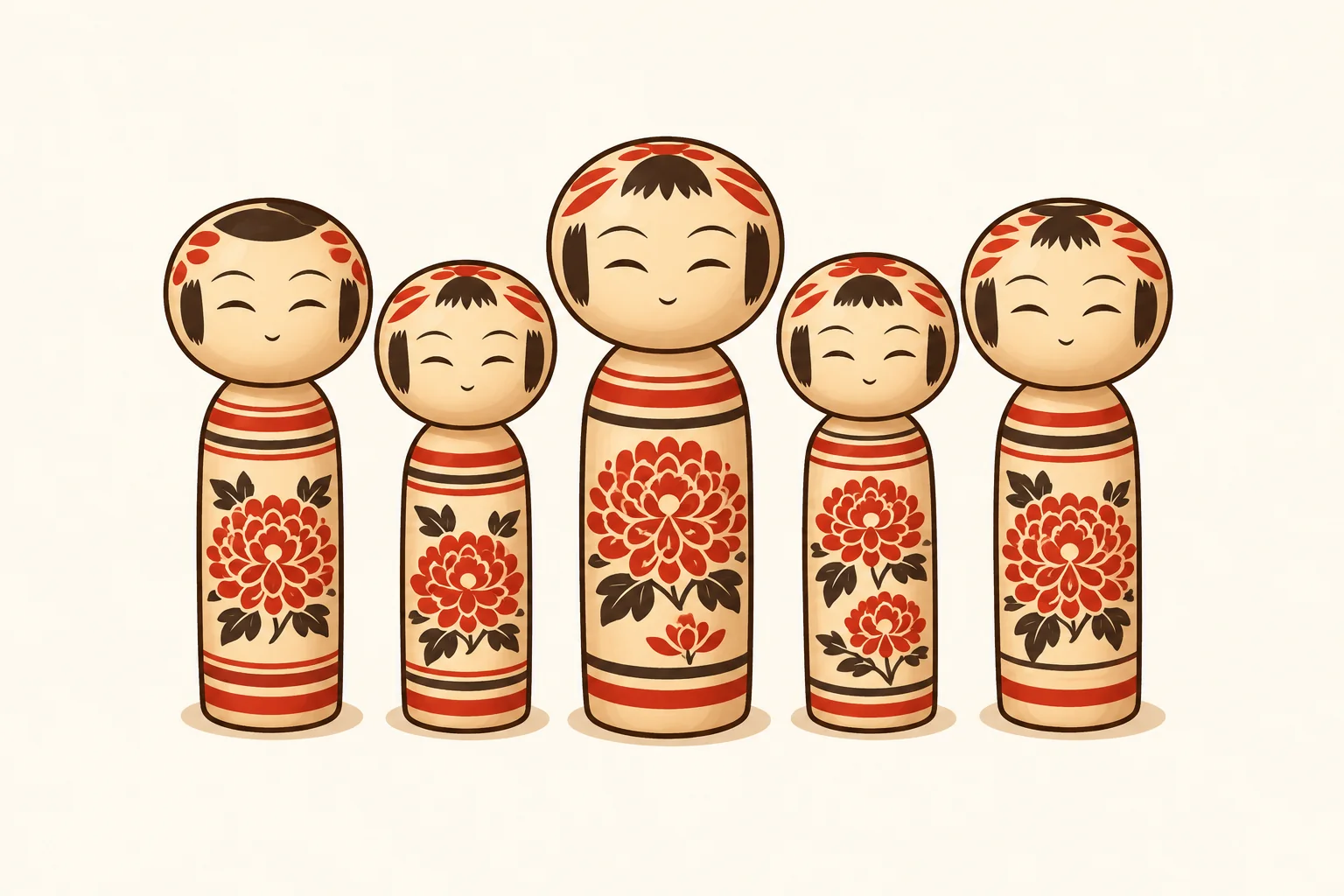
At a glance
Lathe-turned wooden dolls from Tōhoku’s hot-spring towns: how they went from toys to collectibles, how to tell the regional lineages apart, and where to watch makers at work.
- A kokeshi is a limbless wooden doll: a cylindrical body and a round head, painted with ink and red and green pigments.
- It comes from the mountain hot springs of Tōhoku, where woodturners sold it to farmers taking cures to bring home to their children.
- Kokeshi are generally thought to have appeared in the late Edo period, in the early 19th century; no record fixes a precise start.
- Traditional kokeshi are grouped by place into lineages, usually counted as eleven, such as Naruko, Tōgatta and Yajirō.
- The maker’s name is usually written on the base of a traditional kokeshi, telling you its lineage and line of teachers.
A kokeshi is about as simple as a doll can be: a wooden cylinder for a body, a ball for a head, no arms or legs, and a face made of a few strokes of ink. Yet a shelf of them in a shop in northern Japan can hold you for an hour, because no two faces are quite alike and the patterns on their bodies tell anyone who knows how to read them exactly which mountain hot-spring town they came from. They began as cheap toys for farm children and became one of Japan’s most collected folk crafts. This piece explains where they came from, how they are made, how the regional styles differ, and where to go to meet the people who still turn them.
01What a Kokeshi Is
Traditional kokeshi come from Tōhoku, the six prefectures of northern Honshū. They are made by woodturners called kijishi, craftsmen whose original trade was turning bowls, trays and other wooden vessels on a lathe. The doll is a by-product of that trade: the same lathe, the same chisels, the same offcuts of wood, turned into a small figure.
The shape follows from the tool. A lathe makes things that are round in cross-section, so the body is a column and the head is a sphere. Decoration is applied in two ways. While the piece is still spinning, the craftsman touches a brush to it and draws rings of color around the body and head; these are called rokuro-sen, lathe lines. Then the lathe stops, and the face, hair and floral patterns are painted by hand. The palette is traditionally limited to black ink, red, and sometimes green, yellow or purple dyes.
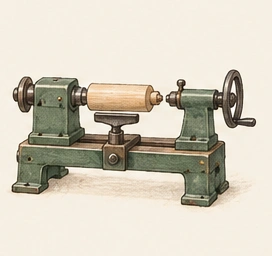
The wood spins on the lathe while the turner holds a long-handled tool against it.
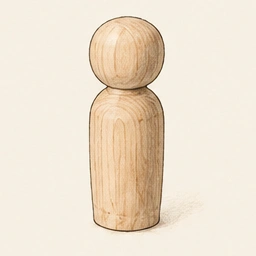
A turned blank before painting: cylindrical body, round head.
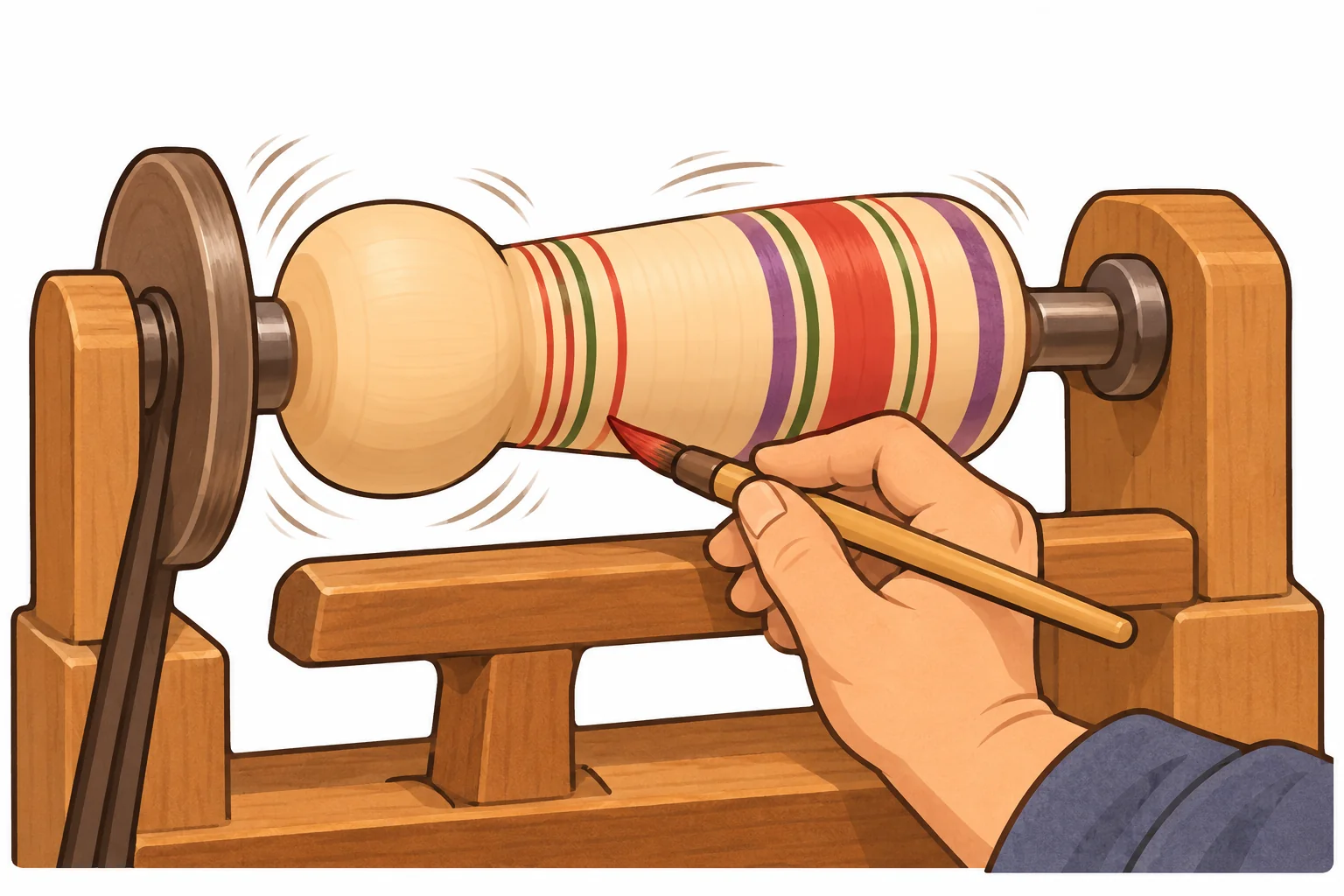
A craftsman touches a brush to a kokeshi spinning on the lathe, painting rings of colour (illustration).
The face is everything. Two eyebrows, two eyes, a nose that may be a single dot, a small red mouth. A slight change in the angle of an eye turns a calm doll into a shy one or a stubborn one. Collectors say you should choose a kokeshi by its face, and since a craftsman paints dozens in a day by hand, every face is a little different.
02From Bowl Makers to Doll Makers
The kijishi were once a mobile people. In the mountains of medieval and early modern Japan, woodturning communities moved from forest to forest following the supply of suitable timber, and they claimed a right to cut timber in the hills, backed by a legend tracing their craft to Prince Koretaka and by imperial edicts now regarded as forgeries. Over the Edo period (1603–1868), many of them settled near the hot springs of Tōhoku, where there was a steady stream of customers.
Those customers were farmers on tōji, the custom of the healing soak. In the slack seasons, after harvest or before spring planting, farming families from the surrounding countryside would travel to a mountain spa and stay for a week or more, lodging cheaply and cooking their own rice, bathing several times a day to recover from a year of heavy labor. When they went home, they bought small presents for the children: spinning tops, wooden toys, and dolls.
Kokeshi are generally thought to have appeared in this setting in the late Edo period, around the early nineteenth century, though no document pins down a precise beginning. They were toys for little girls, who carried them on their backs in imitation of their mothers carrying babies, put them to bed, and played house with them. That explains much of their design: a body slim enough for a small hand, a smooth surface with no sharp edges, and nothing to break off.
The word "kokeshi" itself was not universal. Different districts had their own names, such as kiboko, kideko, deku and kogesu (and, by one account, kokesu), all roughly meaning "little wooden figure." In 1940 collectors agreed to standardize on kokeshi, written in hiragana (one account places the decision at a collectors’ gathering in Tokyo, another in Naruko in 1939), and that is the name that stuck.
One story needs to be cleared away. A popular explanation claims the word comes from ko-keshi, "child erasing," and that the dolls were memorials for infants killed in times of famine. This etymology appeared only in the second half of the twentieth century and has no basis in folklore research; scholars and the producing regions reject it. Kokeshi were made for living children to play with.
03Making One
The wood is usually mizuki (Japanese dogwood) or itaya-kaede (a kind of maple). Both are pale and fine-grained, which means ink lines stay crisp and colors stay bright. Trees are typically felled from late autumn into winter, while they are dormant, stripped of bark, and stacked to dry for months or even more than a year. Wood that is not properly seasoned will crack or warp after the doll is finished.
The dried wood is cut into lengths and mounted on the lathe. In the past the lathe was turned by a second person pulling a cord, or by a treadle; today it is electric, but the shaping is still done with hand-held cutting tools pressed against the spinning wood. The craftsman judges thickness and curve by eye and by feel. Head and body are usually turned separately and then joined, either by a peg or by pressing the head into a socket.
The turned piece is polished smooth, traditionally with tokusa, the horsetail plant whose silica-rich stems work like fine sandpaper. Then come the lathe lines, the stopped-lathe painting of the face and patterns, and sometimes a coat of wax. Finally the craftsman writes his or her name on the base. On a traditional kokeshi that signature matters a great deal, because it identifies the lineage the doll belongs to.
04The Eleven Lineages
The most absorbing thing about traditional kokeshi is that they are grouped into keitō, lineages or schools, usually counted as eleven. Some counts merge two and arrive at ten, and since 2018 Nakanosawa, split off from Tsuchiyu, has sometimes been counted as a twelfth. Each is tied to a place and passed down from master to apprentice or parent to child, and each has its own recognizable shape and painting style. Once you learn a few, you start seeing them everywhere.
Naruko (Miyagi Prefecture) is the easiest to spot. The body has broad shoulders and a slightly narrowed waist, painted with layered chrysanthemum petals. The head is fitted into the body so tightly that turning it produces a squeak, which locals liken to the doll crying. Naruko Onsen is often called the largest kokeshi-producing area and has one of the largest concentrations of makers today.
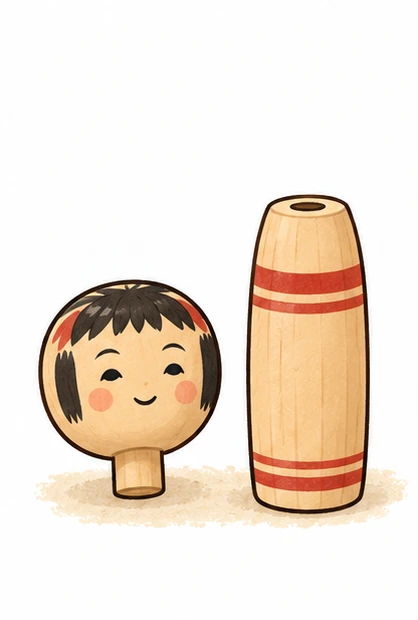
Head and body are made separately: a peg under the head, a hole in the top of the body (diagram).
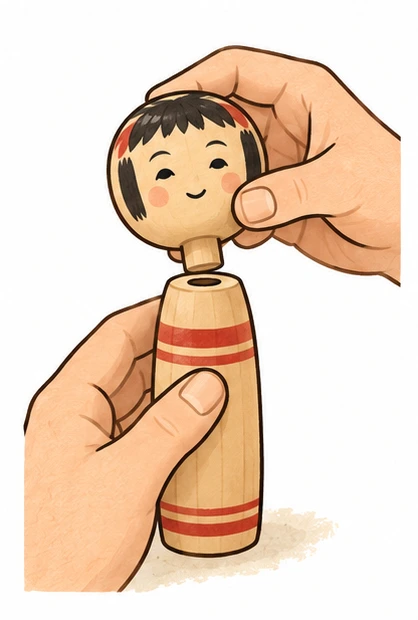
The head is pressed tightly into the body, so turning it makes a squeak.
Tōgatta (also Miyagi) has a large head on a slender body. The crown is painted with a radiating red ornament, like a ring of petals or hair ribbons, and the body mostly with layered chrysanthemums, sometimes plum or cherry blossoms. The faces, with narrow crescent eyes and a faint smile, are seen by many as the archetypal kokeshi face, often called the most representative of all.
Yajirō (near Shiroishi, Miyagi) wears concentric colored rings on top of its head, which make it look as though it has a beret on, and its body is banded with bright lathe lines and painted with a kimono collar and hem. Tsuchiyu (Fukushima) has a small head, a black ring on the crown called a janome, "snake’s eye," a slim body, and long black sidelocks painted at the temples.
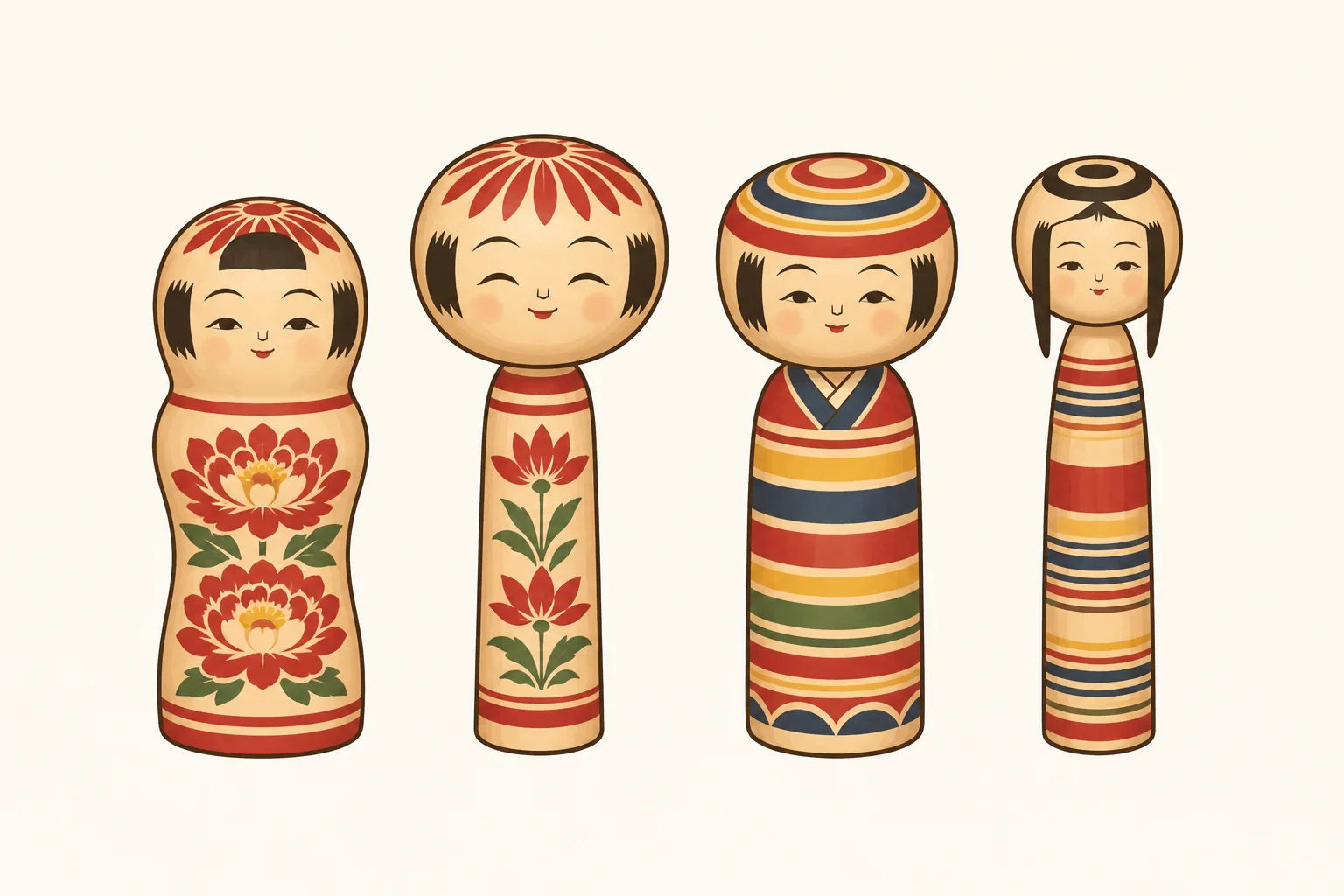
Kokeshi of four lineages: Naruko, Tōgatta, Yajirō and Tsuchiyu.
Farther north, Tsugaru dolls from Aomori are turned from a single piece of wood and painted with Daruma figures or peonies; some carry the bold designs of the region’s Neputa summer festival lanterns. Nanbu dolls from Iwate are often left unpainted, with a loose head that wobbles; they were originally baby toys, something like a rattle. Kijiyama dolls from Akita, also one-piece, wear a striped kimono or a pattern that resembles an apron. Hijiori dolls, influenced by Naruko and Tōgatta, have cheerful crescent eyes, and Sakunami and Yamagata dolls tend to be slim and elegant. The eleventh, Zaō Takayu, comes from the hot springs on the Yamagata side of Mount Zaō.
These differences are not just regional taste. Behind them are specific chains of teachers and students: which master worked at which hot spring, where his apprentices went, which older style each craftsman inherited. Collectors chart these relationships as family trees and talk about a craftsman’s sogata, the model from an earlier master that he or she reproduces. A highly regarded traditional maker is one who captures the spirit of that predecessor’s work while still putting something personal into it.
05Rescued by Collectors
From the Meiji era onward, celluloid dolls and tin toys reached the countryside, and as toys, kokeshi lost their market. What saved them was the attention of urban adults.
In the 1920s and 1930s, the mingei (folk craft) movement led by Yanagi Sōetsu taught educated Japanese to see beauty in the plain, anonymous objects of everyday rural life. Kokeshi fit that outlook perfectly. In 1928 Amae Tomiya of Sendai published Kokeshi Hōko no Hanashi (Stories of Kokeshi and Hōko Dolls), generally regarded as the first book devoted to them. Collector groups formed in Tokyo, Sendai and elsewhere, reportedly including Ōsaka. Their members visited hot springs, recorded the names and lineages of craftsmen, commissioned copies of old designs, and in some cases encouraged makers to revive styles that had died out.
The real boom came after the war, from the 1950s through the 1970s. As incomes rose and domestic tourism took off, kokeshi became the standard souvenir of a trip to Tōhoku, and work by popular makers had waiting lists. The same period produced shingata ("new-style") and sōsaku ("creative") kokeshi, which ignore the lineage rules. Some depict girls in kimono; others reduce the figure to bare wood grain and a few abstract lines. Gunma Prefecture, outside Tōhoku, became a center of creative kokeshi. Many of the dolls in airport and station gift shops today belong to this category, and the best creative kokeshi are serious works of design in their own right.
Demand fell away from the 1980s, and many lineages came to depend on a handful of aging craftsmen. Over the past fifteen years or so, interest has revived among younger Japanese. The word kokejo, "kokeshi girls," came into use for young women who travel to the hot-spring towns to meet makers and buy dolls, and a number of young people have apprenticed themselves to masters and moved to spa towns to carry on a lineage.
06How to Look at a Kokeshi
Start with the base. A traditional kokeshi is signed, often with the maker’s age and the place of production as well. The name tells you the lineage and the line of teachers.
Then look at the turning and the brushwork. The profile should be smooth and balanced, the proportion of head to body pleasing, the lathe lines clean and even. The strokes of the face should look confident, laid down in one movement. Beyond that is the hardest quality to describe and the one collectors care about most: expression. Some dolls simply look gentle, or bashful, or obstinate. Collectors compare choosing a kokeshi to an arranged meeting: among dozens of nearly identical dolls on a shelf, one will catch your eye.
Age changes them, too. The red dyes used in older dolls, said to be magenta-type dyes, fade in sunlight to soft pink or violet, and the white wood darkens to the color of honey. Collectors value that patina rather than seeing it as damage.
07Visiting the Kokeshi Towns
The best single destination is Naruko Onsen in Miyagi Prefecture. From Sendai, take the Tōhoku Shinkansen to Furukawa and change to the JR Rikuu East Line; the trip takes a little over an hour. Near the station, Kokeshi-dōri is lined with kokeshi shops, said to number a dozen or more, several of which double as workshops where you can watch a maker at the lathe, in some cases reportedly through a glass window. Up the hill, the Japan Kokeshi Museum displays old and new work from every lineage, and after an hour there you will be able to tell them apart. In early September Naruko holds the National Kokeshi Festival (still held as of 2026), with demonstrations, sales, a nationwide kokeshi competition whose top prize is the Minister of Education award, and a Saturday-night parade through the spa town.
In southern Miyagi, Tōgatta Onsen has the Miyagi Zaō Kokeshi Museum, and nearby Shiroishi has the Yajirō Kokeshi Village; Shiroishi also hosts the All-Japan Kokeshi Competition in May (still held as of 2026). Tsuchiyu Onsen in Fukushima has its own workshops and displays, and in central Sendai the Kamei Museum holds a large kokeshi collection. Many of these places run painting workshops: the craftsman supplies a turned blank, you paint the face and patterns yourself, and in about an hour you leave with a doll of your own.
When you buy, ask who made the doll and which lineage it belongs to; makers are usually glad to talk. As of 2026, a small traditional kokeshi costs two or three thousand yen, while a large piece by a well-known craftsman can run to tens of thousands. A signed doll bought at the source carries more than its looks: years later you will remember which hot spring it came from and whose hands passed it to you.