
At a glance
How Japanese swords are forged from iron sand, why they curve, how connoisseurs read a blade, and how the craft survived the samurai’s end.
- Nihontō are curved, single-edged swords made in Japan from the late Heian period onward, forged from Japanese steel such as tamahagane.
- As of 2022, 122 swords had been designated National Treasures.
- The curve comes mainly from hardening: the thinly coated edge cools fast, expands, and bends the blade back toward the spine.
- Connoisseurs read a blade from sugata to jigane to hamon to bōshi, and only then the file marks and signature on the tang.
- In Japan a real sword must carry a registration certificate from a prefectural board of education, as an art object.
Most people in the West meet the Japanese sword through films: a samurai’s katana flashing out of its scabbard, a duel decided in one stroke. In Japan the sword is treated rather differently. It is legally an art object, it is collected and studied like painting or ceramics, and as of 2022 no fewer than 122 swords had been designated National Treasures, by a commonly quoted estimate about half of all National Treasures in the crafts category (254 as of 2026). Japanese call these swords nihontō, simply "Japanese swords." This introduction explains what makes a sword Japanese, how one is forged from iron sand and charcoal, how connoisseurs look at a blade, what happened to the sword when the samurai disappeared, and where a visitor to Japan can see swords and swordsmiths at work.
01What Counts as a Japanese Sword
The term nihontō refers to curved, single-edged swords made in Japan from the late Heian period (roughly the eleventh century) onward, forged by traditional methods from Japanese steel. The word katana is often used in English for all of them, but in Japanese it names one specific type.
A few features define the form. The blade is curved, a quality called sori. It has a cutting edge on one side only. In cross-section it is not flat: a ridge line called the shinogi runs the length of each side, and the steel tapers from this ridge down to the edge and back toward the spine. Near the tip a transverse line marks off the point section, the kissaki, so that the tip reads as its own small geometric area.
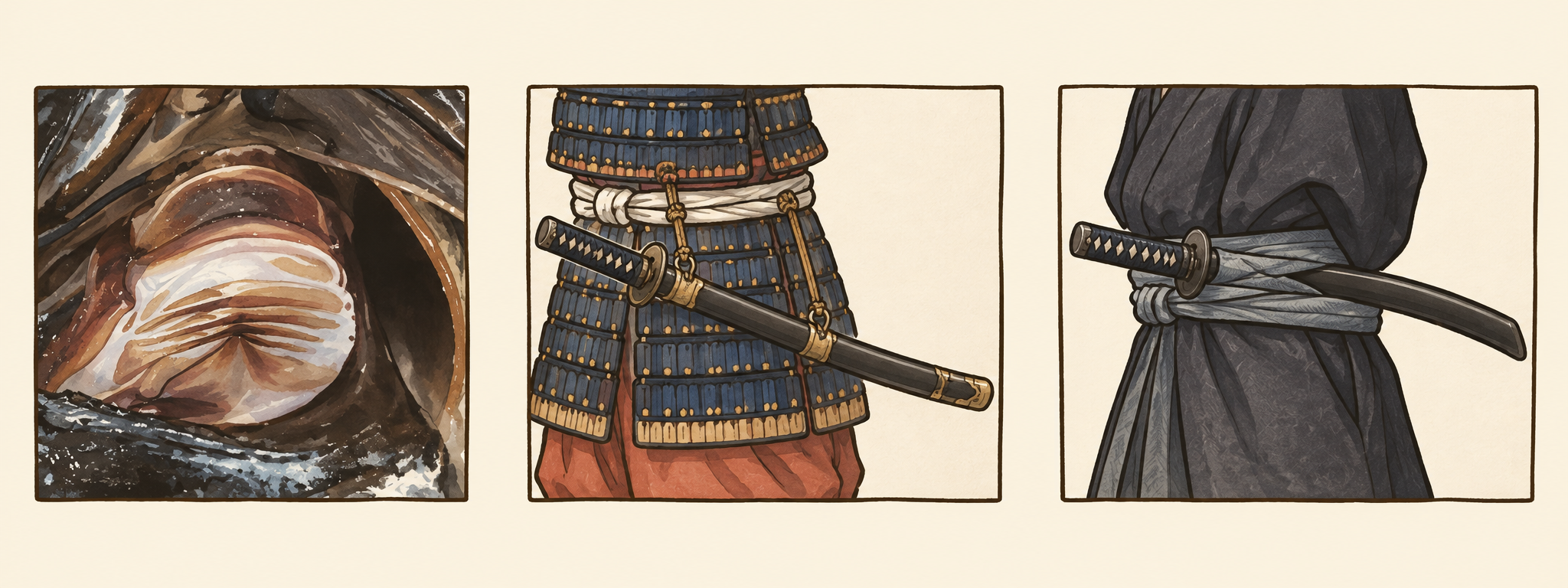
The uchigatana was thrust through the sash, edge up, so drawing and cutting were one motion (illustration)
Swords are classified mainly by length and by how they were worn. The tachi was the main sword from the Heian period into the early Muromachi period. It is long, with a blade of more than about 60 centimeters (by one account typically around 73 to 76 centimeters), and deeply curved, and it was slung from the belt by cords with the edge facing down, a style suited to fighting from horseback. The katana proper became dominant from the fifteenth century. It is of similar length but usually less curved, and it was thrust through the sash with the edge facing up, so that drawing the sword and cutting were a single motion, useful in fighting on foot. A blade between about 30 and 60 centimeters is a wakizashi; anything shorter is a tantō, or dagger. The paired swords worn by samurai of the Edo period, known as daishō ("long and short"), were a katana and a wakizashi. Polearms such as the curved-bladed naginata and the straight spear, yari, are also counted within the family by sword specialists.
- 1Nakago (tang)fits into the hilt; the smith carved his signature, the mei, here
- 2Peg holea bamboo peg through it secures the hilt, which can be removed
- 3Habaki (collar)metal collar at the base of the blade, wedged into the scabbard mouth
- 4Jiganethe steel surface of the blade
- 5Hamonthe pale band of hardened steel along the edge
- 6Bōshithe hamon in the point section
These names come up throughout; the signature is carved on the tang, hidden in the hilt in normal use.
The parts of the sword have names that come up constantly in any discussion of them. The tang, nakago, is the part of the blade that fits into the hilt. It is hidden in normal use, and it is where the smith carved his signature, the mei, often with a date. The tang has a hole through which a bamboo peg secures the hilt, so the hilt can be removed for study and cleaning. A small metal collar, the habaki, sits at the base of the blade and wedges it into the mouth of the scabbard. The steel surface of the blade is the jigane, and the pale, misty band of hardened steel along the edge is the hamon. The hamon in the point section has its own name, the bōshi.
A sword in full mounting has a scabbard, a hilt wrapped in silk or cotton cord over ray skin, a guard called the tsuba, and several small metal fittings. The whole ensemble is the koshirae. When a sword is not being worn, the blade is usually kept in a plain wooden scabbard of magnolia wood, the shirasaya, which lets the steel breathe and protects it from rust. Swords exhibited in museums are almost always shown bare, out of their mounts, because the blade is what people come to see; the mounts are often displayed separately as works of metalwork and lacquer in their own right.
02From Straight Blade to Curved Sword
Japan’s earliest iron swords were straight. Blades of the Kofun and Nara periods were either imported from the Korean peninsula and China or made locally in continental styles, and some of the finest survive in the Shōsōin, the eighth-century imperial storehouse at Nara.
The curved sword appeared during the Heian period, taking shape over the tenth and eleventh centuries. How exactly it developed is debated. One widely cited line of descent runs from the warabitedō, a sword with a hilt curled like a fern frond, associated with the Emishi people of northeastern Japan, through an intermediate type whose hilt and blade were forged in one piece, to the fully curved tachi. Whatever the path, the reason for the curve is clear enough. This was the period in which a warrior class was rising, and their fighting was done largely on horseback. A curved blade cuts by drawing through its target rather than chopping into it, and it is less likely to jam. It also comes out of the scabbard more smoothly.
The classic form was established by a handful of smiths whose names are still revered. Sanjō Munechika worked in Kyoto in the late tenth century, around the Eien era (987–989); a Noh play, Kokaji ("The Little Smith"), tells how the fox deity of Inari helped him forge a sword for the emperor, a story that is legend rather than history. Yasutsuna of Hōki province, in present-day Tottori, made the blade known as Dōjigiri, said to have been used by the warrior Minamoto no Yorimitsu to behead the demon Shuten Dōji. The early smiths of Bizen province, in present-day Okayama, known collectively as Ko-Bizen ("Old Bizen"), produced slender, elegant tachi with the deepest curve near the hilt and a small point, a shape often compared to a drawn bow.
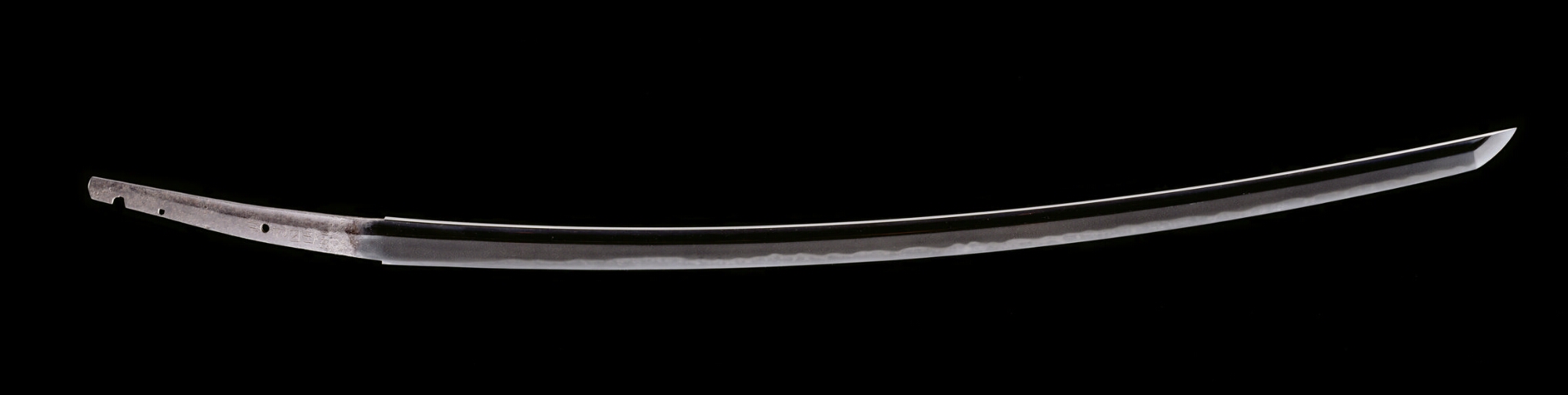
The tachi Ōkanehira by the Ko-Bizen smith Kanehira: the deepest curve lies near the hilt, and the point is smallTokyo National Museum, tachi signed Bizen no Kuni Kanehira saku (known as Ō-Kanehira), Heian period, 12th century
The Kamakura period (1185–1333) is generally regarded as the high point of Japanese sword making. The retired emperor Go-Toba was a passionate devotee of swords; according to tradition he summoned smiths from different provinces to serve at his court in monthly rotation and even forged blades himself, marking them with a chrysanthemum. In Kyoto the Awataguchi school produced Tōshirō Yoshimitsu, a master of the tantō whose daggers were treasured by later warlords. In Bizen the Fukuoka Ichimonji and Osafune schools flourished, and Osafune became the largest center of sword production in Japan for centuries. Its name is still tied to swords today.
Late in the Kamakura period the smith Masamune worked in Sagami province, near the shogunal capital of Kamakura. He and the smiths around him developed what is called the Sōshū tradition, with large, bright crystals of martensite in the hamon, a vigorous and irregular temper line, and streaks of shining steel called kinsuji and inazuma ("lightning") running through it. Masamune has come to be regarded as the greatest of all Japanese swordsmiths, but very few signed works by him survive, and his reputation owes much to sword appraisers of the Muromachi and Edo periods who promoted him. The list of his ten great pupils, the Masamune juttetsu, was also a later construction.
Sword historians traditionally group the old smiths into five traditions, the gokaden, named after provinces: Yamato (Nara), Yamashiro (Kyoto), Bizen, Sagami (Sōshū), and Mino (in present-day Gifu). Yamato smiths worked for the great temples and their armed monks and made sturdy, plain blades. Yamashiro work is refined and restrained. Bizen is known for flamboyant hamon shaped like clusters of clove buds, a pattern called chōji. Sōshū is defined by its strong crystalline brightness. Mino was the latest to emerge and grew enormously in the wars of the fifteenth and sixteenth centuries. This scheme is a framework devised by connoisseurs after the Edo period, generally thought to have taken shape in modern times, rather than a description of how smiths saw themselves, but it remains the standard way to begin.
The Mongol invasions of 1274 and 1281 are commonly said to have influenced sword design, with blades becoming wider and thicker and points larger in the decades that followed. During the civil wars of the fourteenth century, the Nanbokuchō period, enormous swords called ōdachi or nodachi were made, some with blades over a meter long, carried on the back or by an attendant. Many such long blades were later shortened to make them usable, a process called suriage. Cutting down the tang removed the signature, which is one reason why so many important early swords are unsigned and are attributed to their makers by appraisal.
In the Muromachi period, warfare shifted toward large armies of foot soldiers, and the katana worn edge-up replaced the tachi. Demand during the Warring States period of the sixteenth century was immense, and Osafune and Seki in Mino turned out mass-produced blades known as kazuuchi-mono, of uneven quality. The same era produced celebrated names: Kanemoto of Seki, known as Magoroku Kanemoto, whose hamon rises in regular clusters of pointed peaks called sanbonsugi ("three cedars"), and Muramasa of Ise, whose blades were famously sharp.
03How a Blade Is Made
The raw material for a Japanese sword is tamahagane, a steel produced in a clay smelting furnace called a tatara. Iron sand and charcoal are fed into the furnace continuously for about three days and nights. At the end the furnace is broken apart, and at its base lies a large, irregular bloom of steel called the kera. The best portions of this bloom are the tamahagane. Tatara smelting died out in the modern period, but in 1977 the Society for the Preservation of Japanese Art Swords revived it in Okuizumo, in Shimane prefecture, and the furnace there is fired several times each winter to supply smiths across the country.
The smith begins by heating pieces of tamahagane, flattening them into thin plates, quenching them, and breaking them into small chips. By looking at the fractured surfaces he sorts them by carbon content, separating hard, high-carbon steel from softer, low-carbon steel. Selected chips are stacked on a steel plate fixed to a handle, wrapped in paper, coated with straw ash and clay slurry, and heated in the forge until they weld together into a single block.
Then comes the famous folding. The smith heats the block, and he and his apprentices hammer it out to double its length. He scores it across the middle with a chisel, folds it back on itself, and hammers it out again. Each fold doubles the number of layers; fifteen folds produce more than thirty thousand. The point is not the number of layers. Folding drives out slag and impurities and evens out the distribution of carbon. The layers also leave a visible grain in the finished steel, which depending on how the folding was done resembles flat-sawn wood (itame), burl (mokume), or straight-grained wood (masame).
The essential principle of the Japanese blade is the combination of two steels. Hard, high-carbon steel gives a sharp edge that holds; soft, low-carbon steel gives a blade that bends rather than breaks. A sword made only of hard steel would shatter, and one made only of soft steel would not stay sharp. Most smiths wrap a core of soft steel, the shingane, in a jacket of hard steel, the kawagane, and forge them together. Different schools used different constructions, some adding separate steel for the spine and sides.
The composite bar is drawn out to the length of the blade and then shaped with the hammer, forming the point, the ridge line, and the spine. At this stage the blade is still straight.
The decisive step is the hardening, yaki-ire. The smith coats the blade with a paste of clay, charcoal powder, and powdered whetstone, spreading it thickly over the spine and sides and thinly over the edge. Many smiths draw lines or patterns in the clay along the edge with a bamboo spatula, and these determine the shape the hamon will take. The blade is heated evenly in the charcoal fire, to roughly 750 to 850 degrees Celsius. The smith judges the temperature by the color of the glowing steel, which is why hardening is traditionally done at night or in a darkened forge. At the right moment he plunges the blade into a trough of water.
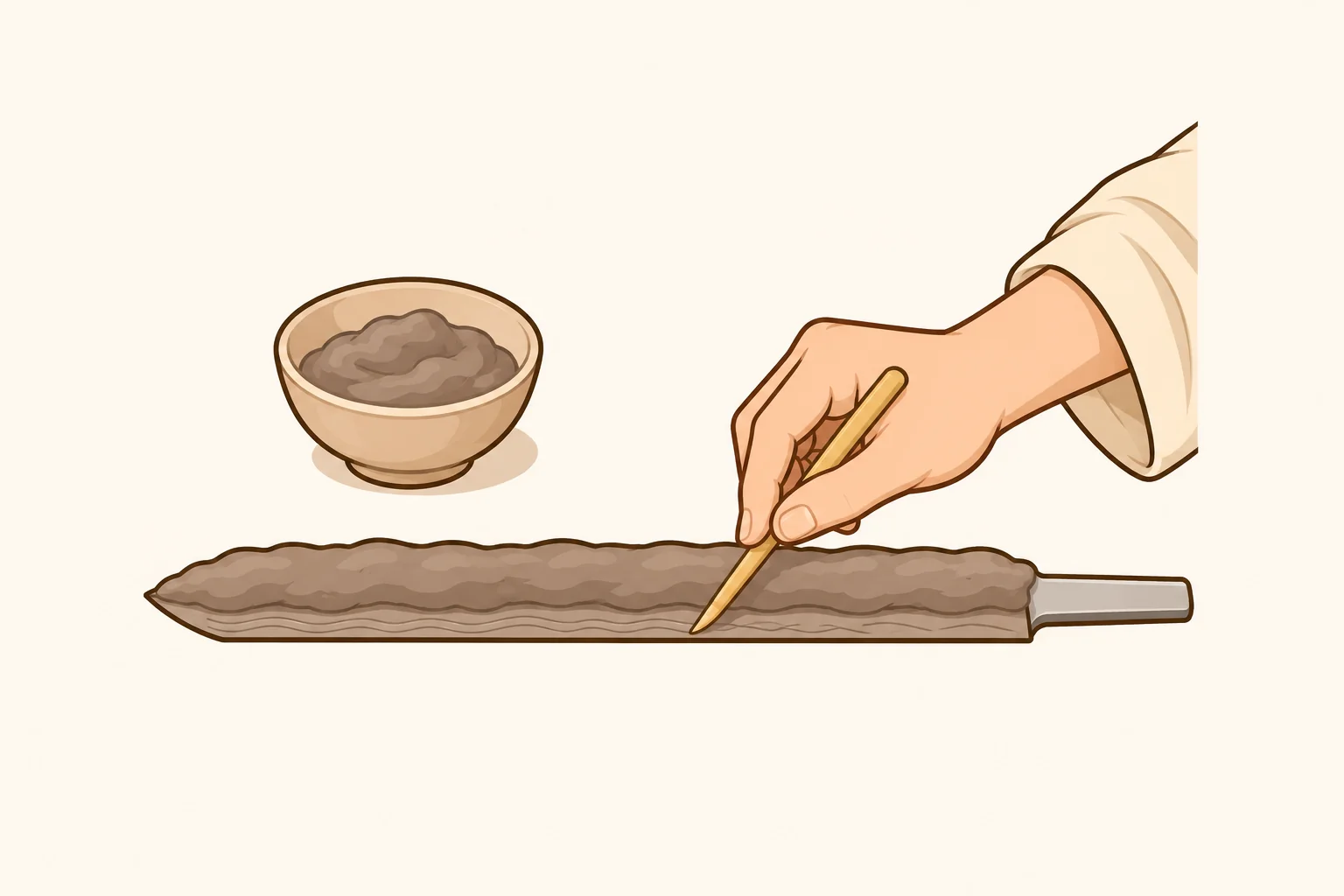
Before hardening (yaki-ire), the still-straight blade is coated in clay: thick over the spine and sides, thin over the edge.
Two things happen in that moment. The thinly coated edge cools very quickly and turns into martensite, an extremely hard crystalline form of steel. The thickly coated body cools more slowly and stays tougher and softer. Martensite occupies slightly more volume than the steel around it, so the edge expands, and the blade bends back toward the spine. Much of the curve of a Japanese sword is created in this instant of quenching. The boundary between hardened edge and softer body is the hamon. It is also the moment of greatest risk: a blade can crack, or the hamon can come out wrong, and weeks of work may be lost in a few seconds.
| Edge | Spine and sides | |
|---|---|---|
| Clay coat | Thin | Thick |
| Cooling | Very fast | Slower |
| Result | Martensite, extremely hard | Tougher, softer |
The edge cools fast, hardens and expands, so the blade bends back toward the spine; the boundary between hard and soft is the hamon.
After hardening the smith does a rough polish to check the shape and adjust the curve, files a pattern of marks into the tang, and chisels his signature. His part of the work is then complete.
A finished sword passes through several more pairs of hands. The polisher, togishi, works the blade over a series of natural whetstones from coarse to fine over one to two weeks, finishing with tiny flakes of stone and an iron-oxide paste that darken the jigane and whiten the hamon, so that the grain and crystals of the steel become visible. Much of what one sees in a Japanese sword is revealed by polishing; the same blade can look dull or magnificent depending on the polisher. Other craftsmen make the habaki, carve the scabbard, wrap the hilt, cast and chase the guard and fittings, and lacquer the scabbard. A full koshirae is a collaboration among metalworkers, woodworkers, lacquerers, and braiders.
04How to Look at a Blade
Connoisseurs look at a sword in a set order. The first thing is the sugata, the overall shape: where the curve is deepest, how the width changes from base to tip, how large the point is. The shape alone often indicates the period. Heian and early Kamakura tachi are slim with a deep curve near the hilt and a small point. Fourteenth-century blades are broad with long points. Early Edo swords are nearly straight with only a shallow curve.
The second is the jigane, the steel surface and its grain. Moving slightly in front of a display case, a visitor can usually make out the wood-like pattern of the folding. Good jigane is fine and dense and has a moist look, as if the steel were wet.
The third, and the one that catches most visitors, is the hamon. Hamon fall into two broad types: suguha, a straight line, and midareba, any irregular pattern. Irregular patterns have many names: chōji, the clove-bud clusters of Bizen; gunome, a regular row of semicircles; notare, a slow undulation; the pointed sanbonsugi of Seki; and tōran, a pattern like rolling waves devised by the Ōsaka smith Tsuda Sukehiro in the seventeenth century.
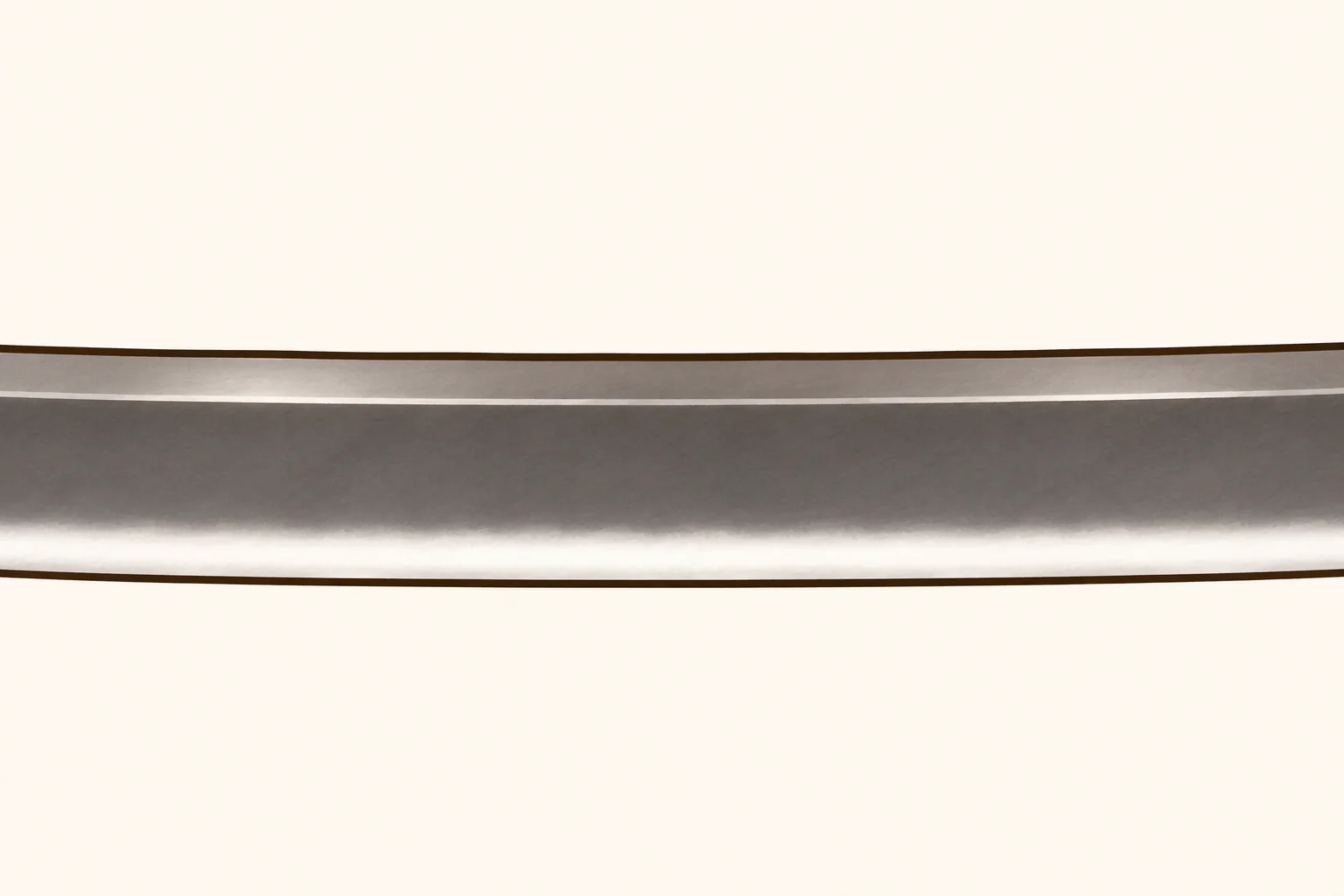
Suguha is a straight white band along the edge.
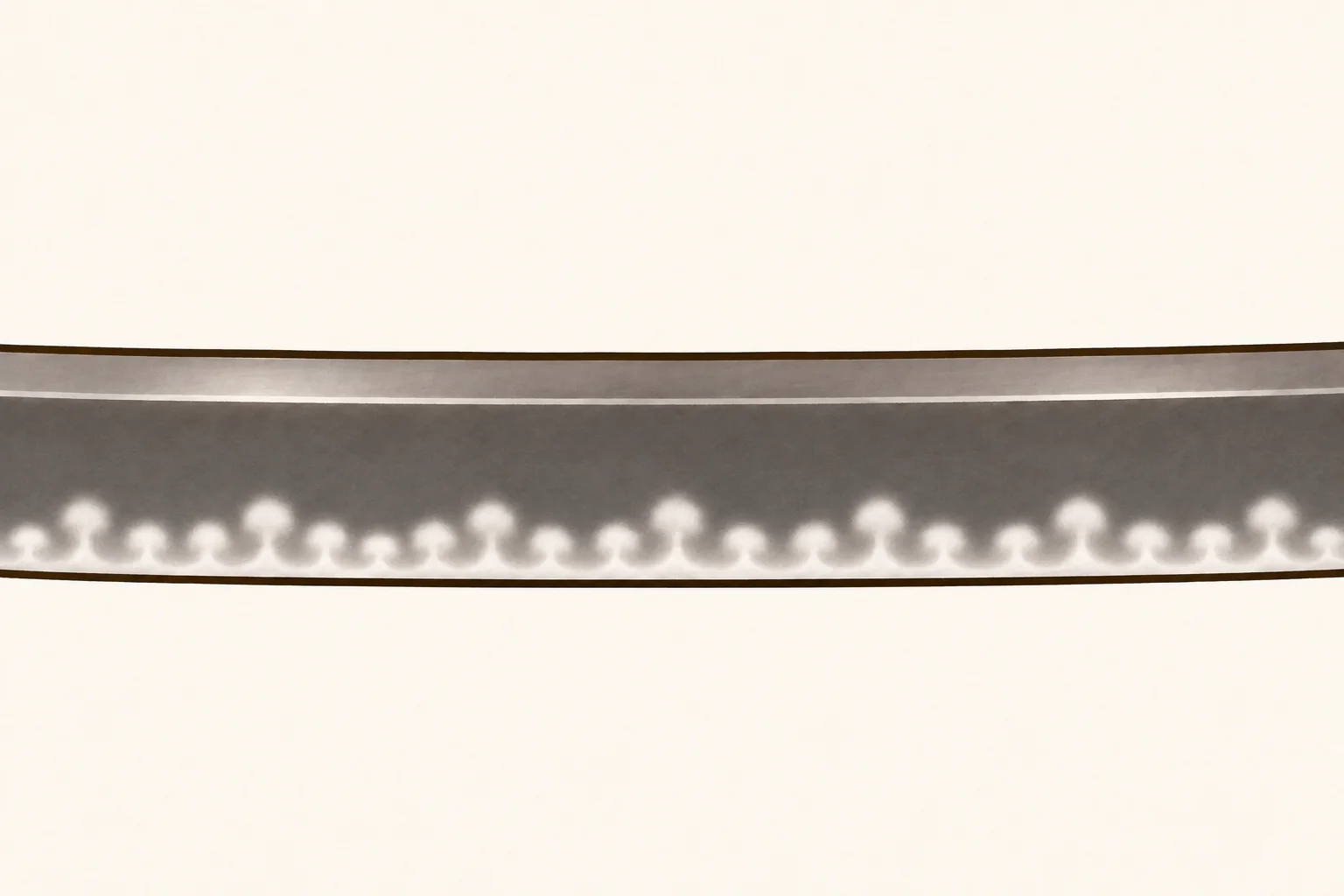
Chōji rises in clusters shaped like clove buds.
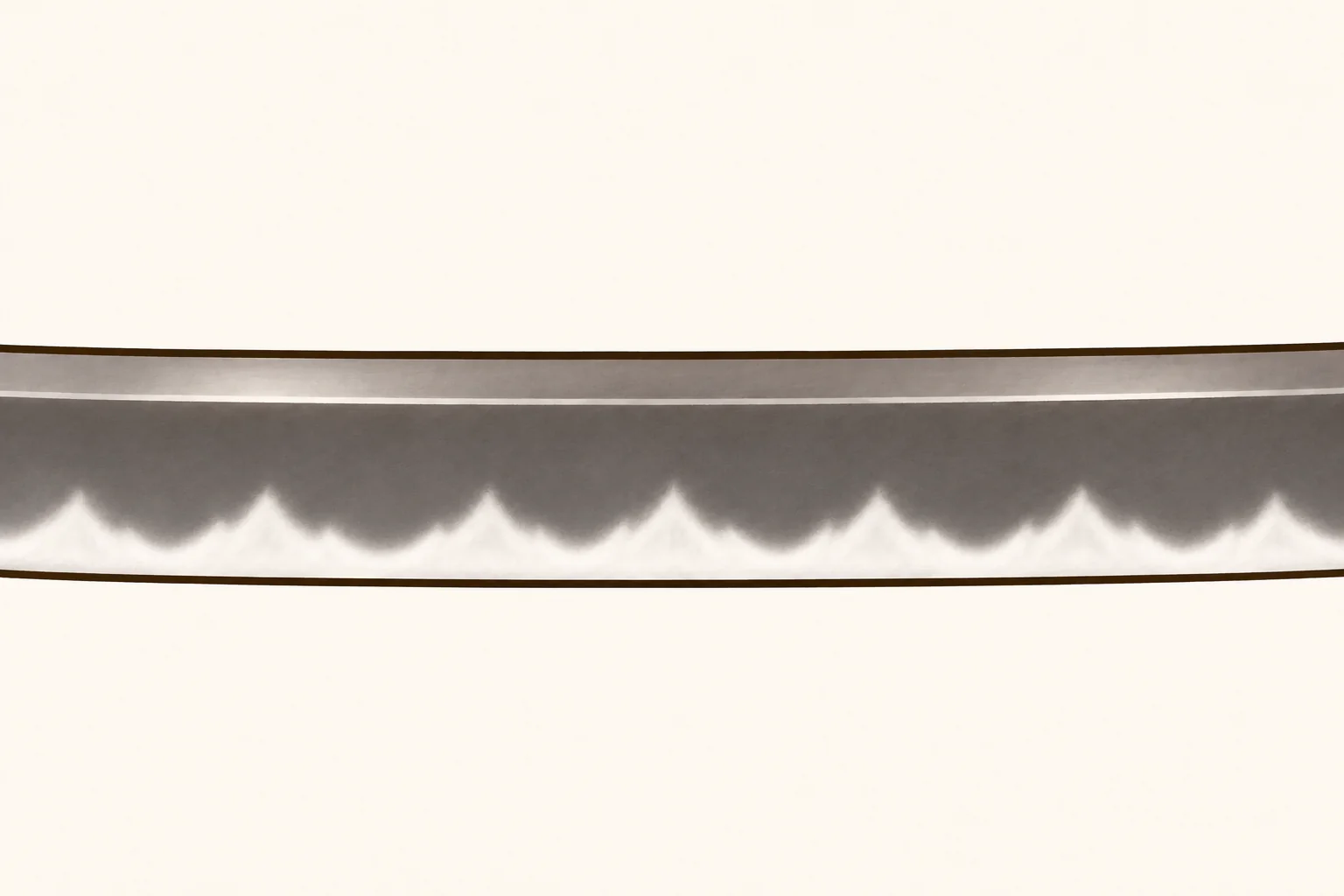
Sanbonsugi, “three cedars,” rises in regular clusters of pointed peaks.
What gives a hamon life is its texture. The white band is not a painted line; it is made of countless tiny crystals. When the crystals are large enough to see individually, sparkling like silver sand, they are called nie. When they are too fine to distinguish and form a soft, misty glow, they are called nioi. Sōshū work is known for nie, Bizen work largely for nioi. Within the hamon there are smaller features, called hataraki ("activities"): short lines running toward the edge called ashi, isolated spots called yō, and the bright streaks of kinsuji and inazuma.
The secret of seeing a hamon is light. Looked at straight on, the hamon is often faint. It appears when a point light source shines from beyond the blade and the viewer looks along the steel, adjusting the angle until the crystals catch the light. Good sword galleries light their cases with this in mind, and serious visitors can be seen crouching, tilting their heads, and stepping sideways in front of the glass, hunting for the right angle.
When swords are handled privately or at sword society meetings, there is a strict etiquette. The steel is never touched with bare fingers, since the moisture and salt of skin cause rust. The blade is held by the tang, or by a cloth below the habaki. Traditionally one holds a folded sheet of paper in the mouth so as not to breathe or spit on the steel, and one does not talk while viewing. The point is never directed at anyone. Afterward the old oil is wiped away with soft paper and a fresh, thin coat of clove oil is applied. Each rule has a practical reason: the blade is a piece of carbon steel that has to survive centuries.
Enthusiasts also play an appraisal game called kantei, in which the tang is covered and participants try to identify the period, school, and smith from the blade alone. Sword societies still hold kantei sessions, and they show how seriously the reading of steel is taken. The appraiser works from sugata to jigane to hamon to bōshi, and only then, if allowed, to the file marks and the shape of the characters in the signature.
- 1Sugataoverall shape; often indicates the period
- 2Jiganethe steel surface and its grain
- 3Hamonsuguha or midareba; nie and nioi
- 4Bōshithe hamon in the point
- 5File marks and signatureonly then
In kantei the appraiser reads the blade first, and only last the file marks and signature on the tang.
05Old Swords, New Swords, and the End of the Samurai
Japanese sword history has one major dividing line. Blades made before about the Keichō era (1596–1615) are kotō, "old swords"; those made after are shintō, "new swords." The division was set by Edo-period writers on swords, but it reflects real changes. After the wars ended, the way steel was produced and traded changed, and smiths gathered in castle towns such as Edo, Ōsaka, and Kyoto, working with different materials and different methods. Certain qualities of kotō steel were never reproduced, and modern smiths still try to recover them.
The best-known smith of the shintō period is Nagasone Kotetsu of Edo, who began his career as an armor maker in Fukui in Echizen province and turned to swords only after he moved to Edo, reportedly past the age of fifty. His blades were celebrated for cutting ability, and many carry inscriptions on the tang recording test cuts through two or three bodies. The Shinsengumi commander Kondō Isami is said to have carried a Kotetsu, though most believe it was a forgery; the line later put in his mouth on stage, "Tonight my Kotetsu thirsts for blood" (Koyoi no Kotetsu wa chi ni uete iru), became famous but is generally regarded as invented. In Ōsaka, Tsuda Sukehiro, who created the wave-like tōran hamon, and Inoue Shinkai, whose work was praised as "the Masamune of Ōsaka," were the leading figures. In the late eighteenth century Suishinshi Masahide called for a return to the methods of the Kamakura period, opening what is called the shinshintō, or "new new sword," era, and Minamoto Kiyomaro, working in Yotsuya in Edo, earned the nickname "Yotsuya Masamune."
The sword’s role as a symbol of status began with Toyotomi Hideyoshi’s sword hunt of 1588, which disarmed the peasantry. Under the Tokugawa shogunate only samurai could wear the paired long and short swords; commoners might at most carry a short sword when traveling. The Edo period was largely peaceful. A samurai might go his whole life without drawing his sword in anger, yet it was in these two and a half centuries that the idea of the sword as "the soul of the samurai" took firm shape.
In 1876 the Meiji government issued the Haitōrei, the Sword Abolishment Edict, forbidding anyone other than soldiers and police from wearing swords in public. Samurai status had already been abolished, and the edict removed the sword from daily life. Many smiths lost their livelihoods and turned to making farm tools, kitchen knives, and scissors, and the craft came close to dying out.
Military swords for officers revived demand in the early twentieth century, but many wartime blades were machine-made or oil-quenched from industrial steel. These shōwatō are not regarded as true nihontō. After Japan’s defeat in 1945, the occupation authorities ordered the surrender of swords, and great numbers were destroyed or taken abroad as souvenirs. Japanese sword experts lobbied to have blades recognized as art, and eventually swords of artistic value were allowed to be registered and kept. The Society for the Preservation of Japanese Art Swords, the Nihon Bijutsu Tōken Hozon Kyōkai, was founded in 1948 and later established the Japanese Sword Museum in Tokyo.
The modern system follows from those years. In Japan, possessing a sword is in principle prohibited, with an exception for art objects. A real sword must have a registration certificate issued by a prefectural board of education, and the certificate stays with the sword when it is sold or inherited. New swords, too, need approval from the prefectural board of education, one blade at a time. A would-be swordsmith typically spends years as an apprentice under an approved smith (at least five, by the usual account) and completes a three-year practical training course before receiving approval to forge, and may only make swords by traditional methods. Output is restricted; the figure usually given is no more than two long swords a month. Few smiths are active (reports put the number of licensed smiths nationwide at around two to three hundred), and fewer still make a living from it. The finest are recognized as Living National Treasures, Holders of Important Intangible Cultural Properties, a title only a handful of swordsmiths, among them Miyairi Yukihira and Amata Akitsugu, have received since the system began in 1955.
06Famous Blades and Their Stories
Japanese treat famous swords almost like famous people: each has a name, a pedigree, and a record of the hands it passed through. The best-known group is the Tenka Goken, the "Five Swords Under Heaven": Dōjigiri Yasutsuna, Onimaru Kunitsuna, Mikazuki Munechika, Ōdenta Mitsuyo, and Juzumaru Tsunetsugu. Dōjigiri, the blade said to have killed Shuten Dōji, is a National Treasure in the Tokyo National Museum. Mikazuki Munechika, "the crescent moon," takes its name from crescent-shaped patterns in its hamon; it is also a National Treasure in the Tokyo National Museum, and is often called the most beautiful of the five. Onimaru is an imperial possession managed by the Imperial Household Agency. Ōdenta was an heirloom of the Maeda lords of Kaga and belongs to the Maeda Ikutokukai foundation. Juzumaru, said to have been carried by the Buddhist priest Nichiren, is kept at the temple Honkō-ji in Amagasaki.
Most sword names come from stories. Onimaru, "demon blade," gets its name from a tale in the fourteenth-century chronicle Taiheiki: a head of the Hōjō regent family (Tokiyori in most retellings, Tokimasa in others) was tormented nightly by a small demon in his dreams until the sword toppled over by itself and sliced through a demon-shaped ornament on a brazier stand, after which the dreams stopped. Juzumaru, "rosary blade," is named for the Buddhist rosary Nichiren hung on its hilt. Shokudaikiri Mitsutada, "candlestand cutter," belonged to the warlord Date Masamune, who is said to have cut through a retainer and the bronze candlestand behind him with a single stroke. The sword passed to the Mito branch of the Tokugawa family and was badly burned in the Great Kantō Earthquake of 1923. For decades it was thought lost, until the Tokugawa Museum in Mito put the scorched blade on public display in 2015.
The reverse of the famous sword is the cursed one. Muramasa blades are said to have brought misfortune to the Tokugawa: Tokugawa Ieyasu’s grandfather and father are supposed to have been killed or wounded with them, and a Muramasa to have been the blade used to behead his eldest son at his enforced suicide. Kabuki plays and popular storytellers turned this into the legend of a bloodthirsty demonic sword. In reality Muramasa’s works were prized fighting swords from Kuwana in Ise, and the curse grew out of a few unlucky coincidences; the Owari branch of the Tokugawa family is said to have kept Muramasa blades among its own heirlooms. In the 1860s, when opposition to the shogunate was rising, Muramasa blades became fashionable for exactly that reason. Tales of a contest between Masamune and Muramasa are pure invention; the two lived some two centuries apart.
Famous swords were the highest class of gift. Daimyo presented them to one another as acts of diplomacy, and a shogun’s gift of a named blade was a great honor. The Hon’ami family served the shogunate as hereditary sword appraisers, and their certificates were called origami. The phrase origami-tsuki, "with certificate," entered everyday Japanese meaning "guaranteed" or "of acknowledged quality."
The most enthusiastic audience for Japanese swords today is young women. In 2015 a browser game called Tōken Ranbu ("Wild Dance of Swords") was released, reimagining famous historical blades as handsome young men whom players collect and train. The game spawned stage musicals and anime, and museum exhibitions of the swords behind the characters began drawing long queues of fans in their twenties and thirties, nicknamed tōken joshi, "sword girls." Some museums and shrines collaborated with the game, and several blades that had not been shown for years went back on display. The craze pulled the Japanese sword out of a small world of older male collectors and back into popular view.
07Seeing Swords in Japan
In Tokyo, the most accessible place is the Tokyo National Museum in Ueno, where a gallery on the first floor of the Honkan, the main building, is devoted to swords. Displays rotate through the museum’s National Treasures and Important Cultural Properties, and the cases are lit specifically so the hamon can be seen. The Japanese Sword Museum, run by the preservation society, moved in 2018 from Yoyogi to a new building in Ryōgoku, Sumida ward, on the grounds of the old Yasuda Garden and a short walk from the sumo arena. It is small, but everything in it is of high quality, and it rewards a slow visit.
The national museums in Kyoto and Nara hold sword exhibitions as well, and in Kyoto the Awataguchi and Sanjō neighborhoods are where the capital’s smiths worked in the Heian and Kamakura periods. The Tokugawa Art Museum in Nagoya holds swords handed down in the Owari branch of the Tokugawa family, a classic daimyo collection. The Sano Art Museum in Mishima, Shizuoka prefecture, is known for its sword collection and exhibitions.
To see smiths at work, two places stand out. The Bizen Osafune Japanese Sword Museum in Setouchi, Okayama prefecture, stands in the old heartland of Bizen swords; alongside the museum are workshops of smiths, polishers, scabbard makers, and other craftsmen, and on certain days visitors can watch forging. The other is the city of Seki in Gifu prefecture, a sword town since the Muromachi period and today Japan’s largest producer of cutlery; many Japanese kitchen knives, scissors, and nail clippers come from here. Seki’s Traditional Swordsmith Museum holds regular demonstrations of traditional forging (its exhibition halls closed for renovation in September 2026, with work scheduled to run through March 2027; the forge remains in use, and as of November 2026 no reopening date had been announced), and on January 2 each year there is the uchizome-shiki, the first forging of the new year, when smiths dressed in white strike the first blows before a Shinto altar.
The most striking thing about a forging demonstration is the rhythm. The master taps the hot steel with a small hammer to show where to strike, and two or three apprentices swing heavy sledges in turn, sparks flying. Where the small hammer taps, the big hammers fall. Almost nothing is said; there is only the ring of metal and the breath of the bellows. The Japanese expression aizuchi o utsu, meaning to chime in or nod along in conversation, comes from this alternating hammering.
As for buying, there are established sword dealers in Tokyo, around Ginza and elsewhere (some say around Ueno as well), and every real sword they sell comes with its registration certificate. As of 2026, prices are generally said to run from several hundred thousand yen to many millions, and new work by contemporary smiths typically costs a million yen or more. A foreign visitor who wants to take a real sword out of Japan must obtain an export certificate for antique art objects from the Agency for Cultural Affairs, return the registration certificate to the issuing prefecture after departure, and comply with the laws of their home country, which can be strict. Most visitors buy mogitō, replicas cast from alloy with no edge, which cost tens of thousands of yen and can look very convincing; they are sold in souvenir shops and specialist stores in Kyoto, Asakusa, and elsewhere. The more practical purchase is a kitchen knife forged in Seki or in Sakai near Ōsaka, the form in which the sword-forging tradition is most present in everyday Japanese life.
Nobody carries a Japanese sword into battle anymore, but the craft continues with remarkable stubbornness. Smiths still use steel smelted from iron sand and charcoal, still wait in darkened forges to read the color of the fire, and polishers still work through their stones one by one. The hamon a visitor sees in a museum case is the record of a few seconds in which hot steel met cold water, sometimes many centuries ago.