
At a glance
How a style of gold screens, irises and wind gods passed between artists who never met, from Sōtatsu and Kōrin to Hōitsu and modern design.
- The name Rinpa comes from the second character of Ogata Kōrin’s name; the short form became standard only in the later twentieth century.
- Rinpa had no family workshop: it passed by shishuku, artists learning from earlier masters through their works alone.
- Kōetsu and Sōtatsu began it in early-1600s Kyoto; Kōrin took up Sōtatsu about a century later, and Sakai Hōitsu in Edo took up Kōrin a century after that.
- Typical features: broad gold or silver grounds, flat composition, court literature and seasonal plants, and pooled tarashikomi ink.
- Hōitsu painted Summer and Autumn Grasses on the back of Kōrin’s Wind God and Thunder God, so one screen held three generations.
Picture a pair of folding screens covered in gold leaf, and across them nothing but clumps of irises, deep blue-violet blossoms and stiff green leaves repeated in a rhythm almost like a textile pattern. That is Ogata Kōrin’s Irises, painted in the early 1700s and shown every spring at the Nezu Museum in Tokyo. It is the best-known image of Rinpa, a style of Japanese painting and design that is bold, flat, glittering and strangely modern. Rinpa matters to anyone curious about Japan because its look never went away: it lives on in kimono patterns, lacquer boxes, seasonal sweets and twentieth-century posters. This is an introduction to what it is, who made it, and where you can see it.
01A School Without a Master
Most schools of Japanese painting were family businesses. The Kanō school, which painted for shoguns for some four hundred years, passed its secrets from father to son and from master to apprentice in a tightly run workshop. Rinpa worked differently. Its main figures lived roughly a century apart and never met. Each one discovered the work of an earlier artist, fell in love with it, copied it and pushed it further. The Japanese word for this kind of relationship is shishuku: learning from someone you revere without ever being their pupil.
The name itself came late. "Rinpa" means "the school of Rin," taken from the second character of Kōrin’s name. Earlier writers spoke of the "Kōrin school" or the "Ogata school," and modern scholars sometimes prefer "Sōtatsu-Kōrin school" to give credit to the earlier painter Tawaraya Sōtatsu. The short form Rinpa only became standard in the later twentieth century, through exhibitions and art histories that wanted a single label for the whole lineage.
What holds the lineage together is a way of seeing. Rinpa artists liked large fields of gold or silver leaf, with no attempt at deep space. They chose subjects from classical court literature, especially The Tale of Genji and The Tales of Ise, and from the plants and flowers of the four seasons. They simplified shapes into strong silhouettes, repeated motifs like a designer would, and left wide areas empty. At the same time they loved soft, wet ink effects that gave the flat surfaces a sense of texture. The result combines aristocratic taste with the money and craftsmanship of Kyoto’s merchant class, which is exactly where Rinpa came from.
02Kōetsu and Sōtatsu in Early Kyoto
The story starts in Kyoto around 1600, just as the wars of the sixteenth century were ending and the city’s wealthy townspeople were investing in culture. Hon’ami Kōetsu (1558–1637) belonged to a family that polished and appraised swords for the warrior elite. Kōetsu himself became famous for calligraphy; he is counted among the "Three Brushes of the Kan’ei Era," the outstanding calligraphers of the early seventeenth century. He also shaped tea bowls by hand, and designed lacquerware. Today we might call him a creative director.
In 1615 the shogun Tokugawa Ieyasu granted Kōetsu land at Takagamine, in the hills north of Kyoto. Kōetsu settled there with relatives and craftsmen in what is often described as an artists’ village. His house later became the temple Kōetsu-ji, which you can still visit. His white Raku tea bowl named Fuji-san is a National Treasure, and the Tokyo National Museum owns a lacquer writing box associated with his designs, the Funabashi box, whose lid swells up into a high dome crossed by a strip of lead representing a bridge, with poem characters scattered across the gold. It looks startlingly sculptural even now.
Kōetsu’s great partner was Tawaraya Sōtatsu, a painter whose birth and death dates are unknown. He ran a shop called Tawaraya that produced painted fans, decorated papers and poem cards for wealthy clients. Together the two made some of the most beautiful handscrolls in Japanese art. In the Crane Scroll at the Kyoto National Museum, Sōtatsu painted a flock of cranes in gold and silver pigment, rising, gliding and landing along more than thirteen meters of paper, and Kōetsu brushed poems by the Thirty-six Immortal Poets over the top. Neither the painting nor the writing illustrates the other. They move together like two musicians playing different lines.
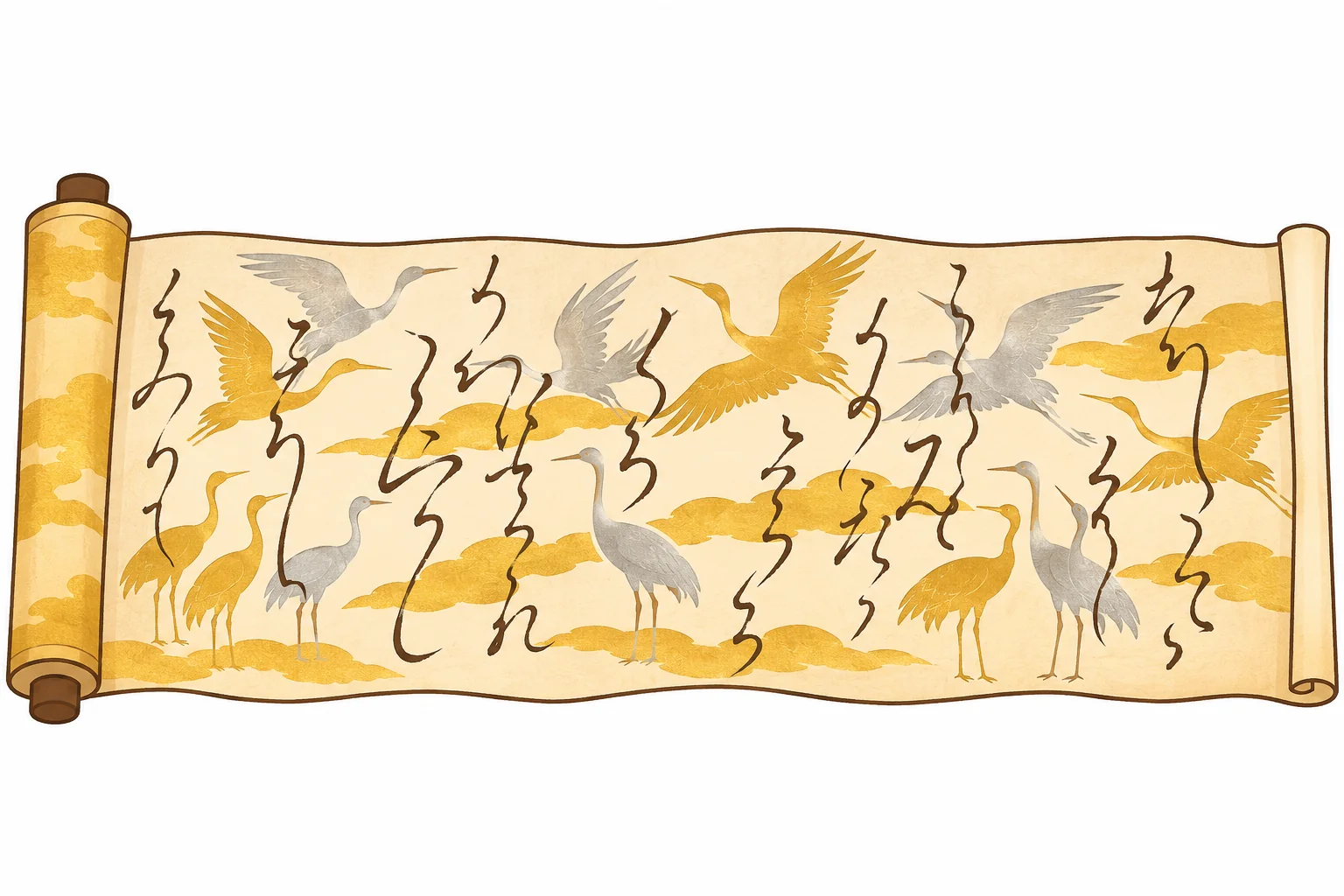
An unrolled handscroll: cranes in gold and silver flying and standing, overlaid with flowing ink calligraphy (illustration).
Working on his own, Sōtatsu painted the screens that became Rinpa’s emblem: Wind God and Thunder God, owned by Kennin-ji, a Zen temple in the Gion district. On the left the white-bodied Thunder God beats a ring of drums; on the right the green Wind God holds a billowing bag of wind. Both ride dark, smudged clouds and seem to burst in from outside the frame. Between them is nothing but gold, and that empty space is the point: it makes you feel the distance and speed between them. The original is now kept at the Kyoto National Museum, while Kennin-ji displays a high-quality reproduction.
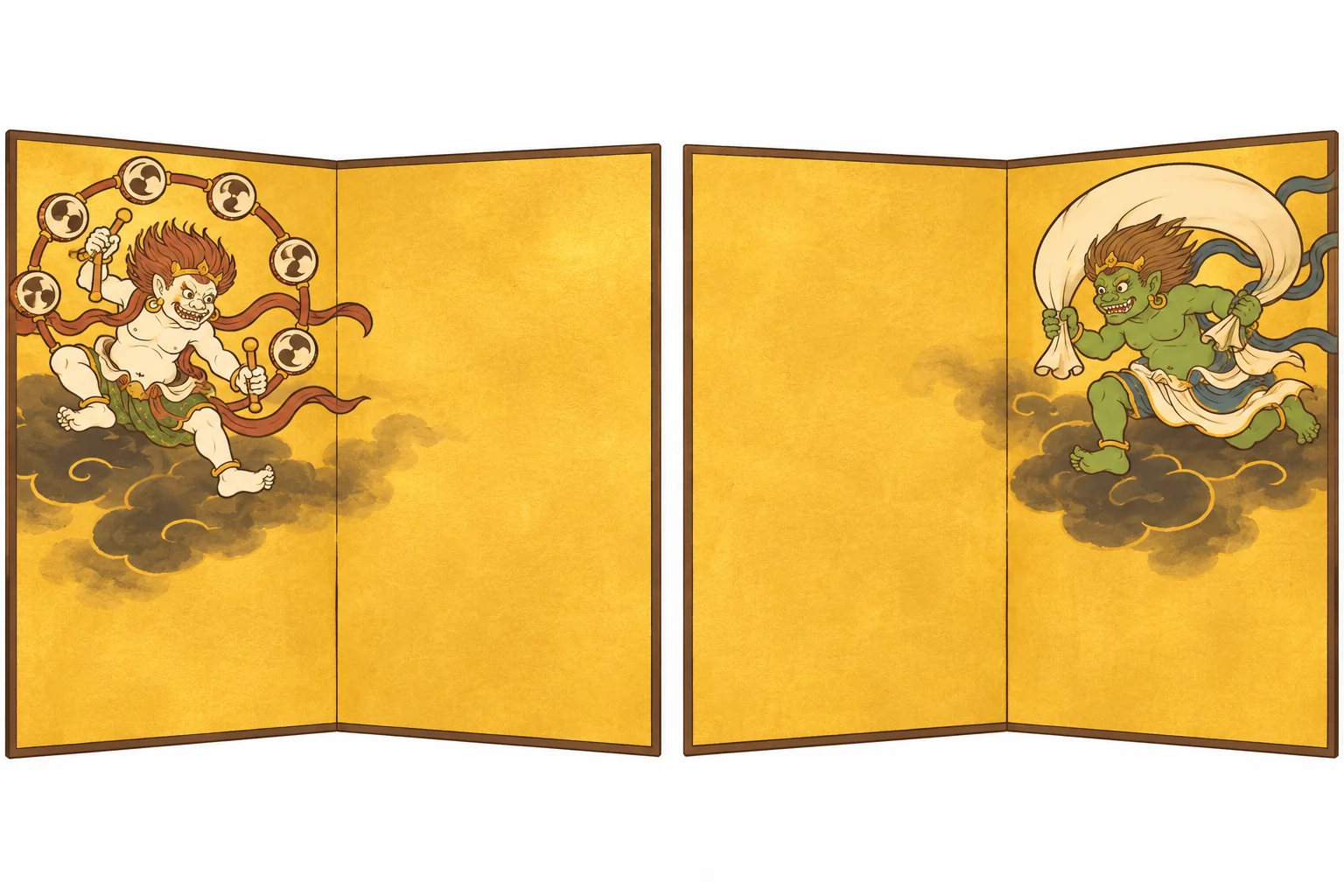
A pair of gold two-panel screens: green Wind God with wind bag at right, white Thunder God with drums at left, empty gold between (illustration).
Sōtatsu is also credited with a technique that became a Rinpa signature, tarashikomi, or "dripping in." While one layer of ink or pigment is still wet, the painter drops in another, and the two bleed into each other in irregular pools. On tree trunks, moss or clouds, it gives a soft, organic texture to an otherwise flat design. At Yōgen-in, a small temple in eastern Kyoto, you can see cedar doors he painted with white elephants and Chinese lions, plump and almost cartoonish in their simplicity.
03Ogata Kōrin, the Designer
Ogata Kōrin (1658–1716) was born into the Kariganeya, one of Kyoto’s leading textile houses, which made luxurious kimono for court ladies and the households of great lords. He grew up surrounded by pattern books, dyed silks and color samples, and he studied Noh, tea and calligraphy as a well-to-do young man would. After his father’s death Kōrin inherited a fortune and spent it freely. Only around the age of forty, with his money running low, did he turn to painting as a profession.
The Ogata family had marriage ties to the Hon’ami family, so Kōrin had access to works connected with Kōetsu and Sōtatsu. He made his own copy of Sōtatsu’s Wind God and Thunder God, now in the Tokyo National Museum. Placed side by side, the two versions show what Kōrin did to his model. He pulled the gods slightly inward, sharpened their outlines and brightened their colors. Sōtatsu’s version has the energy of a performance; Kōrin’s looks as if a designer has tidied it up.
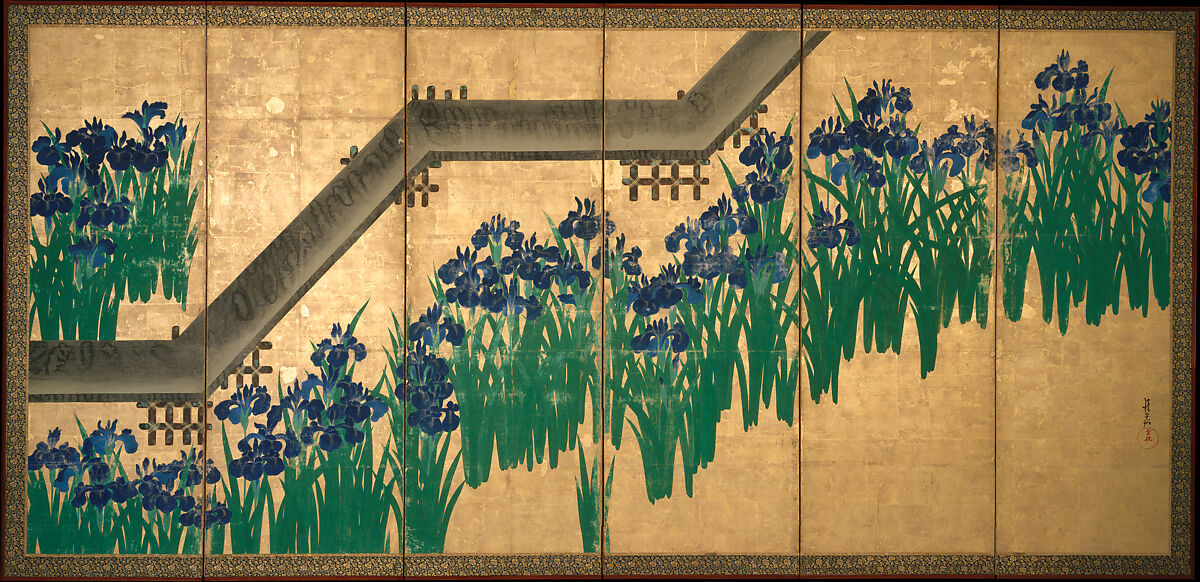
Irises, in the Nezu Museum and designated a National Treasure, shows that designer’s instinct at its strongest. The subject comes from an episode in The Tales of Ise: an exiled courtier reaches a place called Yatsuhashi, "Eight Bridges," where irises are blooming, and composes a poem longing for his wife in the capital, beginning each line with a syllable of the word kakitsubata, iris. Kōrin leaves out the courtier, the bridges and the stream. Only the flowers remain, painted in two pigments, ultramarine blue and malachite green, with clusters of identical shape appearing again and again, as though stenciled. Viewers who knew the story would think of the poem at once. Viewers who did not could simply enjoy the color and rhythm. A later version, Irises at Yatsuhashi in the Metropolitan Museum of Art in New York, brings back a zigzag plank bridge running through the flowers.
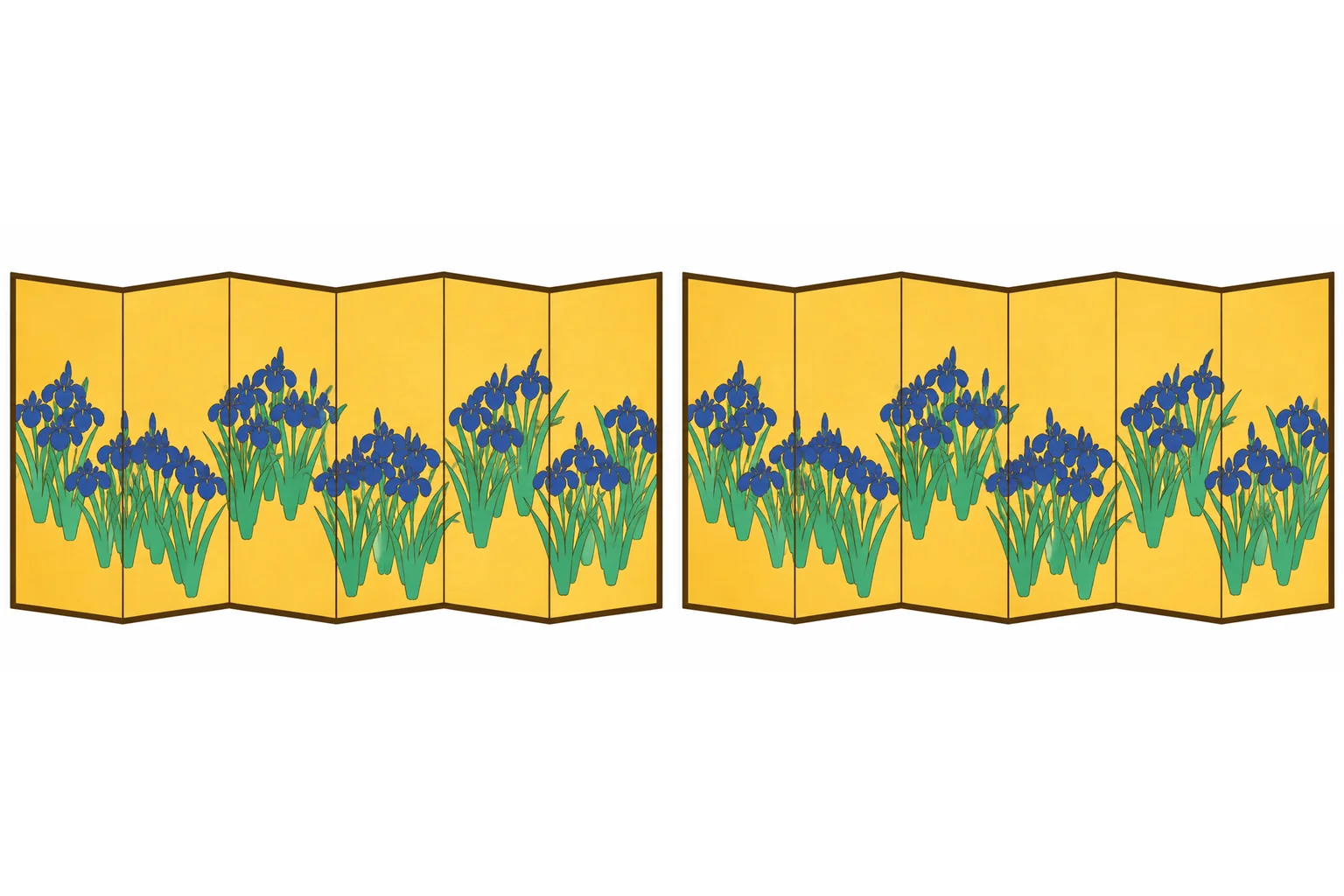
A pair of six-panel gold screens bearing nothing but clumps of irises repeated in rhythm (illustration).
Near the end of his life Kōrin painted Red and White Plum Blossoms, now at the MOA Museum of Art in Atami, also a National Treasure. A red plum tree stands on one screen and a white plum on the other, and between them flows a broad dark river whose currents are drawn in swirling, almost abstract patterns. The trunks are painted with Sōtatsu’s tarashikomi. The stylized waves came to be known as "Kōrin waves," and the round, simplified "Kōrin plum" became one of the most recognizable motifs in Japanese design.
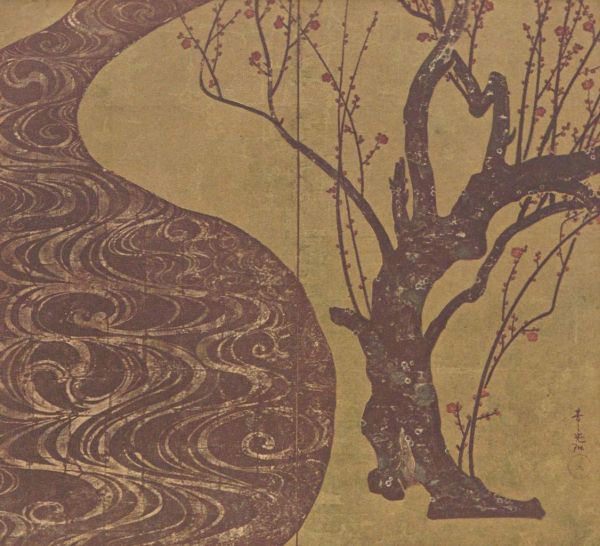
Red and White Plum Blossoms, red-plum side (detail): the river’s swirling “Kōrin waves” and a trunk mottled with tarashikomiNational Diet Library, Geijutsu shiryō (1941), reproduction of Ogata Kōrin, Red and White Plum Blossoms, detail (original in the MOA Museum of Art, Edo period)
Because he came from the textile trade, Kōrin’s art flowed quickly back into fashion. He painted autumn grasses directly onto a white silk kosode robe for the Fuyuki, a wealthy merchant family in Edo; the robe survives in the Tokyo National Museum. In the early eighteenth century, "Kōrin patterns" became a craze, appearing in kimono pattern books, on fans, ceramics and boxes for sweets. Kōrin may have been the first Japanese painter whose name turned into a brand.
04Kenzan and Rinpa on a Plate
Kōrin’s younger brother Ogata Kenzan (1663–1743) was quieter, bookish and drawn to Zen. He learned pottery in the circle of Nonomura Ninsei, the great Kyoto potter, and in 1699 opened a kiln at Narutaki, northwest of the city. Northwest in the old directional system is inui, written with the character ken, and so he took the name Kenzan, "northwest mountain," which also became the mark on his wares.
The most charming Kenzan ware comes from the brothers’ collaboration. Kenzan formed and glazed square dishes, Kōrin painted a few quick strokes on them, a god of longevity or a spray of plum, and Kenzan added a poem or inscription, so each plate reads like a page from an album. Kenzan also made dishes in the shapes of maple leaves or chrysanthemums for kaiseki, the formal meal served with tea, so that the table looked like autumn before any food arrived. Late in life he moved to Edo and kept making pottery there until his death in 1743, at eighty-one by traditional count.
05Hōitsu, Kiitsu and Edo Rinpa
About a hundred years after Kōrin died, the style found a second home in Edo, today’s Tokyo. Sakai Hōitsu (1761–1828) was born into the family of the lords of Himeji; the reigning lord, Sakai Tadazane, was his elder brother. As a young man he moved in Edo’s pleasure quarters and literary circles, writing comic verse and painting beauties in the ukiyo-e manner. In 1797, at thirty-six, he took Buddhist vows, which freed him from his family duties, and he later settled in a studio called Uka-an in the Negishi district.
Hōitsu’s family had been among Kōrin’s patrons and owned works by him, and Hōitsu became his most devoted admirer. In 1815, for the hundredth anniversary of Kōrin’s death, he organized a memorial service and exhibition of Kōrin’s paintings and published One Hundred Paintings by Kōrin, a woodblock book of reduced copies. In the same year he published a book of seals tracing the line from Kōetsu and Sōtatsu down to Kōrin. Much of the way we tell the Rinpa story today, as a chain of admirers across generations, took shape through Hōitsu’s efforts.
His most famous painting is a direct reply to that chain. On the back of Kōrin’s Wind God and Thunder God, Hōitsu painted Summer and Autumn Grasses. Behind the Thunder God he placed summer plants bowed by a sudden rain, with a stream swollen by the storm; behind the Wind God, autumn grasses and ivy blown by the wind. The ground is silver rather than gold, and the mood is cool and quiet. One object thus held three artists across two centuries: Sōtatsu’s invention, Kōrin’s copy, and Hōitsu’s answer. The two sides have since been separated to protect them, and both are in the Tokyo National Museum.
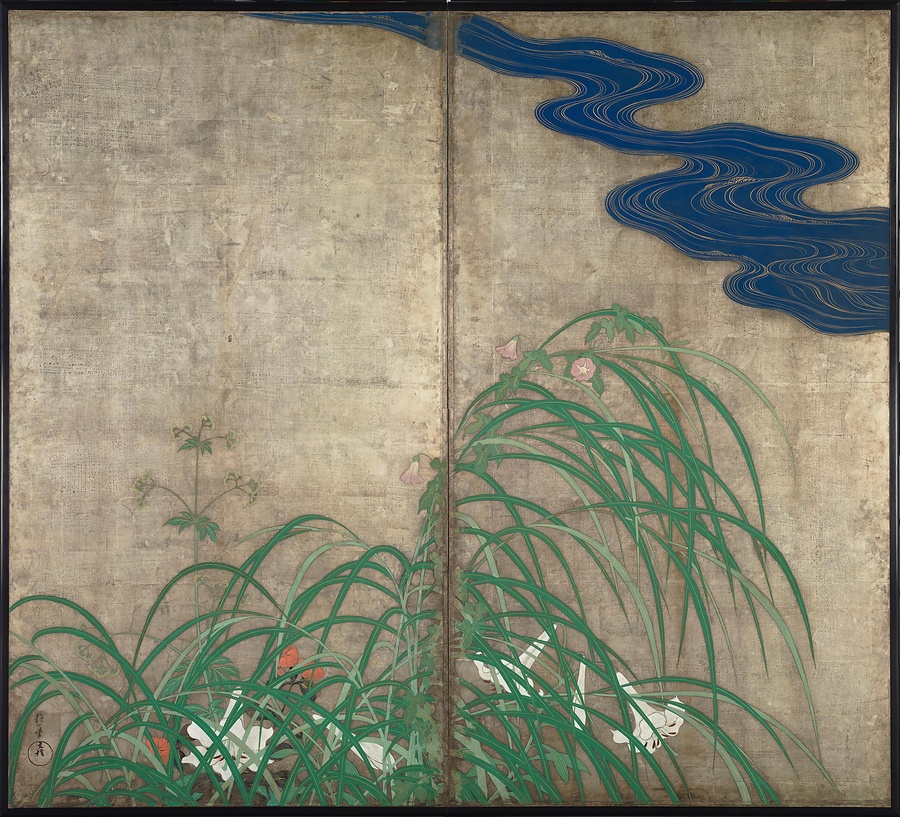
Right screen, summer grasses: once behind the Thunder God, plants after a sudden rain, with a stream
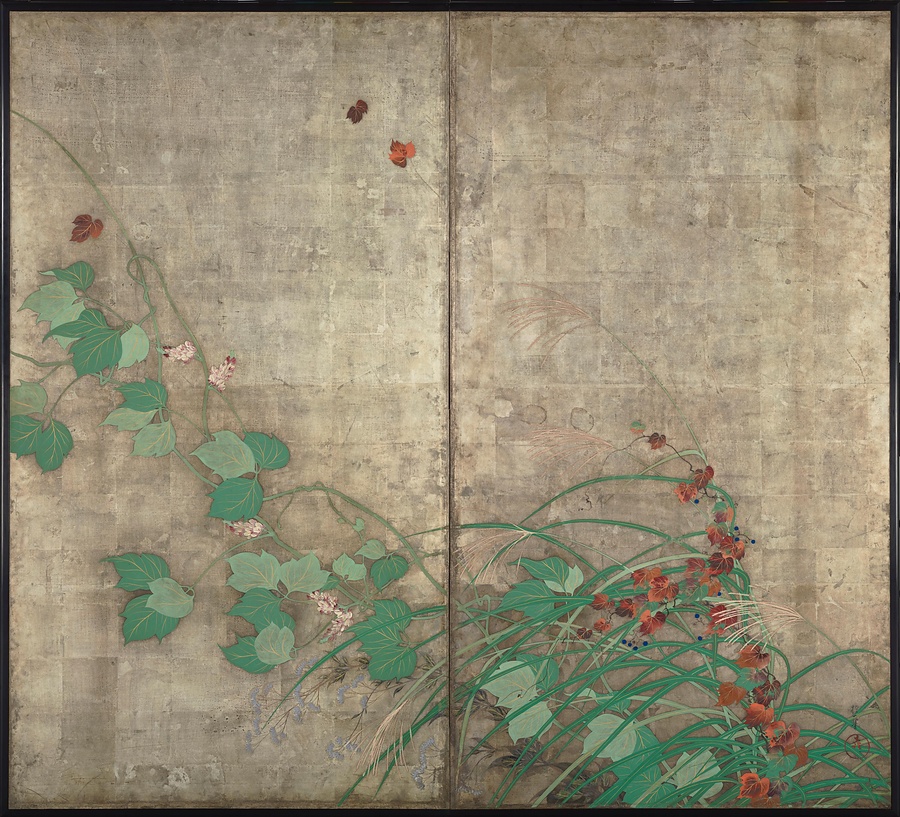
Left screen, autumn grasses: once behind the Wind God, plants blown by the wind
Tokyo National Museum, Sakai Hōitsu, Flowering Plants of Summer and Autumn (Edo period, 19th century)
Edo Rinpa is softer and more lyrical than the Kyoto version. Hōitsu liked silver grounds, pale colors, autumn grasses, the moon and small creatures, with a seasonal feeling close to haiku. His pupil Suzuki Kiitsu (1796–1858) went in the opposite direction, toward intense color and strange, crowded compositions. Kiitsu’s Morning Glories in the Metropolitan Museum covers a pair of gold screens with tumbling vines of blue flowers that almost vibrate. Kiitsu was little known for a long time, but he has become a favorite in Japan in recent years, especially after a major retrospective at the Suntory Museum of Art in Tokyo in 2016.
06From Folding Screens to Modern Design
During the Meiji era Rinpa was sometimes dismissed at home as old-fashioned merchant decoration, but it found new admirers abroad. Japanese art and design books, including copies of Hōitsu’s Kōrin album, reached Paris during the vogue for Japonisme, and European designers of the late nineteenth century responded to the empty space, flat color and repeated flower forms. Echoes of Rinpa appear in Art Nouveau design. People often compare Gustav Klimt’s gold-ground paintings with Rinpa screens; whether he looked at Rinpa directly is debated, but the family resemblance is easy to see.
In Kyoto, the designer Kamisaka Sekka (1866–1942) revived the style for a modern audience. His woodblock-printed album Momoyogusa ("Flowers of a Hundred Worlds"), published around 1909–1910, uses flat color and Kōrin-like simplification for flowers, waves and people, and Sekka also created designs for lacquer, ceramics and textiles. He returned Rinpa to where it had always been happiest: in objects people used.
After the Second World War, Japanese graphic designers drew on the same tradition. The posters of Tanaka Ikkō, with their bold planes of color and simplified geometric forms, are often described as Rinpa translated into modern graphic design. And Rinpa motifs never left everyday life. Kyoto confectioners still make nerikiri sweets in the shape of Kōrin’s plum and yōkan jellies with flowing-water patterns. Fans, kimono, obi, stationery and furoshiki wrapping cloths use the combination of gold, autumn grasses and stylized waves without anyone stopping to name its source. In 2015 Kyoto marked "Rinpa 400," counting from Kōetsu’s move to Takagamine four centuries before.
07Where to See Rinpa
Most major Rinpa works are screens and scrolls that are sensitive to light, so they spend most of the year in storage and appear only for limited periods. Check the museum’s schedule before you plan a trip around a particular piece.
The easiest to plan for is Irises at the Nezu Museum in Aoyama, Tokyo. It is usually shown for a few weeks from mid-April into May, timed to the flowering of real irises around the pond in the museum’s garden, so you can see Kōrin’s blue on the screen and then outside in the water. The MOA Museum of Art in Atami, an easy day trip from Tokyo by bullet train, normally shows Red and White Plum Blossoms in the plum season around February. Its grounds have their own red and white plum trees, and the museum also displays a reconstruction of the golden tea room of Toyotomi Hideyoshi.
In Kyoto, Sōtatsu’s Wind God and Thunder God appears from time to time at the Kyoto National Museum. When it is not on view, the reproduction at Kennin-ji gives a fair idea of its scale, and the temple’s ceiling painting of twin dragons makes the visit worthwhile in any case. Yōgen-in, across the road from Sanjūsangen-dō, still keeps Sōtatsu’s painted doors. Kōetsu-ji at Takagamine is a quiet, leafy temple best in autumn, reached by bus from central Kyoto. The Hosomi Museum near Heian Shrine specializes in Rinpa and holds small, carefully made exhibitions.
In Tokyo, the Tokyo National Museum owns Kōrin’s Wind God and Thunder God, Hōitsu’s Summer and Autumn Grasses and the Funabashi writing box, which rotate through its galleries and special exhibitions. The Idemitsu Museum of Arts also has strong holdings of Hōitsu and Kiitsu, but its Marunouchi galleries closed at the end of 2024 while their building is rebuilt, and as of 2026 they have not reopened.
When you stand in front of a Rinpa screen, begin from a few steps back. These works were made to be seen from a seated position on tatami, as a whole, in a dim room. Take in where the masses of color sit on the gold and how much is left empty. Then move close to look at the pooled tarashikomi, the sheen of gold and silver pigment, and the brushwork in a single petal. Under museum lighting gold leaf can look flat. In a room lit by daylight from the garden or by a lamp, it shifts and glows as you move, and that changing light is what these painters had in mind.