
At a glance
How the yukata moved from bathhouse robe to summer outing wear, what its dyes and patterns mean, where the jinbei fits in, and how to wear one properly.
- The word yukata is short for yukatabira, the thin hemp robe Heian aristocrats wore in the steam bath.
- In the Edo period, as cotton spread and public bathhouses multiplied, the yukata became a summer robe worn after bathing.
- Classic yukata are indigo and white, dyed by the long-board nagaita chūgata method or by chūsen pouring, which arose in Ōsaka in the late 1880s.
- The jinbei is a two-piece outfit whose top closes with inner and outer ties instead of a sash; it is more casual than a yukata.
- Wear a yukata left side over right, so the collar forms a lowercase y; right over left is how the dead are dressed.
On a July evening in Tokyo, the trains heading toward the Sumida River fill up with people in yukata: young women in indigo cotton printed with morning glories, their hair pinned up, wooden geta clacking on the platform; couples in matching stripes; small boys in two-piece jinbei with goldfish on the shorts. At a hot-spring town a few hours away, every guest at the inn is wearing the same blue-and-white robe, strolling between bathhouses with a towel in hand. The yukata began life as something you wore in or after the bath. Over several centuries it walked out of the bathhouse and became the easiest, most seasonal piece of traditional clothing Japan still wears. This is an introduction to what it is, why it looks the way it does, how its fabrics are dyed, where its little cousin the jinbei fits in, and how to wear one yourself without embarrassment.
01A Garment Named for Bathing
The word yukata is a contraction of yukatabira, "bathing katabira" (written either 浴帷子 or 湯帷子). A katabira was an unlined robe of hemp or ramie. As early as the Heian period (794–1185), it is generally said, aristocratic bathing usually meant a steam bath rather than a soak, and bathers wore a thin hemp robe inside the steam room, partly for modesty, partly to absorb sweat and keep the skin from the heat. That robe was the yukatabira, and it was an indoor, upper-class garment with little resemblance to anything you would see on a street today.
Over the following centuries the robe shifted to the moment after the bath, when it served to blot moisture from the body, and from the late Muromachi into the early Edo period, as Bon dancing spread, ordinary people began to wear it too. The decisive change came in the Edo period (1603–1868), and it had two causes. First, cotton spread across Japan. Summer clothing had long meant hemp, which is stiff and coarse; cotton was softer, absorbed sweat better, and became cheap enough for ordinary townspeople. Second, Edo and Ōsaka filled with public bathhouses, sentō, where people soaked naked in hot water. Nobody wore a robe into the bath anymore, so the yukata became what you put on after it: a light cotton robe for walking home, lounging in the cramped row-houses of the city, and stepping out on a hot night to catch the breeze by the river.
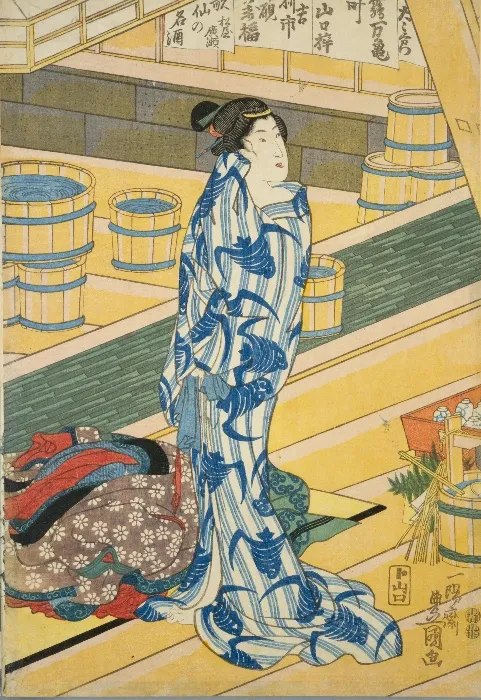
Utagawa Toyokuni III, New Year’s First Bath (detail): a woman at the bathhouse wrapped in a blue-and-white yukata.National Diet Library, Utagawa Toyokuni III, first bath of the New Year (late Edo period, ukiyo-e)
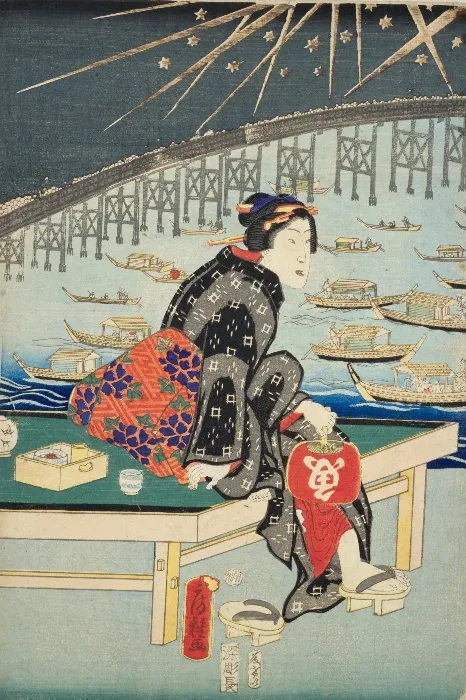
Woodblock prints of the period are full of these figures, fanning themselves on bridges or watching fireworks over the Sumida. Even so, the yukata kept its informal status for a long time. It was closer to loungewear or sleepwear than to clothes for visiting, and wearing it to call on someone would have been rude. That origin still shapes how Japanese people think of it: the yukata is for summer, for leisure, for evenings off.
02Why It Is Built This Way
A yukata is cut exactly like a kimono: straight panels of cloth sewn together into a T-shaped robe, the front panels overlapped and held closed with a sash, or obi. The difference is in what is left out. A yukata has no lining, and it is not worn over the long under-robe, the nagajuban, that goes beneath a formal kimono. It is usually a single layer of cotton against the skin, and that is the whole point.
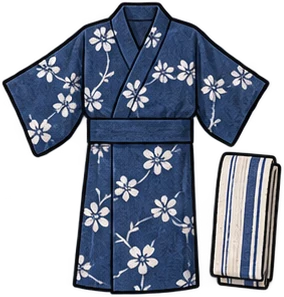
Straight-cut body, wide sleeves, and overlapping front panels held by a sash; a folded sash lies on the right.
The wide sleeves and loose hem pump air as you walk. Cotton soaks up sweat without clinging. When the day is over, you can wash it in plain water and hang it to dry, which you could never do with silk. Traditional yukata fabrics are chosen for this. Plain-weave cotton is smooth and takes dye crisply. Crinkled weaves such as shijira and chijimi have a fine puckered texture that holds the cloth slightly away from the skin, which makes them noticeably cooler. Cotton-hemp blends are crisp and breathable. Inexpensive modern yukata are often polyester, which resists wrinkles but traps heat, and people who wear yukata regularly tend to avoid it.
Everything else in the outfit is equally light. You wear geta, wooden sandals, on bare feet, with no split-toe tabi socks. Women tie a hanhaba obi, a half-width sash much narrower and lighter than the formal obi of a silk kimono, often in a bow at the back. Men wear a stiff narrow kaku obi or a soft, scarf-like heko obi, knotted low on the hips. With a little practice the whole thing goes on in a few minutes, which is why the yukata has survived when most kimono have not: it is the member of the kimono family with the lowest barrier to entry.
03Indigo and White: How Yukata Are Dyed
Ask a Japanese person to picture a yukata and many will describe white patterns on indigo, or indigo patterns on white. The pairing makes sense. Indigo, made by fermenting the leaves of the indigo plant, hides dirt, survives repeated washing, and grows softer and deeper with age; there was also an old belief that indigo-dyed cloth kept away insects and snakes. White reads as cool in the heat.
The classic Edo technique is called nagaita chūgata, "long-board medium pattern." The dyer lays the cotton out on a wooden board about 6.4 meters long, places a carved paper stencil over it, and spreads a paste of rice flour through the stencil to resist the dye. Then the cloth is turned over and the same pattern is pasted on the back, aligned exactly with the front, before the whole length is dipped in the indigo vat. Because both sides are resisted, the white pattern is sharp on the front and the back alike. Chūgata, originally meaning a medium-sized pattern, became almost a synonym for yukata. The method is slow, few workshops still practice it, and its leading craftsmen have been designated Living National Treasures. The stencils themselves are a craft of their own: Ise katagami, cut from layers of mulberry paper bonded with persimmon tannin in the Suzuka area of Mie Prefecture, supplied dye shops across the country.
- 1Lay out the cottonon a board about 6.4 meters long
- 2Paste the frontstencil, then resist paste
- 3Paste the backaligned exactly with the front
- 4Dip in indigothe whole length
- 5Sharp on both sidesa clean white pattern
Both sides are pasted before the cloth goes into the indigo, so the pattern is sharp on front and back alike.
Around the late 1880s another method appeared in Ōsaka, called chūsen, "poured dyeing"; it was devised for hand towels and later applied to yukata. The cloth is folded back and forth into a thick stack, with resist paste applied layer by layer, and dye is poured in from above through a spouted can so that it soaks down through the whole pile. Front and back color at once, and the dyer can pour two or three colors into one area and let them bleed softly into each other. The result has gentle edges and a handmade look, and it is far faster than the long-board method. Chūsen is centered in places like Sakai in Ōsaka Prefecture, Hamamatsu, and the Tokyo area, and it is also how most tenugui, the thin cotton hand towels sold everywhere in Japan, are dyed.
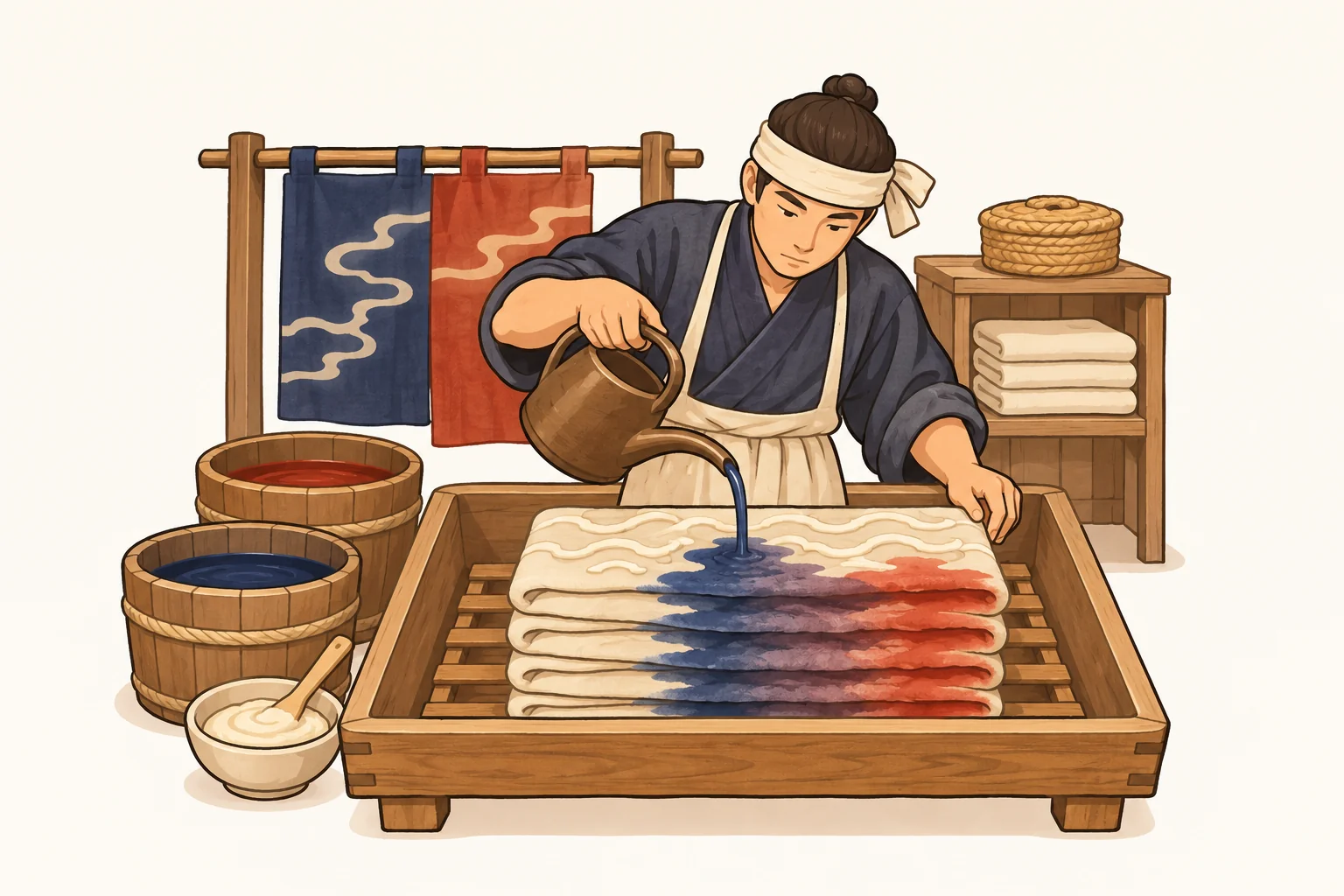
Chūsen dyeing: dye poured through a spouted can into a folded stack of cloth layered with resist paste.
A third family is shibori, tie-dyeing. Arimatsu and Narumi, on the old Tōkaidō highway just outside Nagoya, have made shibori since the Edo period, binding tiny pinches of cloth with thread before dyeing to produce dense dots and nets of pattern. Arimatsu shibori yukata keep a crinkled texture that springs away from the body, and they are among the most prized.
Most yukata sold today are machine-printed, which has freed up both color and design: pink, yellow, black grounds with big florals, anything goes. A hand-dyed yukata can cost ten times as much. What you are paying for is the feel of the cloth, the depth of the color, and how good it still looks after years of washing.
04Patterns of Summer
Yukata designs are almost always about summer, or about feeling cool. The morning glory, asagao, is the classic; Edo gardeners went through a craze for breeding strange varieties of it, and its early-morning summer bloom matches the yukata season exactly. Goldfish, dragonflies, fireflies, paper fans, fireworks, flowing water, waves, bamboo, bellflowers, pinks, and hydrangeas are all common. The dragonfly had a nickname, kachimushi, "victory insect," said to come from the way it flies forward and never back, and it often appears on men’s yukata for that reason.
Geometric patterns are popular too. Fine vertical stripes make the wearer look tall and neat. The asa-no-ha, a six-pointed hemp-leaf star, is said to express a wish that a child grow as fast and straight as hemp, and was long used for children’s clothing. Men’s yukata tend toward navy, gray, black, and brown with quiet patterns; women’s run the full range. There is an older convention that young women wear bright colors and big flowers and move toward darker grounds, smaller motifs, and stripes as they get older, but it is loosely observed now.
Inn yukata are their own genre. A ryokan (traditional inn) or hot-spring hotel usually has yukata made with its name or crest printed in a small repeating blue-on-white pattern. Guests wear them throughout the building and out into the town, adding a padded over-jacket called a tanzen or a short haori when it is cool. When a street fills with people in identical robes, you know they are all staying at the same place.
05Jinbei: The Two-Piece Cousin
The jinbei is related to the yukata but built differently. It comes in two pieces. The top looks like a short kimono jacket, with overlapping front panels, but instead of a sash it closes with pairs of fabric ties sewn inside and outside the front, knotted at the side. The bottom is a pair of loose shorts that reach about the knee. The sleeves are short and wide, and the side seams are often left partly open or joined with a decorative open cross-stitch called chidori kagari, so air moves through freely.
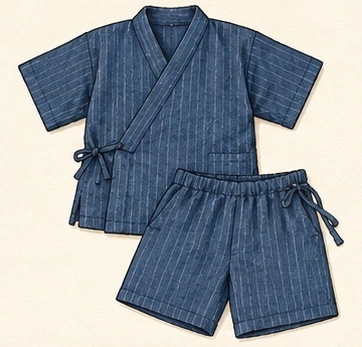
A short-sleeved top with overlapping front panels closed by fabric ties at the side, worn with matching shorts.
Where the name comes from is uncertain; it is also written jinbē. One story says a man named Jinbē first made the garment. Another holds that in the late Edo period a sleeveless commoner’s vest looked enough like the jinbaori, the sleeveless coat samurai wore over armor in camp, to be called a "jinbē haori." These are later explanations, not documented history. The early jinbei was a sleeveless vest, sometimes lined or padded for winter; the unlined summer top with tube sleeves and tie closures spread from the Kansai region in the nineteenth century, and the matching shorts that complete today’s two-piece set are a more recent addition.
The jinbei began as men’s wear at home, and it largely still is. A father or grandfather in a jinbei after his evening bath, sitting on the veranda with a beer and the baseball game on TV, is a stock image of the Japanese summer. Because there is no sash to loosen and no front to fall open, you can sit cross-legged, run around, or do chores in one, which makes it ideal for children; at any summer festival you will see small boys in jinbei printed with goldfish, dinosaurs, or traditional patterns. In the past fifteen years or so, jinbei for women and girls have become common as well, in brighter colors and sometimes with skirt-like shorts, and some young people find them an easier option than a yukata.
The jinbei is still a step more casual than the yukata. A yukata is fine for fireworks, festivals, and a summer dinner out. A jinbei belongs at home, in the neighborhood, and at festivals, and in a more formal setting it looks like pajamas. Staff at izakaya and festival stalls often wear jinbei in summer precisely because it signals a relaxed, friendly atmosphere.
06Fireworks, Bon Dances, and Hot-Spring Towns
After the Meiji era brought Western dress into daily life, the yukata retreated to the home and the inn, and by the late twentieth century few Japanese wore one in public. The revival came from around the 1990s onward. Department stores and clothing chains began marketing yukata as summer fashion, affordable sets of yukata, obi, and geta appeared on store racks, and magazines ran yukata features every June. Young women took to the yukata as the thing to wear on a summer date or to the fireworks. Today, in July and August, the crowds at the Sumida River fireworks in Tokyo, the Tenjin Festival in Ōsaka, or the big displays at Nagaoka and Ōmagari are a sea of cotton prints.
The yukata has three natural habitats. The first is the fireworks show, hanabi taikai, and the summer festival, where wearing one is part of the celebration. The second is the Bon dance, held during the Obon season in mid-August, when towns set up a raised stage in a shrine yard or plaza and dance in rings around it. Big dance festivals like Awa Odori in Tokushima and Gujō Odori in Gifu draw dancers in matching yukata, and spectators in their own yukata join in. In Gujō the all-night dances continue until dawn, and the beat of hundreds of geta on the street is part of the music.
The third is the hot-spring town. Kinosaki Onsen in Hyōgo Prefecture is the model: seven public bathhouses strung along a willow-lined river, and guests walk from one to the next in their inn’s yukata and geta, so that the whole town behaves like the corridor of one large inn. Kyoto has its own yukata season during the Gion Festival in July, when streets around Shijō close to cars on the nights before the great procession and people in yukata wander among the illuminated floats, eating street food and buying charms. In Kyoto and in Tokyo’s Asakusa, kimono rental shops switch to yukata for the summer and will dress you, do your hair, and send you out the door within an hour or two.
07How to Wear One
The one rule that matters most: the left side goes over the right. From the wearer’s own point of view, you wrap the right panel against your body first and then lay the left panel over it, so that from the front the collar forms a lowercase "y." Right over left is how the dead are dressed for burial, and Japanese people will notice instantly. The rule is the same for men and women.
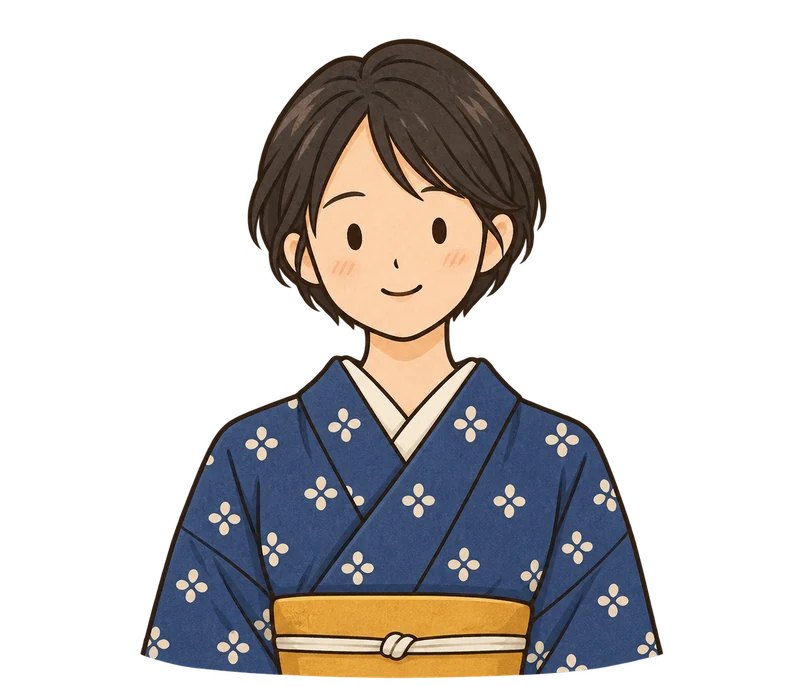
The wearer’s left panel lies over the right, so from the front the collar forms a lowercase y.
Women’s yukata are cut longer than the wearer’s height. The extra length is folded up at the waist and tied with a cord, creating a neat tuck called the ohashori, and the obi goes on over that. The hem should fall around the ankle, just showing the geta. The collar sits slightly away from the nape of the neck at the back, which Japanese eyes find graceful. Men’s yukata are cut to height with no tuck, and the obi sits low, on the hips rather than at the waist; a little belly pushing forward over it is considered to look right.
Geta take some getting used to. They are worn with the heel hanging just slightly off the back, and you walk with short steps, toes turned a little inward. The thong rubs between the toes, and first-timers often end up with a blister there; a bandage applied before you go out solves the problem. Hold your sleeve with your other hand when reaching for something high or across a table. Smooth the back of the robe before you sit so it does not crease, and gather the hem and sleeves when using the toilet.
At a ryokan, the house yukata can be worn to dinner, to the baths, around the building, and out on the streets of a hot-spring town, but it is better to change before going to a proper restaurant or leaving the resort area. Wear underwear beneath it. Sizes usually run small, medium, and large by height, and the front desk will swap one that is too short. You can sleep in it, though you will wake to find it has come undone overnight, and Japanese guests have the same problem.
Outside the inn, the yukata is a summer garment, worn roughly from June to early September and above all in July and August. Wearing one in autumn looks out of season. A yukata also makes a good souvenir: it is inexpensive, it packs flat, it washes easily, and back home on a hot night it brings a little of the Japanese summer with it.