
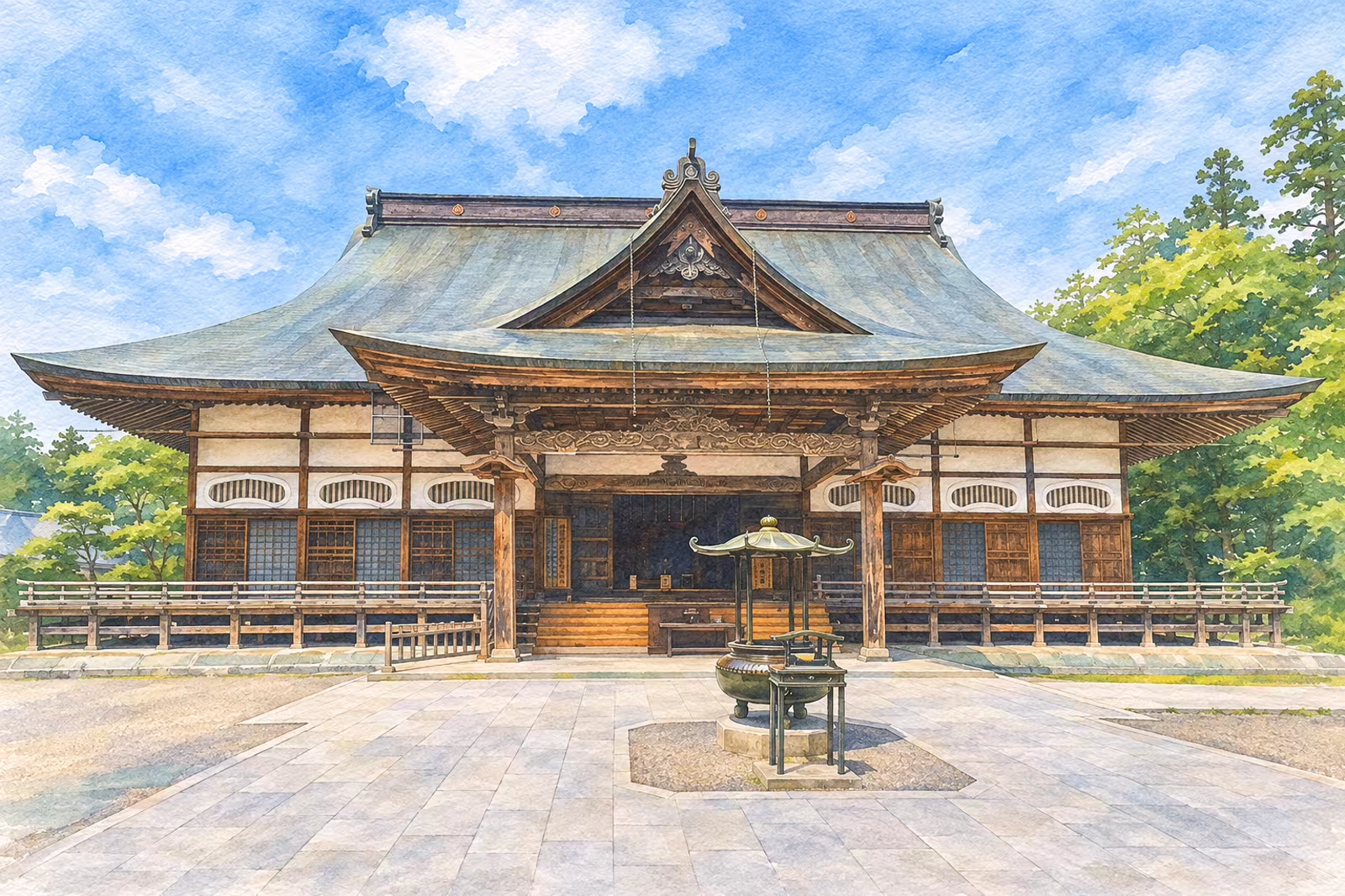
Chūson-ji is a Tendai Buddhist temple on a wooded hill in Hiraizumi, Iwate Prefecture. In the twelfth century the Northern Fujiwara ruled northeastern Japan from Hiraizumi, and Chūson-ji was their principal temple. Its Golden Hall, completed in 1124 and covered in gold leaf inside and out, holds the remains of four generations of the family and was among the first buildings designated a National Treasure. In 2011 the temple was inscribed on the World Heritage List as part of Hiraizumi.
01Fujiwara no Kiyohira and the founding
Temple tradition says Chūson-ji was founded in 850 by the monk Ennin, but its real growth began with Fujiwara no Kiyohira. Kiyohira lived through the Former Nine Years’ War and the Later Three Years’ War, lost close family in the fighting, and emerged as ruler of the north. In the early twelfth century he built temples along the main road into Hiraizumi; by one account there were more than forty halls and pagodas and over three hundred monks’ lodgings. A dedication text of 1126 is said to express his wish to pray for the dead of both sides and to build a Buddhist land in the northern frontier.
02The Golden Hall and the fall of the Fujiwara
The Golden Hall is small, about five and a half meters square. Its wooden frame is covered in gold leaf, and its altars are decorated with mother-of-pearl, lacquer, and metalwork, with an Amida Buddha at the center. Beneath its three altars lie the bodies of Kiyohira, Motohira, and Hidehira, and the head of Yasuhira. In 1189 Minamoto no Yoritomo invaded the north; Yasuhira was killed and the Northern Fujiwara fell. That same year Minamoto no Yoshitsune, who had taken refuge in Hiraizumi, died at Koromogawa. The Kamakura shogunate continued to protect the temple, but a fire in 1337 destroyed most of its buildings; the Golden Hall and the sutra repository were among the few that survived. In 1689 the poet Matsuo Bashō visited and wrote a haiku about the hall, which the early summer rains seemed to have left untouched.
03What can be seen today
The Golden Hall itself is twelfth-century. It was enclosed in a protective outer building from the Kamakura period onward, dismantled and repaired between 1962 and 1968, and now stands behind glass inside a reinforced-concrete shelter completed in 1965; the older shelter was moved nearby. The hall is a National Treasure, and the sutra repository is an Important Cultural Property. The Buddhist canon the Fujiwara commissioned, written in alternating lines of gold and silver on indigo paper, is also a National Treasure, though most of it later went to Kongōbu-ji on Mount Kōya and elsewhere. Temple treasures are kept in the Sankōzō museum. The present main hall dates from 1909, and the Noh stage of Hakusan Shrine, rebuilt in the late Edo period, is an Important Cultural Property. Tall cedars line the Tsukimizaka approach, along which smaller sub-temples and halls are scattered.
Chūson-ji (Hiraizumi)
01A Temple Above a Lost Capital
Chūson-ji stands on a wooded ridge called Kanzan, on the west bank of the Kitakami River in southern Iwate Prefecture. Most visitors climb to it up the Tsukimizaka, the "moon-viewing slope", a long avenue lined with tall cedars planted by the Sendai domain in the Edo period. Small halls appear along the way, and the main hall and the famous Golden Hall wait near the top.
The town below, Hiraizumi, is quiet today. In the twelfth century it was the largest city in northern Japan and, by the estimate of many archaeologists, second only to Kyoto in the whole archipelago. For close to a hundred years it was the seat of four generations of a warrior family known as the Ōshū Fujiwara, or Northern Fujiwara. Their residence stood on the riverbank; great temples such as Mōtsū-ji and Muryōkō-in rose around it; and excavations have turned up Chinese ceramics and Kyoto-style tableware in quantities found almost nowhere else outside the capital.
Chūson-ji was the first and most important of Hiraizumi’s temples. To understand why it exists, you have to start with the man who built it.
02Legend and Founder
The temple’s own tradition says it was founded in 850 by Ennin, a celebrated monk of the Tendai school of Buddhism, during a journey through the north. Many old temples in northeastern Japan claim Ennin as their founder, and historians treat this as later temple lore.
The real founder was Fujiwara no Kiyohira, who by the usual account began building on the ridge in 1105, after moving his residence to Hiraizumi. According to a list of Hiraizumi’s temples preserved in the Azuma Kagami, the official chronicle of the Kamakura shogunate, his first structure stood at the center of the hill: a temple enshrining the Buddhas Śākyamuni and Prabhūtaratna seated side by side. He also had wooden markers painted with golden images of Amida, the Buddha of the Western Pure Land, set up at regular intervals along the main road from the Shirakawa barrier in the south to Sotogahama at the northern tip of Honshū, so that Chūson-ji sat at its symbolic center. Building went on for more than twenty years.
03Kiyohira, Survivor of Two Wars
Kiyohira’s life explains much of what he built. In the mid-eleventh century the northern part of Mutsu Province, a region called the Six Districts of Oku, was controlled by the Abe family. The court sent the warrior Minamoto no Yoriyoshi against them, and a long conflict known as the Former Nine Years’ War followed. Kiyohira’s father, Fujiwara no Tsunekiyo, was married to a daughter of the Abe chief and fought on the Abe side. When the Abe were destroyed in 1062, Tsunekiyo was captured and executed; later accounts say Yoriyoshi had him beheaded slowly with a blunt sword as punishment for his betrayal.
Kiyohira was a small child. His mother, now a defeated man’s widow, was married to Kiyohara no Takesada, a lord of neighboring Dewa Province who had helped the court win. Kiyohira grew up as a stepson in the Kiyohara household. Two decades later that household tore itself apart. Kiyohira, his half-brother Iehira and his stepbrother Sanehira fought one another, and Minamoto no Yoshiie, Yoriyoshi’s son, intervened as governor of Mutsu. In this Later Three Years’ War (1083–1087), Iehira killed Kiyohira’s wife and children. In the end Kiyohira and Yoshiie took the Kanezawa stockade together and the Kiyohara were finished.
Kiyohira emerged as the sole master of the north. He took back his father’s surname, Fujiwara, and around the end of the eleventh century moved his base south to Hiraizumi, at the southern edge of his lands and facing the road to Kyoto.
04The Dedication of 1126
In 1126 Chūson-ji was formally dedicated in a great ceremony. The dedicatory prayer composed for it describes a "great temple for the protection of the nation" with a main hall, a three-storied pagoda, a two-storied sutra repository, a bell tower, a great gate and a large pond. The text is generally attributed to the Kyoto scholar Fujiwara no Atsumitsu. The original is lost; Chūson-ji keeps two later copies, one dated 1329 and one made by the courtier-general Kitabatake Akiie in the 1330s. A few scholars have argued the text is a later forgery, but most still read it as Kiyohira’s own statement.
The prayer contains the passage most often quoted about Hiraizumi. Kiyohira asks that the temple bring peace to the spirits of everyone who died in the wars of the north, government soldiers and "barbarians" alike, and even the birds, beasts and fish that were killed, so that all might be reborn in the Pure Land. In the same text he calls himself the chieftain of the distant eastern barbarians, at once owning his frontier origins and placing his realm under the emperor and the Buddha. Hiraizumi sent gold, horses and northern goods to Kyoto every year; Chūson-ji was a statement that the north belonged to the same Buddhist and imperial order.
Kiyohira died in 1128, aged 73 by the traditional Japanese count.
05The Konjikidō
Of everything Kiyohira built, one building survives whole: the Konjikidō, or Golden Hall, also called the Hikaridō, "Hall of Light". An ink inscription on its ridgepole records that the frame was raised in 1124.
It is small, three bays on each side and only about five and a half meters across. What makes it extraordinary is that nearly every surface, outside and in, is covered with gold leaf. Inside, four pillars and three altar platforms are inlaid with mother-of-pearl cut from the turban shell of southern seas, along with ivory, gems, lacquer with sprinkled gold, and openwork gilt metal fittings. Gold panned from the rivers of the north, shell from the islands south of Kyūshū, and ivory that came by way of China all meet in this one room, a direct record of how far Hiraizumi’s wealth and trade reached.
Each of the three platforms was set with a group of eleven statues: Amida flanked by two attendant bodhisattvas, six figures of Jizō, and two guardian kings. Beneath the platforms lie the remains of the family. Kiyohira is under the central platform; his son Motohira and grandson Hidehira lie under the other two; and, by the usual account, a box in Hidehira’s platform holds the head of the fourth lord, Yasuhira. Exactly which side platform belongs to which lord has been argued over by scholars, partly on the evidence of the statues’ dates.
The hall began as Kiyohira’s own funerary chapel; the side platforms were added later for his successors. Laying one’s body at the feet of Amida inside a golden replica of paradise was the most direct expression possible of the Pure Land faith that swept late Heian Japan.
06The Mummies and the Lotus Seeds
In 1950 a research team organized by the Asahi newspaper examined the remains. All four were there. The three lords had survived as desiccated mummies, and Yasuhira’s skull showed sword cuts and a nail hole, matching the Azuma Kagami’s account that his head was nailed up for display after his death.
Whether the bodies were deliberately preserved remains debated; some scholars think some treatment was involved, others credit the dry interior and the coffins.
Inside Yasuhira’s head box the team also found more than a hundred lotus seeds. Decades later several were germinated, and the plants first flowered in 1998. The "Chūson-ji lotus" now blooms in the temple’s ponds each summer.
07Motohira and Hidehira
After Kiyohira’s death his sons fought over the inheritance, and Motohira won. Motohira put his energy into Mōtsū-ji, a temple just south of Chūson-ji that contemporaries thought even grander; his wife founded Kanjizaiō-in beside it.
Under the third lord, Hidehira, Hiraizumi reached its height. In 1170 the court appointed him Commander of the Pacification Headquarters, the old military office for the north, and in 1181 governor of Mutsu, giving him formal authority over the region. He built Muryōkō-in, modeled on the Phoenix Hall of the Byōdō-in at Uji but on a larger scale.
Those were the years of the Genpei War between the Taira and Minamoto clans. Both sides courted Hidehira, but he stayed neutral, and rumors of the cavalry he could field kept Kamakura cautious.
08Yoshitsune Comes North
Minamoto no Yoshitsune, the most famous general of the Genpei War, came to Hiraizumi twice. As a teenager he left the temple of Kurama north of Kyoto and traveled to Hidehira’s court; legend says he was guided by Kichiji, a gold merchant who traded between Kyoto and the north. When his half-brother Minamoto no Yoritomo rose against the Taira in 1180, Yoshitsune hurried south to join him, and went on to win the battles of Ichinotani, Yashima and Dannoura that destroyed the Taira.
Victory turned the brothers into enemies. Hunted by Yoritomo, Yoshitsune wandered in hiding and in 1187 reached Hiraizumi again. Hidehira took him in, then died that winter. The diary of the Kyoto courtier Kujō Kanezane, the Gyokuyō, records that on his deathbed Hidehira told his sons to treat Yoshitsune as their lord and stand together against Kamakura.
His heir Yasuhira could not hold that line. Yoritomo pressed him, and the court issued orders for Yoshitsune’s arrest. On the thirtieth day of the intercalary fourth month of 1189 (June 15 in the Julian calendar), Yasuhira’s men attacked Yoshitsune’s residence on the Koromo River. Yoshitsune took his own life; he was 31 by the traditional count. His head was preserved in sake and sent to Kamakura.
The bluff called Takadachi above the Kitakami River is traditionally identified as the place he died. A small hall dedicated to him was built there in the Edo period by the Date lord of Sendai. The stories that Yoshitsune escaped to Hokkaidō, or even to the continent, are later legends.
09The Fall of Hiraizumi
Killing Yoshitsune did not save Yasuhira. That summer Yoritomo led a large army north, accusing the Fujiwara of having harbored the fugitive. After the defensive line at Atsukashiyama broke, Yasuhira burned his residence and fled north, and in the ninth month he was killed by his own retainer, Kawada Jirō. Yoritomo had Yasuhira’s head nailed up for display; it is the head that lies in the Golden Hall today.
When Yoritomo entered Hiraizumi, monks of Chūson-ji and Mōtsū-ji presented him with an inventory of their temples and asked for protection. That inventory, copied into the Azuma Kagami, is still the best description of the city’s temples at their height. Yoritomo granted the request, and Chūson-ji survived the war intact. Back in Kamakura he built the temple of Yōfuku-ji, modeled partly on a hall he had seen at Chūson-ji.
10Fire and Decline
Without its patrons the temple declined under the Kamakura shogunate’s supervision. In 1288 the shogunate repaired the Golden Hall and built a wooden shelter around it to protect it from the weather. In 1337 a fire swept the ridge and destroyed most of the remaining buildings; the Golden Hall and parts of the sutra repository survived. Through the Warring States period the temple shrank further. In the Edo period Hiraizumi lay within the Sendai domain, and the Date family repaired and protected what was left.
11Bashō’s Visit
In the summer of 1689, five hundred years after the fall of the Fujiwara, the poet Matsuo Bashō arrived in Hiraizumi with his companion Sora on the journey he would describe in Oku no Hosomichi (The Narrow Road to the Deep North). He climbed Takadachi first and looked out over the Kitakami and Koromo rivers. In the most famous passage of the book he reflects that three generations of glory had passed like a single dream, recalls Du Fu’s line that the nation falls but the mountains and rivers remain, and sits weeping on the grass. Then comes the haiku:
natsukusa ya / tsuwamonodomo ga / yume no ato: summer grass, all that remains of warriors’ dreams.
At Chūson-ji he saw the sutra hall and the Hall of Light. He notes the coffins of the three lords and the three Buddhas, and writes that the hall’s jewels were scattered and its pillars weathered, and that it would have crumbled into grass if a shelter had not been built around it. His second poem:
samidare no / furinokoshite ya / hikaridō: has the early summer rain left it untouched, the Hall of Light?
Stones carved with both poems stand at Takadachi and at Chūson-ji.
12What You See Today
In 1951 the Golden Hall became one of the first buildings designated a National Treasure under Japan’s postwar cultural property law. Between 1962 and 1968 it was dismantled and fully restored, its gold leaf and inlay renewed. The old wooden shelter, in its present form thought to be a Muromachi-period (fifteenth-century) rebuilding, was moved about a hundred meters away in 1964 and replaced by a modern concrete one, inside which the hall now sits behind glass in a climate-controlled room. The old shelter, an Important Cultural Property, still stands nearby and can be entered.
Walking up Tsukimizaka, you first reach the Hondō, the main hall, rebuilt in 1909. Further along is the Sankōzō, the temple museum, with three large seated Heian-period Buddhas, among them the Amida that was once the main hall’s principal image, the mother-of-pearl octagonal altar from the sutra repository, and treasures from the Golden Hall such as gilt-bronze ornaments. The Golden Hall itself is next to it. North of it stand the sutra repository, an Important Cultural Property rebuilt in the late Kamakura period with Heian timbers; the old shelter; a stone with Bashō’s poem; and the Noh stage of the Hakusan Shrine, rebuilt in 1853 and also an Important Cultural Property.
The temple’s most famous manuscript set, a complete Buddhist canon written in alternating lines of gold and silver on indigo paper and commissioned by Kiyohira, mostly left Hiraizumi around the turn of the seventeenth century; most of it is now at Kongōbu-ji on Mount Kōya, and Chūson-ji keeps only fifteen scrolls.
In 2011 "Hiraizumi – Temples, Gardens and Archaeological Sites Representing the Buddhist Pure Land" was inscribed as a UNESCO World Heritage Site, with Chūson-ji at its core. From the ridge you can still see the logic of Kiyohira’s choice: the temple on the height, the city below, the river to the east, and beyond it, northward, the lands his father’s and mother’s families had once ruled.