
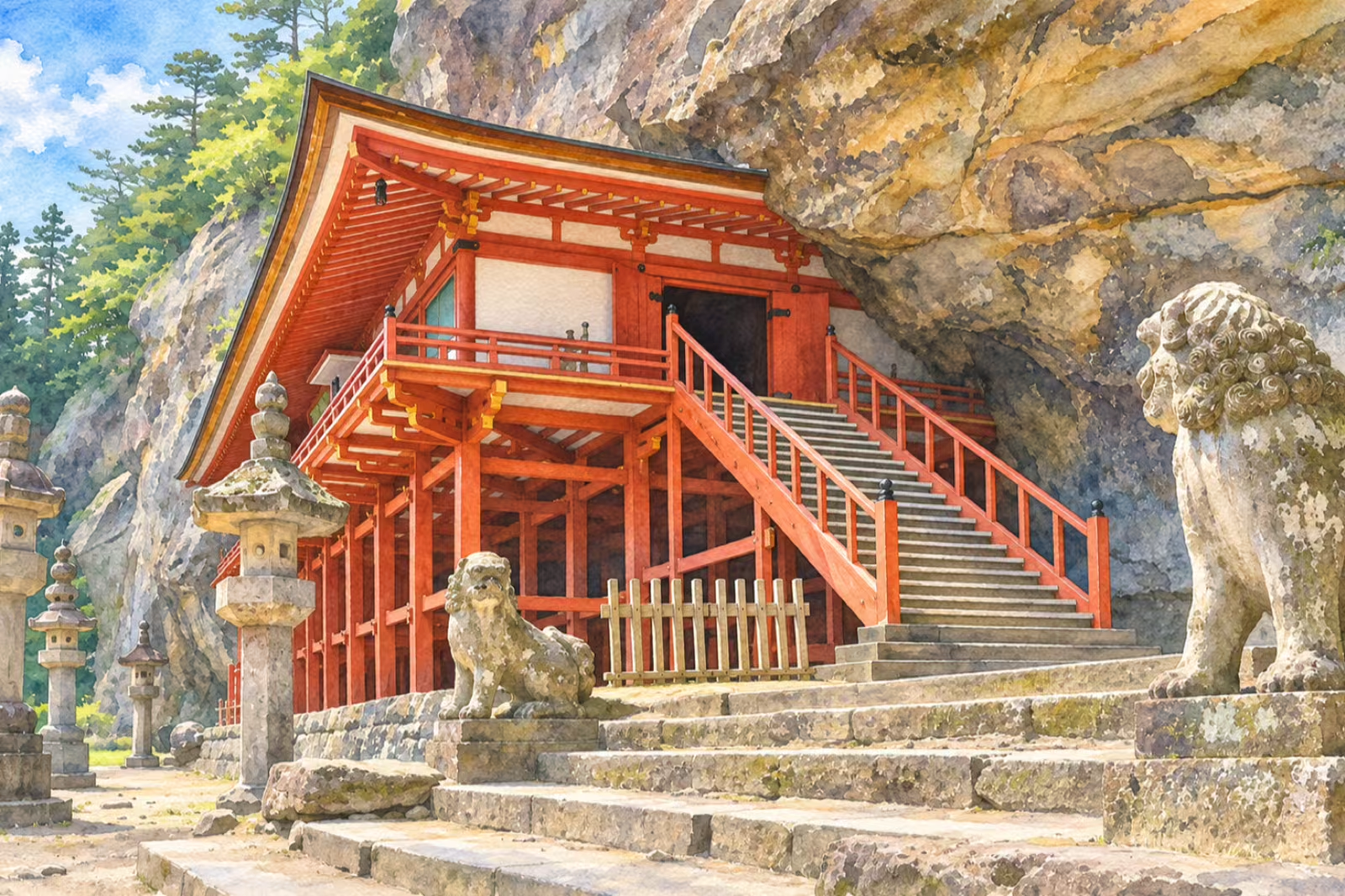
The site of Isawa Castle and Takkoku no Iwaya both lie in southern Iwate Prefecture, the first in Mizusawa in the city of Ōshū and the second in the town of Hiraizumi, a little over ten kilometers apart. Both are tied to Sakanoue no Tamuramaro’s campaigns against the Emishi in the early 9th century: Isawa was a military and administrative base set up by the imperial court in the north, while Takkoku no Iwaya is a cliffside hall whose founding legend turned that conquest into religious memory.
01Isawa Castle: the court’s northern base
In the late 8th century the court fought a long series of wars with the Emishi of the northeast, and in 789 Aterui, a leader from the Isawa area, inflicted a heavy defeat on a court army. In 802 Tamuramaro, holding the title of seii taishōgun, built a fortress here. That same year Aterui and More surrendered; they were taken to the capital and later executed in Kawachi. The Chinjufu, the headquarters for military affairs in the north, is generally thought to have moved here from Taga-jō in present-day Miyagi Prefecture around 808.
Isawa Castle was a square enclosure about 670 meters on each side, surrounded by a roofed earthen wall and a ditch. At its center stood a government hall for ceremonies and administration, with offices, kitchens and storehouses around it; it was not a castle with a keep in the later sense. It seems to have remained in use until about the late 10th century. Excavations have produced wooden tablets, lacquer-soaked paper documents and pottery with ink inscriptions that record the administration and daily life of the frontier. The site was designated a national Historic Site in 1922. Most of it is now farmland and housing; the area around the south gate has been laid out as a historic park, and finds are displayed at a nearby archaeological research center.
02Takkoku no Iwaya: a hall beneath the cliff
The Takkoku no Iwaya Bishamon-dō is built against a high cliff on stilts in the kakezukuri style. Temple tradition says that in 801 Tamuramaro defeated Akuro-ō and others who held the caves here, and built the hall with 108 statues of Bishamonten in gratitude for the deity’s protection. This is a later tradition with no contemporary record. According to the Azuma Kagami, Minamoto no Yoritomo passed the site after the Ōshū campaign of 1189, which shows it was already a well-known landmark.
The present hall was rebuilt in 1961 after a fire in 1946. On the rock face west of the hall is a huge carved Buddha face, the Ganmen Daibutsu, generally dated to the late Heian period and traditionally linked to Minamoto no Yoshiie; whether it depicts Dainichi or Amida is disputed. Takkoku no Iwaya is also a national Historic Site.