
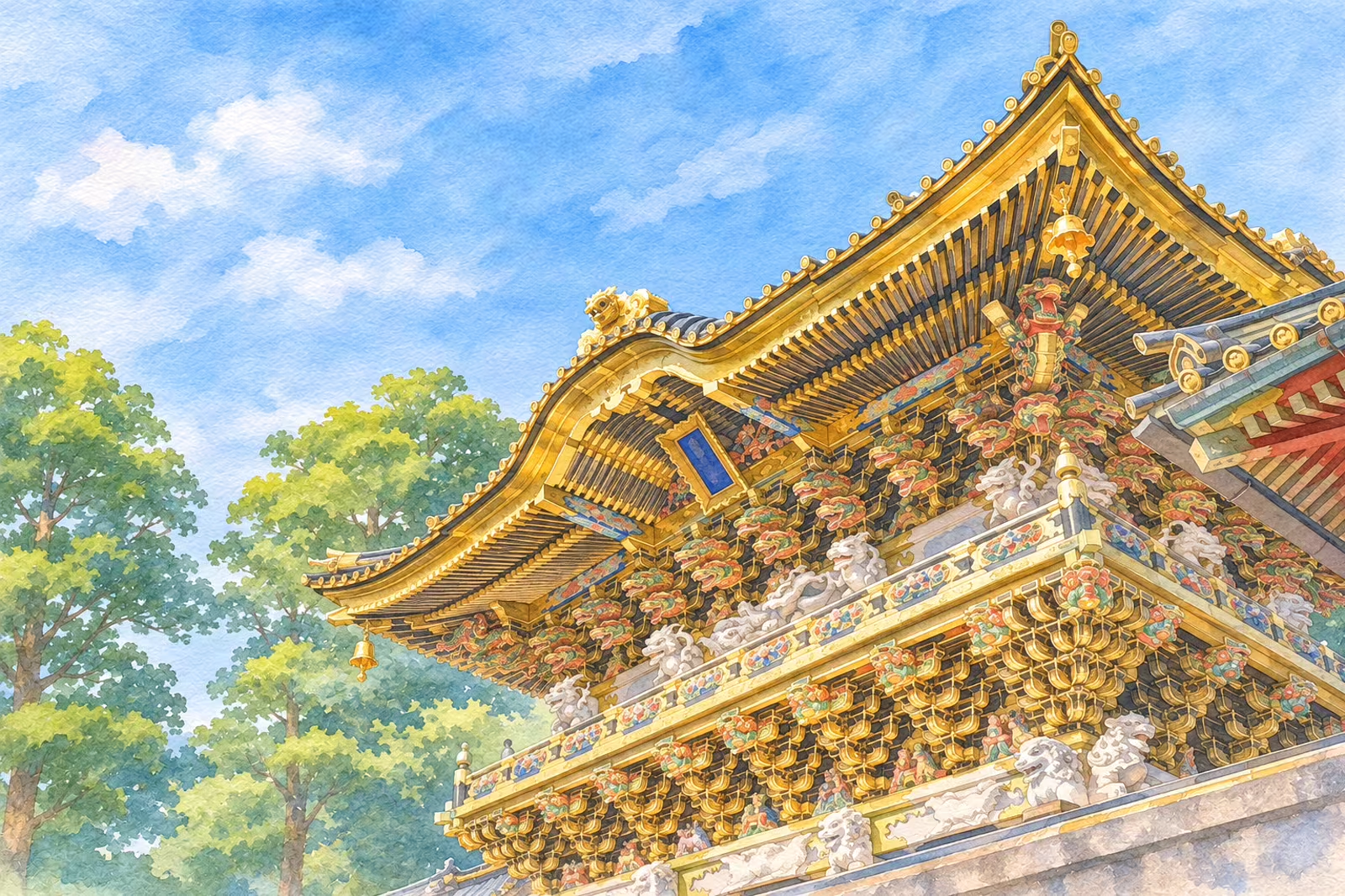
Nikkō Tōshōgū, in Nikkō City, Tochigi Prefecture, is the Shinto shrine where Tokugawa Ieyasu, founder of the Tokugawa shogunate, is enshrined as a deity. Most of its present buildings come from a vast rebuilding ordered by the third shogun, Tokugawa Iemitsu, in the 1630s, and they are famous for dense polychrome carving, gold leaf and lacquer. In 1999 Tōshōgū was inscribed on the World Heritage List together with Futarasan Shrine and Rinnō-ji as the Shrines and Temples of Nikkō.
01Ieyasu’s deification and the Kan’ei rebuilding
Ieyasu died in 1616 and was first buried at Kunōzan in Suruga. In keeping with his wishes, his remains were moved to Nikkō the following year, 1617, where the second shogun, Tokugawa Hidetada, built a shrine. At the urging of the Tendai monk Tenkai, Ieyasu was deified as Tōshō Daigongen and worshipped according to Sannō Ichijitsu Shinto. From 1634 Iemitsu had nearly all of Hidetada’s buildings torn down and rebuilt, finishing in 1636 around the 21st anniversary of Ieyasu’s death; this is known as the Kan’ei rebuilding. In 1645 the imperial court granted the title of gū, and from then on it was called Tōshōgū. The court sent an envoy with offerings every year, and shoguns and daimyo made repeated pilgrimages to Nikkō during the Edo period. In the early Meiji years, the separation of Shinto and Buddhism divided the once combined religious complex of Mount Nikkō into three bodies: Tōshōgū, Futarasan Shrine and Rinnō-ji.
02What can be seen today
The buildings rise up the slope from outer to inner: the stone torii, the five-story pagoda, the Front Gate, the Sacred Stable, the Yōmeimon, the Karamon, and finally the main sanctuary, in which the worship hall, the stone-floored connecting chamber and the main hall are joined in the gongen-zukuri style. The famous "see no evil, hear no evil, speak no evil" monkeys are one panel in a series of eight monkey carvings on the Sacred Stable. The Yōmeimon carries several hundred carvings and is nicknamed the Higurashi-mon, the gate one could gaze at until sunset. Above the Sakashita Gate leading to the inner precinct is the Sleeping Cat, traditionally attributed to Hidari Jingorō. Beyond it, more than 200 stone steps climb to the Okumiya, where Ieyasu’s tomb stands. The "crying dragon" ceiling painting in the Honjidō (Yakushidō) was lost in a 1961 fire and later repainted. The five-story pagoda was first built in 1650, burned in 1815 and rebuilt in 1818.
Eight structures, including the Yōmeimon, the Karamon and the main sanctuary, are National Treasures, and several dozen more are Important Cultural Properties. As of the 2020s, a major restoration program begun in the Heisei era continues in stages; work on the Yōmeimon was completed in 2017.
Nikkō Tōshōgū
01A Small Hall in the Mountains
In the spring of 1616 Tokugawa Ieyasu lay dying at Sunpu Castle, his retirement seat in Suruga Province (today’s Shizuoka). He was seventy-five by the traditional East Asian count. The year before, his armies had destroyed the Toyotomi family at Ōsaka, removing the last rival to the government he had founded in Edo. What remained was to secure the dynasty after his death, and Ieyasu gave instructions for that too.
The Zen monk Ishin Sūden, one of his closest advisers, recorded them in his diary. Ieyasu’s body was to be buried on Mount Kunō, near Sunpu, overlooking Suruga Bay. His funeral was to be held at Zōjō-ji, the Tokugawa family temple in Edo. His memorial tablet was to stand at Daiju-ji in Mikawa, the temple of his ancestors. And after the first anniversary of his death, a small hall was to be built on Mount Nikkō, where his spirit would be invited to dwell as the guardian of the eight provinces of the Kantō, the eastern plain that was the Tokugawa heartland.
Ieyasu died on the seventeenth day of the fourth month of Genna 2, which corresponds to June 1, 1616. Everything you see around you began with that last instruction about a "small hall."
02Why Nikkō?
Nikkō had almost nothing to do with Ieyasu’s life. It was, however, one of the oldest sacred mountains in eastern Japan. According to temple tradition, a monk named Shōdō climbed into these mountains in the late eighth century and founded the first temple here. Over the following centuries the worship of Mount Nantai, the shrine of Futarasan, and a large Buddhist establishment grew together into a single religious complex. By the medieval period "Nikkō-san" was a powerful institution with warrior patrons across the Kantō.
Ieyasu left no explanation for his choice, and later writers have filled the gap. A popular idea holds that Nikkō lies due north of Edo, so that the deified Ieyasu would guard the city like the Pole Star. Another notes that Mount Kunō, Mount Fuji and Nikkō fall roughly on one line. These are later interpretations. What the record does show is a man who wanted to become the protecting deity of the region his family ruled, placed on a mountain that people in the east had revered for eight hundred years.
03A Quarrel over a Divine Title
Making Ieyasu a god raised a practical question: what kind of god?
Sūden and the Yoshida family of Shinto priests in Kyoto wanted him enshrined as a myōjin, a "bright deity," under the rites of Yoshida Shinto. There was an obvious precedent. When Toyotomi Hideyoshi died in 1598, the Yoshida had enshrined him as Toyokuni Daimyōjin in a grand shrine in Kyoto.
Against them stood Nankōbō Tenkai, a Tendai Buddhist monk of uncertain origins who had become one of Ieyasu’s most trusted religious advisers. Tenkai argued that Ieyasu had followed Sannō Ichijitsu Shinto, a Tendai doctrine that treated the gods of Japan as manifestations of Buddhas. Ieyasu should therefore be enshrined as a gongen, an "avatar," a Buddha appearing temporarily in the form of a Japanese deity. In this scheme Ieyasu’s original Buddhist form was Yakushi, the Buddha of healing.
According to later accounts, Tenkai clinched the argument by pointing to Hideyoshi. The Toyotomi had made him a myōjin, and within twenty years the Toyotomi were gone. Was that a title anyone would want? The second shogun, Ieyasu’s son Tokugawa Hidetada, sided with Tenkai. The court offered several possible titles, the shogunate chose one, and in 1617 the imperial court granted Ieyasu the title Tōshō Daigongen, "Great Avatar Illuminating the East." The shrine took its name from it: Tōshō-sha, the Tōshō shrine, later Tōshōgū.
Tenkai went on to direct the rites of the new cult and, for the rest of his very long life, the affairs of Nikkō. He also founded Kan’ei-ji in Ueno, Edo’s great Tendai temple. He died in 1643, by most reckonings well over a hundred years old.
04The Procession of 1617
On the fifteenth day of the third month of 1617 Ieyasu’s coffin left Mount Kunō. The procession traveled through Suruga, Sagami and Musashi and turned north into Shimotsuke Province, reaching Nikkō early in the fourth month. On the eighth the coffin was placed in the tomb at the back of a new shrine built under Hidetada’s orders, and on the anniversary of Ieyasu’s death, the seventeenth day of the fourth month, Hidetada attended the great ceremony that installed his father as a god.
That date became the shrine’s main festival. Each spring the Tōshōgū still holds a procession of roughly a thousand people dressed as samurai, priests and retainers, carrying portable shrines down through the town. It is modeled on the procession of 1617.
Whether Ieyasu’s remains actually traveled with that procession is still argued. Kunōzan Tōshōgū in Shizuoka holds that his body was never moved and that only his spirit was transferred. Nikkō follows the records of the reburial and places his remains in the tomb at the back of this shrine. Neither side has been able to settle the matter.
The first shrine, usually called the Genna shrine after the era name, was modest by later standards. Very little of it survives here. Some of its buildings were dismantled and moved elsewhere; the Tōshōgū at Serada in Gunma Prefecture is said to have received the worship hall and other structures from the Genna inner sanctuary in the 1640s.
05Iemitsu’s Rebuilding
Almost everything you see today is the work of Ieyasu’s grandson, the third shogun Tokugawa Iemitsu.
Iemitsu’s devotion to his grandfather went far beyond family duty. As a boy he had been passed over in favor of his younger brother Tadanaga, whom their parents preferred, and a well-known story says that Ieyasu himself intervened to confirm Iemitsu as heir. Whatever the exact truth, Iemitsu believed he owed his position to Ieyasu. He dreamed of his grandfather repeatedly and had the painter Kanō Tan’yū record the visions; several of these "dream portraits" survive.
Between the eleventh month of 1634 and the fourth month of 1636 Iemitsu tore down most of the Genna shrine and replaced it with the complex standing now. The work was timed to finish for the twentieth anniversary of Ieyasu’s death, observed in 1636 as the twenty-first memorial. The project is known as the Kan’ei Great Rebuilding, after the era. Akimoto Yasutomo served as commissioner of works. The master carpenter Kōra Munehiro led the design and construction, and painters of the Kanō school, with Tan’yū at their head, supplied the painted decoration.
Records from the period put the cost at 568,000 ryō of gold, 100 kan of silver and 1,000 koku of rice. The shogunate paid for all of it. The idea that Iemitsu made the great lords build the shrine at their own expense is common but wrong; their contributions came in the form of lanterns, a stone gate and a pagoda. Contemporary tallies count some 4.5 million person-days of labor. The whole rebuilding took about seventeen months, an extraordinary pace for a project of this size and finish.
06Gongen-zukuri and the Art of Excess
The main sanctuary follows a plan called gongen-zukuri, the "avatar style," named after this shrine. A worship hall in front and a main hall behind are joined by a lower connecting room, the ishi-no-ma or "stone room," so that the three form one continuous building. The plan existed before Nikkō, but the fame of the Tōshōgū fixed it as the standard, and many of the hundreds of Tōshōgū shrines built across Japan in the Edo period copied it.
What made Nikkō famous, though, is its surface. Black and red lacquer, gold leaf, white shell-based gofun paint and polychrome carving cover almost everything. The carvings include dragons, kirin (the Chinese unicorn), lions, phoenixes, Chinese sages and immortals, children at play, flowers and birds, more than five thousand of them across the shrine. This was the decorative tradition of the Momoyama period, the age of Hideyoshi and Ieyasu, pushed to its limit.
Opinions have always divided. An Edo-period saying ran "Don’t say kekkō until you’ve seen Nikkō," a pun on kekkō, "splendid." Some modern critics found it overwrought. The German architect Bruno Taut, who visited in the 1930s, admired the restraint of the Katsura Imperial Villa in Kyoto and dismissed Nikkō as showy. No one has disputed the craftsmanship.
07Monkeys, a Gate and a Sleeping Cat
The first carving most visitors look for is on the Sacred Stable, the Shinkyūsha, where the shrine’s sacred horse was kept. It is one of the few buildings here left in plain unpainted wood. Monkeys were believed to protect horses from disease, so eight carved panels run along its beams, following a family of monkeys through life from birth to raising young of their own. The second panel shows the three monkeys covering their eyes, mouth and ears: "see no evil, speak no evil, hear no evil." In Japanese the phrase is a pun, since -zaru, "not doing," sounds like saru, "monkey."
The Yōmeimon is the heart of the shrine. It is a two-storied gate covered with more than five hundred carvings, and its nickname, Higurashi-mon, the "Twilight Gate," comes from the idea that you could look at it all day and not notice the sun going down. The plaque bearing the name Tōshō Daigongen was written by Emperor Go-Mizunoo. Of its twelve white columns, one has its pattern carved upside down. The usual explanation is that a perfect building begins to decay the moment it is finished, so the builders left a deliberate flaw.
Corridors run east and west from the gate, their outer walls carved with birds and flowers. Above the Sakashita-mon, the gate in the eastern corridor that leads to the tomb, is the Nemuri-neko, the Sleeping Cat. Tradition credits it to Hidari Jingorō, a legendary carver of the early Edo period whose very existence is uncertain. On the reverse side of the same beam are sparrows playing, unafraid, and the pairing is usually read as an image of peace.
Inside the Yōmeimon stands the Karamon, a gate painted entirely in white and carved with Chinese sages. In the Edo period only people of high rank could pass through it. Beyond it are the worship hall and the main sanctuary, surrounded by a fence of carved openwork panels.
08Emperors, Envoys and the Dutch
The Tōshōgū was not only a family mausoleum. It became a tool of Tokugawa authority, and the shogunate used it to show that authority to the court, to the great lords and to foreigners.
In 1645 the imperial court raised the shrine’s status by granting it the title gū, the designation of a shrine of the highest rank, previously reserved for a very small number such as Ise. From the following year the court sent an envoy with offerings to Nikkō every year, a custom that continued until the end of the shogunate. The last stretch of his route into Nikkō is still called the Reiheishi Kaidō, the "Imperial Envoy Road."
Embassies from Joseon Korea were brought to Nikkō three times, the first in 1636, the year the rebuilding was completed. The embassy of 1643, sent to congratulate the shogun on the birth of his heir, the future fourth shogun Ietsuna, brought a bronze bell from King Injo, which hangs near the Yōmeimon, along with an incense burner, candle stand and flower vase. The Dutch East India Company, whose merchants were soon to be the only Europeans allowed to trade in Japan, also sent offerings: a European-style bronze chandelier in 1636 and a revolving lantern in 1643. On the revolving lantern the Tokugawa hollyhock crests are mounted upside down, a detail that guides have enjoyed pointing out ever since.
The great lords gave more. Kuroda Nagamasa, lord of Fukuoka, donated the stone torii at the entrance in 1618, with the stone shipped from Kyūshū. Sakai Tadakatsu, lord of Obama, donated the five-storied pagoda in 1650 (some sources say 1648). More than a hundred stone and bronze lanterns line the precincts, each a statement of loyalty from a daimyo house. Date Masamune’s iron lantern is said to have been cast from metal imported from Portugal.
One donation stretches far beyond the precinct. Matsudaira Masatsuna, a lord who had served Ieyasu, could not afford a lantern, according to a popular story. Instead, from around 1625, he spent more than twenty years planting cryptomeria trees along three roads leading to Nikkō, and the planting was dedicated to the shrine in 1648 for the thirty-third anniversary of Ieyasu’s death; his son Masanobu set up the dedication stones. This is the Cedar Avenue of Nikkō. The protected stretch runs about thirty-seven kilometers and still has more than twelve thousand trees, and it is designated both a Special Historic Site and a Special Natural Monument.
09Shogunal Pilgrimages and Iemitsu’s Own Mausoleum
When a shogun traveled to Nikkō in person, the event was called a shasan. It was an enormous undertaking, with tens of thousands of attendants and the post towns along the Nikkō road mobilized for weeks. Counting visits by retired shoguns and heirs, there were nineteen such pilgrimages in the Edo period. Iemitsu made ten of them. The eighth shogun Yoshimune revived the custom after a long gap as part of his effort to restore the shogunate’s prestige, and the last was made by the twelfth shogun Ieyoshi in 1843.
Iemitsu died in 1651 at forty-eight by the traditional count. He asked to be buried at Nikkō so that he could continue to serve his grandfather. His son, the fourth shogun Ietsuna, built him a mausoleum a short walk west of the Tōshōgū, finished in 1653. Called the Taiyūin after Iemitsu’s posthumous Buddhist name, it is now part of Rinnō-ji. It is said Iemitsu instructed that it must not outshine his grandfather’s shrine, and its black and gold have a darker, more restrained feel. If you have time, it is worth comparing the two.
The religious organization of the mountain was also rebuilt. In 1655 an imperial prince, a son of Emperor Go-Mizunoo, became abbot of Nikkō with the title Rinnōji-no-miya. His successors, also princes, held Kan’ei-ji in Edo and the Tendai headquarters on Mount Hiei as well, and stood at the top of the Edo-period religious world. Having an imperial prince on hand in the shogun’s capital and at his ancestor’s shrine also gave the Tokugawa a useful link to the throne.
10War, Separation and Survival
In 1868, during the Boshin War, part of the defeated shogunate’s army withdrew into Nikkō, and forces of the new imperial government followed. The shrine was in real danger. The usual account is that Itagaki Taisuke, a commander from Tosa on the imperial side, persuaded the shogunate commander Ōtori Keisuke not to fight among the shrines and temples, and the shogunate forces left the mountain. A statue of Itagaki stands near the Shinkyō Bridge for this reason, though historians debate how much credit he deserves.
The new Meiji government then ordered the separation of Shinto and Buddhism. On Mount Nikkō, where the two had been one institution for a thousand years, this meant dividing everything between three bodies: Tōshōgū, Futarasan Shrine and the temple of Rinnō-ji, now together known as the "two shrines and one temple." The division was messy. Some Buddhist buildings inside the Tōshōgū precinct that should have gone to Rinnō-ji proved too difficult to move and stayed where they were. The Yakushi-dō, also called the Honji-dō, and the sutra repository are two of them, and their ownership has never been fully settled between shrine and temple.
Local people and former shogunate retainers formed a preservation society, the Hōkōkai, in 1879 to raise money for repairs at a time when the shrines had lost shogunal funding. In 1999 the Shrines and Temples of Nikkō were inscribed on UNESCO’s World Heritage List, covering 103 buildings of the two shrines and one temple together with the surrounding landscape.
11What You Are Looking At
The main buildings are those completed in 1636, and they keep Iemitsu’s design. Five of them, counted as eight structures, are designated National Treasures: the main sanctuary with its stone room and worship hall, the Karamon, the openwork fence, the Yōmeimon, and the east and west corridors. Another thirty-four are Important Cultural Properties.
They have not survived untouched. Lacquer and paint need renewing every few decades, and the shogunate maintained an office for Nikkō repairs throughout the Edo period. Some buildings have been replaced. The five-storied pagoda burned in 1815 and was rebuilt by the Sakai family in 1818. The Yakushi-dō burned in 1961 and was rebuilt; its ceiling dragon, originally by Kanō Yasunobu, was repainted by the painter Katayama Nanpū. The tomb at the back was wooden when built in 1622, rebuilt in stone in 1641, and after an earthquake damaged it in 1683 was recast in bronze, the form it has today.
A long program of restoration has been running in recent decades. The Yōmeimon reopened in 2017 after a full restoration of its lacquer and color, which is why it looks so bright. Other buildings are being worked on in turn, and you may find one of them under scaffolding. For the 400th anniversary of Ieyasu’s death in 2015 the shrine held a great festival and opened a new treasure museum.
12A Walk Through the Precinct
Coming up from the town, you cross the Daiya River beside the red Shinkyō Bridge and climb into the forest. The approach to the Tōshōgū is a broad stone-paved slope between tall cedars.
At the top is Kuroda Nagamasa’s stone torii, and to the left the five-storied pagoda. It stands about thirty-six meters tall; look at the carvings of the zodiac animals on the first story. The central pillar inside hangs from the fourth story and does not touch the ground, which lets the structure settle as the timber shrinks.
Pass through the Omotemon, the front gate guarded by two Niō kings. On your left is the Sacred Stable with its monkeys. Ahead are three storehouses; on the gable of the upper one are two carved "imagined elephants," based on sketches by Kanō Tan’yū, who had never seen an elephant, and they look it.
Climb the steps. The bell tower and drum tower stand to either side, with the Korean bell and the Dutch lanterns nearby. Behind the drum tower is the Yakushi-dō, where a monk will strike wooden clappers beneath the dragon painted on the ceiling, and the echo rings back and forth like a roar: the "crying dragon."
Then the Yōmeimon. Stop under it and look for the upside-down column. Inside are the hall for the portable shrines, the sacred dance stage, and the white Karamon, with the worship hall behind it. Visitors can enter the worship hall, whose interior is decorated with Kanō-school paintings.
Finally, go through the Sakashita-mon under the Sleeping Cat. Beyond it a flight of more than two hundred stone steps climbs through the cedars to the Okumiya, the inner sanctuary, where Ieyasu’s bronze tomb stands in a quiet enclosure. There is almost no carving here, only stone, bronze and trees. Of everything at Nikkō, it comes closest to the "small hall" Ieyasu asked for.