
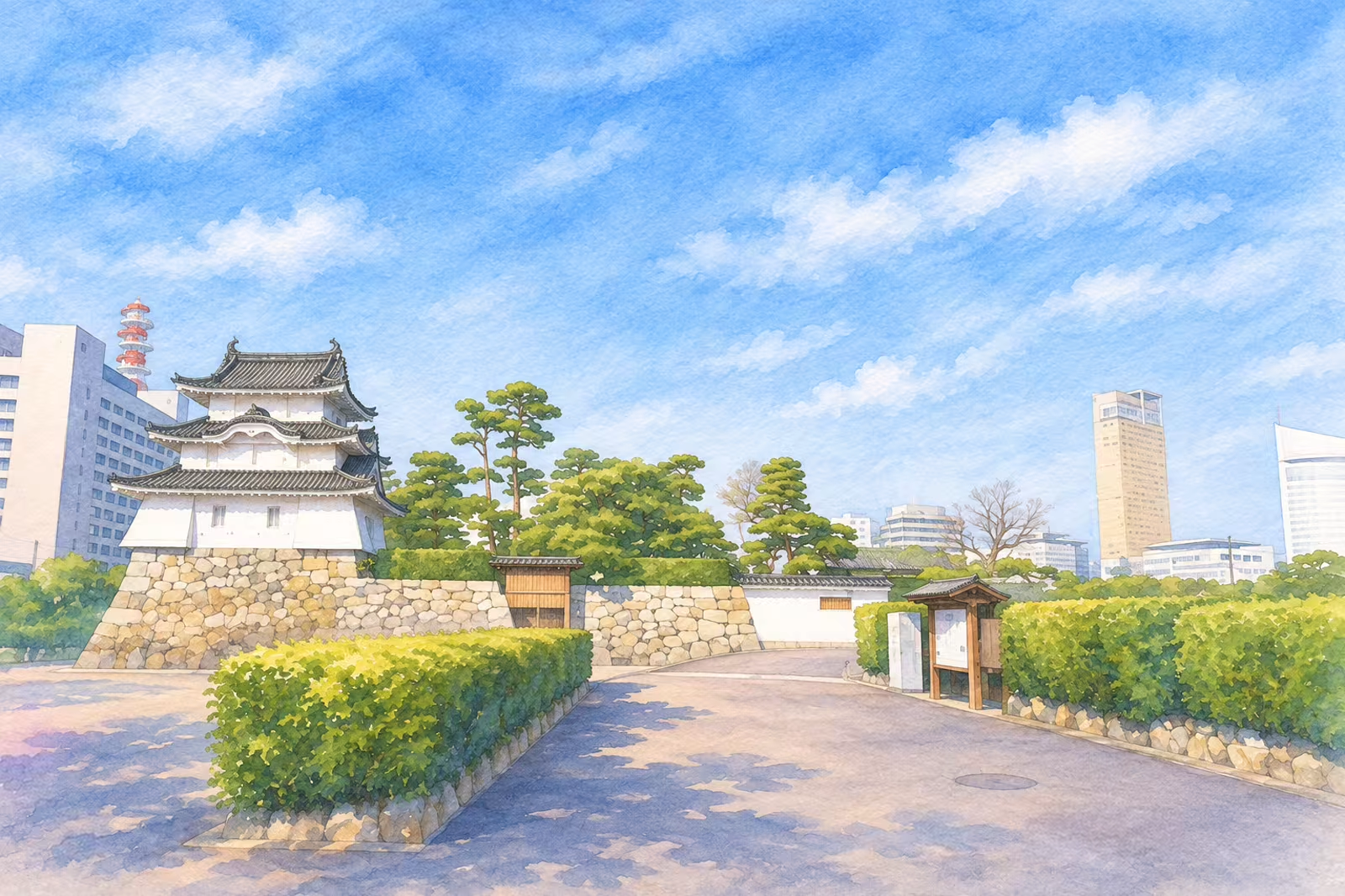
Takamatsu Castle stands on the shore of the Seto Inland Sea in Takamatsu, Kagawa Prefecture. It is a "sea castle" whose moats are fed directly by seawater, and it is counted with Imabari and Nakatsu as one of Japan’s three great water castles. The grounds are now Tamamo Park. The keep is gone, but several Edo-period turrets and gates survive. The name Tamamo comes from a poetic epithet for the province of Sanuki in the Man’yōshū.
01The Ikoma and the Matsudaira
In 1587 Toyotomi Hideyoshi granted Sanuki to Ikoma Chikamasa, who began building a castle on the coast in 1588 and named the surrounding town Takamatsu. The Ikoma ruled for four generations until 1640, when a dispute within the house led to their removal. In 1642 Matsudaira Yorishige, eldest son of Tokugawa Yorifusa of the Mito branch, was given the domain, and his line ruled Takamatsu for eleven generations until the Meiji Restoration. Yorishige rebuilt the keep in the 1660s as a three-story tower whose top floor is said to have overhung the floor below, in a style resembling the keep of Kokura Castle.
02After the castle era
The keep had decayed badly and was pulled down in 1884. The grounds remained the property of the Matsudaira family, who built Hiunkaku, a large residence in the shoin style, on the site of the old palace around 1917. The city of Takamatsu acquired the site in 1954 and opened it the following year as Tamamo Park; it was designated a National Historic Site in the same year.
03What can be seen today
The moats still take in seawater and rise and fall with the tide, and sea fish can be seen swimming in them. The Tsukimi-yagura turret facing the sea, the Mizute-gomon water gate, the connecting Watari-yagura, and the Ushitora-yagura turret are designated Important Cultural Properties; the Ushitora-yagura was moved from the eastern enclosure, so its present position is not its original one. Hiunkaku is also an Important Cultural Property. The stone base of the keep was dismantled and rebuilt between the 2000s and the early 2010s. The keep itself has not been reconstructed, although the city has discussed rebuilding it from historical evidence.