
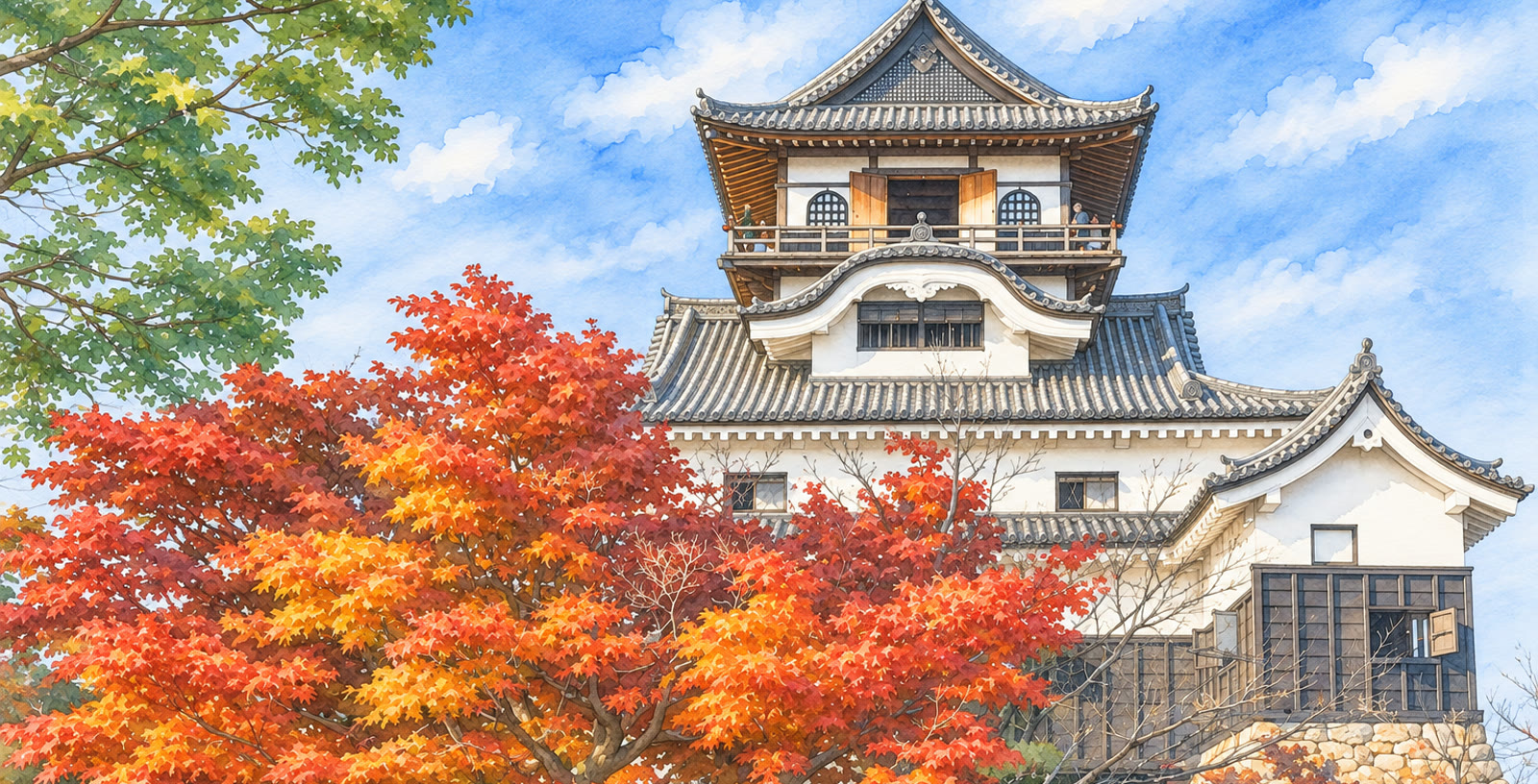
Inuyama Castle stands on a steep hill above the south bank of the Kiso River in Inuyama, Aichi Prefecture, looking across the water into Gifu Prefecture. Its keep is one of only twelve in Japan that survive from before the end of the Edo period, and one of five castle keeps designated a National Treasure. The castle is also known as Hakutei-jō, "White Emperor Castle," a name traditionally credited to the Confucian scholar Ogyū Sorai, who is said to have taken it from a poem by the Chinese poet Li Bai.
01A border fortress
The usual account dates the castle to 1537, when Oda Nobuyasu, an uncle of Oda Nobunaga, moved his seat to this hill. Inuyama controlled a crossing of the Kiso River between the provinces of Owari and Mino. Nobuyasu’s son Oda Nobukiyo later turned against Nobunaga and lost the castle to him, usually dated to 1564 (some accounts say 1565). In 1584, at the start of the Komaki–Nagakute campaign, the former castellan Ikeda Tsuneoki sided with Hashiba Hideyoshi and seized Inuyama in a surprise attack; Hideyoshi then used it as a base in his standoff with Tokugawa Ieyasu and Oda Nobukatsu.
Under the Tokugawa, Inuyama belonged to the Owari domain, ruled by a branch of the shogun’s family. In 1617 Naruse Masanari, a senior retainer assigned to guide the Owari house, was given Inuyama, and his descendants held the castle until the Meiji Restoration. In 1868 the Naruse were recognized as independent daimyo of a new Inuyama domain, which disappeared a few years later when the domains were abolished.
02How old is the keep?
The keep has three roofs outside but four floors above ground and two below, rises about 19 meters, and sits on a base of unshaped stone about 5 meters high. An old tradition held that it had been moved here from another castle, but the full dismantling and repair carried out between 1961 and 1965 found no sign of relocation. The accepted view then became that the lower floors came first and the lookout was added later. Tree-ring dating announced in 2021 overturned this: a first-floor pillar was cut in 1585 and a fourth-floor beam in 1588, so all four floors went up in one campaign around 1585–1590. The curved gables and the top balcony were added around 1620 under the Naruse.
03A privately owned castle
Most of the castle’s buildings were pulled down in the early Meiji years. After the Nōbi earthquake of 1891 damaged it, Aichi Prefecture gave the castle grounds to the former lord Naruse Masamitsu free of charge in 1895 on condition that he repair it. For more than a century Inuyama was the only castle in Japan owned by an individual, until ownership passed in 2004 to a foundation, the Inuyama Castle Hakutei Bunko. The keep was designated a National Treasure in 1935 and again under the postwar law in 1952, and the castle site was designated a National Historic Site in 2018. The town below keeps its Edo-period street plan, and the spring Inuyama Festival parades floats with mechanical puppets through it.
Inuyama Castle
01A Castle with Its Back to the River
Climb to the top floor of Inuyama Castle’s keep and step out onto the narrow balcony, and the Kiso River is directly below you. It comes out of the mountains to the east, bends around the foot of the castle hill, and runs west into the wide Nōbi Plain. The far bank is Gifu Prefecture, which in the sixteenth century was the province of Mino. The near bank is Aichi Prefecture, then the province of Owari. The castle sits on the border between them, on a hill that rises less than 100 meters above sea level but drops in a cliff straight to the water.
Japanese castle builders had a phrase for this kind of site: ushiro-kengo, "strong at the back." With a cliff and a broad river behind it, Inuyama could not easily be attacked from the north, and its defenders could concentrate on the approaches from the south, where the gates, the samurai residences and the town lay. The river was more than a moat. Timber floated down it from the mountains, and ferries crossed it between Owari and Mino. Whoever held Inuyama held one of the doors between the two provinces.
The castle has a literary nickname, Hakutei-jō, "White Emperor Castle." The original White Emperor City stands on a height above the Yangtze in China, and the Tang poet Li Bai opened one of his best-known poems with a departure from it at dawn. The story goes that the Edo-period Confucian scholar Ogyū Sorai, seeing Inuyama perched above its river, thought of the poem and gave the castle the name. The attribution is a tradition rather than a documented fact, but the name has stuck.
What draws most visitors is the keep, or tenshu, the tower at the castle’s heart. It is one of only twelve keeps in Japan that survive from before the end of the Edo period, and one of five castle keeps designated a National Treasure, alongside Himeji, Matsumoto, Hikone and Matsue. Its story begins with the Oda family.
02The Oda Build a Fortress
In the early sixteenth century Owari was nominally governed by the Shiba family, but real power had passed to their deputies, the Oda, who were divided into rival branches. One minor branch rose quickly under Oda Nobuhide, the father of Oda Nobunaga.
The usual account is that in 1537 Nobuhide’s younger brother, Oda Nobuyasu, moved his seat from nearby Kinoshita Castle to this hill, and this is taken as the founding of Inuyama Castle. There may have been an Oda outpost in the area before then, but the castle is normally dated from Nobuyasu. He was one of Nobuhide’s most useful commanders in a long series of wars against Saitō Dōsan, the lord of Mino across the river, and he was killed fighting Dōsan’s forces, usually said to have been at the battle of Kanōguchi in 1544, though some accounts give 1547.
Nobuyasu’s castle was not the building you see now. Fortresses of the early sixteenth century were mostly earthworks, ditches and simple timber structures, without the tall keeps that came later. The present keep belongs to a later generation.
03Nobunaga Takes Inuyama
Nobuyasu’s son, Oda Nobukiyo, inherited Inuyama. At first he was on good terms with his cousin Nobunaga, whose elder sister, known as Inuyama-dono, became Nobukiyo’s wife (some sources call her a younger sister). In the 1550s, as Nobunaga defeated his rivals inside Owari one by one, Nobukiyo fought alongside him against the Iwakura branch of the Oda in the north of the province.
Once Owari was largely in Nobunaga’s hands, the two quarreled over the division of land. Nobukiyo turned to the Saitō of Mino and became Nobunaga’s enemy. For Nobunaga this was intolerable: Inuyama stood on his road into Mino and controlled a river crossing he needed. According to the chronicles, his retainer Niwa Nagahide and others first won over the smaller castles around Inuyama, isolating it, and the castle then fell. The usual date is 1564, though some accounts give 1565. Nobukiyo fled to the Takeda in Kai province and is said to have lived out his life there under the name Inuyama Tessai.
With Inuyama secure, Nobunaga crossed the Kiso and pressed into Mino. In 1567 he took the Saitō stronghold of Inabayama and renamed it Gifu. On a clear day, it is said, you can see Mount Kinka, the peak above Gifu Castle, from the top of Inuyama’s keep, about 15 kilometers away to the west-northwest.
04Ikeda Tsuneoki and the Komaki–Nagakute Campaign
Under Nobunaga, Inuyama was entrusted to Ikeda Tsuneoki. Tsuneoki’s mother had been Nobunaga’s wet nurse, and the two had grown up together; he was among the retainers Nobunaga trusted most. In time Tsuneoki was moved on to other commands. In 1580 he captured Hanakuma Castle in Settsu and was given lands there, and after Nobunaga’s death at Honnō-ji in 1582 he sat with Hashiba Hideyoshi (later Toyotomi Hideyoshi), Shibata Katsuie and Niwa Nagahide at the Kiyosu conference that settled the Oda succession. The conference left him with Ōsaka, Amagasaki and Hyōgo in Settsu, and in 1583 he was moved to Ōgaki in Mino.
In 1584 Hideyoshi broke with Nobunaga’s second son, Oda Nobukatsu, who allied himself with Tokugawa Ieyasu. The war that followed was fought across northern Owari and is remembered as the Komaki–Nagakute campaign. Both sides courted Tsuneoki, and he chose Hideyoshi. In the third month of the year, while Inuyama’s lord, Nobukatsu’s retainer Nakagawa Sadanari, was away, Tsuneoki crossed the Kiso and took the castle by surprise. He had been its lord, and he knew its ground and its weak points.
The loss of Inuyama stripped Nobukatsu and Ieyasu of their northern shield. A few days later Tsuneoki’s son-in-law Mori Nagayoshi was beaten by Tokugawa troops near Haguro, south of Inuyama, and Ieyasu moved at once to occupy Komakiyama, a lone hill in the plain to the south. Late in the month Hideyoshi himself arrived at Inuyama with his main army and used the castle as his base before building a fortified line at Gakuden, facing Ieyasu across the plain. Both sides dug in behind earthworks, and neither was willing to attack.
To break the deadlock, Tsuneoki proposed sending a force around Komakiyama to strike at Ieyasu’s home province of Mikawa. Hideyoshi agreed and placed his nephew Hashiba Nobuyoshi (later Toyotomi Hidetsugu) in nominal command, with Tsuneoki, his eldest son Ikeda Motosuke and Mori Nagayoshi among the generals. Ieyasu learned of the movement, followed, and on the ninth day of the fourth month (May 18, 1584) caught and destroyed the raiding force near Nagakute. Tsuneoki, Motosuke and Nagayoshi were all killed. Another of Tsuneoki’s sons, Ikeda Terumasa, survived and later became the lord of Himeji.
Nagakute was a battlefield victory for Ieyasu, but the campaign was settled by politics. Hideyoshi put pressure on Nobukatsu, who made a separate peace late that year, and Ieyasu, left without a cause to fight for, withdrew. For a few months in 1584 Inuyama had been the forward headquarters of the man who would soon rule Japan; after the peace it went back to Nobukatsu’s side, held by his retainers.
05Under the Toyotomi, and Sekigahara
In 1590, after conquering the Hōjō at Odawara, Hideyoshi ordered Nobukatsu to give up Owari and move to Ieyasu’s former lands. Nobukatsu refused and was stripped of everything. Owari went to Toyotomi Hidetsugu, and Inuyama was placed in the hands of men close to him, including his natural father, Miyoshi Yoshifusa. When Hidetsugu was forced to kill himself in 1595, the arrangements changed again, and Inuyama went to a Toyotomi retainer, Ishikawa Sadakiyo (also known as Mitsuyoshi).
When the realm split before the battle of Sekigahara in 1600, Ishikawa joined the western coalition led by Ishida Mitsunari. Inuyama lay between the two armies, and several Mino commanders, among them Inaba Sadamichi, Katō Sadayasu, Takenaka Shigekado and Seki Kazumasa, were sent to help hold it. They were in secret contact with the eastern side, Ishikawa had to abandon the castle, and it passed to the East without a serious fight. Ishikawa himself went to Sekigahara and, according to later accounts, was spared after the defeat through the intercession of Ikeda Terumasa, took the tonsure under the name Sōrin and lived quietly in Kyoto.
A long-lived tradition connects Ishikawa with the keep itself: in 1599, it was said, he dismantled the keep of Kaneyama Castle in Mino, floated the pieces down the Kiso, and rebuilt it at Inuyama. We will come back to that story.
06The Naruse, Lords Who Were Not Quite Daimyo
After Sekigahara, Ieyasu gave Owari to his fourth son, Matsudaira Tadayoshi, and one of Tadayoshi’s retainers, Ogasawara Yoshitsugu, held Inuyama. Tadayoshi died young in 1607, and Owari passed to Ieyasu’s ninth son, Tokugawa Yoshinao, founder of the Owari house, one of the three senior Tokugawa branches. Ieyasu sent a veteran retainer, Hiraiwa Chikayoshi, to guide the boy, and Hiraiwa was based at Inuyama. He died without an heir in 1611.
In 1617 the castle went to Naruse Masanari, an old companion of Ieyasu who had fought at Komaki–Nagakute, Sekigahara and the siege of Ōsaka. Ieyasu had attached him to Yoshinao as a tsukegarō, a senior retainer assigned by the shogunate to a branch house. On paper he was a vassal of the Owari lord; in practice he was the shogun’s man inside the Owari government. His lands at Inuyama came to 30,000 koku, raised to 35,000 under the third head of the family, Naruse Masachika: the size of a small domain.
The position was honorable and awkward at once. The Naruse kept a residence in Edo and dealt with the shogunate and with daimyo, yet they were formally only rear-vassals, retainers of a retainer. Through the later Edo period the tsukegarō families repeatedly petitioned to be made daimyo in their own right. Only in 1868, after the shogunate fell, did the new government grant the Naruse an independent Inuyama domain. Naruse Masamitsu, the last lord, became its governor until the domains were abolished a few years later. The family had held Inuyama for about two and a half centuries, and the castle you see is largely the castle they kept.
07How Old Is the Keep?
The keep has three roofs on the outside and four floors inside above ground, with two basement levels set into the stone base. The keep itself stands about 19 meters high (about 24 meters including the stone base) and follows the older "lookout" type, in which a small observation tower sits on top of a broad two-story main block. The base is built in the nozura-zumi style, of unshaped fieldstones fitted together with small stones in the gaps. It looks rough, but it drains well and has lasted for centuries.
When the keep was built is the great puzzle of Inuyama. For a long time it was widely called the oldest surviving keep in Japan, partly because of the Kaneyama story: if the tower had been moved from a sixteenth-century castle, its history went back further than any other. Between 1961 and 1965 the keep was taken completely apart and rebuilt, and the specialists who examined every member found no marks of an earlier dismantling and relocation. The Kaneyama theory has been largely abandoned since.
The repair team concluded that the keep was built in stages. The two lower floors came first; the third and fourth floors of the lookout were added later; and the curved kara-hafu gables on the north and south sides were added later still. Scholars then dated the stages from mid-Edo documents in two ways. One reading put the lower floors in 1537, under Oda Nobuyasu, with the lookout added in the Keichō era; the other put the lower floors in 1601, under Ogasawara Yoshitsugu, with the lookout added in the Genna era after Naruse Masanari arrived. The 1601 date became the one usually cited for the keep.
In 2019 and 2020 the city of Inuyama had specialists in dendrochronology and architectural history date the keep’s timbers, and the results were announced in 2021. A first-floor pillar with its outer surface intact was felled in 1585, a beam under the fourth floor in 1588, and other original fourth-floor members between 1585 and 1588. With only three years between them, and after re-examining the repair report’s evidence and the tool marks in the third-tier roof space, the researchers concluded that the first through fourth floors were built in one continuous campaign between about 1585 and 1590. The two-stage theory was overturned. On this dating, work began the year after the Komaki–Nagakute campaign, when the castle was in Nobukatsu’s hands. The same study dated a bracket under the top-floor balcony to about 1620, supporting the view that the north and south gables, the remodeled main roof and the balcony railing were added under Naruse Masanari. A felling date is not strictly a construction date, but the researchers thought it unlikely that the timber sat unused for five or ten years. On this basis the city calls Inuyama the oldest surviving keep. Matsumoto Castle in Nagano, usually dated to the mid-1590s (the city long used 1593–1594), is often named as a rival; Maruoka Castle in Fukui was long thought to be very early, but a survey report published in 2019 placed its keep in the Kan’ei era of the Edo period, on the basis of tree-ring and other scientific dating. What is not in doubt is that Inuyama’s keep belongs to the earliest group of surviving keeps.
Around the top floor runs an open balcony with a low railing, and visitors can walk all the way around it. Few surviving keeps allow this. According to the research described above, the balcony and its railing were not part of the original keep but were added around 1620, when Naruse Masanari remodeled the top.
08Demolition, Earthquake and a Private Owner
In the early Meiji years most of Japan’s castles were treated as useless relics of the old regime. The domains were abolished in 1871, and in 1873 Inuyama was formally decommissioned as a castle and passed to Aichi Prefecture. Its gates, turrets and residences were pulled down or sold, leaving only the keep. A few gates were moved to temples in Inuyama and neighboring towns, where some can still be found.
In October 1891 the Nōbi earthquake struck Gifu and Aichi, one of the largest inland earthquakes in Japan’s recorded history. Part of the keep collapsed, the attached turret at its southeast corner was damaged, and for a time demolition seemed possible. In 1895 the prefecture handed the whole castle ground, keep included, to the former lords, the Naruse family, free of charge, on condition that they repair and maintain it. Naruse Masamitsu accepted, and the people of Inuyama raised donations to help. From then on Inuyama was the only castle in Japan owned by a private individual.
In 1935 the keep was designated a National Treasure under the prewar preservation law. Inuyama escaped heavy bombing in the Second World War, and in 1952, under the new Law for the Protection of Cultural Properties, the keep was designated a National Treasure again. The great dismantling repair of 1961–1965 followed; it took apart the stone base as well and restored the parts removed after the earthquake.
For decades afterward the Naruse family continued to own the castle while the city of Inuyama handled its management. Owning a National Treasure castle is generally said to have brought heavy burdens of upkeep, inheritance and tax, and in April 2004 a foundation, the Inuyama Castle Hakutei Bunko, was set up and ownership passed to it, ending the era of the private castle lord (the foundation became a public-interest foundation in 2013). In February 2018 the castle site was designated a National Historic Site.
09The Town, the Festival and the River
The castle town lies to the south. In the Edo period samurai houses stood closest to the castle, with merchants’ and artisans’ quarters beyond, and the whole town was enclosed by an outer ring of earthworks and moats. Little of those defenses remains, but the street plan has survived largely intact: straight streets run north toward the castle hill, lined with a good number of old townhouses.
The town is at its liveliest during the Inuyama Festival each spring, the festival of Haritsuna Shrine at the foot of the castle hill, which is generally dated back to 1635, in the Kan’ei era. Thirteen three-tiered floats are drawn through the streets, with mechanical karakuri puppets performing on their top tiers to festival music. At night each float is hung with hundreds of lanterns. In 2016 the festival was inscribed, as part of a group of Japanese float festivals, on UNESCO’s Representative List of the Intangible Cultural Heritage of Humanity.
The river is part of Inuyama’s identity too. The rocky gorge upstream between Mino-Kamo and Inuyama is known as the "Japan Rhine," a name said to have been coined by the geographer Shiga Shigetaka in the early twentieth century. On summer nights, fishermen below the castle practice cormorant fishing, working by torchlight from boats as their birds dive for sweetfish.
Just east of the castle, in the Uraku-en garden, stands another Oda relic: Jo-an, a teahouse designated a National Treasure. It was built by Nobunaga’s younger brother Oda Urakusai at Shōden-in, a subtemple of Kennin-ji in Kyoto, in the early seventeenth century, changed hands several times after the Meiji Restoration, and was moved to Inuyama in 1972. It has no historical connection with the castle, but the Oda family’s castle and the Oda family’s teahouse now stand within sight of each other.
10Walking Up to the Keep
From the town, the approach climbs the south side of the castle hill, passing Sankō Inari Shrine and Haritsuna Shrine on the way. In the Edo period this slope was guarded by a series of gates and turrets. Today mostly the terrain and stone walls are left, and the turns in the path show where the gates once stood.
The keep stands at the highest point, in the inner enclosure. In front of it projects a low attached turret, and this is where you enter. Look up and you can see the large roof over the second floor, the curved gable on the third and the balcony at the top. The stone base is not tall, and its uneven fieldstones are typical of building practice around 1600.
Inside, you start in the basement, within the stone base, and climb steep wooden stairs. The first floor has a group of rooms at its center surrounded by a corridor where defenders could move freely. One of the rooms is raised a step above the others and is generally thought to have been reserved for the lord. The second floor held weapons, and the third is a small space behind the gables. The stairs grow steeper as you go, until they are closer to ladders. That is the mark of an original keep: the concrete reconstructions built in many Japanese cities after the war usually have gentle staircases and sometimes elevators.
At the top you can step out and walk around the balcony. To the north lie the Kiso River and the hills of Gifu, with the Inuyama Bridge crossing the water; to the northwest, on a clear day, you may pick out Mount Kinka above Gifu; to the south spread the castle town and the Nōbi Plain, with the towers of Nagoya in the distance. The railing is low, and the drop below is long.