
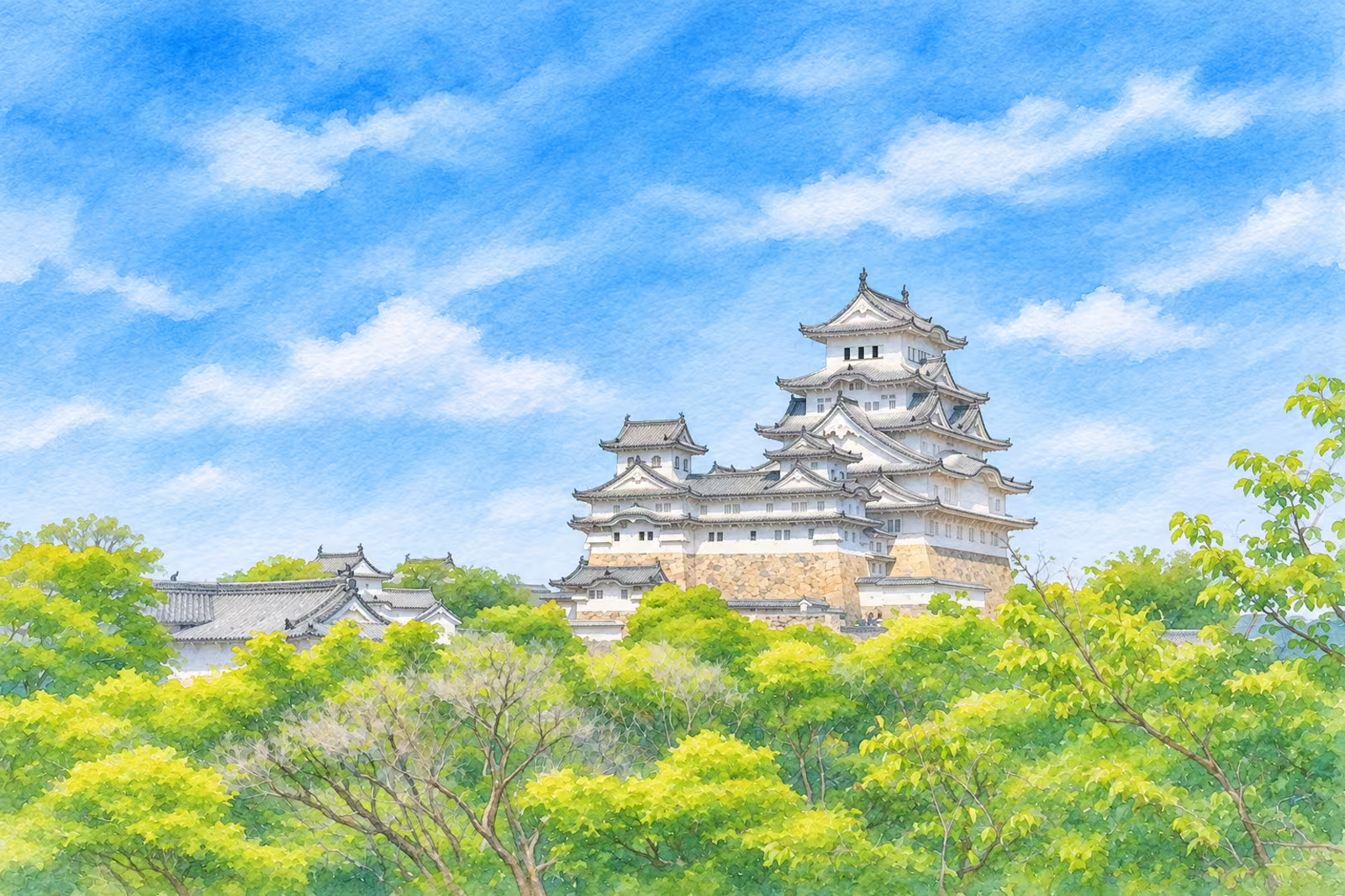
Himeji Castle stands on Himeyama hill in the center of Himeji, Hyōgo Prefecture. Its white plaster walls earned it the nickname Shirasagi-jō, "White Heron Castle." The keep complex dates from the early seventeenth century and survived both the Meiji-era dismantling of castles and the bombing of the Second World War, making it the largest surviving castle complex from before the end of the Edo period. In 1993 it became, together with the Buddhist monuments of the Hōryū-ji area, one of the first two places in Japan inscribed on the World Heritage List.
01From hill fort to great castle
Fortification on the hill is usually traced to the Akamatsu family in the fourteenth century; later the Kuroda family held it for the Kodera clan. Around 1580, as Hashiba (later Toyotomi) Hideyoshi campaigned in western Honshū, Kuroda Yoshitaka (Kanbei) handed the castle to him. Hideyoshi built a three-story keep and used Himeji as a base against the Mōri.
The castle seen today is mainly the work of Ikeda Terumasa, Tokugawa Ieyasu’s son-in-law, who received Harima after the Battle of Sekigahara. Beginning in 1601 he rebuilt the castle on a large scale over about nine years, finishing the five-roofed keep around 1609. Honda Tadamasa, who took over in 1617, added the Nishi-no-maru, where Ieyasu’s granddaughter Senhime is said to have lived with her husband Honda Tadatoki. The castle changed hands several times; from 1749 the Sakai family held it until the Meiji Restoration.
02Preservation in modern times
In early Meiji the castle is said to have been sold at auction and left standing because demolition would have cost too much, though accounts of this story differ. In 1945 air raids burned much of Himeji, but the keep complex escaped serious damage. The Shōwa restoration of 1956–1964 took the main keep completely apart and reassembled it. The Heisei repairs of 2009–2015 renewed the roofs and plaster, leaving the walls strikingly white for a time.
03What can be seen today
The main keep shows five roofs outside but has six floors above ground and one below. Corridor turrets link it to three smaller keeps, the east, northwest, and west, forming a connected cluster. These eight structures are National Treasures, and 74 other structures, including the Hishi Gate, turrets, and earthen walls, are Important Cultural Properties. The grounds are a Special Historic Site. The approach doubles back repeatedly between gates and enclosures, and the stone walls steepen toward the top, with gun ports and stone-drop openings still in place. The long corridor and Keshō turret of the Nishi-no-maru are tied to the Senhime story. Most buildings of the outer San-no-maru are gone, and the residence in the Bizen-maru burned in 1882, leaving open ground.
Himeji Castle
01The Castle in Front of You
Walk north from Himeji Station along the broad avenue called Ōtemae-dōri and the castle fills the end of the street: a cluster of white towers stacked on a low hill, roofs flaring outward one above another. The look of the white plastered walls and the spreading eaves earned it the nickname Shirasagi-jō, "White Heron Castle." The hill itself is called Himeyama, and the city’s name is usually said to derive from it.
What you see is a "linked" keep complex. The great main keep (daitenshu) is joined to three smaller keeps by covered two-story corridors called watari-yagura, so that the four towers enclose a small inner courtyard and can be defended as one unit. This arrangement, and almost all of the main structures, date from a rebuilding carried out between 1601 and 1609 by the daimyo (regional lord) Ikeda Terumasa. Unlike most Japanese castles, Himeji was never burned in war, never demolished after the Meiji Restoration, and never reconstructed in concrete. The keeps are the original timber buildings.
In 1951 the main keep, the three smaller keeps and the four connecting corridors, eight structures in all, were designated National Treasures. Dozens of other gates, turrets and walls are Important Cultural Properties. In 1993 Himeji Castle and the temple of Hōryū-ji near Nara became the first places in Japan inscribed on the UNESCO World Heritage List.
But the castle’s story runs longer than Ikeda Terumasa. Each major change in its shape came when a new family moved in: a warlord on his way to ruling Japan, a son-in-law of the shogun, a widowed shogun’s daughter, and a line of hereditary vassals who stayed for more than a century.
02A Hilltop Fort and the Kuroda Family
According to the traditional account, the first fortification on Himeyama was built in 1346 by Akamatsu Sadanori, a son of Akamatsu Norimura, the military governor of Harima Province (the southwestern part of today’s Hyōgo Prefecture). The account comes from Edo-period chronicles, and some historians credit the first real castle to the Kuroda family in the sixteenth century; the earliest reliable document mentioning a castle at Himeji dates from around 1561. Either way, the hill was an obvious place for a fort: it rises out of the flat Harima plain close to the main road running west from the capital.
By the sixteenth century, Harima was divided among local lords. Himeji fell within the territory of the Kodera family, based at nearby Gochaku Castle, and their senior retainers, the Kuroda, held the small castle on Himeyama. In 1546 a son was born there, by the usual account, to Kuroda Mototaka, who served the Kodera so well that he was allowed to use their surname. The son is best known as Kuroda Kanbei, or by his later Buddhist name Josui, and he became one of the most famous strategists of the age.
03Kanbei, Hideyoshi and the First Keep
In the 1570s, Harima lay between two expanding powers: Oda Nobunaga to the east and the Mōri family to the west. Kanbei argued that the Kodera should side with Nobunaga. When Nobunaga sent his general Hashiba Hideyoshi (the future Toyotomi Hideyoshi) west in 1577 to conquer the Chūgoku region, Kanbei welcomed him into Himeji Castle, and in 1580 he formally handed it over to serve as Hideyoshi’s headquarters.
The next few years were rough. Bessho Nagaharu at Miki Castle rebelled against Nobunaga, as did Araki Murashige in neighboring Settsu Province. Kanbei went to Araki’s castle at Arioka to talk him into surrendering and was instead thrown into a cell, where he was held for about a year. He came out with a damaged leg. Miki Castle surrendered in 1580 after a long siege that starved the garrison; Bessho Nagaharu took his own life.
With Harima secured, Hideyoshi rebuilt Himeji as his base for the western campaign and raised a three-story keep there, completed in 1581. Stones were in short supply, according to a well-known story. An old woman who sold rice cakes near the castle gave Hideyoshi her hand-mill stone, and her example inspired others to donate. That stone, called Ubagaishi ("the old woman’s stone"), is still embedded in a wall near the northwest small keep, protected by wire mesh. Whether or not the story is true, the walls do contain plenty of recycled material, including stone coffins and lantern parts, which shows how widely the builders searched for stone.
In 1582, when Nobunaga was killed at Honnō-ji in Kyoto, Hideyoshi was besieging Takamatsu Castle in Bitchū. He made peace with the Mōri and rushed his army back east. On the way he stopped at Himeji and, according to a well-known account, distributed the castle’s stores of gold, silver and rice to his men, and pressed on to defeat Nobunaga’s assassin, Akechi Mitsuhide, at the Battle of Yamazaki. After that Hideyoshi’s attention moved to Ōsaka, and Himeji passed first to his brother Hashiba Hidenaga and then, from 1585, to Kinoshita Iesada, the elder brother of Hideyoshi’s wife Nene.
04Ikeda Terumasa Builds the Great Castle
After the Battle of Sekigahara in 1600, Tokugawa Ieyasu gave the whole province of Harima, assessed at 520,000 koku of rice, to Ikeda Terumasa. Terumasa was the son of Ikeda Tsuneoki, one of Nobunaga’s leading generals, and he had married Ieyasu’s daughter Tokuhime. He had fought on the Tokugawa side at Sekigahara.
The reason for placing a trusted son-in-law here was strategic. Hideyoshi’s heir Toyotomi Hideyori still held Ōsaka Castle, and many of the great lords of western Japan had been Toyotomi loyalists. Himeji sat on the San’yō road, the main route from the west into the Kyoto–Ōsaka region. A powerful castle here would watch the west and block it.
Terumasa began rebuilding in 1601. Over the next eight years or so his workers dismantled Hideyoshi’s three-story keep, reshaped the hill, and laid out a spiral of moats and walls around it. The main keep and the three smaller keeps were finished in 1609. The master carpenter was Sakurai Genbei. From the outside the main keep appears to have five stories, but inside it has six floors plus a basement. It stands on a stone base about 15 meters high, and the timber structure rises roughly 31.5 meters above that. Two huge pillars, the east and west shinbashira, run up through the building from the basement and carry much of the load.
Terumasa and his sons came to control Harima, Bizen and Awaji, close to a million koku altogether, and people called him the "Shogun of the West." He died in 1613, aged 48. His heir Toshitaka died in 1616, leaving a young son, and in 1617 the shogunate moved the family to Tottori, judging that a child could not be trusted to hold such an important post.
05Honda Tadamasa and Princess Sen
The new lord of Himeji in 1617 was Honda Tadamasa, eldest son of Honda Tadakatsu, one of Ieyasu’s most celebrated generals. With him came his heir Honda Tadatoki and Tadatoki’s wife, Senhime (Princess Sen).
Senhime was the eldest daughter of the second shogun, Tokugawa Hidetada. In 1603, as a child of six, she had been married to Toyotomi Hideyori, partly as a political gesture between the two houses. When Ōsaka Castle fell in 1615, she was brought out of the burning castle while Hideyori and his mother Yodo-dono died inside. The next year she married Tadatoki. Popular stories grew up around these events, including the tale that the lord Sakazaki Naomori, who claimed credit for rescuing her, plotted to abduct her when he was denied her hand, but the details belong more to legend than to the record.
Tadamasa built the Nishi-no-maru, the western enclosure on the neighboring hill of Sagiyama, as a residence for the young couple. Tradition says it was funded from Senhime’s dowry, the income of 100,000 koku of land granted on her marriage. The Keshō Yagura was built in 1618. Along the outer western wall runs a corridor about 240 meters long called the Hyakken Rōka, the "hundred-ken corridor" (a ken is about 1.8 meters), divided into small rooms where her ladies-in-waiting lived. At its end is the Keshō Yagura, the "dressing tower," where Senhime is said to have rested on her way to pray at the Tenmangū shrine on Otokoyama hill to the west.
Senhime’s years at Himeji were not happy ones in the end. Her son Kōchiyo died as a small child, and in 1626 Tadatoki died, aged 31 by the traditional Japanese count. She returned to Edo with her daughter, became a Buddhist nun under the name Tenjuin, and lived until 1666. Today you can walk the full length of the corridor and look into the dressing tower, which has a small display of figures recreating her life there.
06A Revolving Door, Then the Sakai
After the Honda, Himeji changed hands often. Branches of the Matsudaira, the Sakakibara and others came and went, some for only a few years. The shogunate treated Himeji as the guardian post of the west and wanted a capable, trusted lord there. A child heir or a lord in disfavor was usually transferred elsewhere.
That ended in 1749, when Sakai Tadazumi moved to Himeji from Maebashi. His family, the Sakai of the Uta-no-kami line, were among the oldest hereditary vassals of the Tokugawa, and their descendants ruled Himeji until the domains were abolished in 1871.
The domain was deep in debt. From 1808, under the lord Sakai Tadahiro, the senior retainer Kawai Sunnō (Kawai Michiomi) carried out reforms that became famous. The domain bought up cotton cloth woven in the Himeji area and shipped it directly to Edo, cutting out the Ōsaka merchants who had dominated the trade. The profits helped clear the domain’s debts, and "Himeji cotton" became a known brand. Kawai also founded an academy, the Jinjusan-kō, on Mount Jinju east of the city.
The family produced one celebrated artist. Sakai Hōitsu, a younger brother of the lord Sakai Tadazane, grew up in Edo, gave up his position, and became the leading painter of the Edo Rinpa school, reviving the style of Ogata Kōrin.
At the end of the shogunate, Sakai Tadashige served as the shogun’s chief minister (tairō), and the domain was seen as loyal to the Tokugawa. After the Battle of Toba-Fushimi in early 1868, the new government ordered troops from the Okayama domain and others to surround Himeji. The domain submitted, and the castle came through intact. A wealthy local merchant, Kitakaze Shōzō, is said to have helped defuse the crisis with a large contribution to the new government.
07Sold for Small Change? The Meiji Years
In the early Meiji period, castles were seen as relics of the feudal past. Many were torn down or sold. Himeji has a famous story attached to this moment: that the castle was auctioned and bought for 23 yen 50 sen by a man named Kanbe Seijirō, who intended to salvage the roof tiles and timber, only to find that dismantling and hauling them would cost more than they were worth. The purchase fell through and the castle stayed in state hands; the details of the story are hard to confirm.
What is clearer is that the army took over the grounds, building barracks in the outer enclosure. In 1878 an army officer, Colonel Nakamura Shigetō, urged that Himeji and Nagoya castles be preserved as examples of Japanese architecture, and the next year the government agreed. Repairs followed, including a major one in 1910–1911. A monument to Nakamura stands on the castle grounds.
In 1931 the main buildings were designated National Treasures under the law of the time. In July 1945, American bombers burned much of central Himeji. An incendiary bomb is said to have struck the top floor of the main keep without igniting, and the keep survived. Photographs taken after the raid show the white keep standing almost alone above a flattened city.
08Taking the Keep Apart: The Great Repairs
Centuries of weather and settling had left the keep leaning and damaged. Between 1956 and 1964 the main keep was completely dismantled and reassembled in what is known as the Shōwa Great Restoration. The hardest task was replacing the rotted west central pillar. A suitable cypress was found in the forests of Tsukechi in Gifu Prefecture, but it broke while being felled and transported. In the end a second cypress was brought from Kasagata Shrine in Ichikawa, Hyōgo Prefecture, and spliced to the broken trunk near the third floor. The original pillar had also been made of two joined pieces.
A second large project, the Heisei Restoration, ran from 2009 to 2015. This time the roofs were retiled, the white plaster renewed and the structure reinforced. When the scaffolding came down, the fresh plaster on the roof joints made the castle look so bright that people joked about "Shiro-sugi-jō," the "too-white castle." It has toned down with weathering since.
09Ghosts and Goddesses
On the top floor of the main keep is a small shrine to Osakabe, a deity associated with the hill before the castle was built. A body of legend grew up around a mysterious woman, Osakabe-hime, who was said to live at the top of the keep; one story has the swordsman Miyamoto Musashi climbing up to confront her. The writer Izumi Kyōka used this lore in his 1917 play Tenshu Monogatari (The Tale of the Castle Keep).
In the Kami-Yamazato enclosure is a well known as the Okiku Well (the name caught on only after the castle opened to the public in the early twentieth century), the setting of the ghost story Banshū Sarayashiki. Okiku, a serving woman, is falsely accused of losing one of ten precious plates and thrown into the well. Every night afterward her voice is heard counting plates, "one, two . . . nine," and then weeping. The story was popular in the Edo period in several versions, including a famous one set in Edo.
There is also a story that the master carpenter, Sakurai Genbei, discovered on completion that the building leaned and threw himself from the top in shame. There is no good evidence for it, though the keep did tilt over the centuries because its foundations settled.
10A Walk Through the Castle
Start in the large open plaza of the San-no-maru, the outer enclosure, for the classic view of the whole keep complex. Then pass through the Hishi-no-mon, the largest surviving gate, named for the diamond (hishi) shapes carved on its crossbeam, and with elegant bell-shaped windows on its upper story.
The path to the left leads to the Nishi-no-maru. Walk the Hyakken Rōka and finish at the Keshō Yagura. Coming back, you enter a maze of gates named with the first syllables of the Japanese syllabary: I, Ro, Ha, Ni. The route twists, narrows, doubles back and sometimes seems to lead away from the keep; that was the point. Attackers could never march straight up. Watch the walls for loopholes (sama) in circular, triangular and square shapes, for bows and guns.
Near the northwest small keep, look for the Ubagaishi in the stone wall. In the Kami-Yamazato enclosure you will find the Okiku Well. From the Bizen-maru, the open terrace in front of the main keep, you get the best close view looking up at its face.
Inside the keep, the stairs are steep. The two great pillars rise through several floors. Look for the weapon racks along the walls and the ishi-otoshi, openings in the floor at the corners through which stones or other missiles could be dropped on attackers below. At the top is the Osakabe shrine, and windows on all four sides look out over the city toward the Inland Sea.
On the way down, look again at the walls for recycled stone coffins, and then turn back from the San-no-maru for one last look at the keep.