
At a glance
Japan’s 27 World Heritage sites and the domestic system beneath them, from National Treasures to Japan Heritage stories, with advice on which places repay the trip.
- As of 2026, Japan has 27 World Heritage sites: 22 cultural and 5 natural.
- Japan ratified the convention only in 1992; Hōryū-ji, Himeji Castle, Yakushima and Shirakami-Sanchi were inscribed first, in 1993.
- The Nara Document on Authenticity of 1994 accepted the continuity of traditional techniques as a source of authenticity.
- At home, protection comes in three strengths: designation, registration and selection; as of 2026 there are 1,150 National Treasures.
- Japan Heritage, begun in 2015, recognizes stories that link cultural properties; there were 104 by 2020.
As of 2026, Japan has 27 places on UNESCO’s World Heritage List, and together they make a fair outline of the country’s history: a seventh-century temple, the excavated palaces of Japan’s first capitals, a white castle, mountain pilgrimage roads, a nineteenth-century silk mill, an island where women may not set foot. Behind the list sits a much larger domestic system that decides what counts as a National Treasure, what is merely "registered," and why whole streets of old houses can be frozen in place. Since 2015 there has also been a separate "Japan Heritage" label that sounds similar and means something quite different. This is a guide to all three layers, and to which sites repay the trip.
01A Late Start and a Fast Climb
Japan was slow to join. The World Heritage Convention dates from 1972, but Japan ratified it only in 1992. Once in, it moved quickly. In December 1993 four sites were inscribed together: the Buddhist monuments in the Hōryū-ji area near Nara, Himeji Castle in Hyōgo Prefecture, the island of Yakushima off southern Kyūshū with its ancient cedars, and the beech forests of Shirakami-Sanchi on the border of Aomori and Akita. The choice was telling. Two were cultural, two natural, and each was a superlative: the oldest wooden buildings in the world, the best-preserved original castle keep, a mountain island of thousand-year-old cedars, and one of the largest remaining virgin beech forests in East Asia.
The 1990s then filled in the obvious names. Kyoto came in 1994 as a package of seventeen temples, shrines and a castle, including Kiyomizu-dera, Kinkaku-ji, Ginkaku-ji, Nijō Castle, the Byōdō-in in Uji and Enryaku-ji on Mount Hiei. The rural farmhouses of Shirakawa-gō and Gokayama, with their steep thatched roofs, followed in 1995. In 1996 came a pairing that still feels deliberate: the Hiroshima Peace Memorial, the gutted dome left standing after the atomic bombing, and Itsukushima Shrine on Miyajima with its torii gate in the sea. Nara’s temples, shrines and the primeval forest on Mount Kasuga were inscribed in 1998, the shrines and temples of Nikkō in 1999, and the gusuku castle sites of the Ryūkyū Kingdom in Okinawa in 2000.
After 2000 the list grew more interesting, because Japan began nominating landscapes, routes and industries rather than single monuments. The Sacred Sites and Pilgrimage Routes in the Kii Mountain Range (2004) include the paths themselves, the Kumano Kodō that hikers now walk between Kumano’s three great shrines, Kōyasan and Yoshino. Iwami Ginzan (2007) in Shimane is a silver mine that in the sixteenth and seventeenth centuries fed a large share of the world’s silver trade. Hiraizumi in Iwate, a twelfth-century Pure Land capital, and the remote Ogasawara Islands both came in 2011. Mount Fuji followed in 2013, the Tomioka Silk Mill in Gunma in 2014, and in 2015 the "Sites of Japan’s Meiji Industrial Revolution," a set of shipyards, coal mines and ironworks across eight prefectures that includes the abandoned island of Hashima, better known as Gunkanjima or Battleship Island.
Recent additions have been varied: Le Corbusier’s National Museum of Western Art in Tokyo’s Ueno Park, as part of a multi-country listing (2016); the sacred island of Okinoshima and related sites in Fukuoka (2017); the Hidden Christian sites of Nagasaki and Amakusa (2018); the Mozu-Furuichi kofun, giant keyhole-shaped burial mounds near Ōsaka (2019); and in 2021 both the Jōmon prehistoric sites of Hokkaidō and northern Tōhoku and the natural site of Amami-Ōshima, Tokunoshima, northern Okinawa and Iriomote. The Sado Island gold mines in Niigata followed in 2024. Nothing was added in 2025, and in July 2026 Asuka-Fujiwara in Nara Prefecture became the 27th site: 19 buried palace, temple and tomb sites in Kashihara, Sakurai and Asuka village from the late sixth to the early eighth century.
- 19934 sitesHōryū-ji, Himeji Castle, Yakushima, Shirakami-Sanchi
- 1994Kyoto
- 1995Shirakawa-gō and Gokayama
- 19962 sitesHiroshima Peace Memorial, Itsukushima Shrine
- 1998Nara
- 1999Shrines and temples of Nikkō
- 2000Ryukyu Kingdom gusuku sites
- 2004Kii Mountain Range sacred sites and routes
- 2005Shiretoko
- 2007Iwami Ginzan
- 20112 sitesHiraizumi, Ogasawara Islands
- 2013Mount Fuji
- 2014Tomioka Silk Mill
- 2015Sites of Japan’s Meiji Industrial Revolution
- 2016National Museum of Western Art
- 2017Okinoshima
- 2018Hidden Christian sites of Nagasaki and Amakusa
- 2019Mozu-Furuichi kofun
- 20212 sitesJōmon sites; Amami-Ōshima, Tokunoshima, northern Okinawa and Iriomote
- 2024Sado Island gold mines
- 2026Asuka-Fujiwara (the 27th site)
Since the first four in 1993 the list has grown almost every year or two; as of 2026 it holds 22 cultural and 5 natural sites.
That makes 22 cultural sites and 5 natural ones, the fifth being the Shiretoko Peninsula in Hokkaidō (2005). Four of the five lie within national parks; Shirakami-Sanchi is protected instead as a Nature Conservation Area and a forest ecosystem reserve. Day-to-day rules for visitors come mainly from these domestic nature-protection systems rather than from UNESCO.
02The Problem of Wood
Japan’s biggest contribution to how the world thinks about heritage came from a technical argument about wood. The World Heritage system judges sites partly on "authenticity," and in its early decades that word was read through a European lens shaped by stone cathedrals and ruins: original fabric, original material, as little replacement as possible.
Japanese wooden architecture does not work that way. Timber rots, insects eat it and fire destroys it, so major temples are periodically taken apart down to the last bracket, decayed members are replaced, and the building is reassembled as before. The Ise Shrines go further: every twenty years the main sanctuaries are rebuilt from new timber on an adjacent plot, in a cycle called Shikinen Sengū. The most recent rebuilding was in 2013.
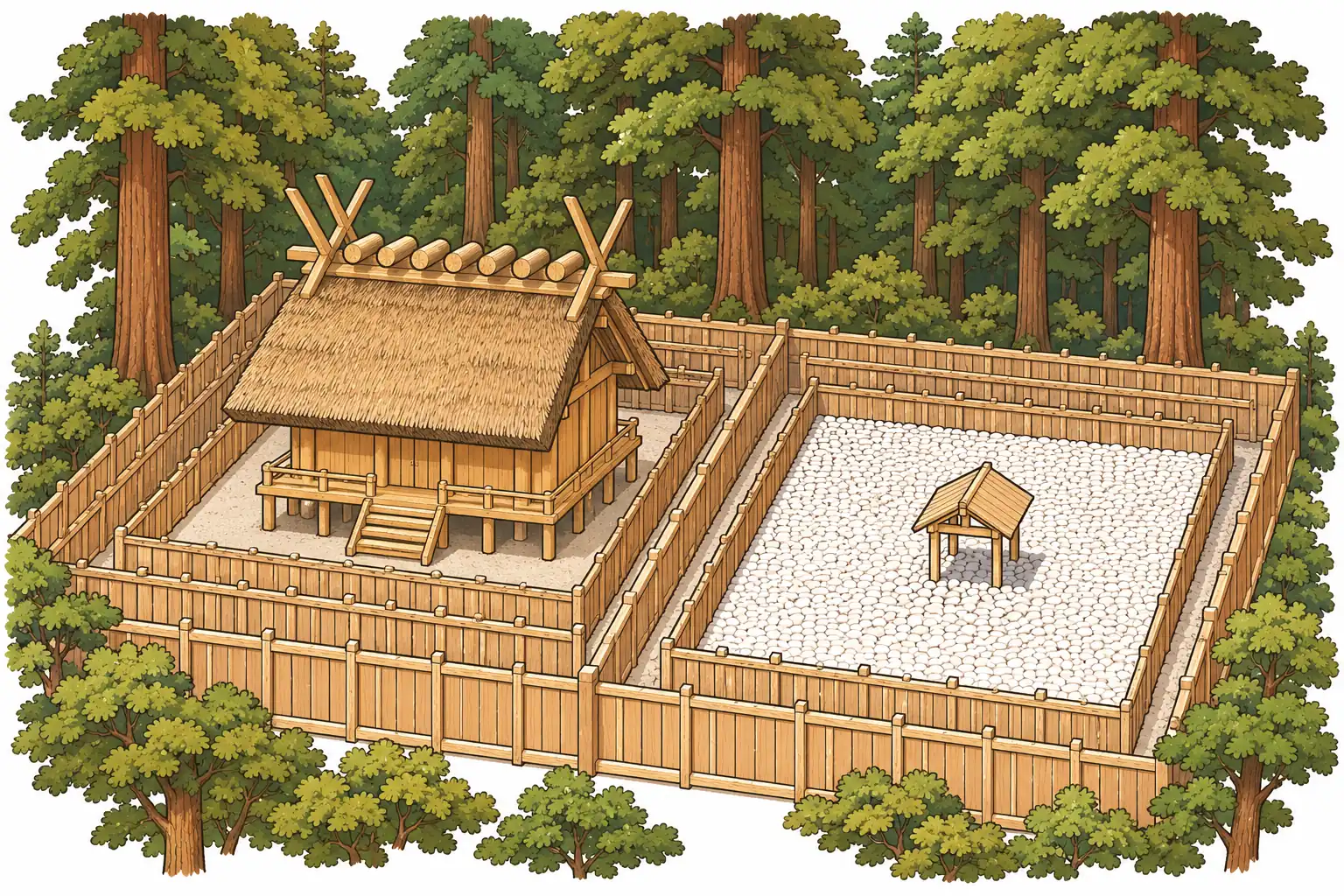
Two adjacent sites at Ise's Inner Shrine: the plain-wood main hall, and beside it an empty plot of white pebbles (illustration).
Is such a building "authentic"? In 1994 experts gathered in Nara and produced the Nara Document on Authenticity, which argued that authenticity must be judged within each culture’s own terms, and that the continuity of traditional techniques and practices can itself carry authenticity. The document reshaped how non-Western heritage is evaluated around the world.
So when you stand before the Golden Hall at Hōryū-ji, you are looking at a building from the late seventh or early eighth century, with some parts replaced over the centuries by carpenters using the same methods. Those methods are now protected too. In 2020, "Traditional skills, techniques and knowledge for the conservation and transmission of wooden architecture in Japan," seventeen crafts from building carpentry to cypress-bark roofing and architectural lacquer work, were added to UNESCO’s Representative List of the Intangible Cultural Heritage. As of November 2026 Japan has 23 elements on that list, and they also include Nōgaku (the Noh theater tradition), kabuki, washoku (traditional Japanese food culture), washi paper, festivals with floats, visiting-deity rituals and, in 2024, traditional sake brewing. Japanese calligraphy (shodō) has been recommended for inscription and is scheduled to go before the committee in December 2026.
03National Treasures and the Domestic System
No country can nominate a World Heritage site that is not already protected by its own law. In Japan that law is the Law for the Protection of Cultural Properties of 1950, and it was written in the shadow of a disaster. On January 26, 1949, a fire broke out at Hōryū-ji’s Golden Hall during restoration work and badly damaged most of its wall paintings, painted around the end of the seventh century and among the finest Buddhist murals in Asia. Since 1955 January 26 has been Cultural Property Fire Prevention Day, and temples and shrines across the country hold fire drills.
Earlier laws, the Ancient Shrines and Temples Preservation Law of 1897 and the National Treasures Preservation Law of 1929, had protected mainly religious buildings and art objects. The 1950 law widened the net to include performing arts and craft techniques, folk customs, historic sites, places of scenic beauty, natural monuments, and later cultural landscapes and groups of historic buildings. It is administered by the Agency for Cultural Affairs (Bunkachō), which moved its headquarters from Tokyo to Kyoto in 2023.
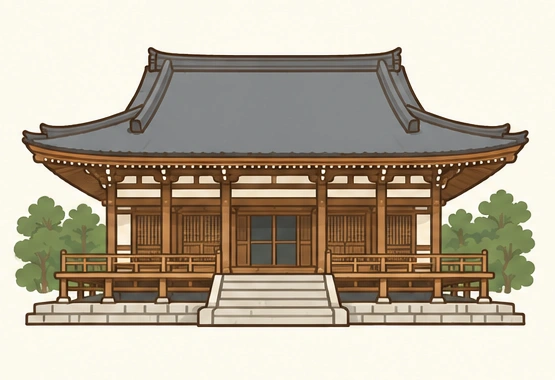
Tangible cultural property: buildings
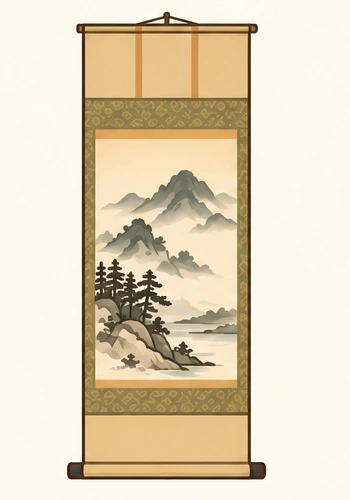
Tangible cultural property: paintings

Intangible cultural property protects the craft technique itself, such as textile dyeing
For a visitor, the useful thing is to know three verbs, because the signboards at the gate always use one of them.
The strictest is designation (shitei). The state designates objects and buildings as Important Cultural Properties, and from among those selects the most outstanding as National Treasures (kokuhō). As of 2026 there are 1,150 National Treasures and about 13,600 Important Cultural Properties (a count that includes the National Treasures). Once designated, a building cannot be altered, repaired or exported without the agency’s permission, and the state pays most of the cost of repairs. In the performing arts and crafts, the state designates Important Intangible Cultural Properties and recognizes the people who embody them, the potters, weavers and actors popularly called Living National Treasures (ningen kokuhō). Historic sites and scenic places are designated too, with "Special" added for the highest rank: Himeji Castle’s keep is a National Treasure, and the castle grounds are a Special Historic Site.
The second is registration (tōroku), introduced in 1996 as a lighter touch for modern buildings at least fifty years old. An old bank, a Meiji-era Western-style house, a family inn can become a Registered Tangible Cultural Property, marked by a small bronze plaque at the door. Owners must notify the authorities before changing the exterior, but they can use and renovate the inside freely. The system has quietly saved thousands of ordinary buildings that would never qualify as treasures, and as of 2026 it covers nearly 15,000 structures.
The third is selection (sentei), used for whole areas and for skills. A town first passes its own preservation ordinance, and the state then selects the district as an Important Preservation District for Groups of Traditional Buildings. There are 130 of these as of 2026, from Ogimachi village in Shirakawa-gō to Sannenzaka and Gion Shinbashi in Kyoto, the old merchant streets of Takayama and the post town of Tsumago on the Nakasendō. Important Cultural Landscapes, such as the waterways of Ōmihachiman or the Shimanto River basin, are also selected, as are the conservation techniques, like harvesting cypress bark for roofing, that keep designated buildings standing.
The layers stack. Shirakawa-gō was a preservation district before it was a World Heritage site; a temple can be part of a World Heritage listing while individual halls within it are National Treasures and others are Important Cultural Properties.
04Japan Heritage: Selling Stories
World Heritage and National Treasures are about things. Many regional treasures, though, are unremarkable on their own: a few kiln sites, a stretch of old road, a local festival, a regional dish. In 2015 the Agency for Cultural Affairs launched Japan Heritage (Nihon Isan), which recognizes not objects but stories that link a region’s cultural properties into a theme.
Eighteen stories were recognized in the first year, among them the Shikoku pilgrimage of 88 temples. Later examples show the idea at work. Gunma’s story ties together silkworm farmhouses, reeling mills and weaving towns under a title borrowed from a local saying about strong-willed wives who ran the silk economy. Southern Kyoto Prefecture tells "800 years of Japanese tea" through the tea fields of Uji and nearby villages. The former naval base cities of Yokosuka, Kure, Sasebo and Maizuru joined to tell the story of the imperial navy’s chinjufu, or naval districts. Six old pottery centers, Echizen, Seto, Tokoname, Shigaraki, Tanba and Bizen, were grouped as the "Six Ancient Kilns." By 2020 the government had reached its target of about 100 and stood at 104.
Japan Heritage is not a legal protection. It restricts nothing; it is a brand, a subsidy and a tourism strategy, and stories are reviewed periodically, with the possibility of losing the title if they fail to deliver. For travelers, its real value is as a route-finder: a story’s website will tell you which sites in an unfamiliar region make sense together.
05After the Listing
The tourist effect of inscription in Japan can be dramatic. Visitor numbers at the Tomioka Silk Mill multiplied in the year it was listed. Shirakawa village has a population of around 1,500, far fewer than the visitors on a busy day, which by some reports, as of 2025, can exceed 10,000. On Mount Fuji, Yamanashi Prefecture began charging a climbing fee and capping daily numbers on the Yoshida Trail in 2024, rules still in force as of 2026.
Fuji’s listing itself has a story. It was inscribed as a cultural site, not a natural one, under the title "Fujisan, sacred place and source of artistic inspiration," and its components include shrines at the foot of the mountain, worship sites at the summit, the Fuji Five Lakes and the Shiraito Falls. ICOMOS, UNESCO’s advisory body, recommended dropping the pine-lined beach of Miho no Matsubara, about 45 kilometers away in Shizuoka. Japan argued that the view of Fuji over the pines was one of the classic images of woodblock prints, and the beach stayed in.
Some listings carry diplomatic weight. The Meiji industrial sites and the Sado mines both involve the wartime use of Korean laborers, and South Korea objected to both. Japan committed to presenting the full history on site, and visitors to Hashima or Sado will find the issue addressed, with varying candor, in the local exhibitions.
And at one site, inscription means almost nobody can go. Okinoshima, a small island in the Genkai Sea, is held sacred in its entirety as the site of Munakata Taisha’s Okitsu-miya shrine, the whole island traditionally regarded as the body of the deity itself. Women have traditionally been barred, men allowed to land only under strict rules, and since the listing general visits have stopped altogether. Some 80,000 ritual offerings excavated there, all designated National Treasures, are displayed at the shrine’s treasure hall on the mainland, and the island can be worshiped from a distance at a hall on nearby Ōshima.
06Seeing Them
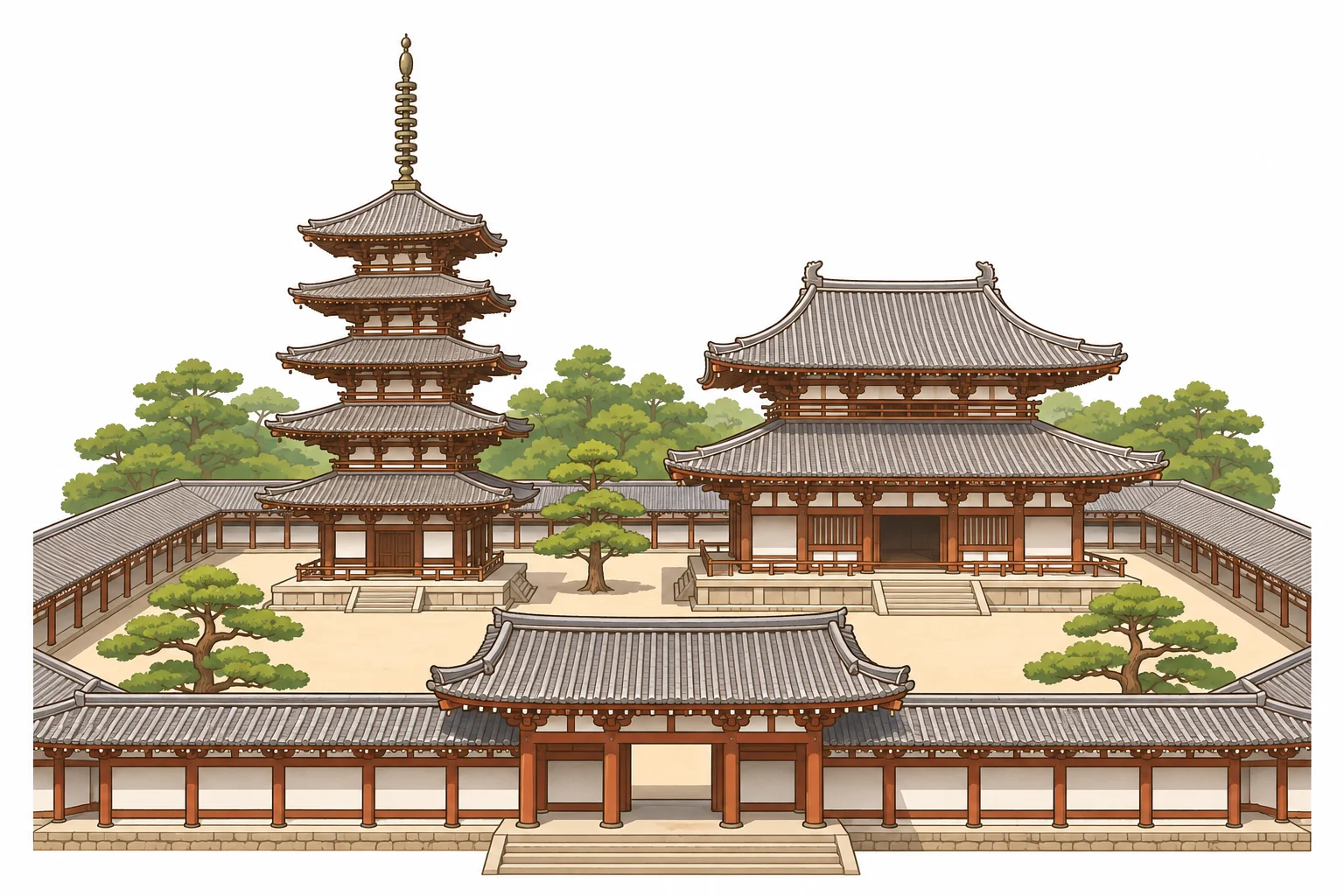
Twenty-seven sites spread from Hokkaidō to Okinawa will not fit in one trip. On a first visit Kyoto and Nara are almost unavoidable; the best way to add depth is to give half a day to Hōryū-ji, a short train ride from Nara city and far quieter than Tōdai-ji. Its western precinct, where the five-story pagoda and Golden Hall stand side by side, is the oldest group of wooden buildings in the world. Walk on to the octagonal Yumedono of 739 in the eastern precinct to feel the scale of an Asuka- and Nara-period monastery.
At Himeji, go early. You remove your shoes and climb six floors of steep wooden stairs inside the keep, and queues build quickly in spring and autumn. From the top floor you can see the main avenue running straight to Himeji Station.
At Shirakawa-gō, stay the night in a gasshō-zukuri farmhouse inn. The tour buses leave by late afternoon, the village goes quiet, and dinner is served around an irori hearth. Winter, when snow lies thick on the roofs, is the most photogenic season and the hardest to book.
Walkers should consider the Nakahechi route of the Kumano Kodō, two or three days from Takijiri-ōji to Kumano Hongū Taisha with small inns along the way. At Itsukushima, check the tide table: at high tide the great torii appears to float, and at low tide you can walk out to its base.
Then, wherever you go, read the signboard at the gate. Whether it says National Treasure, Important Cultural Property, Registered Tangible Cultural Property or Preservation District tells you how the place is protected, and the 27 World Heritage sites turn out to be the top of a much deeper stack. Nearby you may also find a national park or a stretch of satoyama, the managed village woodland and farmland that Japan protects as a living landscape rather than a monument.