
Iwami Ginzan is the site of a silver mine centered on Mount Sennoyama, in the Ōmori district of Ōda City, Shimane Prefecture. From the mid-16th century to the early 17th century it was among the most productive silver mines in Japan, and its metal fed a trade that reached Korea, Ming China and, through Portuguese merchants, markets farther afield. In 2007 the mine workings, the mining town below them, and the roads and harbors that carried the silver out were inscribed together on the World Heritage List as "Iwami Ginzan Silver Mine and its Cultural Landscape."
01Rise and decline
According to mine chronicles compiled in the Edo period, the Hakata merchant Kamiya Jutei began working the deposits around 1526 (some accounts say 1527). In 1533 he brought technicians from Hakata who introduced haifuki, the cupellation method that had reached Japan from the Korean peninsula. With it, silver could be refined on the spot instead of shipping out raw ore, and output rose sharply.
During the Warring States period the Ōuchi, Amago and Mōri houses fought repeatedly for the mine, and from 1562 the Mōri held it. After the Battle of Sekigahara in 1600 it passed under direct Tokugawa control. Administrators such as Ōkubo Nagayasu pushed production to a peak in the early 17th century. The veins then gave out gradually, and the shogunate ran the mine and the surrounding shogunal lands from a magistrate’s office in Ōmori. In the Meiji era the mine passed to private operators, and mining ended in 1923.
02What you can see today
Hundreds of small tunnels, known locally as mabu, are scattered through the hills. Ryūgenji Mabu, a shaft worked directly by the magistrate’s office in the Edo period, is partly open to visitors, and chisel marks can still be seen on its walls. Ōmori, the old mining town, stretches along a narrow valley with samurai residences, merchant houses, temples and shrines; it was designated a Preservation District for Groups of Traditional Buildings in 1987. The site of the magistrate’s office and the residence of the wealthy Kumagai family, an Important Cultural Property, stand here. At Rakan-ji, five hundred stone arhats carved in the 18th century are generally said to have been made to console the souls of those who died in the mine.
To the north, on the Sea of Japan, Yunotsu shipped silver in the late 16th century; after the early 17th century, when silver was sent overland to Onomichi on the Inland Sea instead, it remained the port for the mine’s supplies. It is also a hot-spring town, and it too was designated a preservation district, in 2004. The nearby inlets of Okidomari and Tomogaura, and the mine roads linking them to the mountain, fall within the World Heritage property. The mine site itself was designated a National Historic Site in 1969.
Iwami Ginzan
01A mine you cannot see at first
Visitors who come to Iwami Ginzan expecting an industrial landscape are usually surprised. There is no open pit, no headframe, no ruined factory. A road leads from the old town of Ōmori up a wooded valley beside a stream, past moss-covered stone walls and the foundations of vanished temples, and every so often a small dark opening appears in the hillside, barely large enough for one person to enter bent over. These openings are the remains of a silver mine that, in the 16th and early 17th centuries, helped make Japan one of the largest silver producers in the world.
The mine lies in what is now Ōda City in Shimane Prefecture, on the Sea of Japan side of western Honshū. The ore bodies are concentrated around Mount Sennoyama, a peak of a little over 500 meters. "Iwami Ginzan" simply means "the silver mountain of Iwami," Iwami being the old name of the province. But the name covers much more than one hill: the mine tunnels and smelting sites, the mining town where workers and merchants lived, the mountain castles built to defend it, and the roads and harbors through which the silver left. In 2007 this whole landscape was inscribed on the World Heritage List as "Iwami Ginzan Silver Mine and its Cultural Landscape." One point stressed at the time was that mining here was done almost entirely by hand, without stripping the surrounding forests, so the remains survive inside a living landscape of woods and villages.
02A merchant from Hakata
Most of what is known about the mine’s beginnings comes from chronicles compiled during the Edo period, above all a text known as the Ginzan kyūki ("Old Records of the Silver Mine"). These were written more than a century after the events and mix history with legend, but their outline has long been accepted.
According to these accounts, there was an early tradition that the Ōuchi family of Suō Province had found silver here in the early 14th century, though nothing lasting came of it. The real story begins with Kamiya Jutei, a member of a prominent merchant family of Hakata, the great trading port of northern Kyūshū. Legend says that while sailing along the Iwami coast he saw a mountain shining in the distance. He enlisted Mishima Seiemon, who operated a copper mine in neighboring Izumo, and around 1526 (some accounts say 1527) they began to work the deposits.
The shining mountain is a story told after the fact, but there was nothing accidental about Kamiya’s interest. The Kamiya were overseas traders with close ties to the Ōuchi, who dominated Japan’s trade with Ming China and Korea at the time. A Hakata merchant knew better than most what silver was worth across the sea.
03Cupellation: refining silver on the mountain
At first, ore was mostly shipped away, to Hakata and elsewhere, to be refined. That was slow and wasteful. The decisive change came in 1533, when, according to the chronicles, Kamiya brought two technicians from Hakata, named Sōtan and Keiju, who refined silver at the mine itself using a method called haifuki, or cupellation. It is generally thought that the technique reached Japan from the Korean peninsula, and Iwami was one of the first places in Japan where it was used successfully.
The process works like this. Crushed ore is smelted together with lead, and the silver dissolves into the molten lead, producing a silver-rich lead alloy. This alloy is then heated on a hearth lined with ash while air is blown across it. The lead oxidizes and soaks into the ash, leaving a bead of fairly pure silver on the surface. The same principle had been known in other parts of the world for a very long time; what mattered in Iwami was that it was now available at the mine.
Refining on the spot meant that a compact, valuable, easily traded metal left the valley instead of bulky ore. Output and profits rose sharply. Miners, smelters, merchants and craftsmen poured into the valleys, and a mining town grew up almost overnight. From Iwami the method spread to other mines, including Ikuno in Tajima and later Sado, and it became the technical foundation of Japan’s great surge in gold and silver production in the 16th and 17th centuries.
04Warlords fight for the mountain
A mountain that produced silver in such quantity was bound to be fought over, and Iwami Ginzan sat on the border between rival powers. To the west were the Ōuchi of Yamaguchi in Suō; to the east, the Amago of Izumo; and later the Mōri, who rose from Aki Province.
In the mine’s early years the Ōuchi were its main protectors and built mountain forts nearby, including Yataki Castle, to guard it. Over the following decades the mine changed hands repeatedly. The Amago captured it, the Ōuchi retook it, and local lords such as the Ogasawara were drawn into the fighting. Yamabuki Castle, on the mountain directly above the mine, was a recurring prize.
In 1551 Ōuchi Yoshitaka was forced to take his own life after a revolt by his retainer Sue Takafusa (later Sue Harukata), and the Ōuchi house collapsed. Mōri Motonari used the turmoil to rise, destroying Sue and then the remnants of the Ōuchi, and turned to contest the mine with Amago Haruhisa. The struggle lasted years, and the Mōri suffered defeats along the way. Haruhisa died at the very end of the third year of Eiroku (January 1561), and Amago power weakened. In 1562 Honjō Tsunemitsu, the local Iwami lord holding the mine area, went over to the Mōri, and from then on the Mōri held the mine firmly.
Its revenue became a pillar of Mōri power. When Emperor Ōgimachi held his enthronement ceremony in 1560, Mōri Motonari paid a large share of the costs, and it is generally believed that Iwami silver was part of that contribution. Later, after the Mōri submitted to Toyotomi Hideyoshi, a substantial portion of the mine’s silver went to the Toyotomi government, and some Toyotomi-era silver coinage was struck from Iwami metal.
05Silver and the wider world
The timing of the mine’s rise was no accident. In the mid-16th century, Ming China was moving toward a tax and commercial system reckoned and paid in silver, and Chinese domestic production fell far short of demand. Silver was worth much more in China than in Japan, and that price gap made Japanese silver the most sought-after commodity in East Asian maritime trade.
Within a few years of the mine’s development, Korean records describe Japanese traders arriving with large quantities of silver, so much that the Joseon court found it troublesome. The Ming dynasty banned private overseas trade and refused open commerce with Japan, but smugglers and so-called wakō pirates on the southeast China coast carried Japanese silver to China anyway, exchanging it for raw silk, silk cloth, porcelain and medicines. After the Portuguese reached East Asia in the 1540s, they set up at Macau and ran a carrying trade between China and Japan, moving great amounts of Japanese silver into China.
Some historians estimate that in the early 17th century Japan produced roughly a third of the world’s silver, and that Iwami supplied a large part of it. Such figures are reconstructions from scattered sources and vary from scholar to scholar, but the weight of Japanese silver in East Asian trade at the time is not in doubt. Europeans knew of the mine too: a map of Japan published in Europe in the late 16th century marked the Iwami area with a note about silver mines.
06Tokugawa control and Ōkubo Nagayasu
At the Battle of Sekigahara in 1600, Mōri Terumoto was the nominal commander-in-chief of the Western Army. After the defeat the Mōri lost most of their domains, and Tokugawa Ieyasu took Iwami Ginzan under his direct control. Holding the country’s principal gold and silver mines was one of the financial foundations of the Tokugawa shogunate.
Ieyasu entrusted the mine to Ōkubo Nagayasu, one of the more remarkable figures of the age. Born into a family of sarugaku performers, he had served the Takeda family of Kai and, after their fall, joined Ieyasu, earning a reputation as a skilled financial manager and mine administrator. In Iwami he recruited independent mine operators, known as yamashi, from across the country, offered them generous terms and encouraged the opening of new tunnels. Production reached its peak in the early 17th century. Later accounts claim that the silver sent to the shogunate was enormous and that the mining district held as many as 200,000 people, a figure generally regarded as exaggerated.
Ōkubo went on to oversee the Sado gold and silver mines and gold mines in Izu as well, accumulating great power. After his death in 1613 he was accused of misconduct while in office, and his sons were severely punished. The affair was one of the major political scandals of the early Edo period, but it did not change the shogunate’s direct hold on the mines.
Throughout the Edo period, the mine and its surrounding villages formed a shogunal territory administered from a magistrate’s office in Ōmori. The magistrate, or daikan, was responsible both for mine production and for governing the villages.
07Life in the mining town
At the height of the boom, miners and their families lived scattered through the valleys of Sennoyama in small hamlets. The tunnels, called mabu, were cut with chisels and hammers, following the veins inch by inch. Inside it was cramped, lit only by oil lamps, and drainage and ventilation were constant problems. Dust in the tunnels caused lung disease, and many miners died young. A widely repeated local saying holds that a miner who reached the age of 30 had cause to celebrate, though its early source is unclear.
From the mid-17th century the easily reached ore was exhausted. Tunnels went deeper, drainage became more costly, and output fell. The center of life moved from the mountain hamlets down to Ōmori, home to the magistrate’s office, samurai residences, merchant houses that handled mine business and also brewed sake and lent money, and a large number of temples and shrines.
One magistrate of the mid-Edo period left a lasting memory. Ido Heizaemon arrived in 1731, already an old man, just as the great Kyōhō famine struck western Japan. According to local tradition he opened the official granaries for relief without waiting for permission from Edo, and introduced sweet potatoes from Satsuma, encouraging villagers to plant them as a famine crop. People called him the "Sweet Potato Magistrate" and raised memorial stones and shrines to him throughout the region. Some details have grown in the retelling, but the respect he earned is real.
The five hundred arhats of Rakan-ji also date from this period. The stone figures are said to have been carved over some twenty years beginning in the 1740s and were set into caves cut into the rock face. They are generally thought to have been made to console the spirits of those who died working the mine, and of ancestors. Each face is different, and the caves remain one of the best-loved sights in the district.
08The end of mining
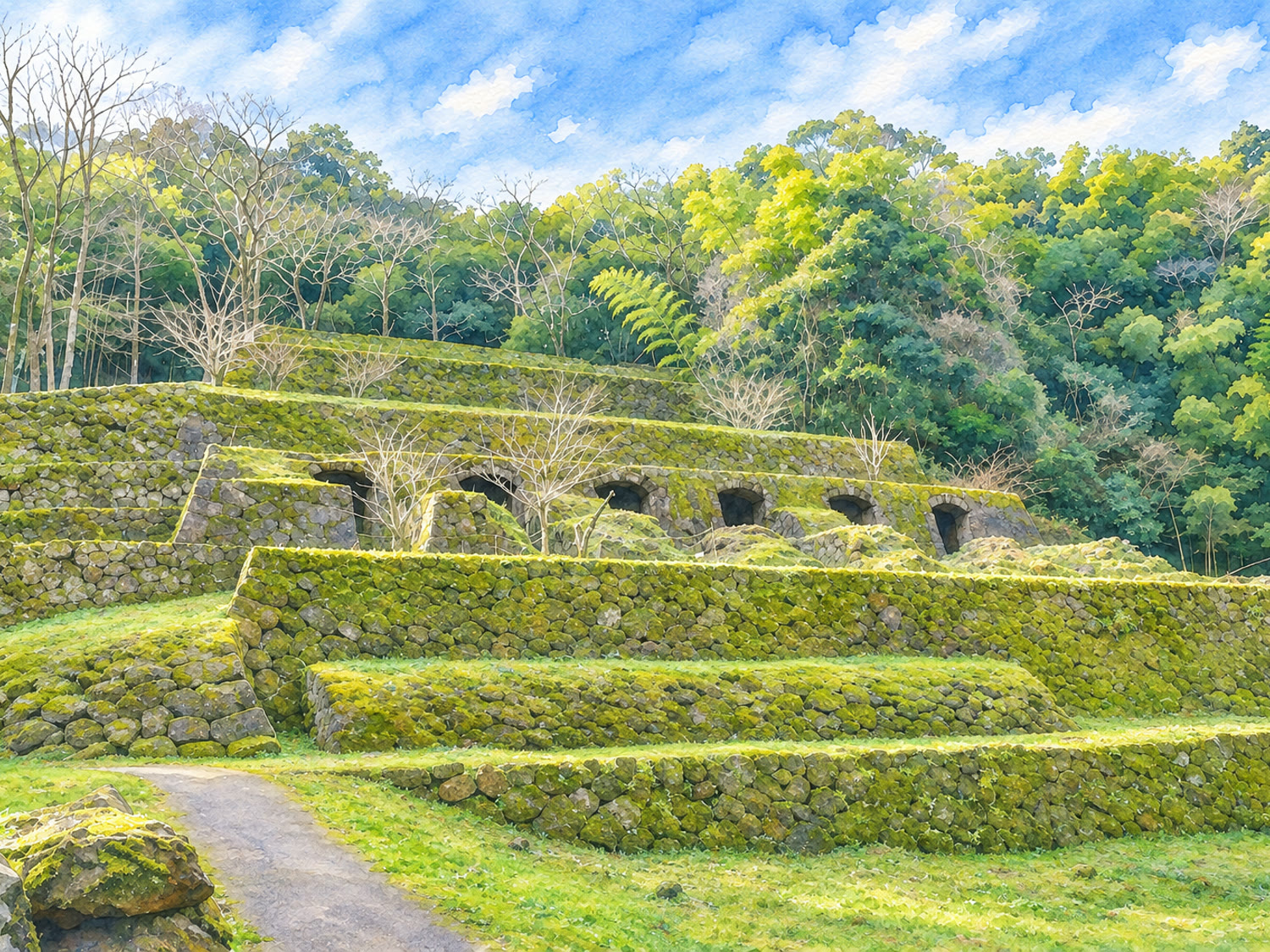
After the Meiji Restoration, shogunal control ended and the mine passed to private hands. In 1886 the Fujita-gumi company of Ōsaka acquired the mining rights and tried to revive it with modern methods, mining copper as well as silver. The company built a large refinery at Shimizudani that began operating in 1895, but the ore proved poorer than expected, the refining technology fell short, and the plant was shut down after about a year and a half. Today only its terraced stone foundations remain on the hillside. Operations moved to other parts of the field but never regained their old scale, and in 1923, with copper prices falling, mining at Iwami Ginzan stopped, closing a history of about four centuries. Copper mining was briefly revived during the war years, until a flood swamped the tunnels in 1943 and ended it for good.
After closure the population fell sharply. The mountain hamlets disappeared almost entirely, and Ōmori grew quiet. Yet precisely because the area escaped large-scale modern development, the mine remains and the old town survived. The mine site was designated a National Historic Site in 1969, and Ōmori’s townscape became a Preservation District for Groups of Traditional Buildings in 1987. Decades of conservation by local residents laid the groundwork for the World Heritage nomination.
09Yunotsu, Okidomari and the silver roads
Silver refined in the valley had to travel overland to the coast. In the early period the main route ran north to Tomogaura, a small inlet from which Ōuchi-era silver ore was shipped to Hakata. After the Mōri took over, they relied more on the route northwest to Yunotsu and Okidomari. Okidomari is a long, narrow natural harbor, and holes cut into the rocks along its shore are generally thought to have been used for mooring ships. The Mōri built a fort nearby to protect the harbors.
Yunotsu was both a port and a hot-spring town. Early in the Edo period the shogunate switched to sending silver overland to Onomichi on the Inland Sea, but supplies for the mine still came in through Yunotsu, and the harbor town and its baths prospered together. Today Yunotsu keeps its old streets and inns and is also a designated preservation district.
These roads and harbors are part of the World Heritage property because together they show the entire chain, from extraction and refining to shipment. Stretches of the old mine roads still preserve stone paving and the line of the original route.
10Walking the site
A visit usually begins in Ōmori. The old town follows a narrow valley, lined with wooden houses roofed in the reddish-brown glazed tiles typical of the region. The site of the magistrate’s office now houses a museum on the mine’s history, and the Edo-period gate and row house still stand at its front. The Kumagai residence, a wealthy merchant house of the late Edo period designated an Important Cultural Property, shows how the merchant families who handled mine and magistrate business lived. Along the street are samurai residences, several temples, and Kigami Shrine, whose hall ceiling bears a painted dragon.
From Ōmori the path leads up past the arhats of Rakan-ji and along the stream into the area once called the Sakunouchi, the fenced core of the mining district, thick with tunnel entrances, smelting sites and temple ruins. Ryūgenji Mabu, a shaft worked directly by the magistrate’s office in the Edo period, has been partly restored so visitors can walk inside. Its walls are covered in chisel marks, and side passages that followed individual veins branch off along the way. Elsewhere in the hills are Sahimeyama Shrine, dedicated to the deity of the mine, and the ruins of the Shimizudani refinery.
With more time, it is worth going north to Yunotsu and Okidomari and following the silver route to the sea. Standing on the rocks at Okidomari, one can picture ships laden with silver setting out for Hakata, and from there to Korea and China, with Portuguese traders carrying some of it farther still, and understand how this quiet valley was once tied to the wider world.