
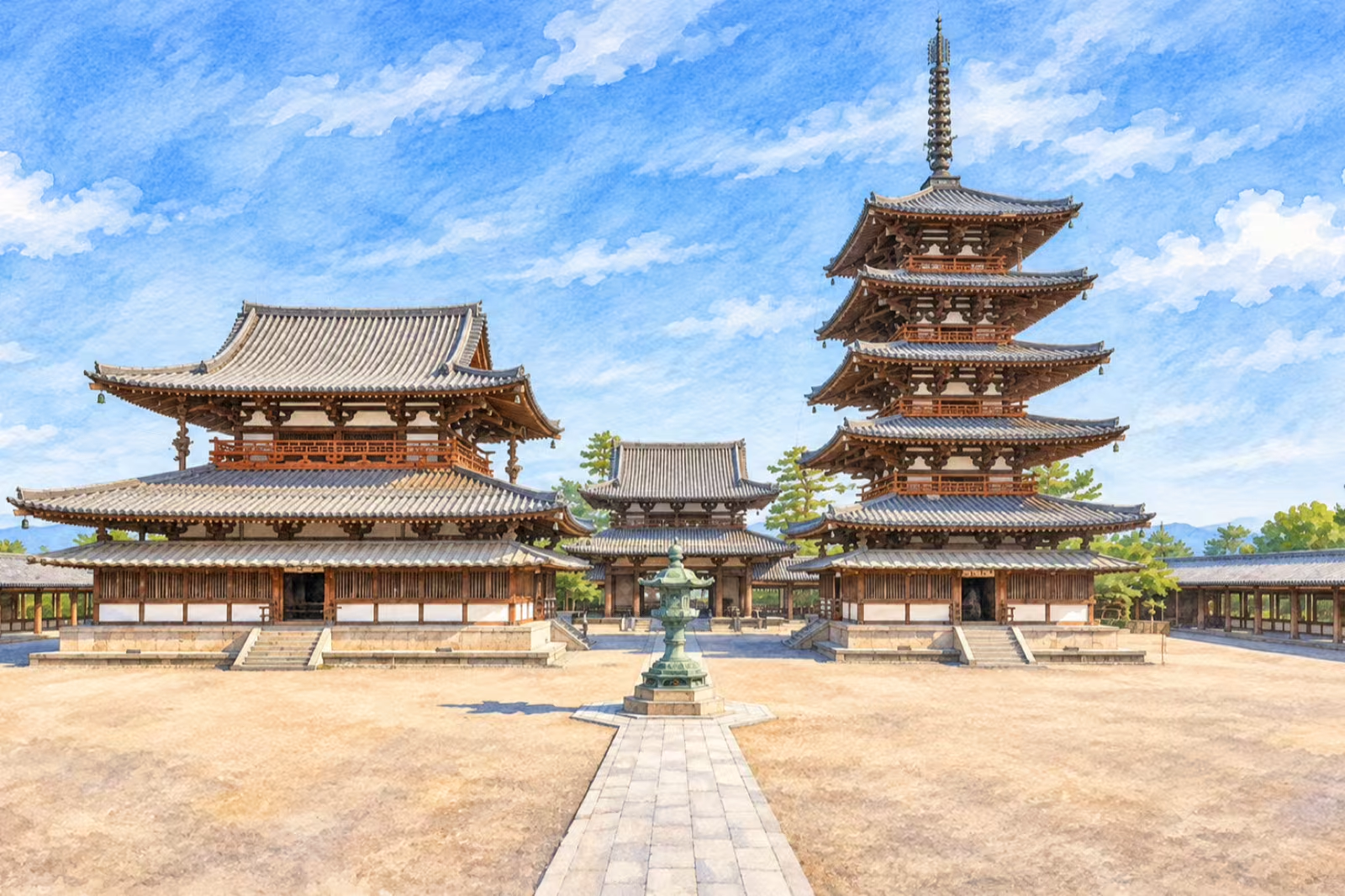
Hōryū-ji is a Buddhist temple in the town of Ikaruga, Nara Prefecture. Tradition credits its founding to Prince Shōtoku and Empress Suiko, and it is one of the oldest temples in Japan. The Kondō (Golden Hall) and five-story pagoda of its Western Precinct are generally regarded as the oldest surviving group of wooden buildings in the world, and the temple holds a large collection of Buddhist sculpture and craft from the Asuka and Nara periods. In 1993 Hōryū-ji and the nearby Hokki-ji were inscribed together as the World Heritage Site "Buddhist Monuments in the Hōryū-ji Area," among the first places in Japan to receive that status.
01Founding and Rebuilding
According to the inscription on the halo of the Yakushi image in the Kondō and other records, the temple was completed around 607 as a prayer for the recovery of Emperor Yōmei. Prince Shōtoku’s Ikaruga palace stood close by, and the temple was closely tied to his family. The Nihon Shoki states that Hōryū-ji burned to the ground in 670. Whether the present Western Precinct is a post-fire rebuilding or the original was argued for decades in modern scholarship. In 1939 excavators found the remains of an earlier temple, known as the Wakakusa Garan, on a different site and alignment, and since then the rebuilding view has prevailed. The present Western Precinct is generally dated to the late 7th or early 8th century.
The Eastern Precinct occupies the site of the Ikaruga palace. Around 739 the monk Gyōshin built the octagonal Yumedono (Hall of Dreams) in memory of Prince Shōtoku, who had died in 622.
02Buildings and Treasures
In the Western Precinct a middle gate and roofed corridor enclose a courtyard where the Kondō and pagoda stand side by side. The Kondō houses the Shaka Triad by the sculptor Tori Busshi, made according to its inscription in 623 in memory of the prince. The temple also holds the Kudara Kannon and the Tamamushi Shrine, both from the Asuka period. The Yumedono enshrines the Guze Kannon, a hidden image kept wrapped for centuries until Okakura Kakuzō and Ernest Fenollosa were allowed to open its shrine in 1884.
In January 1949 a fire broke out in the Kondō during repairs and badly damaged its late 7th-century wall paintings. The loss led directly to the Law for the Protection of Cultural Properties in 1950, and January 26 is now observed as Cultural Properties Fire Prevention Day.
03What Can Be Seen Today
The Kondō, the pagoda, the Yumedono and many other buildings are National Treasures. From the 1930s to the 1980s the buildings went through the half-century Shōwa Great Repair. The paintings now on the Kondō walls are replicas made after the fire, and the burned originals are kept separately. Most of the major sculptures and craft objects are displayed in the Daihōzō-in treasure hall, while some hidden images are shown only at set times of year.