
At a glance
Who Kannon is, why the bodhisattva has eleven heads or a thousand arms, how the Japanese worship and make pilgrimages to her, and how to read her statues.
- Kannon (Kanzeon) is the bodhisattva of the Lotus Sutra’s Kannon chapter: call her name with a sincere heart and she comes to help.
- The sutra says Kannon takes 33 forms, the source of the 33 in the Saigoku pilgrimage and in Sanjūsangen-dō.
- A Thousand-Armed Kannon usually has 42 arms: two hands in prayer and forty more, each saving 25 worlds, for a total of a thousand.
- Sanjūsangen-dō in Kyoto holds 1,001 life-size standing figures of the Thousand-Armed Kannon.
- To identify a statue, look at the head and hands: a small Amida in the crown, a ring of little faces, a halo of arms.
Spend a few days visiting temples in Japan and you will meet Kannon again and again. She stands in the dim main hall of Kiyomizu-dera in Kyoto, she is the hidden heart of Sensō-ji in Tokyo’s Asakusa, and she sits in weathered stone by country roads, a faded red bib tied around her neck. Sometimes she has eleven heads; sometimes she has a thousand arms; sometimes she is locked away in a cabinet that opens once in a generation. Kannon is the bodhisattva of compassion, and for well over a thousand years she has been the figure ordinary Japanese people have turned to when they needed help. This piece explains who she is, why she takes so many strange forms, how people in Japan have worshipped her, and what to look for when you stand in front of her statue.
01The one who hears the cries of the world
Kannon is the Japanese name for the Indian bodhisattva Avalokiteśvara. Chinese translators rendered the name in two ways. The fifth-century monk Kumārajīva chose Guanshiyin, "the one who perceives the sounds of the world," and the seventh-century pilgrim Xuanzang preferred Guanzizai, "the one who sees freely." Japanese uses both: Kanzeon in sutras and formal titles, Kanjizai in the opening line of the Heart Sutra, which many Japanese can recite from memory. In everyday speech she is simply Kannon-sama, with the polite suffix sama attached.
A bodhisattva (bosatsu in Japanese) is a being who has reached the threshold of enlightenment but chooses to remain in the world to help others. In practice this makes a bodhisattva more approachable than a buddha. Buddhas preside; bodhisattvas come when called. Kannon also appears as one of the two attendants of Amida Buddha, the buddha of the Western Pure Land, which is why a tiny seated Amida usually sits in the front of Kannon’s crown. If you see that little figure on a statue’s headdress, you are almost certainly looking at Kannon.
The text that made Kannon so popular is a single chapter of the Lotus Sutra, usually called the Kannon Sutra in Japan and often chanted on its own. It promises that anyone facing fire, flood, shipwreck, execution, chains, or bandits need only call Kannon’s name with a sincere heart, and the bodhisattva will hear and come to the rescue. The same chapter says Kannon will take whatever form a person needs in order to be saved: a buddha, a king, a merchant, a monk, a woman, a child, even a non-human being. The sutra lists thirty-three such forms. That number, thirty-three, turns up all over Japanese Kannon worship, from the length of temple halls to the number of stops on pilgrimage routes.
02Is Kannon a woman?
English-language guidebooks usually call Kannon "the goddess of mercy," and the image of a serene woman in a white robe is what many visitors expect. The reality is more mixed. In Indian art Avalokiteśvara was clearly male, often with a mustache, and the oldest Kannon statues in Japan follow this model. In China, from around the Song dynasty onward, Guanyin gradually took on a feminine appearance, and figures such as the White-Robed Kannon and the child-giving Kannon spread to Japan along with Zen ink painting and popular devotion.
Most temple statues in Japan sit somewhere in between: smooth-faced, gentle, adorned with jewelry, sometimes with a faint painted mustache. Doctrinally, bodhisattvas are beyond gender, and the sutra’s promise that Kannon can appear as a woman or a man settles the question for believers. Japanese speakers rarely have to choose a pronoun anyway. This piece uses "she" because that is what most English readers will recognize, but a Japanese temple-goer would simply say Kannon-sama.
03The oldest statues
Buddhism arrived in Japan in the sixth century, and some of the oldest Buddhist sculptures in Japan are images of Kannon in and around Nara. At Hōryū-ji, the temple associated with Prince Shōtoku, the octagonal Hall of Dreams (Yumedono) houses the Guze Kannon, a tall gilded wooden figure said to have been made in the prince’s likeness. For centuries it was a hidden image, wrapped, by one well-known account, in hundreds of meters of cloth. In the 1880s the American scholar Ernest Fenollosa and his Japanese colleague Okakura Kakuzō persuaded the monks to unwrap it, and found the gilding almost perfectly preserved.
Hōryū-ji also holds the Kudara Kannon, an unusually slender figure a little over two meters tall. Kudara is the Japanese name for the Korean kingdom of Paekche, but the label dates from much later and where the statue was actually made is still debated. Next door at Chūgū-ji, a seated figure with one leg crossed and a finger raised to its cheek, lost in thought, is traditionally identified as Nyoirin Kannon. Its faint smile has made it one of the best-loved sculptures in Japan.
In the eighth century, esoteric Buddhist ideas brought more elaborate forms. In the Hokkedō (Sangatsudō) at Tōdai-ji stands the Fukūkenjaku Kannon, with a third eye in its forehead and a lasso in one hand for hauling beings out of suffering. Up the hill, Nigatsudō enshrines an Eleven-Headed Kannon that is the focus of the Shuni-e, a two-week repentance ceremony held every March. Its best-known part, Omizutori, "the drawing of water," has been performed since 752, and each evening, as the monks climb to the hall, attendants lighting their way carry enormous flaming torches along the hall’s balcony while crowds below try to catch the falling sparks for luck.
04Eleven heads and a thousand arms
To a first-time visitor, a statue with a ring of small heads or a halo of arms can look alarming. To believers, each form expresses a particular way of helping.
| Where | Face | Meaning |
|---|---|---|
| Front | Compassionate | Kindness for the good |
| Sides | Angry | Wrath for the wicked |
| Back | Laughing | Laughter to jolt the deluded |
| Top | Buddha’s head | — |
Each face is a way of helping: Kannon faces every direction.
The Eleven-Headed Kannon (Jūichimen Kannon) wears a crown of smaller faces. Those at the front are calm and compassionate, those at the sides are angry, a face at the back bursts into laughter, and a buddha’s head crowns them all. Together they mean that Kannon faces every direction and meets every kind of person, with kindness for the good, wrath for the wicked, and laughter to jolt the deluded.
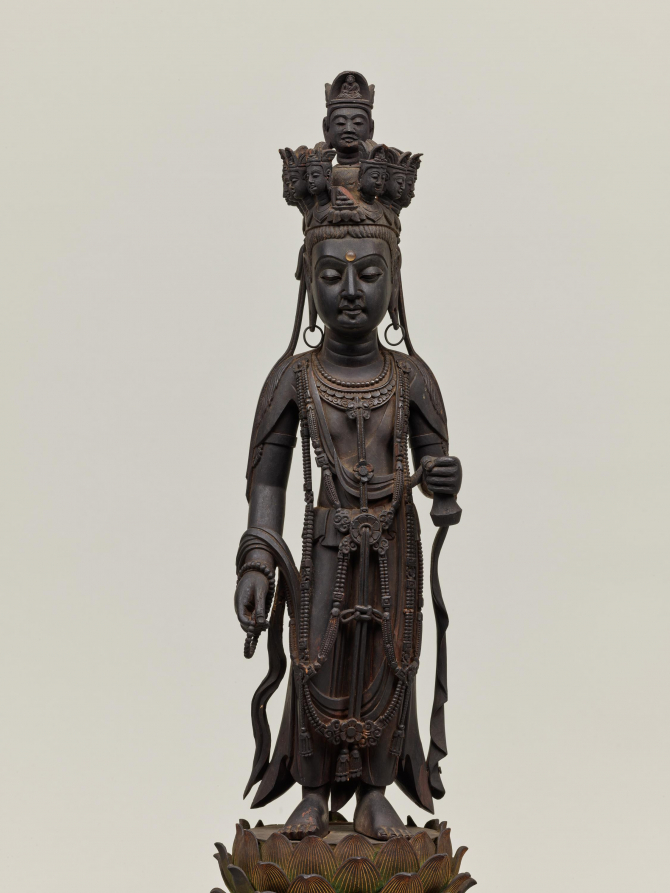
A standing Eleven-Headed Kannon, with a ring of small faces on the head and a buddha’s head on top.Tokyo National Museum, Standing Eleven-Headed Kannon (China, Tang dynasty, 7th century, sandalwood)
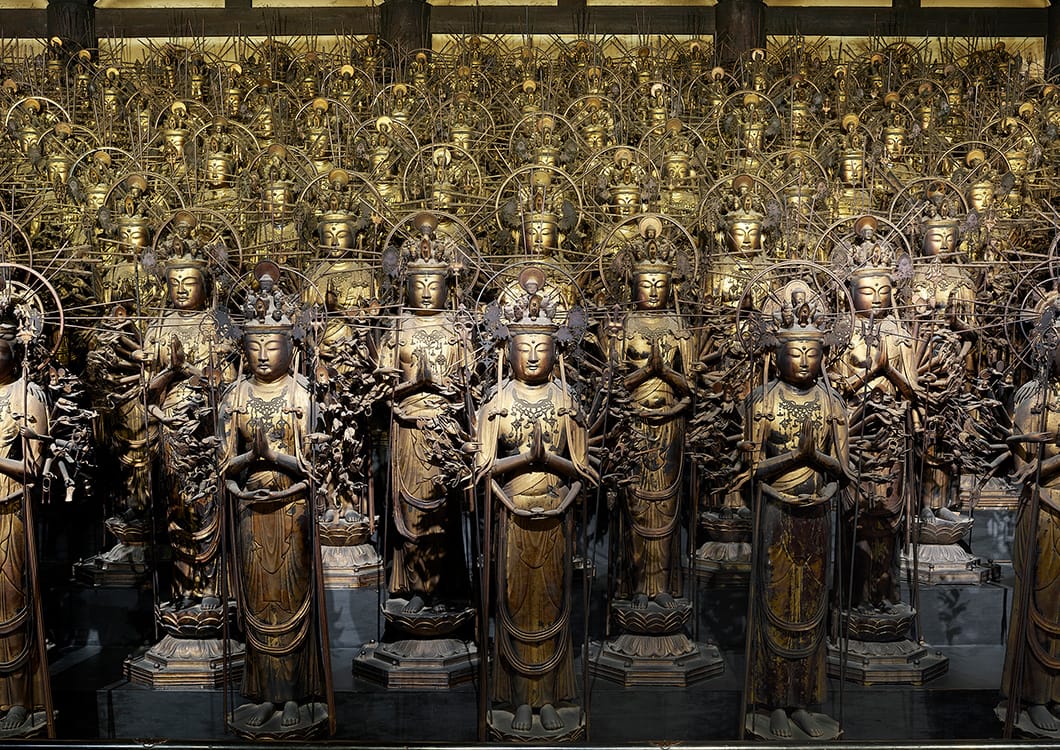
Inside Sanjūsangen-dō, life-size standing Thousand-Armed Kannon stand row upon row, 1,001 in all.
The Thousand-Armed Kannon (Senju Kannon) rarely has a full thousand arms. The standard sculptural solution is forty-two: two hands pressed together in prayer and forty more, each of which saves twenty-five worlds, for a total of a thousand. Many of the hands hold objects, such as a lotus, a sword, a bow, a rope, a wheel, or a mirror, and often each palm carries an eye, giving the full name "Thousand-Armed, Thousand-Eyed Kannon." Nothing escapes her sight, and nothing is out of reach.
Japanese Buddhism groups these and other forms into the Six Kannon, each assigned to one of the six realms of rebirth: the basic one-faced, two-armed Shō Kannon; the Eleven-Headed and Thousand-Armed forms; Batō Kannon, who wears a horse’s head in the hair and has a furious face; Nyoirin Kannon, six-armed and pensive, holding a wish-granting jewel and a wheel; and either Fukūkenjaku or Juntei Kannon, depending on the school. Each looks after a different class of suffering beings. Batō Kannon, for example, is in charge of animals, which is how he became the protector of horses in rural Japan.
Nowhere shows off the Thousand-Armed Kannon like Sanjūsangen-dō in Kyoto, officially Rengeō-in. It was built for the retired emperor Go-Shirakawa by the warrior Taira no Kiyomori in 1164, burned down, and was rebuilt in 1266. Inside the long, narrow hall, 1,001 life-size standing figures of the Thousand-Armed Kannon line up in tiers, with a large seated Kannon by the Kamakura-period sculptor Tankei at the center. Walking the length of the hall is an experience that photographs, which are not allowed inside, cannot convey. People like to say that among the thousand faces you will find one that resembles someone you have lost. The name Sanjūsangen-dō, "hall of thirty-three bays," comes from the number of spaces between the pillars of its inner sanctum, and the thirty-three again points back to Kannon’s thirty-three forms.
05Famous temples and hidden images
Many of Japan’s great Kannon temples begin with a story of discovery. Sensō-ji in Asakusa traces its origins to the year 628, when two fishermen brothers, Hinokuma Hamanari and Takenari, pulled a small golden statue of Kannon out of the Sumida River in their net. The local headman, Hajino Nakatomo, recognized it as a sacred image and turned his home into a temple. That statue has never been shown to anyone; by tradition, not even the priests look at it. The millions of people who walk through the Thunder Gate and down the shopping street of Nakamise each year are paying respects to a Kannon no one has seen.
Kiyomizu-dera in Kyoto, founded according to its own records in 778, enshrines an Eleven-Headed, Thousand-Armed Kannon. Its famous wooden stage, jutting from the hillside on a lattice of tall pillars, was built as a platform for offering music and dance to the bodhisattva. "Jumping off the stage at Kiyomizu" is a Japanese idiom for taking a bold plunge. In the hills of Nara, Hase-dera houses an Eleven-Headed Kannon roughly ten meters tall, one of the largest wooden statues in the country. Court women of the Heian period made the journey there to pray, and the trip appears in The Tale of Genji and in Sei Shōnagon’s The Pillow Book.
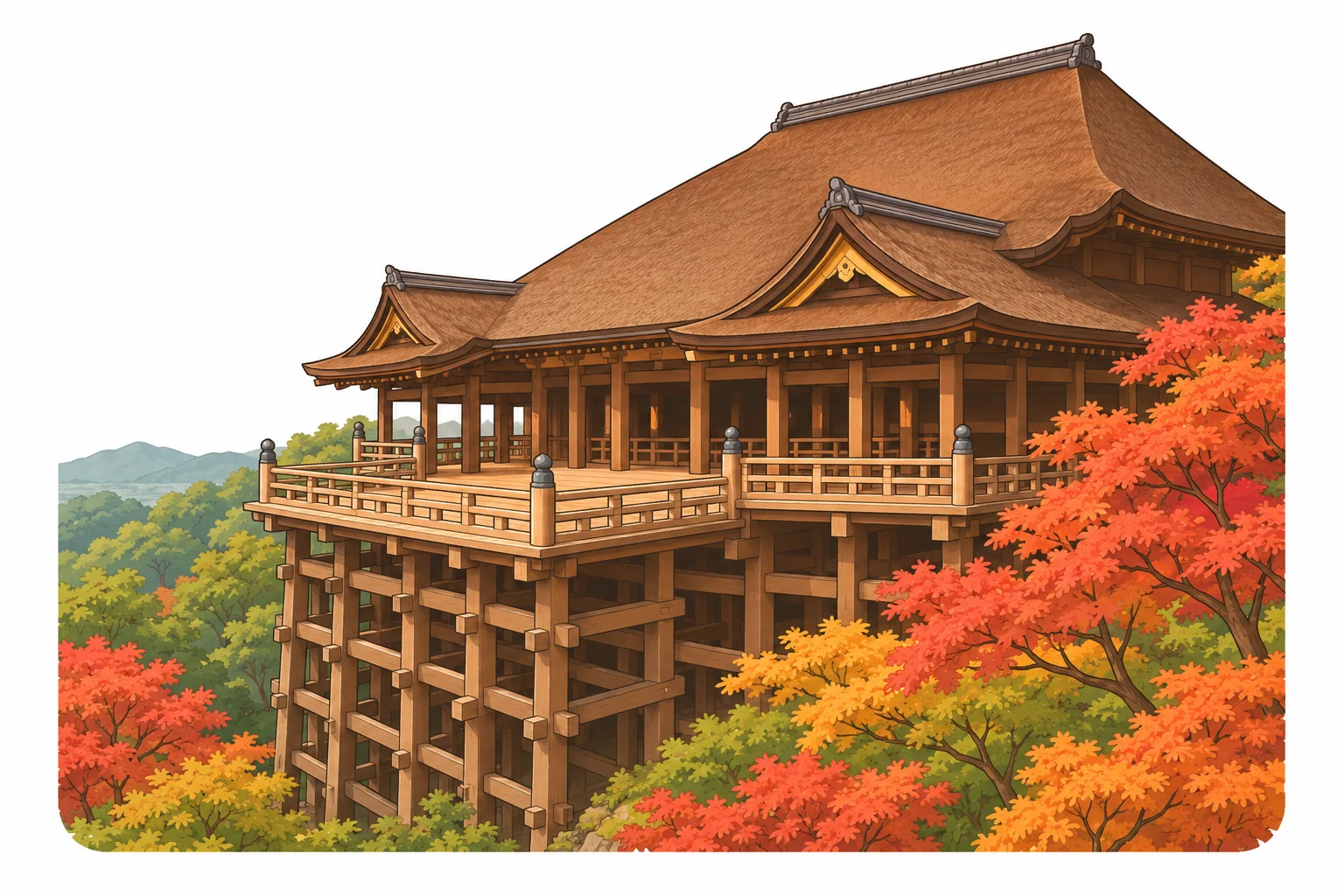
Kiyomizu-dera's stage juts from the hillside, held up by a lattice of tall timber pillars (illustration).
Sensō-ji’s hidden statue is an extreme case of a common practice. Many temples keep their principal image as a hibutsu, a secret buddha, locked in its shrine cabinet and shown only at intervals of several years, decades, or once every thirty-three years. During the rest of the time, a stand-in figure called the maedachi ("standing in front") receives worship in its place. The logic is close to that of a sacred relic: what is concealed is more powerful, not less, and the years when a cabinet is opened, called kaichō, can bring enormous crowds.
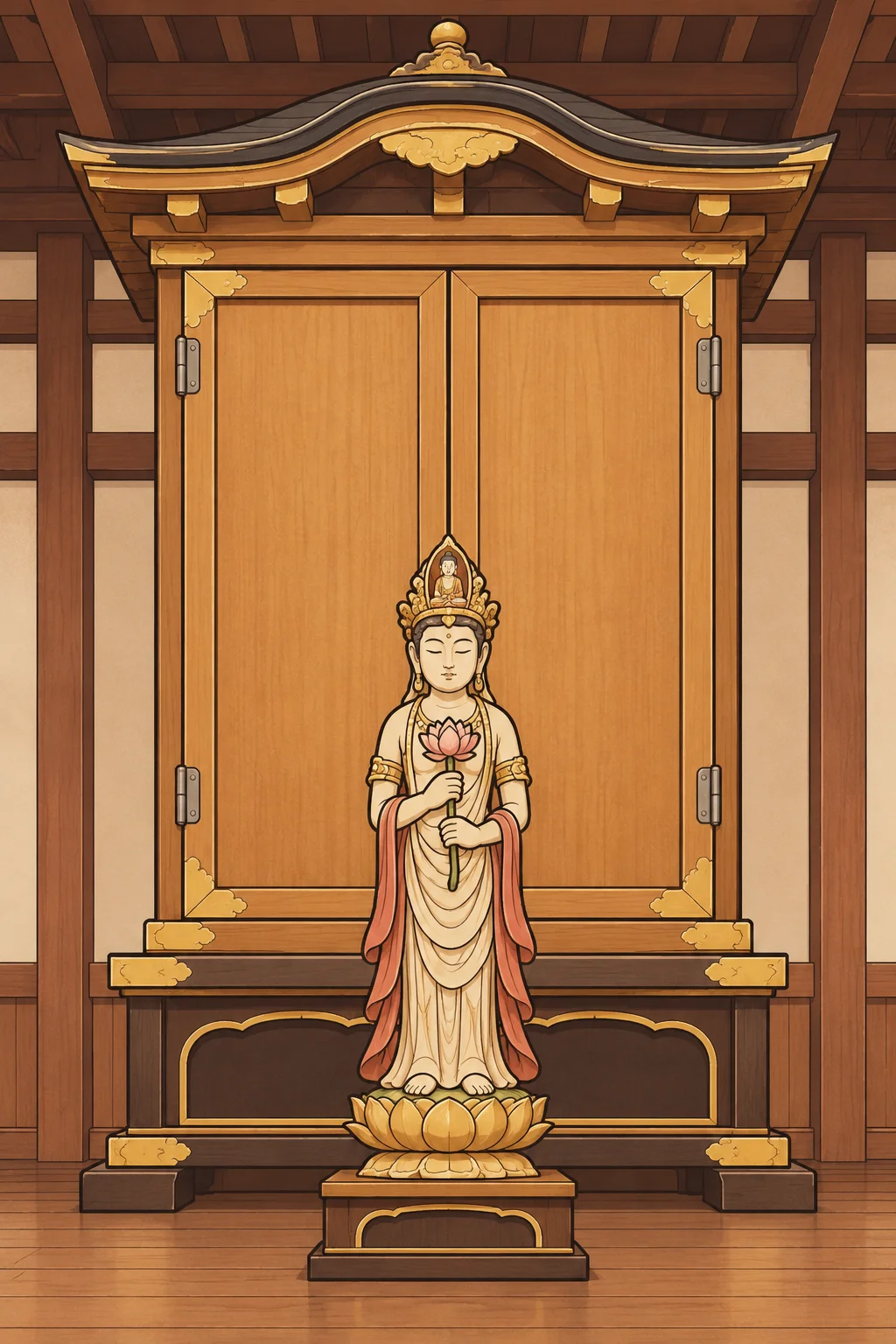
Many temples keep a hibutsu locked in its shrine cabinet while a stand-in figure, the maedachi, receives worship.
06The pilgrimage of thirty-three temples
What carried Kannon into the lives of ordinary people was pilgrimage. Japan’s oldest pilgrimage circuit, the Saigoku Thirty-Three Temples, links thirty-three Kannon temples across the Kansai region, starting at Seiganto-ji near the Nachi waterfall in Wakayama and ending at Kegon-ji in Gifu, with Kiyomizu-dera, Hase-dera, and Ishiyama-dera among the stops in between. Temple legend says the route was revealed to a Nara-period priest named Tokudō by the king of the underworld and revived later by the retired emperor Kazan, but these are founding stories. What the records show is that monks were making the circuit by the late Heian period, and by the Edo period it had become a great journey for commoners.
Eastern Japan copied the idea with the Bandō Thirty-Three and the Chichibu Thirty-Four, and together the three routes make up the "Hundred Kannon." Traditional pilgrims dress in white and carry a wooden staff. At each temple they visit the stamp office, where a temple worker brushes the name of the main image in ink and presses a red seal into the pilgrim’s book or onto a hanging scroll. This is one of the sources of the goshuin temple-seal collecting that has become hugely popular in recent years. A finished scroll bearing all thirty-three seals is often treasured by a family and sometimes placed in its owner’s coffin.
Walking the whole Saigoku route means covering roughly a thousand kilometers, and most pilgrims today complete it in stages by car, bus, or train. Shikoku’s famous eighty-eight-temple pilgrimage is a separate tradition centered on the monk Kūkai, though pilgrims there look and behave much the same way.
07Kannon by the roadside, in the factory, and on the skyline
Kannon is not confined to great temples. Walk a country lane and you may pass a stone engraved with the characters for Batō Kannon. These were set up by farmers and packhorse drivers in memory of horses that died in their service, and to ask for safe travel. Koyasu Kannon, the Kannon of safe childbirth, has her own shrines all over the country.
During the centuries when Christianity was banned, hidden Christians in Kyūshū prayed before white porcelain figures of Kannon holding a child, privately understanding them as the Virgin Mary. These "Maria Kannon" can now be seen in museums in Nagasaki and elsewhere.
The twentieth century added giant statues. The White-Robed Kannon in Takasaki, Gunma, completed in 1936, stands about 41 meters tall; the Ōfuna Kannon gazes down on a busy railway junction south of Yokohama; and the Sendai Daikannon, a hundred meters tall, rises over a residential suburb. Most were built as prayers for peace, memorials to the dead, or local landmarks. Some visitors find them moving and others find them kitsch, but they show that Kannon remained the obvious symbol of compassion in modern Japan.
She even shaped a global brand. In the 1930s a small Tokyo company working on Japan’s first 35mm camera with a focal-plane shutter called its prototype "Kwanon," after the bodhisattva, and later changed the name to the similar-sounding Canon. A cabinet with two doors that swing open from the center is still called kannon-biraki, "Kannon opening," after the doors of a shrine cabinet.
08Visiting Kannon
The etiquette at a Kannon temple is the same as at any Buddhist temple. Bow at the gate, rinse your hands and mouth at the water basin, drop a coin in the offering box in front of the main hall, put your palms together, and pray silently. Do not clap; clapping belongs to Shinto shrines. If you want words, "Namu Kanzeon Bosatsu" ("I take refuge in Kannon") is the simplest. The eighteenth of each month is Kannon’s day, and many temples hold services then. At Sensō-ji, July 9 and 10 are Shiman-rokusen-nichi, "forty-six thousand days," when a single visit is said to earn as much merit as forty-six thousand days of worship; as of 2026, the temple grounds still fill with stalls selling bright orange Chinese lantern plants in little hanging pots.
When you stand before a statue, a few clues will help you read it. Look at the crown: a small seated buddha in front marks Kannon, and a ring of little heads means the Eleven-Headed form. Look at the hands: one face and two arms, usually holding a lotus (sometimes a water vase), is Shō Kannon; a hand raised to the cheek in thought is usually Nyoirin; a great fan of arms is Senju. Look at the face and body, which often tell you the period. Asuka figures are tall, flat, and smiling; Nara figures are full and dignified; late Heian figures are soft and rounded, in the style of the sculptor Jōchō; Kamakura figures are muscular and realistic, with crystal eyes.
Because so many Kannon are hidden images, you will sometimes arrive at a famous temple and find the cabinet shut. It is worth checking the temple’s website for opening dates before you go. The national museums in Kyoto and Nara also regularly show Kannon statues from temples across the country, and under museum lighting you can see details that are invisible in a dark hall.
Then spend a moment simply watching the people around you. A student praying before exams, an older woman with a sick husband at home, an office worker on a lunch break who pauses, bows, and moves on. The promise in the sutra is simple: call Kannon’s name and she will hear you. For many people in Japan, that is still reason enough to stop.