
At a glance
How Inari grew from a rice god into Japan’s all-purpose god of prosperity, why foxes and vermilion gates belong to it, and how to visit Fushimi Inari.
- Inari began as a god of the rice harvest and became a god of business, household safety and almost anything else.
- Some 30,000 shrines across Japan are said to honor Inari, though some counts put Hachiman shrines higher.
- The head shrine is Fushimi Inari Taisha in Kyoto; by shrine tradition, the god descended on Mount Inari in 711.
- Mount Inari is said to hold about 10,000 torii, all donated, with donors’ names and dates on the back.
- Foxes are not Inari but the god’s messengers; the keys, jewels and rice ears in their mouths each carry a meaning.
Spend a few days in Japan and you will keep running into the same deity without necessarily knowing it. The tunnel of vermilion gates climbing a mountain in Kyoto, the tiny shrine on the roof of a Tokyo department store, the pair of stone foxes in red bibs at the edge of a rice field, the sweet tofu pouches of rice sold in every convenience store: all of these belong to Inari. Inari began as a god of the rice harvest and became a god of prosperity in general, the patron of merchants, households and companies. Shrines to Inari are commonly counted at around 30,000, often described as the largest group of shrines in Japan, though some tallies put Hachiman shrines ahead, and that figure leaves out countless household and rooftop shrines. This piece explains who Inari is, where the foxes and the gates come from, why Fushimi Inari in Kyoto sits at the head of it all, and how to read an Inari shrine when you walk into one.
01The Most Common God in Japan
In Edo, the city that became Tokyo, people had a saying for things you could not avoid seeing: Iseya, Inari ni inu no kuso, "shops called Iseya, Inari shrines and dog droppings." It is a crude line, but an accurate one. Inari shrines were everywhere in Edo, and they still are in modern Japan. At one end of the scale are great institutions such as Fushimi Inari Taisha in Kyoto, Toyokawa Inari in Aichi Prefecture and Yūtoku Inari in Saga. At the other end is a wooden box the size of a dollhouse behind a shop, with a miniature gate in front and two small foxes on guard.
An Inari shrine is easy to recognize. The torii, the gateway that marks the entrance to sacred ground, is painted vermilion, and often there is not one but a row of them, set so close together that they form a corridor. The posts carry the names of the people or businesses that donated them. Beside the altar sit two foxes, usually one holding a key in its mouth and the other a jewel, sometimes a sheaf of rice or a scroll. The foxes often wear red cloth bibs tied by local worshippers. Offerings include fried tofu, a cup of sake, a little dish of rice.
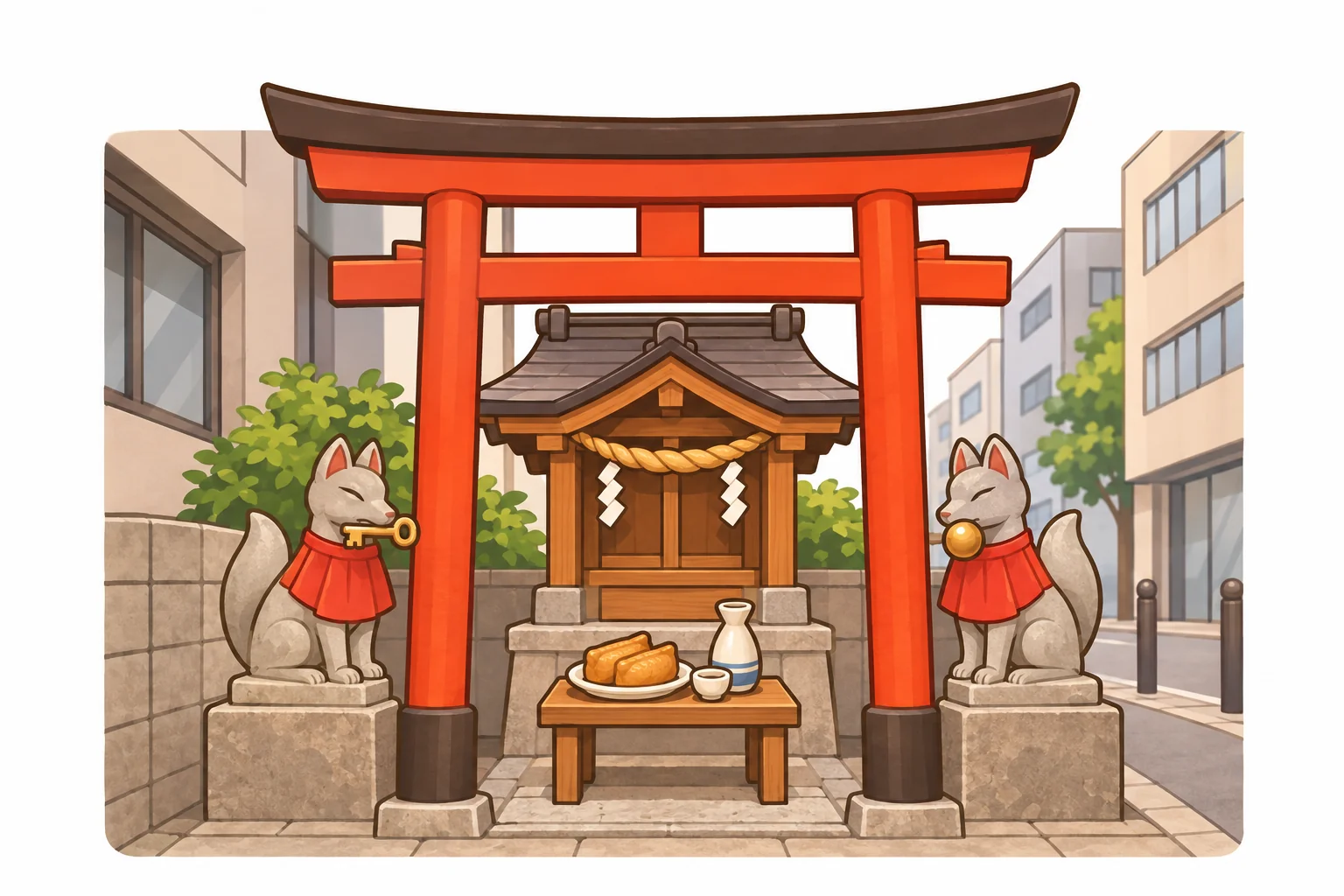
A small street-corner Inari shrine: a vermilion torii, two stone foxes in red bibs, an offering of fried tofu (illustration).
The reason for all these shrines is the range of things people ask of Inari. A god who looks after the harvest is, in an agricultural society, a god who looks after wealth, and when Japan’s towns grew, merchants, artisans and samurai households all took Inari as their own. Inari became the god you prayed to for good business, a thriving family, protection from fire, recovery from illness. Many families and shops installed Inari as a yashikigami, a guardian deity of a particular plot of land, which is why a single city block in old Tokyo or Ōsaka can hold several of these small shrines.
02Who Inari Is
The name is usually explained as coming from ine-nari, "the rice grows" or "the rice ripens." The characters used to write it, 稲荷, literally mean "carrying rice," and Inari is often pictured as an old man with a bundle of rice stalks over his shoulder. In other images Inari is a young woman, or a figure riding a white fox. Inari has never had one fixed form or even one fixed gender, which suits a deity who is worshipped more through relationships than through doctrine.
At Fushimi Inari Taisha, the principal deity is Uka no Mitama, a god of grain and food whose name shares a root with old words for food. In the Kojiki, Japan’s oldest chronicle, completed in 712, Uka no Mitama appears as a child of the storm god Susanoo. Fushimi Inari worships Uka no Mitama together with four other deities, Satahiko, Ōmiyanome, Tanaka and Shi no Ōkami, and calls the five together "Inari Ōkami." Most visitors, though, simply speak of O-Inari-san, an affectionate form of address, as if for a familiar neighbor.
Inari also has a Buddhist side. From the medieval period, Inari was identified with Dakiniten, a figure who started out in India as a fearsome female spirit and was transformed in Japanese esoteric Buddhism into a goddess riding a white fox. The Shingon school treated Inari and Dakiniten as two faces of the same power. As a result, some of Japan’s best-known Inari sites are Buddhist temples rather than Shinto shrines. Toyokawa Inari in Aichi is formally Myōgon-ji, a Sōtō Zen temple; its principal image is the Thousand-Armed Kannon, but its fame rests on Toyokawa Dakini-shinten, enshrined as the temple’s guardian. Saijō Inari in Okayama belongs to the Nichiren tradition. When the Meiji government ordered the separation of Shinto and Buddhism in 1868, many Inari sites had to choose which side they were on. Toyokawa remained a temple, so a visit there today combines incense, sutra chanting and a hillside full of stone foxes.
03Fushimi Inari and Its Mountain
The head shrine of all Inari shrines is Fushimi Inari Taisha, in the south of Kyoto. According to the shrine’s own tradition, Inari descended onto the three peaks of Mount Inari, the hill behind the shrine, on the first Day of the Horse in the second month of 711. The first Horse day of February, called Hatsu-uma, is still Inari’s great festival. Kyoto people climb to the shrine on that day and take home a sprig of cedar, the shirushi no sugi, as a token of the god’s protection.
The early history of the mountain is tied to the Hata, a powerful clan descended from immigrants from the Korean peninsula who settled in the Kyoto basin, opened up farmland and built irrigation works. A fragment of an ancient provincial gazetteer, the Yamashiro fudoki, tells how a wealthy man of the clan, Hata no Irogu, was so rich that he used a rice cake as an archery target. When his arrow struck it, the cake turned into a white bird and flew off to the mountain peak, where rice sprouted. The place was then called Inari. It reads like a warning against wasting food, and it was later retold as the story of how Inari got its name.
When the capital moved to Kyoto in 794, the mountain gained an important new neighbor. According to legend, Kūkai, the founder of Shingon Buddhism, met an old man carrying rice on his back while he was building the temple of Tō-ji, recognized him as the god of Mount Inari, and asked him to protect the temple. The bond survives: during the Inari Festival in spring, the portable shrines carrying the deity still stop at Tō-ji, where monks present offerings. Inari’s standing at court rose steadily, and by 942, in the mid-Heian period, the god had received the highest rank in the court’s system of divine ranks. That is why so many Inari banners and plaques read Shōichii Inari Daimyōjin, "Inari, Great Bright Deity of the Senior First Rank."
The climb itself has a long history. Sei Shōnagon, a lady-in-waiting at the Heian court around the year 1000, describes in The Pillow Book going up Mount Inari on Hatsu-uma. Halfway up she was gasping for breath, and she was filled with envy when another woman, said to be about forty by the traditional count (some translations make her about thirty), passed her, cheerfully saying that she planned to make the round trip seven times that day and had already done three. Anyone who has climbed the mountain on a warm afternoon will understand.
04A Thousand Gates
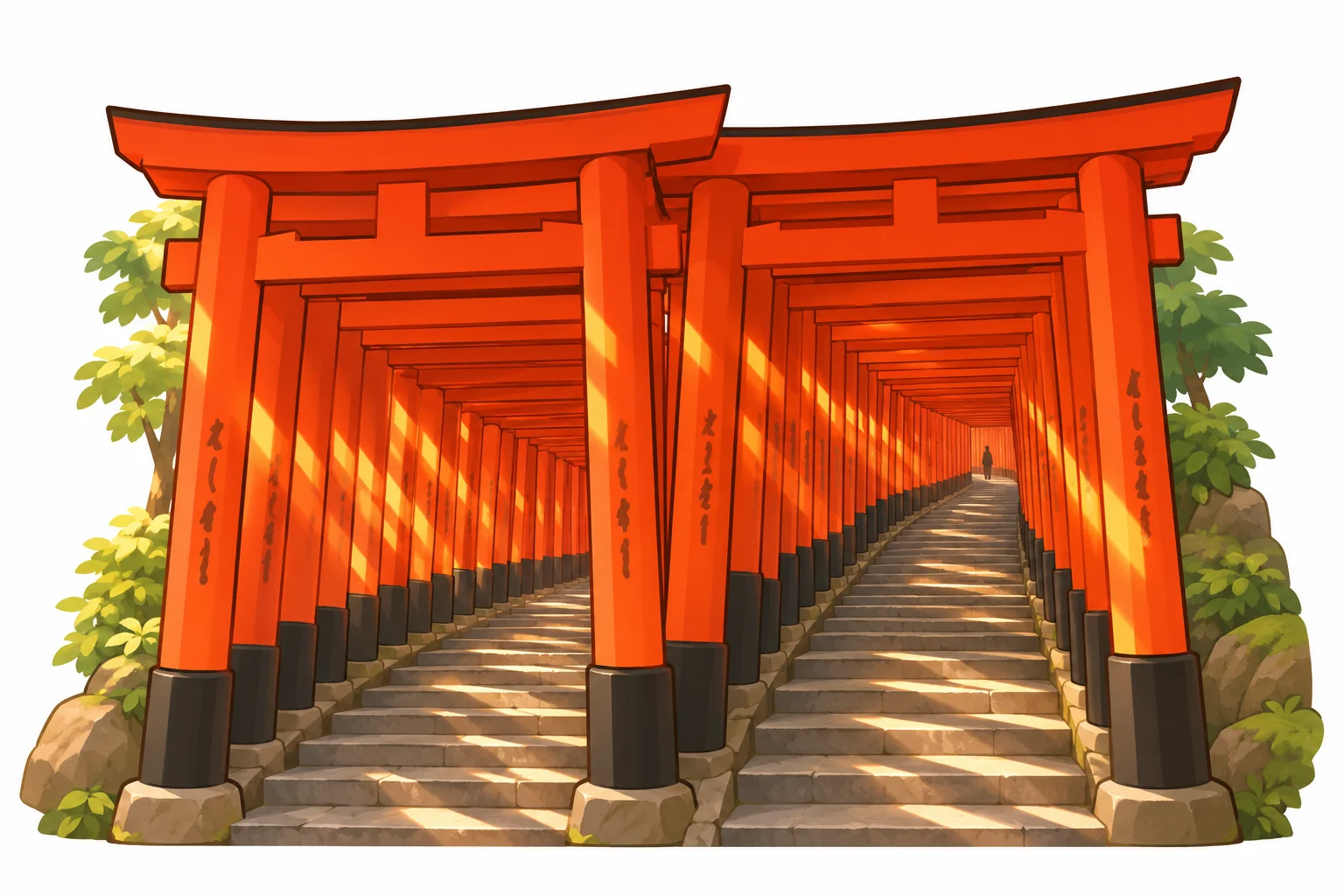
Fushimi Inari’s fame today rests on the Senbon Torii, the "thousand gates." Just behind the main hall, two parallel lines of vermilion gates begin, so tightly spaced that walking through them feels like walking down a tunnel, with sunlight falling in thin stripes between the posts. Across the whole mountain there are said to be around ten thousand torii, from huge ones that two people could not reach around to little ones knee-high, standing in front of private altars.
Every one of them is a donation. The custom of offering torii to Inari spread during the Edo period (1603–1868). People would pray for something and, when it came true, give a gate in thanks; some gave one in advance, punning on the idea that a torii, which you pass through, would help their wish "go through." Walk up the mountain and you see only blank vermilion; turn around and walk down, and the back of every post is lettered in black ink with the donor’s name and the date: a construction company, a sushi shop, a family in Ōsaka. Donating a gate today still means a substantial offering, scaled to the size of the gate; as of 2026 the shrine is reported to keep a price list, with small gates said to cost several hundred thousand yen and large ones over a million. The tunnel is in effect a centuries-long ledger of merchants’ hopes.
Why vermilion? The usual explanation is that the color wards off evil and expresses the vitality of the god and the abundance of the harvest. Cinnabar, the mineral that produced the old red pigment, also protected wood from rot. Not every shrine gate in Japan is red, but nearly every Inari gate is, and the color has become Inari’s trademark.
The full loop of the mountain, from the main hall to the summit at Ichi-no-mine and back, is about four kilometers and takes two to three hours. The best view is at Yotsutsuji, a crossroads about halfway up, where the city of Kyoto spreads out below. Above that, the crowds thin and the gates grow older and mossier. Scattered across the slopes are thousands of otsuka, stone markers set up by individual worshippers, each carved with a name the devotee has given to their own form of Inari and surrounded by miniature gates, fox figures and candle stands. This is where the character of Inari worship is clearest. There is no scripture and no central creed; every person, family and business has its own arrangement with the god.
- 1Main hall
- 2Senbon ToriiBegins just behind the main hall
- 3YotsutsujiAbout halfway up; the best view over Kyoto
- 4Ichi-no-mineSummit
The full loop from the main hall to the summit and back is about four kilometers and takes two to three hours; higher up, the crowds thin and the gates grow older.
05Why Foxes?
The foxes at an Inari shrine are not Inari. They are the god’s messengers, o-tsukai. But foxes are so prominent that many Japanese casually call Inari shrines "fox shrines," and in popular imagination the line between god and messenger has always been blurred.
Several strands explain the link. One is farming. Foxes come down from the hills to the villages in spring and retreat in autumn, a rhythm that matches the agricultural year, and they eat the mice that raid stored grain. A second is Buddhism: Dakiniten rides a white fox, and once Inari and Dakiniten were merged, the fox was firmly attached to Inari. A third is a matter of spelling. Uka no Mitama was known as a miketsu-kami, a god of food, and the title was later written with homophonous characters meaning "three-fox god," tying the fox to Inari; some also say ketsu echoes kitsu, an old word for fox.
Inari’s foxes are white and invisible, known as byakko. The objects in the mouths of the statues each carry a meaning: the key opens the rice granary, the jewel stands for the god’s spiritual power, the rice sheaf for the harvest, the scroll for wisdom. Fried tofu, aburaage, became the standard offering because foxes are said to love it, and so Japanese cooking gained kitsune udon, "fox noodles," topped with a sweet slab of fried tofu, and inarizushi, rice packed into a tofu pouch. In eastern Japan inarizushi is usually shaped like a rice bale; in the west it is often triangular, which some say resembles a fox’s ears.
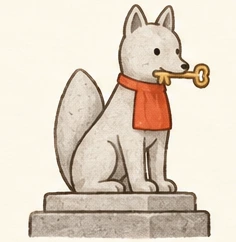
A fox in a red bib with a key in its mouth: the key opens the rice granary
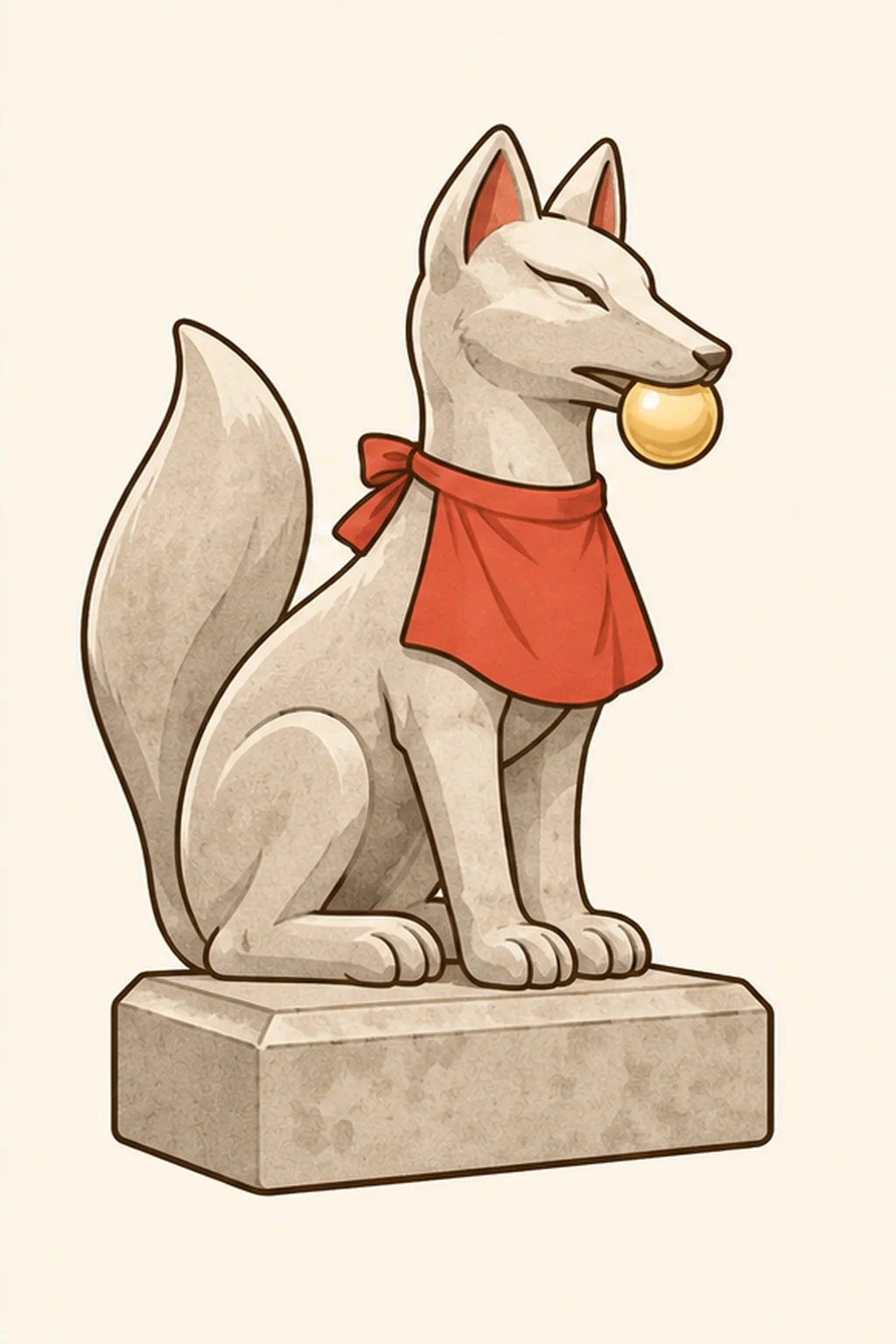
The jewel stands for the god’s spiritual power.
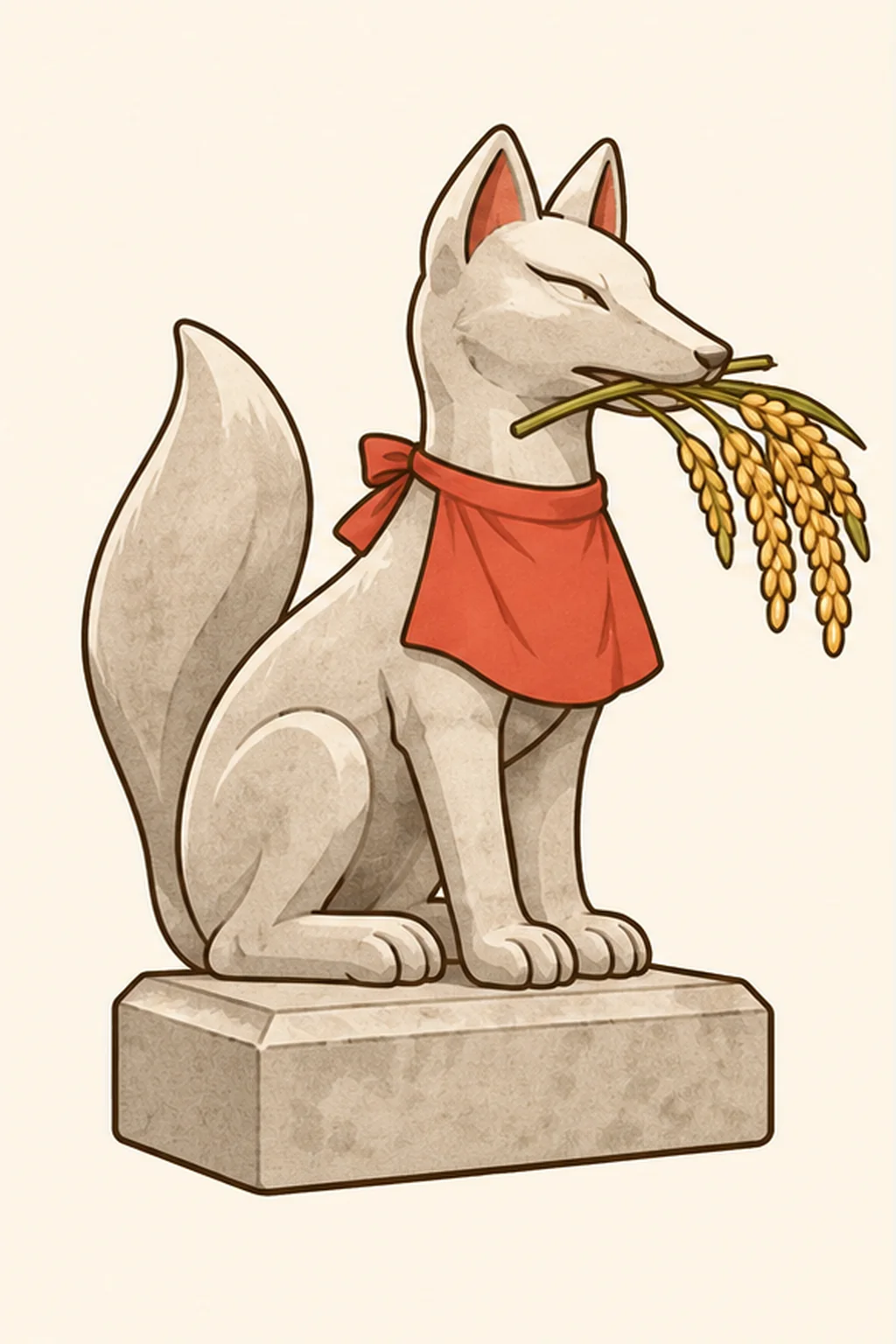
The rice sheaf stands for the harvest.
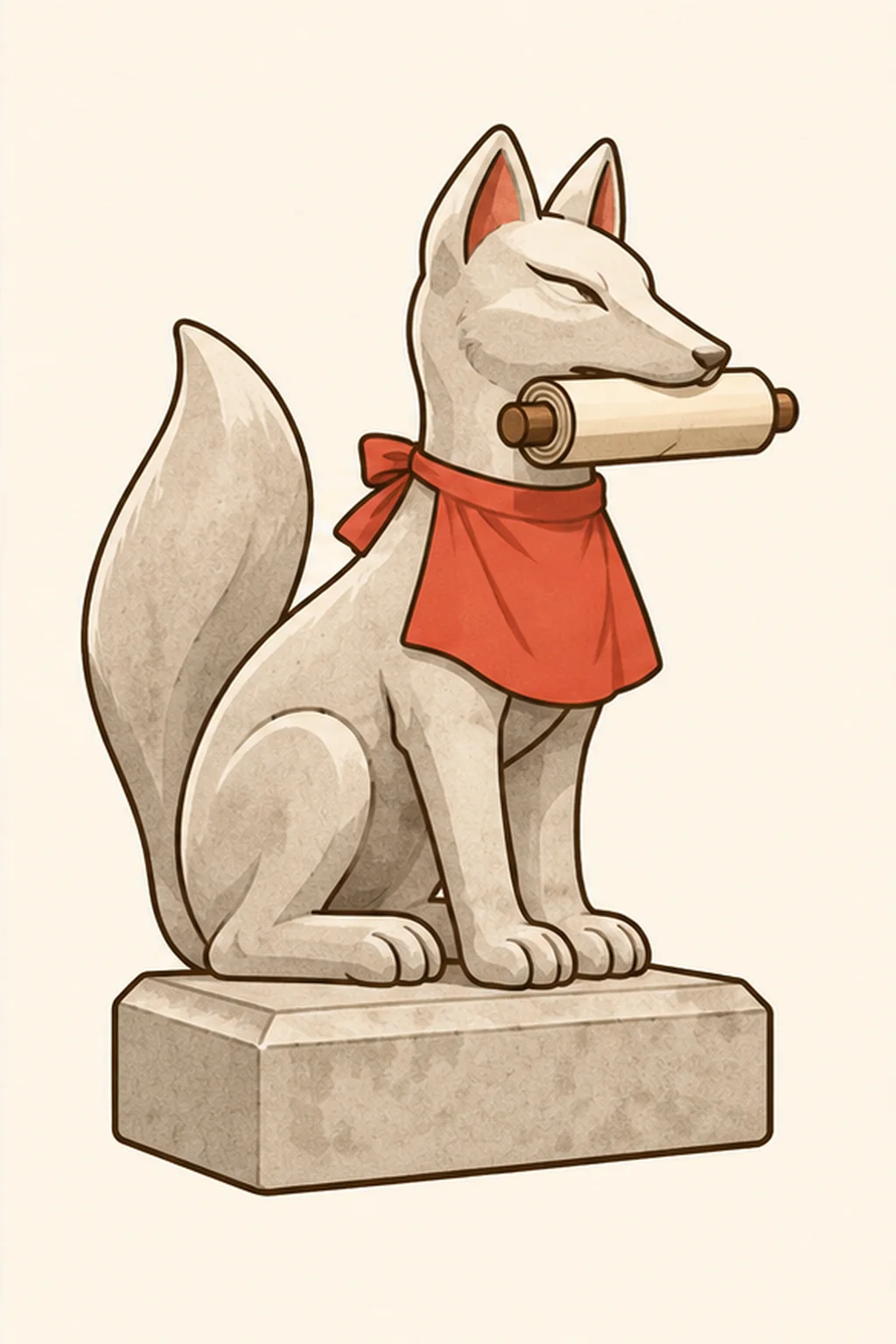
The scroll stands for wisdom.
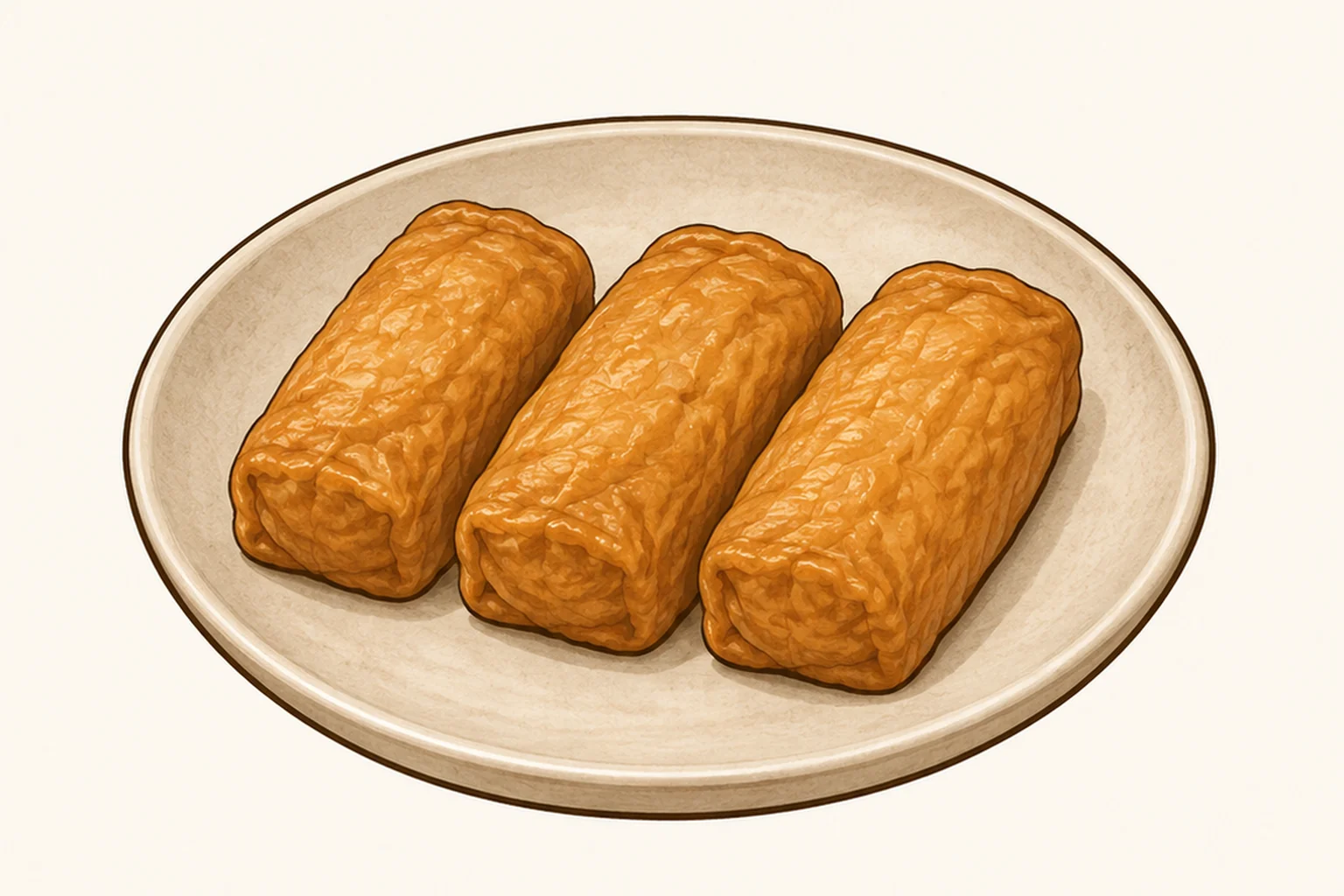
In eastern Japan it is usually shaped like a rice bale.
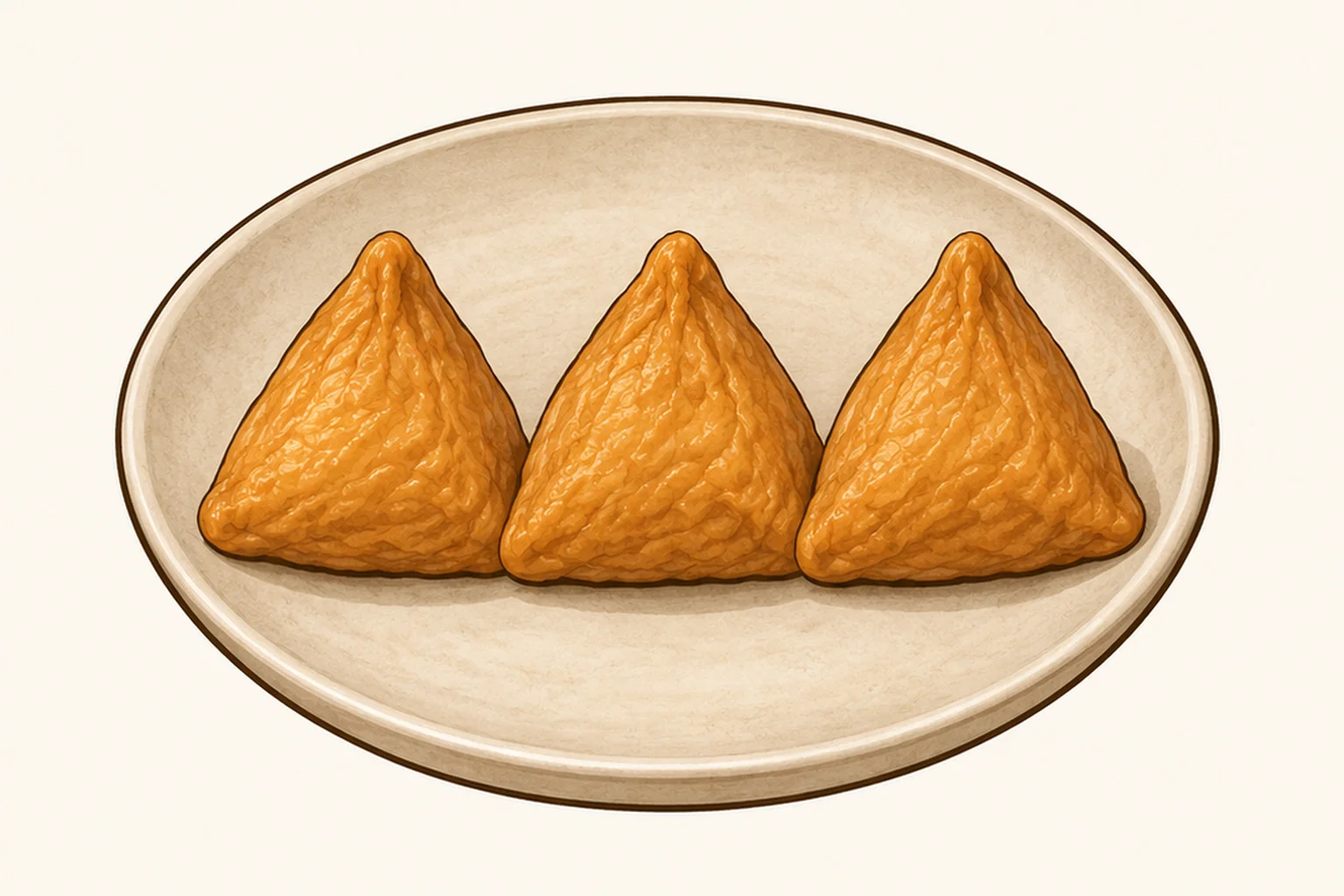
In the west it is often triangular, which some say resembles a fox’s ears.
The fox has a darker reputation too. Japanese folklore credits foxes with the power to shapeshift and to possess people, and kitsune-tsuki, fox possession, was long treated as a real affliction. Inari worship absorbed both sides of the animal: treat the god well and you are protected; neglect or offend it and trouble follows. That is why, when an old building is demolished, the Inari shrine on its roof or in its yard is moved with a proper ceremony rather than simply torn down.
06Inari in Edo and Today
Inari truly spread everywhere during the Edo period. Edo was dense, fire-prone and full of commerce, and its people wanted a nearby god who could handle every kind of request. Feudal lords brought the Inari of their home domains into their Edo residences, merchants built shrines behind their shops, and neighbors pooled money for small shrines at street corners.
Some of Tokyo’s Inari shrines are well known. Ōji Inari in the north of the city is traditionally regarded as the head of the Inari shrines of the Kantō region. Utagawa Hiroshige’s series One Hundred Famous Views of Edo includes a print of the foxes of Kantō gathering under a great nettle tree near Ōji on New Year’s Eve, their fox-fires glowing in the dark, before proceeding together to pay respects at the shrine. Since 1993 the neighborhood has staged a fox parade on New Year’s Eve, with participants wearing fox masks and makeup.
Hatsu-uma was a major festival in Edo as well. Every household and neighborhood Inari was honored with lanterns and drums, and children went from door to door collecting sweets. The terakoya, the small private schools where Edo children learned reading and arithmetic, are said to have often taken in new pupils on this day.
Modern Inari is very much an urban god. Department stores and office buildings in Ginza and Nihonbashi often keep a small Inari shrine on the roof, some of them open to the public. Many companies enshrine Inari on their premises, and executives lead staff to Fushimi Inari at the start of the year. Fushimi Inari draws one of the largest crowds of New Year worshippers in western Japan, and in the first days of January the approach from the station is packed shoulder to shoulder. Over the past fifteen years or so, photographs of the gate tunnel have also made it one of the most visited sites in Kyoto for international travelers.
07Visiting an Inari Shrine
Getting to Fushimi Inari is easy. The JR Nara Line stops at Inari Station, directly opposite the great gate at the entrance; Fushimi-Inari Station on the Keihan Line is a few minutes’ walk away. The entrance to the Senbon Torii is crowded for most of the day. If you want the tunnel without other people in it, come early in the morning or simply keep climbing: past Yotsutsuji the crowds fall away. After dark the upper paths are dimly lit and the stone steps can be slippery, so plan your time.
Worship follows the usual shrine pattern. Bow lightly at the gate, rinse your hands and mouth at the water basin, then at the hall drop a coin in the box, ring the bell, bow twice, clap twice and bow once more. Fushimi Inari’s ema, the wooden prayer plaques, are shaped like fox faces, and visitors draw their own expressions on them, so a wall of them makes for entertaining browsing. Partway up the mountain you can try the omokaru-ishi, the "heavy-or-light stone": make a wish, then lift the round stone on top of a lantern. If it feels lighter than you expected, the wish will come true; if heavier, you have more work ahead.
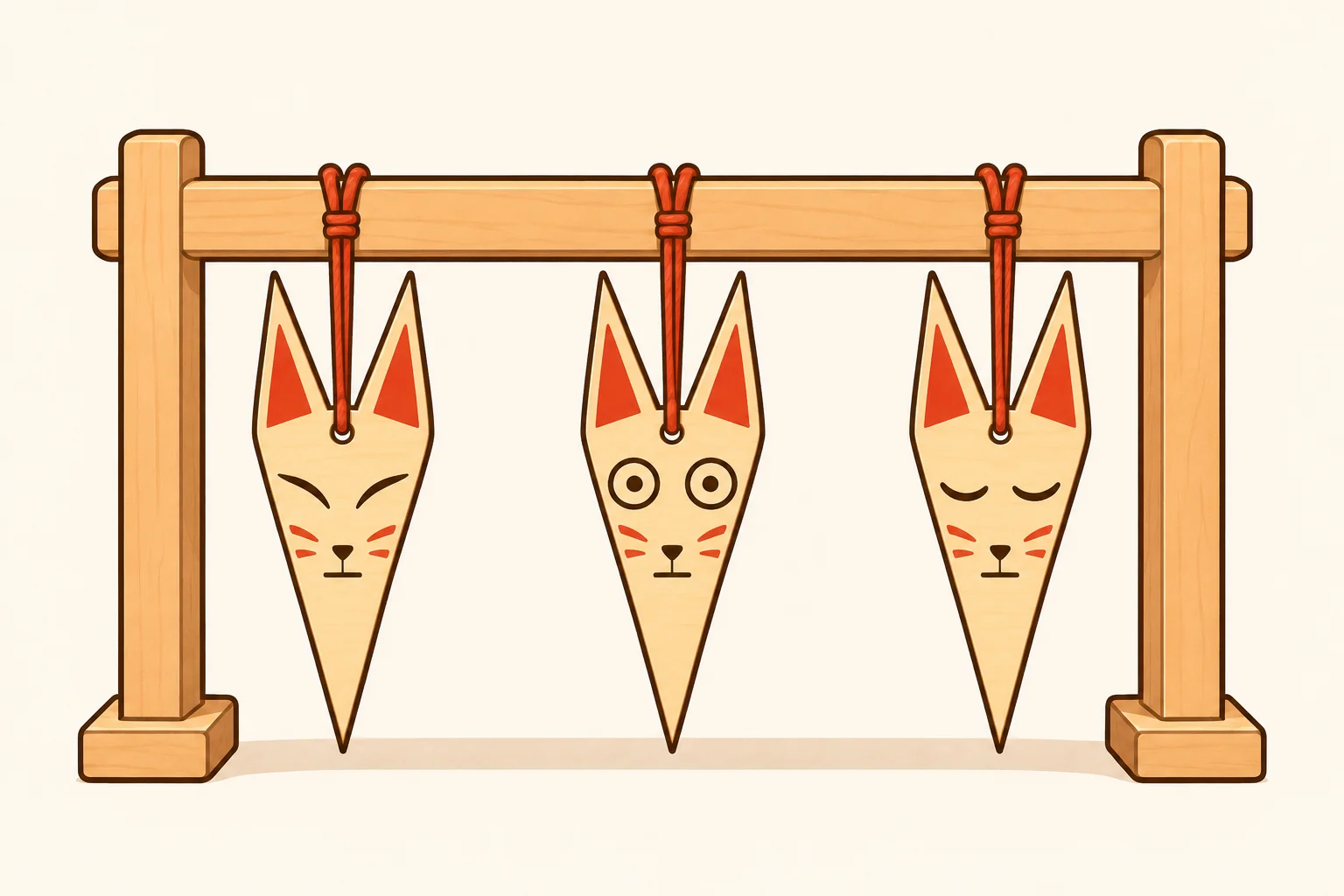
Fushimi Inari’s ema are shaped like fox faces, and visitors draw their own expressions on them.
The shops along the approach sell inarizushi and kitsune udon, and a few still serve grilled sparrow, an old local specialty explained as a service to the rice god, since sparrows eat grain. Away from the big shrines, when you pass a small Inari shrine on a city street, a pause and a slight bow is all that is expected. If there is fresh fried tofu or a cup of sake in front of it, someone in the neighborhood is looking after it every day, and has been for longer than anyone remembers.