
At a glance
How Japanese families say goodbye, from the wake and picking bones with chopsticks to the home altar and Obon, and why Buddhist temples came to handle death.
- A funeral usually takes two days: the wake (tsuya) on the first evening, and the funeral and farewell ceremony the next morning.
- After cremation, two relatives lift the same piece of bone together with long chopsticks and place it in the urn: kotsuage.
- As of the 2020s, Japan’s cremation rate exceeds 99 percent, close to the highest in the world.
- The Edo shogunate’s terauke system tied every household to a family temple, which is how Buddhism came to handle death.
- Memorial services continue after the forty-ninth day, and in most places the thirty-third anniversary is the last.
Most Japanese people will tell you they are not religious, yet almost all of them will be sent off by a Buddhist priest. A Japanese funeral moves through a precise sequence: a wake, a ceremony, cremation, and then a moment that surprises most outsiders, when the family picks the bones out of the ashes with chopsticks. Grief does not end there. The dead receive a new Buddhist name, a lacquered tablet in the family altar, a bowl of rice each morning, and a calendar of memorial services that can run for thirty-three years. This is an introduction to how Japan buries its dead and keeps them close, and why Buddhism, of all the country’s traditions, ended up in charge.
01Born Shinto, Die Buddhist
There is a common Japanese saying that people are born Shinto and die Buddhist. Babies are taken to a Shinto shrine for their first blessing, weddings are held at shrines or in chapel-style halls, but when someone dies the family calls a Buddhist temple. The division is not arbitrary. Shinto treats death as a source of pollution, kegare, something to be kept away from sacred ground. Shinto funerals do exist, but they are a small minority, and shrine priests have historically avoided the dead. Buddhism, by contrast, has a whole vocabulary for what happens after death: rebirth, the Pure Land, the forty-nine days between lives, and the merit that the living can transfer to the departed.
The deeper reason is political. In the seventeenth century the Tokugawa shogunate banned Christianity and needed a way to prove that every subject was not a secret Christian. Its answer was the terauke system: every household had to register with a Buddhist temple, which certified each member’s religious status each year. The registers, shūmon aratame-chō, functioned as the country’s population records. A family became a danka, a parishioner household, of a particular temple, its bodaiji, and that temple handled its funerals, gave its dead their Buddhist names, and performed their memorial rites. In return, the family supported the temple financially.
The system was abolished after the Meiji Restoration in 1868, but the habits it created survived. Many Japanese today cannot name their family’s Buddhist sect without checking which temple holds the family grave. Temples, for their part, came to depend on funerals and memorial services for their income. In 1963 the historian Tamamuro Taijō published a book titled Sōshiki Bukkyō, "Funeral Buddhism," and the phrase stuck as a mildly scornful description of a religion that many people encounter only when someone dies.
02The Wake and the Funeral
When someone dies in Japan today, usually in a hospital, the family’s first call is to a funeral company. The body is brought home or to a funeral hall and laid with its head to the north, kitamakura, echoing the posture in which the Buddha is said to have entered nirvana. Sleeping with your head to the north is considered unlucky for exactly this reason. A small table by the body holds incense, a candle, and a bowl of rice heaped high with a pair of chopsticks standing upright in it. This is why sticking your chopsticks upright in your rice at dinner will make any Japanese companion wince.
The body is then washed and dressed, traditionally in a white robe, and placed in the coffin, sometimes with straw sandals, a pilgrim’s bag, and a paper printed with six coins to pay the ferry across the Sanzu River, the river the dead must cross. The 2008 film Departures (Okuribito), which won the Academy Award for best foreign-language film, follows a young man who stumbles into this work as an encoffiner. Its long, careful scenes of a body being dressed in front of the family made many Japanese viewers look at the job with new respect.
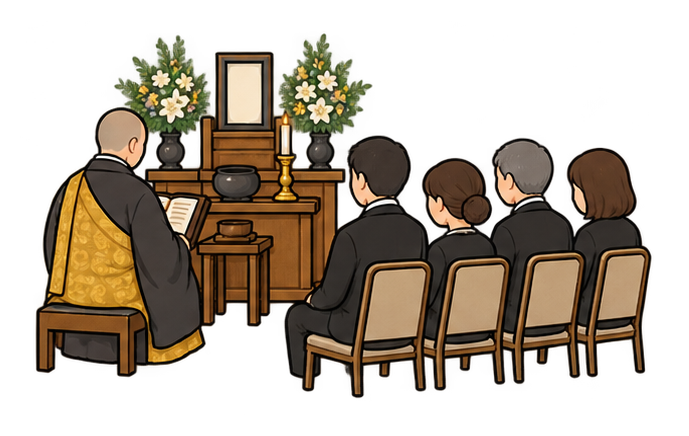
The ceremonies normally take two days. The first evening is the tsuya, or wake. Originally the family stayed up all night beside the body, keeping incense burning; today it usually runs for an hour or two in the early evening. A priest chants sutras while mourners file up one by one to offer incense, and food and drink are served afterward in a side room. Because it falls after working hours, colleagues and neighbors often attend the wake rather than the next day’s service.
The following morning comes the funeral proper, sōgi, usually combined with the kokubetsu-shiki, the farewell ceremony. The priest chants again and formally confers the dead person’s Buddhist name. Friends and family offer flowers and speeches and look at the face of the deceased one last time. The coffin is closed and carried out to a hearse. Before it leaves, the chief mourner thanks the guests while family members hold the portrait photograph and the plain wooden tablet bearing the new name, and as it pulls away the driver sounds one long blast of the horn.
Mourners follow clear conventions. Clothing is black. Women wear little jewelry; a single strand of pearls is acceptable, but not a double strand, which would suggest misfortune repeating itself. Guests bring kōden, condolence money, in a special envelope tied with black-and-white or silver cords. New banknotes are avoided, or folded first, so as not to look as if the death had been anticipated. To offer incense you take a pinch of powdered incense, raise it toward your forehead, and drop it onto the smoldering coals, once or up to three times depending on the sect. On the way out, guests often receive a small packet of salt to sprinkle on themselves before entering their homes. That is a Shinto purification custom that slipped into Buddhist practice; the Jōdo Shinshū sect, which teaches that death is not impure, rejects it.
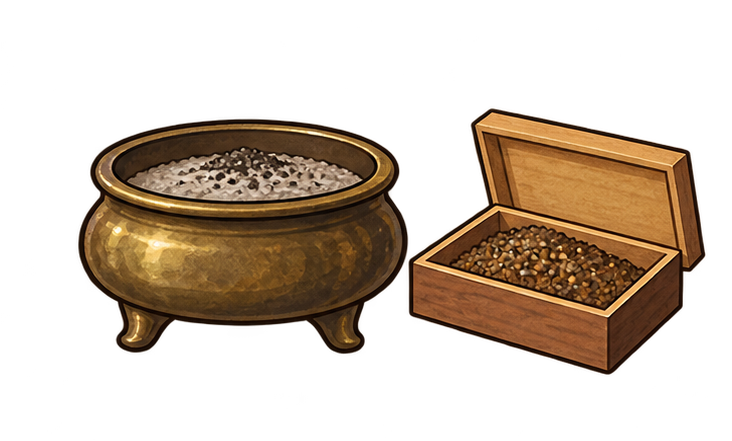
A censer and granular incense. Mourners take a pinch, raise it to the forehead and drop it into the censer.
03Fire and Chopsticks
As of the 2020s, Japan cremates more than 99 percent of its dead, close to the highest rate in the world. This is a modern development. Cremation came to Japan with Buddhism, and the monk Dōshō, who died in 700, is traditionally recorded as the first person cremated in Japan, but for most of history ordinary people were buried. The Meiji government briefly banned cremation in 1873 and then lifted the ban two years later. Over the twentieth century, crowded urban cemeteries, public-health regulations, and municipal crematoriums made cremation standard, and after the Second World War it became nearly universal.
At the crematorium the family waits in a lounge for an hour or two. Then comes kotsuage, the gathering of the bones. The remains are brought out on a tray, not reduced to fine ash but still recognizable as bones. Family members pair up, and two people together lift each fragment with long chopsticks, often mismatched, one bamboo and one wood, and place it in the urn. They begin at the feet and work upward, ending with the skull, so that the dead sit upright in the urn. This ritual is the source of the strongest table taboo in Japan: never pass food from your chopsticks to someone else’s.
Staff at the crematorium will point out one bone in particular, the second cervical vertebra, called the nodobotoke, or "throat Buddha," because its shape resembles a small seated figure with hands pressed together. It is placed on top. Practice differs by region. In eastern Japan the family usually collects all the bones and the urns are large; in western Japan, including Ōsaka and Kyoto, only part of the remains is collected and the urns are smaller.
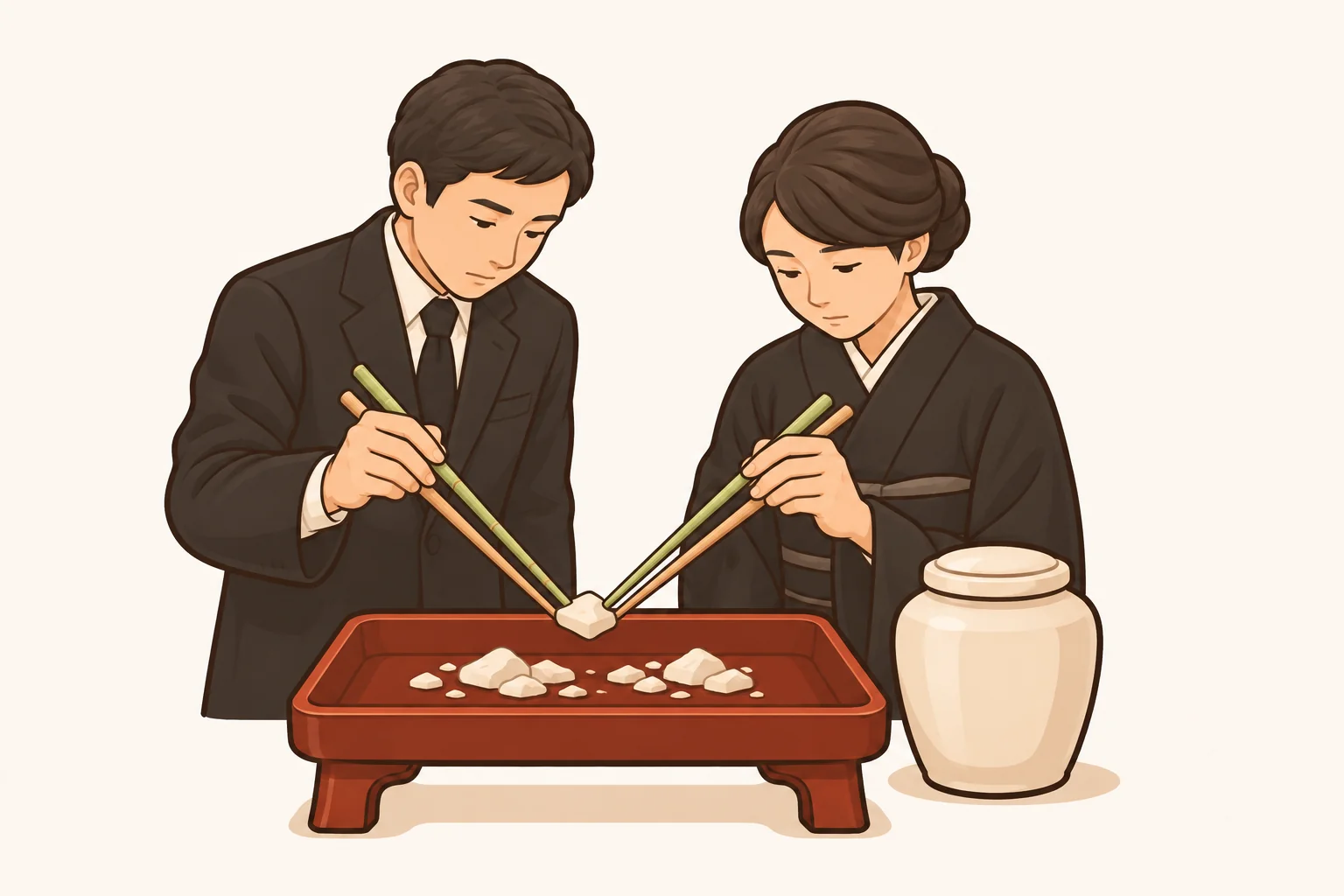
Kotsuage: two family members lift one bone fragment together with long chopsticks and place it in the urn.
04A New Name for the Dead
The dead receive a kaimyō, a posthumous Buddhist name. Originally it was the name a person received on taking monastic precepts; over time it became something conferred on lay people after death, a kind of ordination for the next world. The name is written on the temporary wooden tablet at the funeral and later carved on the gravestone and on a permanent lacquered tablet.
A kaimyō is built from several parts, and its length and prestige vary. The most exalted include an ingō, a title ending in in, a word for a temple hall or sub-temple, and end with honorifics such as koji for men and daishi for women; more modest names end in shinji or shinnyo. The family makes a donation to the temple for the name, and the more elaborate it is, the larger the expected gift, which for the highest ranks can run to a million yen or more. Complaints about the cost of kaimyō are a staple of Japanese newspaper columns, yet many families still feel that a dignified name is the last thing they can do for a parent. In Jōdo Shinshū the name is called a hōmyō, since that sect does not confer precepts; in Nichiren lineages it is a hōgō.
05The Butsudan: A Temple in the Living Room
In many Japanese homes, especially older and rural ones, a corner of the tatami room holds a cabinet with folding doors. This is the butsudan, the household Buddhist altar. Opened, it reveals a miniature temple hall: at the top and center, the principal Buddhist image; on the lower tiers, the ancestral tablets, ihai, along with a censer, candlesticks, flower vases, small cups for rice and water, and a metal bowl-shaped bell, the rin.
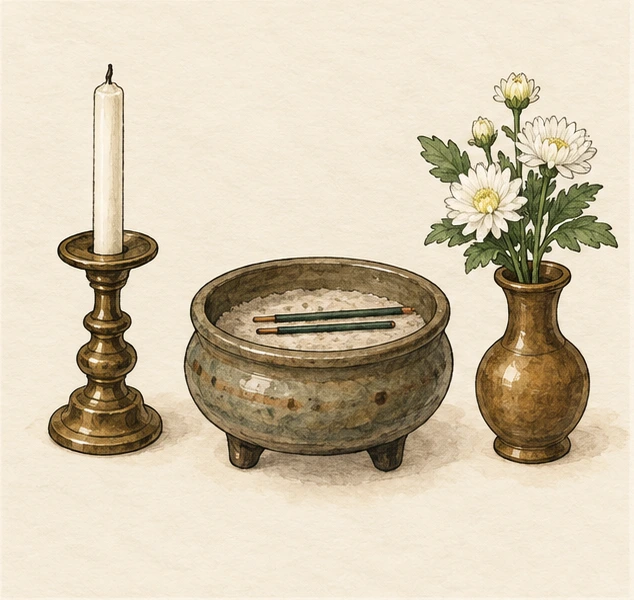
A candlestick, a censer and a flower vase, among the fittings on the lower tiers of a butsudan.
It is easy to think of the butsudan as an ancestor shrine, but its first purpose is to house a Buddha. Which Buddha depends on the family’s sect: Amida for the Pure Land schools, Dainichi for Shingon, usually Shakyamuni for Zen, and for Nichiren followers a calligraphic mandala bearing the invocation of the Lotus Sutra. The ancestors’ tablets sit below, under the Buddha’s protection. The tablets themselves are a Chinese inheritance. They are generally thought to derive from the Confucian spirit tablets used in ancestor worship in China and arrived in Japan with Zen monks in the medieval period. Jōdo Shinshū households generally do without tablets and keep a register of the dead, the kakochō, instead.
The Nihon shoki, the eighth-century chronicle, records that in 685 Emperor Tenmu ordered every household in the provinces to set up a Buddhist shrine with an image and scriptures. The "households" probably meant government offices and powerful clans rather than farmers, but the Japanese altar industry has adopted March 27 as Butsudan Day on the strength of it. Altars actually spread to ordinary homes in the Edo period, along with the temple registration system; having one was part of being a proper parishioner household.
Altars come in distinct styles. In regions where Jōdo Shinshū is strong, such as Hokuriku, Kansai, and the area around Nagoya, the typical altar is a kin-butsudan, a "gold altar," lined with gold leaf and full of carving and lacquer, a small model of an Amida hall. Those made in Hikone, Kanazawa, Nagoya, and Kyoto are officially designated traditional crafts, and they are costly: as of 2025, a gold altar typically sells for about 800,000 to 1.5 million yen, and a fine one can cost several million. Elsewhere the standard is the karaki-butsudan, made of dark tropical hardwoods such as ebony and rosewood. In recent decades furniture-style altars in light wood have become popular: small enough to sit on a sideboard in an apartment, next to the television.
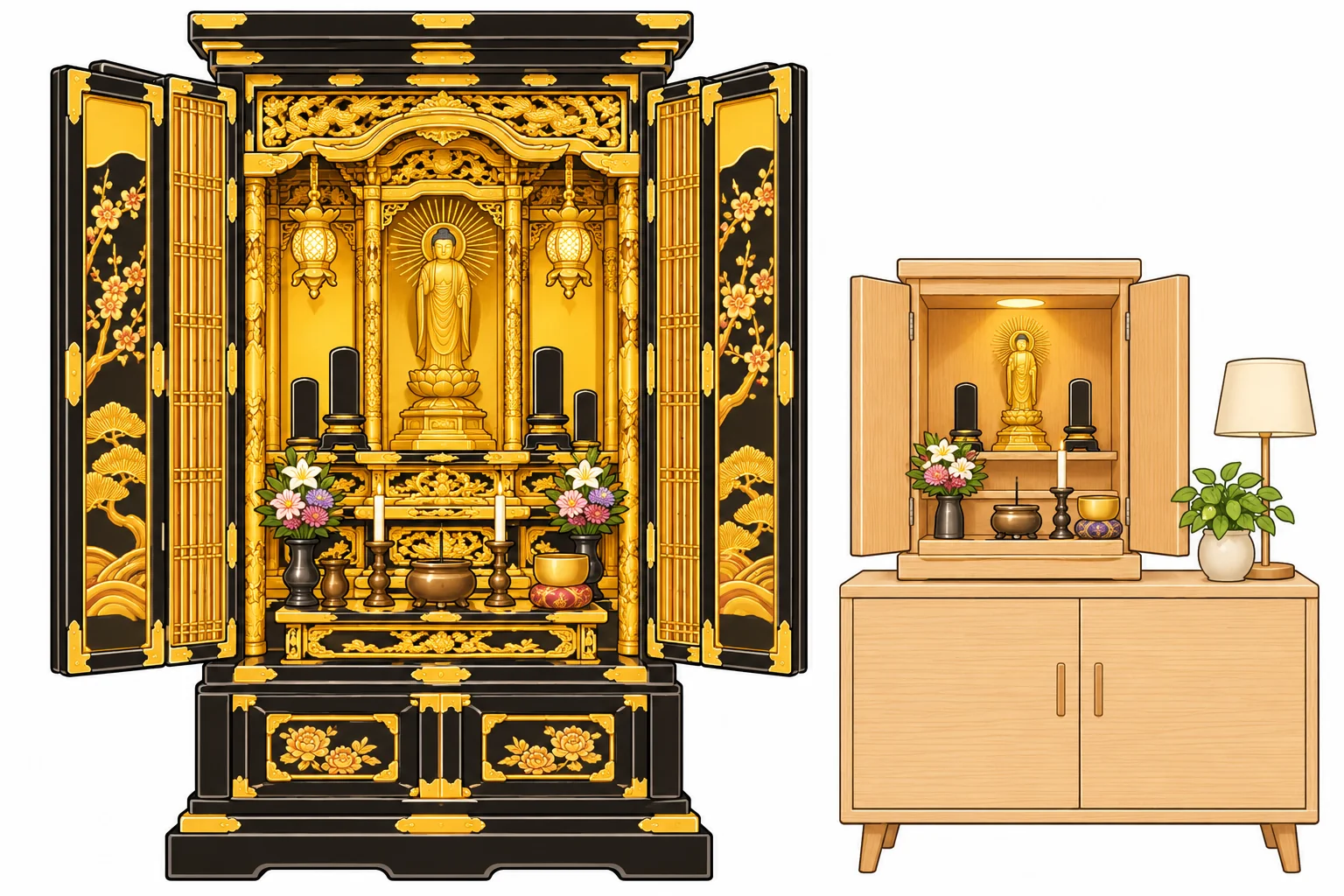
A gilded kin-butsudan with its doors open, beside a small, pale furniture-style altar on a cabinet (illustration).
Daily practice is simple. In the morning, the first rice from the cooker goes into a small bowl on the altar. Water or tea is refreshed, a candle and a stick of incense lit, the bell struck once, and hands pressed together. When the family receives a gift of sweets or fruit, it often goes on the altar first. People report news there, too: a child born, an exam passed, a marriage. Talking to the tablets in an ordinary voice is common, and it says more than any doctrine about what the altar is for. It is the place in the house where the dead are still part of the family.
06Forty-Nine Days, Thirty-Three Years
According to Buddhist teaching, the dead pass forty-nine days in an intermediate state before their next birth, facing judgment every seven days. Families once held services on each seventh day; today the first, shonanoka, is usually folded into the funeral day itself, and the next major rite is held on the forty-ninth day. That is when the ashes are often placed in the family grave and the temporary wooden tablet is replaced by a lacquered one that goes into the butsudan. Formal mourning ends there.
Anniversary services, nenki, follow: the first anniversary, then the third (held in the second year, since the year of death counts as the first), then the seventh, thirteenth, seventeenth, twenty-third, twenty-seventh, and the thirty-third. In most places that last service marks the end, the tomurai-age, though some continue to the fiftieth. The folklorist Yanagita Kunio argued that over these decades the individual dead gradually lose their personality and merge into the collective ancestors who watch over the household. Thirty-three years is also about as long as the people who knew someone personally tend to be around.
- 1Forty-ninth daythe first seventh-day rite is folded into the funeral day; ashes to the grave, lacquered tablet
- 2First anniversary
- 3Thirdin the second year
- 4Seventh
- 5Thirteenth
- 6Seventeenth
- 7Twenty-third
- 8Twenty-seventh
- 9Thirty-thirdthe end in most places, tomurai-age
In most places the thirty-third is the last service, though some continue to the fiftieth; thirty-three years is about as long as the people who knew someone tend to be around.
The great annual festival of the dead is Obon, held in mid-August in most of Japan (in July in Tokyo and some other areas). The spirits of the ancestors are believed to return home. On the evening of the 13th, families light a small welcoming fire at the gate. They make animals from vegetables: a cucumber with four sticks for legs becomes a horse, so the ancestors can hurry home, and an eggplant becomes a cow, so they can return slowly. A special altar is set up with seasonal fruit and vegetables. On the 16th, a sending-off fire guides the spirits back.
Some of these send-offs are spectacular. In Kyoto on the night of August 16, the Gozan Okuribi lights giant characters in fire on the surrounding mountains, the best known being the character 大 ("great") on Daimonji. In Nagasaki, the Shōrō Nagashi turns the city’s streets into a procession of decorated spirit boats, pushed along amid deafening firecrackers. Bon dances in towns across the country began as dances to welcome and console the dead. Obon is also a holiday week, and the trains and expressways fill with people going back to their hometowns to clean the family grave and sit in front of the altar.
The spring and autumn equinoxes bring a second season of grave visits, higan, the seven days centered on each equinox. The red spider lilies that bloom along rice paddy ridges in late September are called higanbana for that reason.
07Family Graves and Their Undoing
A typical Japanese grave is an upright granite stone inscribed "Grave of the X Family," set over a chamber that holds the urns of several generations. Visitors ladle water over the stone, wipe it down, put fresh flowers in the holders, and light incense. Behind many graves stand tall, narrow wooden slats, sotoba, inscribed with Sanskrit letters and the name of the dead, added at each memorial service.
The family grave looks ancient but is largely a modern institution. It depended on two things: the Meiji Civil Code’s household system, which made the eldest son heir to the family’s property, rites, and grave; and cremation, which made it possible for many generations to share one plot. Through the late twentieth century, people moved en masse to the cities and the birth rate fell. Graves were left in distant hometowns with no one to look after them.
Japanese funerary practice is now changing quickly. Small "family funerals," kazokusō, limited to close relatives, have become the norm (about half of funerals in a 2024 industry survey), a shift the Covid-19 pandemic accelerated. Chokusō, cremation with no wake or funeral at all, is increasingly common. Alternatives to the family grave have multiplied: eitai kuyō plots, where a temple promises perpetual memorial care with no need for heirs; tree burials, where ashes go beneath a tree instead of a stone; and urban columbaria where an automated system brings your family’s urn to a viewing booth when you swipe a card. Hakajimai, closing the old family grave and moving the remains, has become an industry of its own. Yet most families still hold the forty-ninth-day service and still go home for Obon. The altars have simply grown smaller.
08Where to See It
Travelers should not expect to attend a funeral, but Japan’s way of keeping the dead is visible everywhere. The best place to feel it is Okunoin on Mount Kōya in Wakayama Prefecture. A path of about two kilometers runs from the Ichinohashi bridge to the mausoleum of Kōbō Daishi, the monk Kūkai, through a forest of giant cedars lined with gravestones and memorials said to number around 200,000. Warlords such as Oda Nobunaga and Takeda Shingen have memorials here, alongside monuments erected by modern companies for their employees. Many believe Kūkai remains in eternal meditation in his mausoleum, and people have long wanted their remains or memorials near him. Staying overnight in a temple lodging lets you join the morning service, where monks chant on behalf of the ancestors of their supporters.
In summer, the Kyoto bonfires, Nagasaki’s spirit boats, or any small-town Bon dance will show you Obon in action. At Osorezan, a volcanic caldera in the far north of Aomori Prefecture, the dead are said to gather; during its festival on July 20–24, mediums called itako, most of them blind women, have traditionally relayed messages from the dead to those who come to ask. In any Japanese city, temple cemeteries are usually open to quiet passers-through, and a short walk among the family names, the wooden slats, and the fresh flowers says a great deal.
If you stay in a farmhouse inn or with a Japanese family and see a butsudan, there is no need to feel awkward. If your host invites you, kneel in front of it, light a stick of incense, ring the bell once, and press your hands together for a moment. The gift you brought may well spend its first night on the altar, so the ancestors can see it before anyone else does.