
At a glance
Where impermanence, mono no aware, wabi and sabi come from, how they shaped tea bowls, cherry viewing, gardens and haiku, and where to see them.
- Wabi first meant dejection and want, sabi growing old and worn; both words began as negatives before being turned into an aesthetic.
- Impermanence, mujō, is a basic Buddhist idea: everything arises and passes away through causes and conditions, and nothing stays the same.
- The mid-Edo scholar Motoori Norinaga, studying The Tale of Genji, raised mono no aware to a central concept of Japanese literature.
- Murata Jukō in the late 15th century is regarded as the founder of wabi tea, and Sen no Rikyū (1522–1591) carried it to its furthest point.
- The National Treasure tea bowl Kizaemon began as an everyday rice bowl made on the Korean Peninsula and is kept at Kohōan in Daitoku-ji, Kyoto.
In a small subtemple in Kyoto sits a lopsided, rough-glazed rice bowl made for ordinary use in sixteenth-century Korea. Japan has designated it a National Treasure. Every spring, millions of people crowd under cherry trees whose blossoms will be gone within a week, and many of them say the best moment is when the petals start to fall. Behind both of these sits a cluster of ideas that the West tends to lump together as "wabi-sabi": the Buddhist sense of impermanence called mujō, the courtly sensitivity called mono no aware, and the tea masters’ taste for the plain, the worn and the incomplete. This essay untangles those ideas, shows where they came from and how they shaped real objects and places, and suggests where a visitor to Japan can go to see them.
01What People Mean, and What They Miss
Search for "wabi-sabi" in English and you will find interior design: linen sofas, raw plaster walls, handmade ceramics in muted grays and browns, a sprig of dried grass in a cracked vase. The word has become shorthand for "the beauty of imperfection," and it has been used to sell everything from paint colors to self-help books. Much of this traces back to a short, influential book by the American designer Leonard Koren, Wabi-Sabi for Artists, Designers, Poets & Philosophers, published in 1994.
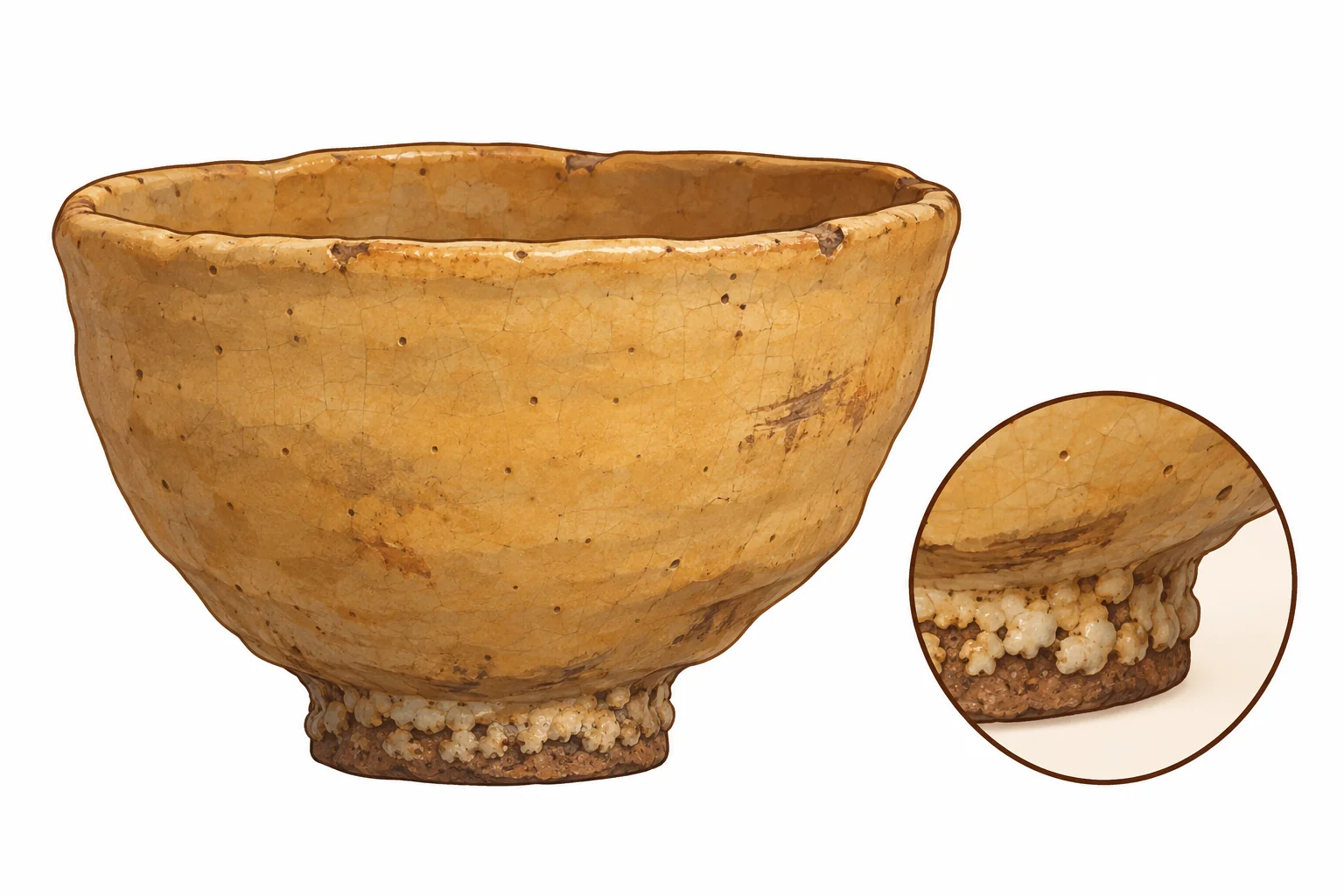
An Ido tea bowl made in Korea, loquat-yellow glaze on coarse clay, with a close-up of its crawled-glaze foot (illustration).
That definition is not wrong, but it is thin. In Japan, wabi and sabi are two separate words with their own histories, and they sit on top of older layers of feeling. Ask an educated Japanese person what wabi-sabi means and you will often get a pause, a laugh, and an attempt to describe a mood rather than a style: the quiet of a mountain hut in autumn, a moss-covered stone lantern, an iron kettle darkened by decades of use. Nobody in Japan would call a new sofa "wabi-sabi," however beige it is.
To understand why a battered Korean bowl could become a National Treasure, it helps to go back a long way, to a Buddhist idea that seeped into Japanese poetry, prose and daily speech until it became almost a temperament.
02Mujō: Nothing Stays
Mujō is the Japanese reading of the Buddhist term for impermanence: everything that arises from causes will pass away when those causes change. The doctrine is as old as Buddhism itself, and it is taught across Asia. What is distinctive in Japan is how thoroughly it moved out of sermons and into literature, where it became less a philosophical proposition than an emotional key signature.
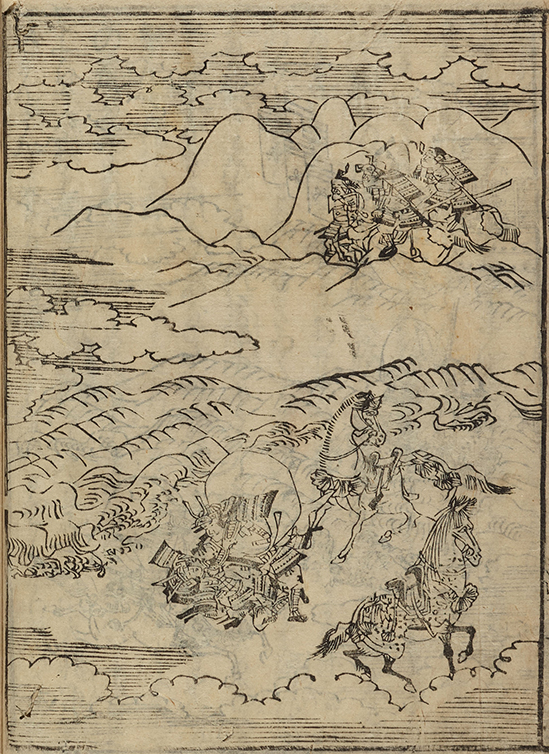
Japanese schoolchildren still memorize the opening of The Tale of the Heike (Heike monogatari), the great war epic about the rise and destruction of the Taira clan in the twelfth century: "The sound of the bell of Gion Shōja echoes the impermanence of all things; the color of the sāla flowers reveals the truth that the prosperous must decline." For centuries the tale was chanted by blind monks accompanying themselves on the biwa, a short-necked lute. Audiences heard, in a voice and a few plucked strings, how a family that had dominated the court was wiped out in a single generation, ending with the drowning of a child emperor at the sea battle of Dan-no-ura in 1185.
A generation later, in 1212, a former court poet named Kamo no Chōmei finished a short prose work called Hōjōki, usually translated as An Account of My Hut. It begins: "The flowing river never stops, and yet the water is never the same." Chōmei had lived through a great fire in the capital, a whirlwind, a famine and a massive earthquake, and he describes the rebuilding of houses that would only burn or collapse again. In the end he retreated to a hut in the hills at Hino, south-east of Kyoto, about three meters square, built so that it could be taken apart and carted away. The hut itself was an argument: why build anything permanent in a world where nothing lasts?
About a century after that, the monk Yoshida Kenkō wrote Tsurezuregusa (Essays in Idleness), a loose collection of reflections that turned impermanence from a cause for lament into a source of delight. If we never faded like dew on the fields or drifted away like the smoke over the cremation grounds, he wrote, life would have no depth; it is precisely its uncertainty that makes it precious. In his most quoted passage he asks whether we should look at cherry blossoms only in full bloom, or at the moon only when the sky is cloudless. To long for the moon on a rainy night, to stay indoors unaware of the spring passing, has its own feeling; branches about to blossom, gardens strewn with fallen flowers, are even more worth seeing. That paragraph is a fair summary of what later generations would call wabi-sabi, written well over a century before the first tea masters.
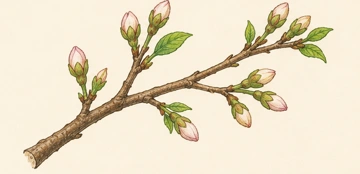
About to open: a cherry branch full of buds.
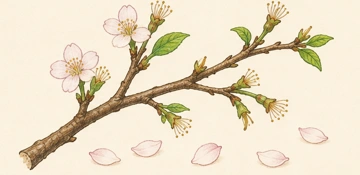
Past its peak: most petals have fallen beneath the branch.
Impermanence was even built into the way Japanese people learned to write. The Iroha poem, used for centuries as a kind of alphabet song, uses each of the forty-seven syllables of the old kana syllabary exactly once. Its meaning runs roughly: the colors are fragrant, but they scatter; in this world of ours, who can last forever? Crossing today the deep mountains of existence, I will not dream shallow dreams or be drunk. It is generally read as a paraphrase of a Buddhist verse on impermanence from the Nirvana Sutra. Tradition credited it to the monk Kūkai, though scholars think it was written later. Either way, generations of children practiced their brushstrokes on a meditation about the emptiness of things.
People often link this sensibility to the islands themselves: earthquakes, typhoons, volcanic eruptions, wooden cities that burned again and again, and seasons that change sharply and visibly. It is hard to prove that geography shapes philosophy, but anyone who reads Chōmei’s description of the earthquake of 1185 will find it hard to dismiss the connection entirely.
03Mono no Aware: Being Moved by Things
Mono no aware is often translated as "the pathos of things" or "the sadness of things," which makes it sound gloomier than it is. Aware began as an exclamation, something like "ah!" or "oh!", uttered when one is struck by something lovely, pitiful, charming or surprising. Mono no aware is that involuntary "ah" in response to the world: a sensitivity to the feelings that things and people stir in us.
The phrase became a central idea in Japanese literary thought thanks to Motoori Norinaga (1730–1801), a physician and scholar of the "National Learning" movement in the mid-Edo period, who devoted much of his life to the study of Japan’s early classics. Reading The Tale of Genji, the eleventh-century novel by the court lady Murasaki Shikibu, he argued that its purpose was neither to teach Confucian morals nor to illustrate Buddhist doctrine, as earlier commentators had claimed. Its purpose was to make readers "know mono no aware": to feel, with Genji and the women he loves, the joy of love, the pain of separation, the regret of mistakes and the slow wearing-away of age. For Norinaga this soft, receptive sensibility was the authentic Japanese heart, older and truer than the imported moral systems of China.
The feelings that aware covers are not all sad, but in Heian-period poetry the deepest ones are almost always bound up with time passing. A poem by Ono no Komachi, a ninth-century poet famous for her beauty, puns on the fading of flowers and of her own looks: the color of the blossoms has faded, while I have idly passed my days gazing out at the long rains. The word furu means both "the rain falls" and "time passes," and nagame means both "long rains" and "a brooding gaze." The poem appears in the Kokinshū anthology of around 905 and in the Hyakunin isshu, the collection of a hundred poems that Japanese families still use for a card game at New Year.
One way to hold the three ideas together is this: mujō is the fact that everything passes; mono no aware is the feeling of being moved by things because they pass; wabi and sabi are ways of living with and making beauty out of that fact.
04Why Watch the Cherry Blossoms Fall
Nothing shows these ideas at work more clearly than hanami, the custom of viewing cherry blossoms. Heian aristocrats already gathered under the trees to compose poems, and cherry blossoms fill the Kokinshū. The courtier Ariwara no Narihira wrote a famous poem saying that if there were no cherry blossoms in the world, our hearts in spring would be at peace. It is a backhanded compliment: the blossoms are so beautiful and so brief that they keep everyone in a state of anxiety from the moment the buds swell to the moment the last petal drops.
The modern cherry season is concentrated even further by biology. The variety that dominates Japanese parks and riversides, Somei Yoshino, was first sold in the late Edo period by nurserymen in the village of Somei, now part of Tokyo (exactly where and how it arose is still unsettled), and is propagated by grafting, so the trees are essentially clones. In any one city they open together and fall together. Full bloom lasts only a few days; a strong wind or a rainstorm can strip a whole avenue overnight. Television news tracks the "cherry blossom front" as it moves north from Kyūshū to Hokkaidō, office juniors are sent out early to claim picnic spots with blue tarpaulins, and the parties under the trees have a slightly urgent cheerfulness. Miss this week and you wait a year.
Japanese has precise words for the stages of falling. Hanafubuki, "blossom blizzard," is the moment when a gust sends petals flying in a cloud. Hana-ikada, "blossom rafts," are the drifting mats of petals that collect on the surface of canals and rivers. Along the Philosopher’s Path in Kyoto or the Meguro River in Tokyo, the rafts at the end of the season are, for many people, more beautiful than the trees in full flower.
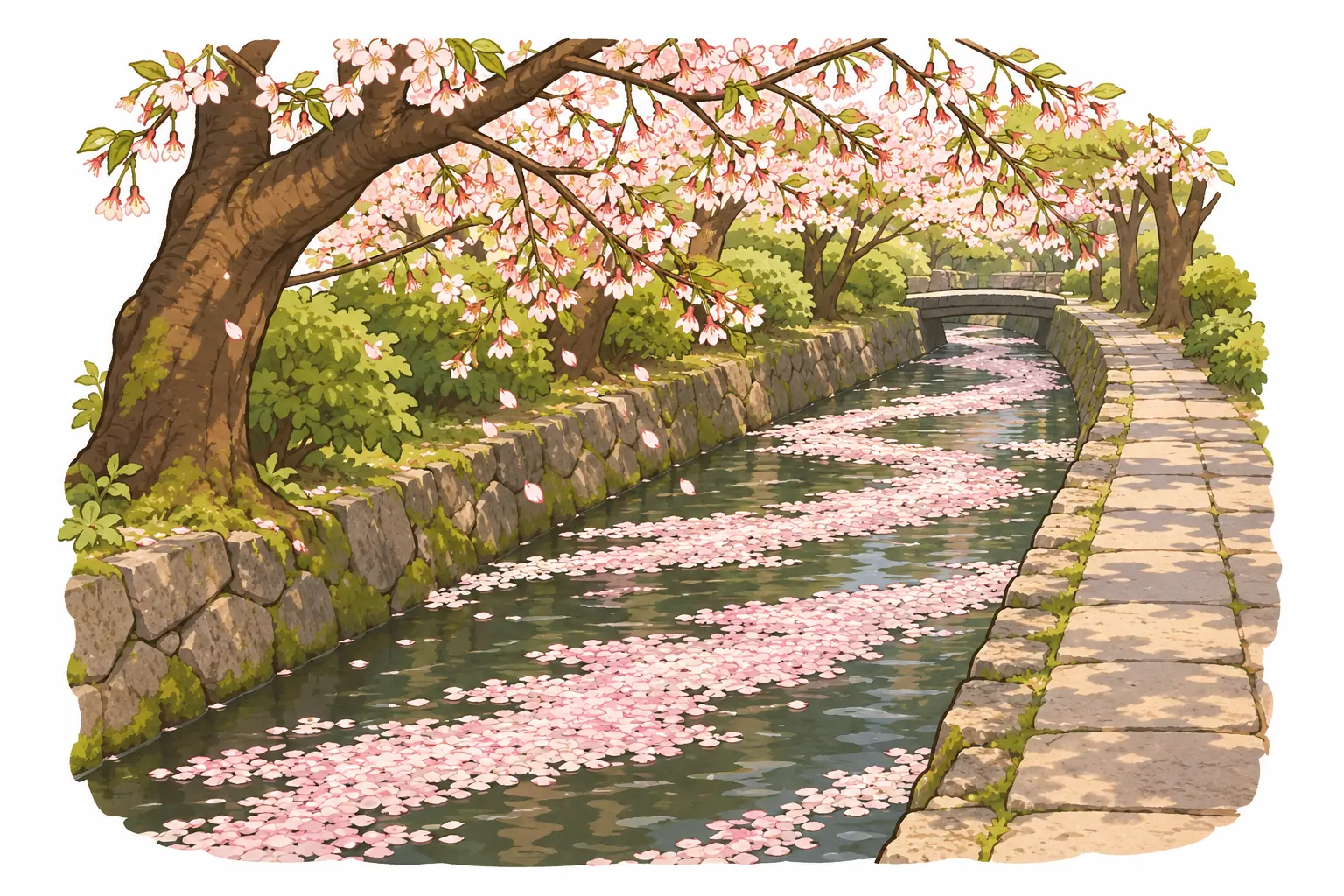
At the end of cherry season, fallen petals gather into hanaikada rafts on the canal along the Philosopher's Path (illustration).
This love of falling blossoms has a darker history. In the late nineteenth and twentieth centuries, nationalist propaganda tied the cherry blossom to the idea of dying young for the emperor, and in the last months of the Pacific War the kamikaze pilots were described as falling petals. That association still makes some Japanese uneasy about too much praise for "the beauty of scattering," and it is a reminder that aesthetic ideas do not stay in poetry books.
Autumn is spring’s counterpart. Momijigari, literally "hunting for red leaves," sends people into the hills and temple gardens to see maples at the peak of color, which is also the moment just before they drop. The haiku tradition formalized this attention to the season: every poem is expected to include a kigo, a season word, so that each one is anchored to a particular, passing moment of the year.
05Wabi and Sabi: From Poverty to Poise
Wabi comes from the verb wabu, to be disheartened, to languish, to be lonely. The adjective wabishii is still used today for something bleak, shabby or forlorn: a cheap meal eaten alone in a cold room is wabishii. Sabi comes from sabu, to grow old, to fade, to become desolate, and it sounds the same as sabi, rust, a connection people often draw. Both words started out negative. They described poverty, cold, age and isolation.
What medieval Japanese hermits and poets did was to turn those conditions inside out. Living alone in a hut in the mountains, with little to eat and nobody to talk to, one could find a clarity and calm that the crowded capital never offered. Zen Buddhism, which reached Japan in strength in the Kamakura period (1185–1333), reinforced this. Zen temples were the main channel for Chinese culture into medieval Japan, and the monks brought ink painting, dry landscape gardens and an austere daily routine that trained people to see richness in very little.
A famous poem by Fujiwara no Teika (1162–1241) became, for later tea masters, the very image of wabi: looking out, there are neither blossoms nor scarlet leaves, only a reed-thatched hut by the bay in the autumn dusk. Blossoms and autumn leaves were the two favorite subjects of court poetry. Teika names them only to say they are absent, leaving a gray shore and a fisherman’s hut. According to the Nanpōroku, a text that claims to record the teachings of the tea master Sen no Rikyū, Rikyū’s predecessor Takeno Jōō used this poem to explain the spirit of wabi tea, and Rikyū himself preferred another, by Fujiwara no Ietaka: to those who wait only for the blossoms, show them the spring in the grasses pushing through the snow in a mountain village. The Nanpōroku surfaced only at the end of the seventeenth century, a hundred years after Rikyū’s death, and historians have long doubted how much of it reflects Rikyū’s actual words. But the pairing of those two poems with wabi tea has become part of the tradition.
Sabi found its fullest expression in haiku. Matsuo Bashō (1644–1694), the poet who raised haiku from a parlor game to an art, wrote verses that look plain on the surface but carry a sense of age, stillness and time. His most famous: an old pond; a frog jumps in; the sound of water. The pond is old, the surroundings are quiet, and the single splash makes the silence afterwards deeper. Bashō’s disciples treated sabi as one of the core qualities of his school: not a deliberately sad subject, but a subdued, weathered tone that seeps naturally into a poem.
Very roughly, then, wabi leans toward a way of living: contentment in simplicity and even in want, an absence of show. Sabi leans toward the look of things: the patina that time leaves, the faded, quiet, lonely quality of something old. They overlap so often that they are spoken as a pair.
06The Tea Masters Make It Visible
Poets could describe this mood, but it was the tea masters who turned it into objects you could hold and rooms you could sit in; the tea ceremony has its own long story (see also: The Way of Tea (Chanoyu): Hospitality Distilled into a Single Bowl), and only the thread that leads to wabi-sabi is followed here. Murata Jukō (also read Shukō), a tea master from Nara active in the late fifteenth century, is credited with starting wabi-cha, "wabi tea," served in a small, plain room with humble local wares set beside the celadons and glossy tenmoku bowls from China that were then prized above everything; a saying attributed to him, "I do not care for a moon with no clouds," echoes Kenkō almost exactly. Sen no Rikyū (1522–1591) took the style to its extreme. Taian, the dim, earth-walled tea room of just two tatami mats traditionally said to be his, is almost bare, and the bowls he commissioned from the Kyoto craftsman Chōjirō, shaped by hand instead of on a wheel and fired at low temperature, came to be called Raku ware: a black Raku bowl is slightly asymmetrical, surprisingly light and warm to the touch. Tea men of the sixteenth century also prized certain rough everyday bowls from Korea, known in Japan as Ido bowls, for exactly the qualities a Korean potter would have considered flaws: coarse clay, a grayish loquat-colored glaze, and a foot where the glaze has crawled into beads, called kairagi after the pebbly skin of a ray used on sword hilts. The most famous, named Kizaemon after the Ōsaka merchant Takeda Kizaemon who once owned it, passed in the late Edo period to the daimyo and tea connoisseur Matsudaira Fumai, whose widow gave it to Kohōan, a subtemple of Daitoku-ji in Kyoto; it is a National Treasure. What tea people learned to admire in such pieces they called keshiki, "scenery": the run of a glaze, spots where ash fell on the pot in the kiln, unexpected colors from the fire, tea stains built up over generations, none of which the potter can fully control. When a bowl broke, it might be mended with lacquer and the seams dusted with gold, the technique called kintsugi, and the repair became part of its scenery.
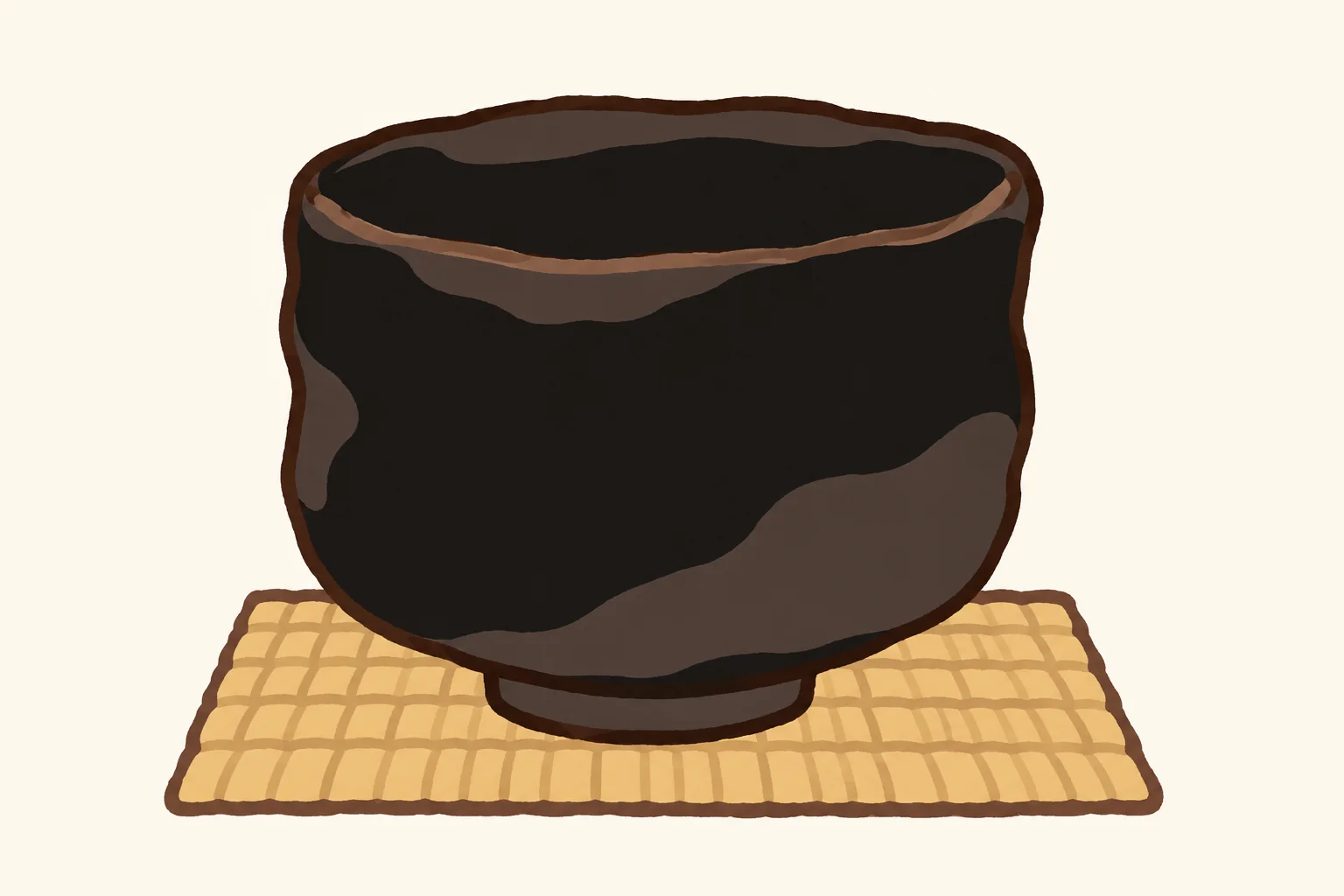
A hand-formed, slightly asymmetrical black raku tea bowl on a tatami mat (illustration).
07Shadows, Moss and Old Wood
Walk into an old Kyoto temple and you will notice how much is deliberately left to age. Wooden pillars have weathered to a silvery brown. Stone lanterns wear coats of moss. The moss gardens themselves take decades to establish and constant, careful weeding to maintain. A Japanese visitor looking at a mossy stone might say it has sabi, or more casually that it is wabi-sabi in a good way.
On the eastern edge of Kyoto, Jishō-ji, better known as Ginkaku-ji, the Silver Pavilion, was built as a retirement villa by the shogun Ashikaga Yoshimasa in the 1480s. Despite the name, the pavilion was never covered in silver. It is a modest two-story wooden building standing between a moss garden and sculpted mounds of white sand, a deliberate contrast with the gold-covered Kinkaku-ji built by Yoshimasa’s grandfather. The circle of artists, tea men and garden designers around Yoshimasa is remembered as Higashiyama culture, and many of the elements we now think of as classically Japanese took shape then: the study-style shoin room with its alcove for a hanging scroll and a flower arrangement, the dry landscape garden, the quiet, restrained palette.
At Ryōan-ji, the famous rock garden is made of raked white gravel and fifteen stones set in clusters, enclosed by an old earthen wall stained by centuries of rain. Visitors sit on the veranda and look at it, not at any particular object but at the spaces between. It is often said that from no point on the veranda can you see all fifteen stones at once, and this is sometimes explained as a lesson that nothing in this world is complete, though that reading is a modern one.
In 1933 the novelist Tanizaki Jun’ichirō published a long essay called In Praise of Shadows (In’ei raisan). Japanese beauty, he argued, lives in darkness: lacquerware reveals its depth only by candlelight, a gold screen glimmers only in a dim room, even the traditional wooden toilet set apart in the garden has its own charm in the half-light. He complained that electric lighting was flooding Japanese rooms and erasing everything that made them beautiful. The essay is still required reading for architects and designers in Japan and abroad, and it reads like wabi-sabi restated for the electric age.
Earlier still, in 1906, Okakura Kakuzō published The Book of Tea in English in New York, describing the tea cult to Western readers as "essentially a worship of the Imperfect." In the 1920s the critic Yanagi Muneyoshi (also known as Yanagi Sōetsu) launched the mingei folk-craft movement, celebrating the everyday objects of anonymous craftsmen. His admiration for Korean ceramics and for rough country pottery ran along the same line as the tea masters’ love of Korean rice bowls.
08Wabi-Sabi in Japan Today
In Japan, wabi-sabi is rarely sold as a look. It lives mostly in habits. People cherish a wooden table that has darkened with use, an iron kettle with a smooth worn handle, cotton towels washed until they are soft. Old shops leave faded noren curtains hanging in the doorway for years. When temples are repaired, carpenters often keep as much of the original timber as they can, patching around it rather than replacing it. Even the design brand Muji, with its slogan "This is enough" and its undyed, unbranded goods, is often described as a modern descendant of this taste, though it is of course a mass-market retailer.
Impermanence survives in everyday phrases. Ichigo ichie, "one time, one meeting," began as a tea saying: every gathering happens only once in a lifetime, so host and guest should give it their full attention. Today it appears on restaurant walls, in wedding speeches and on souvenir towels. Japanese seasonal greetings in letters, which open by noting the weather or the flowers of the moment, do the same quiet work, marking each moment as one that will not come again.
09Seeing It for Yourself
The difficulty with wabi-sabi is that it never calls for your attention. It is rarely in the busiest places or on the sunniest days. To find it you need to slow down and choose your times and places with some care.
Kyoto is the obvious place to start. Saihō-ji, known as Koke-dera, the Moss Temple, has a garden carpeted in moss, often said to include more than a hundred varieties. You will usually be asked to copy a sutra before entering the garden, but after rain the moss glows an almost unnatural green. Go to Ginkaku-ji when it opens in the morning, before the tour groups, when you can hear water running through the garden. At Ryōan-ji, find a spot on the veranda and sit for a quarter of an hour, watching the light move across the gravel. Several of the subtemples of Daitoku-ji open to the public year-round or in season and show small, perfect dry gardens and tea rooms; Kohōan is normally closed, and the Kizaemon bowl is very rarely shown. At Myōkian, in Yamazaki, you can generally look into Taian only from outside; in Sakai, south of Ōsaka, a full-scale reconstruction of Taian as it was first built, at the Sakai Rishō no Mori cultural center, can be entered and gives a closer sense of how small it is.
For tea bowls, the Raku Museum in Kyoto, and in Tokyo the Nezu Museum, the Mitsui Memorial Museum, the Ebara Hatakeyama Museum of Art and the tea utensil galleries at the Tokyo National Museum all show outstanding pieces. When you look at a bowl, look at the foot, the way the glaze has run, and the color changes inside; that is the scenery the tea masters saw. Many temples and tea schools offer short tea experiences, and simply holding a warm, rough bowl of matcha in both hands, kneeling on tatami in a quiet room, teaches more than any definition.
Timing matters as much as place. Visit the cherry blossoms two or three days after full bloom, and wait for the wind to bring a hanafubuki; a few days later, go to a canal to see the blossom rafts. In autumn, choose a temple garden as the maples start to drop, when the ground turns red. A light rain is the best weather for moss gardens and old wooden buildings: the wood darkens, the stones glisten, the moss swells, and the crowds stay home.
Wherever you go, keep to temple etiquette. Do not step on the moss or into the gardens, check whether photography is allowed indoors (often it is not), and stay quiet on the verandas. Part of what wabi-sabi offers is the quiet itself, and it shows itself only to people who stay long enough to notice.