
At a glance
Two uncut pieces of cloth: where the furoshiki got its name and how it is knotted, and why tenugui ends stay raw and chūsen dye shows on both sides.
- A furoshiki is a roughly square cloth that is never sewn into a bag; everything is done by wrapping and knotting.
- Sizes follow old cloth widths of about 34 cm each; the all-purpose futahaba is about 70 cm.
- The name literally means "cloth spread in the bath"; it spread with Edo-period public bathhouses.
- A tenugui is a long, thin cotton cloth, usually about 33–36 cm wide and 90 cm long, with unhemmed ends.
- In chūsen dyeing, 20 to 30 folded layers are dyed at once, so the color shows on both sides of the cloth.
Walk through a Japanese department store’s food hall and you may see a customer lift a box of sweets off the counter, set it on a square of patterned cloth, fold two corners over, tie the other two into a neat knot, and walk off carrying it like a handbag. That square is a furoshiki. In the same store, a few floors up, there may be a rack of long, thin cotton cloths printed with goldfish, Mount Fuji or cats: those are tenugui. Neither is sewn into a shape, and neither has buttons or a zip. Both are simply flat pieces of fabric, and for several hundred years they have been carried to the bathhouse, the market, the festival, the theater and the front door of anyone receiving a gift. This piece explains what they are, why they look the way they do, and how to buy and use them in Japan.
01A Square You Don’t Cut
A furoshiki is a roughly square cloth used to wrap and carry things. All of its usefulness lies in folding and knotting. Because it has no fixed shape, the same cloth can hold a rectangular box, a bottle of sake, a stack of books, a watermelon or a change of clothes, and when you are done it folds down to the size of a handkerchief and goes in your pocket.
Look closely and many furoshiki are not perfect squares. They are usually 2 to 3 percent longer in one direction, which gives the cloth a little more give and makes it easier to wrap with; another explanation links it to the shrinkage of warp and weft in weaving and the margin left when the cloth is cut. Some recent ones are cut square. Sizes are still described in old cloth-width units called haba. A chūhaba, about 45 centimeters across, suits a lunch box or a small gift. The futahaba, around 70 centimeters, is the all-purpose size: it will wrap a standard box of confectionery or a bottle of wine. Sizes of around 90 to 105 centimeters take a 1.8-liter bottle of sake or can be knotted into a shopping bag. A yohaba of about 1.3 meters holds several floor cushions, and the really big ones, about two meters or more, were once used to bundle up bedding when people moved house.
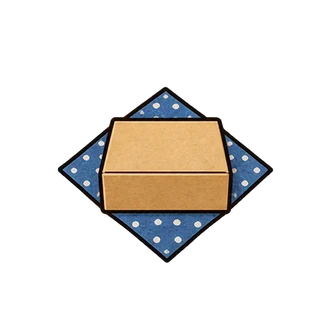
Too small: the corners cannot cover the box or reach to tie.
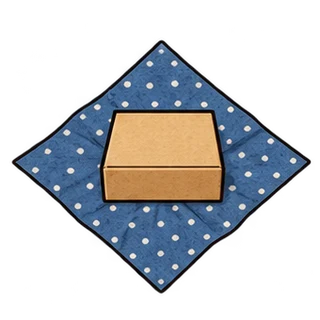
The right size: with the box in the middle, each corner has cloth to fold over and tie.
Material follows purpose. For formal gifts the preferred fabric is silk crepe, chirimen, especially the crepe woven in the Tango region of northern Kyoto Prefecture. Its finely crinkled surface is soft in the hand, grips a knot so it does not slip, and takes dye with a deep, quiet color. Everyday furoshiki are cotton, which is strong and washable and can carry heavy loads. The most common today are polyester: light, cheap and brightly colored. Some are dyed a different color on each side, so a wrapped gift shows one color outside and flashes another at the knot.
02A Name from the Bathhouse
Furo means bath and shiki means something spread out, so the word literally describes a cloth laid down at the bath. The story usually told is that in the Muromachi period the shogun Ashikaga Yoshimitsu built a large bathhouse in Kyoto, and the feudal lords who came to bathe wrapped their clothes in cloths dyed with their family crests so as not to mix them up, then sat on the cloths afterward to dress. The story is widely repeated but is best treated as a later explanation. What is reasonably clear is that furo at the time often meant a steam bath, where spreading a cloth to sit on and to bundle your clothes made obvious sense.
Wrapping cloths themselves are much older than the name. The Shōsōin, the imperial storehouse at Nara, preserves cloths used to wrap treasures and dance costumes from the eighth century, and by one account musical instruments as well. The tenth-century Heian dictionary Wamyō ruijushō calls such a cloth a koromotsutsumi, "clothes wrapper," and by around the Muromachi period it was known as a hirazutsumi, "flat wrapper"; all were essentially the same thing. The word furoshiki spread in the Edo period (1603–1868), when public bathhouses, sentō, became part of daily life in the cities. Ordinary townspeople walked to the bath with their clothes, a bran bag for scrubbing and their belongings tied up in a cloth, and the bathhouse name stuck.
Merchants depended on furoshiki too. Peddlers carried their stock on their backs in huge knotted bundles, and shop boys from kimono fabric stores delivered bolts of cloth to customers’ homes wrapped in them. Japanese still has the idiom ō-buroshiki o hirogeru, "to spread out a big furoshiki," meaning to make grand promises or talk big, as if you could fit anything at all inside.
Ask a Japanese person to picture a furoshiki and many will think first of a green cloth covered in white curling vines. This is the karakusa, or arabesque, pattern, an auspicious design whose endlessly spreading tendrils stand for prosperity and long life. From the Meiji period through the mid-twentieth century, cotton karakusa furoshiki were cheap and sturdy and nearly every household owned one or two for moving, airing futons and storing belongings. Precisely because they were everywhere, they became the cartoon shorthand for a burglar: a man in a bandana with a big green arabesque bundle slung over his shoulder. The image is still instantly recognizable in Japanese comics and advertising.
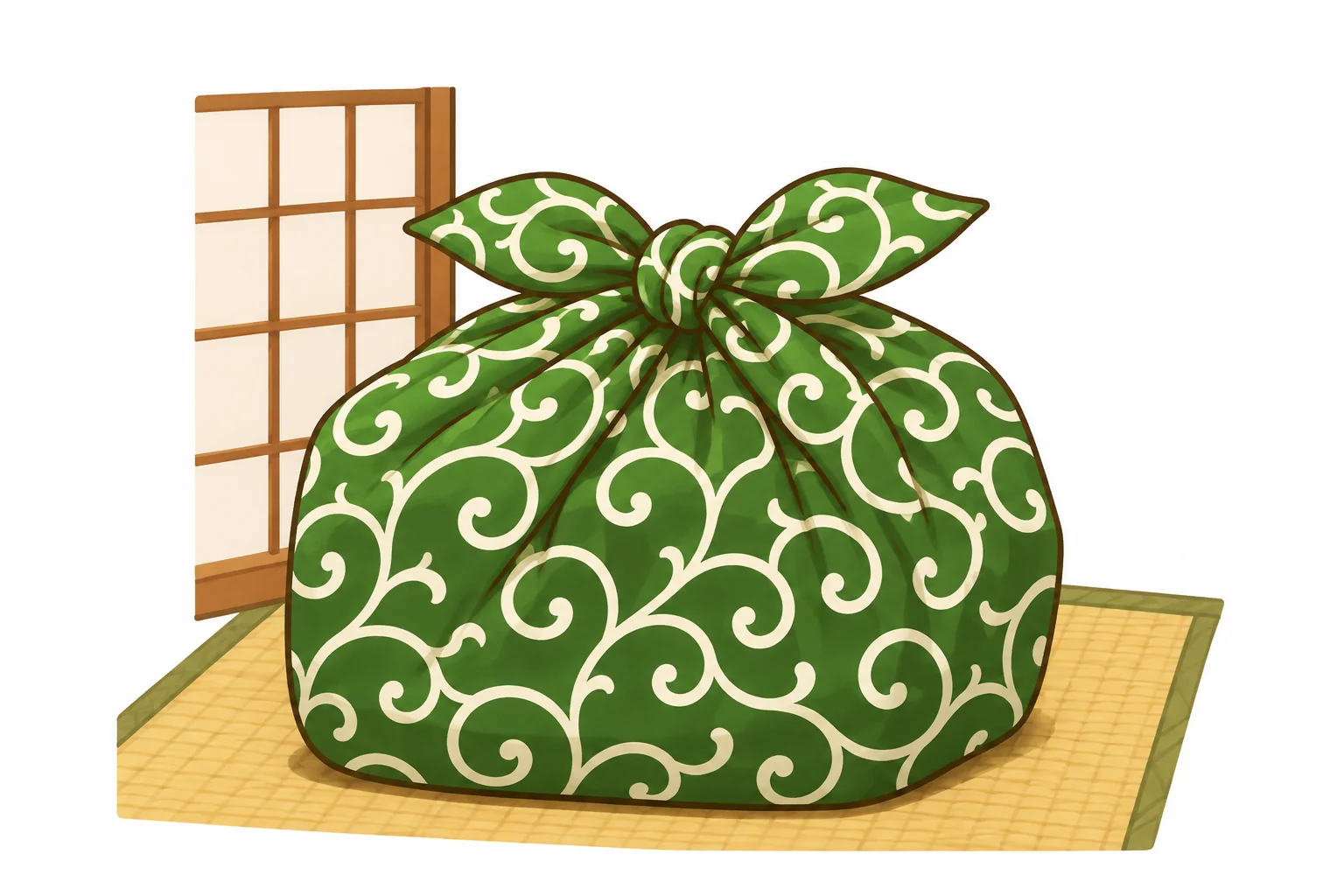
A green furoshiki with white karakusa scrolls, its corners knotted into a large bundle (illustration).
03Folds and Knots
Almost everything in furoshiki technique rests on one knot, the ma-musubi, or square knot. Cross two corners and tie them once, then tie them again in the opposite direction. Done correctly, the knot lies flat and horizontal with its two tails pointing left and right; it tightens under load yet comes undone with a single push from the side. Done wrong, it becomes a tate-musubi, a "vertical knot," which stands upright, looks untidy and slips, so people take care to avoid it on a gift; by one account it was once reserved for funerals.
The basic gift wrap is called otsukai tsutsumi, the "errand wrap." Set the box diagonally in the middle of the cloth, fold the near and far corners over it, then lift the two side corners and tie them in a square knot on top. It is quick to make and quick to open. For more formal occasions there is the hira-tsutsumi, or flat wrap, in which all four corners are folded over and none is knotted, so the box is presented smooth and flat. For a wedding gift, for example, untying a knot is thought unlucky, so the formal wrap simply has none. The futatsu musubi ties two pairs of adjacent corners into two knots; it suits long or bulky objects, and undoing either knot releases the contents.
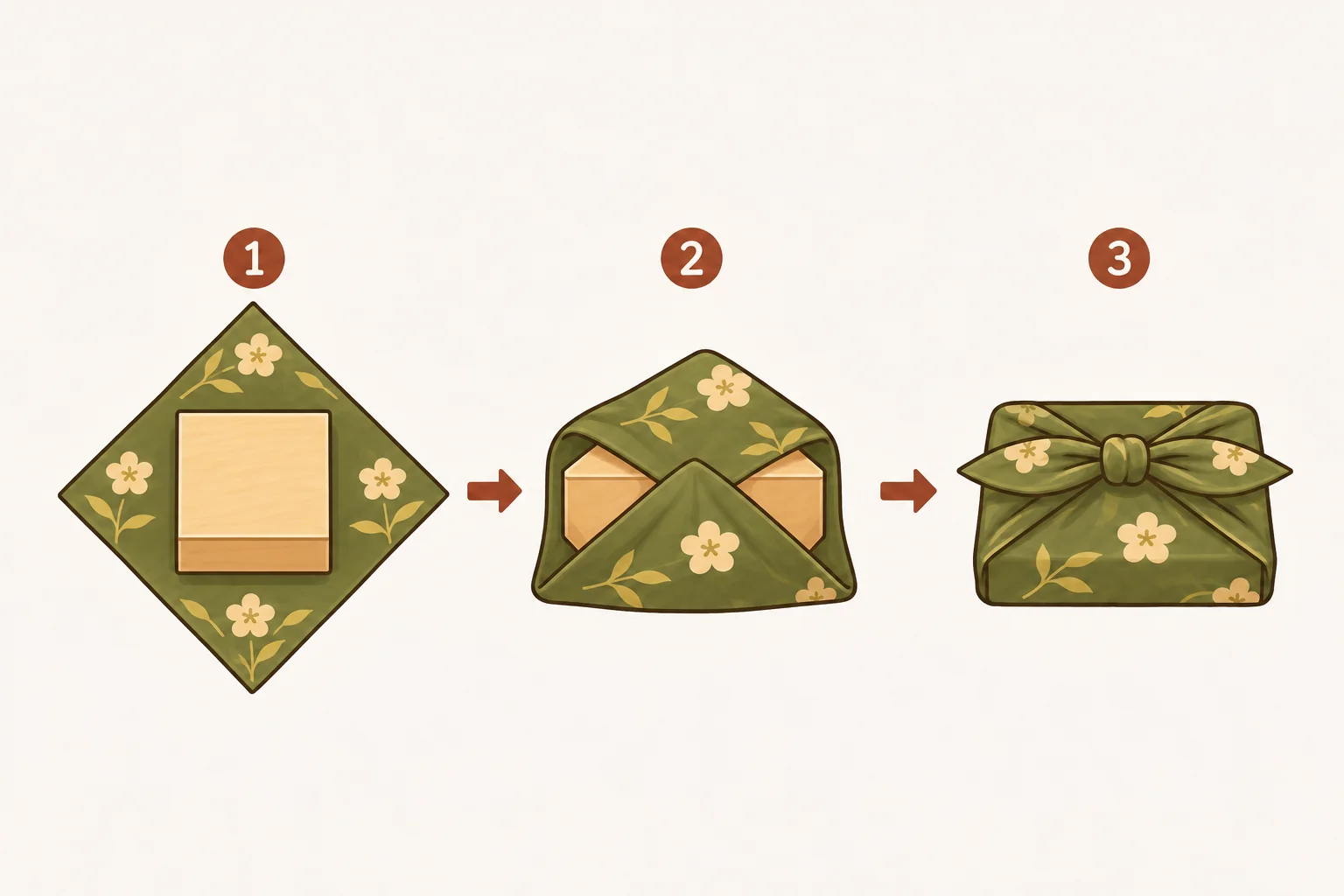
Otsukai tsutsumi: box set diagonally, near and far corners folded over, side corners tied in a square knot.
Round and awkward objects have their own methods. The bin tsutsumi, bottle wrap, holds one or two bottles of sake or wine upright, with a fold of cloth between two bottles so they do not knock against each other. The suika tsutsumi, watermelon wrap, ties each pair of adjacent corners into a loop around a round object, then passes one loop through the other to make a handle. A few more knots and folds turn the same cloth into a tote, a shoulder bag or a backpack.
| Wrap | How | Use |
|---|---|---|
| Otsukai tsutsumi | Fold near and far corners, tie side corners in a square knot | The basic gift wrap |
| Hira-tsutsumi | All four corners folded, no knot | Formal occasions, such as a wedding gift |
| Futatsu musubi | Two pairs of adjacent corners, two knots | Long or bulky objects |
| Bin tsutsumi | Upright, cloth between two bottles | One or two bottles of sake or wine |
| Suika tsutsumi | One loop passed through the other as a handle | Round objects such as a watermelon |
The same cloth, folded and knotted differently, wraps boxes, long objects, bottles and melons.
The logic behind all this is that the cloth adapts to the object, rather than the object being fitted to a ready-made container. It runs through Japanese wrapping more broadly, from origata, the formal paper folds used for ceremonial gifts, to the silk fukusa used to purify utensils in the tea ceremony: wrapping is part of the courtesy, and so is unwrapping. In traditional etiquette, a visitor unties the furoshiki in front of the host, takes out the gift and hands it over, then folds the cloth and takes it home. The present stays; the furoshiki goes back in the guest’s bag.
04Tenugui: A Cotton Cloth with Open Ends
A tenugui is a long, thin strip of cotton, usually about 33 to 36 centimeters wide and about 90 centimeters long, a size some trace to an old standard of 1 shaku 2 sun by 3 shaku. The cloth is a plain weave, either fine bleached cotton called sarashi or a slightly coarser weave, thin enough that you can see light through it. Its most distinctive feature is that the two short ends are left raw and unhemmed.
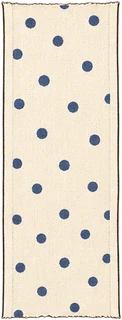
A long, narrow tenugui, about 33–36 cm wide and 90 cm long.
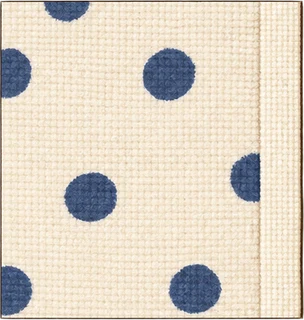
The long sides are the edges of the cloth itself; only the two ends are left raw.
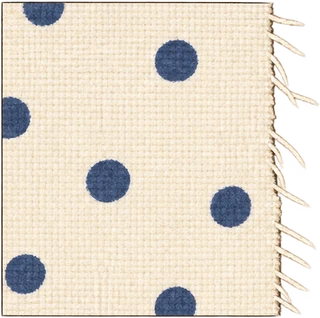
The cut ends are left unhemmed; a few threads work loose at first, then stop.
That is deliberate. A thin cotton strip with open ends dries very quickly, so it does not stay damp and start to smell. The ends shed a few threads at first and then stop of their own accord; after some use they look neat. If you need a strip to fix a broken sandal thong or bind a cut, the cloth tears cleanly along the warp. A modern terry towel holds more water, but it is thick and slow to dry. A tenugui wrung out is nearly ready to use again and hung up it dries in no time, which is exactly what you want in a humid Japanese summer.
Cloths like this were used in Shinto ritual and by Heian aristocrats, but those were mostly hemp or silk and relatively precious. The tenugui became an everyday object only after cotton cultivation spread in Japan from the sixteenth century onward. By the Edo period it was everywhere. People took it to the bathhouse to scrub and dry themselves, tied it over their heads in the fields against sweat and sun, and wound it round their foreheads as a hachimaki headband at festivals. Carpenters, fishmongers and firefighters each had their own way of tying one. Kabuki actors had their crests and signature patterns dyed onto tenugui and gave them to fans, a kind of early merchandise. One famous pattern shows a sickle (kama), a ring (wa) and the kana character nu, which together read kamawanu, "I don’t care." It is said to have been a swagger pattern among street toughs before the actor Ichikawa Danjūrō made it fashionable. In 1784 the writer and artist Santō Kyōden held a tenugui-awase, a competition in which writers and painters each designed a tenugui, and the entries were published as a book.
Tenugui are still part of Japanese life in specific places. Kendo practitioners tie one tightly over their heads before putting on the face guard, to absorb sweat and keep the helmet from shifting. A rakugo comic storyteller performs kneeling on a cushion with only two props, a folding fan and a tenugui; folded, the cloth becomes a wallet, a letter or a tobacco pouch, and opened flat it is an account ledger. Shops and businesses still give customers New Year tenugui printed with the shop’s name.
05Chūsen: Dye Poured Through the Cloth
Turn a good tenugui over and the back is as vivid as the front. The color has gone right through the fabric rather than sitting on top of it. This is the result of chūsen, literally "poured dyeing," a technique developed around Ōsaka in the Meiji period. Today the main centers are Sakai in Ōsaka Prefecture, Hamamatsu in Shizuoka Prefecture and the Tokyo area.
The process works like this. A long roll of white cotton is folded back and forth in tenugui-length layers. At each fold, the dyer lays a stencil over the cloth and spreads a resist paste through it, so that the areas to stay white are protected. After twenty or thirty layers the stack is placed on a perforated table. The dyer pours dye from a watering-can-like vessel over the top while a pump beneath draws it down through all the layers at once, coloring both sides of every cloth in the stack. By building little dams of paste around different areas, several colors can be poured into one design, and where two colors meet they bleed softly into each other. This gradation, called bokashi, is the most admired effect in chūsen. Afterward the paste is washed out and the long cloths are hung from high drying racks, falling like streamers.
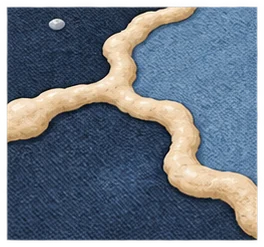
Paste walls off separate areas like dikes, so several colors can be poured on one cloth.
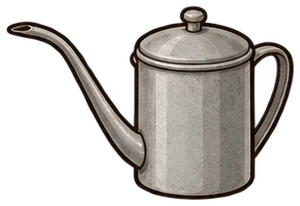
The yakan, a kettle-like pot the dyer uses to pour dye from above.
- 1
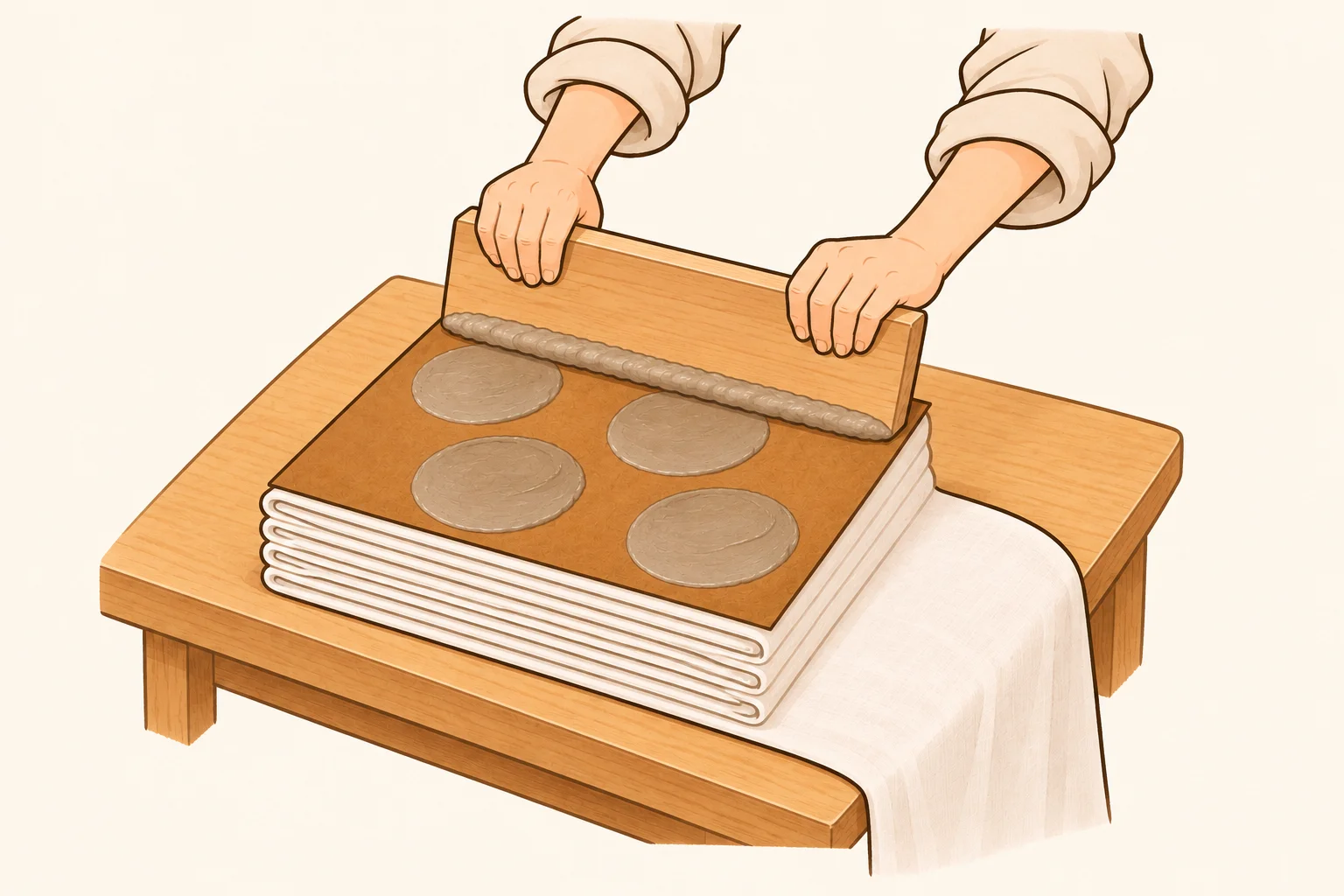 White cotton is folded back and forth; at each fold, resist paste is spread through a stencil.
- 2
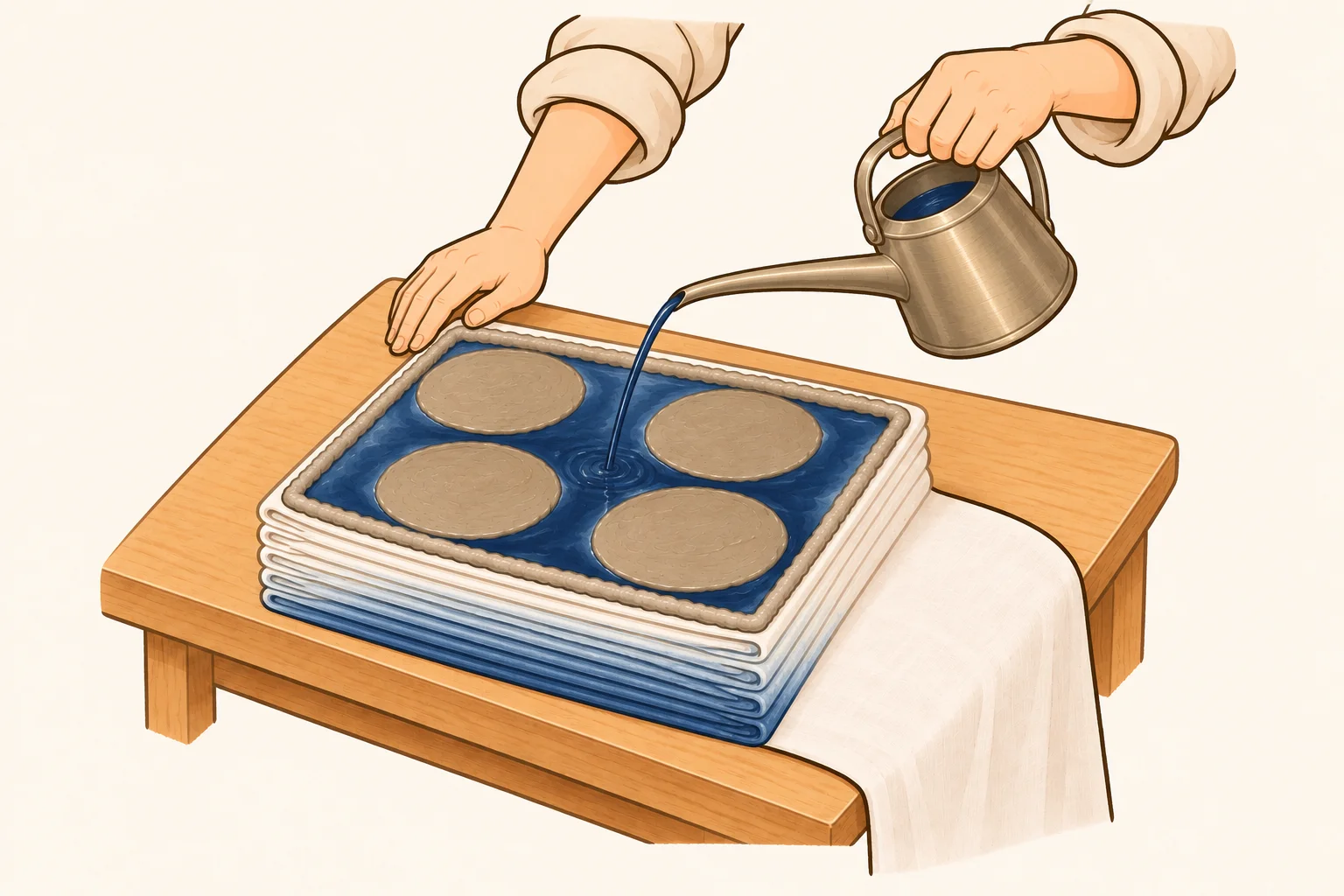 Dye is poured from a watering-can-like vessel over the stack and drawn down through all the layers at once.
- 3
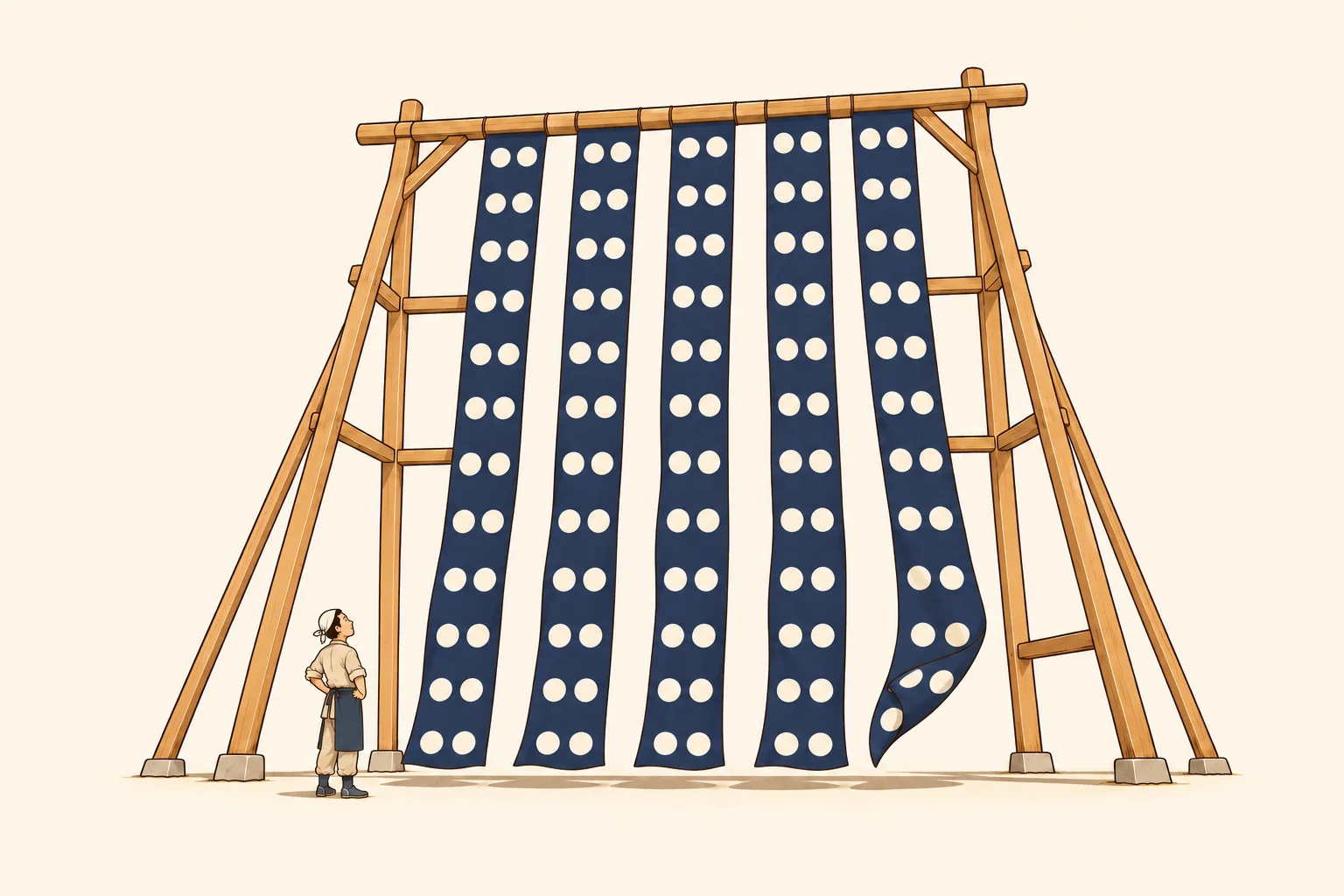 With the paste washed out, the long cloths hang from high drying racks.
Because the dye is poured by hand, the edges of each motif blur very slightly, and no two stacks come out exactly alike. That is the clearest difference from printed tenugui, made by nassen screen-printing, where the color sits on one side only, lines are crisp, fine detail is possible and the price is lower. In a shop, the simplest test is to look at the back.
06Decline and Revival
From the Meiji period, Western-style terry towels arrived and Japan developed its own big towel industries, first in the Senshū area of Ōsaka and later in Imabari on Shikoku. Thick and soft, towels gradually pushed tenugui out of the bathroom and the kitchen. Furoshiki held on longer, but after the war department stores and supermarkets made paper and plastic bags universal, and people no longer needed to carry a cloth. By the 1970s and 1980s furoshiki appeared mainly at weddings, funerals and formal gift-giving, and tenugui retreated to kendo halls, festivals and old-fashioned shops.
The revival came from two directions. One was design. From the late 1980s, specialist shops in Tokyo and Kyoto began selling tenugui with fresh patterns, as cloths to frame and hang on the wall and change with the seasons, as much as towels. Alongside traditional motifs such as hemp leaf, overlapping waves and polka-dot "bean tie-dye," you can now find cats, bicycles, Japanese sweets and city maps. The other was environmental. At the end of 2005 Koike Yuriko, then Minister of the Environment, launched a "Mottainai Furoshiki," made from recycled PET-bottle fabric and printed with flower-and-bird paintings by Itō Jakuchū, and through 2006 promoted it as a replacement for plastic and paper bags under the banner of mottainai, the Japanese sense that waste is a shame. When Japan made plastic shopping bags chargeable nationwide in 2020, furoshiki were promoted again as reusable bags, and plenty of younger people now knot one into a tote and fill it at the convenience store.
07Buying and Using Them in Japan
Kyoto is the easiest place to shop for furoshiki. Miyai, a long-established Kyoto maker, has been producing wrapping cloths for over a century and carries a full range of formal silk crepe. Musubi, a shop run by the Kyoto textile company Yamada Sen’i with branches in Kyoto and Tokyo, sells modern designs, and staff will usually show you a wrap or two, which makes it a good first stop. Department stores sell them in their kimono or gift sections. Prices run from around ¥1,000 to ¥2,000 for cotton or polyester to ¥10,000 and up for silk (as of 2026). A good first furoshiki is a cotton one about 70 centimeters square: it will wrap a box or a bottle and double as a scarf or a picnic cloth.
Tenugui shops are even more plentiful. Asakusa in Tokyo has old shops specializing in hand-dyed tenugui, their walls hung with traditional Edo patterns. Kamawanu, named after the sickle-ring-nu pattern, has shops in Daikan’yama and elsewhere and releases new seasonal designs. Eirakuya in Kyoto is known for reviving patterns from the Meiji period to the early Shōwa era. A chūsen tenugui typically costs ¥1,000 to ¥2,000 (as of 2026), weighs almost nothing and does not crease in a suitcase, which makes it one of the best souvenirs you can carry home.
A few practical points. A new chūsen tenugui will bleed dye in its first wash, so rinse it alone in cold water. Trim stray threads at the ends if you like, but do not hem them; the fraying stops on its own. At a public bath or hot spring you can take a tenugui into the bathing area to wash and dry yourself, but never dip it into the communal bath: fold it and set it on the edge, or on your head as many Japanese bathers do. If you bring a gift wrapped in a furoshiki, untie it once you are inside or seated, hand over the present itself, and fold the cloth away into your own bag.