
At a glance
Why ikebana uses so little: lines, empty space and season, traced from Ikenobō’s temple rikka and tea-room flowers to Sōgetsu’s avant-garde, with tips for seeing and trying it.
- Ikebana is often built on three main branches forming an uneven triangle, with attention to line, empty space and season.
- The Hekizan nichiroku records Ikenobō Senkei’s arrangement in 1462, the year Ikenobō treats as ikebana’s beginning.
- Rikka, perfected by Ikenobō Senkō II in the early Edo period, is a landscape in a vase; tea rooms used just one or two stems.
- Ohara Unshin created moribana in the late Meiji period; Teshigahara Sōfū founded Sōgetsu in Tokyo in 1927.
- Ikenobō, Ohara and Sōgetsu are often called the three main schools; Ikenobō is still based at Kyoto’s Rokkakudō.
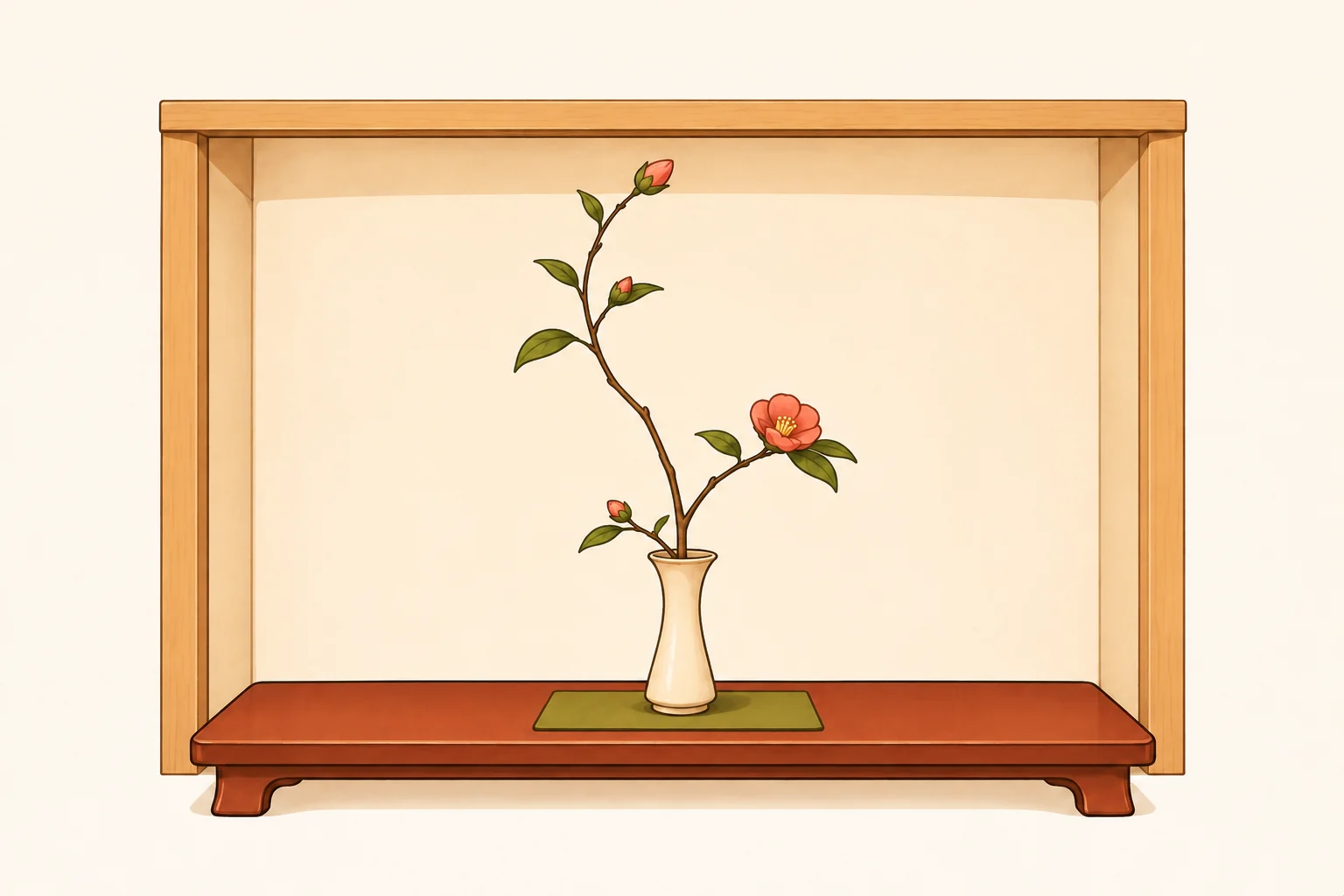
Walk into a traditional Japanese inn and you will often find, in the alcove of your room, a single vessel holding almost nothing: one camellia, a twist of plum branch, a few blades of grass leaning over the rim of a bamboo tube. It can look sparse at first. Then you notice that someone has decided exactly how far that branch reaches, which way the flower faces, and how much empty wall is left beside it. This is ikebana, literally "living flowers," the Japanese art of flower arrangement. It began as offerings before Buddhist altars, grew into a formal art in the mansions of medieval shoguns, became a pastime of merchant households in Edo-period cities, and in the twentieth century turned into a form of sculpture. This guide explains what makes ikebana different from the bouquet on a Western dining table, where its main schools came from, and how to see it, and try it, when you visit Japan.
01Fewer Flowers, More Line
The Western flower arrangement most of us grew up with is about abundance. It tends to be full, rounded and symmetrical, designed to look good from every side, with blooms packed together so that the eye sees a mass of color. Ikebana starts from nearly the opposite premise. A typical arrangement uses only a few kinds of plant material, sometimes just one. It is asymmetrical. It usually has a front, because it was made to be seen from a particular spot. And the arranger cares as much about stems, branches, leaves, buds and even withered or insect-bitten foliage as about the flowers themselves.
The first thing to understand is line. In ikebana a branch is treated almost like a brushstroke drawn in the air: its curve, its angle and its length form the skeleton of the piece. Most schools teach a basic structure of three main stems of different lengths, set at different angles so that their tips form an uneven triangle. These are given names that vary by school, often heaven, earth and human, or the classical terms shin, soe and tai. A beginner’s first lessons are mostly about the proportions between these three lines and the angles at which they leave the vessel.
The second idea is respect for the way a plant actually grows. Japanese arrangers talk about a plant’s shusshō, its "birth" or natural habit: the side that faced the sun, the way a pine bends where it grew from a crack in a cliff, the way an iris stands up straight in a marsh. A good arrangement lets a pine branch still look as if it were reaching out from rock. So before cutting anything, an arranger will turn a branch slowly in the hand, looking for its most natural face.
The third is the season. Ikebana is almost always tied to the time of year. New Year calls for pine, bamboo, plum and the red berries of nandina or senryō. Spring brings peach blossom, cherry branches and yellow rapeseed flowers. Early summer belongs to irises. In high summer arrangers reach for slender grasses or set flowers low in a wide, shallow basin so that the open water itself suggests coolness. Autumn has bellflowers, gentians and maple leaves, and winter has camellias and narcissus. The ideal is to be slightly ahead of the season: pampas grass still tight in bud as autumn begins, rather than lingering on after it has passed. An arrangement quietly tells the viewer what moment of the year it is.
The fourth is empty space. What strikes many visitors most about a fine arrangement is not the flowers but the gaps: between branches, between the arrangement and the wall, above the mouth of the vessel. This is the same sensibility you find in Japanese ink painting and garden design. The Japanese word often used here is ma, an interval in space or a pause in time. Empty space gives the eye somewhere to rest and makes a single line look strong.
Finally, ikebana is also called kadō, "the way of flowers," which places it alongside the way of tea and the way of calligraphy. For many practitioners it is a discipline of attention as much as a decorative skill. Teachers ask students to work quietly, to treat the plant material with respect, and to waste nothing. The cut flower has already been separated from its roots; the arranger’s job, in the phrase people like to use, is to make it live again in the vessel.
02From Temple Offerings to the Shogun’s Alcove
Placing flowers before images of the Buddha came to Japan with Buddhism in the sixth century. Early offerings seem to have been fairly simple: flowers in vases set symmetrically on either side of an altar, much as you still see in temples today. Court aristocrats of the Heian period also enjoyed cut blossoms indoors. In The Pillow Book, written around the year 1000, Sei Shōnagon describes a large blue-green vase set by the railing of the Seiryōden hall, filled with five-foot branches of cherry in bloom. But none of this was yet an art with rules and teachers.
The decisive change came in the Muromachi period, in the fourteenth and fifteenth centuries. Warrior and aristocratic houses adopted a new style of architecture, later called shoin-zukuri, with built-in shelves and a recessed alcove. That alcove, the tokonoma, became the most honored spot in a room, the place to hang a scroll and display a vase or an incense burner. The Ashikaga shoguns were passionate collectors of karamono, prized objects imported from China: bronze vases, celadon, Song and Yuan dynasty paintings. Displaying these treasures properly, with flowers to match, became a specialized skill.
The shoguns employed a corps of attendants called dōbōshū, whose names often ended in "-ami." They appraised art, arranged reception rooms, oversaw tea gatherings and arranged flowers. Men such as Ryūami and Mon’ami were known for their arrangements. In their hands, flower arranging began to acquire conventions: which flowers suited which occasion, where the vase should stand, how the branches should extend.
The oldest school of ikebana, and still the largest, emerged in the same century. Ikenobō was the name of a residence for priests at Rokkakudō, a small hexagonal temple in the middle of Kyoto whose formal name is Chōhō-ji. According to temple tradition it was founded by Prince Shōtoku. The priests who made the daily flower offerings there lived beside a pond, ike, and their lodging was known as Ike-no-bō, "the lodge by the pond." In 1462 a Zen monk’s diary, the Hekizan nichiroku, recorded that a priest named Ikenobō Senkei had arranged dozens of stems in a golden vase at the invitation of a samurai of the Sasaki house, governors of Ōmi, and that people in the capital flocked to see it. This is the first time the Ikenobō name appears in the historical record in connection with flowers, and the school treats that year as a founding moment for ikebana as a whole.
In the early sixteenth century, Ikenobō Sen’ō left a set of teachings known as the Sen’ō kuden. Its best-known idea is that arranging flowers is not merely a matter of admiring pretty blossoms. The arranger should use plants to evoke the landscape of mountains and waterside, and find in the opening and fading of flowers a way of thinking about the world. With that, flower arrangement had a philosophy as well as a technique.
03Rikka: Landscapes in a Vase
The grand style that grew from these beginnings, brought to completion by Ikenobō Senkō II in the early seventeenth century, is called rikka, "standing flowers." A rikka arrangement is tall, intricate and formal. It rises from a tall vase around a strong central branch, the shin, and is built from seven, later nine, elements in all, each with a fixed name and position. Together they suggest a whole landscape: a mountain peak, a waterfall, a village at the foot of the hills, a stream running away into the distance. A rikka is closer to a three-dimensional landscape painting than to a bouquet, and it was designed for the large reception halls where shoguns and lords received guests.
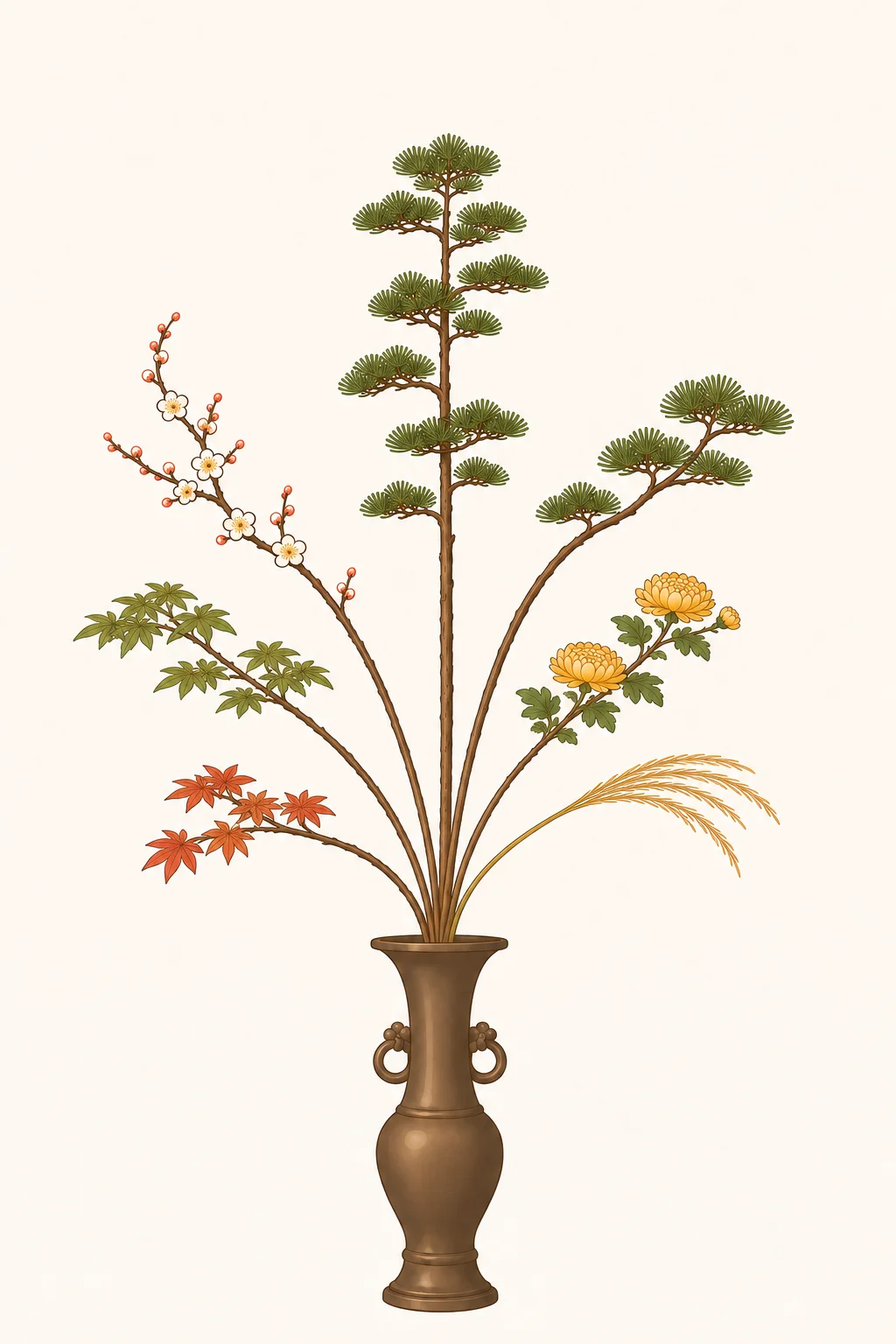
Rikka: tall and formal, rising from a tall vase around a strong central branch, the shin, to suggest a whole landscape.
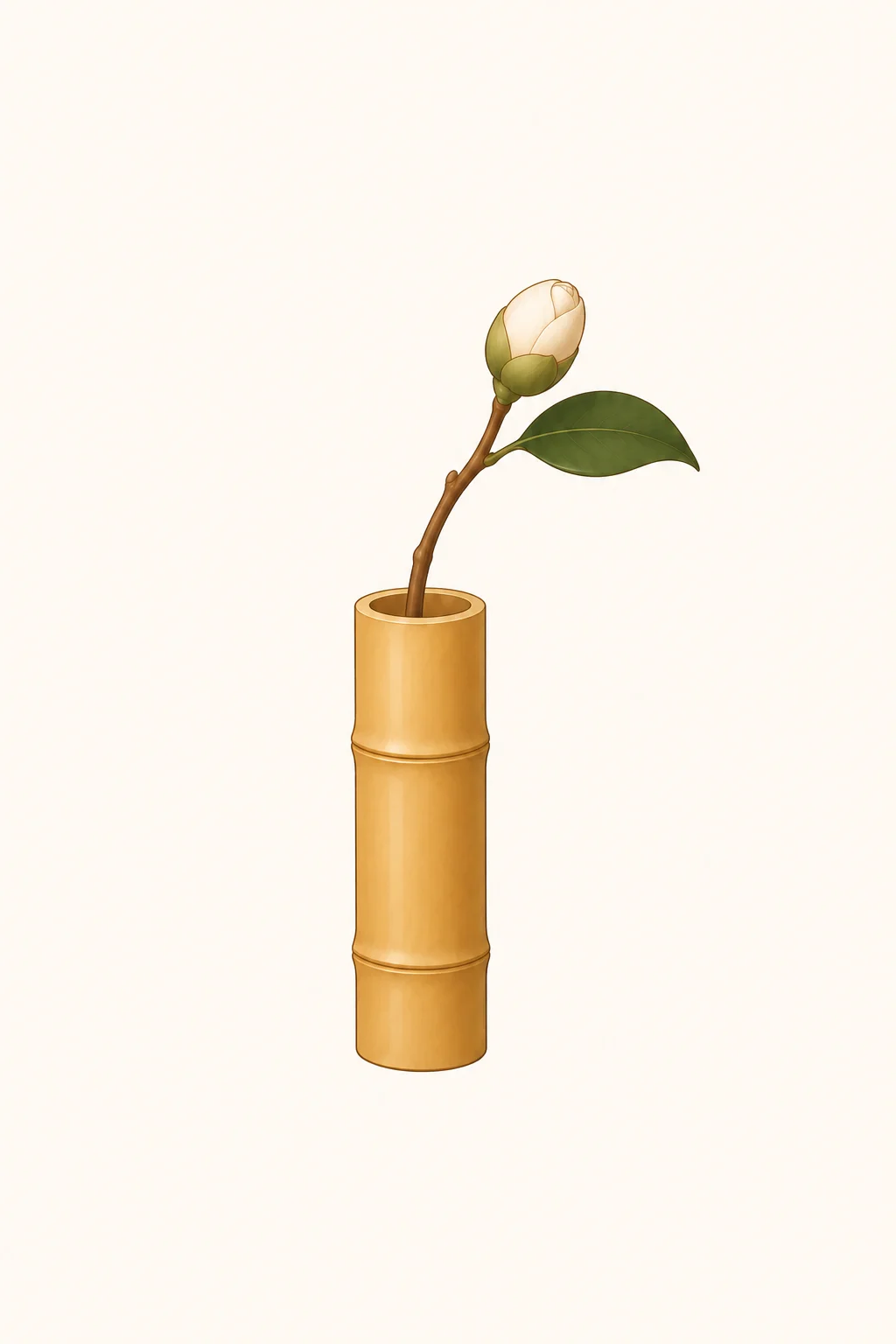
Chabana: a single white camellia bud with one leaf in a bamboo tube.
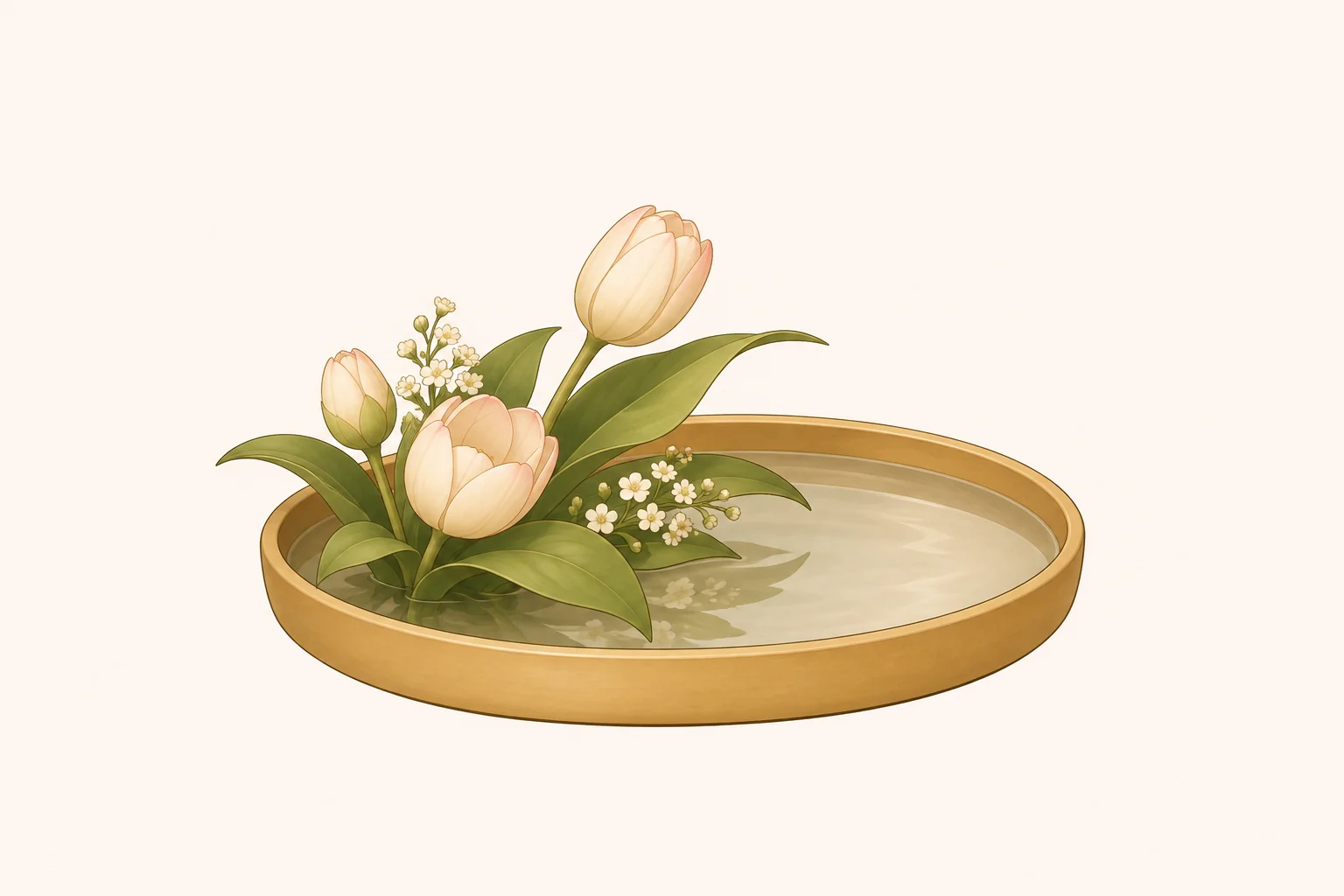
Moribana: Western flowers such as tulips set in a wide, shallow basin and "heaped" across the surface of the water.
The style reached its height around the turn of the seventeenth century. Ikenobō Senkō I, active in the age of Toyotomi Hideyoshi, created an enormous arrangement, more than seven meters wide and built around pine, in a broad sand-filled vessel when Hideyoshi visited the mansion of the warlord Maeda Toshiie in 1594; it was designed to play against four hanging scrolls of monkeys behind it, as if the monkeys were frolicking in the pines, and the school remembers it as Senkō’s masterpiece. His successor, Ikenobō Senkō II, won the favor of Emperor Go-Mizunoo, who held rikka gatherings at the imperial palace around 1629 where courtiers presented arrangements and judged one another’s work. Rikka became, for a time, a fashionable accomplishment among the court nobility.
You can still see rikka at Ikenobō exhibitions. It takes years to master its rules, and next to the spare styles that came later, it shows how solemn and monumental ikebana was at its origin.
04The Tea Room and the Merchant’s Alcove
Ikebana has a second source, and it pulls in the opposite direction. In the sixteenth century the tea master Sen no Rikyū pushed the tea ceremony toward wabi, an aesthetic of rustic simplicity. Tea rooms shrank, some to barely two tatami mats, and their decoration became austere. There was no room for a towering rikka. Instead, tea masters placed one or two wildflowers in a section of bamboo, a rough ceramic jar or a small vessel hung on a post, so that they looked as if they had just been picked from a roadside. This is chabana, "tea flowers."
A set of principles later attributed to Rikyū includes the instruction to arrange flowers "as they are in the field." Chabana has no fixed number of stems and no named positions. It avoids heavily scented or showy flowers and anything out of season. A single white camellia bud with one leaf in a bamboo tube is the classic image of a winter tea room. Chabana’s simplicity and apparent casualness would shape the whole of ikebana. For the tea ceremony itself, see also: The Way of Tea (Chanoyu): Hospitality Distilled into a Single Bowl.
Meanwhile, Japan’s cities were growing. By the eighteenth century the merchants and artisans of Edo, Ōsaka and Kyoto had money and leisure, and they wanted cultural accomplishments of their own. Their houses did not have grand reception halls, but many had a modest alcove. Out of nageire, a looser style in which flowers were "thrown in" to a tall vase, there developed a new form that was more structured than nageire but far lighter than rikka. It was written with the same characters as ikebana, read shōka in the Ikenobō school and usually seika elsewhere. A shōka arrangement uses one to three kinds of material arranged in the heaven-earth-human triangle, with clean, taut lines. It was easy to start and offered a clear path of advancement, and it spread quickly.
The eighteenth and early nineteenth centuries saw an explosion of new schools. Enshū-ryū, Koryū and Mishō-ryū, the last founded in Ōsaka, all date from or flourished in this era. Each had its own rules for the proportions of the main stems, the use of vessels, and the techniques for bending branches, and they competed for students. This was also when the iemoto system settled into its familiar form. The iemoto is the hereditary head of a school, passed down within a family, who holds final authority over its teachings. Students receive licenses from the iemoto at each stage, and at an advanced level may be given a professional name and the right to teach, so that a school grows like a tree, branch by branch. The tea ceremony, incense appreciation and many other traditional arts in Japan are organized the same way.
05Modern Japan: Schoolgirls, Western Flowers and the Shallow Basin
The Meiji Restoration of 1868 hurt ikebana at first, since many of its samurai and temple patrons lost their positions. But it soon found a new role. Along with the tea ceremony, flower arranging became part of the education of young women; many girls’ schools offered lessons in it, treating it, like etiquette and sewing, as part of a proper upbringing. For much of the twentieth century, having studied tea and flowers was a sign that a Japanese woman was well brought up, and a standard part of preparation for marriage. The number of students grew enormously, and ikebana acquired an association with "bridal training" that lasted for decades.
At the same time, Western flowers were arriving: tulips, roses, carnations, dahlias. Brightly colored and often short-stemmed, they did not suit the tall, linear forms of rikka or shōka. In the late Meiji period an arranger named Ohara Unshin found a solution. He set flowers in a wide, shallow basin, suiban, holding them in place with a flower holder, and "heaped" them across the surface of the water to create a scene with depth, a small landscape seen from slightly above. The style was called moribana, "piled-up flowers." It worked with Western flowers, it could depict natural scenery, and it fit the Western-style rooms that were becoming common. The school Ohara Unshin founded, Ohara-ryū, remains one of the largest in Japan.
The tool that spread with moribana in the Taishō and Shōwa periods is the kenzan, the heavy metal disk bristling with metal needles that many people picture when they hear the word ikebana. You press the cut end of a stem onto the needles and it stays upright. The kenzan made arranging far easier and opened the door to bolder shapes.
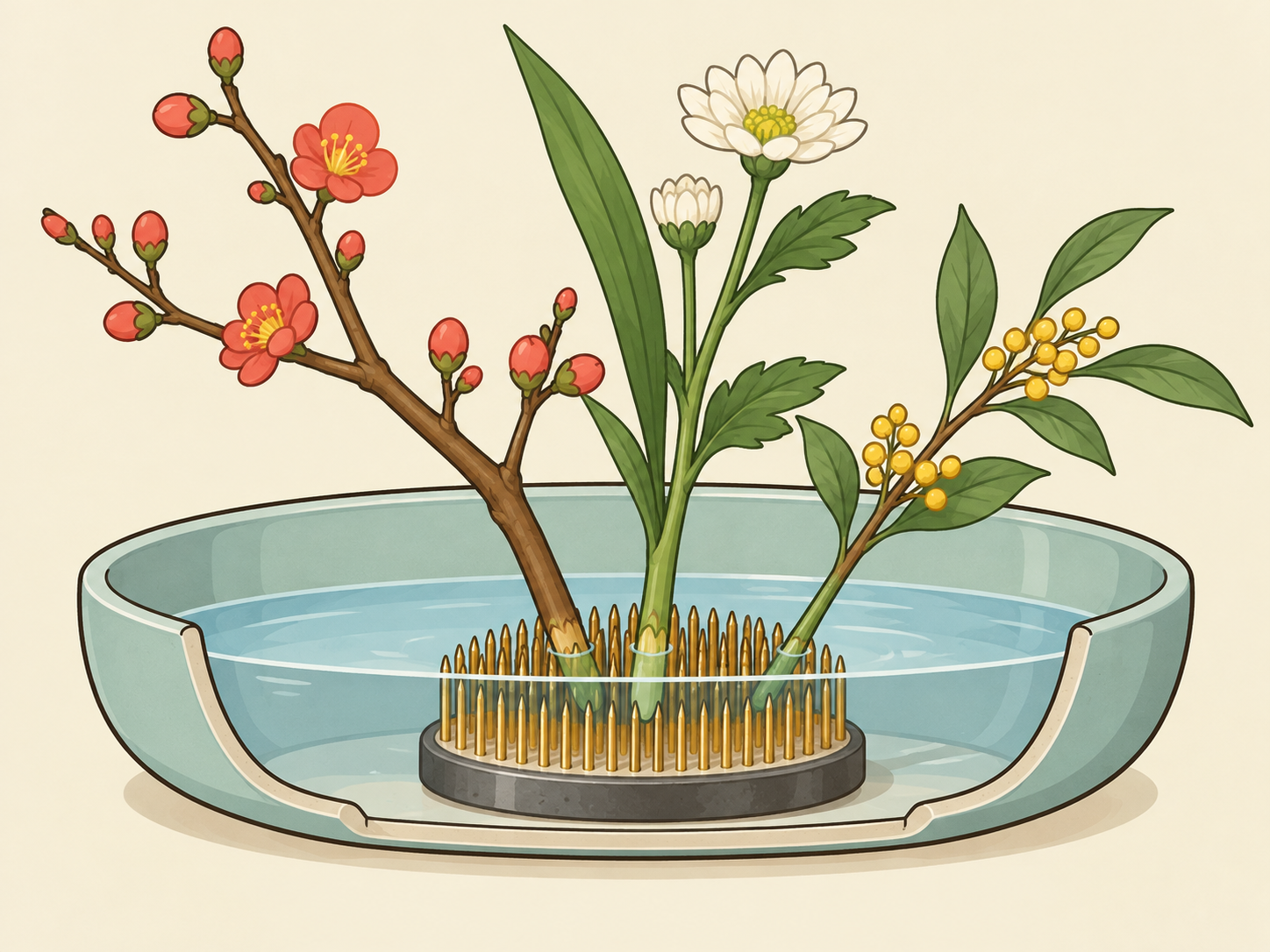
Cutaway of a shallow basin: the kenzan’s heavy base sits on the bottom, and each stem stands once its cut end is pressed onto the pins.
Before the kenzan, an arranger relied on skill in the hands. In tall vases and bamboo tubes, branches were held in place by a small wooden crosspiece wedged in the mouth of the vessel, called a kubari, or by splitting stems so they locked together. A branch that did not curve enough was bent slowly between the hands, a technique called tameru, sometimes after a shallow diagonal cut that let it hold its new shape. Ikebana shears have short, thick blades and round handles, strong enough to cut through sizable wood. To help flowers last, stems are cut under water, mizukiri, and difficult plants may have their ends dipped in boiling water, singed over a flame, or treated with salt or vinegar. These are the invisible techniques that let an arrangement stay fresh in an alcove for days.
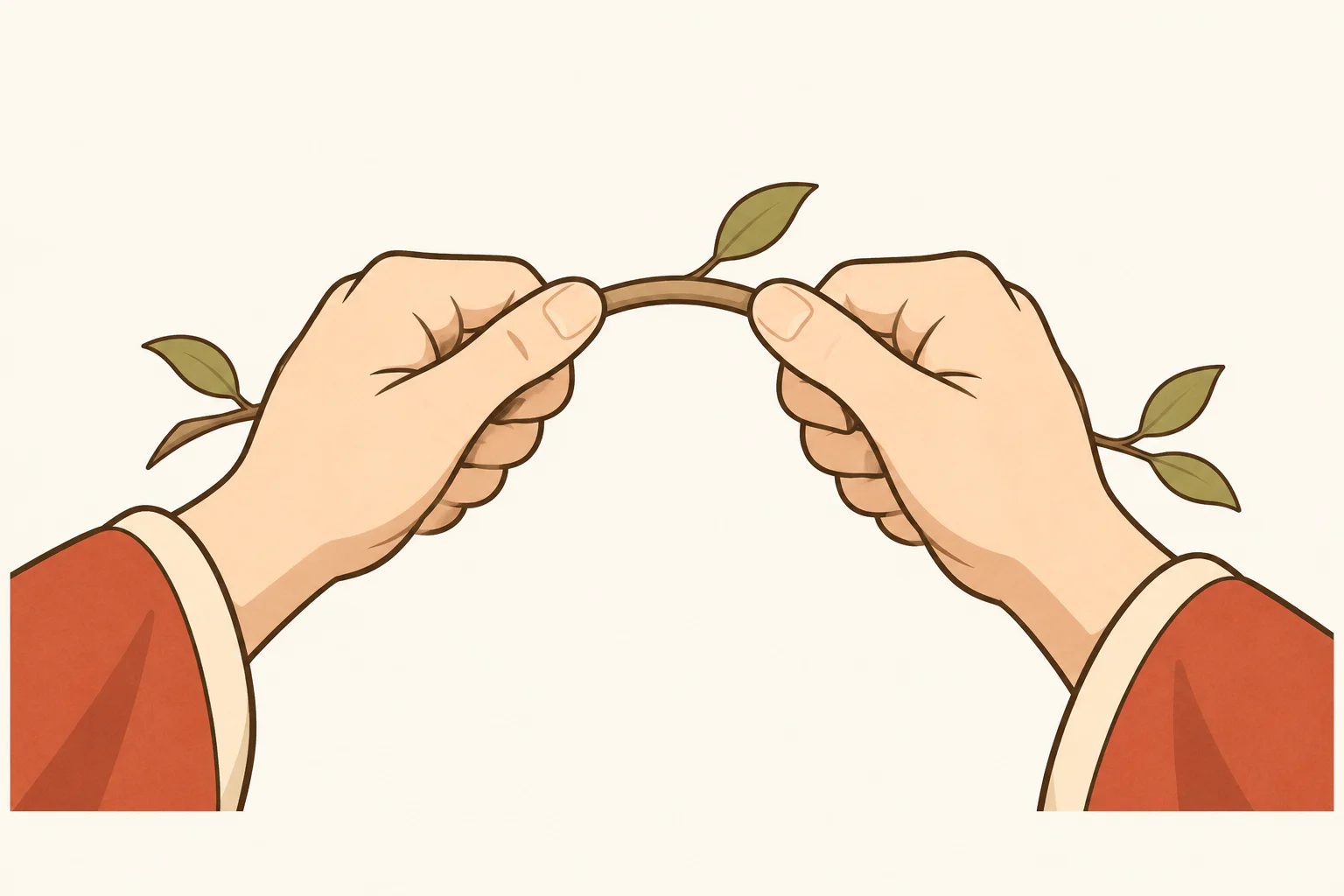
Tameru: a branch that does not curve enough is bent slowly between the hands.
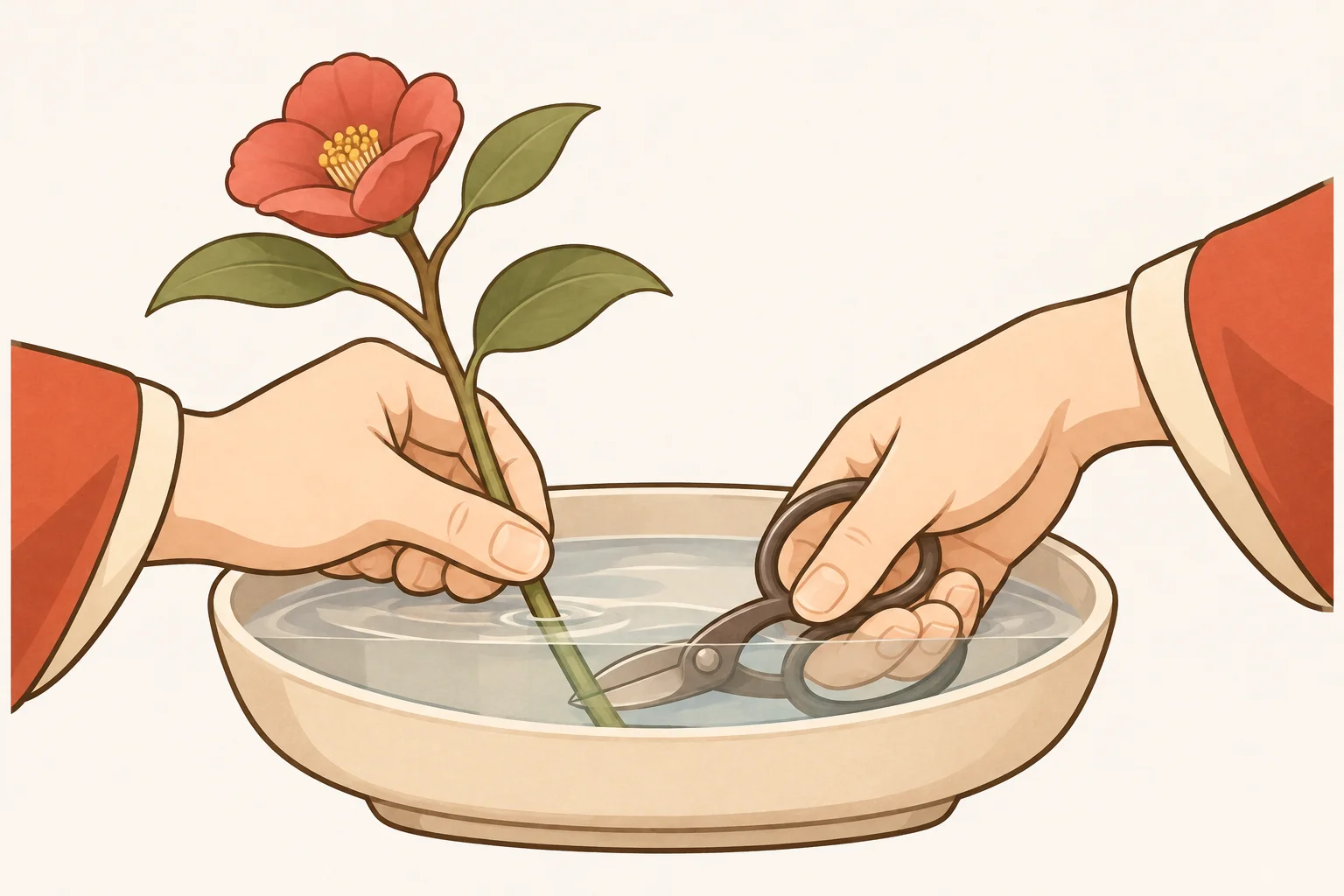
Mizukiri: stems are cut under water to help the flowers last.
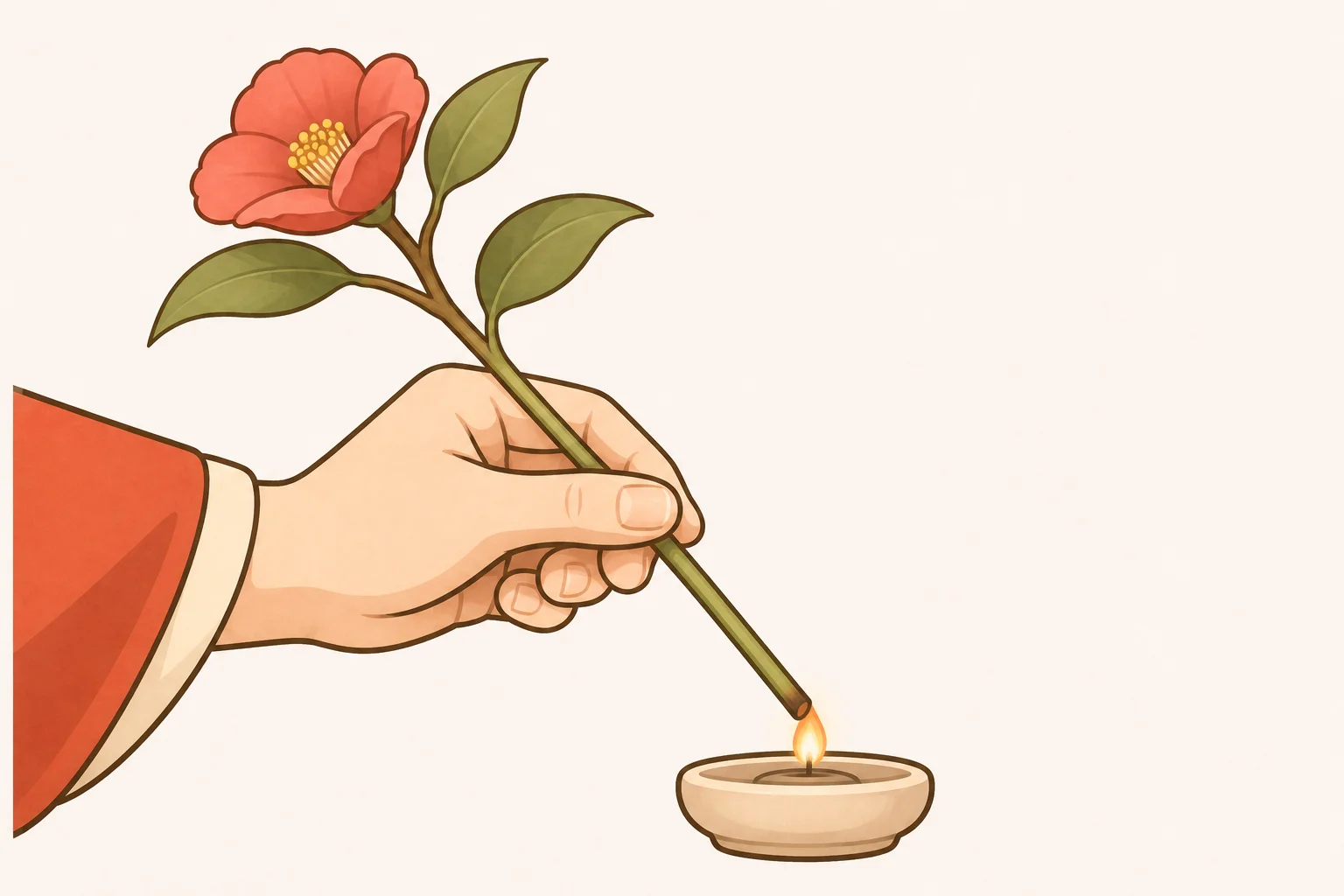
Difficult plants may have their cut ends singed over a flame.
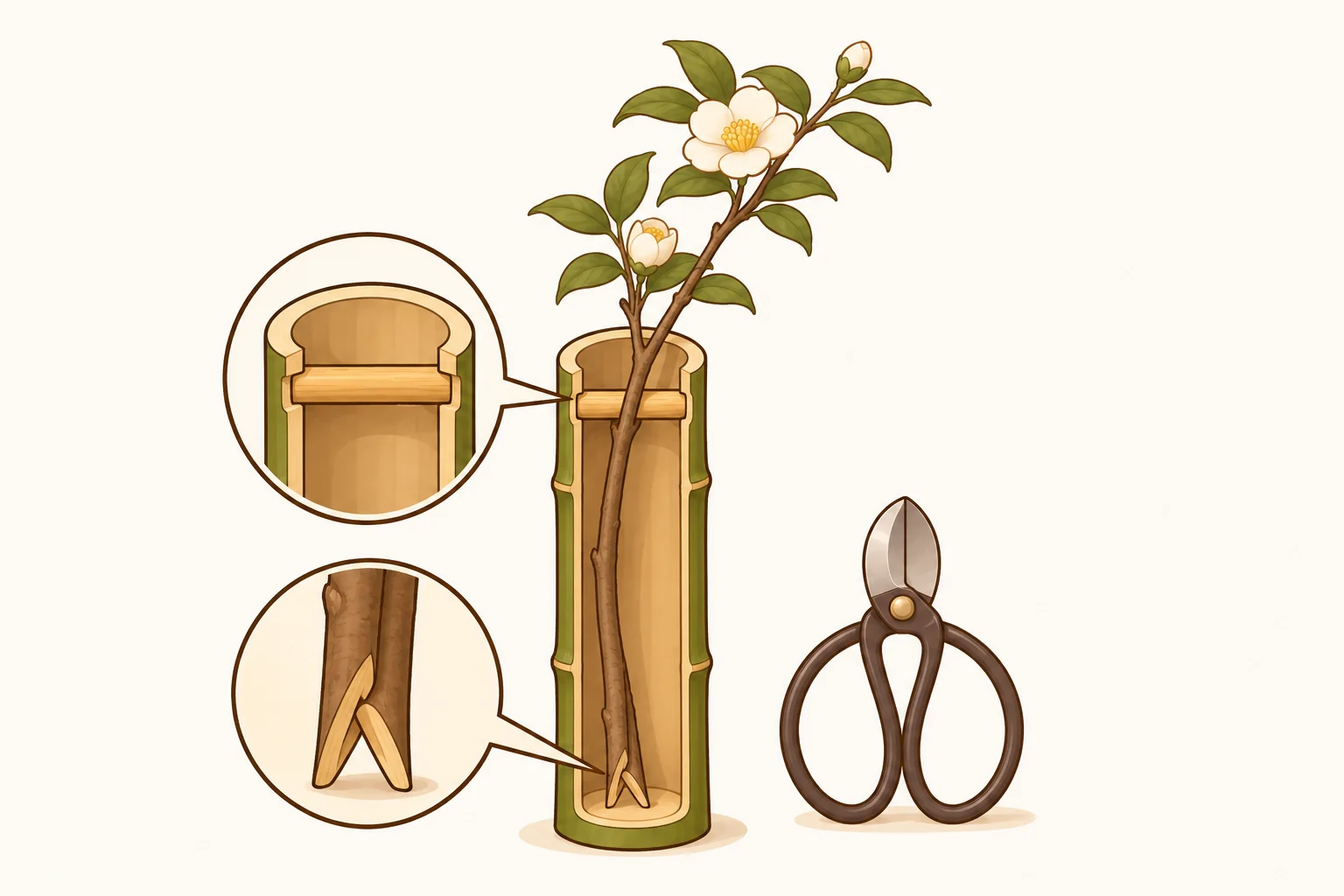
A kubari, a small wooden crosspiece wedged in a bamboo tube, holds the branch in place; beside it, flower shears.
06Sōgetsu and the Avant-Garde
In 1927 Teshigahara Sōfū founded the Sōgetsu school in Tokyo. The son of an ikebana teacher, he had grown frustrated with the fixed forms of the classical schools and argued that flower arrangement should be personal creative expression, using any material, in any setting. Sōgetsu’s motto is that ikebana can be done by anyone, anytime, anywhere. In Sōgetsu work, driftwood, wire, stone, plastic and metal are all legitimate materials, and a piece can be large enough to fill a hall.
In the early 1930s (often dated to 1933, though 1930 and 1931 are also given) a group of arrangers and critics, with the garden designer Shigemori Mirei among the leading figures, issued a manifesto calling for a "new ikebana" freed from the feudal school system and recognized as modern art. After the war the movement grew. Teshigahara Sōfū, Ohara Hōun, third head of the Ohara school, and the independent arranger Nakagawa Yukio are often named together as leaders of postwar avant-garde ikebana; some accounts instead pair Sōfū and Hōun with Nakayama Bunpo of the Mishō school as the "three great masters" of postwar ikebana. Sōfū also made sculpture and calligraphy, and his work was exhibited in Europe and America, where some critics discussed it alongside modern sculpture. His son, Teshigahara Hiroshi, was the film director of Woman in the Dunes and in 1980 became the school’s third head.
The postwar decades also carried ikebana abroad. During the Occupation and after, many foreigners living in Japan, notably the wives of American officers, took lessons. In 1956 an American woman, Ellen Gordon Allen, founded Ikebana International in Tokyo to connect practitioners around the world. As of 2026 it has well over a hundred chapters in more than forty countries and areas, and "ikebana" has become an everyday word in English.
07Schools, Lessons and Ikebana Today
There are hundreds of ikebana schools in Japan today. The three most often mentioned are Ikenobō, Ohara and Sōgetsu. Ikenobō, the oldest, is still headquartered beside Rokkakudō in Kyoto and teaches rikka and shōka alongside a modern freestyle form called jiyūka. As of 2026 its head, Ikenobō Sen’ei, is the forty-fifth in the line, and his designated successor, Ikenobō Senkō, is the first woman designated to lead the school. In October 2026 the Council for Cultural Affairs recommended that Sen’ei be recognized as a holder of rikka as an Important Intangible Cultural Property. Ohara is known for moribana and for its feeling for landscape and season. Sōgetsu, with its freedom of material and form, is probably the best known overseas.
Lessons usually take place in a teacher’s home or at a community culture center, once a week or every other week. The teacher prepares the day’s plant material, demonstrates or points to the textbook form, and the students make their arrangements. The teacher then goes around and adjusts each one, shortening a branch here, removing a leaf that blocks the line there. Students take the flowers home and arrange them again. At each stage a student can apply to the school for a license, which comes with a fee. The system is sometimes criticized as costly and bureaucratic, but it is also what keeps the schools financially alive.
Like many traditional arts, ikebana has lost students over the past few decades. Young women no longer treat it as an essential accomplishment, and fewer homes have an alcove. Yet ikebana has not vanished from Japanese life. Department stores host exhibitions by the various schools every year, hotel lobbies display huge arrangements, and at New Year many households still put pine and red-berried senryō by the door and in the living room. Plenty of people take it up in middle age or after retirement, as a quiet hobby with a long horizon.
Ikebana sits among a cluster of related Japanese arts. It shares the alcove and the sense of season with the tea ceremony, the concern for a plant’s natural form with bonsai, and the concentration of a single uncorrectable stroke with calligraphy. The ideas of wabi-sabi and mono no aware, the beauty of the imperfect and the poignancy of things passing, are easy to find in a flower on the point of falling. See also: The Way of Tea (Chanoyu): Hospitality Distilled into a Single Bowl; Bonsai: An Old Tree in a Shallow Pot; Shodō: The Japanese Art of Calligraphy, Where Every Stroke Is Final; Wabi-Sabi, Mono no Aware and Mujō: How Japan Learned to Love Things That Fade.
08Seeing and Trying Ikebana in Japan
If you visit only one place, make it Rokkakudō in Kyoto. It stands near the corner of Karasuma and Rokkaku streets, a few minutes’ walk from Karasuma Oike subway station, a small temple squeezed between office buildings. Ikenobō arrangements are often placed before the hexagonal main hall, and the school’s headquarters building stands next door, with a gallery on ikebana’s history. Visitors report that from the upper floors of the Ikenobō building you can look down on the temple’s hexagonal roof. The grounds hold a stone said to mark the navel, the exact center, of old Kyoto, and a willow that is supposed to help those who pray to it find a good match.
In Tokyo, the Sōgetsu Kaikan in Akasaka was designed by the architect Tange Kenzō. Its ground-floor lobby holds a stone garden by the sculptor Isamu Noguchi called Heaven, a terraced landscape of granite and running water, often shown together with large Sōgetsu installations. Both Sōgetsu and Ohara offer trial lessons in English for visitors; Ohara’s headquarters is in Aoyama, near Omotesandō. Many culture centers and some temples run one-off classes, typically lasting about an hour and a half. You can photograph your arrangement afterward, but you will usually need to leave the flowers behind at your hotel, since cut plants are subject to quarantine rules in most home countries.
For larger exhibitions, watch for department store shows. Takashimaya in Nihonbashi and other stores often host the schools’ ikebana exhibitions in spring and autumn, usually running only a few days and changing the works partway through. The schools also mount exhibitions in their own buildings and in museums, especially during the cherry blossom and autumn foliage seasons.
When you look at an arrangement, start by standing in front of it, since that is the view it was made for. Look at how the three main lines divide the space. Look at the point where the stems leave the vessel; arrangers call it the mizugiwa, the water’s edge, and a clean, unified emergence there is a sign of skill. Then look at the vessel: bamboo, ceramic, bronze, basketry, each with its own seasonal associations, baskets and glass in summer, heavy stoneware in winter. Finally ask what season the arrangement is trying to make you feel, the chill of early spring or the loneliness of late autumn. In a formal setting, such as a tea room or the alcove of a private home, people bow slightly before and after looking, as a courtesy to the arranger. Do not touch an arrangement or move its vessel for a photograph.
If you try it yourself, you will probably find that the hard part is not putting flowers in but deciding what to take out. The teacher may ask you to cut a lovely branch in half, or to strip away perfectly good leaves. It feels wasteful. Then you step back, and the line of the branch suddenly reads clearly, a space opens above the vessel, and the whole arrangement goes still. That is usually the moment people understand what separates ikebana from putting flowers in a vase.