
At a glance
The folding fan as a Japanese invention, from Heian court fans and Kyoto’s many-handed craft to the closed fan of tea, Noh and rakugo, plus the everyday summer uchiwa.
- The folding fan is generally credited to Heian-period Japan; its earliest form, the hiōgi, was made of strung cypress slats.
- A hiōgi found inside the Thousand-Armed Kannon at Tō-ji bears an ink date of 877 and is counted among the oldest surviving examples.
- In Kyoto it is said that one kyō-sensu passes through about 87 steps, nearly each done by a different specialist.
- A rakugo storyteller works with only a fan and a hand towel; the closed fan becomes chopsticks, a pipe, a brush or a sake flask.
- The 'three great uchiwa' are Marugame (Kagawa), Kyoto and Bōshū (Chiba); Marugame is said to make about 90 percent of Japan’s domestic round fans.
Spend a summer in Japan and you will see fans everywhere. A salaryman on a crowded train flicks open a paper folding fan with one snap of the wrist; a woman in a cotton yukata at a fireworks show pulls a flat round fan from the back of her sash. Japan has two fan traditions, and they could hardly be more different. The folding fan, sensu or ōgi, is generally credited as a Japanese invention, one that traveled to China as a luxury export a thousand years ago and later reached Europe. The rigid round fan, uchiwa, came the other way, from China, and became the most ordinary object of the Japanese summer. This is a guide to both: where they came from, how they are made, why a closed fan carries so much meaning in Japanese ceremony and theater, and how to choose one for yourself.
01A Japanese Invention
Fans are ancient in China. Feather fans and round silk fans appear in Chinese art and literature long before Japan had a written history. What China did not have, as far as anyone can tell, was a fan that folded. The usual account places its invention in Heian-period Japan (794–1185).
The earliest form was the hiōgi, a fan of thin slats of hinoki cypress, pinned together at the base and threaded together with silk cord near the top. It looks strikingly like a bundle of mokkan, the wooden strips that officials of the period used for writing notes and records, and most historians believe that is exactly how it began: someone strung a set of writing slips together and discovered they could be fanned open. One of the oldest surviving examples was found inside one of the arms of a statue of the Thousand-Armed Kannon at Tō-ji in Kyoto, with an ink inscription dated to 877.
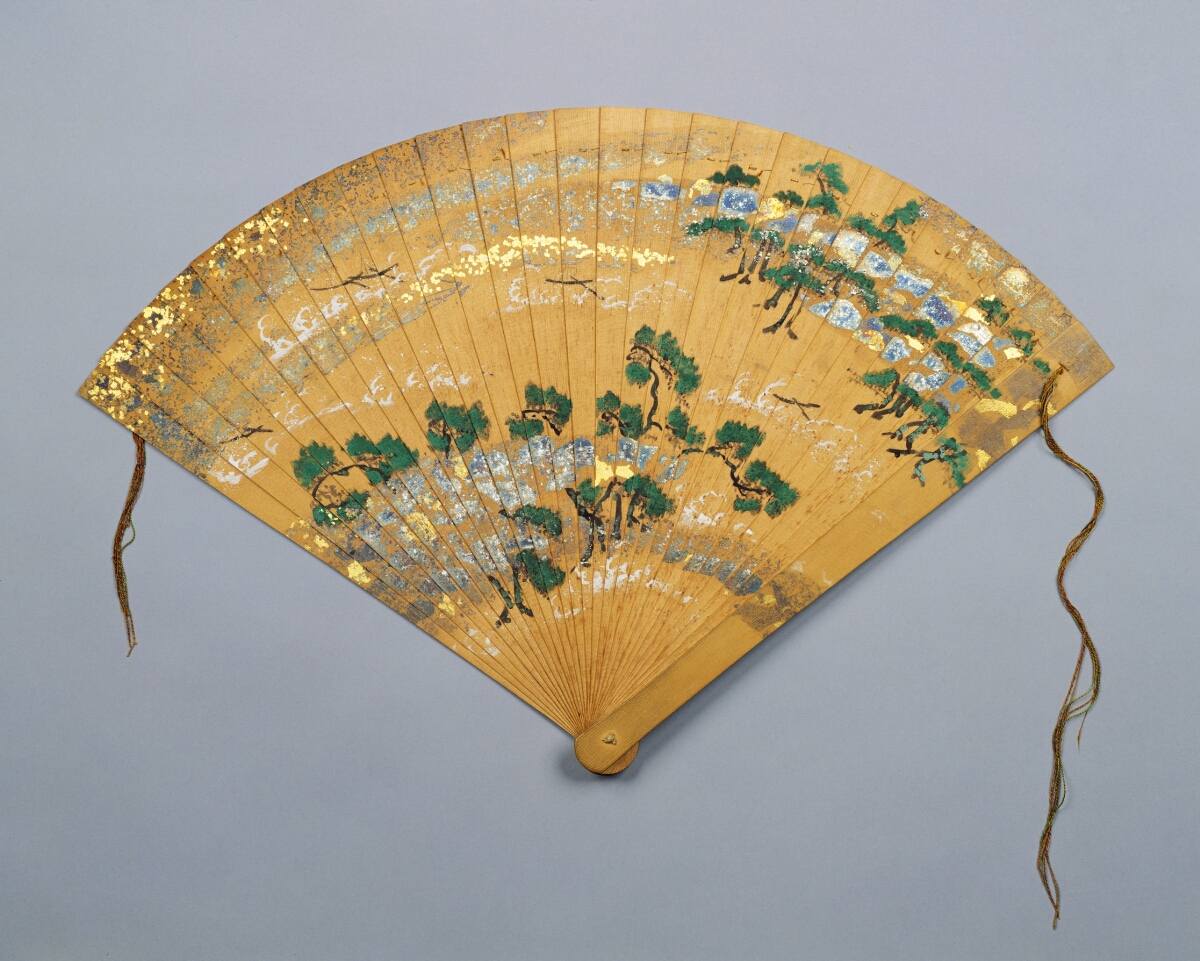
A painted hiōgi of the Muromachi period: thin cypress slats pinned at the base, strung with thread at the top, with cords hanging from both endsKyoto National Museum, painted hiōgi (Muromachi period), Asuka Shrine treasures
At court the hiōgi quickly became part of formal dress. Noblewomen carried painted cypress fans with long tassels of colored cord hanging from both ends. Aristocratic women of the Heian court were not supposed to show their faces to men outside the family, and an open fan was a screen they could carry anywhere. A fan could also carry a poem. In The Tale of Genji, Genji’s affair with the young woman known as Yūgao begins when she sends out a white fan with a verse written on it.
A lighter type followed, the kawahori-ōgi or "bat fan," made with bamboo ribs and paper pasted on one side, so called because it spread like a bat’s wing. This is the direct ancestor of the paper fans sold today. By the late tenth century Japanese fans were prized abroad: the official History of Song records that in 988 a disciple of the Japanese monk Chōnen brought a gift to the Song court that included both cypress fans and bat fans. Through the Song, Yuan and Ming dynasties, Japanese folding fans were a recognized luxury in China, and large numbers were shipped there in the Ming tribute trade. Chinese workshops took up the form and made it their own, and from East Asia, Portuguese and other European traders carried folding fans to Europe, where they became a fashion accessory for centuries.
Fans belonged to warriors too. The most famous fan in Japanese literature appears in The Tale of the Heike, at the Battle of Yashima in 1185. The Taira, retreating by sea, set up an all-crimson fan bearing a golden sun disc on the prow of a small boat and dared the Minamoto to hit it. A young archer named Nasu no Yoichi rode into the surf, drew his bow and struck the fan just above its pivot. The fan spun into the evening sky and fluttered down onto the waves, and both armies cheered, the Taira banging on their boats’ gunwales. Painters returned to the scene again and again on screens and woodblock prints, and Japanese schoolchildren still learn it.
02How a Kyoto Fan Is Made
The best-known folding fans in Japan today are Kyō-sensu, Kyoto fans. People in the trade like to say that a single fan passes through around 87 steps, and that most of those steps belong to separate specialist craftsmen: one workshop for the ribs, another for the paper, another for the decoration, another for the final assembly.
A paper fan has three essential parts. The first is the frame of bamboo ribs. The two thick outer guards are called oya-bone, "parent ribs," and the thin inner ribs are naka-bone. The bamboo is split, shaved thin, dried and polished until every rib matches. Much of the bamboo work for Kyoto fans is in fact done outside Kyoto, in the city of Takashima on the western shore of Lake Biwa in Shiga Prefecture, where the Adogawa River area has made fan ribs since the late seventeenth century and supplies the great majority of Japan’s domestically made bamboo ribs.
The second part is the leaf, the folded paper. A traditional Kyoto fan leaf is made of three sheets pasted together, the middle one a core sheet. While the paper is still damp, a craftsman pleats it into alternating mountain and valley folds, then works a thin bamboo probe along each fold to split the layers open so that the inner ribs can be slid inside. This is what lets the fan open flat and close tightly. The design on the leaf is a separate job: it may be hand-painted, printed from woodblocks, or laid with gold and silver leaf.
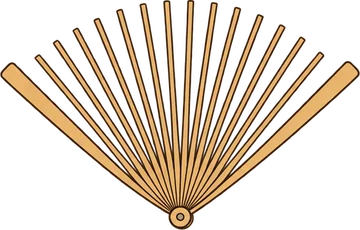
Bamboo ribs: the two thicker outer ribs (oya-bone), the thin inner ribs (naka-bone), all joined at the base by the pivot (kaname)
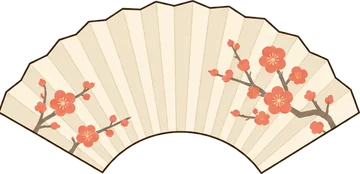
The leaf folded into mountain and valley pleats; the inner ribs slide into its middle layer
The third part is tiny but decisive: the kaname, the rivet that holds all the ribs together at the base. Whether a fan opens smoothly and stays tight after years of use depends on it. In everyday Japanese, kaname also means "the key point" or "linchpin"; to call someone the kaname of a team is to say everything turns on them.
- 1Paste three sheetsthe middle one a core sheet
- 2Pleat while dampalternating mountain and valley folds
- 3Split the layers opena thin bamboo probe along each fold
- 4Slide in the inner ribsnaka-bone, the thin inner ribs
Splitting the layers so the inner ribs can slide inside is what lets the fan open flat and close tightly.
Besides paper fans there are silk-leaf fans, more often carried by women, whose ribs by one account pass directly through the cloth rather than slotting between layers of paper, and fans made of thin slats of sandalwood that give off a faint scent as you wave them. Prices range widely. As of 2026, a printed fan at a tourist stall may cost a few hundred yen. A handmade paper fan from an old Kyoto shop typically runs from about 3,000 yen to somewhat over 10,000 yen, and one with ribs of susudake, bamboo darkened by decades of hearth smoke in old farmhouse roofs, or with a hand-painted leaf, can cost tens of thousands.
03The Closed Fan: Ceremony, Stage and Storytelling
Much of the time a Japanese fan is not opened at all. It is held closed, tucked into a sash, or set down in front of the body, and in that state it means more than it ever does as a cooling device.
An open folding fan is called suehiro, literally "widening toward the end," because it spreads from a narrow pivot to a broad arc. The shape is read as a promise of a future that keeps growing, and fans are a standard auspicious gift at weddings, coming-of-age celebrations and the New Year. In a traditional Shinto wedding, the bride in white shiromuku carries a small fan in her sash and the groom in crested formal kimono holds a white fan. These are ceremonial fans, part of the outfit, and nobody opens them.
The tea ceremony uses a short fan of its own. A guest entering the tea room lays the closed fan horizontally on the mat in front of their knees before bowing. The fan marks a line between the guest and the host or the object being viewed, a small physical gesture of humility. It is never opened during the gathering; its whole job is to be placed.
In Noh theater and classical Japanese dance, the fan is the most important prop on stage. A Noh actor’s fan, the chūkei, is made so that its top edge flares slightly even when closed. With it the actor can pour sake, gaze at the moon, draw a sword or point out a distant mountain, and the audience reads the gesture with the help of the chanted text. Dancers in nihon buyō use a mai-ōgi, a dance fan that is larger and heavier than an ordinary one, often weighted with lead in the guards so it can be spun and tossed and caught.
The use that surprises visitors most is in rakugo, the solo comic storytelling art. A rakugo performer kneels alone on a cushion and plays every character in the story with only two props: a folding fan and a tenugui, a thin cotton hand towel. The closed fan becomes chopsticks as the performer slurps imaginary soba noodles; held upright it is a tobacco pipe, a writing brush or a fishing rod; half-open it is a sake flask or an abacus. In rakugo slang the fan is called kaze, "wind," and the towel mandara. Between them they are almost the entire set.
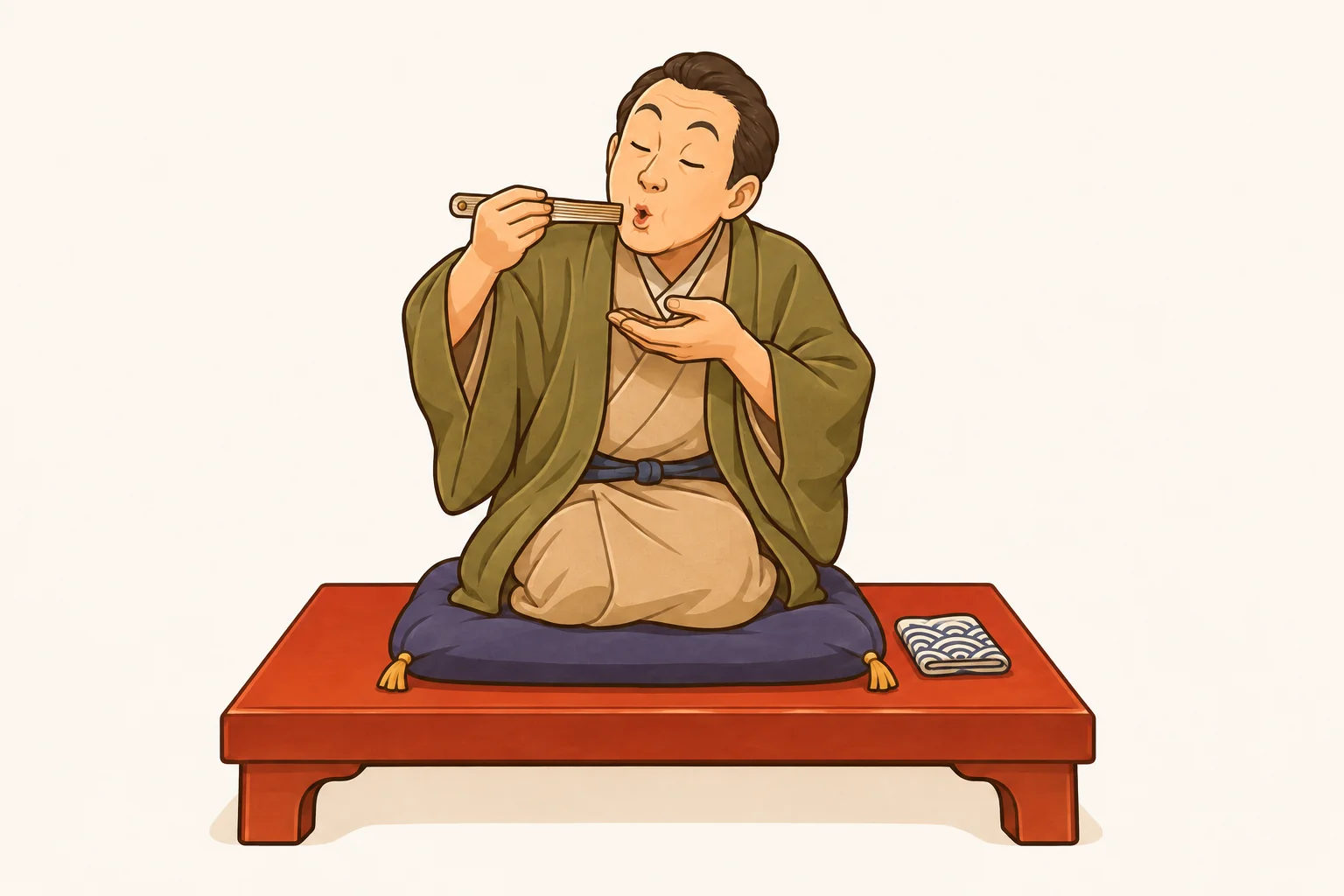
A rakugo performer kneeling on a cushion uses a closed fan as chopsticks to slurp imaginary soba.
04Uchiwa: The Round Fan of Everyday Life
The uchiwa is the flat, non-folding round fan, much older in Japan than the folding fan; the type arrived from China before the Nara period. Early uchiwa were ceremonial objects carried in processions of the elite. It was in the Edo period (1603–1868) that cheap uchiwa of split bamboo and paper were made in large numbers and became something every household owned.
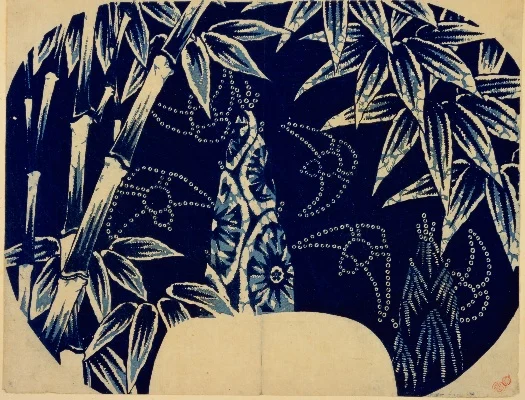
An uchiwa-e print of a bamboo grove, not yet cut and mounted on ribsNational Diet Library, uchiwa-e print
Edo printers soon saw that a fan face was a ready-made canvas. Uchiwa-e, prints made to be pasted onto fans, showed kabuki actors, beautiful women and famous views, and they became a significant branch of ukiyo-e; Utagawa Kuniyoshi and Utagawa Hiroshige both designed many. Shops also gave away fans printed with their names, a custom that never stopped. On a summer evening in Tokyo you can still be handed a free plastic uchiwa advertising a mobile phone plan or a new beer outside a station.
Japanese crafts writers often name three great uchiwa traditions, and each one is built differently.
| Uchiwa | From | How it is built | Notes |
|---|---|---|---|
| Marugame | Kagawa | Handle and ribs from a single piece of bamboo | By far the most made; said to be about 90% of Japan’s uchiwa |
| Kyō-uchiwa | Kyoto | Face and handle made separately; handle inserted (sashi-e) | Delicate faces, often for display |
| Bōshū | Chiba | Round medake bamboo; handle kept round | Small semicircular lattice “window” |
The three differ in how ribs and handle meet: one piece of bamboo, a handle inserted afterwards, or a round bamboo handle.
Marugame uchiwa, from Marugame in Kagawa Prefecture on Shikoku, are made in by far the largest numbers; the city is said to produce around 90 percent of Japan’s domestic uchiwa. The industry is said to have grown out of souvenirs sold to Edo-period pilgrims visiting the shrine of Konpira-san (Kotohiragū) nearby. In a Marugame fan the handle and ribs come from a single piece of bamboo: the top of the stem is split into dozens of fine ribs, which are spread into a fan and covered with paper.
Kyō-uchiwa, from Kyoto, work the opposite way. The face and the handle are made separately, with many fine ribs laid out across the face, and the handle is inserted afterwards, a method called sashi-e. Freed from the constraints of a single piece of bamboo, Kyoto makers can give the face very delicate shapes and decoration, and many Kyō-uchiwa are made to be displayed as much as used.
Bōshū uchiwa, from the southern Bōsō Peninsula in Chiba Prefecture, use slender, round medake bamboo and keep the handle in its natural round shape. Just above the handle, threads are woven into a small semicircular lattice called the "window," which gives these fans their neat, graceful look.
The uchiwa’s real home is daily life. In an eel restaurant or a yakitori shop, the cook still fans the charcoal with a battered uchiwa blackened by years of smoke. Old kitchens kept a shibu-uchiwa, coated with fermented persimmon tannin to make it stiff and water-resistant, specifically for coaxing a fire to life. The gunbai held by the gyōji, the referee in sumo, descends from the war fans of samurai commanders, themselves a type of uchiwa. In Gifu, makers produce mizu-uchiwa, "water fans," whose leaves are of extremely thin gampi paper varnished until they are almost transparent, so that the fan looks cool before it moves any air.
Modern Japan has found new jobs for the uchiwa. At pop and idol concerts, fans in the audience hold up oversized homemade uchiwa decorated with their favorite member’s name or messages like "Look at me" or "Wave to me," and these "cheering fans" are now part of what a Japanese concert crowd looks like. And on a summer night at a fireworks festival, an uchiwa slipped diagonally into the back of a yukata sash is about as classic a look as Japan has.
05Buying and Using a Fan in Japan
Kyoto is the best place to buy a good folding fan. Around Shijō and Sanjō in the city center there are several long-established shops, among them Miyawaki Baisen-an and Hakuchikudō, both dating back to the Edo period. Their shelves run from everyday paper fans at a few thousand yen to hand-painted pieces costing far more, and you can see dance fans and tea fans side by side with summer fans. In Tokyo, Ibasen in Nihonbashi, founded in 1590 as a dealer in paper and bamboo and later a publisher of ukiyo-e fan prints, still sells Edo-style uchiwa printed with ukiyo-e designs along with folding fans. In Marugame, the city’s uchiwa museum has craftspeople working on site, and visitors can try making one.
When choosing a folding fan, open and close it several times in your hand. A well-made fan spreads its ribs evenly, closes without gaps, and turns at the kaname neither loose nor stiff. A man’s fan is traditionally about 7.5 sun, roughly 23 centimeters, and a woman’s somewhat shorter, about 6.5 sun. For real summer use, a paper fan moves more air than a silk one, and bamboo ribs deepen in color with handling, taking on a soft sheen after a few years.
There is a modest etiquette to fanning. On a train or in a crowd, keep the motion small and the fan close to your chest so the breeze doesn’t hit your neighbor. At temples and formal occasions, simply carry the fan closed. When you’re not using a folding fan, keep it shut and in its sleeve so the paper doesn’t warp in the humidity. The uchiwa asks for none of this care. You can stick it in your sash, leave it on the tatami, or wave it as hard as you like; it has always been the least formal thing in a Japanese summer.