
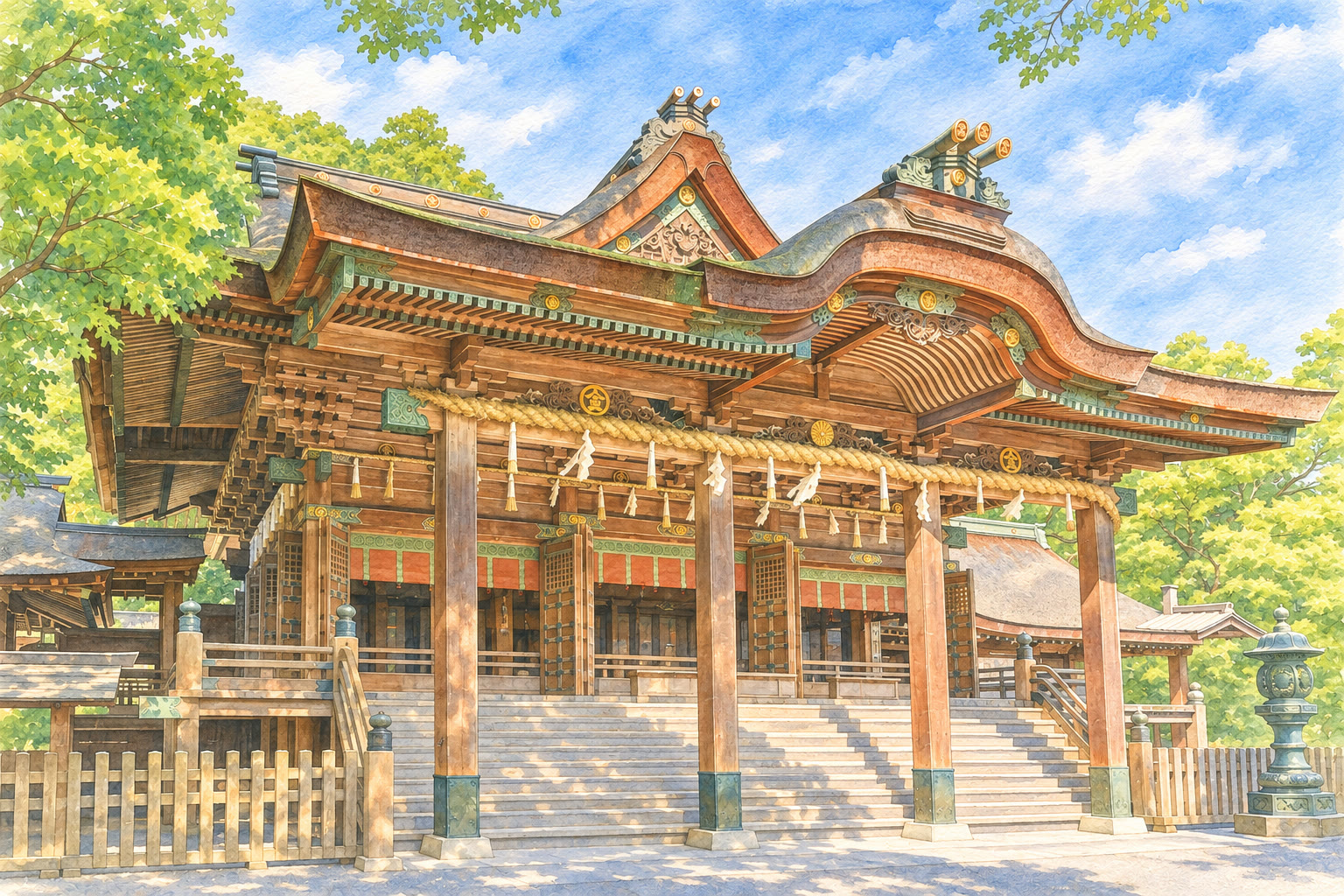
Kotohiragū stands on the slopes of Mount Zōzu in the town of Kotohira, Nakatado District, Kagawa Prefecture. Known affectionately as Konpira-san, it is the head shrine of the many Kotohira and Konpira shrines across Japan. It has long been worshipped as a guardian of seafarers, and in the Edo period the pilgrimage to Konpira was spoken of in the same breath as the pilgrimage to Ise. The town of Kotohira grew up around the flow of visitors.
01From Konpira Daigongen to Kotohiragū
Mount Zōzu takes its name, "elephant head," from its outline. The shrine’s origins are uncertain, and its documented history goes back roughly to the late medieval period. Before the Meiji era it was a combined Shinto-Buddhist cult of Konpira Daigongen. The name Konpira is generally traced to Kumbhīra, a crocodile deity of the Ganges. The site was run by the Shingon temple Matsuo-ji and its administering sub-temple, Konkō-in, which held lands recognized by the shogunate and enjoyed the patronage of neighboring domains. Sailors, fishermen and merchants were especially devoted, and pilgrimage associations formed all over the country. People who could not make the journey sent proxies, and stories tell of dogs traveling to the shrine with a pouch around the neck explaining their errand. In another custom, casks marked as offerings to Konpira were set adrift at sea; whoever found one carried it to the shrine on the sender’s behalf.
02Separation of Shinto and Buddhism
After the government ordered the separation of Shinto and Buddhism in 1868, Konpira Daigongen was turned into a Shinto shrine and in the seventh month of that year took the name Kotohiragū. Matsuo-ji’s Konkō-in was abolished and its buildings became the shrine office, many Buddhist images and implements were removed or disposed of, and the Konkō-in priests became Shinto priests. From 1871 the name was written for a time as Kotohiragū with different characters, and the present form was restored in 1889. Its main deity is now Ōmononushi, with Emperor Sutoku, who died in exile in Sanuki, enshrined alongside. The former Buddhist main hall, completed in 1845, survives under a new name, the Asahi-sha, and is an Important Cultural Property; as of 2026 it is undergoing a major repair begun in 2024 and planned to last about eighteen years.
03What can be seen today
It is 785 stone steps from the start of the approach to the main shrine, and 1,368 to the inner shrine, Izutama Jinja, higher on the mountain. Along the way, the Omote Shoin, once the reception hall of Konkō-in, has sliding-door and wall paintings by Maruyama Ōkyo, and the Oku Shoin has flower paintings by Itō Jakuchū. Both shoin buildings and Ōkyo’s paintings are Important Cultural Properties, and in 2024 the main shrine’s sanctuary, worship hall and related buildings were also designated. The shrine also keeps model ships and votive plaques dedicated by sailors. In the town below stands the Old Konpira Grand Theater, or Kanamaru-za, built in 1835, the oldest surviving kabuki theater in Japan.