
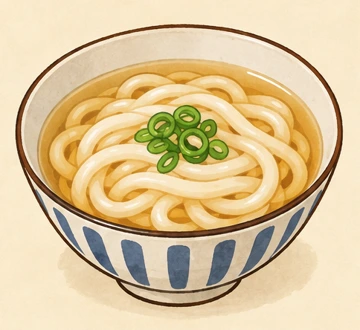
At a glance
What gives udon its chewy bite, why western Japan prefers it to soba, how Kagawa became the 'Udon Prefecture,' and how to order at a self-service shop.
- Udon dough is wheat flour, salt and water, without the alkaline kansui used in ramen, so the noodles are white.
- In the Edo period a split emerged: Edo loved soba, while Ōsaka and Kyoto preferred udon.
- As of the 2021 economic census, Kagawa had about five soba and udon restaurants per 10,000 residents, the highest ratio in Japan.
- Sanuki udon is thick and square-cut, with the strongest koshi of any regional style.
- At a self-service shop you order your noodles and size, take tempura along the counter, and pay at the end.
Udon is the plainest noodle in Japan: wheat flour, salt and water, kneaded into thick white strands and served in broth or with a dipping sauce. It lacks the swagger of ramen and the refined air of soba, yet for many Japanese people it is the taste of home, of school lunches, train-station counters and late-night bowls. This piece explains what makes a good bowl, why udon belongs above all to western Japan, how the small prefecture of Kagawa turned its local noodle into a national obsession, and how to order at a self-service udon shop without hesitation.
01Flour, Salt, Water
Udon dough contains no eggs and none of the alkaline mineral water (kansui) that gives ramen its yellow color and springy bite. What it has instead is salt, which tightens the gluten, and a great deal of kneading and resting. The result is a noodle that is white, slightly sweet with wheat, and, when made well, firm all the way through.
- 1
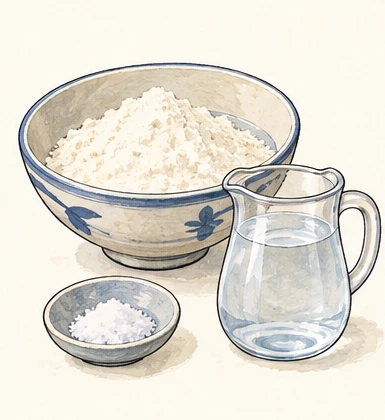 The dough needs only wheat flour, salt and water.
- 2
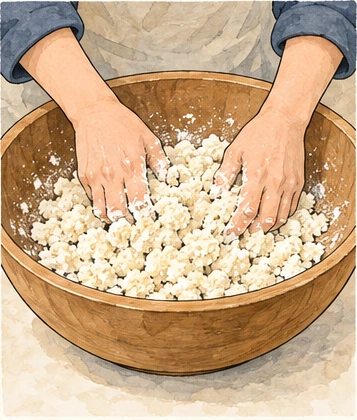 Salted water is worked into the flour until it forms crumbs.
- 3
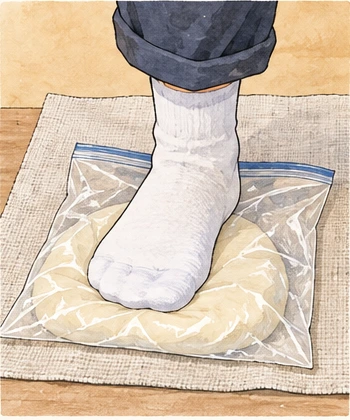 The dough is kneaded hard; in Sanuki it was traditionally sealed in a bag and trodden.
- 4
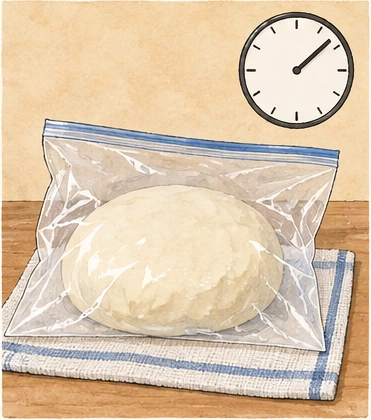 The wrapped dough rests; resting time shapes the texture.
- 5
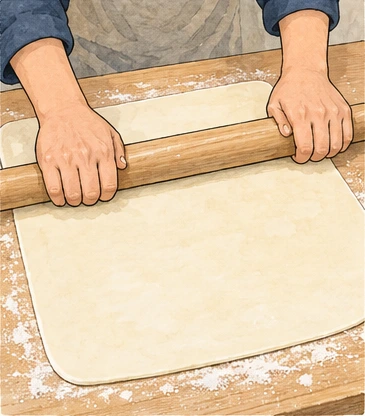 It is rolled into a sheet and then cut into thick noodles.
Japanese diners judge udon on two qualities. The first is koshi, literally "lower back," meaning the noodle’s resilient, chewy strength: a bite should meet resistance and then give. The second is nodogoshi, the smooth feeling of a noodle sliding down the throat. A great udon has both. Soft, swollen noodles that break apart are a failure in most regions, though not in all.
Udon is eaten two broad ways. Hot, it sits in a broth; the simplest version, kake udon, is just noodles, broth and a scatter of sliced scallions. Add a sheet of fried tofu simmered in sweet soy and you have kitsune udon, "fox udon," named for the folk belief that foxes love fried tofu. Add crunchy bits of tempura batter and in Tokyo it becomes tanuki udon. Toppings run on from there: tempura shrimp, a raw egg, wakame seaweed, simmered beef. Cold, the noodles are rinsed in iced water, piled on a bamboo mat and dipped in a concentrated sauce, a dish called zaru udon. Chilling tightens the noodle, so cold udon shows off koshi better than hot.
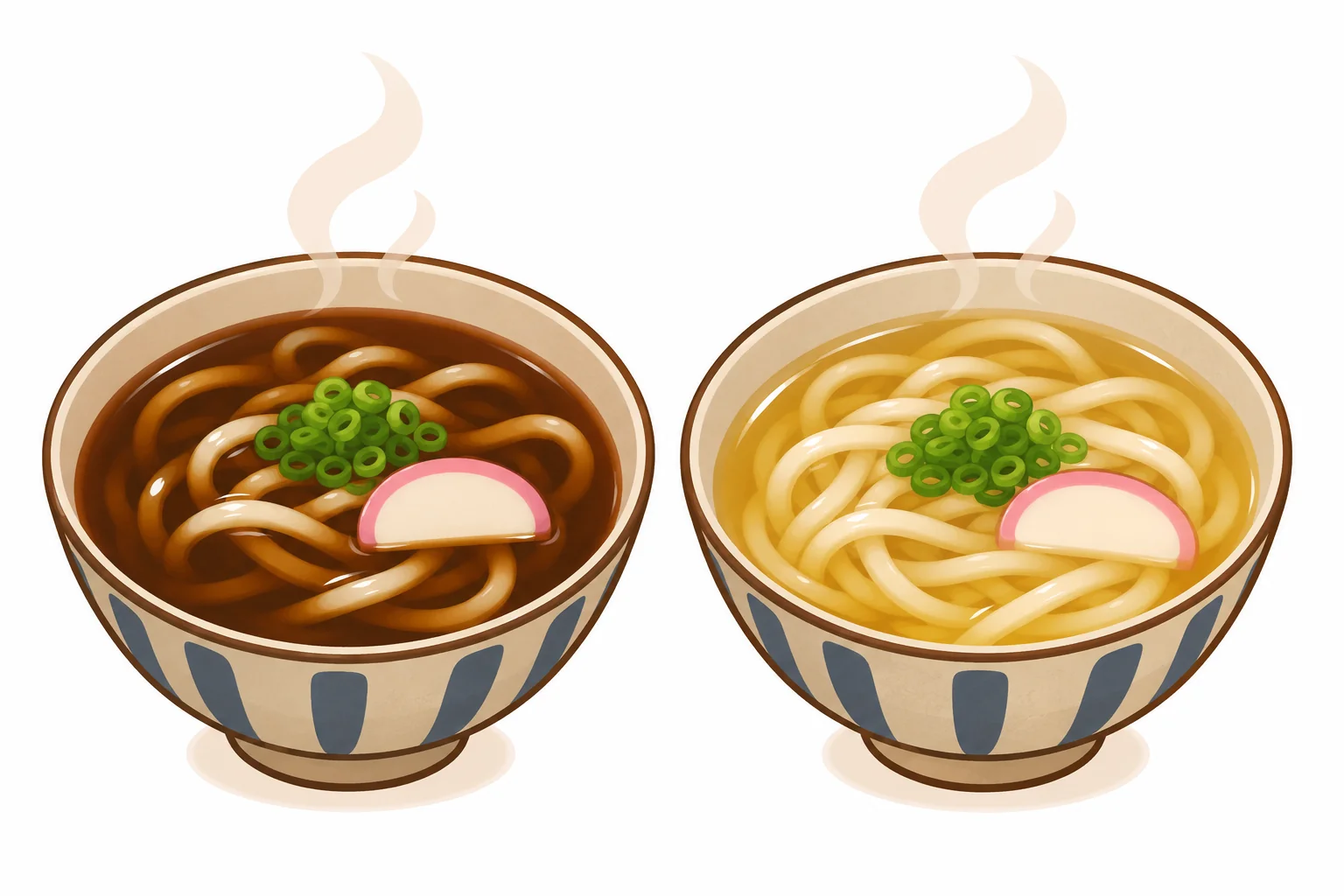
Two bowls of udon with the same toppings: dark Kantō-style broth on the left, clear Kansai-style on the right (illustration).
The broth begins with dashi, a stock made from kelp (kombu), dried bonito flakes or small dried sardines, seasoned with soy sauce and mirin. Here Japan splits in two. In Tokyo and the east, broth is made with dark soy sauce and looks almost black; it tastes salty and robust. In Ōsaka and Kyoto, it is made with light-colored usukuchi soy sauce over a strong kombu base, and it is pale gold, delicate in color but deep in savoriness. Visitors from Ōsaka have long complained about the "black water" served in Tokyo.
02Temple Snack to Western Staple
Nobody knows exactly when udon took its modern form. Wheat noodles came from China in some form, and the usual story credits Buddhist monks who traveled to the continent. In Kagawa a beloved legend says that Kūkai, the great monk of the early ninth century who was born in the province of Sanuki, brought the technique back from Tang China. It is a later tradition with no documentary support. In Fukuoka, the Zen temple Jōten-ji has a stone marker naming it the birthplace of udon and soba, honoring the monk Enni (Shōichi Kokushi), who returned from Song China and founded the temple in the 1240s, and who is said to have brought back the technique of milling flour with a water-driven mill. What these claims share is a real historical pattern: noodles in medieval Japan were associated with temples and served as light meals between main ones.
By the Muromachi period (1336–1573), spellings such as udon and uton appear regularly in temple and court diaries, among them the Onryōken nichiroku kept by monks of Shōkoku-ji in Kyoto; by one account the diary of the shogunate official Ninagawa Chikamoto, the Chikamoto nikki, already lists "udon" as a snack in an entry for 1465. An early Edo cookbook, the Ryōri monogatari (1643), is the first to give a detailed recipe, and in the Edo period (1603–1868) noodles became everyday city food. A division emerged that still holds: Edo, the shogun’s capital, loved soba, while Ōsaka and Kyoto preferred udon. Geography explains much of it. Western Japan grew more wheat, the Inland Sea coast produced salt and dried fish, and kombu from Hokkaidō reached Ōsaka by ship, giving the region exactly the ingredients for a clear, kelp-rich broth.
Ōsaka kept inventing. Kitsune udon is generally traced to Matsubaya, a shop founded in 1893 in the Senba merchant district and now called Usami-tei Matsubaya. It served sweet simmered fried tofu on a side plate; so many customers dropped it into their noodles that the shop began serving it on top. Osakans still order it by a dialect version of the name, ketsune.
03Sanuki: The Udon Prefecture
Ask a Japanese person where the best udon comes from and the answer will almost always be Kagawa, the smallest of Shikoku’s four prefectures and historically the province of Sanuki. According to the 2021 economic census, Kagawa has about five soba and udon restaurants for every 10,000 residents, roughly two and a half times the national average and the highest ratio in Japan, and the national household survey regularly ranks its capital, Takamatsu, first in spending on eating out at soba and udon shops, as it did again in the 2024 survey. Many people eat it for breakfast, and again for lunch. In 2011 the prefectural government leaned all the way in, announcing a mock renaming of Kagawa as "Udon Prefecture" in a video starring the locally born actor Kaname Jun as its "vice-governor." The nickname stuck nationwide.
The land made this possible. The Inland Sea coast has little rain and mild winters, so farmers could grow wheat alongside rice. Salt pans spread along the coast around Sakaide, and around 1955 Kagawa produced about a third of Japan’s salt; Shōdoshima island has brewed soy sauce for centuries; Ibukijima, an island off Kan’onji, supplies the best small dried sardines (iriko) for broth. Every ingredient was local. In the Edo period, pilgrims streamed to the shrine of Kotohiragū, Konpira-san. A festival screen in the shrine’s collection, painted around 1703, shows shops along the approach where workers knead, roll and cut udon dough, one of the earliest pictures of a Sanuki udon shop. Udon was also the food of farm households at harvest time, weddings and funerals, and many families made their own.
Sanuki udon is thick and square-cut, with sharp edges and a glossy surface, and it has the strongest koshi of any regional style. A relatively high salt ratio and long, hard kneading produce it; the dough was traditionally kneaded by foot, usually wrapped in cloth or sealed in a plastic bag. The broth, built on Ibukijima iriko, is clear and lightly fishy. Japan’s fair-competition labeling code for fresh noodles says that Sanuki udon sold with words such as "specialty," "genuine" or "famous local product" must be made in Kagawa, by hand or in the hand-made style, with water at least 40 percent and salt at least 3 percent of the flour by weight, rested for at least two hours, and, if boiled, cooked through in about fifteen minutes. The rule is meant to rein in the many noodles borrowing the name.
Kagawa also has more ways to eat udon than anywhere else, and most of them are designed to put the noodle first. Kamaage noodles are lifted straight from the cooking pot into a bowl of hot water and dipped in sauce. Kamatama tosses freshly boiled noodles with a raw egg and a splash of soy sauce, a dish usually credited to Yamagoe, a famous shop in the town of Ayagawa, where regulars are said to have brought their own eggs before it became a menu item. Shōyu udon is cold or warm noodles with a few drops of soy sauce, grated daikon and a squeeze of citrus. Bukkake pours a small amount of strong broth directly over the noodles.
- 1
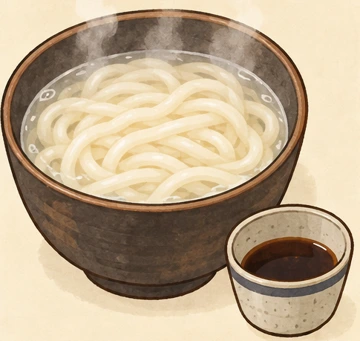 Kamaage: noodles lifted straight from the pot into hot water, dipped in sauce.
- 2
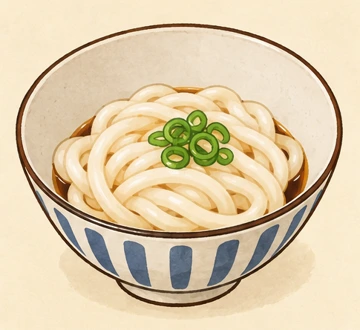 Bukkake: a small amount of strong broth poured directly over the noodles.
- 3
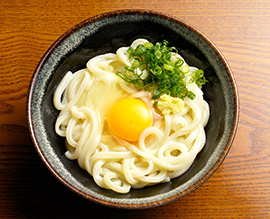 Kamatama: freshly boiled noodles tossed with raw egg and soy sauce
- 4
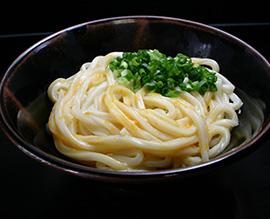 Shōyu udon: noodles with just a few drops of soy sauce
Sanuki udon became a national craze only recently. In 1993 Tao Kazutoshi, editor of a Kagawa town magazine, collected his shop-hunting columns in a book titled Osorubeki Sanuki Udon ("Formidable Sanuki Udon"). It and its sequels mapped the hidden shops behind noodle factories and beside rice paddies, and visitors began driving from one to the next in what became known as the udon pilgrimage. The 2006 film Udon, directed by Motohiro Katsuyuki and loosely based on the boom, added momentum. The nationwide chain Marugame Seimen sells Sanuki-style udon in almost every shopping mall in Japan and in many cities abroad, though its first branch opened in 2000 in Kakogawa, Hyōgo Prefecture; it took its name from the Kagawa city of Marugame.
04Other Regional Styles
Every region has its own udon, and some stand at the opposite extreme from Sanuki. Inaniwa udon from Akita Prefecture, whose method tradition says was established by Satō Kichizaemon of Inaniwa village in 1665, is hand-stretched, thin and flat, then dried; it is silky rather than chewy and is a classic high-end gift. Nagoya’s kishimen is broad and ribbon-flat, typically topped with a drift of bonito flakes. Ise udon from Mie Prefecture is thick and deliberately soft, almost without koshi, served with a dark, sweet tamari-based sauce; locals were eating thick noodles this way before the Edo period, and when pilgrimages to Ise Shrine boomed it spread as a quick bowl to revive tired pilgrims. Hakata udon in Fukuoka is also soft and often comes with a burdock-root tempura.
| Udon | From | Noodles | Served |
|---|---|---|---|
| Inaniwa | Akita | Hand-stretched, thin and flat, dried | A classic high-end gift |
| Kishimen | Nagoya | Broad and ribbon-flat | Topped with bonito flakes |
| Ise udon | Mie | Thick and soft, almost no koshi | Dark, sweet tamari-based sauce |
| Hakata udon | Fukuoka | Soft | With burdock-root tempura |
Beyond Kagawa each region goes its own way: Inaniwa thin and flat, kishimen ribbon-flat, Ise and Hakata soft.
Japanese people like to speak of "the three great udon." Sanuki and Inaniwa are almost always named; the third place is claimed by Mizusawa udon from Gunma, Gotō udon from the Gotō Islands of Nagasaki, Himi udon from Toyama and others, and there is no settled answer. In winter, Nagoya also serves miso nikomi udon, very firm noodles simmered in an earthenware pot of dark soybean-miso broth. Inland from Tokyo, Yoshida udon in Yamanashi is known for being thick, hard and serious work for the jaw.
05At the Counter
The most distinctive way to eat udon is at a Kagawa self-service shop, a format now copied by chains throughout Japan. You pick up a tray and tell the staff what you want and how much. Sizes are usually small, large and extra large; small is one portion of noodles, large is two, and small is enough for most people, especially if you plan to visit several shops in a day. You also say whether you want it hot or cold, in broth or with dipping sauce. In some old-fashioned places the staff hand you a bowl of plain noodles and you warm them yourself in a basket dipped in hot water, then ladle on broth from an urn.
Next you slide along to the tempura counter, where shrimp, fish-cake tubes (chikuwa), soft-boiled eggs and sweet potato sit on racks to be taken with tongs. Scallions, tempura crumbs and grated ginger are usually free. You pay at the end. In a small Kagawa shop, a bowl of kake udon costs a few hundred yen. Small bowls were once reported at two or three hundred, and with two pieces of tempura the total was only five or six hundred and rarely reached a thousand; as of 2026 many shops have raised prices modestly as costs rise, but udon here is still much cheaper than in Tokyo. When you finish, return the tray and bowl to the marked spot.
- 1
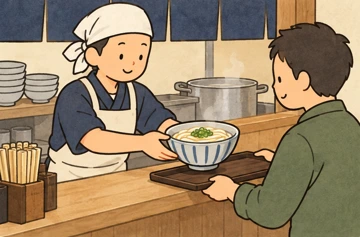 Take a tray, name the dish and size at the counter, and receive your noodles.
- 2
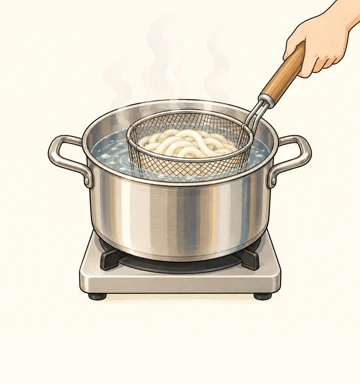 In some old-fashioned shops you warm the noodles yourself in hot water.
- 3
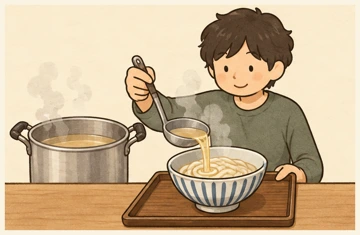 You ladle on the hot broth yourself.
- 4
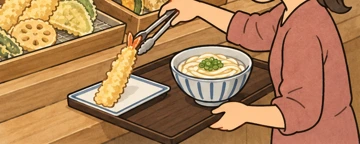 Slide along the counter, take tempura with tongs, and pay at the end.
Slurping is fine; it shows you are enjoying the food and helps cool hot noodles. Eat hot udon promptly, before the noodles soften and lose their bite. Driving, or riding the Kotoden railway, between Takamatsu, Marugame and Kotohira and stopping at three or four shops is the classic way to spend a day.
Outside Kagawa, udon is everywhere: at standing counters in train stations, in department-store restaurants and in the chilled cases of convenience stores. In Ōsaka, order kitsune udon and watch the sweet tofu float on golden broth. It is the clearest single taste of what western Japan means by udon.