
At a glance
How Japanese pickles are made in salt, rice bran and sake lees, why they belong beside rice, and which regional classics to taste and buy.
- Tsukemono is the umbrella term for Japanese pickles, also called kō-no-mono or oshinko: the small dish served with rice in a set meal.
- They are classed by pickling bed: salt, quick pickling, rice bran, miso, sake lees and more, all starting from salt.
- A rice-bran bed must be stirred by hand once a day; well kept, it can last for decades.
- Wooden tablets from the 8th-century Heijō capital already record salted melons and greens.
- Senmaizuke, suguki and shibazuke are known as Kyoto’s three great pickles.
Order a set meal almost anywhere in Japan and the tray arrives with a dish so small you might overlook it: two slices of yellow radish, a few pale cucumber rounds, perhaps a single wrinkled pickled plum. These are tsukemono, literally "soaked things," and they are as fixed a part of a Japanese meal as the bowl of rice they sit next to. Some are made overnight in a plastic bag; others age for years in barrels of sake lees. Every region has its own, and Kyoto has turned them into an art and a souvenir industry. This piece explains what tsukemono are, how they are made, why the Japanese table feels incomplete without them, and how to eat and buy them on a trip.
01Rice, Soup, and Pickles
The traditional Japanese meal is built on a simple formula, ichijū issai: one soup, one side dish, plus rice. Pickles are not counted as the side dish. They are assumed, in the way bread is assumed at a French table. A home breakfast, a ryokan (traditional inn) breakfast, a lunchtime set meal at a diner, a convenience-store bento: nearly all of them include a pinch of pickles somewhere, even if it is only a few shreds of purple shibazuke in a corner.
Pickles do three jobs on the Japanese table. First, they make plain rice go down. White rice is mild, and a salty, sour bite of pickle invites another mouthful. For most of Japanese history, ordinary people ate little meat or fish, and rice with pickles and miso soup was the everyday meal, not a side arrangement. Second, they refresh the palate. After tempura or grilled mackerel, a crisp slice of turnip or cucumber cuts through the oil. The Japanese call this role hashiyasume, "a rest for the chopsticks." Third, they close the meal. At the end of a formal kaiseki dinner, rice, soup and pickles come out together as the final course, and the last mouthful of rice is eaten with the last pickle. In the tea-ceremony meal, pickles arrive with yutō, scorched rice in hot water, and the last slice is used to wipe the bowl clean.
There are several words for pickles, and you will see all of them on menus. Tsukemono is the general term. Kō no mono, "fragrant things," is the older, politer name; one common explanation ties it to the aroma of miso-pickled vegetables. Oshinko, from shinko, "new fragrance," originally meant lightly pickled vegetables and is now the everyday Tokyo word for pickles in general. At a sushi bar, an oshinko maki is a thin roll filled with pickled radish.
02Salt, Bran, and Lees: How Tsukemono Are Made
Every Japanese pickle starts with salt. Salt draws water out of the vegetable, firms up its texture and keeps spoilage bacteria at bay. What happens next depends on the pickling medium, called the toko or "bed," and the Japanese classify their pickles largely by what the vegetables are buried in.
The simplest are salt pickles and asazuke, "shallow pickles." Cucumber, napa cabbage or eggplant is rubbed with salt, weighted down and left for a few hours or overnight. The result is bright, crunchy and only lightly seasoned, closer to a salad than to anything aged. This is what most Japanese households make today, often in a plastic container with a screw-down press, or with a bottle of ready-made asazuke liquid from the supermarket.
- 1
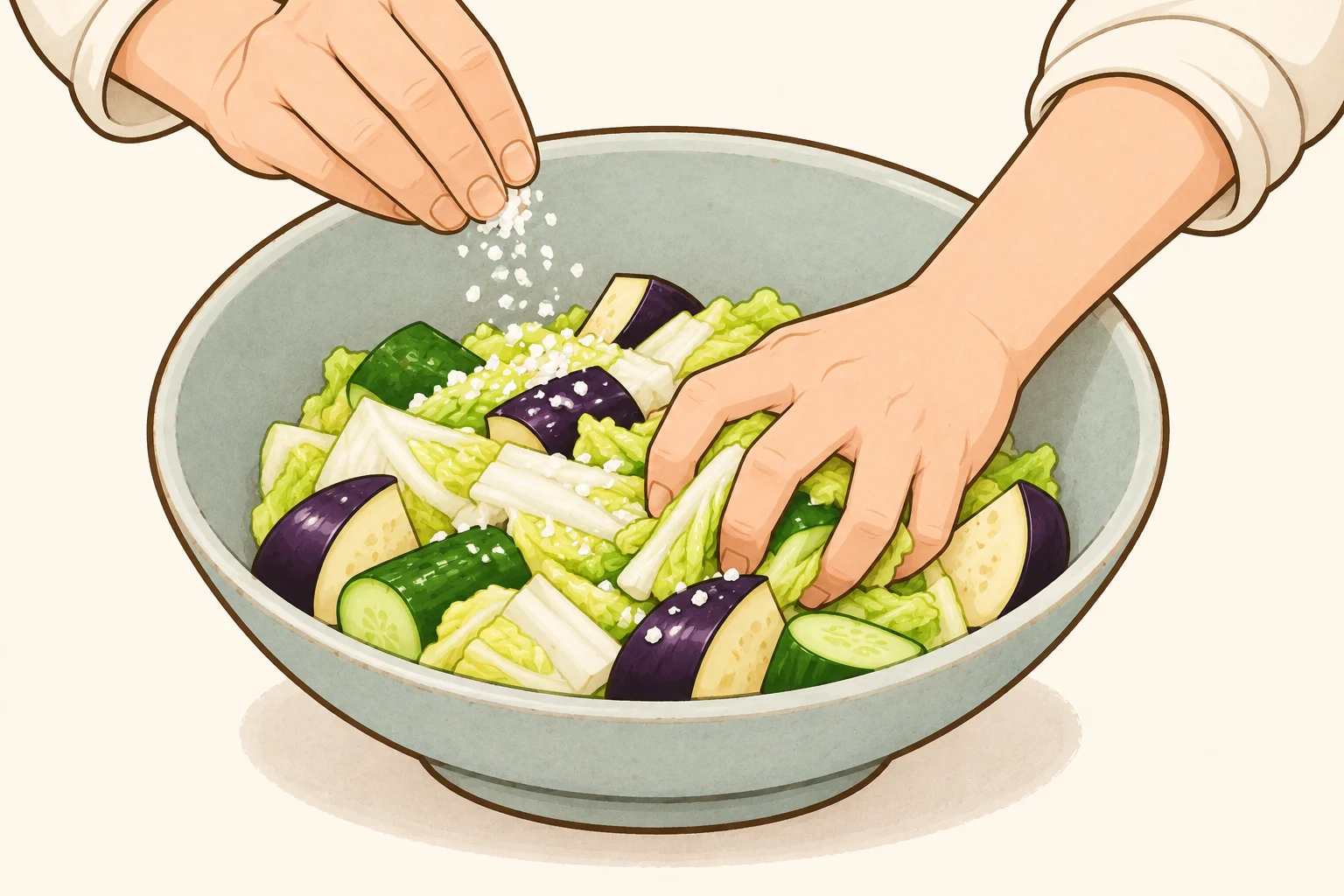 Cucumber, napa cabbage and eggplant are rubbed with salt.
- 2
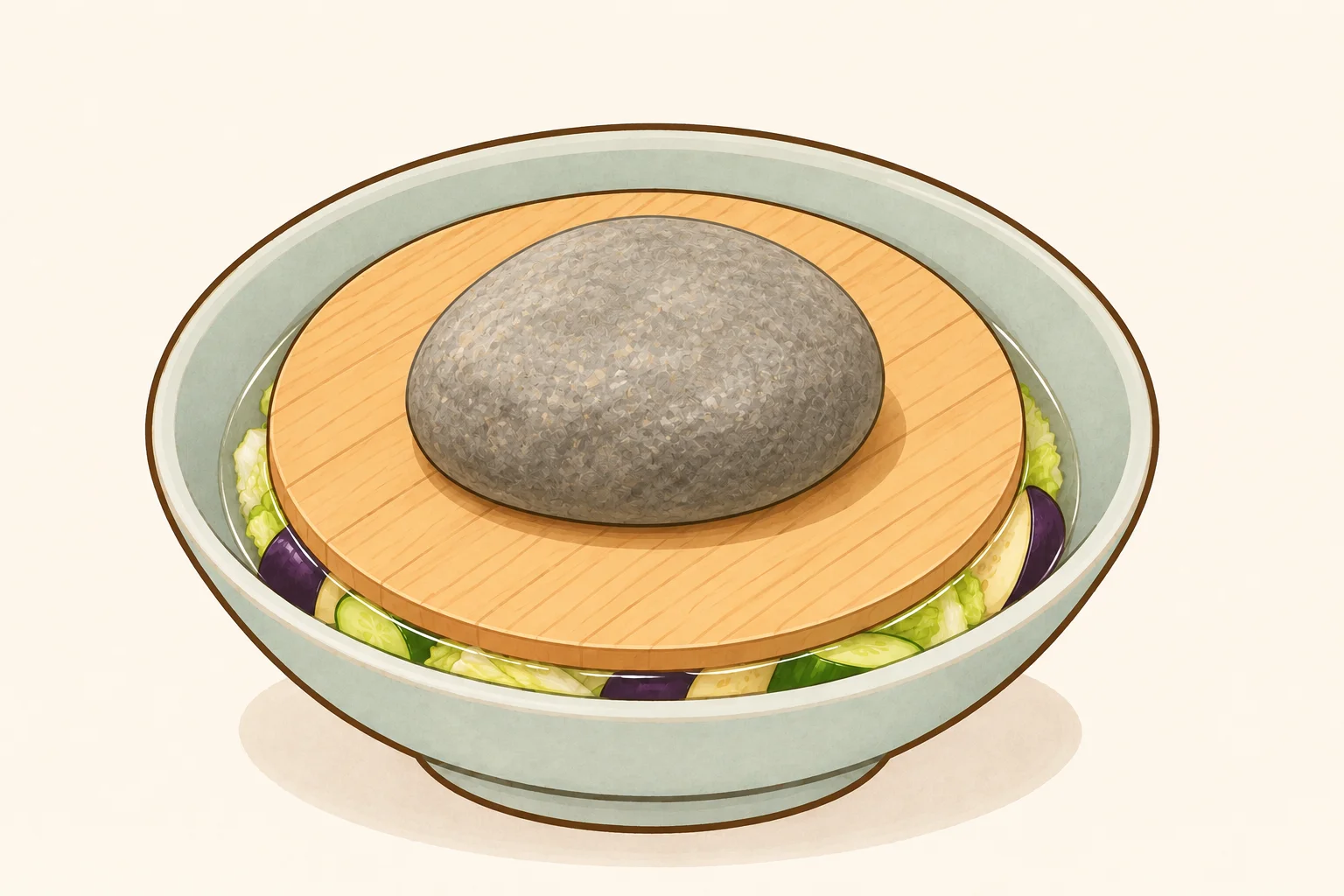 Weighted down and left for a few hours or overnight, the vegetables give up their water to the salt.
- 3
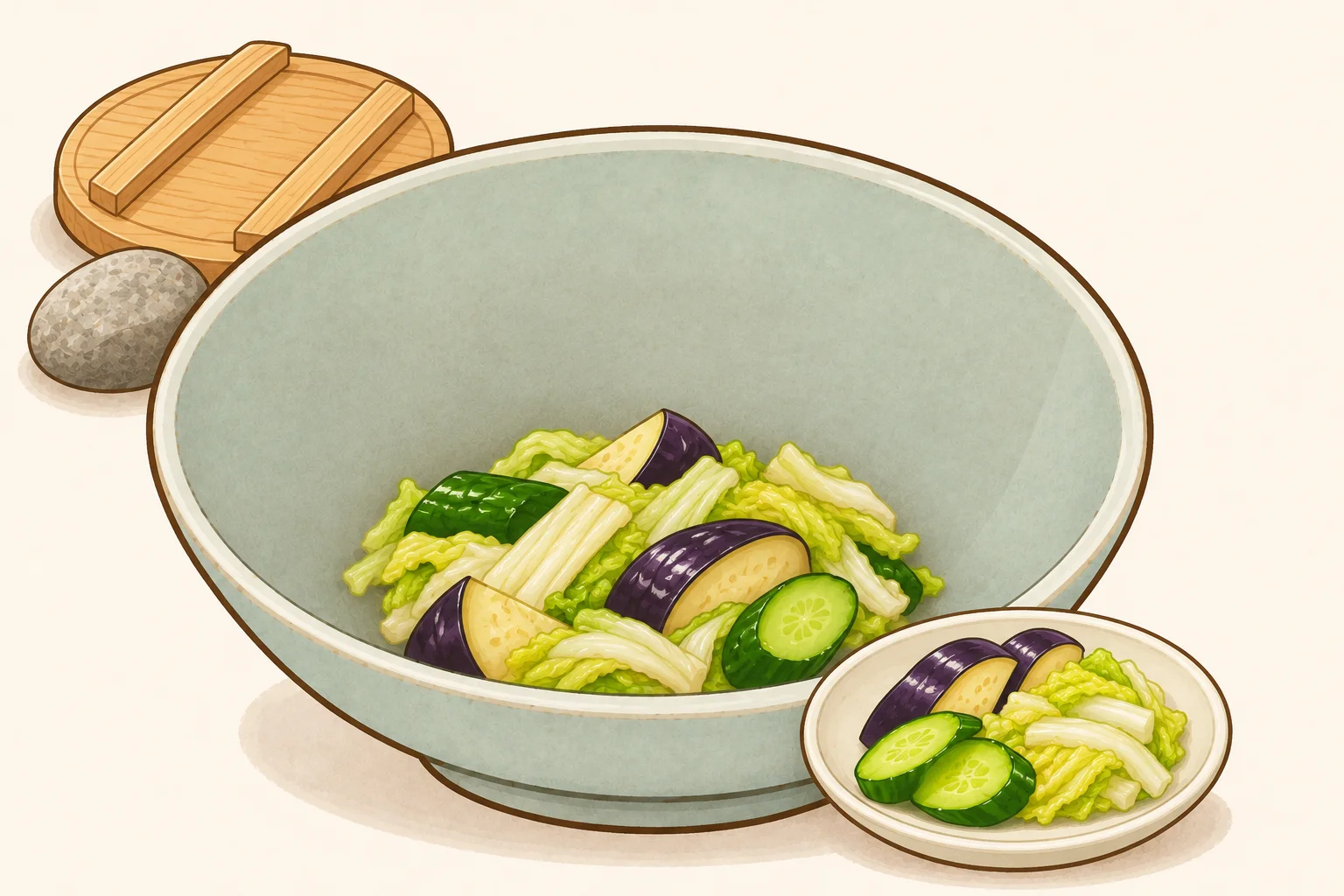 Sliced and served, the pickles are bright, crunchy and only lightly seasoned.
The most characteristic Japanese pickle, though, is nukazuke, pickled in rice bran. When brown rice is polished into white rice, the outer layers come off as bran, or nuka. Mixed with salt and water into a paste the texture of wet sand, it becomes a nukadoko, a bran bed. Cucumbers, eggplants, carrots and daikon radish are buried in it for half a day to a day and come out sour, slightly funky and noticeably more complex than the raw vegetable. The bed is alive. Lactic acid bacteria and yeasts thrive in it, and they need care: the bed has to be turned over by hand every day to let air in, or it develops unpleasant smells. In summer it needs more attention; if the family goes away, it gets a thick layer of salt on top and waits. A well-kept bed can last for decades, and some are handed down from mother or mother-in-law. When older Japanese talk about "the taste of home," they sometimes mean, quite literally, a particular crock of bran.
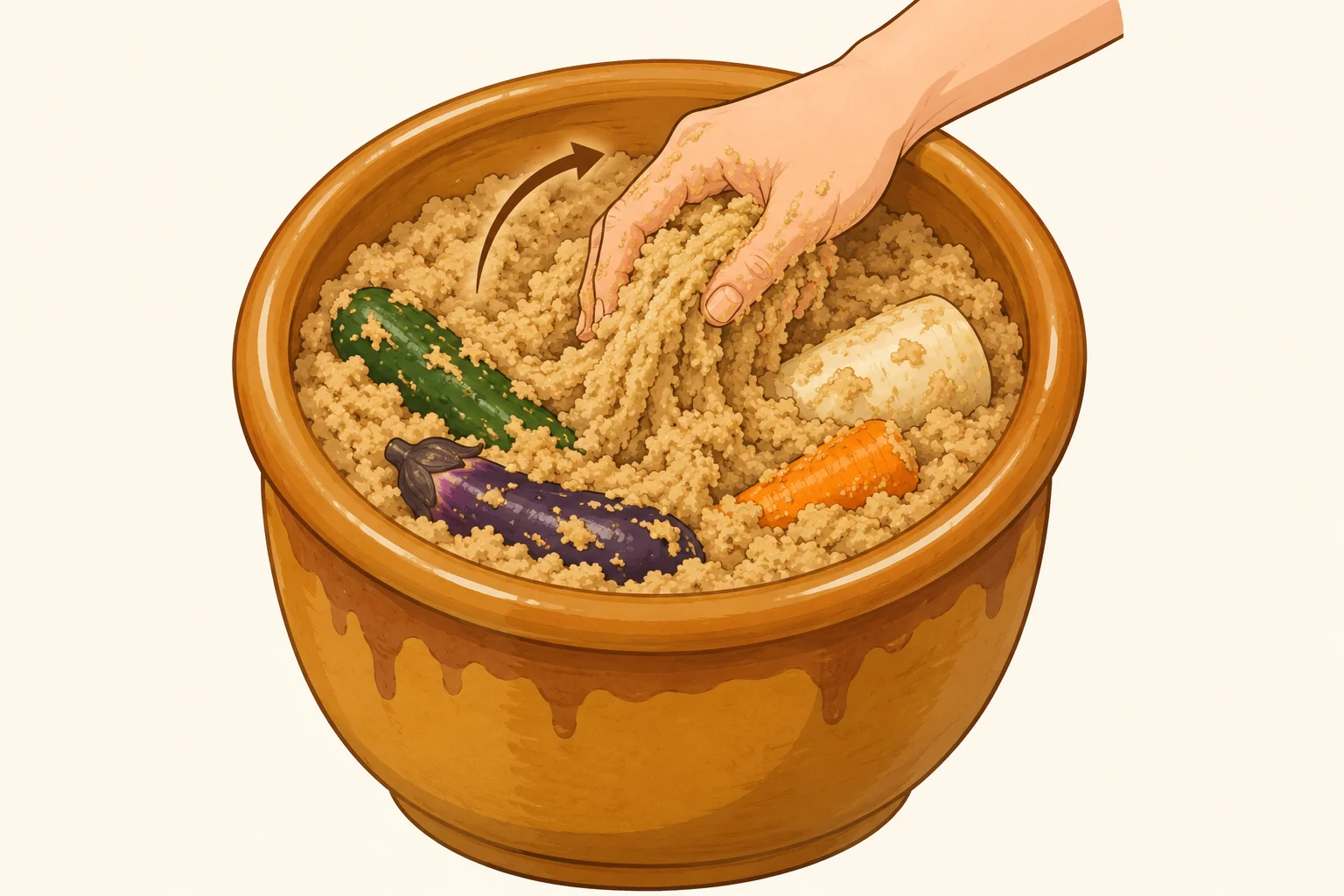
Turning a nukadoko, a bran bed, by hand, with cucumbers and eggplants buried inside.
Then there are pickles cured in Japan’s other fermented seasonings: miso, soy sauce, kōji (the rice mold used to brew sake and soy sauce) and sake lees, the paste left over after sake is pressed. Narazuke, from Nara, are gourds and cucumbers cured repeatedly in sake lees until they turn a deep brown-black and taste rich, sweet and boozy. Fukujinzuke is a relish of chopped daikon, eggplant, lotus root, cucumber and other vegetables simmered in sweetened soy sauce. Vinegar pickles include the pink sliced ginger served with sushi, called gari, and sweet-sour pickled shallots, rakkyō.
Finally, some pickles are made with time and bacteria alone. Kyoto’s suguki is just a turnip-like green and salt, left to ferment until sharply sour. In the Kiso valley of Nagano, sunki is fermented without any salt at all. These belong to the same family as sauerkraut and Korean kimchi: the sourness is produced by fermentation, not added from a bottle.
03From Wooden Tablets to Edo Radish
Pickling in Japan is very old. Wooden tags excavated at the site of Heijō-kyō, the eighth-century capital at Nara, record salted melons and greens, and tags from the household of Prince Nagaya list melons and eggplants pickled in sake lees. The Engishiki, a compendium of court regulations compiled in the early tenth century, lists vegetables to be pickled for the palace and the methods used: salt, a fermented soybean paste, sake lees, and something called susuhori, thought to have been turnips and greens pickled with salt and soybean or rice meal, and sometimes described as an ancestor of bran pickling or of takuan. In this period pickling was mainly a way to survive winter. Vegetables harvested in autumn had to last until spring, and salt made that possible.
Pickles became truly universal in the Edo period (1603–1868). City dwellers in Edo, Ōsaka and Kyoto took to eating polished white rice, which produced mountains of bran, and bran pickling spread from around the 1690s until, by the late Edo period, it was ordinary household fare. The pickled daikon radish called takuan became a national staple at this time. According to a popular story, it is named after Takuan Sōhō, a Zen monk of the early seventeenth century who served pickled radish to the shogun Tokugawa Iemitsu at Tōkai-ji temple in Shinagawa; when Iemitsu asked what the dish was called, he was told it had no name, and named it after the monk. Another explanation, probably more prosaic and more plausible, derives the word from takuwae-zuke, "stored pickles." Either way, sun-dried daikon cured in bran and salt until it turns golden yellow, sliced into half-moons and tucked into a lunchbox, has been part of Japanese life ever since.
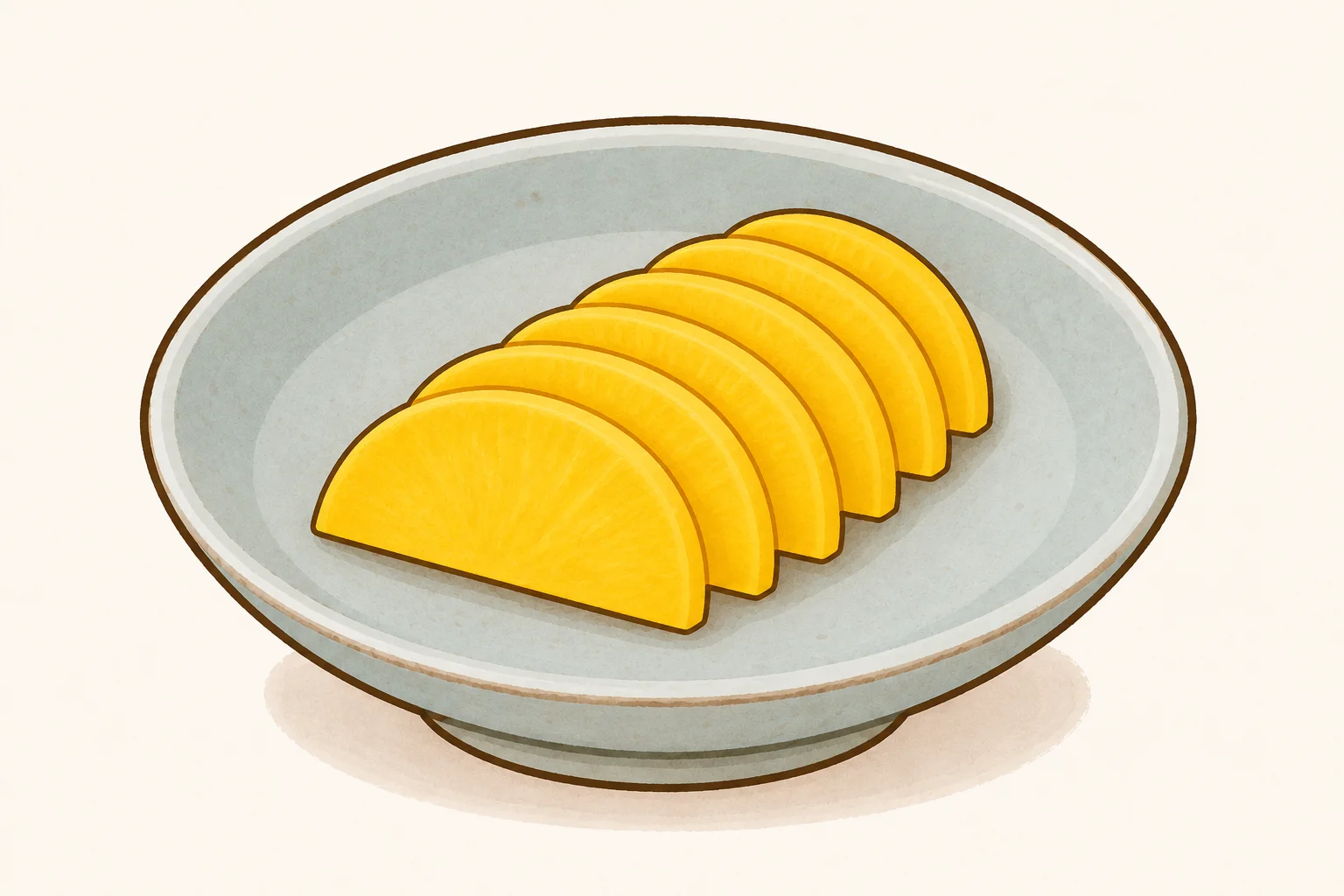
Takuan is sun-dried daikon cured in bran and salt until golden yellow, then sliced into half-moons.
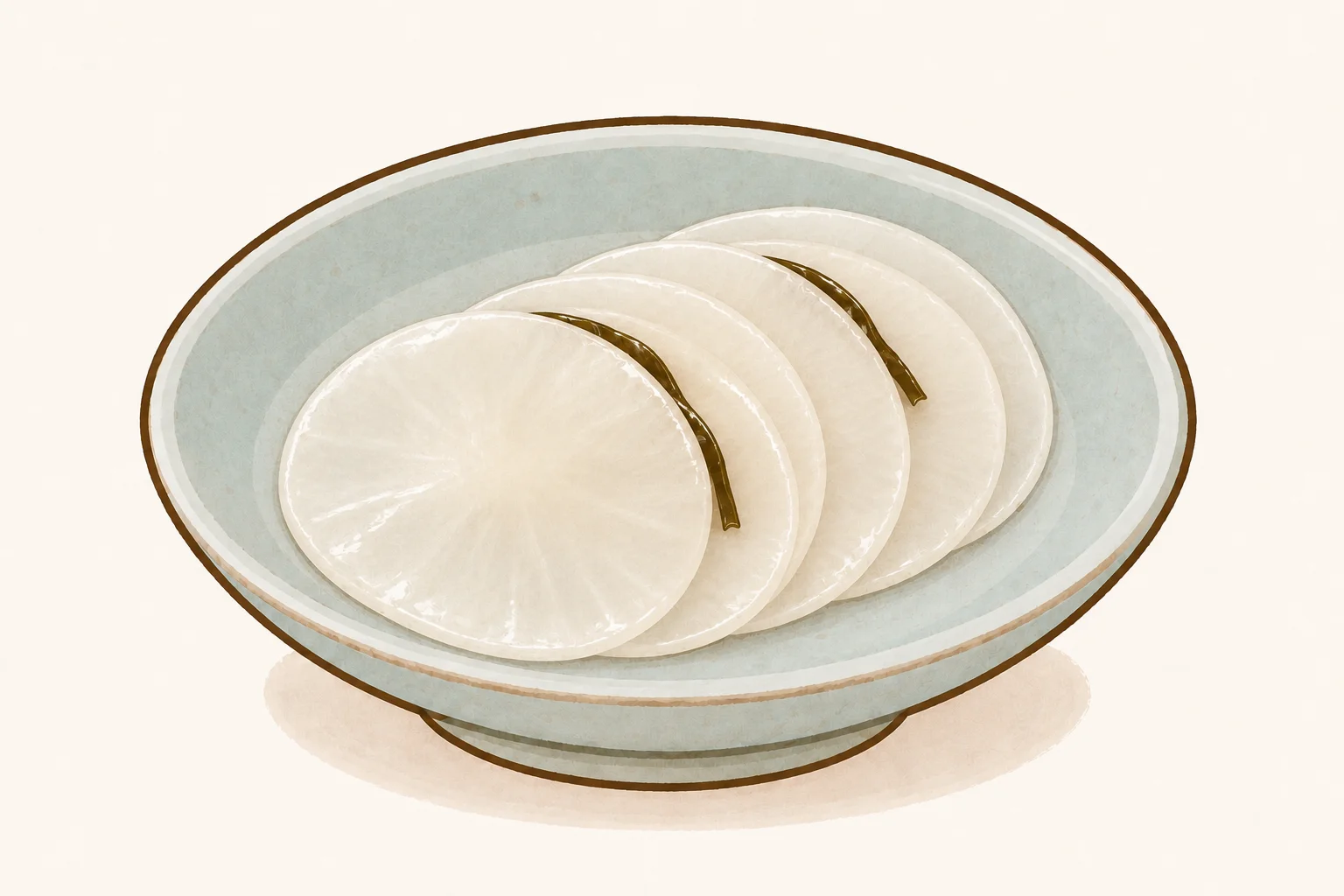
Kyoto’s senmaizuke is Shōgoin turnip shaved paper-thin and layered with kelp in sweetened vinegar, translucent white.
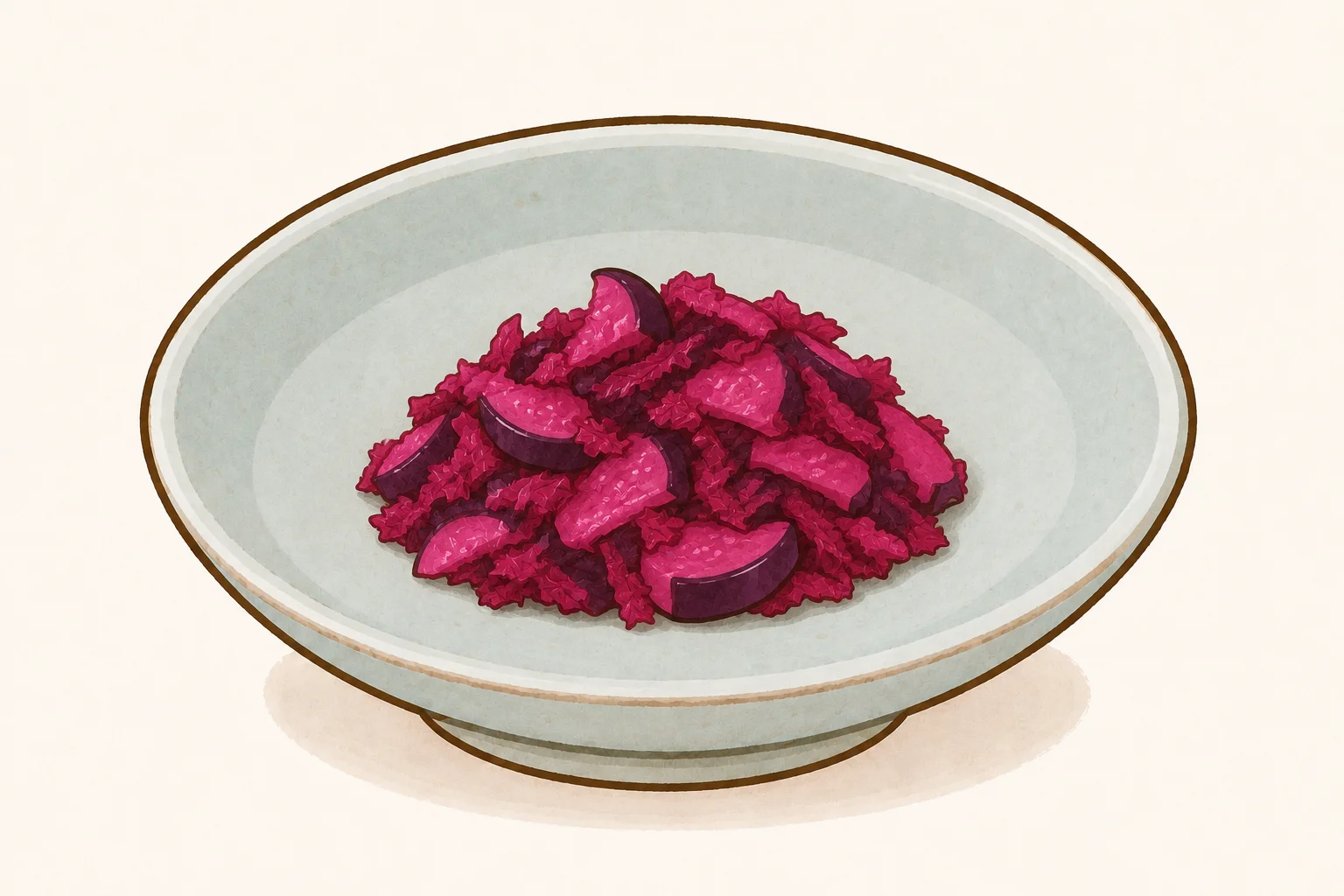
Shibazuke, from Ōhara north of Kyoto, is chopped eggplant fermented with red shiso, which dyes it vivid purple-red.
The pickled plum, umeboshi, has a similarly long history. Ume, a fruit closer to an apricot than a plum, are salted and then dried in the sun, giving them a sourness that makes first-timers wince. Samurai of the Warring States period are said to have carried them on campaign to fight fatigue and thirst. The Japanese have long believed umeboshi keep rice from spoiling, and a lunchbox of plain white rice with a single red plum in the center is called a hinomaru bentō, after the red-disc national flag it resembles.
Pickles kept adapting as Japanese food changed. Fukujinzuke is said to have been created in the Meiji era by Shuetsu, a pickle shop in Ueno, Tokyo, and named after the Seven Lucky Gods because it contained seven vegetables. It later became the standard garnish for Japanese curry rice, a bright red heap at the edge of the plate, a pairing often traced to the dining rooms of ocean liners.
04Kyoto and the Regional Classics
Pickles are among the most local of Japanese foods. They depend on particular vegetables, particular winters and particular water, and almost every prefecture can name one or two it is proud of. The place to start is Kyoto.
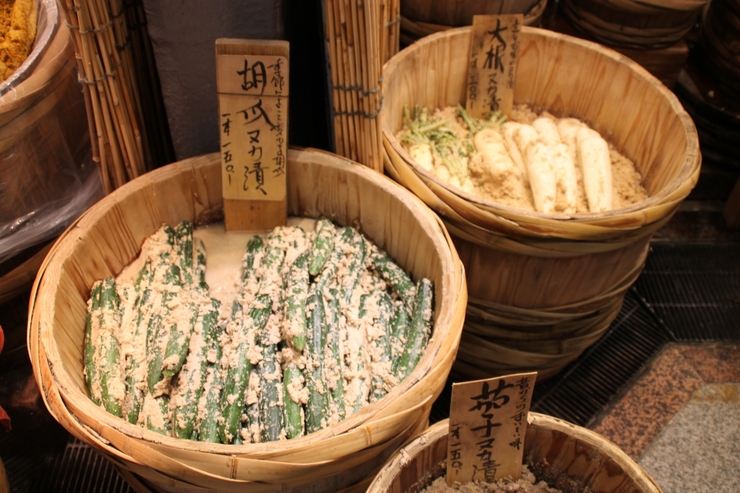
Kyoto counts three pickles as its great classics. Senmaizuke, "thousand-slice pickles," is made from the Shōgoin turnip, a local variety that can grow as large as a child’s head. It is shaved into paper-thin rounds and layered with kelp in sweetened vinegar, so the slices come out translucent white, soft and faintly slippery from the kelp. It is a winter product, made from late autumn. It is usually credited to Daikokuya Tōzaburō, a cook at the imperial palace at the end of the Edo period, who left court service in 1865 and opened a pickle shop named Daitō after characters from his own name; the shop still sells it in Kyoto. Suguki comes from the Kamigamo district in the north of the city, where a turnip green of the same name is grown. The greens are salted and then pressed with a long wooden lever weighted with stones, a method called tenbin-oshi, before fermenting in a warm room until they turn sour and clean-tasting. Shibazuke, from the village of Ōhara north of Kyoto, is chopped eggplant fermented with red shiso leaves, which dye it a vivid purple-red. Legend says it was named by Kenreimon’in, the empress who survived the destruction of the Taira clan in 1185 and retired as a nun to Jakkō-in temple in Ōhara; local people brought her these pickles, and she named them for the color of the shiso.
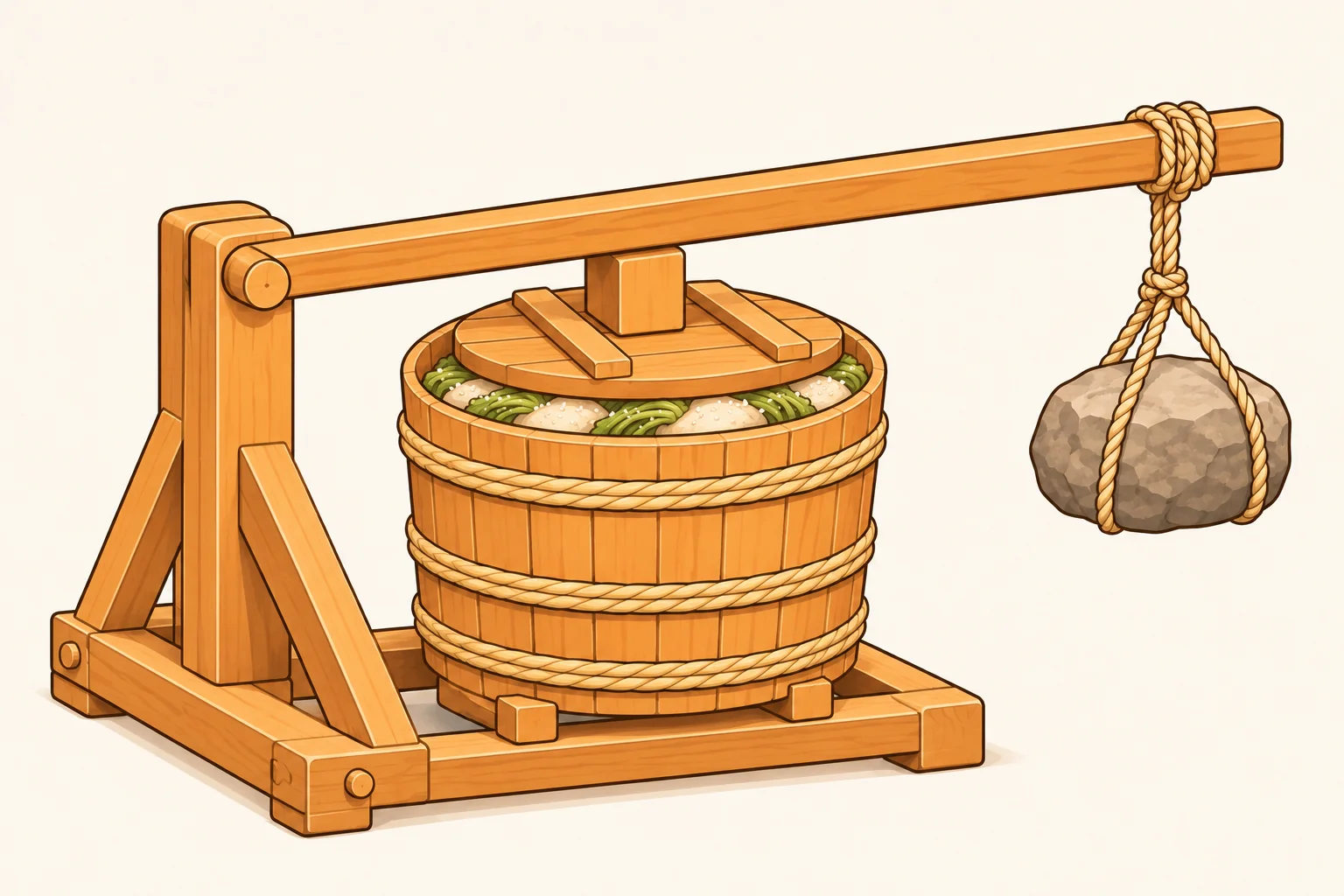
Suguki pressed by tenbin-oshi: a long wooden lever weighted with stones bears down on the salted greens.
Elsewhere, nozawana-zuke from Nagano is made from a leafy relative of the turnip grown around the hot-spring village of Nozawa Onsen. It is bright green, crunchy and a fixture of Nagano winters. Iburigakko from Akita is daikon smoked over a hearth fire before being cured in rice bran. The smoking began as a practical answer to Akita’s cold, damp winters, when radishes hung outside would freeze before they dried, and the result tastes like smoked cheese and pickle at once. Kyūshū has takana-zuke, pickled mustard greens, often stir-fried with chili and sesame; in Hakata ramen shops, a jar of spicy karashi takana sits on the counter for customers to add to their bowls. Around Nagoya, moriguchi-zuke uses an extraordinarily long, thin radish, more than a meter in length, cured in sake lees and mirin lees until it is chewy and sweet. And the Kishū region of Wakayama grows most of Japan’s ume. Its Nankō variety makes large, soft, thick-fleshed umeboshi, sold today in versions from old-fashioned and fiercely salty to mild ones sweetened with honey.
05Pickles in Japan Today
The honest picture is that tsukemono matter less to everyday Japanese life than they did fifty years ago. Japanese people eat less rice than they used to, and pickles follow rice. Fewer households keep a bran bed. Doctors and public-health campaigns have urged people to cut down on salt, and heavily salted traditional pickles are among the first things to go. In 2012, lightly pickled napa cabbage from a factory in Sapporo caused an O157 outbreak that killed 8 people, and the national hygiene code for pickles was revised that year. From 2021, making pickles for sale required a business license, with a grace period that ended in May 2024, and many farmers who sold homemade pickles at roadside stands and farm shops stopped rather than invest in licensed facilities.
What has happened, though, is less a disappearance than a change of form. Supermarket chillers carry rows of small packets of low-salt and lightly pickled vegetables. Convenience-store rice balls are filled with umeboshi, takana or nozawana. At the other end of the market, Kyoto’s pickle houses present tsukemono as a luxury gift in wooden tubs and bamboo baskets, and a box of senmaizuke or shibazuke is one of the classic things to bring back from the city. Interest in fermentation and gut health has also brought nukazuke back into fashion among younger people, helped by bran-bed kits designed to live in the refrigerator and survive a few days without stirring.
In Kyoto, pickles remain part of the city’s identity. Along Nishiki Market and on the streets leading up to the big temples, pickle shops display dozens of varieties in wooden tubs with toothpicks for tasting. Old houses such as Nishiri, Murakami-jū, Uchida and Daitō each have their loyal customers. In the basement food halls of Japanese department stores, the pickle counter is usually one of the more crowded corners.
06Eating and Buying Tsukemono
The natural time to eat pickles is during a meal, alongside rice. With a set meal or ryokan breakfast, there is no need to finish the dish first or save it all for the end. Take a slice with a mouthful of rice, use one to clear your palate after something fried, and keep the last one or two for when the rice bowl is nearly empty. Many set-meal restaurants and ochazuke (rice in tea) shops put out pickles for free self-service in small jars on the table; take a little at a time. At a kaiseki meal, pickles arrive with the rice as the final course, and here they are meant to be savored. Finishing with a bowl of rice, a few pickles and green tea poured over the top is a very Japanese way to end a meal.
In pickle shops, tasting is expected. Most Kyoto shops cut samples of their products and set them out on the counter, and staff will point you to what is in season. In winter, look for senmaizuke and suguki. In summer, look for lightly pickled mizunasu, the juicy eggplant of the Senshū area south of Ōsaka, so full of water you can squeeze it, as well as shibazuke. If you plan to take pickles home, choose vacuum-packed varieties that keep at room temperature. Asazuke and senmaizuke generally need refrigeration and have short shelf lives, so they are better eaten in your hotel that evening. Pickles come with brine, so pack them in checked luggage, and check your home country’s rules on importing vegetable products before you buy.
If you are staying somewhere with a kitchen, a small bag of ready-made bran bed from a supermarket is an easy experiment. Bury a cucumber in it before bed, pull it out in the morning, rinse it, slice it and eat it with a bowl of hot rice. It takes one night, and it is the most ordinary Japanese food there is.