
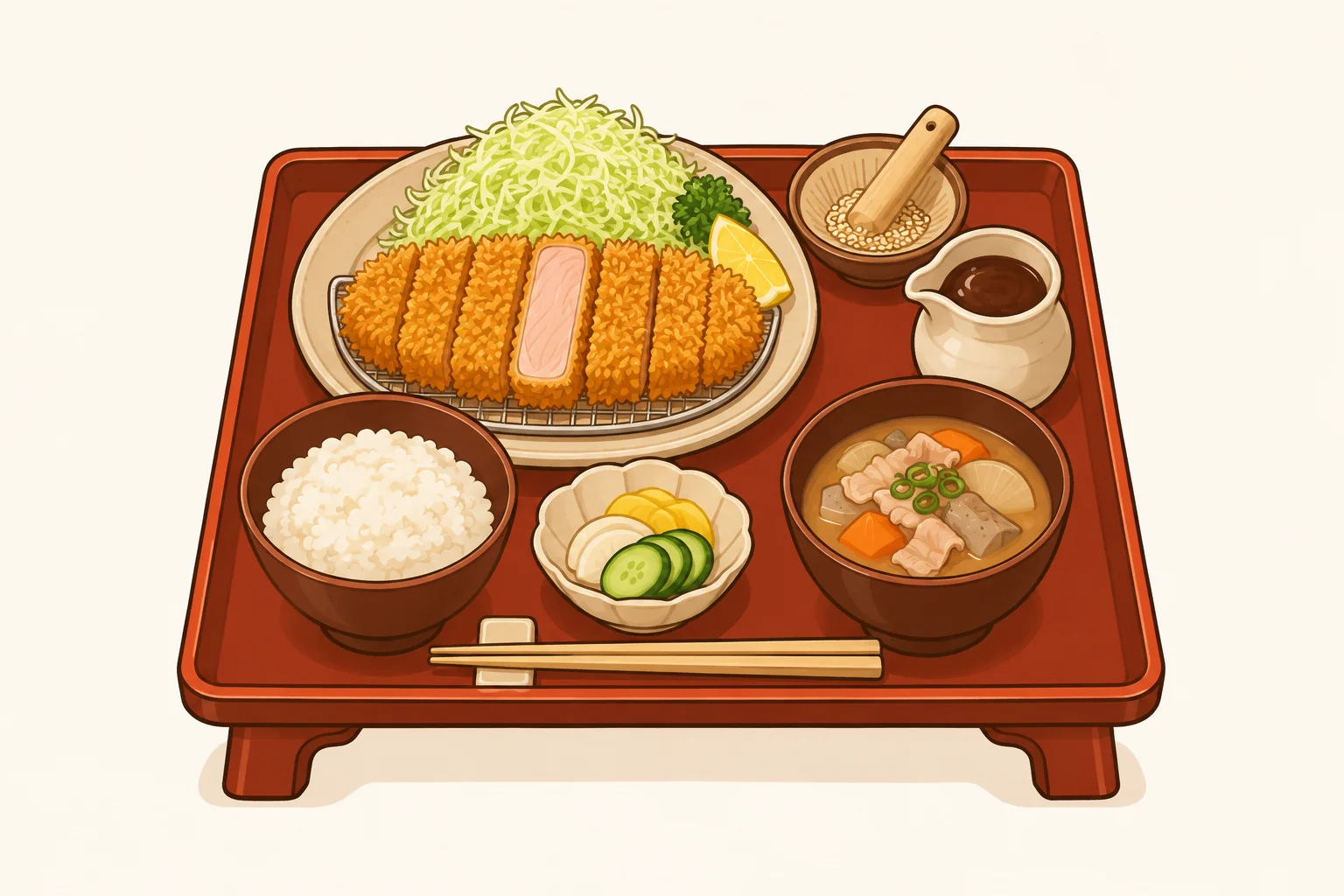
At a glance
How a European cutlet became Japan’s tonkatsu with rice and shredded cabbage, plus croquettes, kushikatsu, karaage, and how to order and eat them.
- Tonkatsu grew out of the Western cutlet; Rengatei in Ginza, opened in 1895, switched to pork and deep-fried it.
- Ponchiken in Ueno is generally credited with the thick, pre-sliced cutlet served with rice in 1929, which made the name tonkatsu stick.
- You first choose fatty-edged rōsu (loin) or lean, tender hire (fillet), served with shredded cabbage, rice and miso soup.
- Katsu sounds like katsu, "to win," so eating katsudon before exams or matches is a widespread custom.
- At kushikatsu shops in Ōsaka’s Shinsekai the shared sauce pot carries a rule: dip only once.
A thick pork cutlet in a crisp, craggy shell of breadcrumbs, sliced into strips and served with a mound of shredded cabbage, a bowl of rice and a cup of miso soup: tonkatsu is one of the most ordinary meals in Japan and one of the most satisfying. It began as a borrowed European dish in the restaurants of Meiji-era Tokyo, and within a few decades it had been reshaped so thoroughly that most Japanese people think of it as their own. Around it has grown a whole family of breaded and fried foods, from the potato croquettes sold at neighborhood butcher shops to the skewers of Ōsaka and the fried chicken of every convenience store. This is the story of how that happened, what makes a good tonkatsu, and how to eat one when you get there.
01A Country Learns to Eat Meat
For more than a thousand years, meat occupied an awkward place in the Japanese diet. Buddhist teaching against killing, imperial edicts that banned the eating of certain animals, and ideas about ritual pollution meant that cattle and pigs were not part of ordinary meals. People did eat wild boar and venison, often under the polite fiction that it was medicine, but the everyday table was built around rice, fish, soy and vegetables.
That changed after the Meiji Restoration of 1868. The new government looked at the larger, stronger soldiers of the Western powers and decided that diet was part of the gap. Eating meat was promoted as modern and patriotic, and in 1872 it was publicly announced that the Meiji Emperor himself ate meat. Beef hot pots became fashionable in Tokyo, and restaurants serving yōshoku, Western-style cooking adapted for Japanese diners, began to open.
One of the dishes they offered was the cutlet, katsuretsu in Japanese, from the English "cutlet" and the French côtelette. In Europe this usually meant a thin slice of veal or lamb, often on the bone, breaded and pan-fried in butter. It did not translate well. Veal was scarce, butter was expensive, and the result struck many Japanese diners as heavy.
02Rengatei and the Birth of a Japanese Cutlet
The decisive changes are usually credited to Rengatei, a Western-style restaurant that opened in Ginza in 1895 and is still in business. Its kitchen switched from veal to pork, which was cheaper and more readily available, and abandoned the shallow pan-fry in favor of deep-frying in plenty of oil, the way Japanese cooks had long fried tempura. The dish was called pōku katsuretsu, pork cutlet.
Rengatei is also associated with two other details that define tonkatsu to this day. The first is the cabbage. The original garnish was warm vegetables, but according to a story the restaurant itself tells, when cooks were called up for the Russo-Japanese War of 1904–05 and the kitchen was short-handed, it switched to raw cabbage cut into fine shreds, which could be prepared quickly. Diners found that the cool, crunchy cabbage cut through the richness of the fried meat, and it stayed. The second is rice. Serving Western dishes with a bowl of white rice rather than bread made them feel like a proper meal to Japanese customers and allowed them to be eaten with chopsticks.
The final step came in the early Shōwa period. A restaurant called Ponchiken in Okachimachi, near Ueno in Tokyo, is widely credited with serving, around 1929, a pork cutlet two or three centimeters thick, cooked slowly at a lower oil temperature until done all the way through, then sliced before serving so it could be eaten with chopsticks. The name tonkatsu was already in use before Ponchiken, but it was this thick, sliced, rice-and-miso-soup style that made it famous: ton is the Sino-Japanese reading of the character for pig, and katsu is the front half of katsuretsu. Other old restaurants in Ueno, Asakusa and Shinjuku have their own claims, and the question of who was first will never be settled, but the Ueno area, home to long-established shops such as Ponta Honke, Horaiya and Isen, is generally regarded as tonkatsu’s heartland. The new name was short, easy to say, and happened to sound exactly like katsu, "to win." That last coincidence would prove useful.
03What Makes a Good Tonkatsu
Order tonkatsu in Japan and the first choice is the cut. Rōsu, from the English "roast," is pork loin with a band of fat along one edge; when fried well, the fat turns sweet and the meat stays juicy, and it is the choice of those who like their tonkatsu rich. Hire, from the French filet, is the tenderloin, lean, soft and usually a little more expensive. Better restaurants name the breed and the farm. Kurobuta, the black pork of Kagoshima in southern Kyūshū, from local black pigs crossed with British Berkshires in the Meiji period, is the most famous, but there are dozens of regional brand pigs, and menus at specialist shops can read like wine lists.
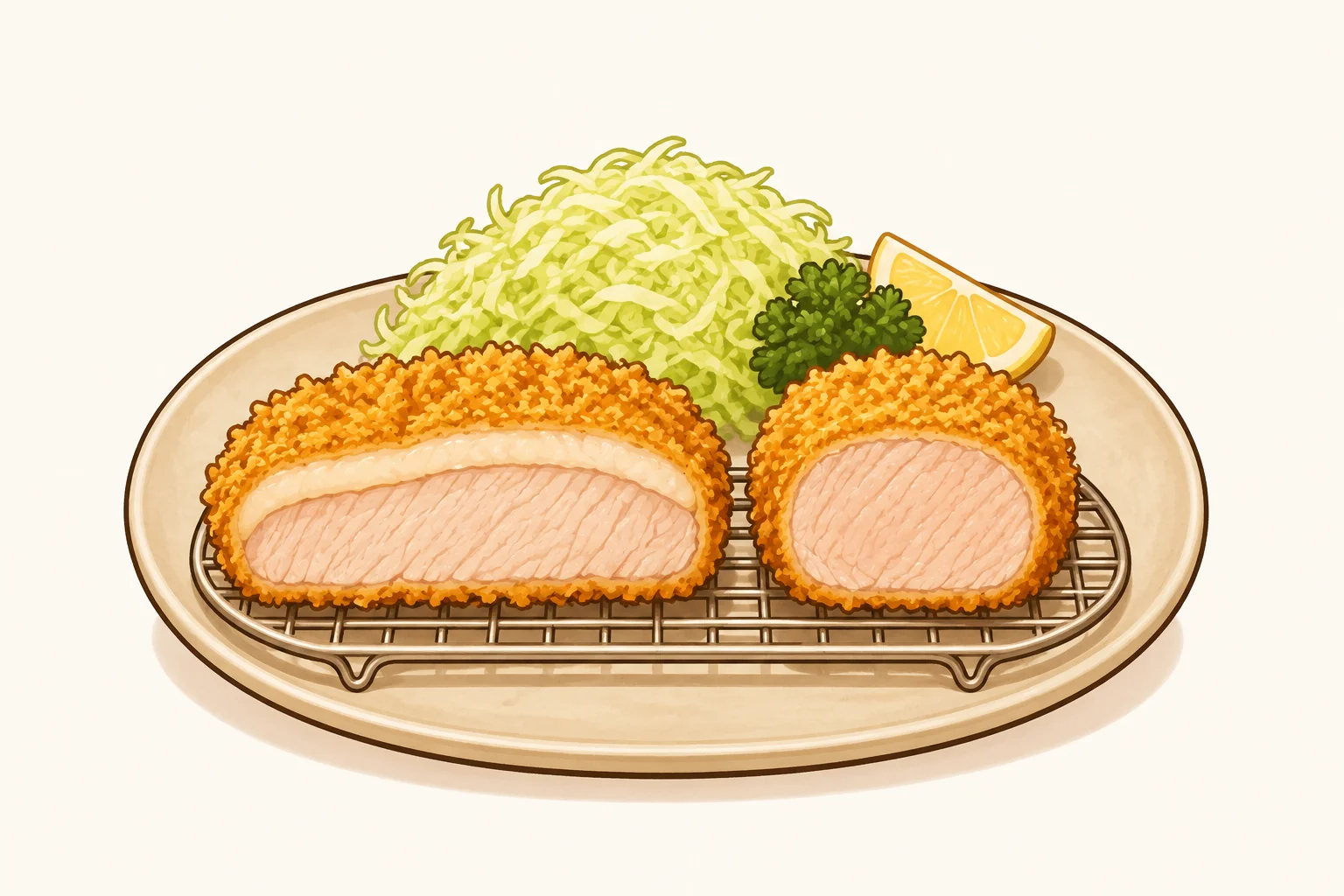
Two cuts of tonkatsu: rōsu, pork loin with a band of fat, and hire, the lean tenderloin.
The real difference lies in the frying. A thick cutlet has to be cooked through without being dried out, so many serious shops fry in two stages, first in oil at a moderate temperature to cook the meat gently, then briefly at a higher temperature to crisp the coating. Some let the cutlet rest after frying so the residual heat finishes the center, which may be left faintly pink. Lard, alone or mixed with vegetable oil, gives the deepest flavor.
The coating is just as important. Japanese panko breadcrumbs are coarser and flakier than the fine crumbs used in much of Europe and America, and many tonkatsu specialists insist on fresh, undried panko. Fried properly, it stands up in jagged shards that shatter lightly when you bite, a texture Japanese describes with the word saku, rather than forming a hard shell. Cooks say it absorbs less oil than fine crumbs, so the result is lighter than it looks.
Then come the accompaniments. The cabbage should be cut almost as fine as hair and crisped in cold water. At many shops, cabbage, rice and miso soup are refilled for free; the soup is often tonjiru, a hearty miso soup with pork and root vegetables. On the table you will find a jug of thick, dark tonkatsu sauce, a postwar development of the Worcestershire-style sauce that came to Japan in the Meiji period, cooked down with fruit and vegetables until it clings to the crumbs. Some restaurants bring a small ridged mortar, a suribachi, with a spoonful of toasted sesame seeds for you to grind yourself before pouring in the sauce. Others encourage you to try the pork with just salt, hot mustard or a squeeze of lemon, on the principle that good meat needs little help.
04Where to Taste It
Tokyo has the deepest bench. Tonki in Meguro, founded in 1939, is a classic: a long counter, white-coated cooks working in silent coordination, one frying, one slicing cabbage, one serving rice, the whole operation visible from your stool. Maisen in Aoyama, set in a former public bathhouse, built its reputation on cutlets so tender, its slogan says, that you can cut them with chopsticks. Butagumi in Nishi-Azabu is known for its menu of named breeds. In Kyoto, the Katsukura chain introduced many visitors to the ritual of grinding sesame at the table.
You do not need a famous name to eat well. Chains such as Katsuya, Saboten and Wako serve reliable tonkatsu in shopping districts and station buildings across the country, with a set meal at Katsuya costing a little under 1,000 yen as of 2026. A premium loin set at a well-known specialist will run to 2,000 or 3,000 yen, and sometimes more.
05Katsudon, Katsu Sando and Katsu Curry
Tonkatsu’s genius is that it combines well with other things. The most famous combination is katsudon. Sliced tonkatsu is simmered briefly with onion in a sweet, savory broth of dashi, soy sauce and mirin, then bound with beaten egg and slid, half set, onto a bowl of rice. The crust softens and soaks up the broth; it is a completely different pleasure from a crisp cutlet. The dish is usually said to have been invented in the Taishō period near Waseda in Tokyo. An older style uses no egg at all: the cutlet is dipped in a Worcestershire-based sauce and laid over rice. Yōroppa-ken in Fukui is the best-known home of this sōsu katsudon, and Komagane in Nagano prefecture has its own version. Niigata dunks thin cutlets in a sweet soy glaze for tare katsudon, and Okayama pours over a demi-glace. Ordering the local katsudon is one of the small pleasures of traveling around Japan.
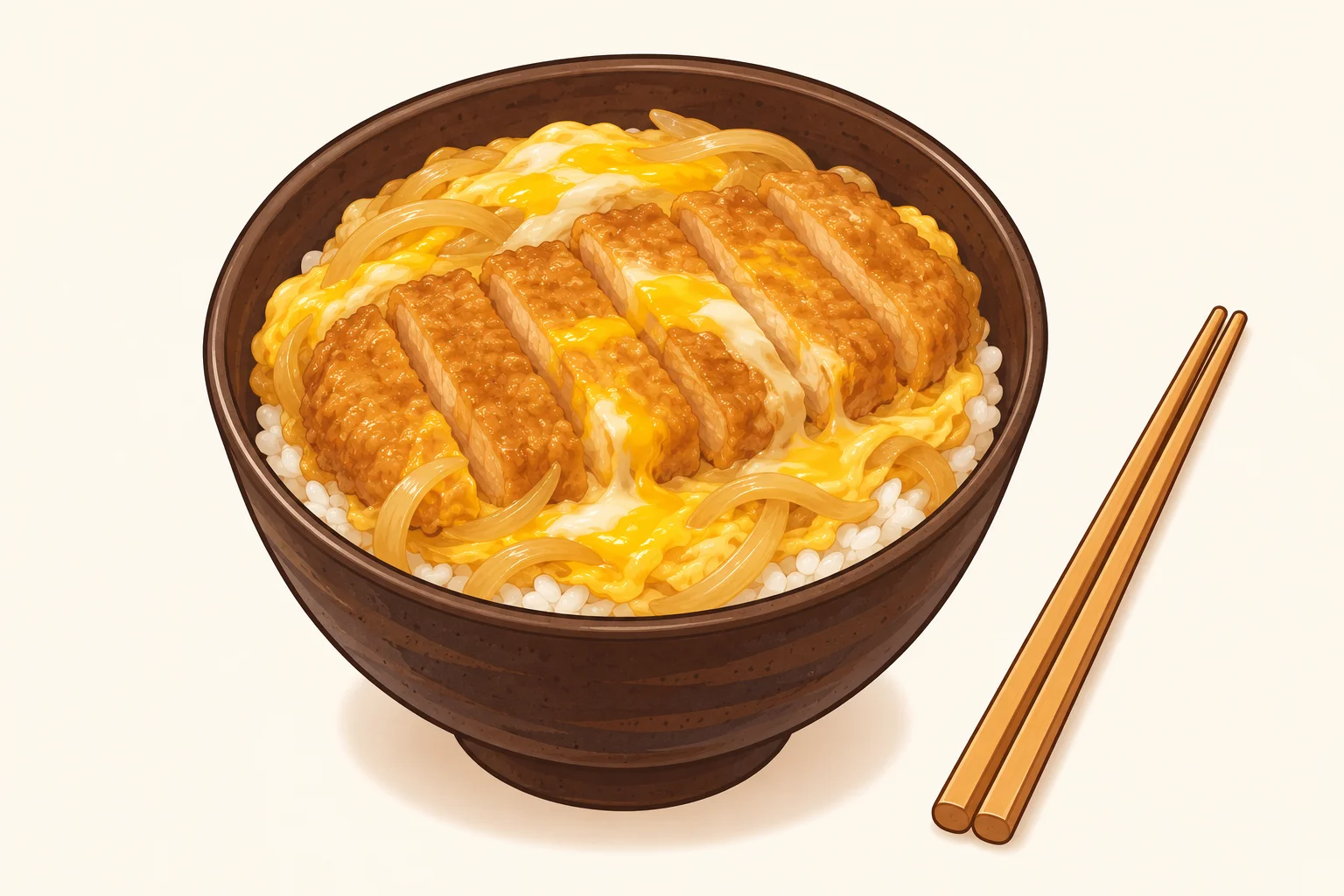
The best-known katsudon: sliced cutlet simmered with onion in broth, bound with beaten egg and slid half set onto rice.
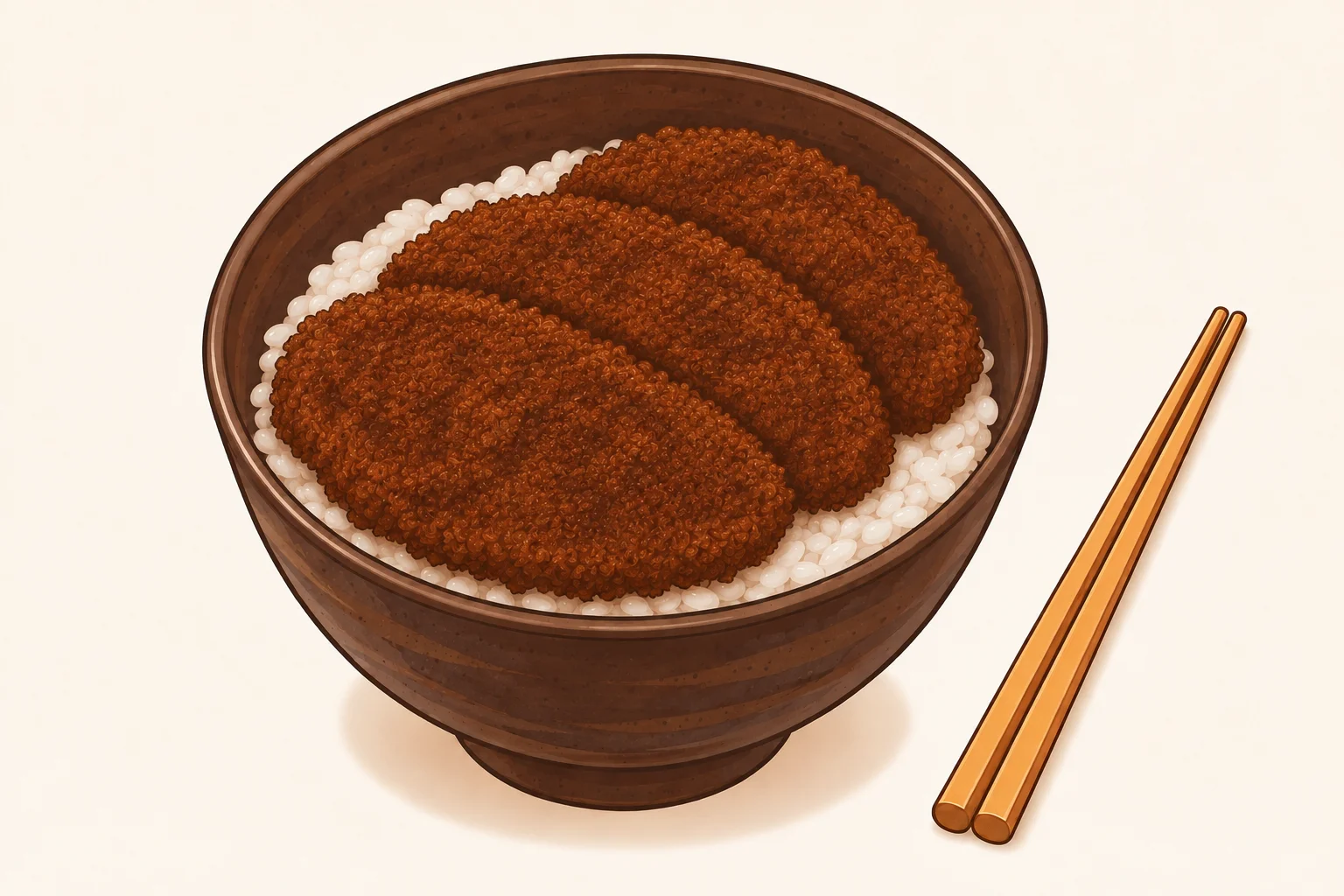
An older style uses no egg: the cutlet is dipped in a Worcestershire-based sauce and laid over rice.
Because katsu sounds like "win," katsudon is the traditional meal before an exam or a big game. Students eat it the night before university entrance exams, high school baseball teams eat it before tournaments, and shops near cram schools put "pass the exam" katsudon on the menu during exam season.
The katsu sando, a pork cutlet sandwich on soft white bread, reportedly with the crusts cut off, is said to have been created at Isen in Ueno in the early 1930s, cut into small pieces so that geisha from the neighborhood could eat without smudging their lipstick. Boxed katsu sando are now a standard purchase on shinkansen platforms and in department store food halls. Katsu karē, a cutlet on top of Japanese curry rice, has several origin stories; a well-known one from the Ginza restaurant Swiss tells of the Yomiuri Giants player Chiba Shigeru, who in 1948 wanted both dishes at once and asked for the cutlet to be put on the curry. Whatever its origins, it is now a staple of curry shops everywhere.
06Croquettes, Menchi-Katsu and the Wider Family
Tonkatsu traveled from Western restaurants into Japanese homes alongside the korokke, from the French croquette. In France croquettes are often bound with a thick white sauce; in Japan the standard version became mashed potato mixed with a little ground meat and onion, breaded and fried. It was cheap and filling, and in the Taishō period a popular song, "Korokke no Uta" ("The Croquette Song"), joked about a newlywed couple eating croquettes every day; by around 1920 croquettes had become one of the most familiar Western dishes in Japan. Cutlets, croquettes and curry rice were later called the three great yōshoku dishes of the Taishō era. Neighborhood butcher shops still fry korokke at the counter and sell them for a hundred yen or two as of 2026, to be eaten hot while you walk; the cream croquette, with a molten béchamel center, preserves the older French style.
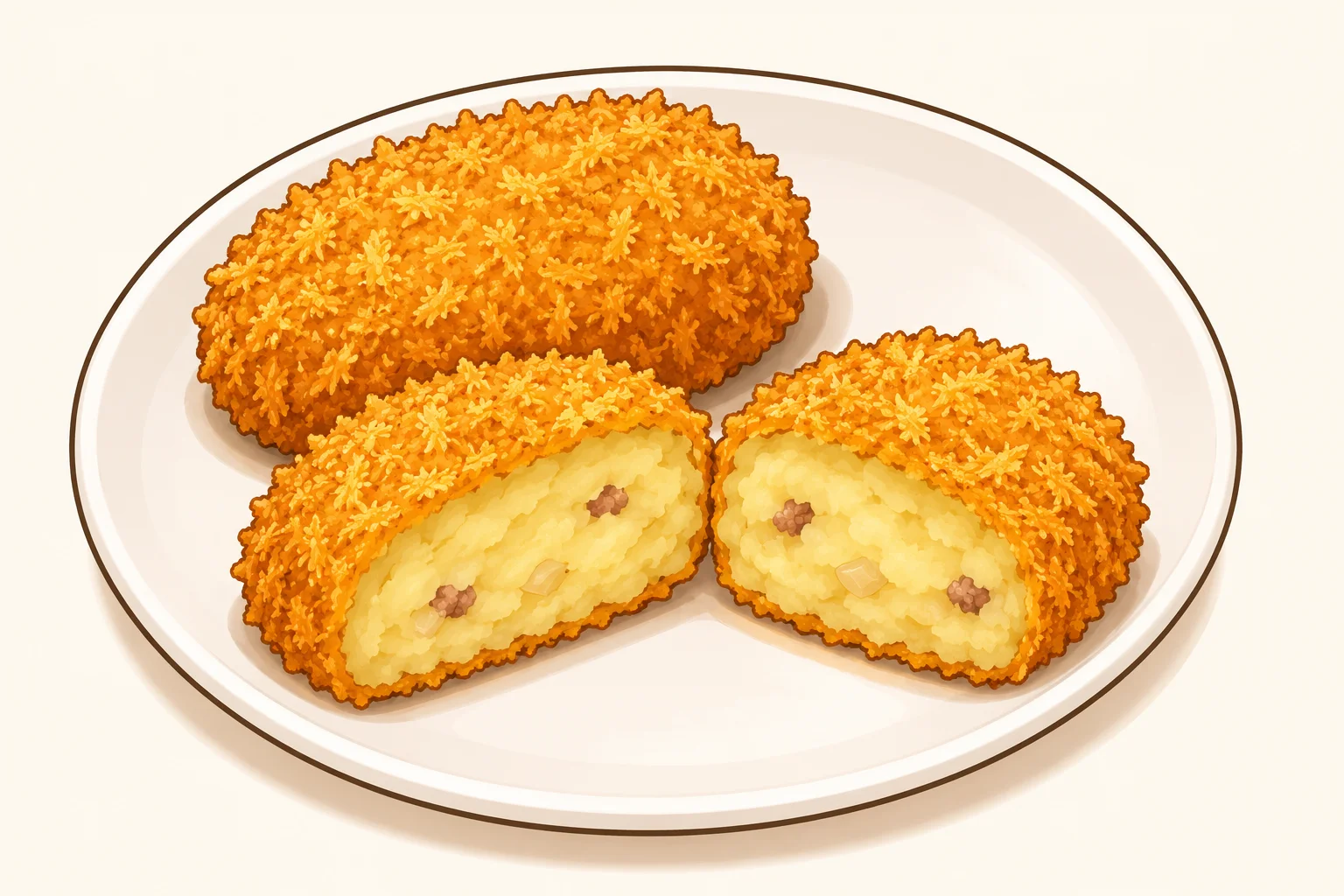
Korokke: mashed potato mixed with a little ground meat and onion, breaded and fried.
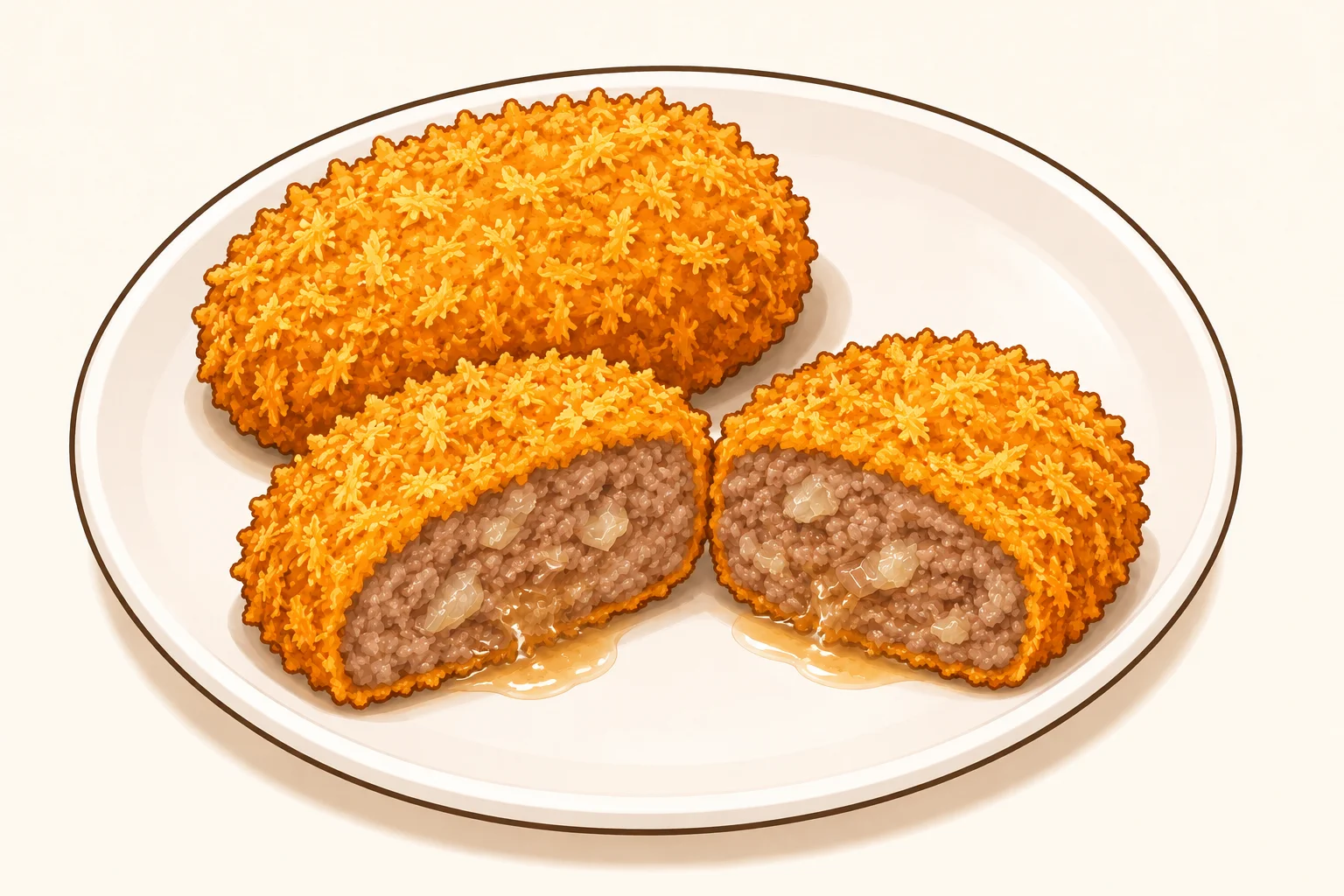
Menchi-katsu: a patty of ground meat and onion, so juicy it floods when cut.
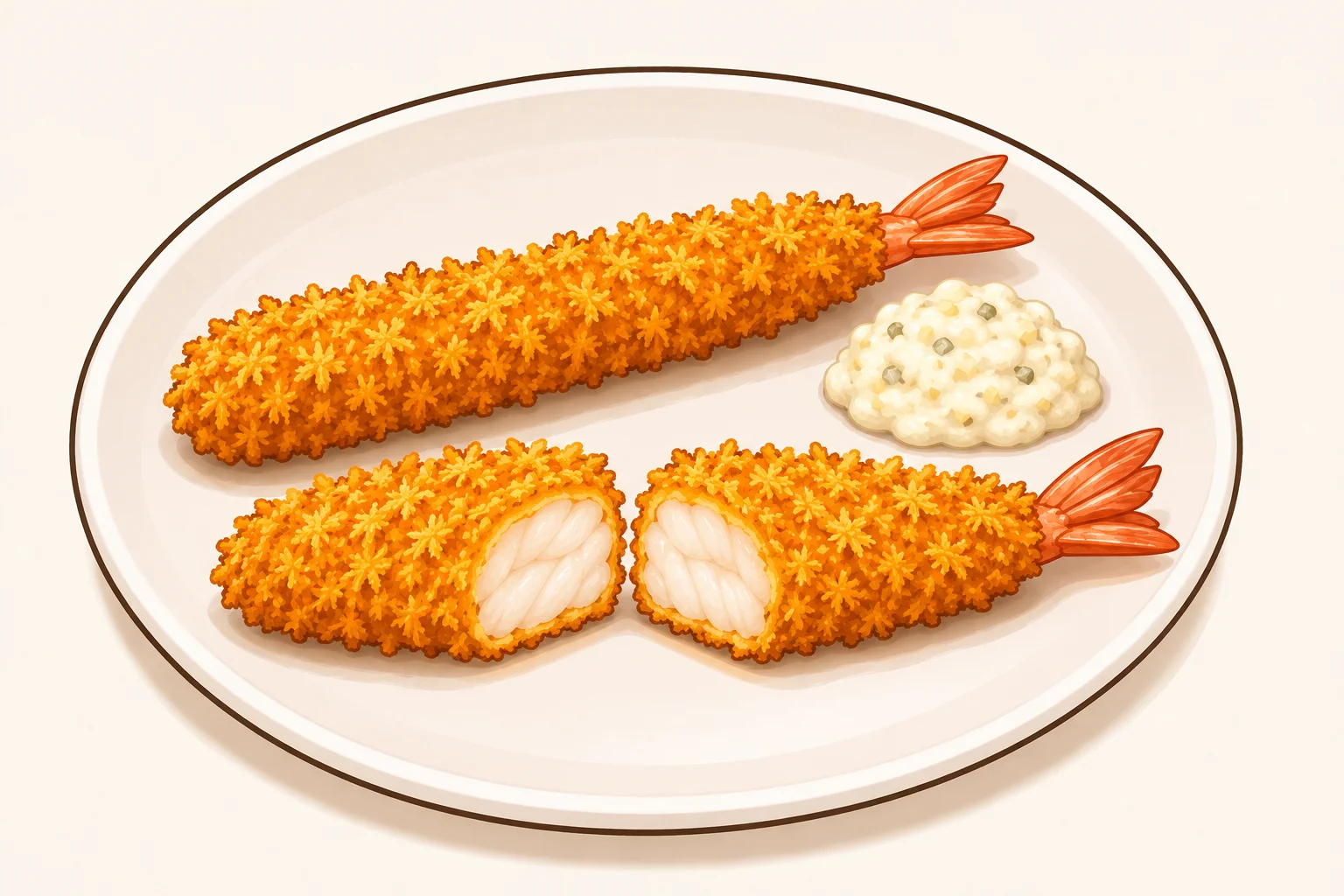
Ebi furai: prawns straightened before breading and frying, served with tartar sauce.
Menchi-katsu is ground meat and onion shaped into a patty, breaded and fried, so juicy that it releases a little flood when you cut it. A butcher in the Kichijōji shopping arcade in western Tokyo is famous for the line outside its door. Ebi furai, fried prawns straightened before breading and served with tartar sauce, are a fixture of children’s meals and bento boxes. Nagoya has a curious attachment to them: in the 1980s a television comedian mocked the local accent by calling them ebi furyā, and rather than taking offense the city more or less adopted fried prawns as a local specialty. Nagoya’s other contribution is miso katsu, tonkatsu covered in a thick, sweet sauce made from dark bean miso of the Hatchō type; Yabaton is the best-known name. In winter, kaki furai, fried oysters, appear on menus, and aji furai, fried horse mackerel, is a staple of set-meal diners and seaside restaurants.
All of these differ from tempura. Tempura uses a thin batter of flour and cold water, usually with egg, that lets the ingredient show through. The furai family uses three layers, flour, egg and breadcrumbs, and the crust is a pleasure in itself. Japanese classify tempura as washoku, Japanese cuisine, and the breaded foods as yōshoku, though both have long since become thoroughly Japanese.
Tempura (washoku)
- A thin batter
- Lets the ingredient show through
Furai (yōshoku)
- Flour
- Egg
- Breadcrumbs
- The crust is a pleasure in itself
A thin batter lets the ingredient show through; three layers make the crust a pleasure in itself. The first is washoku, the second yōshoku.
07Kushikatsu and Karaage
Ōsaka’s kushikatsu takes a different route. Beef, pork, onion, lotus root, quail eggs, pickled red ginger and almost anything else are threaded on bamboo skewers, coated in fine crumbs, fried and dipped in a communal tub of thin sauce. The dish is generally associated with Shinsekai, a working-class entertainment district south of central Ōsaka, where it has been sold cheaply to drinkers since before the war; as of 2026, a skewer still costs little more than 100 yen. The famous rule is nidozuke kinshi: no double dipping. The sauce is shared, so once you have bitten a skewer, it does not go back in. If you want more sauce, use a leaf of the free raw cabbage on the counter as a scoop. In Tokyo the same idea, called kushiage, tends to be more refined, served one skewer at a time across a counter in a set sequence.
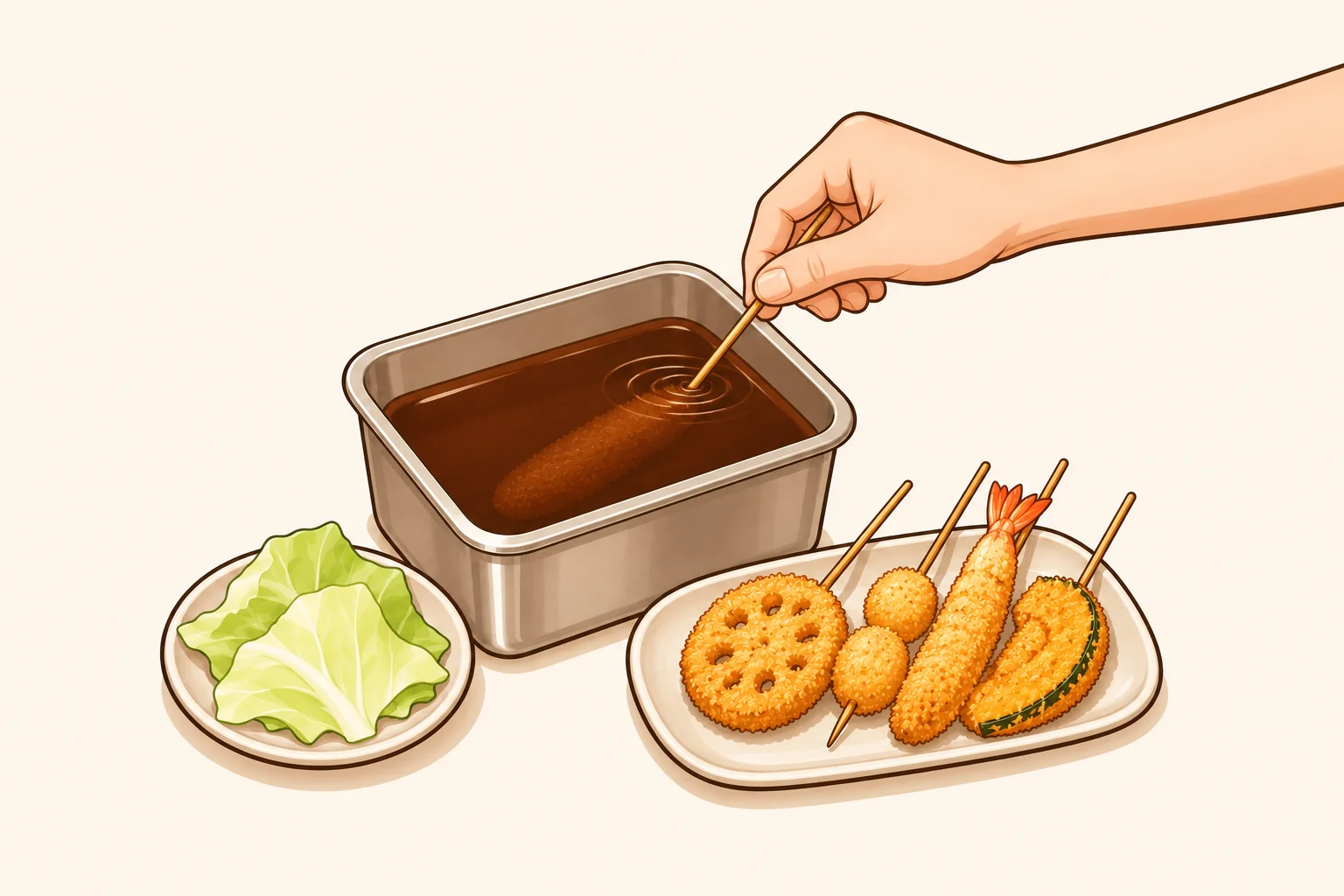
Kushikatsu in Ōsaka: the shared sauce allows one dip only, and a leaf of raw cabbage serves as a scoop for more.
Karaage is fried chicken without breadcrumbs: pieces of thigh marinated in soy sauce, ginger and garlic, dusted with potato starch or flour and fried until crisp. The kara in the name refers to China, a nod to its continental roots, but karaage became truly widespread only after the war, when industrial poultry farming made chicken cheap. Today it is everywhere, in izakaya, in bento and in the hot cases of convenience stores. The towns of Nakatsu and Usa in Ōita prefecture call themselves the homes of karaage and are lined with takeout shops; Hokkaidō has its own heavily seasoned version, called zangi. Whether to squeeze lemon over a shared plate of karaage without asking is a perennial argument at Japanese tables.
08How to Eat It
Tonkatsu restaurants tend to be small, and the good ones have lines at lunchtime. Some have a ticket machine by the door; at others you order once seated. Choose rōsu or hire, then the size, and look for the word teishoku, a set meal with rice, miso soup and pickles. Jō and tokujō indicate better or thicker cuts.
The cutlet usually arrives already sliced. Many enthusiasts suggest tasting a middle piece on its own first, to appreciate the meat and the crust, then trying one with salt, and only then reaching for the sauce. Dress the cabbage with the sesame dressing or the citrusy dressing on the table, or simply with tonkatsu sauce. If the menu says okawari jiyū, refills are free: just catch a server’s eye. The end pieces are the fattiest and the center pieces the thickest, so a single cutlet offers a range of textures.
For the wider family of fried foods, go to a shopping street butcher or a department store food hall, where croquettes, menchi-katsu and karaage are sold by the piece. In Ōsaka, stand at a kushikatsu counter in Shinsekai and remember the one-dip rule. In Nagoya, order miso katsu. In Fukui or the Ina Valley of Nagano, look for sauce katsudon. Japanese say fried food is best agetate, the moment it leaves the oil, so eat it while it is hot rather than carrying it back to your hotel.