
At a glance
Sukiyaki keeps the flavor in the pot and shabu-shabu leaves it outside; how Meiji beef pots and a postwar Ōsaka invention became Japan’s celebration meals.
- Sukiyaki simmers thin beef in a sweet-salty sauce of soy sauce, sugar and more, then dips it in raw egg.
- Shabu-shabu swishes thin beef two or three times in plain broth, then dips it in ponzu or sesame sauce.
- Kantō cooks simmer in premixed warishita; Kansai cooks sear the beef first with sugar and soy sauce.
- Early Meiji Japan treated beef as a sign of enlightenment; Tokyo had about 500 beef-pot shops by around 1877.
- In 1952 the Ōsaka restaurant Suehiro introduced shabu-shabu and gave it its name.
Sukiyaki and shabu-shabu are both thin slices of beef cooked at the table, and visitors often treat them as two names for the same meal. They are closer to opposites. Sukiyaki simmers the beef in a sweet, salty soy-based sauce and sends it to your mouth through a bowl of raw egg; shabu-shabu swishes the beef through plain hot water and leaves the flavor to the dipping sauces beside the pot. One grew out of the Meiji-era conviction that eating beef made you modern; the other was given its name in a postwar Ōsaka restaurant. This is an introduction to what each dish is, why it is eaten the way it is, where it came from, and how to sit down to a good one in Japan.
01Flavor in the Pot, Flavor Outside It
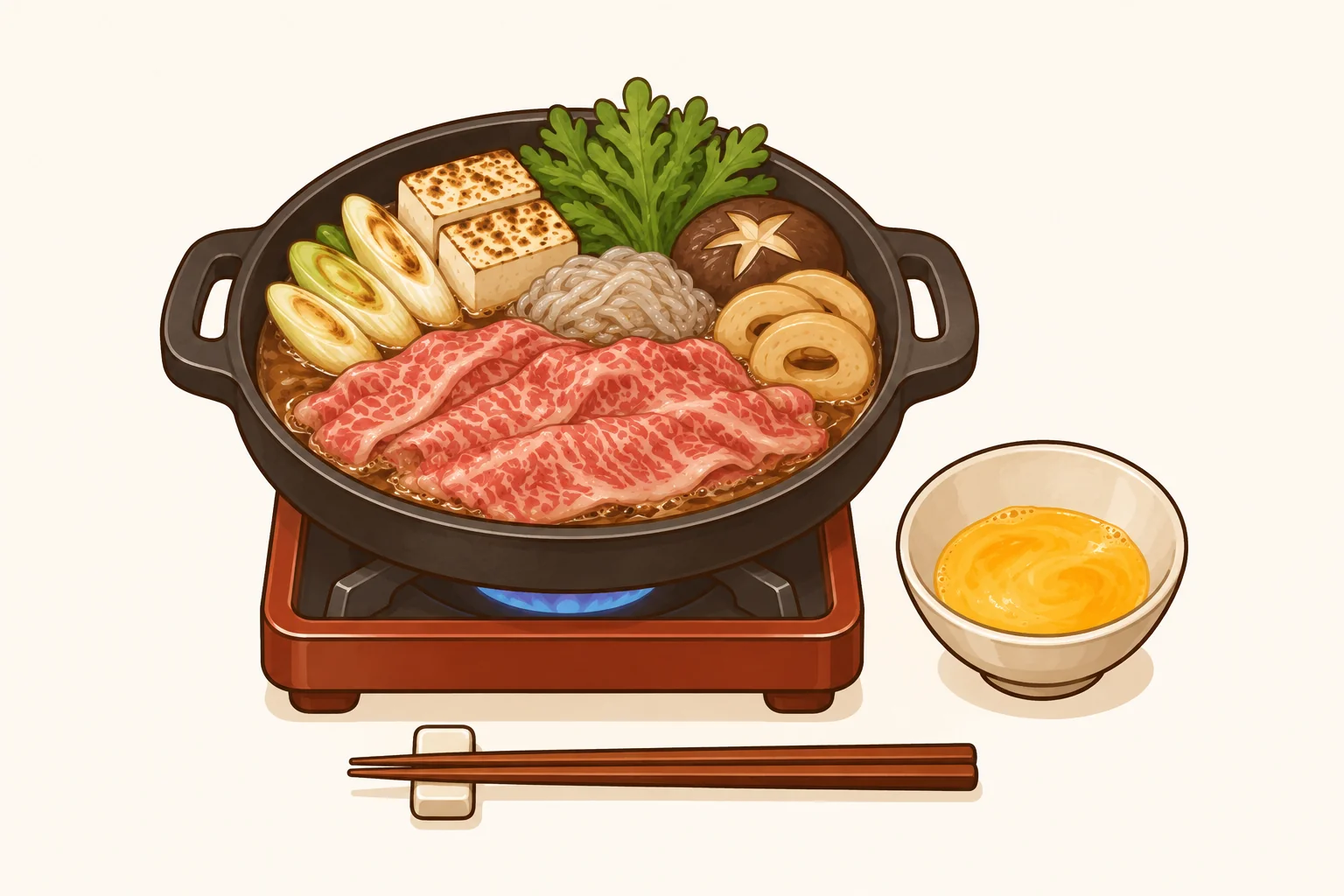
A sukiyaki pot is a shallow, heavy cast-iron pan. It goes on the burner until it is very hot, and the first thing that touches it is a cube of beef fat, rubbed around with chopsticks until the surface glistens and the room smells of it. Then come the slices of beef, so thin they drape over the chopsticks, and a pour of warishita, a sauce of soy sauce, sugar, mirin and sake. The beef changes color in seconds. You lift a slice out, dip it into a small bowl of beaten raw egg, and eat it. After the first round of meat the pan fills with the supporting cast: long green onion cut on the diagonal, grilled tofu, shirataki (translucent noodles made from konjac), shungiku (edible chrysanthemum greens), shiitake mushrooms and little discs of wheat gluten called fu. All of them soak up a sauce that grows darker and richer with every round.
Shabu-shabu is served in a different kind of pot: sometimes a copper ring-shaped pot with a chimney in the middle, more often an ordinary earthenware or metal pot of water with, at most, a strip of kombu kelp in it. The beef is cut even thinner than for sukiyaki, thin enough that light comes through the fat. You take one slice with your chopsticks and swish it back and forth in the simmering water two or three times. The name is the sound of that motion. As soon as the pink turns pale, you dip the slice in one of two sauces: ponzu, a sharp citrus-and-soy sauce often loaded with grated daikon and chopped scallion, or a thick, nutty sesame sauce called gomadare. Vegetables and tofu cook in the same water and get dipped the same way.
- 1
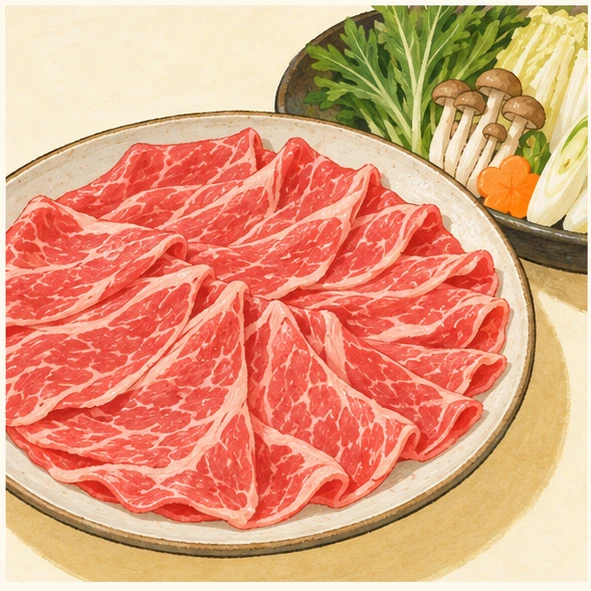 1. Thin slices of marbled beef on a platter, with vegetables and tofu alongside.
- 2
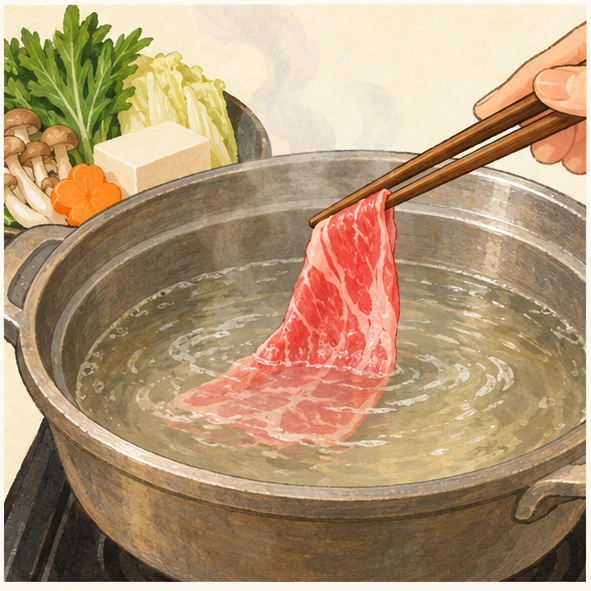 2. Hold one slice with chopsticks and swish it two or three times in the simmering water.
- 3
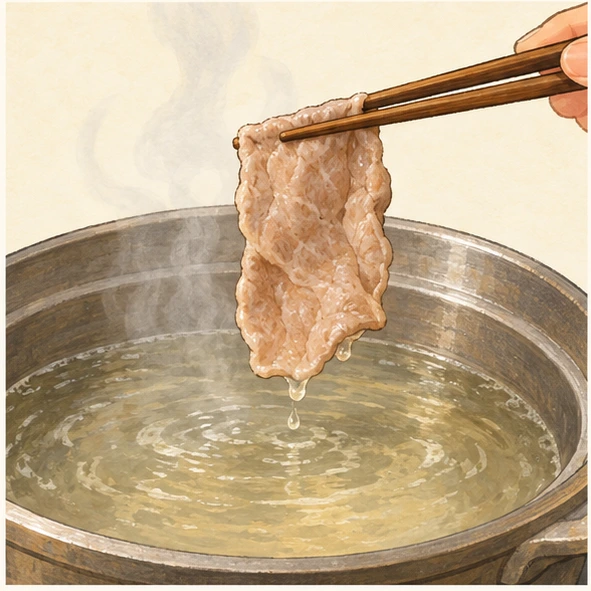 3. Lift it out as soon as the pink turns pale brown.
- 4
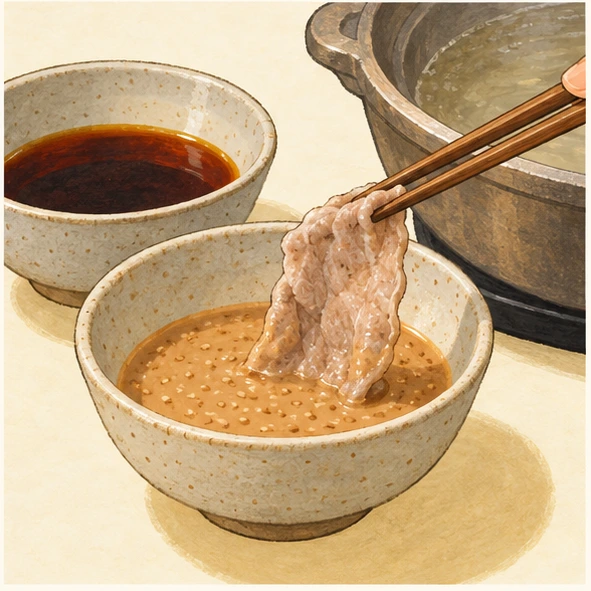 4. Dip it in ponzu or sesame sauce in your own bowl, outside the pot.
The simplest way to tell them apart is to ask where the flavor lives. In sukiyaki it is in the pot. Everything cooks in one sauce and slowly converges on one deep, sweet-savory taste. In shabu-shabu the pot stays mild from start to finish and the seasoning sits outside it, in sauces you choose bite by bite. Sukiyaki behaves like a dish that is being stewed in front of you. Shabu-shabu is more a way of eating meat, and what it shows off is the meat itself: its tenderness and the sweetness of its fat.
What they share is devotion to thinly sliced, heavily marbled beef. Japanese hot-pot beef is typically shimofuri, "frost-fallen," meaning the fat runs through the red meat in a fine web. Cut thick and grilled like a steak, beef this rich can be overwhelming. Sliced a millimeter or two thick and heated for a few seconds, the fat just melts and the slice almost dissolves. That is the whole logic of both dishes.
02Tokyo and Ōsaka: Simmer or Sear
Sukiyaki is not made the same way everywhere, and the difference between the Kantō region around Tokyo and the Kansai region around Ōsaka and Kyoto is a favorite topic of friendly argument.
The Kantō style mixes the warishita in advance. Meat and vegetables go into the pan together and the premade sauce is poured over them, so the pan works like a shallow simmering broth. This method descends directly from the gyūnabe, or "beef pot," of Meiji-era Tokyo and Yokohama. It is forgiving and consistent; whoever is in charge of the pan, the result tastes much the same.
The Kansai style takes the yaki, "grilling," in the name more literally. After the fat is rubbed in, the beef goes in alone. The cook sprinkles sugar directly over it and then splashes on soy sauce, so the sugar and soy caramelize and sizzle on the hot iron and coat the meat. That first slice, seared rather than simmered, is the point. Vegetables follow, and the water they release gradually loosens the sauce; a little sake or water is added only if needed.
Kantō: simmer
- Warishita mixed in advance
- Meat and vegetables go in together
- Sauce poured over; a shallow simmering broth
Kansai: sear
- Fat rubbed into the pan
- Beef goes in alone
- Sugar sprinkled on, then soy sauce
- The first seared slice
- Vegetables follow
- A little sake or water only if needed
Kantō mixes the warishita first and simmers everything together; Kansai sears the beef with sugar and soy, and that first slice is the point.
In practice the line has blurred. At good restaurants in either region a server usually cooks for you, and the first slice is often briefly seared with sugar and soy or a splash of warishita before the meal settles into the house routine.
03From Forbidden Meat to "Civilization and Enlightenment"
Japan’s history of openly eating beef is short. As Buddhism took hold, the court issued repeated edicts against killing animals and eating meat. The one most often cited is the order of Emperor Tenmu in 675, which banned eating cattle, horses, dogs, monkeys and chickens; the edict as recorded names the fourth to the ninth month, and it is usually read as applying only in that part of the year. Cattle were working animals that plowed fields and pulled carts, and slaughtering one for food struck most people as both unclean and wasteful. Meat never vanished entirely. In the Edo period (1603–1868) shops sold wild boar under the nickname "mountain whale" and venison as "maple leaves," often framed as medicinal food. But beef remained on the margins.
Even the word sukiyaki has several proposed origins. The best-known story says farmers grilled birds or fish on the iron blade of a worn-out spade, a suki, out in the fields, though some authorities doubt this explanation. Another derives it from sukimi, thinly sliced flesh. Cookbooks from the late Edo period do mention a dish called sukiyaki, but it was wild goose, duck or even serow grilled on an old spade, and it had little to do with the beef dish that took the name later.
The real change came after Japan opened its ports in the 1850s. Western residents in Yokohama and Kōbe wanted beef, and supply and slaughter followed. Yokohama had beef-pot shops by the 1860s; one of them, Ōta Nawanoren, says it opened in 1868 and, as of 2026, still serves gyūnabe of chunked beef simmered with miso in a shallow iron pan, square according to some accounts. The new Meiji government promoted beef as part of bunmei kaika, "civilization and enlightenment," and in 1872 it was made public that the Emperor Meiji himself had eaten beef.
Gyūnabe shops multiplied across Tokyo; by around 1877 there were roughly 500 of them. The comic writer (gesakusha) Kanagaki Robun published Aguranabe (roughly "Sitting Around the Beef Pot") beginning in 1871, a collection of comic sketches of all sorts of customers talking big over their pots. A line from it is quoted constantly: whoever you are, the book says in effect, if you don’t eat gyūnabe you are hopelessly unenlightened. The beef of those days was tougher and gamier than today’s. Tokyo shops set a flat iron pan over a charcoal brazier and simmered the meat in warishita with nothing but short lengths of long green onion, and no one dipped it in raw egg, a long way from the generously loaded pans of modern sukiyaki.
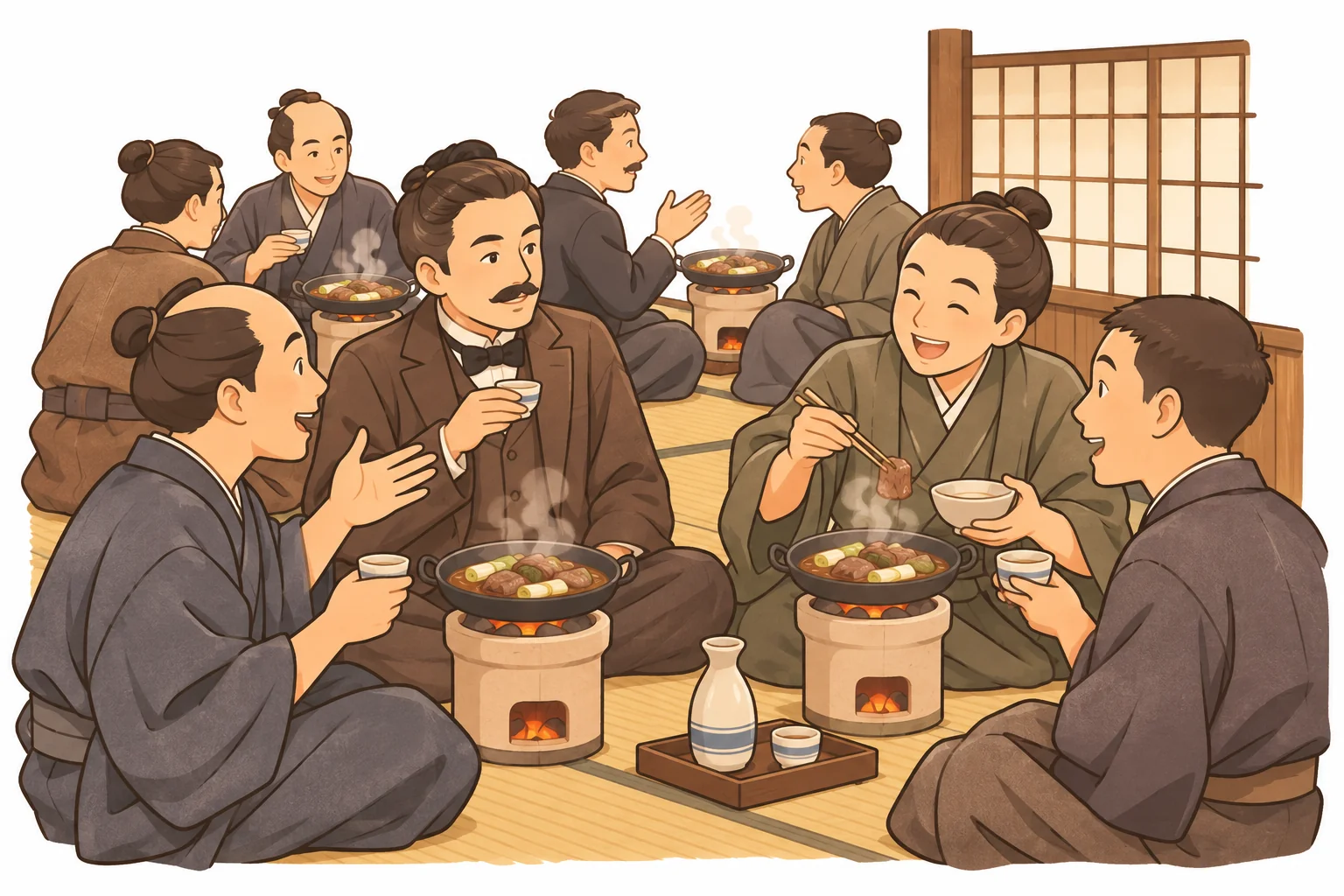
An early Meiji gyūnabe shop: diners around small iron pans of beef and leeks over charcoal, drinking and talking (illustration).
In Kansai, meanwhile, the name sukiyaki had stayed in use. Mishima-tei in Kyoto, founded in 1873, is the classic example of an old Kansai sukiyaki house. For decades the division held: Tokyo had gyūnabe, Kansai had sukiyaki. During the Taishō era (1912–1926) the Kansai name gradually replaced gyūnabe in Tokyo and then nationwide. The Great Kantō Earthquake of 1923, which destroyed many Tokyo beef-pot shops and opened the way for Kansai-style sukiyaki restaurants, is generally thought to have sped the change, even though Tokyo kept its habit of mixing the sauce in advance.
After World War II, as incomes rose, beef became less of a luxury, and sukiyaki became the Japanese family’s celebration dinner. New Year, visiting relatives, a child’s entrance exam passed, a bonus paid: out came the electric burner and the iron pan, and everyone gathered around. For many Japanese people sukiyaki still carries a faint sense of "today is special."
The word got an unexpected boost abroad in 1963, when Sakamoto Kyū’s song "Ue o Muite Arukō" ("I Look Up as I Walk") reached number one on the Billboard Hot 100 in the United States. The record company decided the original title was too hard for American listeners and released it under a Japanese word they might already know: "Sukiyaki." The lyrics, about walking with your face turned up so the tears won’t fall, have nothing to do with food.
04Shabu-Shabu: A Postwar Invention
Shabu-shabu is much younger. Its usual ancestor is said to be the Beijing dish of instant-boiled mutton, shuan yangrou, in which paper-thin lamb is dipped into a pot of boiling water and eaten with sauces. Yoshida Shōya, a physician from Tottori who had served in Beijing as an army doctor during the war and was active in the mingei folk-craft movement, is credited with adapting it to beef and introducing it to the Kyoto restaurant Jūnidanya, which served it as a beef mizutaki, a hot pot cooked in plain water.
In 1952 the Ōsaka steak restaurant Suehiro refined the dish and gave it the name shabu-shabu. According to the restaurant’s story, the name came from the sound of a towel being rinsed in a basin of water, which an employee thought sounded like diners swishing meat through the pot. The word was catchy and described the act of eating perfectly. Suehiro later registered "Suehiro no shabu-shabu" as a trademark but reportedly did not stop other restaurants from using the name, and the word shabu-shabu itself soon became an ordinary noun.
The dish suited its time. It needed no elaborate seasoning, just water and two sauces. It put the quality of the meat front and center, just as regional brands of Japanese beef were taking shape. And it felt light compared with a greasy steak or a sweet, heavy sukiyaki. By the 1960s and 1970s shabu-shabu stood beside sukiyaki as a dish for entertaining guests, including foreign visitors.
It has branched out ever since. Pork shabu-shabu is a weeknight staple in Japanese homes, and in summer people make reishabu, cold shabu-shabu, chilling the cooked pork and serving it as a salad. There is yellowtail shabu-shabu in winter, octopus shabu-shabu, and lamb shabu-shabu in Hokkaidō. Chain restaurants have turned it into an all-you-can-eat meal with individual pots and a time limit. The finish is often the best part. Udon noodles go into the pot, or rice and a beaten egg to make zōsui, a soupy rice porridge, and the water that started out almost bare has become a broth full of beef and vegetables.
05The Beef, the Pan and the Raw Egg
Both dishes owe their standing to Japanese beef. Top restaurants usually serve wagyū from the Japanese Black breed, and the names of producing regions — Matsusaka, Kōbe, Ōmi, Yonezawa — often lead the menu. Wagyu fat melts at a low temperature, which is why it softens so quickly in the pot and gives off a sweet, almost buttery aroma. Thin slicing is a craft in itself. The meat is chilled until firm, cut into even sheets, and laid out on the platter so the marbling shows. At a good restaurant, the plate of raw beef is meant to be looked at before it is cooked.
The raw egg makes many visitors hesitate. Eggs in Japan are produced and graded with raw consumption in mind, and eating them raw is ordinary; plenty of people start the day with tamago kake gohan, raw egg stirred into hot rice. In sukiyaki the egg does a practical job. It cools a slice that has come straight out of a scalding, sugary sauce, softens the saltiness, and gives the meat a silky coating. If you would rather not, you can eat the beef as it is, or ask whether the kitchen can soft-cook the egg.
One piece of sukiyaki lore concerns the shirataki noodles: they should not sit right next to the beef, because something in the konjac is said to toughen the meat and dull its color. The Japan Konnyaku Association has tested the idea and found no difference in the meat’s texture, but many restaurants and households still keep the two apart in the pan.
06Eating Them in Japan
For a proper sukiyaki dinner, the old houses are the place to start: Ningyōchō Imahan and Asakusa Imahan in Tokyo, Chinya in Asakusa, Mishima-tei in Kyoto, Ōta Nawanoren in Yokohama for the older gyūnabe style. These restaurants usually seat you in a private room or at a counter, and a server, often called a nakai, cooks at your table. She rubs the pan with fat, sears the first slice, places it in your egg bowl, and then works through rounds of vegetables and meat. Your job is to eat and to nod when she asks whether you would like another slice. As of around 2025, lunch sets run a few thousand yen; dinner courses built around premium wagyu can easily cost ten or twenty thousand yen per person or more.
There are cheaper routes. Department store restaurant floors often have mid-priced sukiyaki and shabu-shabu restaurants. All-you-can-eat chains will fill you up for a few thousand yen with lower grades of beef but the same pots and sauces. In winter the big beef-bowl chains sell single-serving sukiyaki set meals in small iron pans for around 900 yen (as of winter 2025), which is a fair way to try the flavor.
At shabu-shabu restaurants the server usually demonstrates with the first slice or two. The etiquette is simple. Take one slice at a time rather than tipping the whole plate into the pot. Two or three swishes is enough; overcooked, the beef turns tough. Skim off the foam with the little ladle as it rises so the broth stays clear. Ponzu for the beef and sesame sauce for the vegetables is a common pairing, though nobody will stop you from doing it the other way around. Save room for the noodles or porridge at the end.
Sukiyaki usually finishes with udon simmered in the leftover sauce, or with the last of the egg poured over a bowl of white rice. Some restaurants will ask if you want it; if they don’t, it is fine to ask.
Both are dishes for sharing, best with two or three people or more. When you book, check whether the course is sukiyaki or shabu-shabu, where the beef comes from and how many grams you get. Then sit down, let the pan heat up, and follow the server’s rhythm.