
At a glance
Follows buckwheat from mountain famine crop to Edo street food and New Year’s Eve ritual, explaining how soba is made, regional styles, and how to order and eat it.
- Buckwheat is not a wheat but an annual of the knotweed family that tolerates poor, cold ground; as of 2025 about 40% of Japan’s acreage is in Hokkaidō.
- The word sobakiri first appears in a 1574 document from Jōshō-ji, a temple in the Kiso valley of Nagano.
- Nihachi soba usually means eight parts buckwheat to two of wheat, though some say it was the 16-mon price.
- Handmade soba follows “first the bowl, second the rolling, third the knife”: mixing matters most.
- After cold soba, pour sobayu into the leftover dipping sauce and drink it to finish the meal.
Soba are thin, gray-brown noodles made from buckwheat, and in Japan they live two lives at once. At a train station counter in Tokyo, a commuter can buy a bowl from a ticket machine and finish it standing up in three minutes. In a mountain village in Nagano, a cook may spend the whole morning mixing, rolling and cutting the day’s noodles by hand, and close the shop when they run out. Soba is cheap, everyday food, and also one of the most fussed-over dishes in the Japanese kitchen. This piece explains where soba came from, why Tokyo in particular made it its own, how it is made and served, and how to eat it well when you are in Japan.
01A Plant for Poor Ground
Buckwheat is not wheat, and not a grass at all. It is a relative of sorrel and rhubarb, with small, three-cornered seeds in a dark husk. What made it valuable in Japan was its toughness. It grows in thin, acidic soil and cool mountain climates where rice struggles, and it goes from sowing to harvest in two to three months, so in some areas it can be grown twice a year. For upland farming communities, it was a crop to fall back on when everything else failed. Japan’s famous soba regions, Shinshū (Nagano), Izumo in Shimane, Fukui and Yamagata, tend to be places like that, and as of 2025 about 40 percent of Japan’s buckwheat acreage was in Hokkaidō.
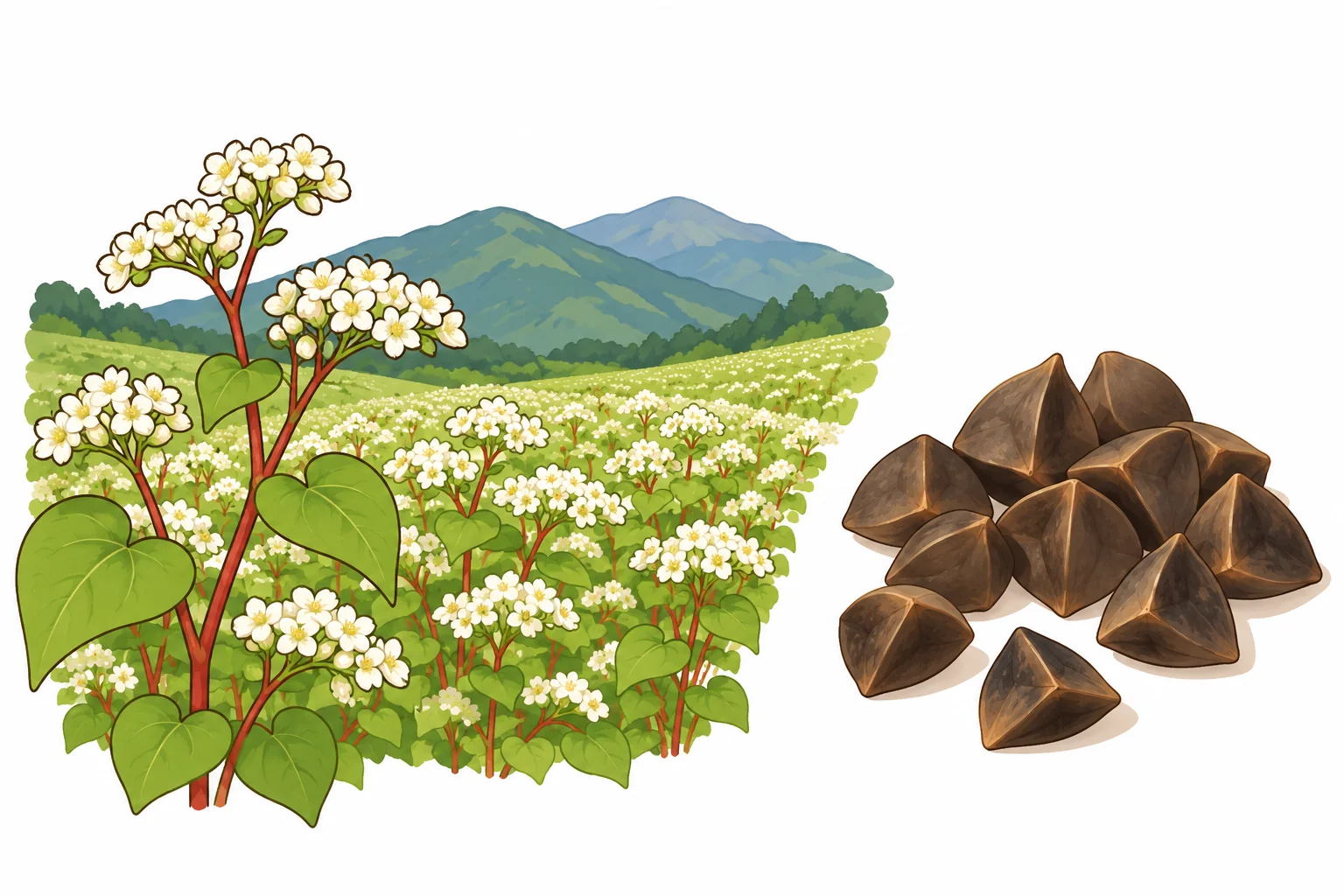
A field of white-flowering buckwheat in the hills, beside close-up three-sided dark brown buckwheat seeds (illustration).
Buckwheat flour has no gluten, which is the reason soba took a long time to become a noodle. Mixed with water, it makes a dough that crumbles rather than stretches. For centuries the Japanese ate buckwheat as porridge, dumplings, or sobagaki, a thick paste made by stirring the flour with hot water and eaten with soy sauce. Rolling the dough flat and cutting it into strips was a separate technique with its own name, sobakiri, "cut soba." The word soba on a menu today is a shortening of that.
The earliest known written use of the word sobakiri is in a record from Jōshō-ji, a temple in the Kiso valley of Nagano. In 1574, during repairs to the temple’s buildings, a donor sent sobakiri to feed the workers, and the temple noted it down. Other regions, notably Kōshū (Yamanashi), have their own origin stories, but by the early 1600s cut soba was spreading well beyond the mountains.
02Edo Makes It Its Own
Soba became a culture, rather than just a food, in Edo, the city that is now Tokyo. Seventeenth- and eighteenth-century Edo was full of men without kitchens: samurai serving rotating terms in the shogun’s capital, artisans, porters, and laborers from the provinces. They needed food that was quick, cheap and filling, and the city answered with stalls and small shops selling soba, sushi and tempura, the trio still remembered as Edo’s fast food.
To keep the noodles from breaking, cooks mixed wheat flour into the buckwheat as a binder. The standard ratio became eight parts buckwheat to two parts wheat, known as nihachi, "two-eight." From the early eighteenth century, Edo soba shops and stalls advertised nihachi on their signs, and a bowl often cost 16 mon, which has led to a second theory: that "two-eight" was a pun on two times eight, the price. Both explanations are still told.
That 16-mon bowl is the setup for Toki Soba, one of the best-known pieces of rakugo, the Japanese art of comic storytelling. It began as an Ōsaka story about udon and was moved to Tokyo, and to soba, in the Meiji era. A sly customer at a night stall pays by counting coins into the vendor’s hand one by one, then interrupts himself at eight to ask the time. "Nine," says the vendor, and the customer carries on counting from ten, cheating him of a coin. A dim-witted onlooker tries the trick the next night, but asks too early, gets the answer "four," carries on from five, and ends up paying four coins too many.
Edo diners had strong views on how soba should be eaten. Cold noodles were served on a bamboo tray and dipped in a dark, salty sauce, but only the bottom third of each mouthful went into it before being slurped up in one go. An old joke has a dying Edo man confess his one regret: he never once got to dunk his soba all the way into the sauce. It mocks the saltiness of Tokyo sauce and the pride people took in eating the right way.
Over time, Edo’s soba shops formed lineages, and three names still hang over the doors of many Tokyo restaurants. Sarashina shops are known for very white, silky noodles made from the inner part of the seed; the line traces back to a shop founded in Azabu in the late eighteenth century. Yabu shops, with Kanda Yabu Soba as the flagship, serve greener, more assertive noodles with a sharp, concentrated dipping sauce. Sunaba shops trace their origin to Ōsaka. In the eighteenth century, soba shops such as Izumiya stood in a district of Shinmachi called Sunaba, "the sandpit," and the shops took the place’s name; by tradition the site had been a yard for sand and stone during the building of Ōsaka Castle. The lineage later moved to Edo.
03How Soba Is Made
Handmade soba begins with mizumawashi, the slow work of sprinkling water into the flour and raking it through with the fingertips until every grain is evenly moist. Soba makers treat this as the most important step, ahead of rolling and cutting; a trade saying, as it is usually quoted, runs ichi hachi, ni nobashi, san bōchō: first the bowl, second the rolling, third the knife. Because buckwheat dough has no gluten to forgive mistakes, the hydration step decides whether the noodles will hold together.
- 1
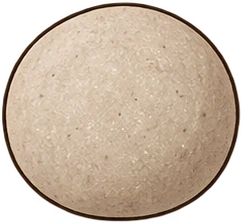 Once the flour has evenly taken up water, knead it into a smooth ball.
- 2
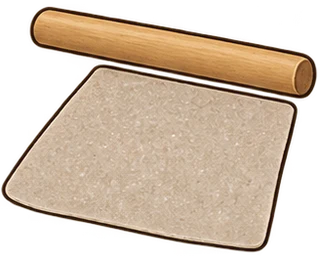 Roll it with a rolling pin into a large square just over 1 mm thick.
- 3
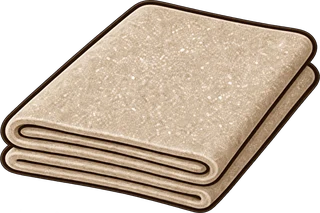 Fold the sheet into layers and lay it on the board.
- 4
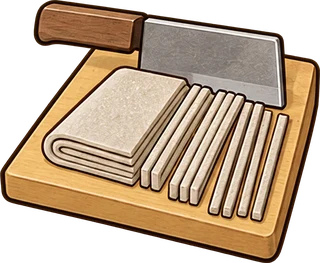 Cut it stroke by stroke with a soba knife into even strands.
- 1
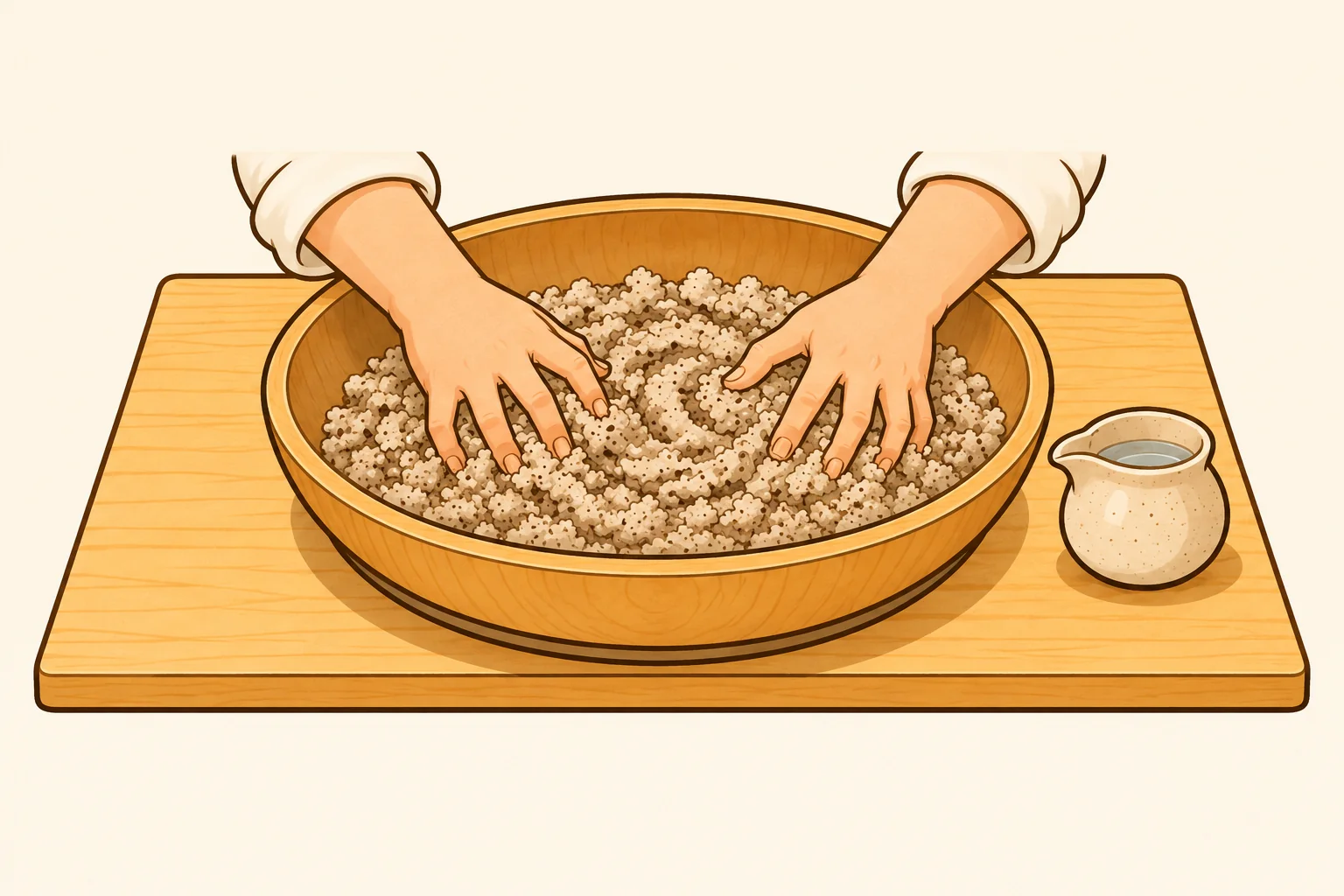 Mizumawashi: water is sprinkled into the flour and raked through with the fingertips until evenly moist.
- 2
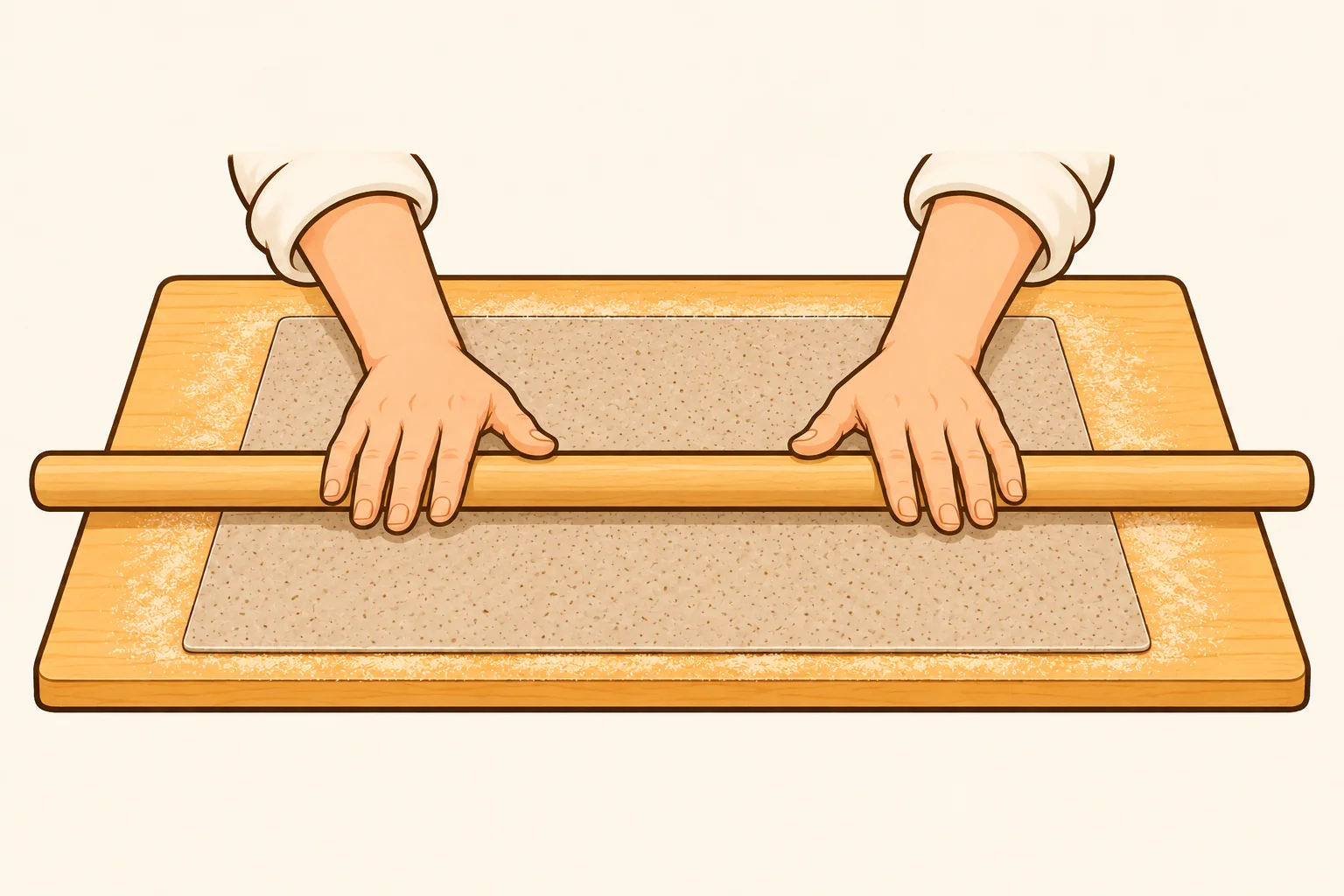 The dough is rolled out with a long wooden pin into a large sheet a little over a millimeter thick.
- 3
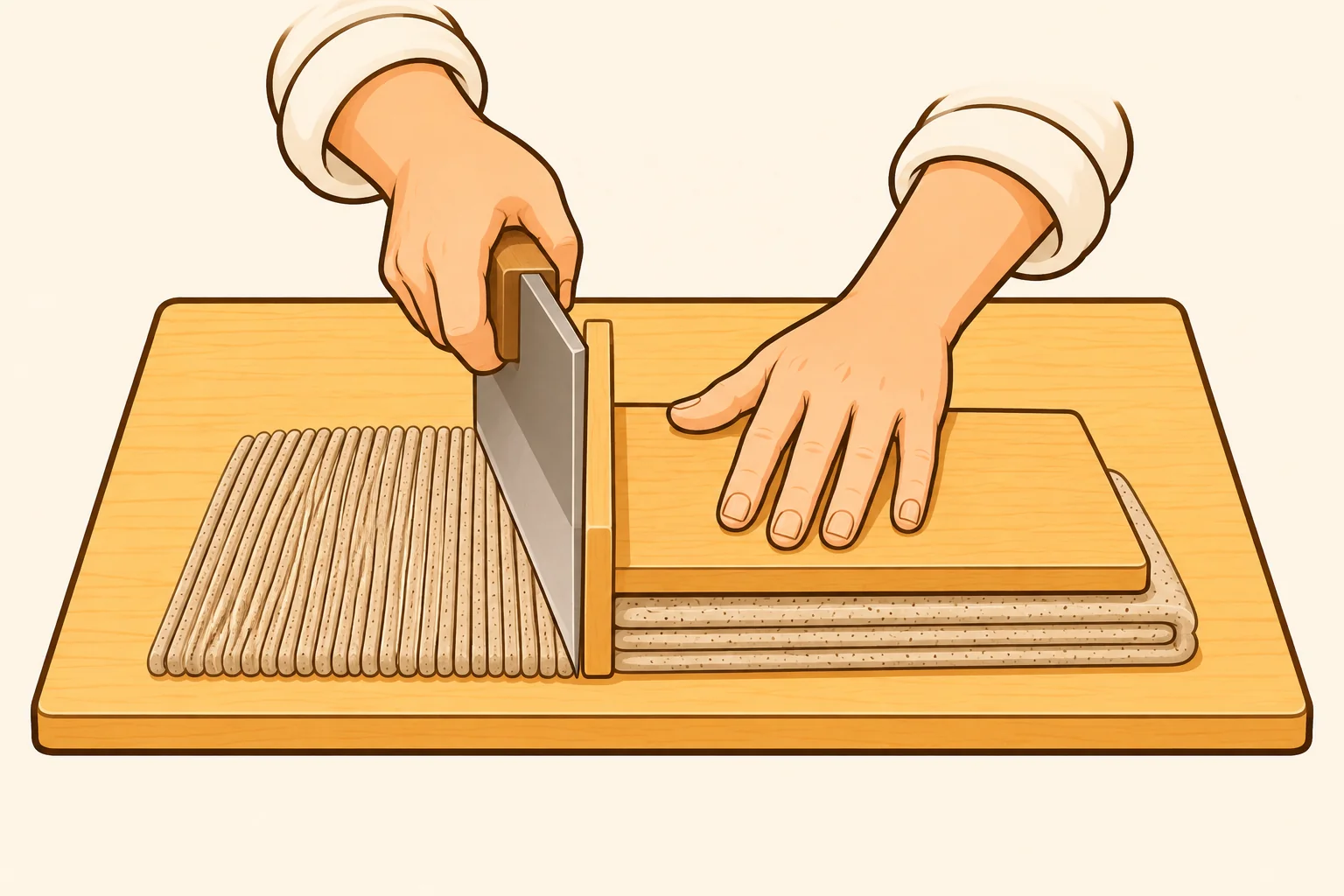 The folded sheet is cut with a heavy soba knife run along a wooden guide board called a komaita.
The moistened flour is gathered into a ball, kneaded smooth, and rolled out with long wooden pins into a large sheet a little over a millimeter thick. The sheet is folded into layers and cut with a heavy, rectangular soba knife. The cutter uses a flat wooden guide board called a komaita, shifting it back a hair after each stroke so that every strand comes out the same width. Watching a skilled maker cut is one of the small pleasures of a good soba shop, many of which do this work behind a window facing the street.
| Flour | Milled from | Noodles |
|---|---|---|
| Ichiban-ko | The core only | Sarashina style, pale and refined |
| Whole-ground | With the outer layers | Inaka soba, dark and speckled |
| Jūwari | Buckwheat only, no wheat | Strongest taste, hardest to make |
The core of the seed is white, mild and smooth; the outer layers are darker and more fragrant.
The flour shapes the flavor. The core of the buckwheat seed is white, mild and smooth; the outer layers are darker and more fragrant. Flour milled only from the core, called ichiban-ko, gives the pale, refined noodles of the Sarashina style. Flour milled with the outer layers gives inaka, "country," soba, dark and speckled with a rougher bite. Soba made with no wheat at all is jūwari, "ten-tenths." It has the strongest buckwheat taste and is the hardest to make well.
In autumn, flour from the new harvest has a noticeably brighter aroma. From roughly September to November, soba shops put up signs reading shin-soba, new soba, and regulars make a point of coming in.
The dipping sauce, tsuyu, is made in two stages in the Tokyo style. Soy sauce, sugar and mirin are cooked into a concentrate called kaeshi and left to rest for days so the flavors settle. It is then mixed with a strong stock of dried bonito. Sauce for cold noodles is concentrated; the broth for hot soba is the same base, diluted. Cold soba usually comes with chopped green onion and wasabi on the side.
04Hot, Cold, and Regional
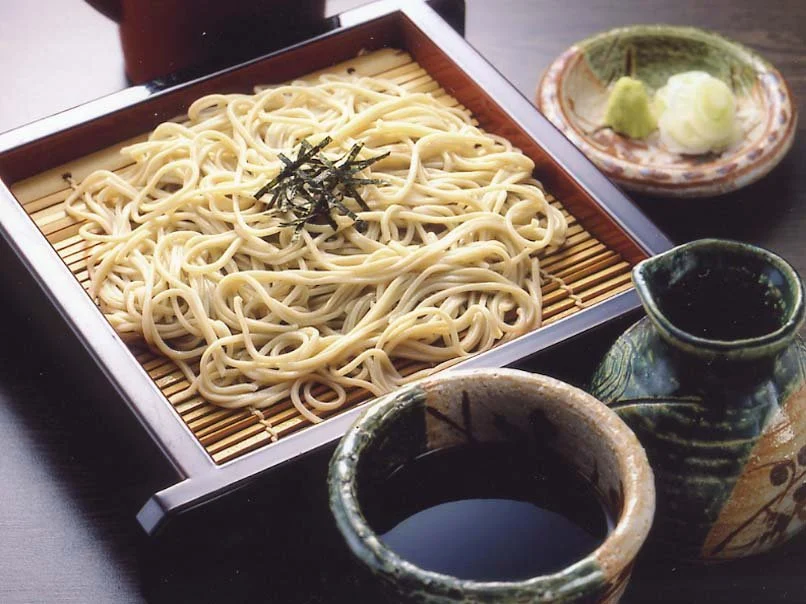
A soba menu divides into cold and hot. The basic cold dish is mori soba, chilled noodles on a bamboo tray with sauce on the side; add strips of nori on top and it becomes zaru soba. The basic hot dish is kake soba, noodles in hot broth with nothing else. From there the menu builds: tempura soba with shrimp tempura, kitsune with sweet simmered fried tofu, tanuki with crunchy bits of tempura batter, kamo nanban with duck and leeks, tsukimi, "moon-viewing," with a raw egg, and tororo with grated mountain yam. Kamo seiro sits in between, cold noodles dipped into hot duck broth.
The words kitsune (fox) and tanuki (raccoon dog) are a famous point of friction between eastern and western Japan. In the Kantō region around Tokyo, tanuki means tempura bits. In Ōsaka, fried tofu on udon is kitsune, and fried tofu on soba is tanuki. Behind the joke is a real division: the Kantō is soba country, and Kansai leans toward udon.
Outside Tokyo, regional styles are a reason to travel. Three are often grouped as Japan’s great soba. In Morioka and Hanamaki in Iwate, wanko soba is served as a kind of endurance game: a server stands beside you and keeps tossing single mouthfuls into your bowl until you clap the lid on, and at the old shops anyone who reaches a hundred bowls gets a commemorative plaque. In Togakushi, in the mountains above Nagano city, dark whole-grain noodles are laid on bamboo trays in five small looped bundles, a style called bocchi-mori. In Izumo, dark soba made with whole-grain flour is served in stacked round red-lacquer dishes called warigo. You pour the sauce straight onto the top tier, eat, and tip what is left into the next tier down.
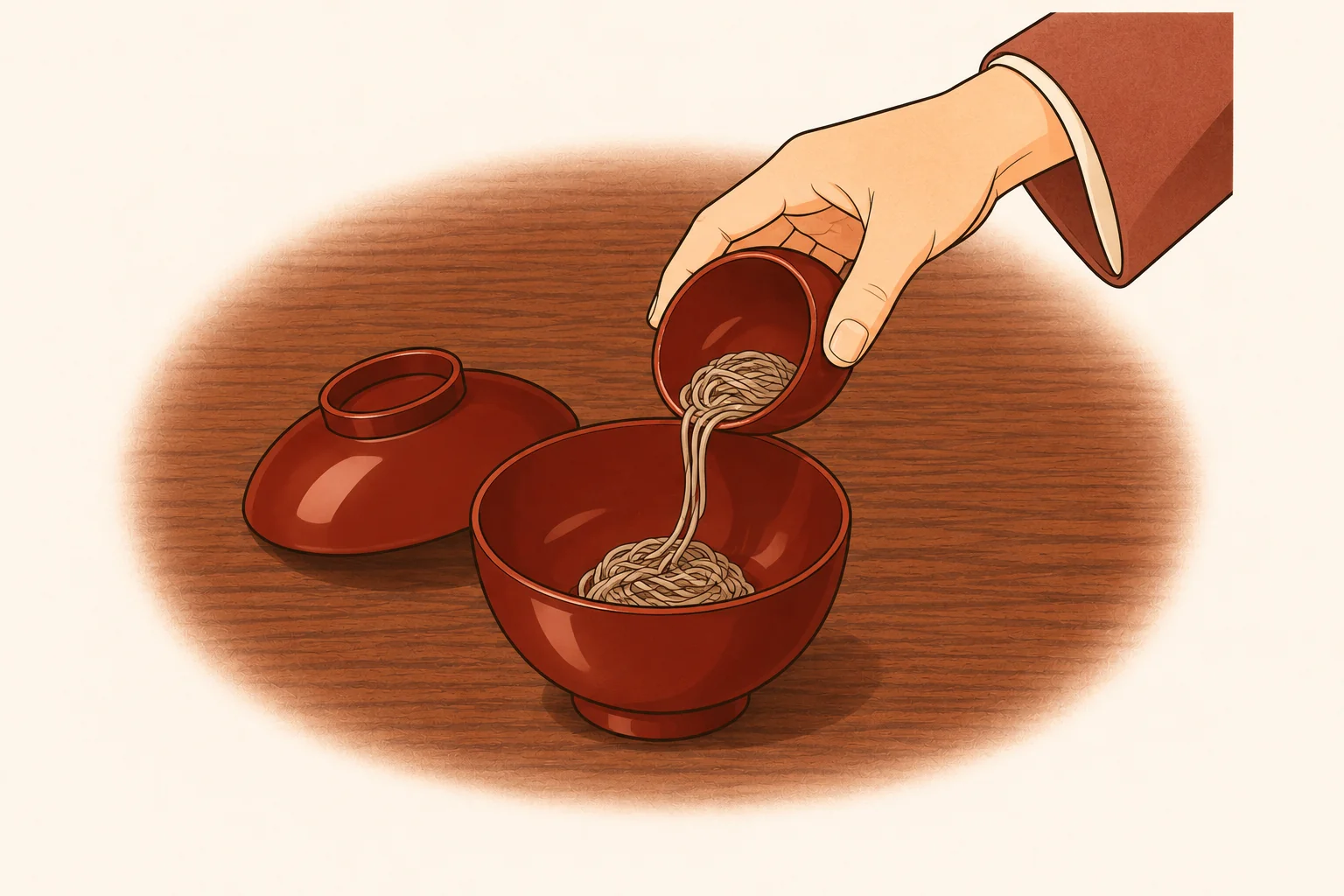
Wanko soba, Iwate: a server keeps tossing single mouthfuls into your bowl until you put the lid on.
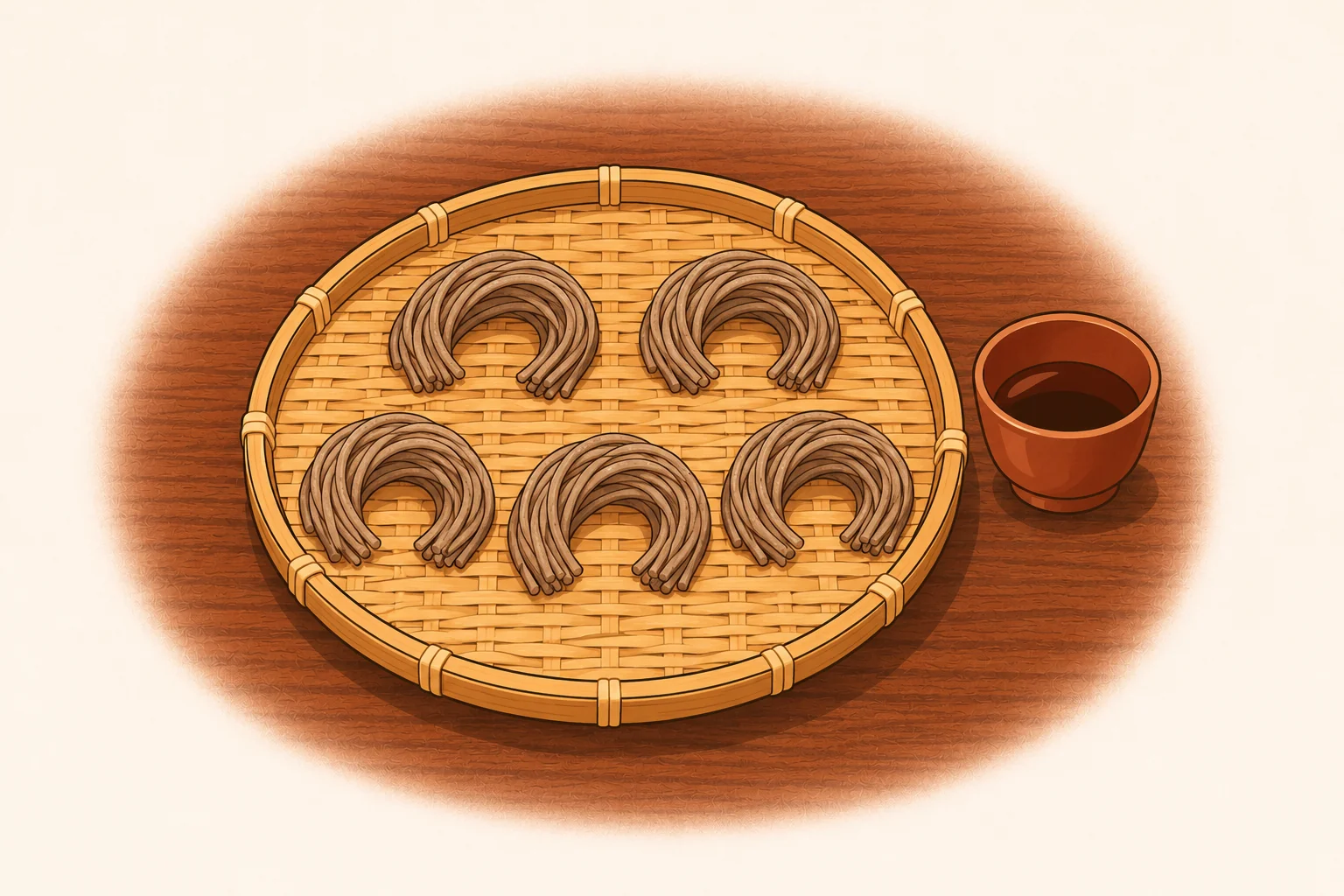
Togakushi soba, Nagano: dark noodles laid on a bamboo tray in five small looped bundles, a style called bocchi-mori.
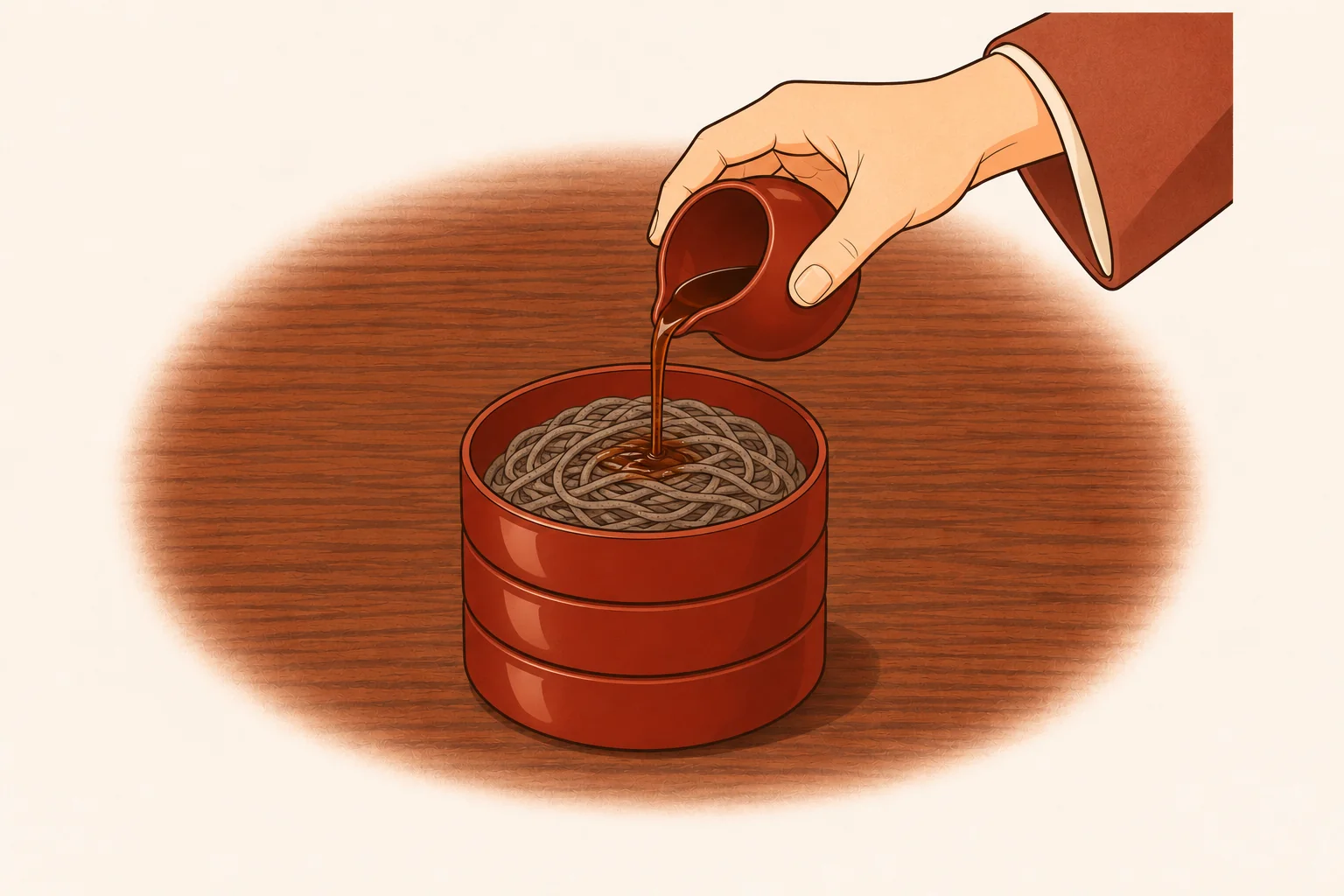
Izumo soba, Shimane: served in stacked round red-lacquer dishes called warigo, with the sauce poured straight onto the top tier.
There are many others. Hegi soba from the Uonuma area of Niigata uses a seaweed called funori as its binder, the same seaweed local weavers once used to size the thread for Ojiya crepe cloth. It gives the noodles a smooth, springy texture, and they come laid out in mouthful-sized portions on a large wooden tray called a hegi. In Izushi in Hyōgo, a single serving is divided among five small plates of white Izushi porcelain; the local story is that the Sengoku lords brought soba makers with them when they were transferred from Ueda in Shinshū in 1706. Yamagata has niku soba, cold chicken soba in a cold broth.
One caution on vocabulary: Okinawa soba and yakisoba, the fried noodles sold at festivals, are made from wheat. In those names, soba simply means noodles.
05New Year’s Eve and Moving Day
On December 31, many Japanese households eat toshikoshi soba, "year-crossing soba." The reasons given vary. Long, thin noodles suggest a long life. Soba breaks easily, so eating it cuts off the hardships of the year. Goldsmiths once used buckwheat dough to gather up stray gold dust, so soba might bring money. Another holds that Edo merchants ate soba at the end of every month, and the habit survived only at year’s end. Most of these are explanations attached after the fact, but the custom was established in the cities during the Edo period, generally said to have spread from the mid-Edo period on, and today soba shops have queues on the afternoon of New Year’s Eve while supermarkets stack up packs of fresh noodles.
There is also hikkoshi soba, "moving soba." In Edo, people moving into a new house gave soba to their neighbors, playing on the word soba, which also means "beside": we are now living beside you, please look kindly on us. The gift has mostly faded in modern cities, but most people still know the custom.
Soba also has a place as an affordable kind of connoisseurship. As of 2026 a bowl at a station counter costs a little over 400 yen; a tray at a celebrated shop may cost well over a thousand. The gap is small, and both can be taken seriously. Learning to make soba by hand is a popular hobby, especially among retired men, and there are classes across the country and even amateur grading exams.
06Eating Soba in Japan
The easiest soba to find is at the station. Chains such as Fuji Soba and Komoro Soba, and the many standing counters known as tachigui soba, work the same way: buy a ticket from the machine at the door, hand it over at the counter, and your bowl arrives in a minute or two. You eat standing, then return the bowl. The noodles are machine-made, but the broth is hot, the service is instant, and a bowl topped with a kakiage fritter of mixed vegetables is as Tokyo as it gets.
For something better, look for an old-line shop or a place advertising handmade noodles, teuchi. Many close when the day’s noodles are gone. On a first visit, order mori or zaru, because cold soba shows the noodle itself. Try a few strands with nothing on them to taste the buckwheat. Then add a little onion and wasabi to the sauce, dip the ends of a mouthful, and slurp. Noisy eating is normal with noodles in Japan. It pulls air and aroma in with the noodles and cools them down.
When the noodles are finished, the staff bring a square lacquered pot of sobayu, the hot water the noodles were cooked in. Pour it into the leftover sauce and drink it as a mild, faintly creamy soup. That is the end of the meal.
- 1
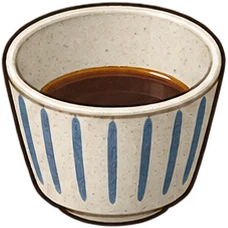 When the cold noodles are gone, dipping sauce is left in the cup.
- 2
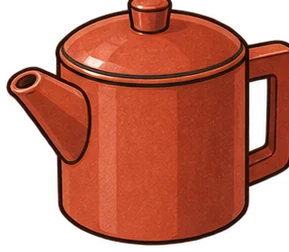 Staff bring a lacquered pot of sobayu, the hot water the noodles cooked in.
- 3
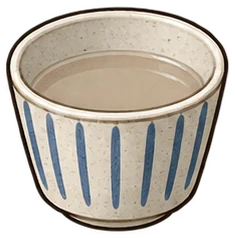 Pour it into the sauce, thin it to a mild soup and drink it to finish.
Old Tokyo shops also keep a slower habit called soba-mae, "before soba": ordering sake and a few small dishes first, such as itawasa (slices of fish cake with wasabi), a sweet rolled omelette, toasted nori, soba miso, or ten-nuki, tempura soba without the noodles. You drink for a while and finish with a tray of cold soba. On a weekday afternoon you can still see older men doing exactly this, alone at a table, the way it has been done since Edo.
One serious warning. As of 2026 buckwheat is among the allergens that must by law be labeled on packaged food in Japan, and reactions can be severe. Udon and soba are often boiled in the same water, so a buckwheat allergy calls for real caution even at an udon shop.