
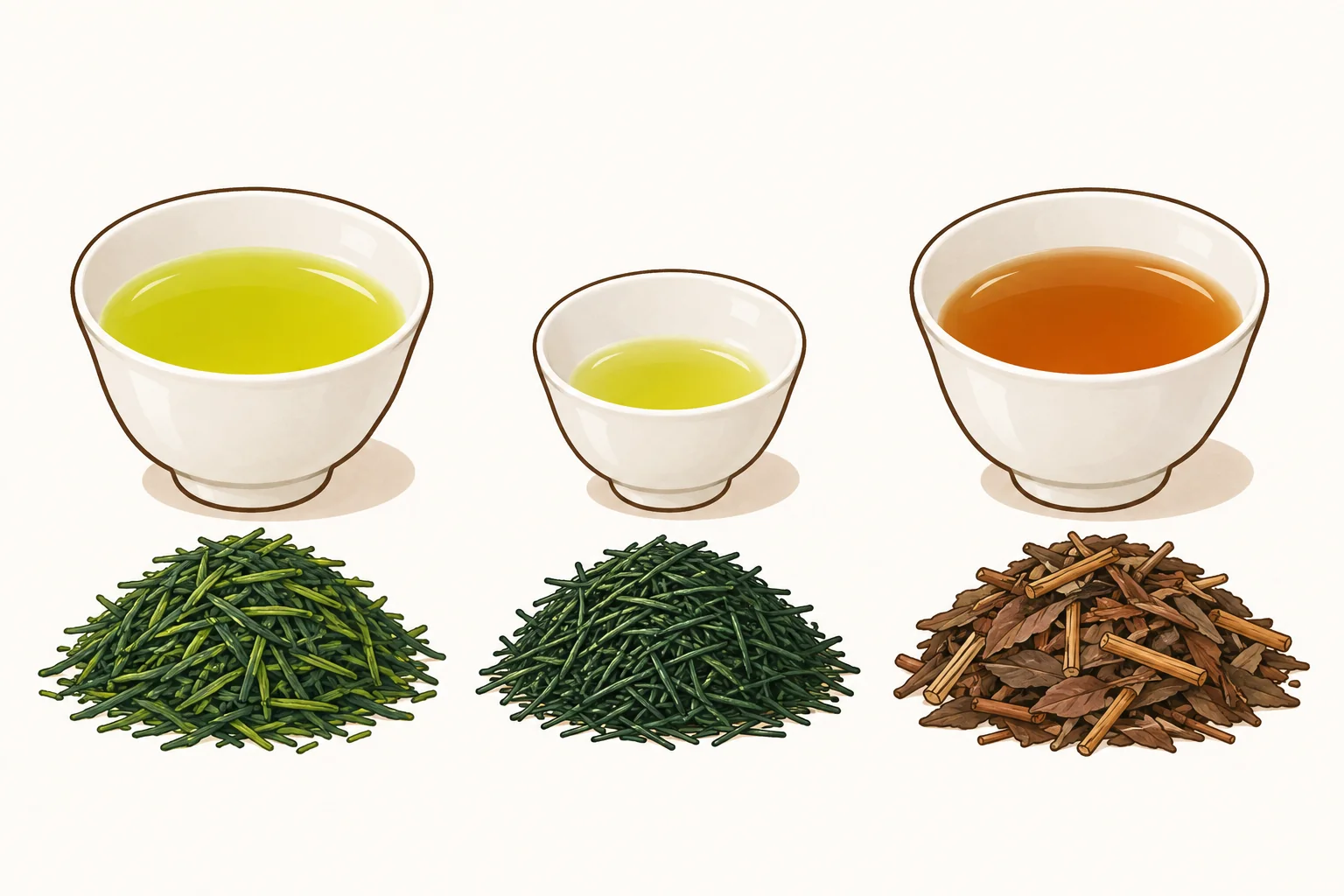
At a glance
Why Japanese green tea is steamed, how shading makes gyokuro sweet and roasting gives hōjicha its aroma, and how to brew and buy tea in Japan.
- Almost all Japanese green tea is steamed: fresh leaves are steamed to stop oxidation, keeping a deep green color and grassy aroma.
- In 1738 Nagatani Sōen of Ujitawara perfected the method of steaming leaves and hand-rolling them into fine needles.
- Gyokuro is shaded for about 20 days before picking, so theanine stays in the leaf and the taste turns sweet and savory.
- Hōjicha is leaf or stem roasted at around 200°C until brown, which leaves it only faintly bitter.
- Brew sencha with water at 70 to 80°C, 2 to 3 grams of leaf per person, for about a minute.
The cup of tea that appears unasked beside your plate in a Japanese restaurant is almost always green, and almost always some form of sencha. It tastes grassier, brighter and more savory than most green teas from China, because Japanese leaves are steamed rather than pan-fired. From the same tea bushes, by changing how the plants are grown and how the leaves are processed, Japanese producers also make gyokuro, a shaded tea so rich in savory flavor that it can taste like broth, and hōjicha, a roasted tea that smells of toasted nuts and caramel. This piece explains what separates the three, where they came from, and how to drink and buy them in Japan.
01Steamed, Not Fried
In Japan, the word ocha (tea) means green tea unless you say otherwise. Green tea is tea whose leaves have been heated soon after picking to stop the enzymes that would otherwise oxidize them and turn them dark, as in black or oolong tea. In China, that heating is usually done in a hot pan or wok. In Japan, it is done with steam: freshly picked leaves pass through a steaming drum for somewhere between half a minute and two minutes. Steaming preserves a vivid green color and a fresh, vegetal aroma, and it gives Japanese tea its characteristic flavor of cut grass, spring greens and seaweed.
Almost every Japanese tea can be placed along two lines. The first is cultivation: are the bushes grown in full sun, or covered for a few weeks before picking? The second is processing: after steaming, are the leaves rolled into needles, dried flat and ground into powder, or roasted? Sencha is the standard case: sun-grown, steamed, and rolled into fine dark-green needles. Gyokuro is shaded and then rolled like sencha. Matcha starts from shaded leaf called tencha, which is steamed and dried without rolling and then stone-ground. Hōjicha is made by roasting sencha, coarser bancha (late-harvest, large-leaf everyday tea) or stems until they turn brown.
| Tea | Cultivation | After steaming |
|---|---|---|
| Sencha | Sun-grown | Rolled into fine needles |
| Gyokuro | Shaded | Rolled like sencha |
| Tencha → matcha | Shaded | Dried without rolling, stone-ground |
| Hōjicha | — | Sencha or bancha roasted brown |
One line is cultivation (sun or shade), the other is what happens after steaming; sencha is the standard case.
Sencha accounts for the large majority of Japan’s tea production. Shizuoka and Kagoshima prefectures are the two great growing regions, together producing close to 80 percent of the country’s crude tea as of 2025 (in 2024 Kagoshima overtook Shizuoka for the first time, and it stayed ahead in 2025), while Uji, south of Kyoto, has the most prestigious name. A single cultivar dominates the fields: as of around 2020, about 70 percent of Japan’s tea acreage was planted with Yabukita, a variety selected in Shizuoka in 1908 by a tea grower named Sugiyama Hikosaburō, who found the original bush on the north side of a bamboo thicket (yabu means thicket, kita north). Registered as a cultivar in 1953, Yabukita spread nationwide after the Second World War because it is hardy, productive and reliably fragrant.
02Sencha: The Everyday Cup and Its Origins
Tea reached Japan from China in the early Heian period, and in the late twelfth century the monk Eisai brought back the Song-dynasty practice of whisking powdered tea, which grew into the tea ceremony. For centuries, though, fine tea belonged to temples, courtiers and warriors. Ordinary people drank rough, brownish bancha.
Two things changed that in the Edo period (1603–1868). First, Chinese monks of the Ōbaku school of Zen, led by Ingen, who arrived in 1654 and later founded the temple Manpuku-ji at Uji, brought the Ming habit of steeping loose-leaf tea in hot water. In the following century a former Ōbaku monk named Baisaō (1675–1763), "the old tea seller," wandered Kyoto with a portable tea stall, selling cups of steeped tea to passersby and talking about poetry and Buddhism. He made loose-leaf tea fashionable among literati, and a separate "way of sencha" (senchadō) later developed in contrast to the matcha-based tea ceremony.
The second change was technical. In 1738 a tea farmer named Nagatani Sōen, from Yuyadani in Ujitawara near Uji, perfected a method of steaming new leaves and then rolling them by hand over a heated drying table until they formed thin, tight needles. The resulting tea brewed into a clear green liquor with a lively aroma, far finer than the bancha of the day. It became known as the Uji method, and it remains the basis of sencha production. According to the Yamamoto family’s account, Nagatani took his tea to Edo, where the Nihonbashi merchant Yamamoto Kahei, second of that name, bought the whole batch on the spot, promised to take the next year’s crop as well, and sold it under the name Tenkaichi, "best under heaven." Yamamoto’s business survives as the tea and seaweed company Yamamotoyama, and Nagatanien, the maker of instant ochazuke (tea-over-rice) packets, was founded by a descendant of Nagatani’s family.
After the Meiji Restoration of 1868, tea and raw silk were Japan’s two main exports (tea is usually said to have ranked second, after silk), and most of the tea went to the United States, first through Yokohama and later directly from Shimizu port in Shizuoka. From 1869, former retainers of the Tokugawa shogunate, left without stipends, cleared land for tea on the Makinohara plateau in Shizuoka; porters who lost their work when the Ōi River crossing system was abolished soon joined them. Makinohara became one of the largest tea districts in Japan, and is often called the country’s biggest tea plantation. Rolling machines invented in the late Meiji era replaced hand-rolling, and sencha became an industrial product.
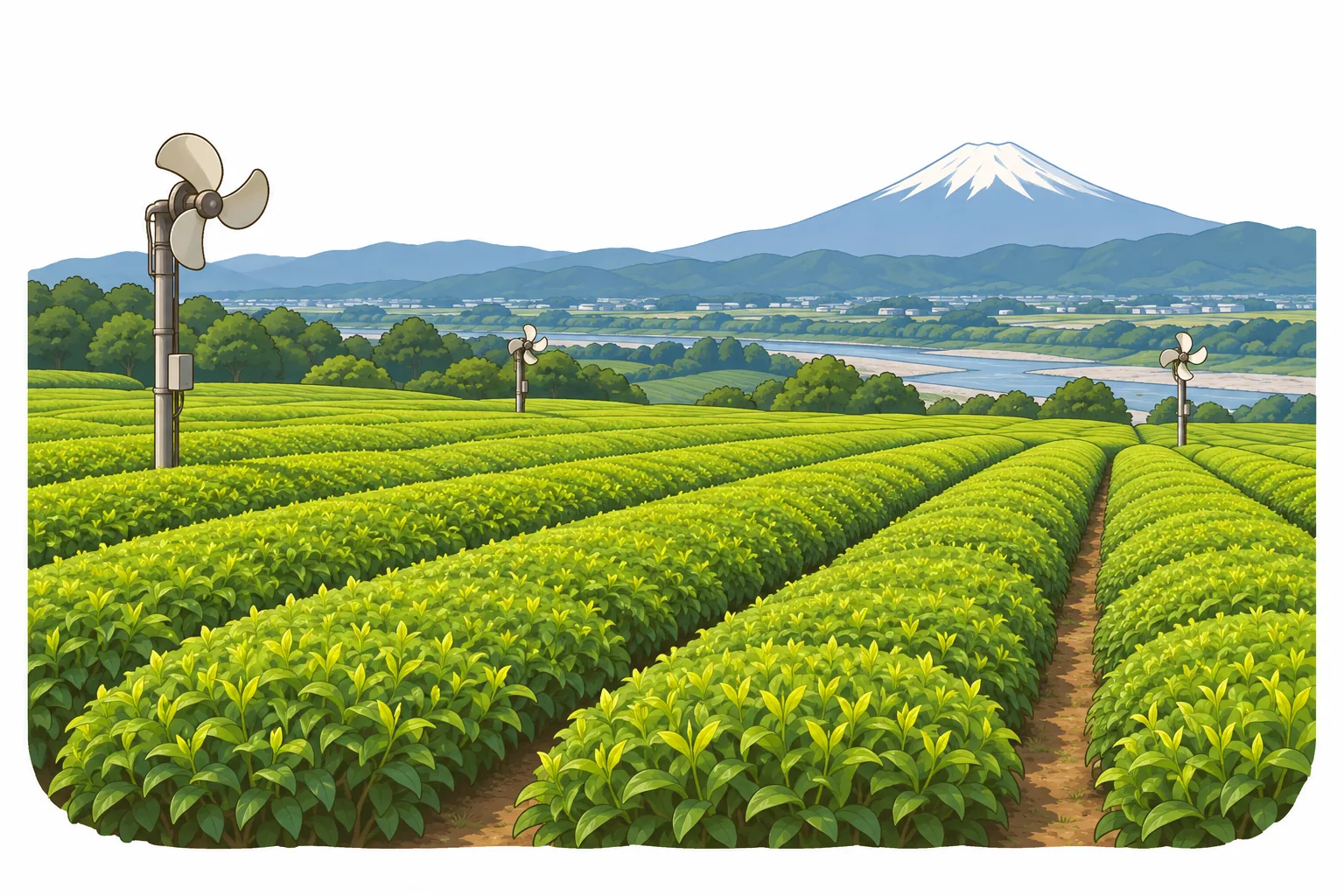
The Makinohara plateau from above, rows of rounded tea hedges stretching across the flat land (illustration).
A further development came from Kikugawa, at the edge of the Makinohara plateau, around the early 1950s: fukamushi, or deep-steamed sencha. Ordinary sencha is steamed for roughly 30 to 40 seconds; fukamushi is steamed for a minute or two, or longer. The leaves soften and break into fine fragments during rolling, and they brew a cloudy, deep-green cup with less bitterness and a rounder, fuller body. It suited the thick, sun-drenched leaves of Makinohara, which tend toward astringency when lightly steamed, and by the 1970s it had spread far beyond Shizuoka; it now fills supermarket shelves across Japan. Lightly steamed asamushi sencha, by contrast, keeps whole needle-shaped leaves and brews a clear, golden-green cup with a sharper aroma.
What makes a good sencha is balance. Savory sweetness, called umami in Japanese, comes from amino acids, especially L-theanine. Bitterness and astringency come from catechins and caffeine. The first harvest of the year, ichibancha or shincha (new tea), picked from late April into May, is richest in amino acids and most prized. Tradition holds that tea picked on hachijūhachiya, the eighty-eighth night counted from the start of spring in early February, which falls around May 2, brings long life, and the new-tea season peaks around that date.
03Gyokuro: Tea Grown in the Shade
Theanine is produced in the roots of the tea plant and carried to the leaves, where sunlight converts it into catechins. More sun means more astringency; less sun means more of the savory amino acids stay in the leaf. Gyokuro, whose name means "jade dew," exploits this.
About twenty days before picking, the gyokuro grower covers the bushes and blocks out almost all of the sunlight. The traditional method, called honzu, uses a framework of poles over the field topped with reed screens and a layer of straw; today many growers use black synthetic netting. Under the cover, the new shoots grow darker, softer and thinner, and they develop a distinctive aroma known as ōika, "covered fragrance," which people compare to nori seaweed or lightly steamed greens. After picking, the leaves are processed like sencha.
Shading was originally done for matcha fields; gyokuro is what you get when shaded leaf is processed as sencha. The best-known origin story is Yamamotoyama’s: in 1835 the sixth Yamamoto Kahei, stirring steamed leaves at a tea works in Ogura near Uji, found they dried into small round pellets, developed the method further and named the result gyokuro. It is a merchant family’s story, and another account credits the Uji tea merchant Tsuji Riemon with perfecting the gyokuro method; but there is no dispute that gyokuro came out of Uji in the late Edo period.
Today the main gyokuro regions are Yame in Fukuoka prefecture, Uji and Kyōtanabe in Kyoto prefecture, and Asahina in Okabe, Shizuoka. Growers from Yame dominate the gyokuro category of the national tea competition year after year, and Yame is generally said to produce more gyokuro than anywhere else. Gyokuro is a small fraction of Japan’s output and costs several times as much as ordinary sencha. Between the two sits kabusecha, "covered tea," shaded for only one to two weeks, with a price and flavor in the middle; Mie prefecture makes a great deal of it and is generally regarded as its main producer.
Gyokuro is brewed differently from any other tea. The water should be cool, around 50 to 60°C, and the ratio of leaf to water high. The cups are tiny, closer to sake cups than teacups, and the result is a few spoonfuls of thick, viscous liquid whose first impression is less like tea than like a delicate dashi. Some enthusiasts go further with shizukucha, "drip tea": leaves in a lidded bowl, a small splash of cool water, sipped slowly from under the lid. The spent leaves are tender enough to eat, dressed with a little soy sauce or ponzu.
04Hōjicha: Roasted Leaves and Stems
Hōjicha is green tea roasted at high temperature, around 200°C, until the leaves turn a reddish brown. Roasting drives off the grassy notes and replaces them with aromas of roasted grain, toasted nuts and caramel. It also reduces the bitterness and some of the caffeine, so the cup is mild, smooth and amber in color.
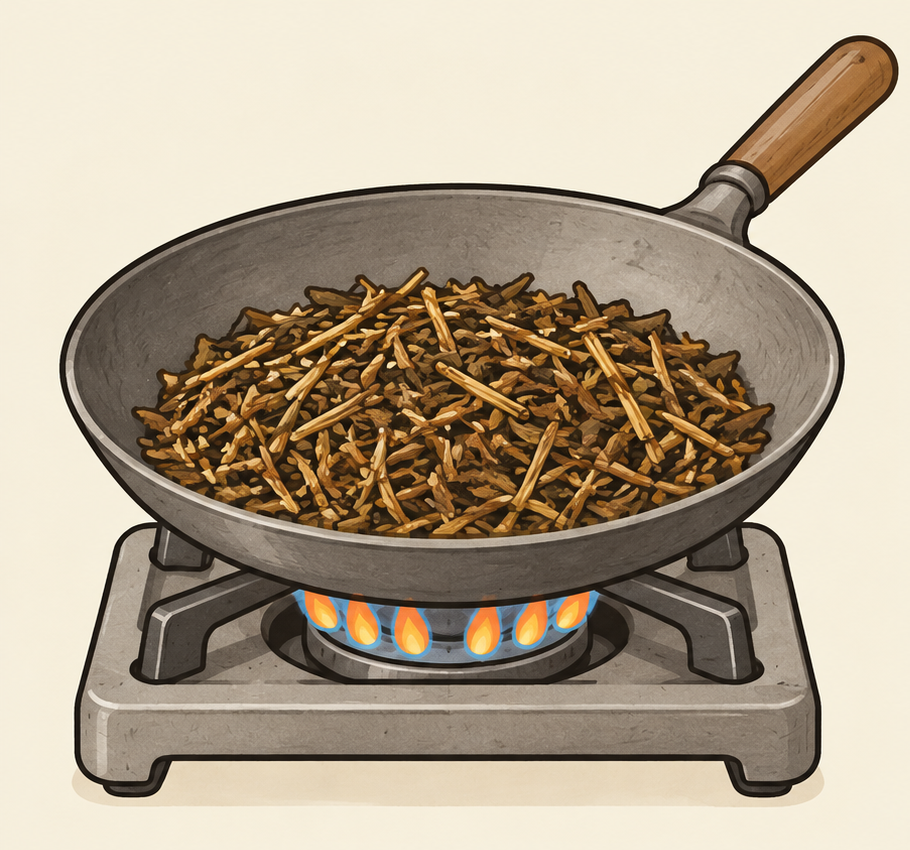
Leaves and stems are dry-roasted in a pan, with no water, until they turn brown and toasty.
It is younger than sencha and developed in the Kansai region, where tea that had lost its aroma to humidity was roasted to bring the fragrance back. The usual story places its origin in Kyoto in the 1920s, when a tea merchant roasted unsold leftover bancha and found that customers loved the result, though the tale is poorly documented. Whatever the exact beginning, hōjicha has always been a way of making inexpensive tea delicious. Its raw material is often later-harvest leaf, the large mature leaves trimmed from bushes in autumn, and the stems sifted out during sencha processing.
Stem hōjicha has its own name in Ishikawa prefecture: Kaga bōcha, "Kaga stick tea." Stems hold more sweetness than leaves, and roasted they give a rounder, sweeter cup. In 1983, when Emperor Shōwa visited Ishikawa for the national tree-planting festival, his hotel asked the old Kaga tea firm Maruhachi Seichajō for the finest roasted tea it could make. The firm chose first-harvest stems (some reports say from Kagoshima) and refined its roasting, and the result, sold as "Kenjō Kaga Bōcha" (Kaga stick tea presented to the emperor), became famous. In the Hokuriku region along the Sea of Japan coast, roasted tea is simply what households drink. Kyoto has another oddity, kyōbancha, made from whole large leaves and twigs dried and roasted without rolling. It looks like a pile of fallen leaves and has a strong smoky aroma; Kyoto families drink it daily, and visitors are often startled.
Japanese people think of hōjicha as gentle: it is served after meals, before bed, to children and the elderly, and many hospitals offer it. In the last fifteen years or so it has also become a flavor in its own right. Cafés serve hōjicha lattes; convenience stores sell hōjicha ice cream, puddings and chocolate; and tea shops in Kyoto roast leaves in revolving drums at the shop front so that the smell drifts down the street. Hōjicha now stands beside matcha as a dessert flavor.
A few related teas often appear alongside it. Kukicha, stem tea, is made from unroasted stems separated in sencha processing and tastes light and sweet; stem tea from gyokuro or top-grade sencha is called karigane. Genmaicha mixes green tea with roasted brown rice and has a toasty, popcorn-like flavor. Konacha, fine tea dust, is the strong green tea served at sushi counters, where it is called agari.
05How to Brew, Where to Drink
The classic Japanese teapot is the kyūsu, a small pot with a straight handle sticking out sideways, so that you can hold it in one hand and keep the lid in place with your thumb as you pour. Tokoname in Aichi prefecture and Yokkaichi in Mie (where Banko ware is made) are the main centers of production, and the reddish-brown unglazed Tokoname pot is the best known. A fine mesh inside the spout keeps even the small fragments of deep-steamed tea out of the cup.
Temperature matters most. For everyday sencha, water around 70 to 80°C is right; for top grades, a little lower. A simple way to cool it is to pour boiling water into the cups first and then into the pot: each transfer lowers the temperature by roughly 10 degrees, and it warms the cups at the same time. Use two or three grams of leaf per person, steep for about a minute, and pour a little into each cup in turn, going back and forth so that every cup gets the same strength. Pour out every last drop, which is the most concentrated, so that the leaves are ready for a second infusion. Hōjicha and bancha go the other way: boiling water and a short steep bring out the roasted aroma.
- 1
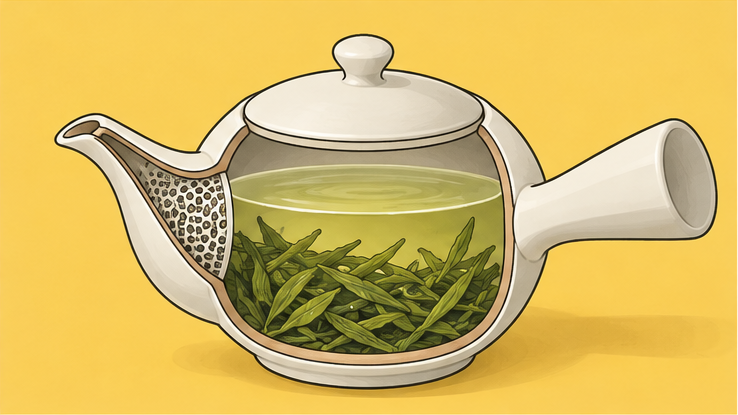 Put the leaves in the kyūsu, add water cooled to 70–80°C and steep for about a minute.
- 2
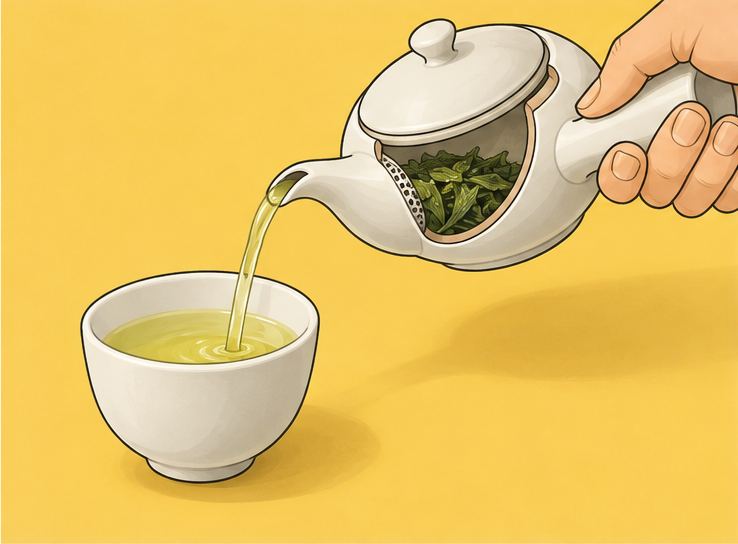 Hold the side handle and pour through the built-in strainer, a little into each cup in turn.
- 3
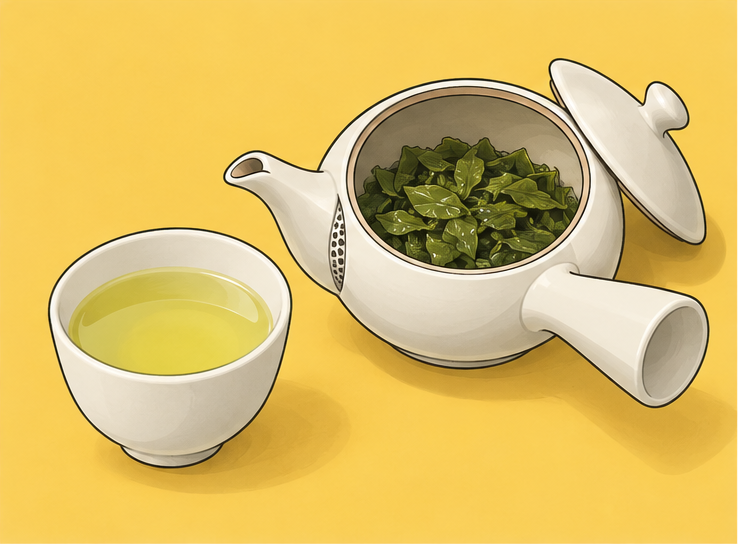 Pour out the last, strongest drops; with no water left in the pot, the second infusion will be good.
Travelers in Japan will be offered tea constantly. Most Japanese restaurants serve it free, usually hot sencha or hōjicha, or cold barley tea (mugicha) in summer. At conveyor-belt sushi restaurants each seat has a canister of powdered tea and a hot-water tap. Bottled green tea is among the best-selling drinks in convenience stores and vending machines. The tea company Itō En launched canned sencha nationwide in 1985, renamed it "Oi Ocha" in 1989 and soon added plastic bottles (in 1990, by the company’s account), and the idea of buying tea rather than brewing it at home took hold; competitors such as Iyemon, Ayataka and Nama-cha followed. Japanese bottled tea is unsweetened. Tea is simply tea.
For a fuller experience, go to the growing regions. In Uji, the approach between the temple Byōdō-in and Uji Bridge is lined with tea shops, including Tsūen, a teahouse at the eastern foot of the bridge said to date from 1160, and tea rooms where you can order gyokuro and brew it yourself under a staff member’s guidance. In Shizuoka there are tea museums and visitor farms on the Makinohara plateau, where in spring you can see rows of bushes clipped into smooth rounded hedges. Tokyo has a growing number of specialist Japanese tea cafés whose menus list sencha by region and cultivar, like a wine list.
When buying, look at the region, whether it is first-harvest, whether it is lightly or deeply steamed, and the packing date. Tea dislikes light, moisture and strong smells, and an opened bag is best finished within about a month. The new-tea season is around May, when shops hang out banners reading shincha. A small bag brewed at home with water that has cooled for a minute or two is the easiest way to bring back the taste of early summer in Japan.