
At a glance
How Chinese noodle soup became Japan’s everyday meal, what goes into a bowl, how Sapporo, Hakata and Kitakata styles differ, and how to order at a ticket machine.
- Ramen grew out of Chinese noodle soup; Rairaiken in Asakusa (1910) is usually counted as the start of ramen as everyday Japanese food.
- Kansui (alkaline water) defines ramen noodles: it turns them yellow, makes them springy and gives them their distinctive smell.
- A bowl has three layers: tare, broth and aroma oil. Shōyu, shio and miso name the tare; tonkotsu names the broth.
- In 1958 Andō Momofuku launched Chicken Ramen, the world’s first instant noodle.
- Most shops sell tickets from a vending machine; the top-left button is usually the house bowl.
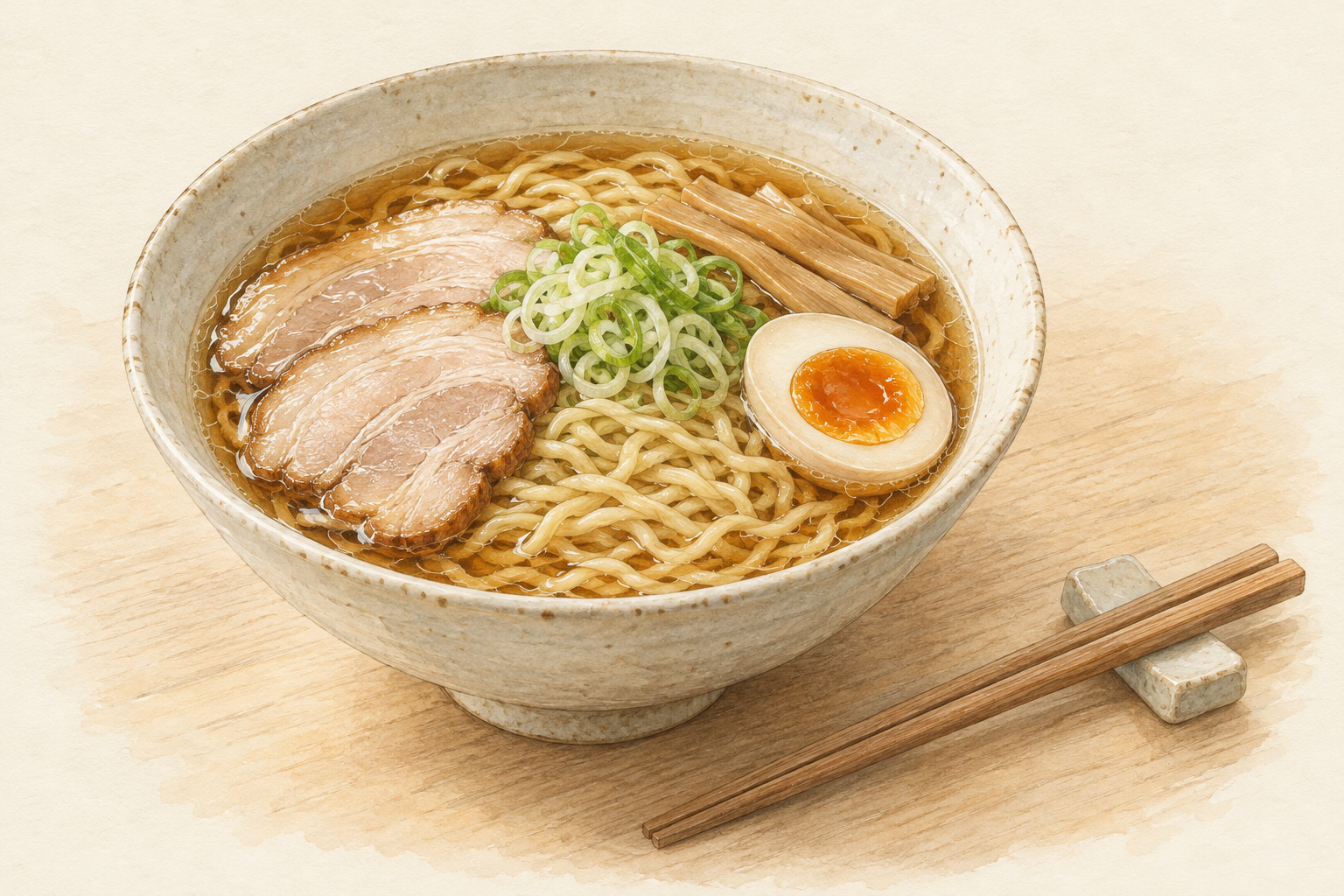
Ramen is the cheapest serious meal in Japan. For around a thousand yen, as of 2026, you press a button on a vending machine, hand over a ticket, and ten minutes later you are looking at a bowl that someone has spent years perfecting: a broth that might be milky white or clear as tea, yellow noodles with a springy bite, slices of braised pork, a sheet of nori leaning against the rim. It is also a young dish. A little over a century ago the Japanese hardly ate it, and what they did eat was called "Chinese noodles." This is the story of how that soup became Japanese, what actually goes into a bowl, why a bowl in Sapporo tastes nothing like a bowl in Fukuoka, and how to order and eat it when you are standing in a tiny shop with a queue behind you.
01From Chinatown Soup to National Food
When Japan opened its ports to foreign trade in the late 1850s and 1860s, Chinese merchants, cooks and laborers settled in Yokohama, Kōbe and Nagasaki. Their neighborhoods were known as Nankinmachi, "Nanjing town," and the small eateries there served wheat noodles in broth, made in the southern Chinese way. The Japanese called the dish Nankin soba, and later Shina soba, "China noodles." For decades it was food for the Chinese community and for the occasional adventurous Japanese diner, not part of ordinary Japanese life.
The usual starting point for ramen as a Japanese food is 1910. That year Ozaki Kan’ichi, a former customs official in Yokohama, opened a restaurant called Rairaiken in Asakusa, Tokyo’s busiest popular entertainment district, and staffed it with Cantonese cooks recruited from Yokohama’s Chinatown, twelve of them by one account. Rairaiken served noodles in a broth of chicken and pork bones seasoned with soy sauce, topped with roast pork, bamboo shoots and green onion. That is very close to what Tokyo still calls a classic shōyu (soy sauce) ramen. What made Rairaiken different was its audience. It was cooking for Japanese customers, in a Japanese neighborhood, at prices working people could pay, and it was enormously popular.
Through the 1920s and 1930s Shina soba spread through Japan’s cities, much of it sold from yatai, wheeled street stalls. Vendors pushed their carts through residential streets at night playing a short, reedy melody on a small horn called a charumera. For generations of Japanese that tune was simply the sound of ramen, and one instant noodle brand still carries the name. After the Second World War the word Shina, by then heavy with the contempt of the war years, fell out of polite use, and the dish became chūka soba, "Chinese-style noodles." Many older shops still write chūka soba on their signs, and when you see it you can usually expect a clear soy-sauce broth.
The war and its aftermath turned ramen into a mass food. Japan’s cities in 1945 and 1946 were hungry. Rice was scarce, while American wheat flour arrived in large quantities as food aid. Millions of soldiers and settlers returned from mainland China and Manchuria, many of them used to eating wheat noodles, and some set up noodle stalls in the black markets around railway stations. A bowl of hot noodle soup was cheap, filling and fast to serve. A striking number of Japan’s famous regional ramen styles trace their beginnings to a single street stall in the late 1940s or early 1950s.
Then came instant noodles. In 1958 Andō Momofuku, working in a shed behind his house in Ikeda, near Ōsaka, invented Chicken Ramen: noodles pre-seasoned with chicken broth and flash-fried so that they would be ready two minutes after boiling water was poured over them. It sold as a kind of miracle food, and it did two lasting things. It made the word rāmen, written in katakana, the standard name for the dish, and it put ramen into every household kitchen. Andō’s company, Nissin, followed with Cup Noodle in 1971. By the 1970s ramen was no longer thought of as Chinese cooking. It was something Japanese children grew up on.
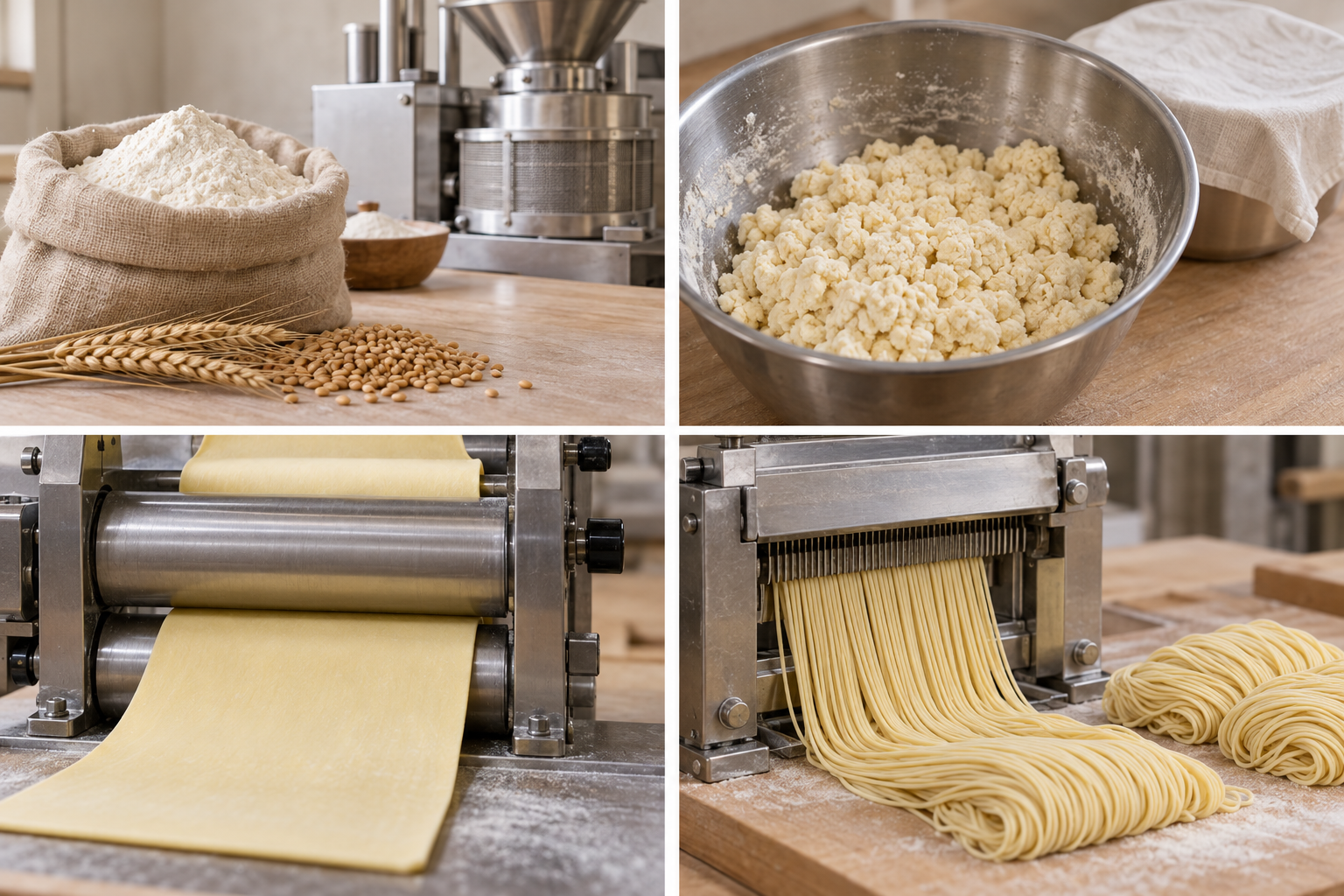
Japanese ramen noodles are not hand-pulled: dough is rolled into sheets between rollers and cut into strands.
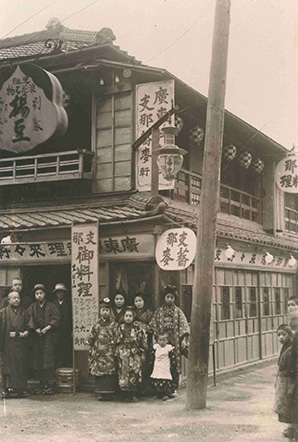
The old storefront of Rairaiken in Asakusa, which opened in 1910
Where the word itself comes from is not settled. One theory links it to the Chinese lāmiàn, hand-pulled noodles. A Sapporo story credits a restaurant called Takeya in the early 1920s, where a Chinese cook supposedly called out hǎo le, "it’s ready," and the "-la" sound stuck. These are later explanations rather than documented history. What is certain is that Japanese ramen noodles are not hand-pulled. They are rolled and cut, usually by machine, which is why visitors who know Lanzhou pulled noodles are often surprised by what arrives under the same name.
02The Noodle: Why Kansui Matters
Ask what separates ramen from udon or soba, and the answer is not the soup. It is an ingredient in the noodle called kansui, an alkaline solution, chiefly of sodium carbonate and potassium carbonate, mixed into the dough. Kansui changes wheat noodles in three ways you can see, feel and smell. Natural pigments in wheat flour turn yellow in alkaline conditions, which is why ramen noodles are pale yellow even when they contain no egg. The alkali tightens the gluten network, giving the noodle its firm, elastic, slightly rubbery bite and helping it hold up in hot soup. And it adds a faint, distinctive aroma that many Japanese would recognize blindfolded as the smell of chūka soba.
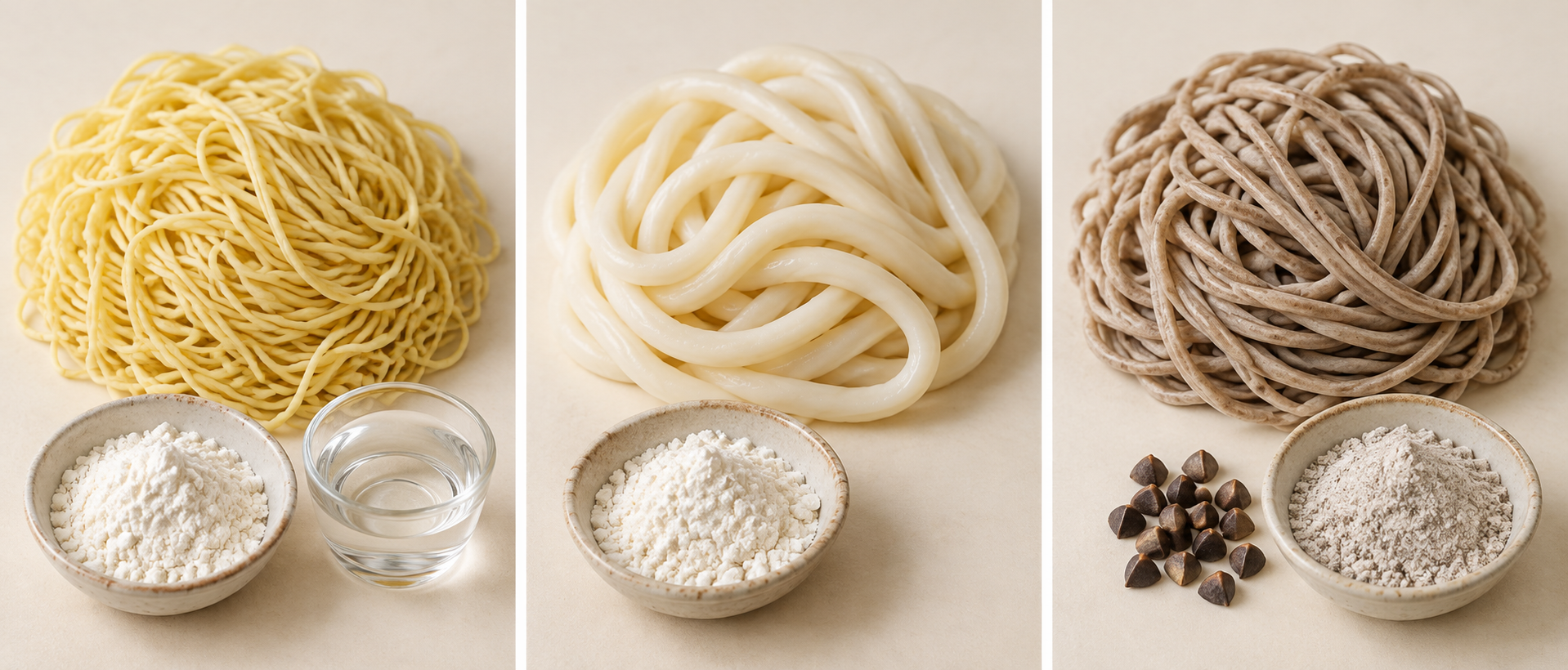
From left: kansui ramen noodles are pale yellow and firm; udon uses only flour, salt and water; soba uses buckwheat flour.
The technique is Chinese. Cooks in northern China traditionally used naturally alkaline water, or lye made from plant ash, to make noodles more resilient. In Japan kansui became the defining feature of the category: noodles made with it are chūka men, Chinese-style noodles, and noodles without it are not. Udon dough is only wheat flour, water and salt, and soba is buckwheat flour, often cut with some wheat, and water, so those noodles are soft and chewy or delicate and earthy, never springy in the ramen way.
Beyond kansui, Japanese noodle makers talk constantly about kasuiritsu, the hydration ratio, the amount of water relative to flour. Low-hydration noodles, like the thin straight ones in Hakata ramen, are firm and almost snappy and soak up broth quickly, but they soften fast. High-hydration noodles, like the thick curly ones in Sapporo or the broad wavy ones in Kitakata, are smooth, bouncy and slippery and survive longer in hot soup. Wavy noodles catch more broth; straight noodles slide cleanly. Many famous shops do not make their own noodles at all but work closely with a supplier, such as Nishiyama Seimen in Sapporo or Sakai Seimen for many Yokohama iekei shops, adjusting the recipe together. The noodle is part of a shop’s identity, not a generic ingredient.
03Anatomy of a Bowl: Tare, Broth, Oil, Toppings
Japanese people often describe ramen by four flavors: shōyu (soy sauce), shio (salt), miso, and tonkotsu (pork bone). It is a handy shorthand, but it mixes up two different things. Soy sauce, salt and miso describe the seasoning; tonkotsu describes the broth. To understand ramen it helps to think of a bowl in layers, built from the bottom up.
- 1
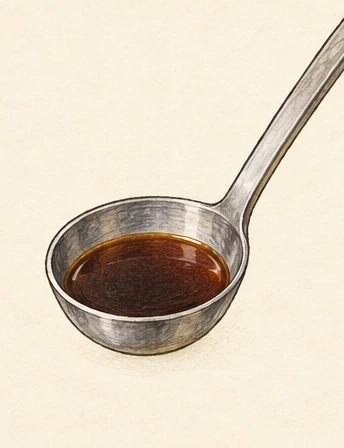 A spoonful of concentrated tare goes into the empty bowl first; it sets the saltiness and direction.
- 2
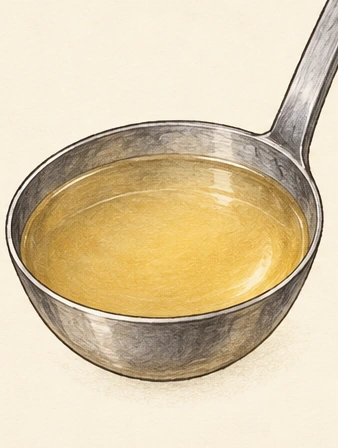 Hot broth goes in next, made from chicken, pork bones or dried fish.
- 3
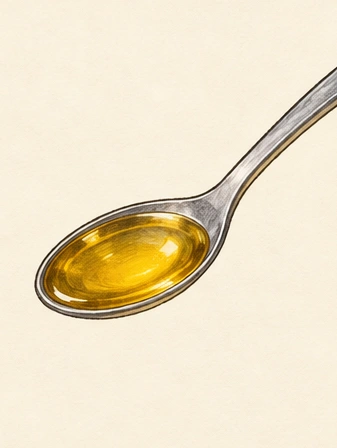 Aroma oil floats on top and gives the first smell as you lean in.
- 4
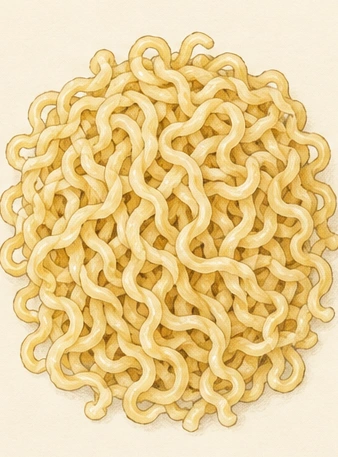 The cooked noodles go in.
- 5
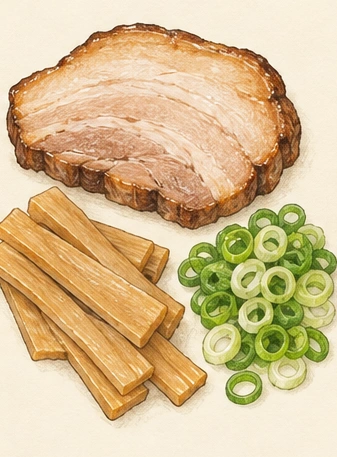 Finally the toppings: chāshū, menma and green onion.
At the bottom is the tare, a concentrated seasoning sauce. The cook ladles a measure of tare into the empty bowl before pouring in hot broth, and that small amount decides the saltiness and the main direction of the flavor. Shōyu tare is soy sauce simmered or steeped with things like mirin, kombu kelp and dried seafood, often blending several soy sauces. Shio tare builds on salt with kelp, dried scallop or dried fish to add depth without color. Miso tare mixes one or more misos with garlic, ginger, sesame or chili, and is sometimes fried before use. The tare is the most closely guarded recipe in a ramen shop; a broth technique can be learned by watching, but the tare is rarely shared.
Next comes the broth. The main families are chicken, made from carcasses and sometimes whole birds, sweet and clear; pork, from leg bones, heads and trotters, which can be clear or cloudy; and seafood, made with niboshi (dried sardines), katsuobushi (smoked dried bonito), kombu and dried mackerel, which brings in the flavors of Japanese dashi. Many shops make an animal broth and a seafood broth separately and combine them at the last moment, a "double soup" that pairs the body of meat with the savory depth of fish. Whether a broth is clear or cloudy depends mainly on heat. Simmer bones gently, never letting the pot bubble hard, and the fat and gelatin stay separate and the soup stays clear. Boil hard for hours and the fat, collagen and marrow are churned into an emulsion, which is why tonkotsu broth looks like milk.
On top floats an aromatic oil, and it matters more than it looks. It carries the first smell that reaches you as the bowl lands. Some shops use chicken fat, some lard, some oil infused with fried scallion or garlic; Kumamoto ramen is known for mā-yu, garlic fried in oil until it turns black and bitter-sweet. The oil layer also traps heat, which is no small thing in a Hokkaidō winter.
Then come the noodles and the toppings. Chāshū, the sliced pork, takes its name from Cantonese roast pork, but most Japanese shops roll pork belly or shoulder and braise it in a soy-based liquid rather than roasting it. Menma are fermented bamboo shoots. Green onion appears as fine white shreds in eastern Japan and as chopped green scallion in the west and in Kyūshū. There is nori, and there is the ajitama or ajitsuke tamago, a soft-boiled egg marinated in soy sauce so the yolk sets to a deep orange gel, which for many people is the one extra they always order. Old-fashioned Tokyo bowls often have a slice of narutomaki, a fish cake with a pink spiral, now uncommon in real shops but still the standard image of ramen in cartoons.
Once you see the bowl as layers, the variety of Japanese ramen makes sense. One broth can take several tare; one tare can sit with different noodles and oils. There is no single correct ramen, and most cooks do not pretend there is. They compete on finding their own combination.
04Tonkotsu: Kurume’s Accident and Hakata’s Refills
If you had to pick one style that shows how far ramen traveled from its Chinese origins, it would be tonkotsu: the thick, opaque, intensely porky broth of Kyūshū, which has few close relatives in Chinese noodle cooking.
The story usually begins in Kurume, a city in Fukuoka Prefecture. In 1937 a man named Miyamoto Tokio opened a street stall there called Nankin Senryō, said to have stood near the station, selling noodles in a pork-bone broth that was still clear. In 1947 Sugino Katsumi, who ran another stall called Sankyū, is said to have left his mother in charge of the stockpot one day; the flame was too high, the broth boiled hard, and when he came back it had turned cloudy and white. He liked it better. That account is local lore, impossible to confirm in its details, but white tonkotsu broth did take hold in Kurume in the late 1940s. Kurume ramen remains the heaviest and most pungent of the tonkotsu family. Some shops keep a pot going for years without fully emptying it, topping up old broth with new bones every day, a method called yobimodoshi, "calling back."
From Kurume the style moved north to Fukuoka city and south to Kumamoto, changing along the way. The best known version today is Hakata ramen, from Fukuoka. Its noodles are very thin, straight and low in hydration; its broth is creamy tonkotsu; its toppings are spare, often just chāshū, scallion and wood-ear mushroom. On the counter you will find pickled red ginger, sesame seeds, and karashi takana, spicy pickled mustard greens, to add as you like.
The thin noodles are usually explained by the Nagahama fish market. When Fukuoka’s central fish market moved to reclaimed land at Nagahama in 1955, stalls sprang up to feed the market workers, who wanted food immediately. Thin noodles cook in under a minute, so they got thinner. But thin noodles go soft quickly in hot broth, so portions stayed small, and if you were still hungry you ordered more noodles to drop into the soup you had left. That is kaedama, a noodle refill. The practice is generally credited to Ganso Nagahamaya, which began as a street stall in 1952 and moved to Nagahama with the market. In Hakata today, when you are halfway through your broth you call out "kaedama," and a freshly boiled bundle of noodles is tipped straight into your bowl, usually for 100 to 200 yen as of 2026. Some shops sell kaedama as a separate ticket or have a button on the table.
- 1
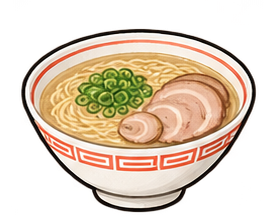 Hakata ramen: milky tonkotsu broth with very thin straight noodles.
- 2
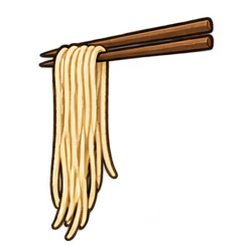 Thin noodles cook in seconds and soften quickly in hot soup, so portions are small.
- 3
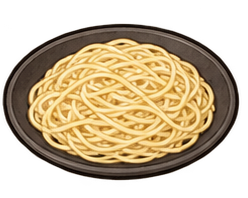 When the noodles are gone and half the soup is left, call "kaedama" and a fresh portion goes straight into your bowl.
Thin noodles also gave Hakata its vocabulary of firmness. Most shops let you choose, from soft to hard: yawa or yawarakame (soft), futsū (regular), kata (firm), barikata (very firm), harigane ("wire"), and at the extreme kona-otoshi, "just knock the flour off," noodles barely dipped in boiling water. Locals often order kata or barikata, reasoning that the noodles keep cooking in the hot broth and will be just right by the last mouthful. If it is your first time, regular or kata is a safe choice.
From the 1980s two Fukuoka chains took tonkotsu ramen to the rest of Japan and then the world. Ippudō, founded in 1985 in Fukuoka’s Daimyō district by Kawahara Shigemi, turned the pungent, male-dominated tonkotsu counter into a bright, clean space where women felt comfortable eating alone. Ichiran became famous for its individual booths: you fill in a form specifying richness, garlic, spice and noodle firmness, and the bowl appears through a bamboo blind without your ever seeing the cook. For many people abroad, "ramen" now means a bowl of white pork broth with thin noodles.
05Hokkaidō: Sapporo Miso and Asahikawa Shōyu
Hokkaidō is Japan’s northern island, with long, snowy winters, and it produced two of the country’s most distinctive bowls.
Sapporo ramen is miso ramen, and miso ramen began at a small restaurant called Aji no Sanpei. Its founder, Ōmiya Morito, started with a street stall in 1948 and opened the shop in Susukino in 1950. The standard account is that Ōmiya, who believed miso was good for the health, took his cue from everyday miso soup, sent for misos from around Japan to find one that suited a pork-bone broth, and created a miso-flavored ramen around 1955, making it a regular menu item in the early 1960s (some accounts date its creation to 1954 or 1958 instead). Straight noodles were the norm then, and he worked with the Sapporo noodle maker Nishiyama Seimen to develop curly ones to go with the miso. Instead of chāshū, Sanpei topped the bowl with minced pork and stir-fried vegetables, bean sprouts, onion and cabbage, and that set the pattern. In the method that became standard in Sapporo the cook stir-fries bean sprouts, onion and ground pork with the miso tare in a very hot wok, then adds broth and brings it to a boil, so the soup has a smoky, wok-seared edge and a film of oil on top. The noodles are thick, curly, yellow and high in hydration.
- 1
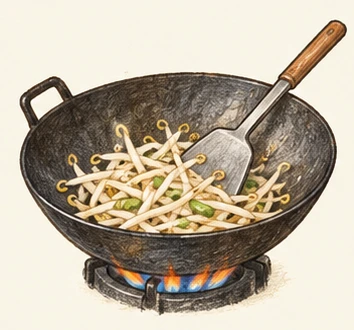 Bean sprouts, other vegetables and minced pork are stir-fried over high heat with the miso tare.
- 2
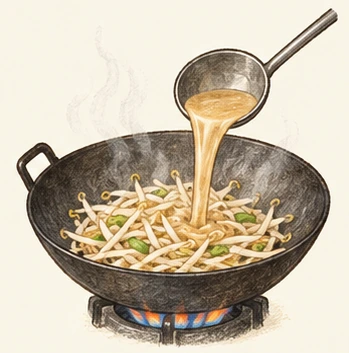 Broth is poured in and brought to the boil.
- 3
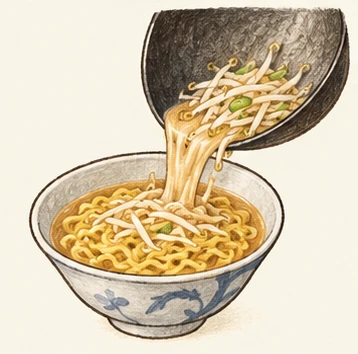 Soup and vegetables are poured over thick curly noodles, leaving a wok-flavored layer of oil.
Miso ramen spread beyond Hokkaidō from the late 1960s. A Sapporo ramen boom, led by the chain Dosanko, carried it nationwide, and in 1968 Sanyo Foods launched Sapporo Ichiban Miso Ramen, a packet noodle modeled on the taste of Aji no Sanpei, which brought the flavor into homes across the country. Some accounts also credit the Hokkaidō produce fairs held in Tokyo department stores with spreading its name. Visitors to Sapporo today often head to the Ramen Yokochō, a narrow alley near the Susukino nightlife district lined with small shops. Aji no Sanpei is still operating, upstairs in a building in central Sapporo, with a simple counter. In 1964 Muranaka Akiko opened a shop whose name, 純連, was then read Sumire, serving a heavy, garlicky miso ramen; it later split into two lines, Junren and Sumire, which defined the modern heavyweight version: a broth so thickly capped with lard that it stays scalding for a long time, richer and saltier than the original.
Asahikawa, about 140 kilometers north of Sapporo, is colder still, and its ramen is shōyu. The broth is a double soup of pork and chicken bones with seafood such as dried fish and kombu, and it too is sealed under a layer of lard to keep the heat in. The noodles are thin, wavy and low in hydration, firm and absorbent. Two shops opened in 1947, Hachiya and Aoba, and both are still regarded as the city’s pillars. Hachiya floats a scorched lard, made with pork back fat and bonito flakes, on its broth, giving it a distinctly smoky, almost burnt note that people either love or don’t. Hokkaidō’s third city of ramen, Hakodate, is known for clear, light shio ramen, and together Sapporo, Asahikawa and Hakodate are called the three great ramen of Hokkaidō.
06Kitakata, Onomichi and Yokohama’s Iekei
Kitakata is a small city in Fukushima Prefecture, with a population in the tens of thousands, yet it has around ninety ramen shops, and had more than 110 at its peak, one of the highest densities per person in Japan. It is often named with Sapporo and Hakata as one of Japan’s three great ramen towns. Kitakata ramen is usually traced to Pan Qinxing, a young man from Zhejiang in China, who sold noodles from a cart in the mid-1920s and later opened Genraiken. The noodles are broad, flat, wavy and high in hydration, often aged before use, soft yet bouncy; the broth is a clear mix of pork bones and niboshi seasoned with soy sauce, light and gently sweet. Kitakata also has a custom rarely found elsewhere, asa-rā, morning ramen. It is said to have started with workers coming off night shifts and farmers starting early, and many shops open early in the morning. The town is known too for its sake breweries and its kura, thick-walled earthen storehouses, and a morning walk among the storehouses followed by a bowl of noodles has become the standard visit.
Onomichi, on the Seto Inland Sea in Hiroshima Prefecture, is a hillside port town of slopes, temples and ferries. Its ramen is best known through Shukaen, which began as a street stall in 1947, is generally said to have been founded by Zhu Ajun, a man from Taiwan, and drew long queues for decades before closing in 2019. Onomichi ramen has a chicken-based broth with small dried fish from the Inland Sea, a soy-sauce tare, flat straight noodles, and a scattering of pork back fat in small pellets across the surface. It looks light and tastes richer than it looks, the back fat adding sweetness and body.
Yokohama’s iekei ramen is a different beast entirely. In 1974 Yoshimura Minoru opened Yoshimuraya in Yokohama’s Shin-Sugita neighborhood, serving a tonkotsu-shōyu ramen: dense pork broth with soy sauce tare and a slick of chicken fat, thick short straight noodles, topped with spinach, chāshū and three large sheets of nori. Apprentices who left to open their own shops tended to give them names ending in -ya ("house"), such as Honmokuya and Rokkakuya, and the whole lineage became known as iekei, "house style," from another reading of the character for house. Large chains later adopted the style and naming, and iekei shops are now everywhere around Tokyo. The signature of iekei is customization: noodle firmness, broth strength and amount of chicken oil, each with three settings. Regulars rattle off "katame, koime, ōme" (firm, strong, extra oil) like a password. Tables carry grated garlic, chili bean paste, ginger and vinegar for adjusting the soup partway through, and many customers order a bowl of rice and wrap it in broth-soaked nori.
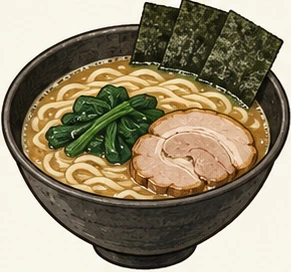
Iekei ramen: rich tonkotsu-shōyu broth with spinach, chāshū and three sheets of nori.
07Tsukemen and the New Tokyo Ramen
Tsukemen, dipping noodles, separates noodles from soup. You get a plate of thick noodles rinsed in cold water and a bowl of concentrated, hot dipping broth; you lift a mouthful of noodles, dunk them, and eat. The inventor is generally said to be Yamagishi Kazuo. By his own account, staff at the shop, on busy days, ate leftover noodles dipped in broth from a teacup as a quick meal. In 1955, as manager of Taishōken in Tokyo’s Nakano, he put the idea on the menu. In 1961 he opened his own Taishōken in Higashi-Ikebukuro, selling it as tokusei mori soba. People queued outside for decades, until redevelopment closed the shop in 2007. It reopened nearby the following year. Yamagishi came to be called the god of tsukemen. His death in 2015 was national news.
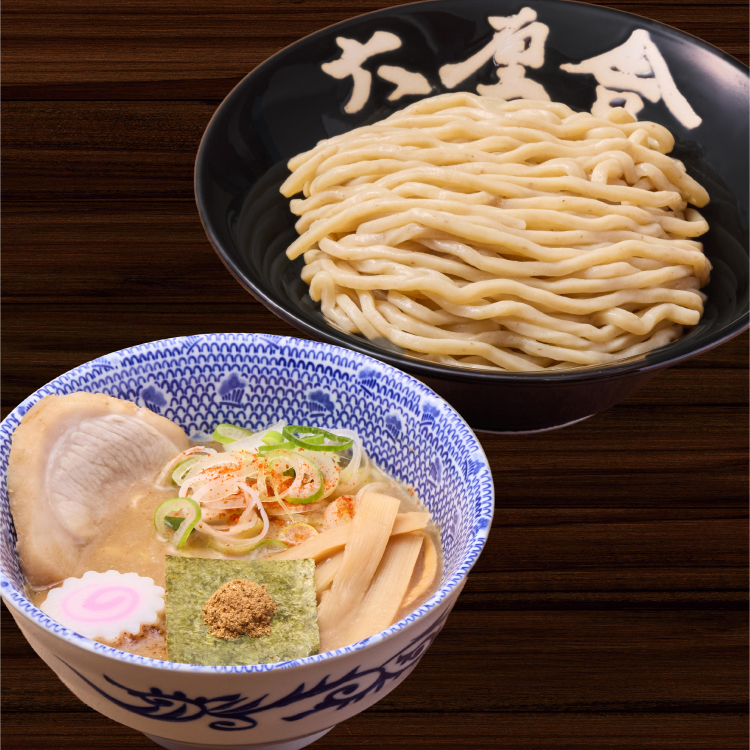
Tsukemen: thick noodles rinsed in cold water, served apart from a bowl of rich dipping broth
The dipping broth is much stronger than ramen soup, saltier, sweeter, often a little sour, because cold noodles pick up only a thin coating. In the 2000s a style called nōkō gyokai tonkotsu, rich seafood and pork, led by shops such as Rokurinsha, made tsukemen a craze in Tokyo: broth thick as gravy, noodles thick and chewy. When you finish the noodles, you can ask for sūpu-wari, and the staff will dilute what is left of your dipping broth with light stock so you can drink it as soup.
Tokyo is where ramen innovation runs hottest. From the 1990s ramen acquired its own magazines, television shows and rankings. In 1994 the Shin-Yokohama Ramen Museum opened, gathering branches of famous regional shops inside a recreation of a 1950s street. New shops chase pedigree chicken, blends of artisanal soy sauces, even truffle oil. In late 2015 Tsuta, a small shop in Tokyo’s Sugamo district, became the first ramen restaurant to receive a Michelin star, and many Japanese realized ramen had become a cuisine that critics could rank. At the other extreme is Ramen Jirō, with its mountains of bean sprouts and cabbage, slabs of pork and heaps of garlic, portions that defeat first-timers, and fans called Jirorian who share a whole private ordering language. Ramen in Japan is fast food, civic pride, a young person’s endurance test and a chef’s proving ground, all at once.
08Walking into a Ramen Shop
Most ramen shops have a ticket machine, a shokkenki, at the entrance or just inside. You choose your bowl and any extras, pay, take the tickets, and hand them to the staff when you sit down. The layout follows a loose convention: the button at the top left is very often the house specialty. Tokusei means the deluxe version with all the toppings; ōmori is a large portion; ajitama adds the marinated egg; kaedama can sometimes be bought in advance. Many older machines take only cash, and some only 1,000-yen notes and coins, so carry small money; newer machines increasingly accept transit IC cards or QR payments. A minority of shops have no machine, take your order at the table and let you pay on the way out.
- 1Top-left buttonVery often the house specialty
- 2TokuseiDeluxe, with all the toppings
- 3ŌmoriLarge portion
- 4AjitamaAdds the marinated egg
- 5KaedamaCan be bought in advance
The button at the top left is very often the house specialty.
When you hand over your ticket you may be asked how firm you want your noodles, or at an iekei shop how strong and oily. If you are unsure, futsū (regular) is always acceptable. At Jirō-style shops, when your bowl is nearly ready the staff ask "Ninniku iremasu ka?" (garlic?). This is your moment to call extras such as yasai (more vegetables) or ninniku (garlic); if you want nothing, say sono mama de, "as it is."
Most shops are counter seating, small and fast-turnover. Queues are normal, and at busy shops you may be told to buy your ticket first and then wait, or be shown to a seat in order; simply grabbing an empty stool is bad form. Water is usually self-service from a jug on the counter. When the bowl arrives, eat. Ramen is at its best for a few minutes before the noodles soften and the soup cools, and the Japanese rarely linger over it. Slurping is entirely normal; drawing in air cools the noodles and carries aroma to your nose, so there is no need to be quiet, though there is no need to perform it either. Many enthusiasts taste the broth first, before the noodles.
The etiquette is light. Do not sit chatting or scrolling on your phone after you have finished when people are waiting. Some shops like customers to place the empty bowl up on the raised counter and wipe their place with a paper napkin; watch what others do. You do not need to finish the broth, and with salty tonkotsu or back-fat soups most Japanese do not; a cook does notice a drained bowl, though, and takes it as a compliment. On your way out say "gochisōsama deshita," thank you for the meal, and you will hear "arigatō gozaimashita" in return.
For years people in Japan talked about the "1,000-yen wall," the idea that a bowl of ramen, however good, should not cost more than a thousand yen. Since the early 2020s, rising prices for flour, pork and energy have pushed many shops’ signature bowls past that line, and by 2026 this had become a news story. That the price of ramen counts as news says a great deal about what it means in Japan. It is the meal anyone can afford, eaten alone after work, after drinks, before a train, ten minutes in and out, and you leave warmer than you came.