
At a glance
Why tempura’s thin shell matters, how Edo street-stall skewers became Tokyo counter courses, and how to eat it, from cheap tendon to a chef’s counter.
- Tempura is food fried in a thin batter that works as a shell, so the ingredient is in effect steamed in oil.
- The batter uses soft flour and ice water and is stirred only a few strokes, to keep gluten down and the coating thin and crisp.
- Oil usually runs 170–180°C; the Tokyo school traditionally fries in sesame oil, Kansai in lighter oils.
- In the late 18th century Edo street stalls sold tempura on bamboo skewers, a fast food alongside sushi and soba.
- At a counter, eat each piece the moment it lands; after a minute or two the coating goes soft.
Fried food is everywhere, and on paper tempura is just seafood and vegetables dipped in batter and dropped into hot oil. In Japan it became something more exacting: a dish judged by the thinness of its shell, the sound it makes in the pot, and how many seconds pass between the oil and your mouth. This piece explains what makes tempura different from other fried food, how a snack sold on skewers at Edo street stalls became one of the most expensive counter meals in Tokyo, and how to eat it in Japan, whether you are spending 700 yen on a rice bowl or ten times that in front of a chef.
01A Shell, Not a Coating
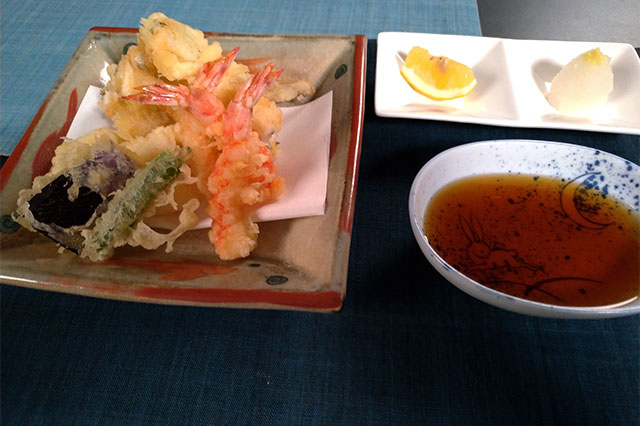
Bite into good tempura and the first thing you notice is how little there is between you and the food. The batter shatters in a thin, lacy layer, and underneath the shrimp or fish is hot, moist and tender, closer to steamed than fried. That is the point. The batter works as a temporary casing: as soon as it hits the oil, its surface dries and stiffens, sealing the ingredient inside. Heat passes through the shell while the food cooks in its own moisture. Tempura chefs sometimes describe what they do as steaming with oil.
To make that shell thin and crisp, cooks follow rules that run against ordinary baking instinct. The flour is low-protein cake flour (hakurikiko). The water is ice-cold, often with an egg or yolk beaten in. The batter is mixed with long chopsticks, only a few strokes, and left lumpy. All of this is about keeping gluten from developing. Stirred batter at room temperature turns elastic and fries up thick and bready, like the coating on onion rings. Cold, barely mixed batter stays loose and fries up brittle. Careful cooks make it in small amounts as they go, because even a resting batter slowly toughens.
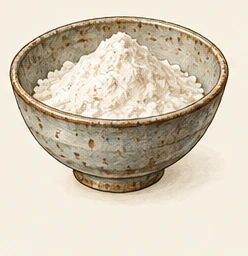
The batter uses low-gluten soft flour and ice water, stirred only a few strokes to hold the gluten down.
When an ingredient goes into the oil there is a burst of loud, fast bubbling as water escapes. As it cooks, the sound thins out into a soft, high crackle and the bubbles get smaller. That change is the signal to lift it out. The oil usually sits somewhere around 170–180°C, hotter for quick-cooking seafood and a little cooler for dense vegetables like sweet potato, which need time to cook through. A tempura chef works by ear and eye as much as by thermometer.
The oil itself is a matter of house style. Tokyo tradition favors sesame oil, especially toasted sesame oil, which gives the tempura a golden or even amber color and a nutty aroma. The Kansai region around Ōsaka and Kyoto has tended toward lighter oils such as refined vegetable "salad oil" (in the past, reportedly, cottonseed oil), producing paler tempura that tastes more of the ingredient. Many shops now blend sesame and vegetable oil in a ratio they treat as something of a trade secret.
02From Portuguese Ships to Edo Street Stalls
Japan had fried foods long before tempura. Fried confections arrived from China in the Nara and Heian periods, and Buddhist temple cooking included vegetables fried in a light coating. Batter-fried fish, though, is generally linked to the Portuguese traders and missionaries who reached Kyūshū in the 16th century. The usual account is that "southern barbarian" (nanban) cooking, which reached Nagasaki in the later 16th century, included floured and fried dishes (fish, by some accounts, fried meat by others), and the technique spread from there. The paper trail is thinner than the story suggests, though. A text of 1669 mentions something called tenpurari without making clear it was fried, and the first unambiguous recipe, for fish dusted with flour and fried in oil under the name tenpura, appears in a 1748 cookbook.
The word itself is usually traced to Portuguese, though no one is sure which word. One candidate is tempero, meaning seasoning or cooking. Another is têmporas, the Ember Days of the Catholic calendar, when the faithful abstained from meat and ate fish instead. Neither theory has firm proof. The common kanji spelling, 天麩羅, comes with its own Edo-period story. Santō Kyōzan wrote that in the 1780s his elder brother, the popular writer Santō Kyōden, came up with the name for a man who had run away from Ōsaka and wanted to sell fried fish from a night stall, and that Kyōzan himself painted the characters on the stall’s lantern. As Kyōzan tells it, Kyōden built the name like a pun: the man was a drifter, a tenjiku rōnin, who had wandered in furari, so ten and pura; fu stood for wheat flour and ra for thin silk gauze, the light coating. The word, however, already appears in a 1715 puppet play by Chikamatsu Monzaemon, so at most the story records how the spelling caught on among Edo’s street stalls.
Another famous story concerns Tokugawa Ieyasu, the founder of the shogunate. In early 1616 he ate sea bream fried in oil, fell ill, and died a few months later, giving rise to the saying that tempura killed him. The meal did happen and did upset his stomach, but he died in the fourth month, and modern writers generally put his death down to an underlying illness, possibly stomach cancer. The dish he ate also was not tempura in the later sense.
Tempura as we know it took shape in Edo, the future Tokyo, in the second half of the 18th century. Edo was crowded and built of wood, and fire was a constant fear; the usual explanation is that deep pots of hot oil were too dangerous indoors. Tempura was sold from street stalls (yatai). The vendor fried fish and shellfish from Edo Bay, such as tiny shrimp, conger eel, goby and shellfish adductor muscles, threaded them on bamboo skewers, and customers stood at the stall, dunked a skewer in a shared pot of dipping sauce, and ate. A skewer is said to have cost only a few copper coins. It was cheap fast food, in the same family as the early sushi and soba stalls. The name still used for the Tokyo style, Edomae tempura, originally meant tempura made from fish caught "in front of Edo," in the bay.
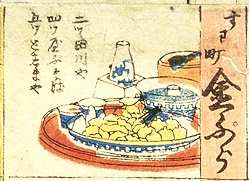
Detail of the “kinpura” square in Utagawa Yoshitsuya’s board game of Edo’s famous goods, c. 1848–1854.Tokyo Metropolitan Library, Utagawa Yoshitsuya, sugoroku board of popular Edo specialties (c. 1848–1854)
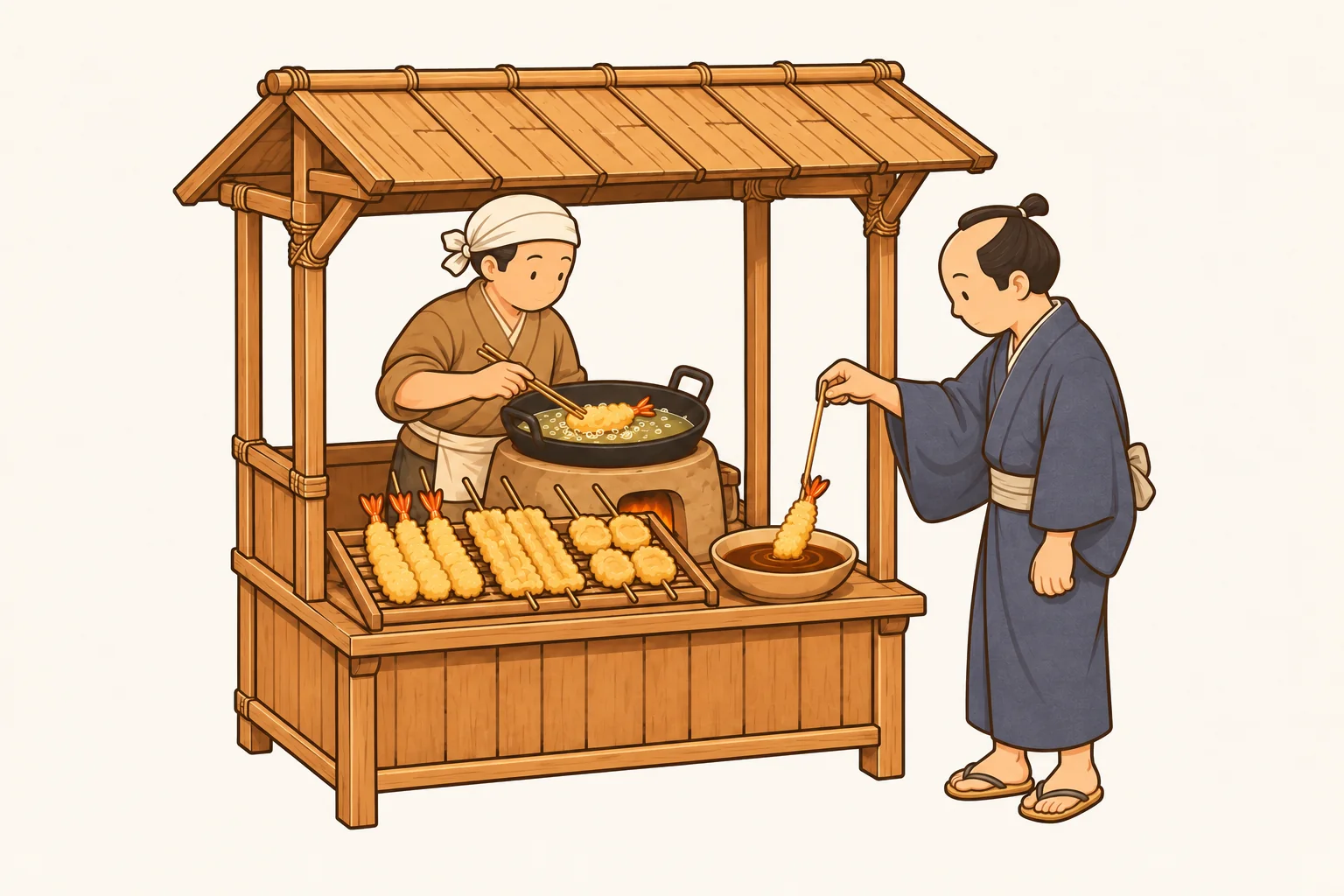
An Edo street stall: fried fish and shellfish on bamboo skewers, dipped by standing customers in a shared sauce (illustration).
In the late Edo and Meiji periods, tempura moved indoors into proper restaurants, some with private rooms for richer customers. Tempura on soba noodles already turns up in an Edo comic verse of 1828; tempura on rice with a sweet soy sauce, tendon, is dated by some to the last decades of the Edo period and by others to the early Meiji years. After the Great Kantō Earthquake of 1923, many Tokyo tempura cooks left the ruined city, a good number of them for the Ōsaka and Kōbe area, where local tempura is said to have improved markedly as a result.
03Salt or Sauce: Tokyo and Kansai
Tokyo tempura traditionally means sesame oil, a slightly heavier and darker batter, and a dipping sauce called tentsuyu, made from dashi (fish and kelp stock), soy sauce and mirin, with a mound of grated daikon radish to stir in. It is a robust style that fits Tokyo’s taste for strong, dark soy. Kansai tempura is lighter in color and flavor, and shops there are generally thought to be quicker to steer you to salt, sometimes flavored with matcha, yuzu or curry, with a wedge of citrus on the side.
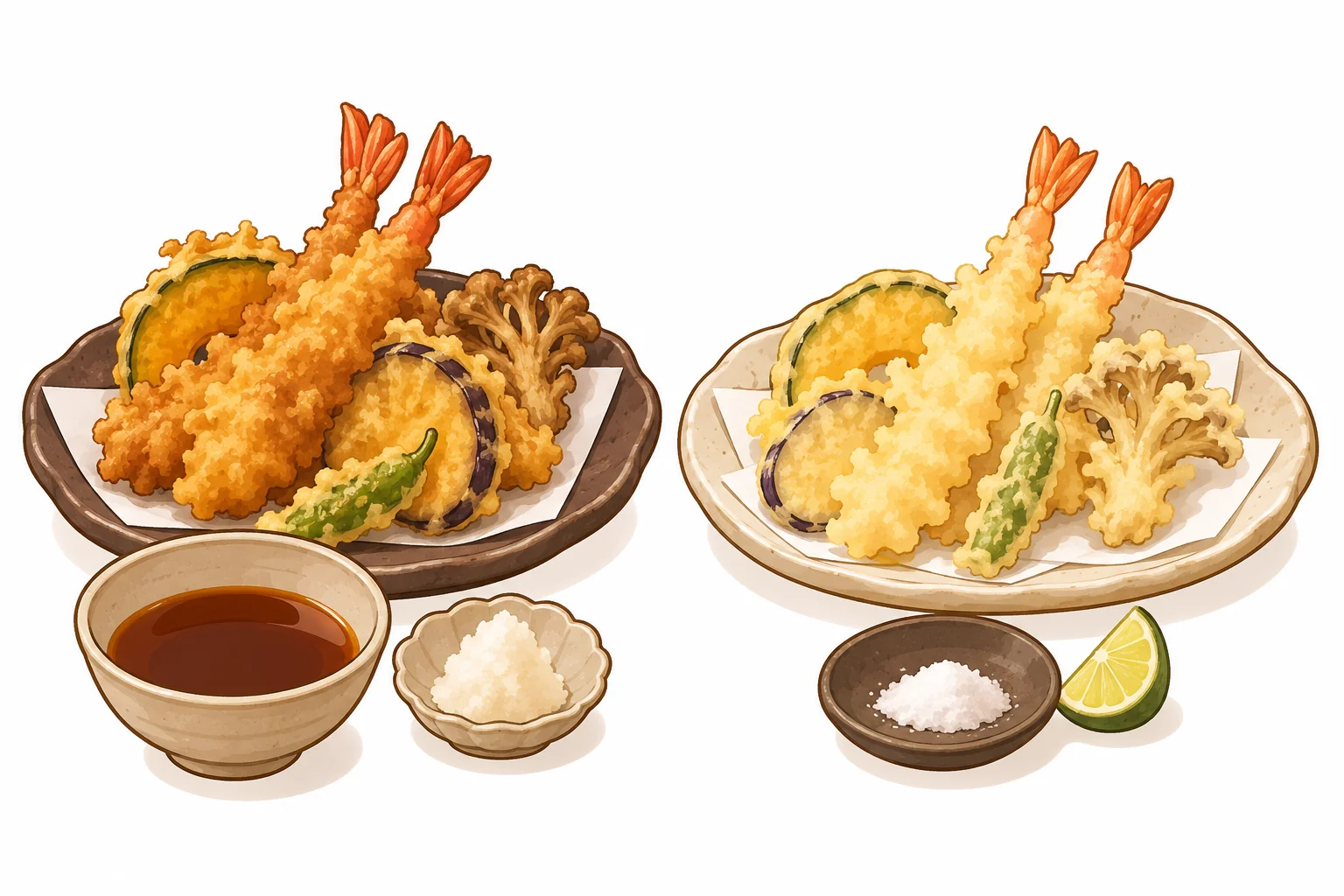
Tokyo-style tempura with tentsuyu and grated radish beside Kansai-style tempura with salt and sudachi (illustration).
Each has its logic. Salt lets the sweetness of a white fish, a scallop or a spring vegetable come through clearly. The sauce softens the batter and adds depth, which suits rich conger eel or a mixed fritter. Many high-end counters put out both and expect you to switch from piece to piece, and the chef will often tell you which one he recommends.
There is one trap in the vocabulary. In much of western Japan and Kyūshū, "tempura" can mean deep-fried fish cake with no batter at all, what Tokyo people call satsuma-age. Order tempura from an oden pot in Ōsaka and you may get a slab of fried fish paste. In Kansai, vegetable-only tempura was traditionally called shōjin-age, after Buddhist vegetarian cooking, to separate it from the seafood kind.
04Shrimp, Conger Eel and the Seasons
The core lineup at a tempura shop still reflects the fish of old Edo Bay. Kuruma prawns are the headline. Serious shops keep them alive, peel them in front of you and fry them so the center stays just translucent. The heads are fried separately until crunchy, and for many regulars they are the best bite of the meal. Sillago (kisu) is soft and white; conger eel (anago) comes whole, crisp outside and almost creamy within. Squid, scallops and small whitebait-like fish appear too. Among vegetables, sweet potato, pumpkin, eggplant, shiitake, green pepper and shiso leaf are staples. Thick rounds of sweet potato are fried slowly until they taste like roasted yams, and some shops serve them as a finale.
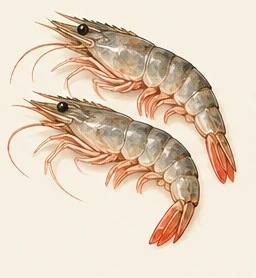
Kuruma prawn is the house signature; the peeled heads are fried separately until crisp.
Tempura is also one of the most seasonal things you can eat in Japan. Early spring is the peak, with bitter mountain vegetables such as butterbur buds (fukinotō) and angelica tree shoots (taranome). Early summer brings sweetfish (ayu) and young corn; autumn brings matsutake mushrooms, ginkgo nuts and chestnuts; winter brings oysters and cod milt. The same chef can serve two entirely different menus in April and October.
Then there is kakiage, a loose fritter of chopped ingredients, such as the small adductor muscles of trough-shell clams (kobashira), little shrimp, onion and carrot, gathered with a little batter and fried into a craggy disc. At a fine counter it comes near the end of the meal, often over rice. At a standing soba shop in a train station it is the cheapest and most filling topping on the menu.
05Tendon, Tempura Soba and the Crumbs
Most Japanese eat tempura not as a course meal but as part of something else. Tendon is a bowl of rice topped with shrimp, fish and vegetable tempura and doused in a sauce thicker and sweeter than tentsuyu, so the batter turns half soft, half crisp. Old shops in Tokyo’s Asakusa and Nihonbashi districts are known for tendon with dark, glossy sauce and lines out the door, while the chain Tenya, which opened its first shop in the underground mall at Tokyo Station’s Yaesu side in 1989, has made it a sub-1,000-yen lunch, as it still was in 2026.
Tempura soba and tempura udon put a fried shrimp or kakiage on top of hot noodles in broth. The batter slowly softens and flavors the soup; some people eat it fast while it is still crisp, others wait for it to soak. Cold soba served with a side plate of tempura, ten-zaru, is a soba-shop classic.
The crumbs of batter that scatter in the oil are not wasted either. Skimmed out, they become tenkasu or agedama, sprinkled on udon, soba, okonomiyaki and takoyaki for crunch and richness. In Tokyo, noodles topped with tenkasu are called tanuki, after the raccoon dog; in Ōsaka and Kyoto the same word means something different, a reminder that noodle names change across the country.
06Eating at the Counter
To see why tempura is treated as a craft, go to a shop with a counter. You sit at a row of pale wood facing the pot and the chef. Each piece is lifted from the oil and set on paper in front of you, and you are meant to eat it immediately. Tempura is at its best for well under a minute; leave it and steam from inside softens the shell. This is not the place for long conversations or a careful photo shoot between pieces.
A typical course starts with one or two prawns, then the fried heads, then white fish, vegetables and shellfish, with whatever is in season, perhaps sweet potato or eggplant along the way, and finally kakiage. The meal closes with one of three options: tendon, the kakiage over rice with sauce; tencha, kakiage over rice with hot green tea poured on top; or plain rice, miso soup and pickles to eat alongside it. On the counter you will find tentsuyu, grated daikon and one or two salts. You eat one piece, then wait for the next. The kitchen sets the pace, much as at a sushi counter.
Prices range widely. As of 2026, in Tokyo a lunchtime tendon or tempura set meal runs from a little over 1,000 yen to around 3,000. Counter courses at lunch are often 5,000 to 10,000 yen, and dinner from over 10,000 to 30,000 yen or more at the most famous shops. Lunch is the best value if you want to try a good counter. In Fukuoka there is a popular style of cheap tempura set-meal shop where you sit at a counter around the fryer and pieces are brought out one by one as you eat, with salted squid (shiokara) on the table as part of the set, a casual version of the same experience; as of 2026 a set costs around 1,000 yen, not far from the price of a bowl of ramen.
A few small habits help. The grated daikon goes into the dipping sauce, not on top of the tempura. Dip only the edge of a piece, so the shell does not go soggy. Eat a large piece in two bites if you need to, but do not leave it sitting on the plate. And watch the chef: the peeling, the dip into batter, the moment of lifting each piece out of the oil are as much a part of the meal as the food.