
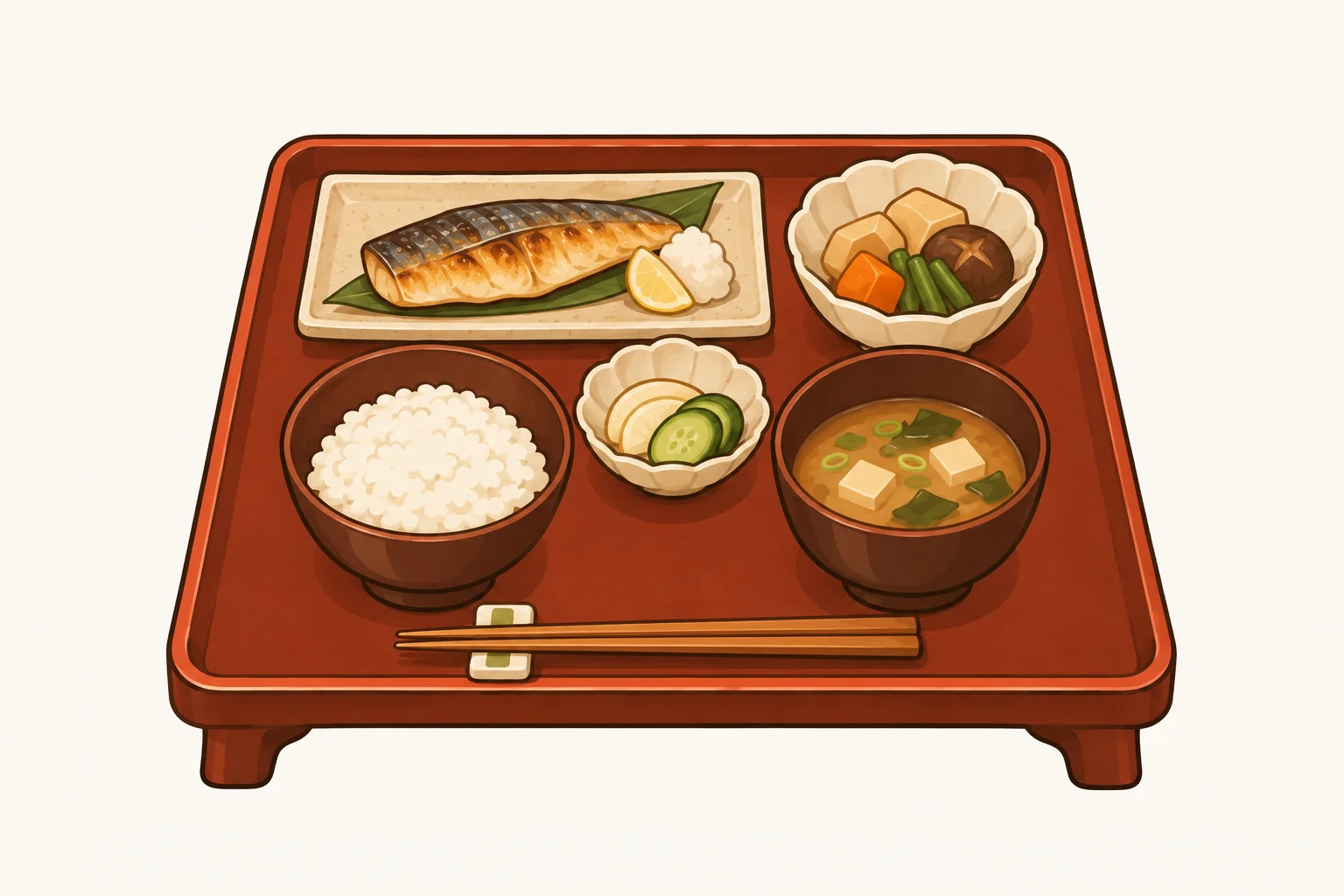
At a glance
Why Japanese meals need only chopsticks, which chopstick habits recall funeral rites, and the basic manners that carry a visitor through a meal in Japan.
- Chopsticks came to Japan from China around the 7th century; wooden chopsticks from the Heijō-kyō site show everyday use by the 8th.
- Japanese chopsticks are shorter and more pointed than Chinese ones, laid horizontally in front of you, tips to the left, on a rest.
- There is usually no spoon: you lift the soup bowl and rice bowl to eat; leaning down to food left on the table is rude.
- The two key taboos relate to funerals: never stand chopsticks upright in rice, and never pass food from chopsticks to chopsticks.
- Say “itadakimasu” before eating and “gochisōsama deshita” after; Japanese restaurants do not take tips.
Sit down to a Japanese meal and you will usually find no knife, no fork and no spoon, only a pair of chopsticks lying sideways in front of you, tips pointing left. With those two sticks you are expected to eat rice, fish, pickles and soup. The soup you drink straight from the bowl. The rice bowl you hold in your hand. And there are a few things you must never do with your chopsticks, because they echo what happens at a Japanese funeral. This piece explains where Japanese chopsticks came from, why they look and behave the way they do, what the taboos mean, and how to get through a meal in Japan without anyone wincing.
01Sticks from the Continent
Chopsticks came to Japan from China. They are generally thought to have spread among the court and aristocracy around the seventh century, when Japan was sending embassies to the Sui and Tang dynasties and importing Chinese ideas about government, writing and ritual. A later story credits Prince Shōtoku: his envoys returned from the Sui court describing how the Chinese ate with chopsticks at formal banquets, and the prince is said to have introduced the custom to his own court. That is a tradition rather than a documented event, but the broad picture, that chopsticks arrived together with Chinese-style court etiquette, is widely accepted. Before that, most people in Japan ate with their hands. By the eighth century, wooden chopsticks were ordinary enough that large numbers of them have been dug up at the site of Heijō-kyō, the capital at Nara.
Early Japan also had a different form, the orihashi, a single strip of bamboo bent in half like a pair of tweezers, used for handling food offered to the gods. Chopsticks have kept a faint sacred quality ever since. At Shinto shrines, food offerings are still arranged with chopsticks, and the Japanese word for them, hashi, is pronounced like the word for "bridge," differing only in pitch accent. People often say chopsticks are a bridge between humans and their food, or between this world and the gods. As etymology that is doubtful, but it says something true about the respect the object commands.
Japanese chopsticks differ from Chinese ones in two obvious ways: they are shorter, and they taper to a fine point. Chinese meals are traditionally shared from large dishes in the middle of a big table, so Chinese chopsticks are long and blunt, made for reaching. A traditional Japanese meal was served individually, on a small tray-table called a zen set in front of each diner, and it often included fish with fine bones. Short, pointed chopsticks are better for picking flesh off a grilled mackerel or lifting a single black bean. Placement differs too. In China chopsticks lie vertically to the right of the bowl; in Japan they lie horizontally across the front of your setting, usually resting on a small chopstick rest called a hashioki. The sticks form a line between you and the food. Picking them up is the moment the meal begins.
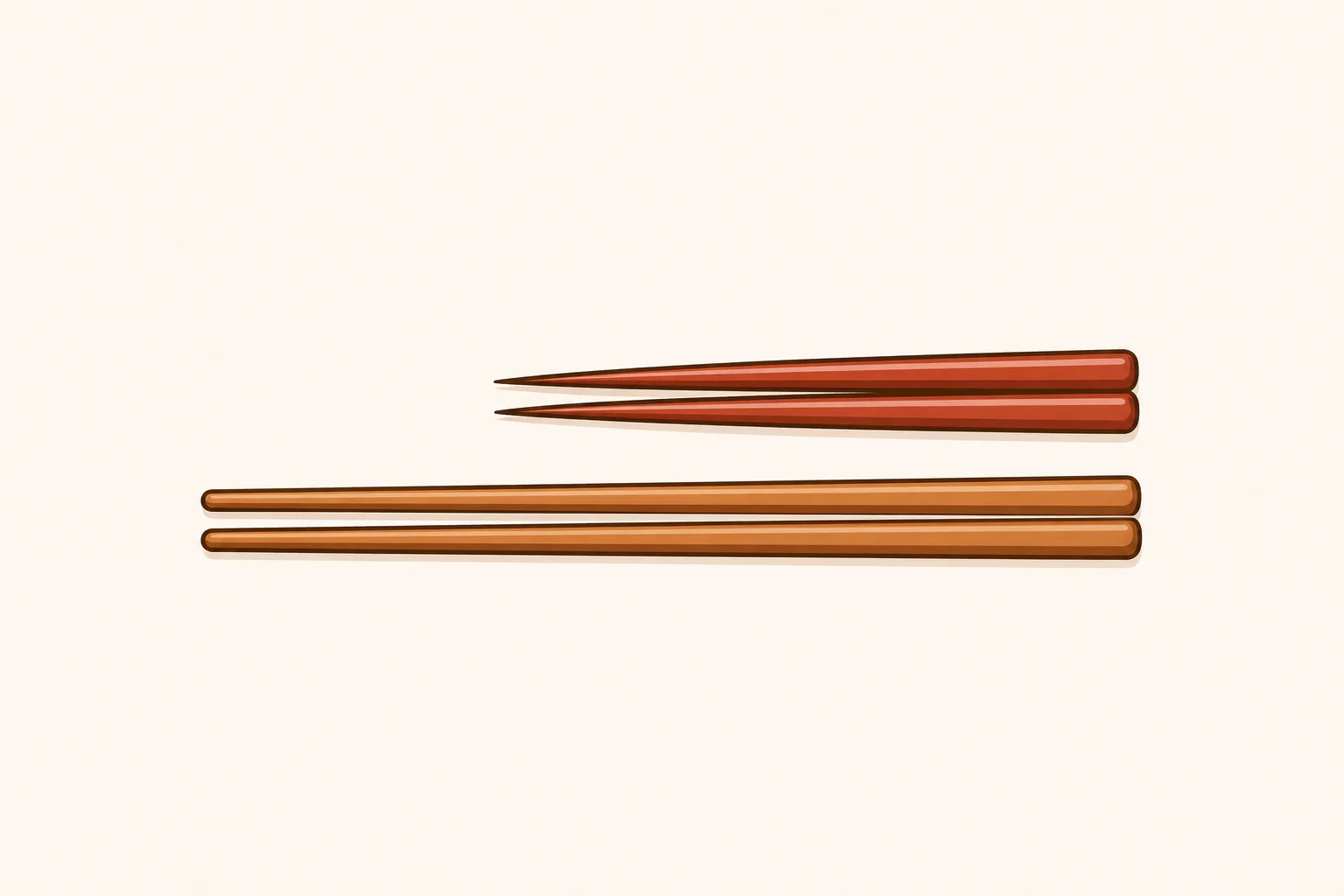
Japanese chopsticks (top) are shorter than Chinese ones (bottom) and taper to a fine point.
| China | Japan | |
|---|---|---|
| Shape | Long and blunt | Short and pointed |
| Meal | Shared from large dishes, big table | Served individually, often fish with fine bones |
| Placement | Vertically, to the right of the bowl | Horizontally across the front |
| Rest | — | Usually on a hashioki |
Shape and placement both follow from how the meal is served: shared dishes, or one portion each.
02A Table without Spoons
A typical home meal in Japan is a bowl of rice, a bowl of miso soup and a few small side dishes. This pattern, known as ichijū sansai ("one soup, three dishes"), is the backbone of Japanese home cooking, and it does not call for a spoon. To eat the soup you lift the bowl, drink from the rim, and use your chopsticks to steer the tofu and seaweed into your mouth. This only works because the bowl is light. Japanese soup bowls are traditionally lacquered wood, which weighs very little and insulates well, so you can hold a bowl of hot soup without burning your fingers. The rice bowl is treated the same way: you cradle it in your left hand, bring it up toward your chest, and eat from it with the chopsticks in your right.
For many Western diners, and for some Chinese ones, picking up a bowl to eat from it looks a little rough. In Japan it is the reverse. Leaving a small bowl on the table and bending your head down to reach it is considered bad manners, and there is an unflattering word for it: inugui, "eating like a dog." The rule of thumb is that anything that fits in your palm gets picked up: rice bowl, soup bowl, small dishes of side vegetables, the little saucer of soy sauce. Large plates, the long platter for grilled fish, the plate of tempura, stay on the table. Careful families teach children to put the chopsticks down first, lift the bowl with both hands, settle it in the left hand, and only then pick the chopsticks back up with the right.
- 1
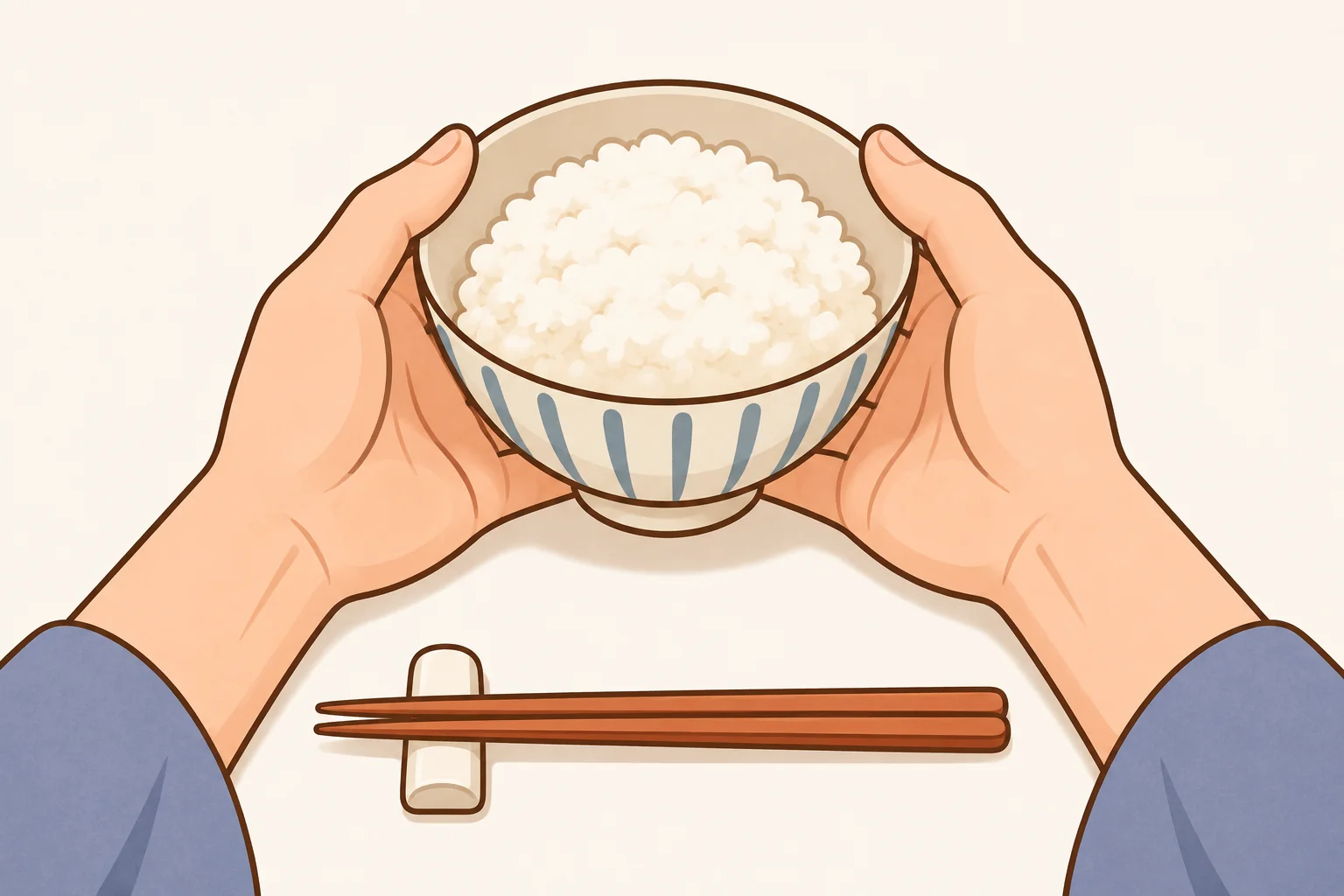 Put the chopsticks down first and lift the bowl with both hands.
- 2
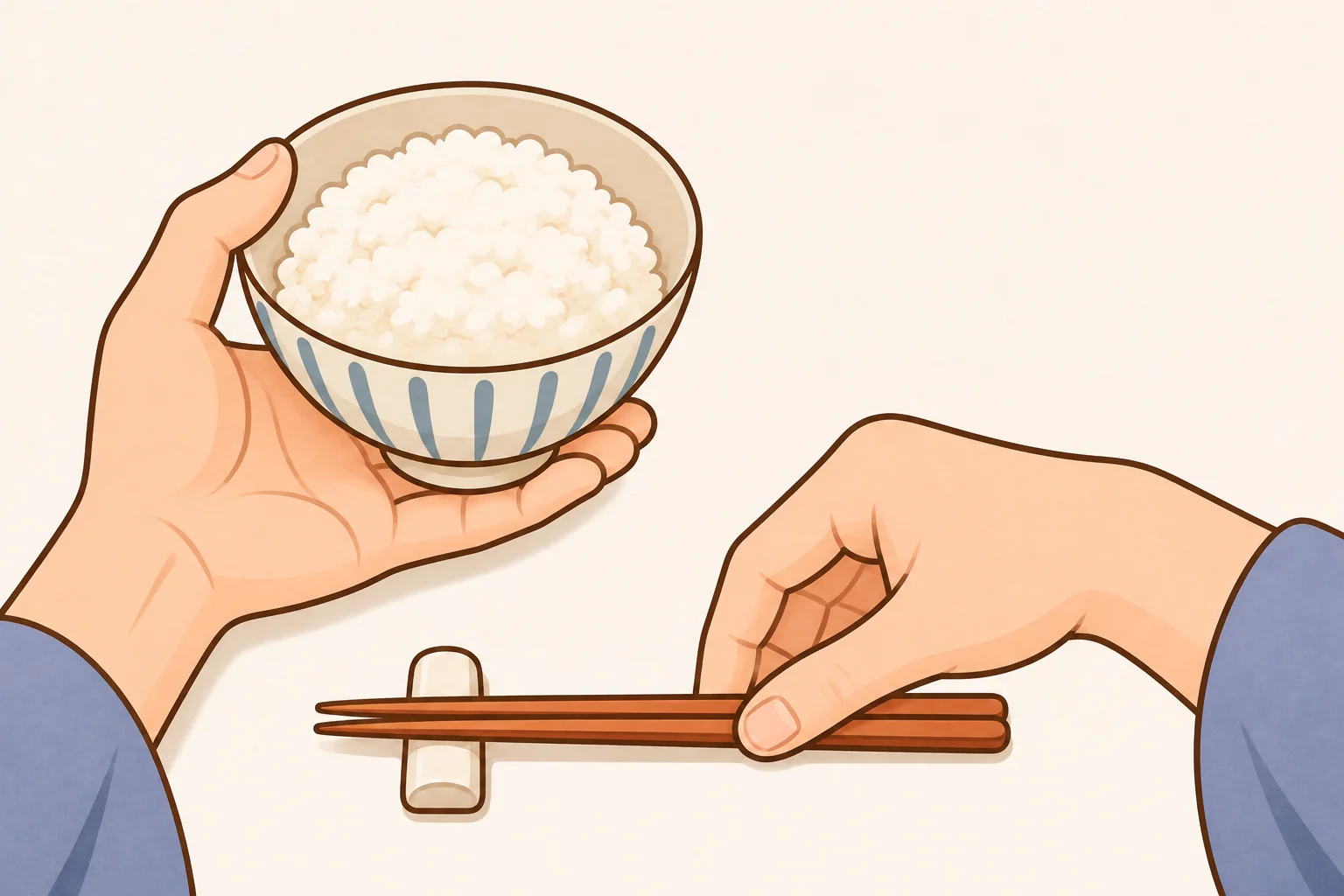 Settle the bowl in the left hand, then reach for the chopsticks with the right.
- 3
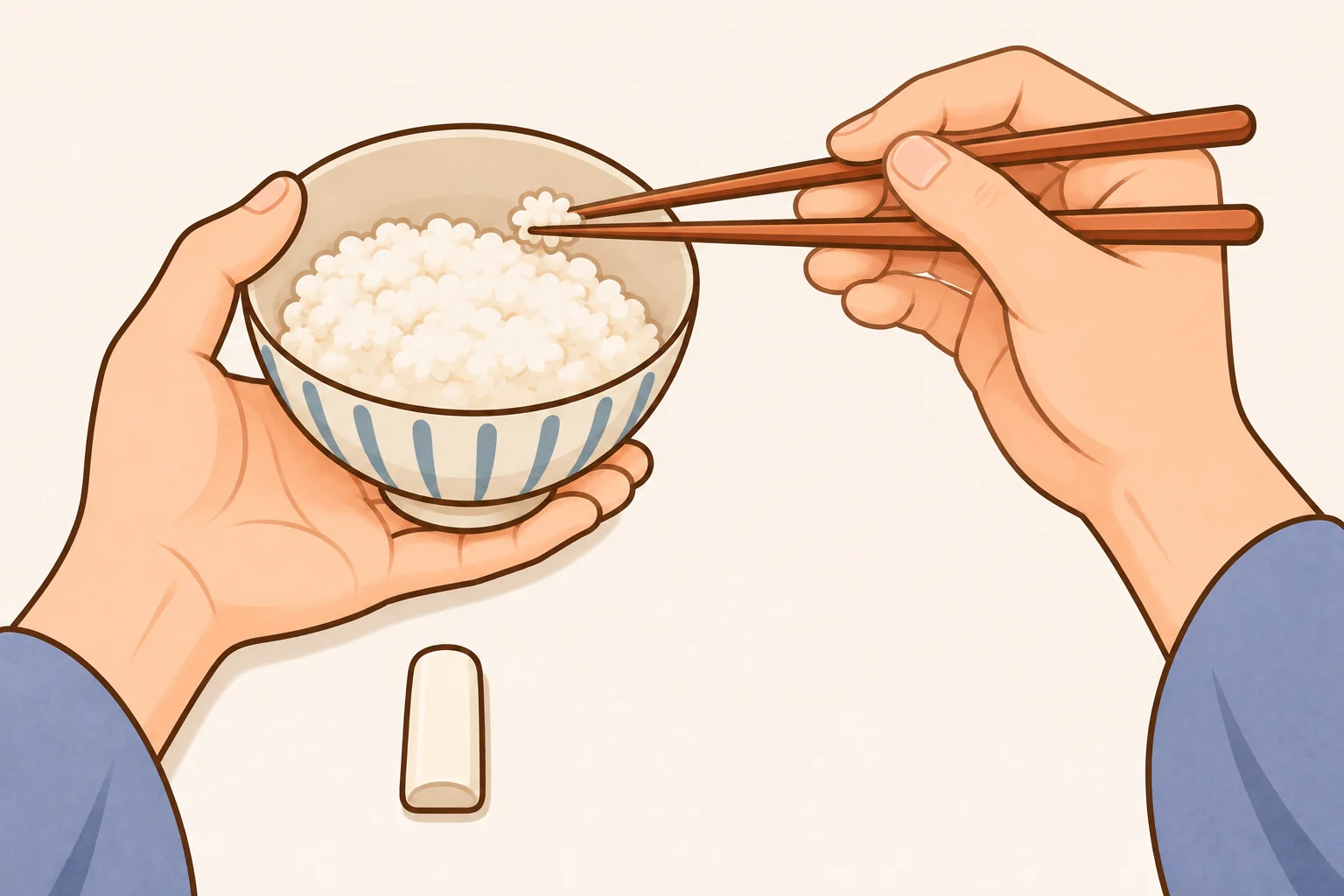 Hold the bowl up toward the chest in the left hand and eat with the chopsticks in the right.
Individual servings go hand in hand with individual utensils. In many Japanese homes, each family member has their own chopsticks and their own rice bowl, in a particular color or size, and others do not use them. Department stores sell meoto-bashi, "husband-and-wife chopsticks," a matched pair in two lengths, as a common wedding present. There is even an old rule for finding the right length: about one and a half times the distance between the tips of your thumb and forefinger spread at a right angle.
Restaurants, by contrast, mostly use waribashi, the disposable wooden chopsticks that come joined at the top and are snapped apart before use. They date from the Edo period (1603–1868). The Yoshino district in Nara Prefecture became famous for making them from cedar offcuts left over from barrel-making. High-end restaurants often provide fine cedar or bamboo waribashi, used once and thrown away. The point is freshness: this pair has never touched anyone’s mouth but yours.
03What Not to Do
The Japanese have a collective name for forbidden chopstick habits, kirai-bashi, and lists of them can run to dozens of entries. Most are things any well-brought-up diner would avoid anyway. Do not spear food with the tips (sashi-bashi). Do not drag a dish toward you with your chopsticks (yose-bashi). Do not hover over the table trying to decide what to take (mayoi-bashi). Do not lick them (neburi-bashi). Do not let sauce drip from the tips as you carry food across the table (namida-bashi, "tear chopsticks"). Do not point at people with them.
Two rules matter more than the rest, because both come from death rites. The first: never stand your chopsticks upright in a bowl of rice (tate-bashi). When someone dies in Japan, a bowl of rice heaped high, with chopsticks stuck straight up in it (usually described as a single chopstick; some accounts say a pair), is placed by the pillow of the deceased as an offering. This is called makura-meshi, "pillow rice." Planting chopsticks in your own rice looks like you are making that offering for yourself.
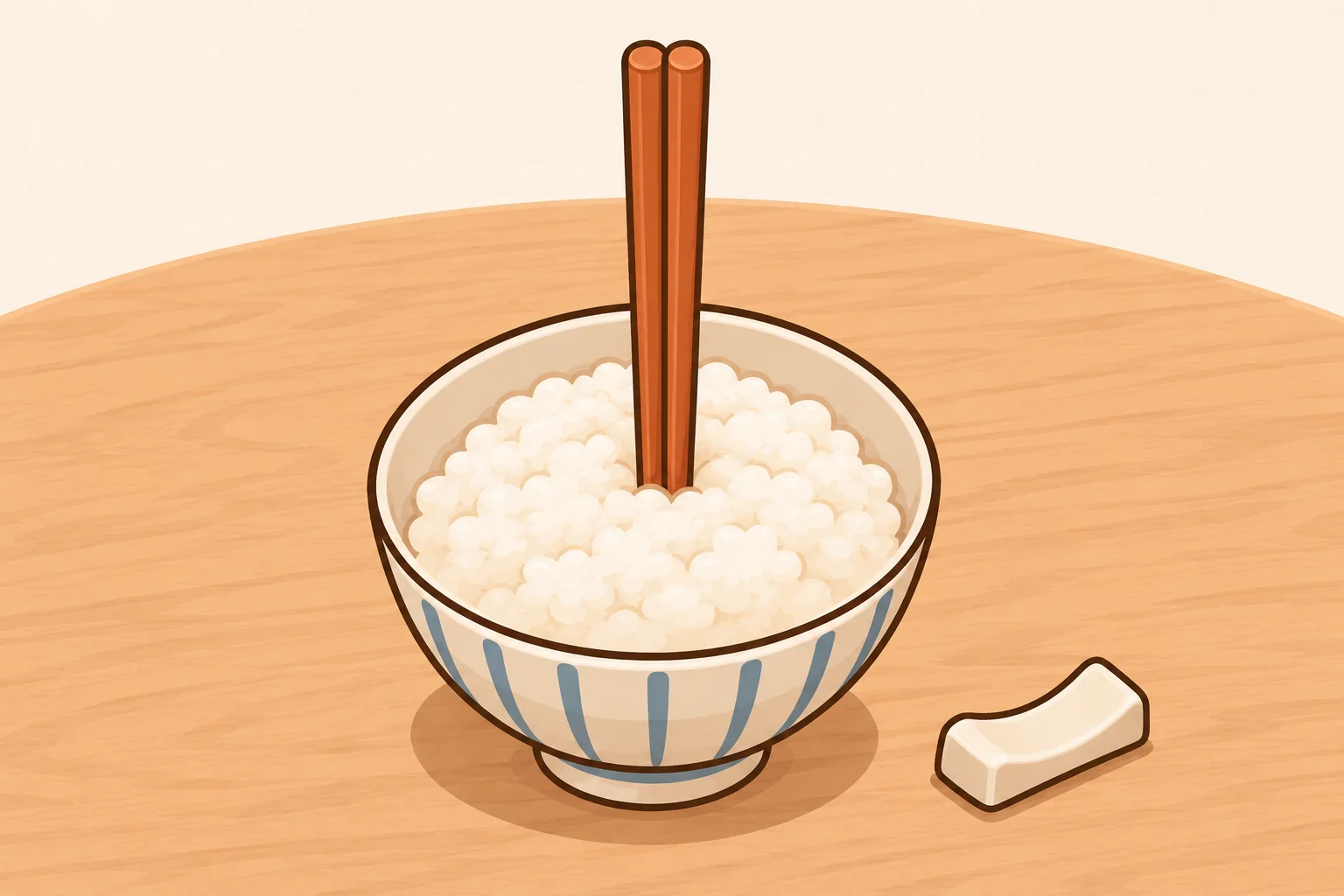
Tate-bashi: never stand chopsticks upright in a bowl of rice.
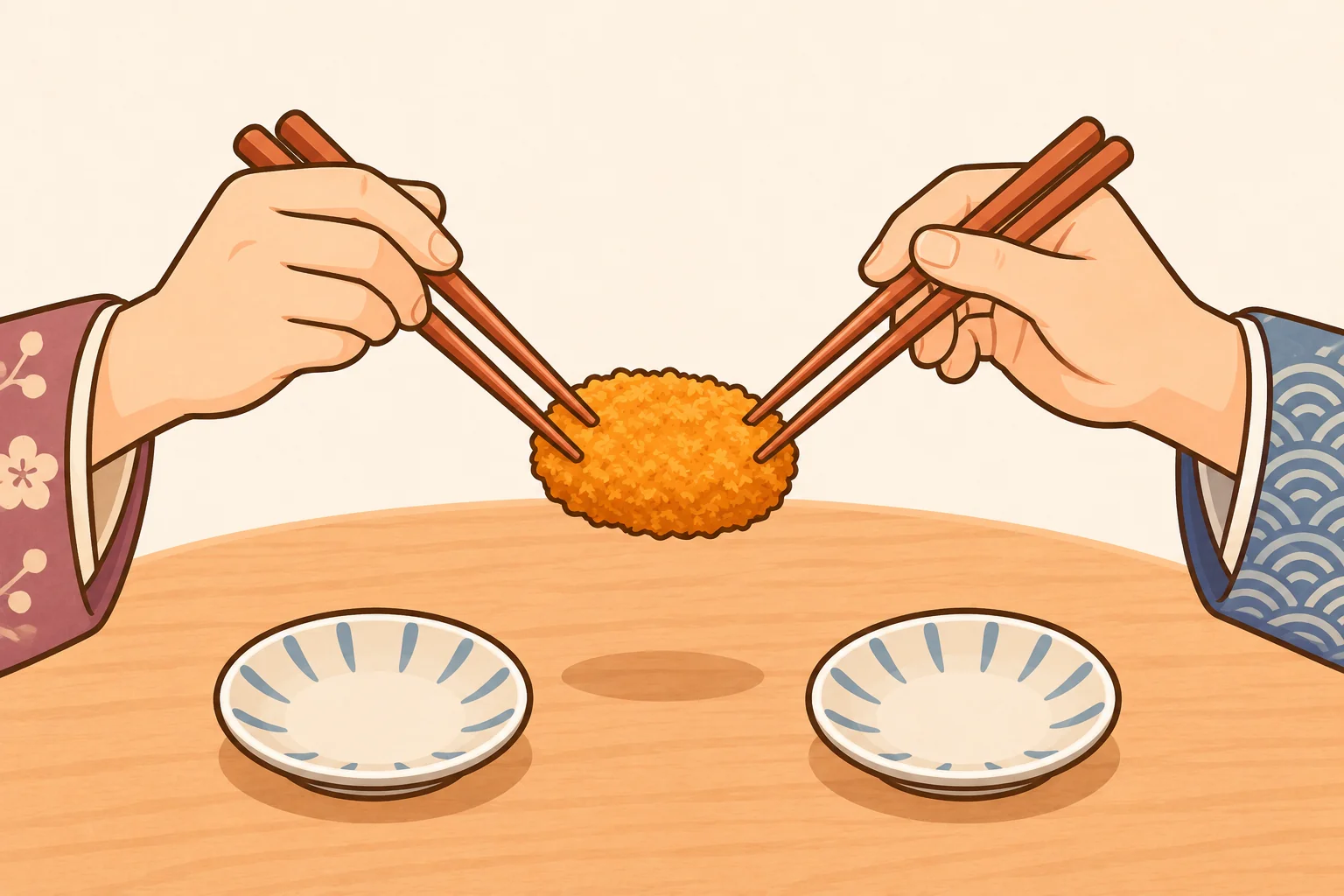
Hashi-watashi: never pass food from your chopsticks to someone else’s.
The second: never pass food from your chopsticks to someone else’s (hashi-watashi, also called awase-bashi). Japan cremates its dead. After the cremation, the family gathers around the remains and, working in pairs, uses long chopsticks to pick up pieces of bone and place them in the urn. This ceremony, kotsuage, is the one time two pairs of chopsticks are supposed to hold the same thing. At the dinner table, if you want to give someone a morsel, put it on their plate and let them pick it up themselves.
A subtler point concerns serving from shared dishes. Some people turn their chopsticks around and use the clean, thick ends to take food from a communal plate. This sakasa-bashi is common, but etiquette guides frown on it, because now the end you were holding has touched the shared food. Formal meals provide separate serving chopsticks, toribashi, for that purpose. If there are serving chopsticks, use them. If there are none, reversing your own is a forgivable compromise.
When you are not using your chopsticks, rest the tips on the hashioki. If there isn’t one, you can fold the paper sleeve of your waribashi into a small knot and use that. Do not lay the chopsticks across the top of your bowl (watashi-bashi), which traditionally signals "I’m finished" and looks rude in the middle of a meal; by another account it can even read as "bring me more." At the end of the meal, slide disposable chopsticks back into their paper sleeve and fold over the end, a small signal that they have been used.
| Name | What it is | Why |
|---|---|---|
| Tate-bashi | Chopsticks standing upright in rice | Looks like makura-meshi, pillow rice for the dead |
| Hashi-watashi (awase-bashi) | Passing food chopsticks to chopsticks | Recalls kotsuage, picking up bones after cremation |
| Watashi-bashi | Chopsticks laid across the bowl | Signals “I’m finished”; rude mid-meal |
The first two come from death rites and matter most; when not eating, rest the tips on the hashioki.
04Two Phrases
Before eating, Japanese people put their palms together and say itadakimasu. After eating, they set down their chopsticks and say gochisōsama deshita. Almost everyone does it, at home and in restaurants, and you will often hear someone murmur itadakimasu to themselves before opening a convenience-store lunch on a park bench.
Itadakimasu is a humble verb meaning "I receive," originally used for accepting something from a superior. A common modern explanation is that the fish, meat and vegetables on the table were all living things, and the phrase thanks them, along with the farmers, fishermen and cooks who brought them to you. Gochisōsama is written with characters meaning "running about." In the days before shops and refrigerators, a host who wanted to entertain a guest had to rush around gathering ingredients, so the word came to mean a feast, and saying it at the end of a meal thanks whoever went to that trouble. Saying both phrases at every meal is generally thought to be a modern habit. Farming families once had little time for table greetings; the custom took hold as families began sitting down together around a low table, the chabudai, which became the place where children learned their manners. Today children also say the phrases in unison at school lunch, and one view holds that the spread of school lunches after the war helped make the phrases universal.
How you finish matters too. Japanese children are told not to leave a single grain of rice stuck to the bowl; one saying holds that seven gods live in every grain, another that wasting rice is an insult to the farmers who grew it. Put the dishes back where they were, replace any lids, and return the chopsticks to their rest. At an izakaya or a conveyor-belt sushi bar, pushing your empty plates slightly toward the edge of the table is plenty. You do not need to clear up for the staff.
05Eating Out in Japan
Most restaurants hand you an oshibori, a damp towel, hot in winter and chilled in summer, when you sit down. It is for your hands. In a casual izakaya you will see older men wiping their faces and necks with it, but in a nicer restaurant that looks crude. Fold it and set it aside when you are done, and do not use it to wipe the table.
Noodles are the famous exception to the rule of eating quietly. Slurping soba, udon or ramen is perfectly acceptable, and many Japanese diners will tell you it is the right way: drawing in air with the noodles brings out the aroma and cools them down on the way in. Smacking your lips or chewing loudly, on the other hand, is as unwelcome in Japan as anywhere.
Sushi can be eaten with your fingers, especially nigiri at a counter. Pick up a piece between thumb and two fingers, turn it over so the fish side touches the soy sauce, and put the whole thing in your mouth in one bite. Dipping the rice side into the soy sauce makes it soak up too much and fall apart, and it drowns the fish. Most Japanese diners also do not stir wasabi into their soy sauce to make a green slurry; at a proper sushi counter, the chef has already put a dab of wasabi between the rice and the fish. The pickled ginger is for cleansing your palate between pieces.
Drinking has its own small rituals. Wait until everyone has a glass, then raise it together with a call of kanpai before anyone drinks. Do not pour for yourself; pour for the people next to you, and when someone pours for you, lift your glass with both hands to meet the bottle. When the table shares large bottles of beer, keeping your neighbors’ glasses topped up is a natural way of looking after one another.
There is no tipping in Japan. Leave change on the table and a server may well run after you to return it. You usually pay at a register by the door rather than at the table. In a zashiki, a tatami-floored dining room, you take off your shoes at the entrance and leave them pointing outward. Walk around the floor cushions rather than over them, and avoid stepping on the raised threshold of a doorway. The formal sitting posture is seiza, kneeling with your weight on your heels, but hosts know this is hard for visitors and will usually tell you to make yourself comfortable. Men can then sit cross-legged, and women commonly fold their legs to one side.
That may sound like a lot to remember, and plenty of Japanese people could not recite the full list of kirai-bashi either. Three things will carry you through most meals: never plant your chopsticks in rice or pass food chopstick to chopstick; pick up your bowl; and say itadakimasu before you start and gochisōsama when you finish.