At a glance
How sushi went from fermented lake fish to Edo street-stall nigiri, what rice and topping each contribute, the regional styles, and how to order at a counter.
- Sushi began as narezushi, fish preserved by fermenting it in rice; Lake Biwa’s funazushi is still made today.
- Nigiri took shape at Edo street stalls in the early nineteenth century, usually dated to around the Bunsei era (1818–1830).
- Edo-mae toppings were usually given shigoto, "the work": vinegar-cured kohada, soy-marinated tuna, simmered anago.
- A piece of nigiri is vinegared rice (shari) plus a topping (neta), with the rice kept near body temperature.
- The first conveyor-belt sushi restaurant opened in Ōsaka Prefecture in 1958 and spread nationwide after Expo '70 in Ōsaka.
Most people outside Japan meet sushi as raw fish, and many assume that rawness is the point. Inside Japan, the story runs the other way. For most of its thousand-year history, sushi was a way of preserving fish by packing it in rice and letting it ferment for months; the rice was thrown away. The hand-pressed nigiri that now defines sushi was a fast-food invention of early nineteenth-century Edo (Tokyo), and even then most of the fish on it had been salted, vinegared, marinated or simmered. This introduction follows sushi from its fermented beginnings to the Edo street stall, explains what the rice and the topping each contribute to a single piece of nigiri, surveys the regional styles that never became nigiri at all, and ends at the counter, with practical advice on ordering and eating.
01Before Vinegar: Fermented Sushi
The oldest kind of sushi still made in Japan comes from the shores of Lake Biwa in Shiga Prefecture. It is called funazushi. In spring, fishermen catch female nigorobuna, a crucian carp native to the lake, just before they spawn. The fish are scaled and gutted through the gills, leaving the roe inside, and packed in salt for several months. In summer they are rinsed and layered into wooden tubs with cooked rice, weighted down with stones, and left until winter or longer; some producers age them for a year or two. Lactic acid bacteria break down the starch in the rice, the tub turns sour, and the acidity keeps the fish from rotting while softening its bones. When it is ready, the rice, by now a sour paste, is scraped off, and the fish is sliced thin, bones and all, showing a ring of orange roe. The smell is strong and the flavor sharp, salty and cheese-like. First-timers often struggle with it. Admirers in Shiga drink sake with it and still recommend it for an upset stomach.
- 1
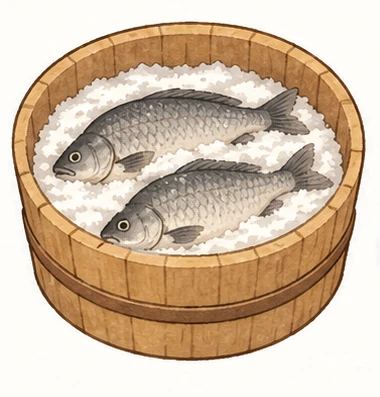 In spring the carp, roe left inside, are packed in salt for several months.
- 2
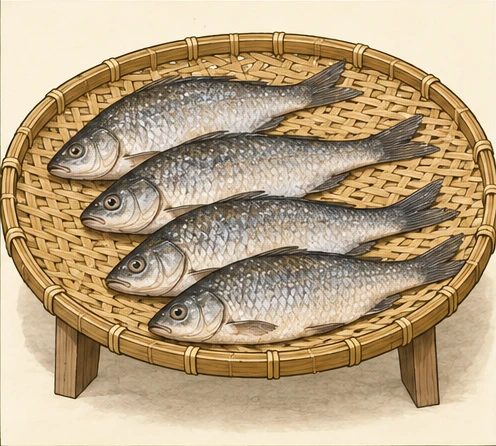 In summer the fish are rinsed.
- 3
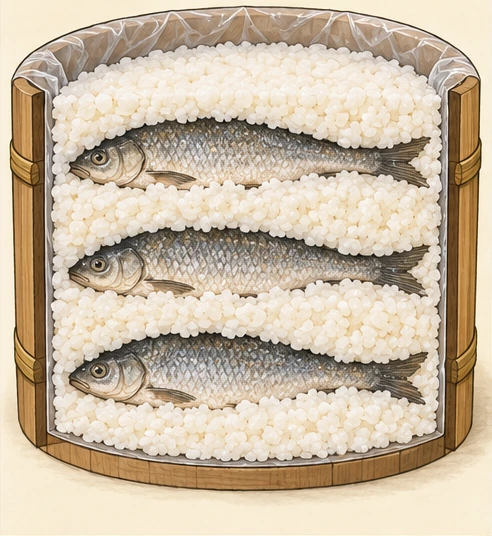 Rice and fish go into a wooden tub in alternating layers.
- 4
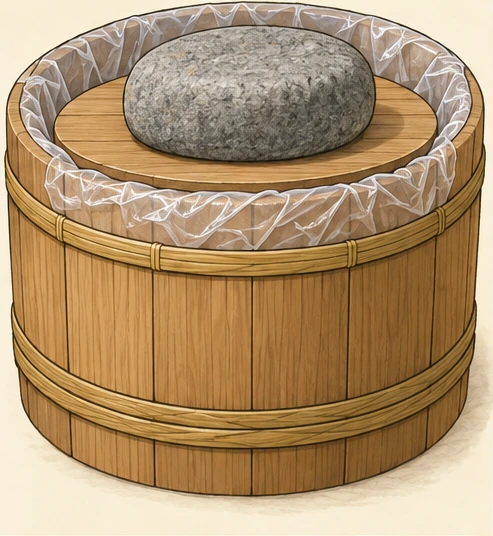 Weighted with a stone, the tub is left until winter, or for a year or two.
- 5
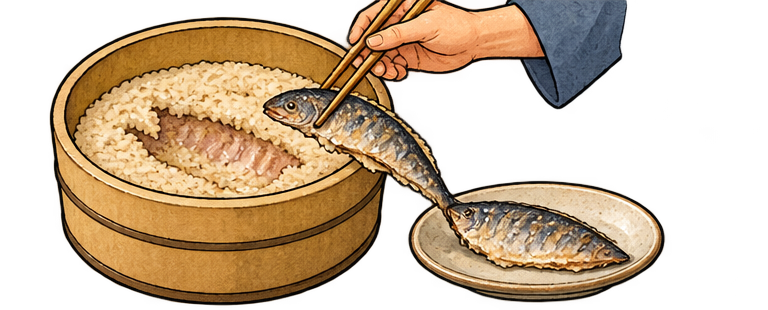 To eat it, the pasty rice is scraped away and only the fish is eaten.
This style is called narezushi, "matured sushi," and the word sushi itself is generally thought to come from the old adjective sushi, "sour." The technique of fermenting fish in rice is usually traced to the rice-growing lowlands of mainland Southeast Asia, around the Mekong basin, where similar fermented fish are still made, and it reached Japan by way of China. Japan borrowed two Chinese characters: 鮓, which in early Chinese dictionaries meant fish fermented with salt and rice, and 鮨, which originally meant a fish paste or sauce but had been merged with 鮓 by the third and fourth centuries; the cheerful-looking spelling 寿司, roughly "long life, in charge," is a later phonetic invention of the Edo period. All three spellings are still used on shop signs.
The earliest Japanese records of sushi are tax records. The Yōrō Code, compiled in the early eighth century, lists fermented abalone and mussels among the goods that provinces sent to the court, and wooden tags excavated at the site of the Heijō Palace in Nara record shipments of fermented fish. By the time of the Engishiki, a body of court regulations completed in 927, many provinces were sending various kinds of sushi to the capital, among them Ōmi, the province around Lake Biwa, with its carp. For an inland capital without refrigeration, fermented fish was a way to eat seafood at all. Sushi was a valuable tribute item and a preservation technology, the opposite of the "freshness" that the word suggests today.
By the Muromachi period (1336–1573), people had grown impatient. A style called namanare, "half-matured," shortened fermentation to anywhere from a few days to a month. The fish kept some of its raw texture and the rice had not yet broken down, so both could be eaten together. From this point on, the rice was no longer just a fermenting bed to be discarded. It had become part of the food.
The next step was to skip fermentation altogether. In the Edo period (1603–1868), cooks began adding vinegar directly to cooked rice to imitate the sourness that fermentation had once supplied, producing hayazushi, "quick sushi," which could be eaten within hours or even immediately. The whole history of sushi up to this point can be read as a steady shortening of time, from years to months to days to minutes. Nigiri is where that road ends.
Narezushi did not disappear. Alongside funazushi, the Hokuriku region on the Sea of Japan coast makes kaburazushi, slices of yellowtail sandwiched in turnip and fermented with rice kōji, and Hokkaidō and northern Honshū make izushi from salmon, herring or sandfish, fermented with rice and vegetables over the winter and eaten at New Year. These are now regional specialties and holiday foods, the oldest branch of the sushi family.
02Edo-mae: Nigiri Is Born at a Street Stall
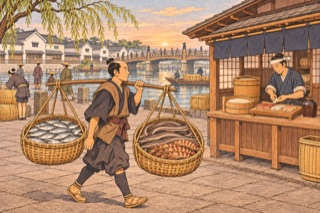
Nigiri sushi took shape in Edo in the early nineteenth century. The city had a population of around a million, with a large surplus of single men: artisans, laborers, peddlers, and samurai posted from the provinces. Its streets were lined with yatai, portable food stalls, selling tempura, soba noodles and sushi to people who wanted to eat standing up and move on.
The usual story credits Hanaya Yohei (1799–1858), who ran a celebrated sushi shop in the Ryōgoku district, with popularizing nigiri during the Bunsei era (1818–1830); some accounts place it slightly earlier. Other names are sometimes proposed, and no one can say for certain who pressed the first piece. What is clear is that by the late 1820s, Edo’s satirical senryū poets were joking about this newfangled sushi squeezed by hand. Yohei’s shop, together with the Matsu no Sushi at Ataka in Fukagawa and the older Kenuki Sushi, which wraps its sushi in bamboo leaves, were later remembered as the "three great sushi shops of Edo."
Edo nigiri differed from today’s in several ways. It was much bigger, reportedly two or three times the size of a modern piece or more, closer to a small rice ball and eaten in two or three bites. One popular explanation for why many shops still serve nigiri in pairs is that cooks began cutting the large pieces in half. The rice was also a different color. Edo sushi shops favored akazu, a red vinegar brewed from sake lees, which gave the rice a faint brown tint and a mellow, slightly sweet depth. Around 1804 Nakano Matazaemon, a sake brewer in Handa on the Chita Peninsula near Nagoya, began making vinegar from the lees left over from brewing, aiming at the demand from Edo’s quick-sushi makers, and shipped it to the city by sea; nigiri’s rise soon afterward widened his market. His business survives as Mizkan, today one of Japan’s largest makers of vinegar and condiments.
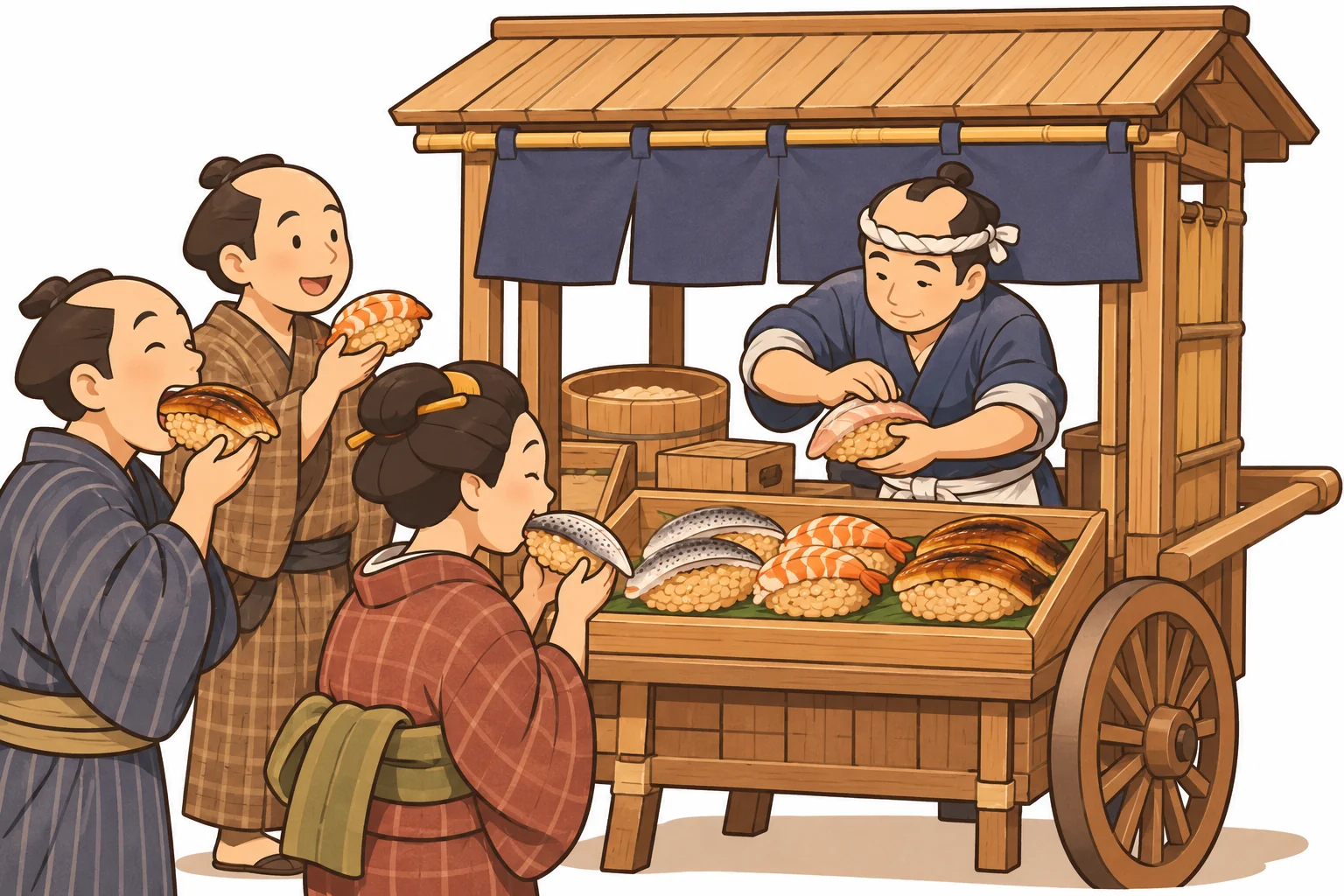
A late-Edo sushi stall: the vendor shapes oversized nigiri while townspeople eat standing (illustration).
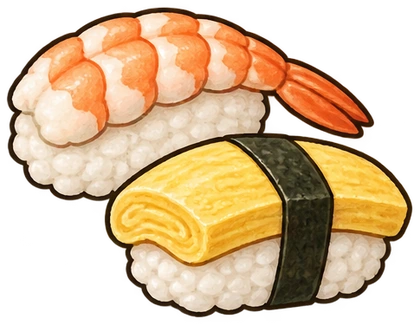
The most important difference was that almost every topping had been worked on. Edo-mae means "in front of Edo," the bay in front of the city, now Tokyo Bay, and it came to mean sushi made from the bay’s fish in the Edo manner. Without refrigeration, raw fish could not simply be laid on rice, so each kind received its own treatment, known collectively as shigoto, "the work." Kohada, a young gizzard shad, was salted and then cured in vinegar. Lean tuna was marinated in soy sauce, a technique called zuke. Conger eel, clams and octopus were simmered and brushed with a thick, sweet reduction. Shrimp were boiled, and the omelet, tamagoyaki, was made with fish paste and cooked slowly. The flavor of Edo-mae sushi was the flavor of salt, vinegar, soy sauce and heat, not of raw fish alone.
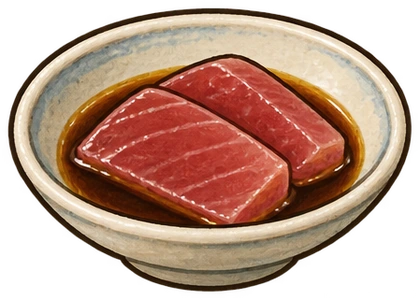
Lean tuna steeped in soy sauce, called zuke, one kind of Edo-mae shigoto.
Serious sushi shops in Tokyo still treat shigoto as the heart of the craft. Regulars judge a chef by his kohada and his conger eel. Refrigeration means fish can now be served raw at any time, but many of the best chefs still salt, cure and age their fish for days, because removing water concentrates the flavor and gives the flesh a texture that marries better with the rice.
03Rice and Topping: How One Piece of Nigiri Works
A piece of nigiri has two parts: the rice, called shari in the trade, and the topping, called neta, a reversal of the word tane, "seed" or "material." Between them there is often a dab of wasabi, and on top there may be a glaze of sauce. That is all. Sushi chefs nonetheless like to say that most of the quality is in the rice.
Sushi rice uses a short-grain Japanese rice that holds its shape. Many shops prefer rice that has been stored for some months, since it is drier and absorbs the seasoning better. It is cooked slightly firmer than table rice and turned out, still hot, into a broad wooden tub called a hangiri. The vinegar mixture is poured over and folded in with a paddle in cutting strokes, while someone fans the rice to drive off steam and give each grain a gloss. The seasoning is vinegar, salt and usually sugar, in proportions each shop guards. Traditional Edo-mae rice is sharper and saltier, with little or no sugar; the sushi rice of the Kansai region and of home cooks tends to be sweeter. Red vinegar has come back into fashion in recent years, and rice seasoned with it, light brown and round in flavor, is especially good with fatty tuna and other rich fish.
The rice is kept at roughly body temperature, which chefs call hitohada, "human skin." Cold rice turns hard and loses its aroma; hot rice starts to cook the fish. Good shops keep the rice in an insulated wooden container and take out small amounts as they go.
The pressing itself takes a few seconds. The chef holds the slice of fish in his left hand, takes a measure of rice in his right, shapes it lightly, sets it on the fish, presses with a finger, turns the piece over and shapes it again with two fingers on top. The goal is a piece that is firm on the outside and airy inside, one that holds together between your fingers but falls apart in your mouth so the grains mix with the fish. Pressed too hard, it eats like a rice ball; too loose, it collapses on the way. An old saying gives an apprentice three years to learn to cook the rice and eight to learn to press it. The numbers are rhetorical, but they show how seriously this skill is taken.
- 1
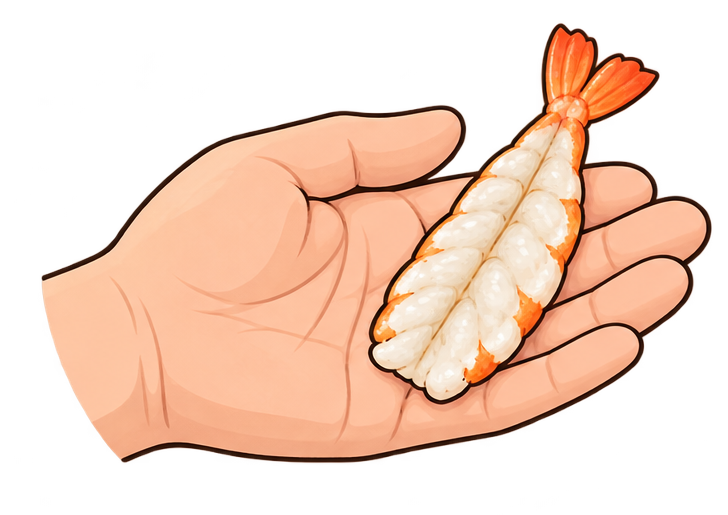 The left hand holds the topping.
- 2
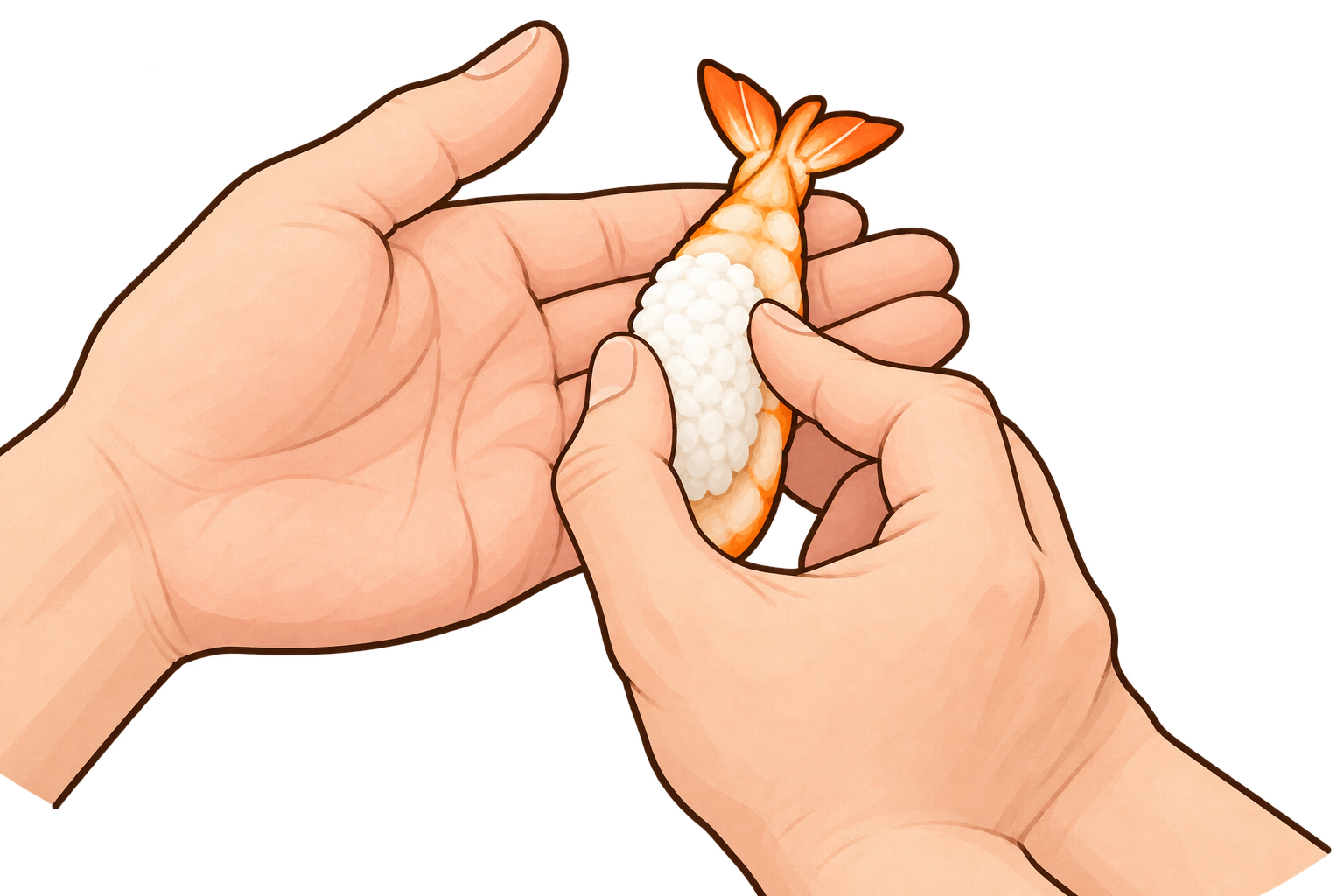 The right hand sets a formed ball of rice on the topping and presses it with a finger.
- 3
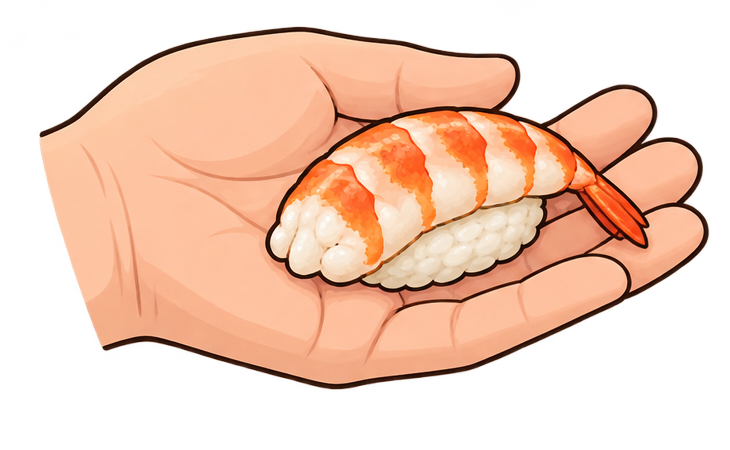 It is turned over, topping up and rice below.
- 4
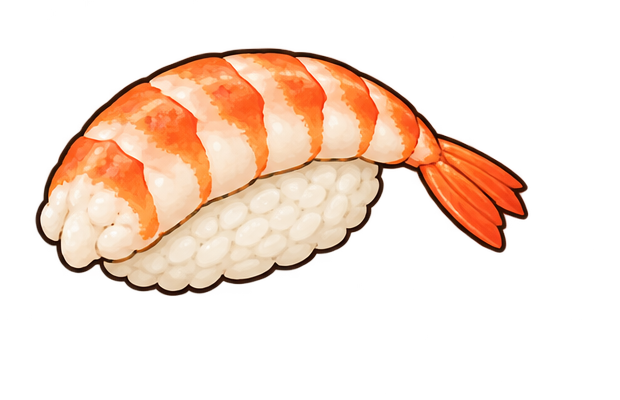 Two fingers shape it from above: firm outside, air left inside.
The toppings are a world of their own. Tuna, maguro, is the most prized, divided by cut into deep-red lean akami, medium-fatty chūtoro, and the marbled belly, ōtoro, which melts on the tongue. In the Edo period, tuna was considered a lowly fish and its fatty belly was often discarded or cooked into a cheap stew with leeks. The appetite for fat arrived in the twentieth century with changing tastes and better freezing and transport. The word toro is roughly a century old; according to a popular story, a customer at Yoshino Sushi Honten in Tokyo’s Nihonbashi coined it because the fat seemed to melt, toro, in the mouth.
Beyond tuna there are white-fleshed fish such as sea bream, flounder and halibut, mild and slightly chewy; hikarimono, "shiny things," the silver-skinned fish like kohada, horse mackerel, sardine and mackerel, usually cured in vinegar; shrimp of several kinds; shellfish such as ark clam, scallop and cockle; squid and octopus; and soft, loose toppings like sea urchin and salmon roe. For those, a strip of nori is wrapped around the rice to form a little wall, creating gunkan-maki, "battleship rolls," traditionally credited to Kyūbey, a Ginza sushi shop, in the early Shōwa period; one account dates it to 1941.
Sushi follows the seasons, a principle the Japanese call shun. Sea bream in spring; horse mackerel, conger eel and shinko, the tiniest kohada, in summer, when a single piece may need several fish and costs accordingly; saury and mackerel in autumn; yellowtail, flounder and the fattiest tuna in winter. The omakase menu at a high-end shop is essentially a list of what is in season that day.
Finally, soy sauce and wasabi. At better shops the chef often brushes each piece with nikiri, soy sauce simmered with sake and mirin to soften it, and in that case you do not dip it again. Wasabi goes between rice and fish, in an amount suited to each topping, to cut fishiness and lift flavor. Real wasabi, grated fresh from the rhizome, has a clean heat followed by a faint sweetness quite unlike the green horseradish paste in tubes. The pickled ginger, gari, is young ginger in sweet vinegar, eaten between pieces to refresh the palate.
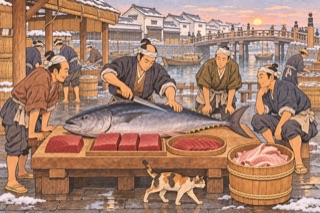 Deep diveTunaOrder an omakase in Tokyo and the tuna usually arrives in a sequence: a slice of deep red lean meat, then something pinker and softer, then a pale, marbled piece that seems to…8 chapters
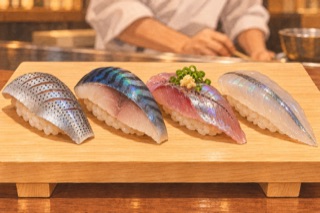 Deep diveHikarimonoSit at a sushi counter in Japan and, somewhere in the middle of the meal, the chef will set down a piece that looks different from the rest.9 chapters
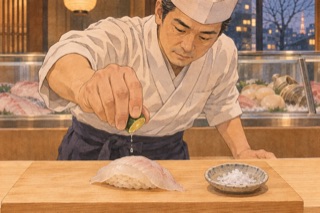 Deep diveBeyond TunaMost first-time visitors walk into a sushi bar thinking about tuna.8 chapters
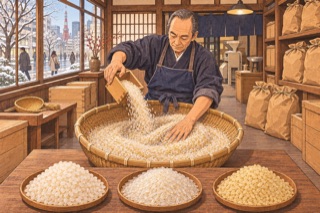 Deep diveShari and Its Supporting CastAt a sushi counter your eyes follow the fish.7 chapters
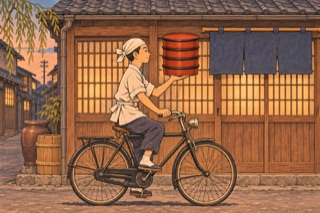 Deep diveThe Sushi ChefFrom a counter seat, a sushi chef looks like a pair of hands and very little else.9 chapters
04From Stall to Restaurant to the World
For about a century after its invention, nigiri was largely a Tokyo food. Several events, some of them disasters, turned it into the national standard.
The Great Kantō Earthquake of 1923 destroyed much of Tokyo, and many sushi chefs returned to their home regions or moved elsewhere to open shops, carrying Edo-mae nigiri with them. Meanwhile, tightening traffic and hygiene rules in the early Shōwa period pushed sushi stalls off the streets; by around 1940 they had largely disappeared, and sushi moved into shops. The long, pale wooden counter that defines a sushi restaurant today is the descendant of the street stall’s board.
After the Second World War, food shortages under the Allied occupation led the government in 1947 to issue emergency measures that shut down most restaurants other than ration-ticket canteens. Tokyo’s sushi makers found a workaround. Customers would bring their own rice, one gō, about 150 grams, and the shop would charge a processing fee to turn it into ten pieces of sushi, rolls included. The authorities accepted this "contract processing" arrangement and it spread to other cities. The standard serving of ten pieces is often traced to this rule. It also had a lasting side effect: the arrangement favored nigiri shops, while Ōsaka’s pressed and boxed sushi struggled, and nigiri emerged as the default form of sushi everywhere in Japan.
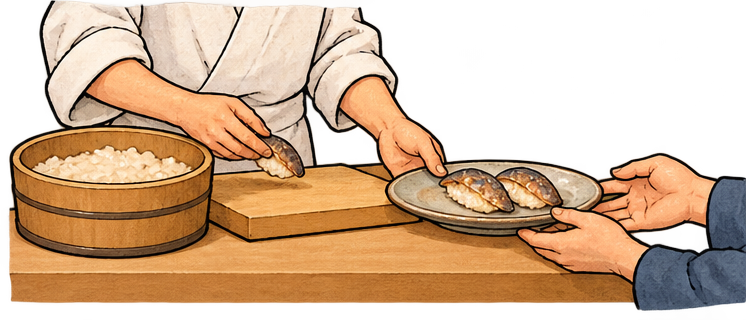
From 1947 customers brought one gō of rice and the shop, for a fee, returned it as sushi.
Refrigeration and modern distribution did the rest. Once fish could travel cold, heavy curing became optional and freshness itself became a selling point. Tokyo’s central wholesale market opened at Tsukiji in 1935, and its predawn tuna auctions eventually became world famous. In October 2018 the market moved to a new site at Toyosu in Kōtō Ward. The first tuna auction of each New Year still makes headlines with record prices, a publicity event more than a market price, but a vivid sign of tuna’s place in the Japanese imagination.
Then came the conveyor belt. In 1958 Shiraishi Yoshiaki opened Mawaru Genroku Sushi near Fuse Station in what is now Higashiōsaka, the first conveyor-belt sushi restaurant, reportedly inspired by watching beer bottles move along a conveyor at Asahi’s Suita brewery. The format drew wide attention at the 1970 Ōsaka World Expo and spread nationwide. Modern kaitenzushi chains such as Sushiro and Kura Sushi are highly automated, with chips in the plates to track freshness and sales (the bill is counted by plate color), tablet ordering and express lanes that shoot orders to your seat. Plates have long cost around a hundred yen (still roughly 110 to 130 yen as of 2026), and these chains turned sushi from a treat for special occasions into an ordinary family meal out.
Sushi went abroad as well. Japanese restaurants in Los Angeles in the 1960s and 70s produced the California roll, with avocado standing in for fatty tuna and the rice rolled on the outside so that the nori was hidden, a design that eased Americans into raw fish and seaweed. Today sushi is sold in supermarkets around the world, and Japan’s top counters, boosted by the Michelin Guide and the 2011 documentary Jiro Dreams of Sushi, draw diners who fly in for a single meal.
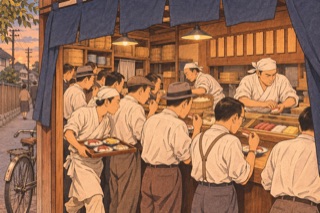 Deep diveKaitenzushiSit down at a kaitenzushi (conveyor-belt sushi) counter anywhere in Japan and the basic deal is the same.8 chapters
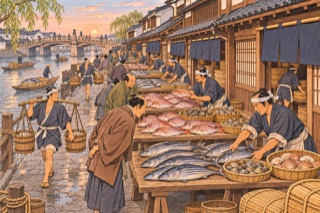 Deep diveFish MarketsThe piece of sea bream a sushi chef slides across the counter at lunchtime has usually changed hands four or five times since it left the water.8 chapters
05Pressed, Rolled, Scattered and Stuffed: Regional and Home Sushi
Nigiri is only one kind of sushi, and in homes and regions across Japan it is not even the most common.
The Kansai region around Ōsaka and Kyoto has a long tradition of pressed sushi. Ōsaka’s hakozushi, "box sushi," layers vinegared rice with cured fish, shrimp and omelet in a wooden frame, presses it firm and cuts it into neat squares, so that it looks like a box of confections. Kyoto’s sabazushi lays a whole fillet of salted, vinegared mackerel on a log of rice, wraps it in kelp and then in bamboo sheath. The road from Obama on Wakasa Bay to Kyoto, which carried salted mackerel to the capital, is still known as the Saba Kaidō, the Mackerel Road; the legend is that the fish was perfectly seasoned after a day and a night on the road. In Kyoto, households traditionally made sabazushi for festivals, and old shops around Gion still sell it.
- 1
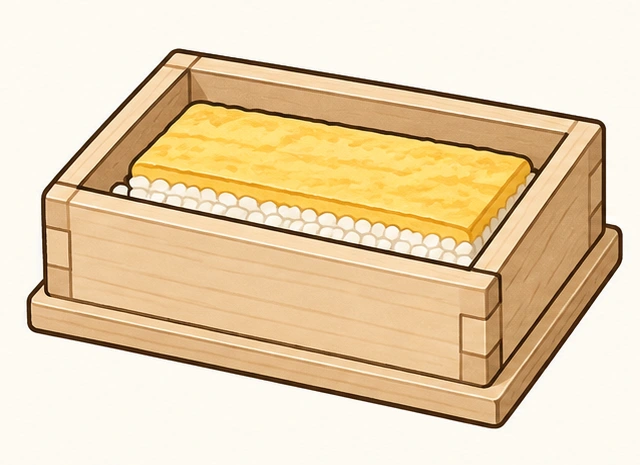 Vinegared rice and toppings are packed into a wooden frame.
- 2
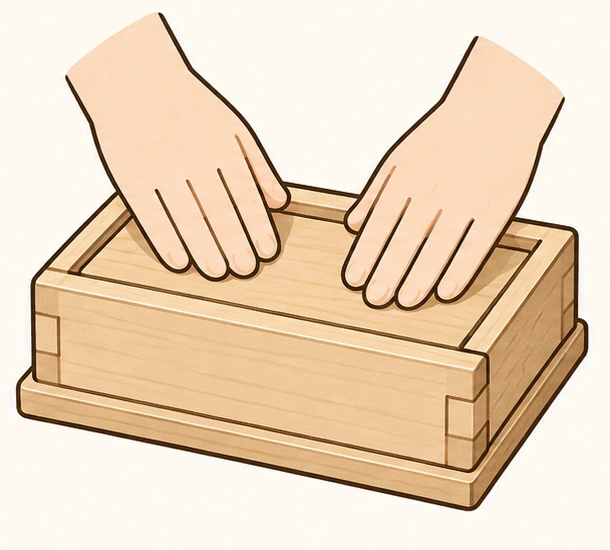 The lid goes on and is pressed down.
- 3
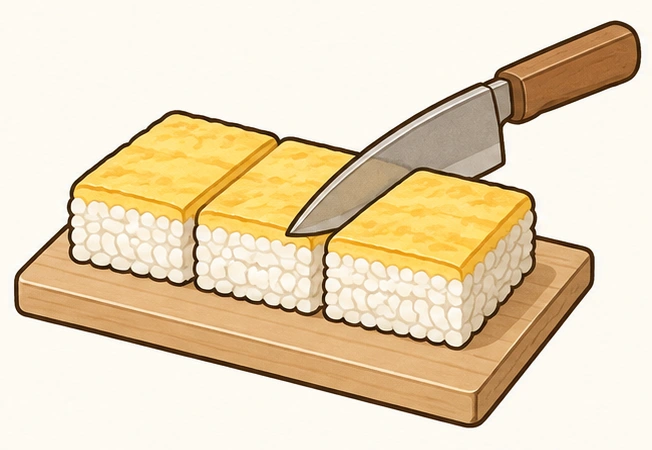 Unmoulded, the block is cut into squares.
In the mountains of Nara and Wakayama there is kakinoha-zushi, small blocks of rice topped with salted mackerel or salmon and wrapped in persimmon leaves, which keep the sushi and lend it a faint fragrance. Toyama’s masu no sushi presses trout onto rice in a round, bamboo-leaf-lined container, producing a pink disk that is cut like a cake and sold as a famous station lunchbox. All of these are sushi made to keep and to travel, closer in spirit to the old preserving tradition than nigiri is.
Rolled sushi, makizushi, was common by the late Edo period. Thin rolls hold a single filling: tuna in tekkamaki, cucumber in kappamaki, simmered gourd strips in kanpyōmaki. Thick rolls, futomaki, wrap omelet, mushrooms, gourd, cucumber and sweet fish flakes, so each slice shows a colorful flower. On Setsubun, the eve of spring in early February, people in the Ōsaka area traditionally eat a whole futomaki in silence while facing the year’s lucky direction. This ehōmaki custom was a local one until the convenience store chain 7-Eleven tried it in Hiroshima in 1989 and rolled it out nationwide in 1998; it is now a national seasonal product.
Chirashizushi, "scattered sushi," comes in two forms. At a sushi shop it is usually a bowl of rice covered with sliced raw fish. At home it is rice mixed with chopped mushrooms, lotus root and carrot, topped with ribbons of egg, snow peas and salmon roe, and it is a fixture of the Doll Festival on March 3. Inarizushi stuffs vinegared rice into pouches of fried tofu simmered in a sweet-salty broth. Foxes are said to love fried tofu, and foxes are the messengers of the Shinto deity Inari, hence the name. Cheap and durable, inarizushi was already a street food in late Edo and is now a staple of lunchboxes and school sports days.
At home, people also make temakizushi, hand-rolled cones of nori filled with rice and whatever toppings are on the table, a sociable do-it-yourself meal. Home sushi and restaurant sushi are almost separate worlds. Families make chirashi, hand rolls and inari for celebrations and guests, and leave nigiri to the professionals.
06At the Counter: How to Order and Eat
There are roughly three ways to eat sushi in Japan. The easiest is conveyor-belt sushi: take a ticket at the door, sit down, take plates from the belt or order by tablet, and pay by the number and color of plates. A filling meal costs one or two thousand yen (as of the mid-2020s). Next come neighborhood sushi shops and standing sushi bars near stations, where you can order directly from the chef at moderate prices. At the top are the high-end counters, often with only eight to a dozen seats, serving mainly omakase. In Tokyo a dinner at such a place typically runs from twenty or thirty thousand yen upward (as of the mid-2020s), and famous shops are booked months ahead.
At a counter there are two ways to order. Omakase, "I leave it to you," lets the chef choose and sequence the meal. Okonomi, "as you like," means ordering piece by piece. The conventional advice is to move from light to rich: white fish and shellfish first, then shiny fish and tuna, finishing with conger eel, omelet or a roll, since strong flavors dull the palate for delicate ones. This is a habit, not a rule, and nobody will object if you start with tuna. Many shops serve a few small dishes and sashimi, called tsumami, before the nigiri, to go with sake or beer.
You may eat nigiri with your fingers or with chopsticks. With fingers, pick up the piece with thumb, index and middle finger, turn it over and touch only the fish side to the soy sauce. If the rice touches the soy sauce it soaks it up and falls apart. Chopsticks work the same way: lay the piece on its side and lift. For gunkan-maki, which cannot be turned easily, you can use a slice of ginger as a brush to dab soy sauce on top. If the chef has already brushed on nikiri or added salt, eat it as it is. Eat each piece in one bite if you can; a bitten piece put back down tends to fall apart, and the chef designed the balance of rice and fish for a single mouthful. When a piece is placed in front of you, eat it promptly, because the rice temperature and the fish are at their best right then.
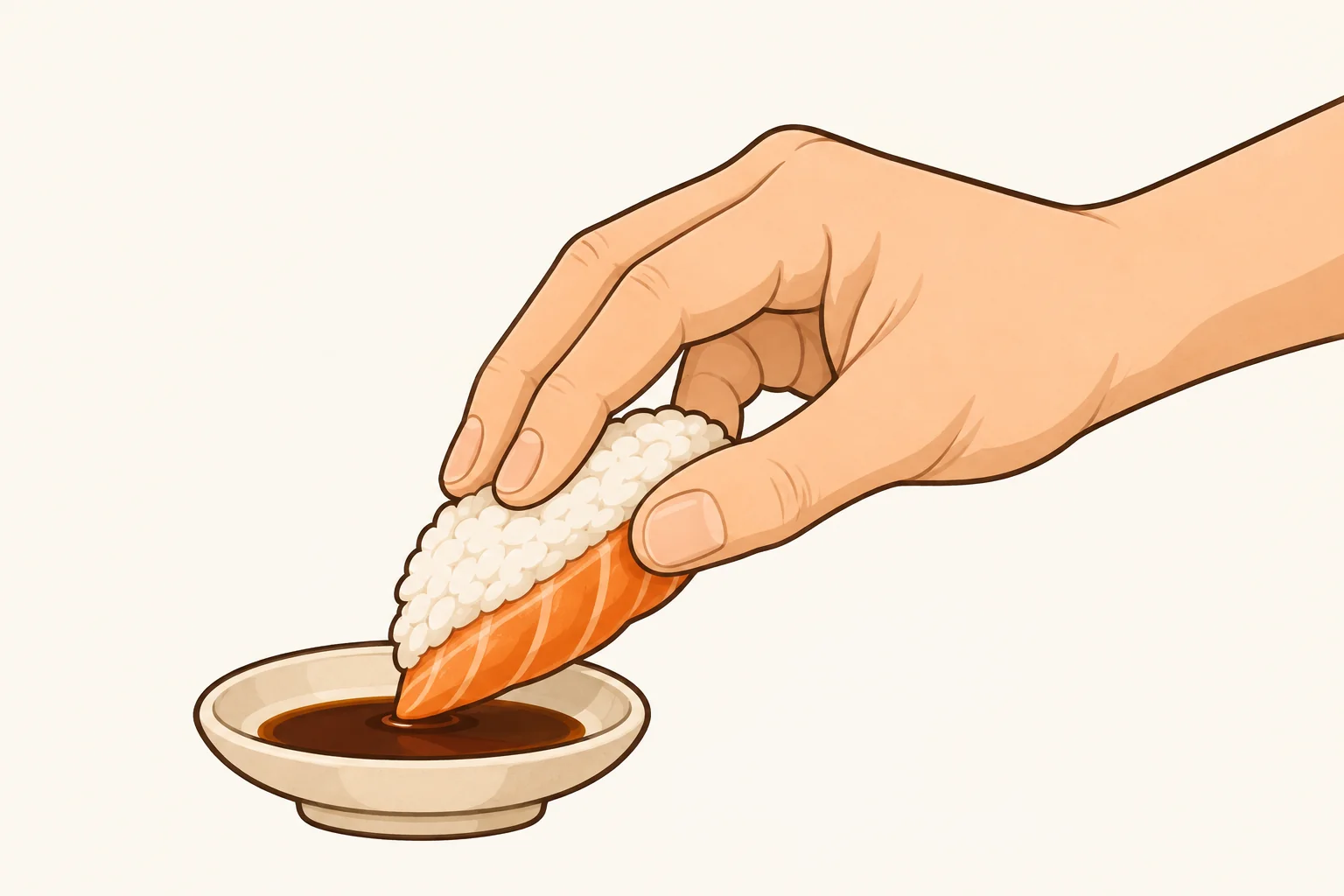
Nigiri lifted with thumb, index and middle finger and turned over so only the fish touches the soy sauce.
A few smaller points. Sushi shops have their own slang: tea is agari, soy sauce is murasaki, the bill is oaiso. These words belong to the staff, and customers who use them can sound affected; ordinary words like ocha for tea and okaikei for the bill are better. Skip strong perfume, which competes with the fish. Photographs are usually fine, but check the shop’s policy and do not let a piece sit while you frame the shot. Tell the shop about allergies or things you do not eat when you book.
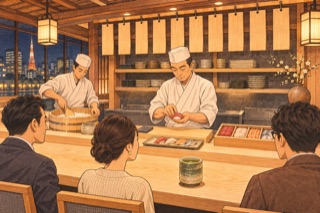
Much of the pleasure of the counter is watching. The chef takes a block of fish from a wooden case, slices it, takes rice from the tub, presses, turns and sets the piece on the board in front of you, all within arm’s reach. You can ask what the fish is and where it came from, and most chefs are happy to answer. Nothing separates the customer from the kitchen, an arrangement that goes straight back to the Edo yatai, where one person stood behind the board pressing rice and another stood in front of it, eating.
Sushi is one part of a larger food culture that rests on rice, soy sauce, dashi stock and sake, and like tempura and soba it is a legacy of Edo’s townspeople. It also has a special place in family life. When someone passes an entrance exam, when guests arrive, when relatives gather at New Year, there is a good chance a tub of sushi is on the table.