
Most visitors meet sushi at a counter: a chef shapes rice in one hand, lays a slice of fish on top and sets it down in front of you, to be eaten within seconds. That style, nigiri, was born as street food in nineteenth-century Edo and has since become the world’s picture of sushi. Travel a few hours out of any big city, though, and the picture changes. In the mountains of the Kii Peninsula you may be handed a rice ball the size of a fist, wrapped in a pickled mustard leaf. In a castle town on the Inland Sea, a slab of rice is cut from a wooden frame and shows five stripes of colour in cross-section. On an island nearly 300 kilometres south of Tokyo, the fish comes with yellow mustard because wasabi does not grow there. Most of these sushi were never meant for a counter. They were made at home, in quantity, the day before a festival or a long day in the fields, and they were built to keep, to travel and to feed a crowd.
This guide covers more than a dozen regional styles. A few famous ones, such as Ōsaka’s box sushi, Kyoto’s mackerel sushi and Nara’s persimmon-leaf sushi, are covered in the main sushi article and appear here only for comparison.
01A Field Guide to Sushi Shapes
Japanese cooks usually sort sushi by shape, and the same handful of categories works anywhere in the country. Nigiri is hand-pressed rice under a topping. Gunkan-maki, "battleship rolls", wrap a strip of nori around a mound of rice to hold soft toppings such as roe. Maki is anything rolled, usually in nori, and sliced. Oshi-zushi or hako-zushi is pressed in a wooden box and cut into blocks. Chirashi or bara-zushi is a bowl or tub of seasoned rice with toppings scattered over it or mixed through. Leaf-wrapped sushi uses bamboo, persimmon or magnolia leaves as both wrapper and plate. Inari-zushi is rice stuffed into a pouch of sweet simmered fried tofu. Sugata-zushi, "whole-figure sushi", is a fish opened along the back, boned, packed with rice and closed again, head and tail intact.
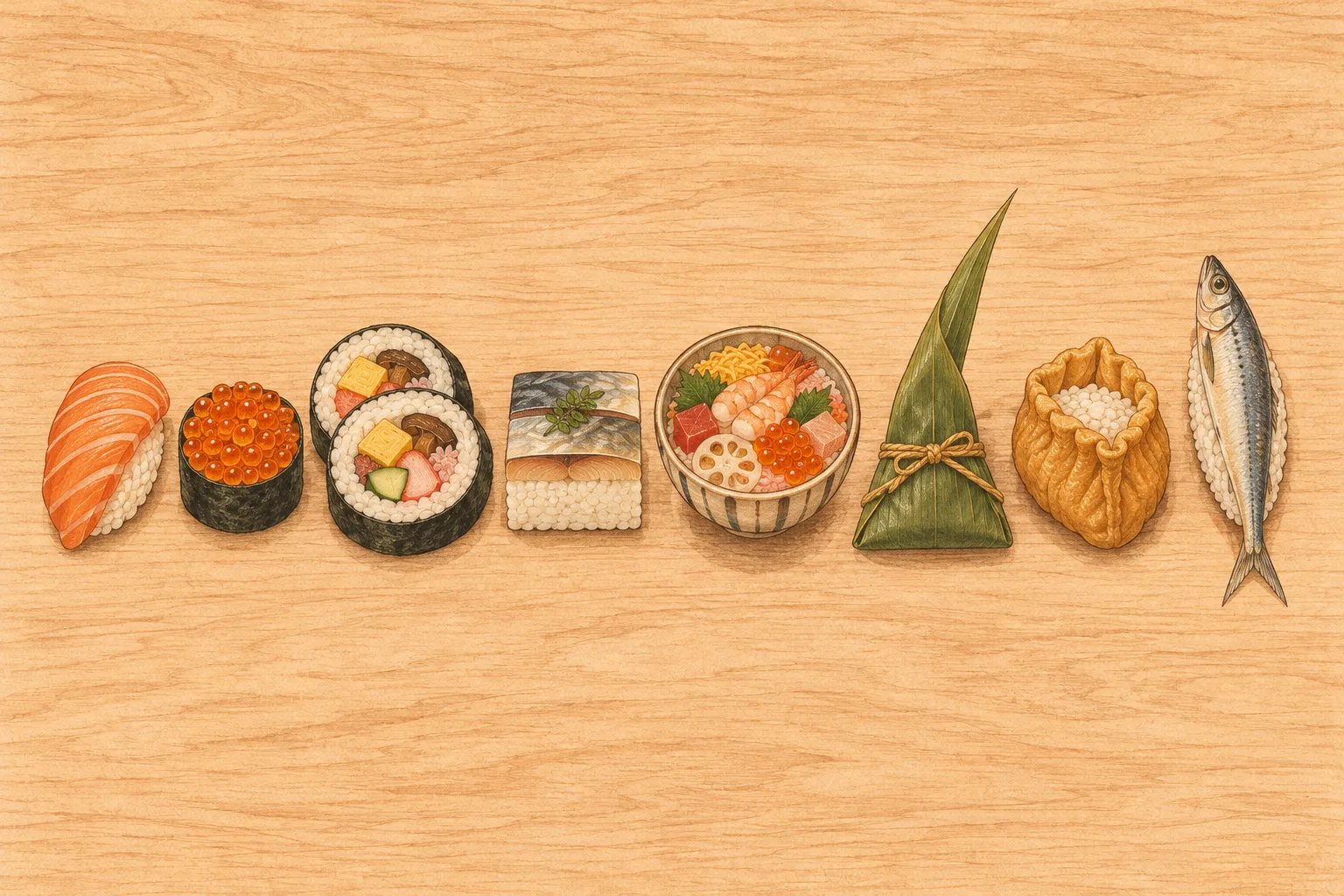
Eight sushi shapes, left to right: nigiri, gunkan-maki, two slices of a thick maki roll, a block of oshi-zushi, a bowl of chirashi, a leaf-wrapped parcel, inari-zushi, and sugata-zushi with head and tail. Regional sushi is mostly the pressed, scattered, wrapped and whole-fish kinds.
Tokyo’s sushi lives at the top of that list. Regional sushi lives almost entirely at the bottom: pressed, scattered, wrapped and whole. Very few regional styles are hand-shaped nigiri, and the ones that are, like the island sushi of Hachijōjima, have their own twist. Keeping these shapes in mind is the quickest way to make sense of an unfamiliar sushi in a station kiosk or a farmers’ market.
02Party Sushi of the Castle Towns
Iwakuni, in eastern Yamaguchi Prefecture, is known for the five wooden arches of the Kintai Bridge. Its local sushi, Iwakuni-zushi, is a pressed sushi on a grand scale. A square wooden frame is lined with leaves of chisha, a leaf lettuce, then filled with vinegared rice and covered with thin strips of omelette, simmered shiitake, vinegared lotus root, pink sweetened fish flakes and snow peas. Another layer of lettuce goes on, then more rice and toppings, until there are three to five tiers, and a lid presses it all down. Big frames can be 60 centimetres square and take about 1.8 litres of rice per tier; with those, cooks used to climb onto the lid to press it, and in traditional restaurants a cook in white tabi still braces one foot on the lid while pulling the frame away. Once the frame is lifted away, the block is cut into large squares whose sides show alternating bands of white rice and colour, like a layer cake. Lotus root, an Iwakuni speciality, sits on top with its ring of holes showing, and locals treat it as the dish’s signature.
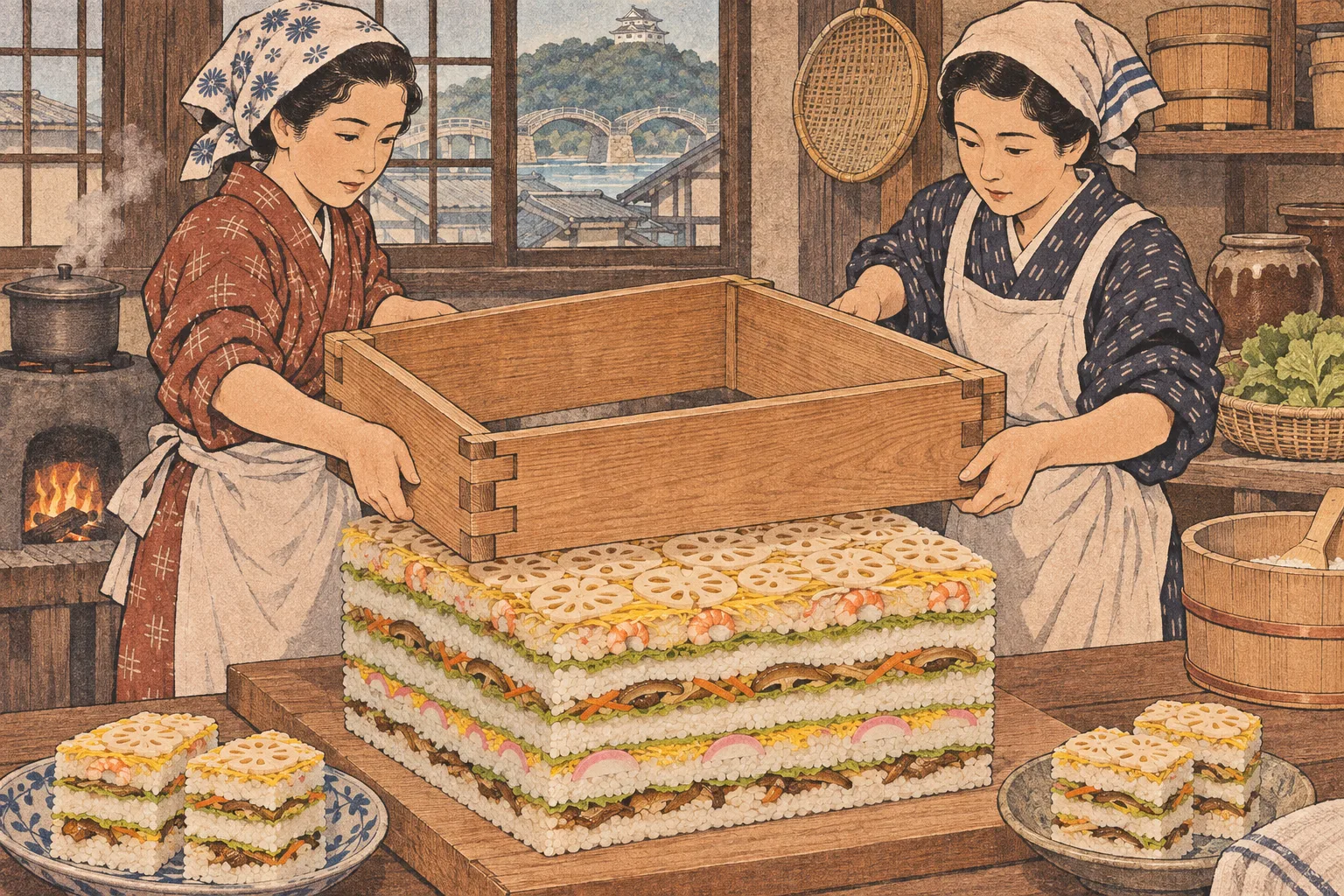
Lifting the frame off Iwakuni-zushi: tiers of rice and toppings with lettuce between them and lotus root slices across the top.
Local tradition credits the Kikkawa lords of the Iwakuni domain in the Edo period, and the dish is also called tonosama-zushi, "the lord’s sushi". It is said to have been devised as a food that was easy to carry up to the hilltop castle, or as a wartime ration ordered by the lord, and to have pleased the Kikkawa lord when it was presented to him. Families once kept their own frames; today home cooks often use lunchboxes or square cake tins instead, but the tiered method is the same, and Iwakuni-zushi still comes out for weddings, memorial services and other celebrations, one frame feeding a room full of relatives.
Ōmura-zushi, from Ōmura in Nagasaki Prefecture, is a brighter cousin. It is also pressed in a shallow wooden box, usually two layers of rice sandwiching a layer of burdock, shiitake, carrot and gourd strips simmered in sweetened soy sauce. The top is covered with pink and green fish cake and a thick layer of golden shredded omelette. The first thing people notice is the sweetness: the rice takes a lot of sugar, a mark of hospitality from the days when sugar was precious and Nagasaki was the port it arrived through. Many households and shops now use less.
The local origin story is a vivid one. In the late fifteenth century, it is said, the lord Ōmura Sumikore was defeated by the Arima family and lost his domain, then fought his way back several years later, usually dated to 1480. His people, wanting to welcome the returning soldiers and short of dishes, spread rice, fish and vegetables in layers in shallow wooden boxes, and the soldiers cut the pressed block into squares with their short swords. On that basis Ōmura-zushi is often described as more than 500 years old. Whether or not the details hold up, the story describes exactly what the dish is: food designed for a crowd to eat at the same moment. It remains a staple of celebrations in the Ōmura area, and turns up in flower-viewing and picnic boxes too.
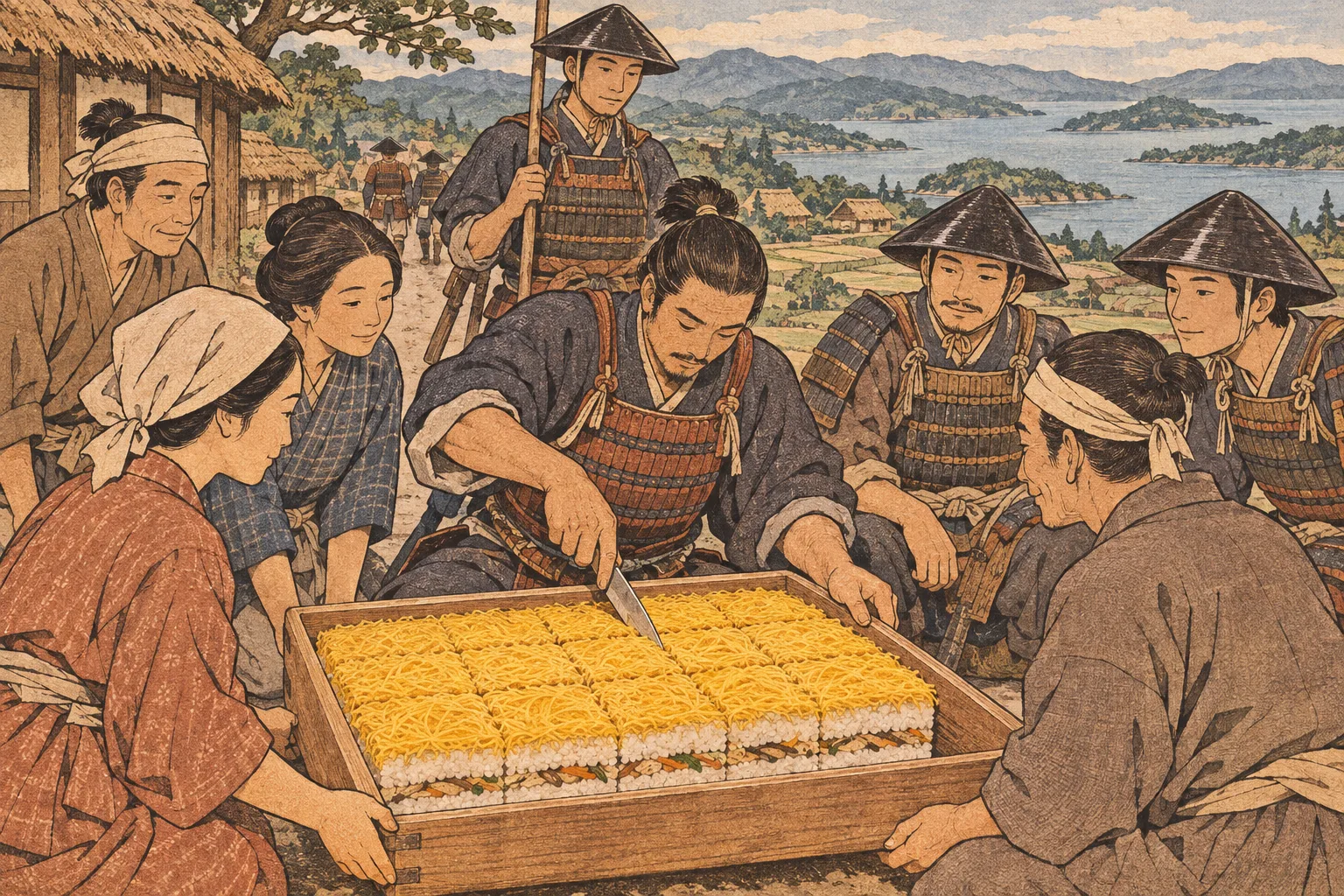
The Ōmura-zushi legend: villagers hold out a shallow wooden box while a returning soldier cuts the egg-topped sushi into squares with his short sword (artist’s impression)
Around Kanazawa in Ishikawa Prefecture, pressed sushi takes a neater form. Depending on the season, sardine, mackerel, horse mackerel or mahi-mahi is heavily salted for a few hours, rinsed, soaked in vinegar for two or three hours, skinned and sliced thin. The slices go into a wooden frame in rows under the rice, which is decorated with navy-dyed seaweed (kon-nori) and tiny pink shrimp, said to echo the pattern of a festival lion costume, along with sanshō leaves, kumquat, ginger or yuzu. Each portion is divided from the next by a bamboo leaf, a haran leaf, a thin wooden slat or kelp, depending on the district, and the pressed sushi rests overnight. Families made it for the spring and autumn festivals, using the new rice in autumn as thanks for the harvest. The bamboo-wrapped sasa-zushi sold in Kanazawa shops today grew out of this home recipe: unwrap one and you find a crisp-edged little block with the fish pressed flat against the rice, smelling faintly of bamboo.
03Sushi by the Tub: Okayama, Kagoshima and Ise-Shima
Okayama’s matsuri-zushi, "festival sushi", also called bara-zushi, looks like chirashi but far more lavish. A wide wooden tub of rice is covered edge to edge with the produce of the Inland Sea: vinegared Spanish mackerel (sawara), the small vinegared fish called mamakari, prawns, conger eel, octopus, squid and ark clams, along with lotus root, bamboo shoots, burdock, shiitake, snow peas and golden omelette. A dozen or more toppings is normal. The rice itself is seasoned first by mixing chopped simmered vegetables through it, and the fish and egg go on top. Spanish mackerel is a spring fish in Okayama, and spring versions favour it along with bamboo shoots and butterbur; an autumn tub may include matsutake mushrooms.
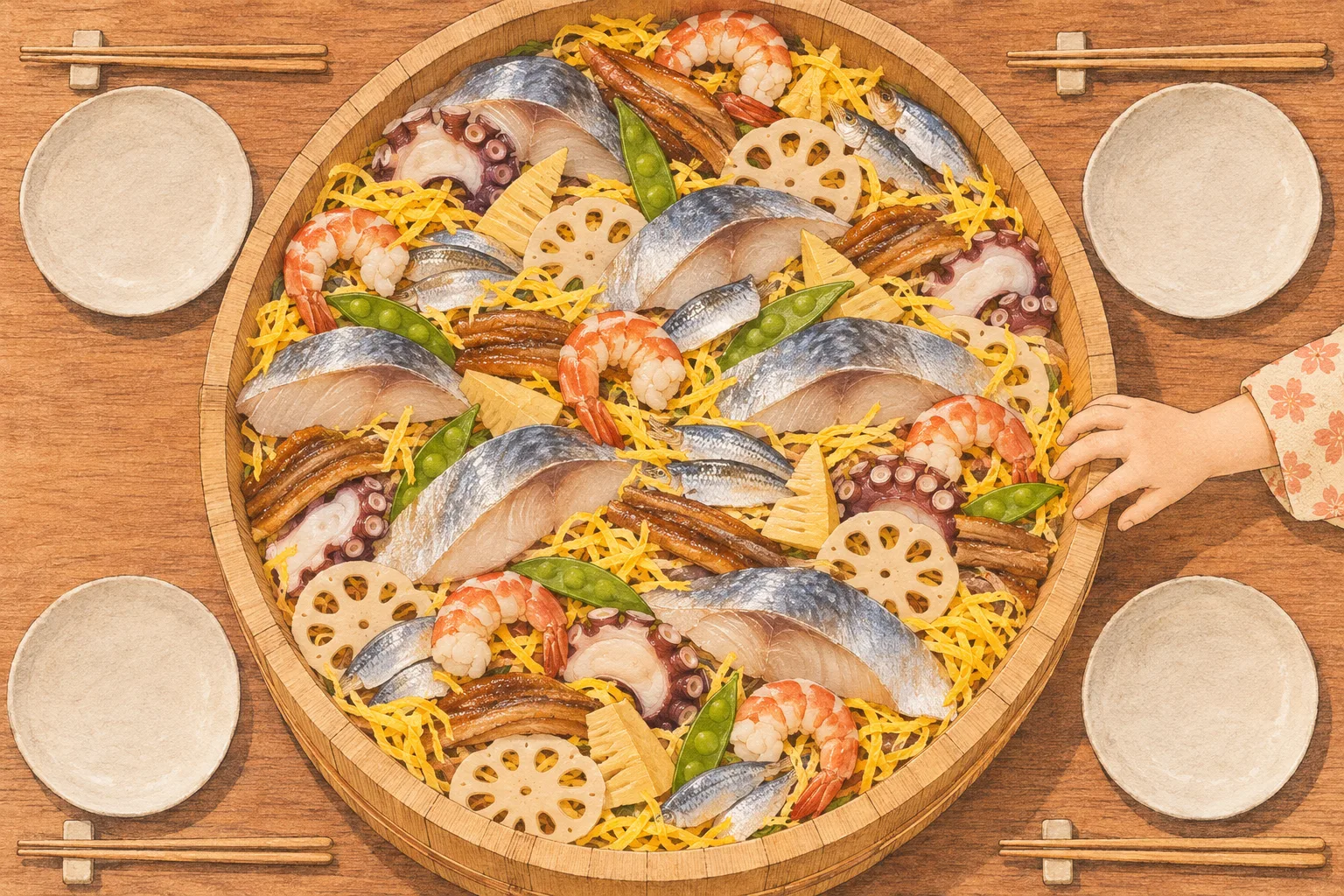
Okayama matsuri-zushi from above: the rice is almost hidden under vinegared Spanish mackerel, prawns, conger eel, octopus, lotus root and golden omelette.
The story everyone tells is about a sumptuary law. In the early Edo period, the domain’s lord Ikeda Mitsumasa is said to have ordered commoners to eat no more than one soup and one side dish at a meal. Okayama people, so the story goes, reasoned that fish and vegetables mixed into sushi rice were no longer a side dish, or, in another telling, that toppings on rice still counted as only one dish, and packed more than ten of them into a half-barrel of rice. Locals tend to tell this with a smile rather than as hard history, but it fits a dish in which the toppings outweigh the rice. Making a tub took a whole day of soaking, simmering and slicing, so it was work for the women of a household the day before a festival. It is still made for the spring and autumn festivals, Obon, memorial services and guests.
Kagoshima’s sake-zushi is one of the most unusual sushi in Japan, because it contains no vinegar. Instead the rice is soaked with akumochi-zake, a local rice wine that is never heat-treated; lye made from wood ash is added at the end of brewing so that it keeps. It is dark and as sweet as mirin, and has been brewed since the eighteenth century. A tub moistened with the wine is filled with two or three alternating layers of rice and toppings, such as sea bream, prawn, fish cake, fried fish cake, bamboo shoot, shiitake, butterbur and omelette, finished with sea bream, prawns and young sanshō leaves, and doused in the wine. A lid goes on with a light weight, and the tub is left for about half a day. It is served by cutting straight down so each portion keeps every layer. When the lid comes off the room smells of sake, and the rice has turned faintly amber.
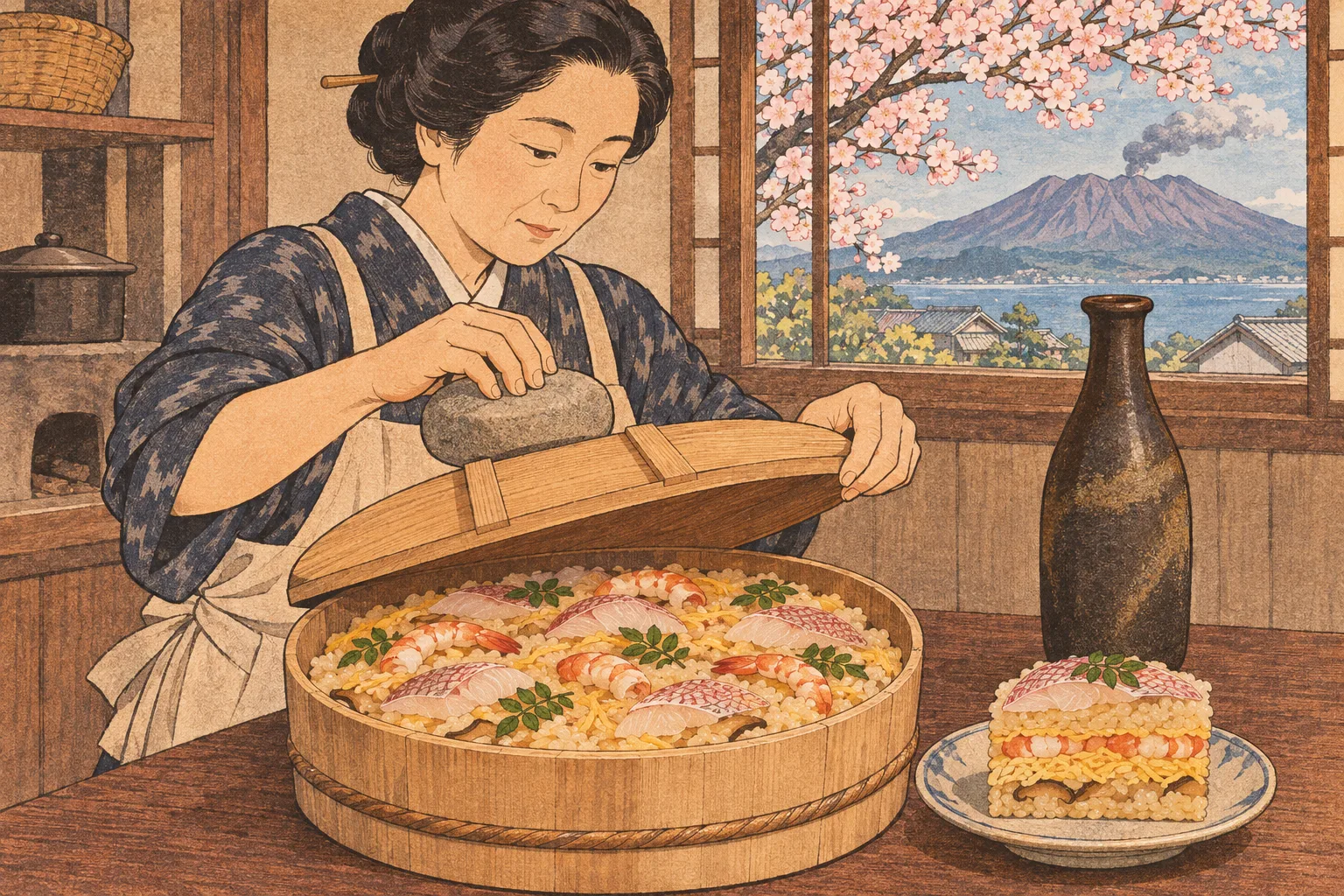
Lifting the lid off a tub of Kagoshima sake-zushi: sea bream, prawns and sanshō leaves on amber-tinted rice, with a cut portion showing the layers.
One story traces it to the Shimazu lords of Satsuma in the Edo period: after a spring flower-viewing party, leftover food and sake were put into a tub together, and the next day it had turned fragrant. Another says it was a dish for lords and senior samurai that only later reached ordinary homes. It began as a spring dish for cherry-blossom parties, made with spring sea bream, bamboo shoots and sanshō leaves; today it is too much work for most homes and appears mainly at celebrations and gatherings. It is a standing joke that a large helping leaves you slightly tipsy.
On the Ise-Shima coast of Mie Prefecture, tekone-zushi began as a fisherman’s meal. The area lands skipjack tuna (katsuo), and crews at sea would slice a fresh fish, marinate it briefly in soy sauce, tip it onto vinegared rice and mix it by hand. Te-kone means "hand-kneaded". Today it is usually served with the marinated slices laid over the rice, dark red turning brown at the edges, scattered with shiso, ginger and shredded nori. Like Tokyo’s soy-marinated tuna (zuke), the soy marinade was a way to keep fish a little longer before refrigeration.
04Fish Climbing into the Mountains: the Kii Peninsula
The Kii Peninsula, home to the Kumano pilgrimage routes, may have more distinct sushi than anywhere else in Japan. Its southern coast faces rich fishing grounds; its interior is steep forested mountains. Fish heading inland had to be salted or soured to survive the journey, and sushi was the natural form.
Sanma-zushi, Pacific saury sushi, is the signature of the Kumano coast, from Shingū and Kushimoto in Wakayama to Owase and Kumano city in Mie. By the time saury reach these waters in late autumn and winter, after the long swim south from the seas off north-eastern Japan, they have lost much of their fat, leaving lean, firm flesh that suits pickling. Each fish is split (along the back around Kumano city, along the belly around Owase), boned, salted and then steeped in the juice of yuzu or bitter orange. It is then laid over a log of rice, head and tail still on, and pressed into shape. A platter of them is unmistakable: rows of slim silver fish with pointed heads. Families made them by the dozen for New Year and festivals; a restaurant in Owase began selling them in 1975, and they became the town’s signature dish. The citrus takes the edge off the oily fish smell, the same idea used in Kōchi across the water.
The same coast keeps an older version, sanma no nare-zushi, in which saury and rice ferment together, eaten young or left until the rice becomes a sour paste. Some batches are said to have been kept for about 30 years, until they no longer look like sushi at all but like yoghurt.
Inland, in the mountains of Kumano and Yoshino, the everyday food was mehari-zushi. It is a large rice ball wrapped completely in a salt-pickled leaf of takana, a broad-leafed mustard green. Old versions could be the size of a softball. There is no fish inside; at most a little chopped pickled stem. The usual explanation of the name is that it is so big you have to open your mouth wide and your eyes widen too (me o miharu), though some say it is simply so good it makes your eyes go wide. Foresters, charcoal burners and farmers took it to work: no chopsticks, no box, and the leaf is eaten along with the rice. The rice is not vinegared, so whether it counts as sushi is debatable; locals don’t worry about it.
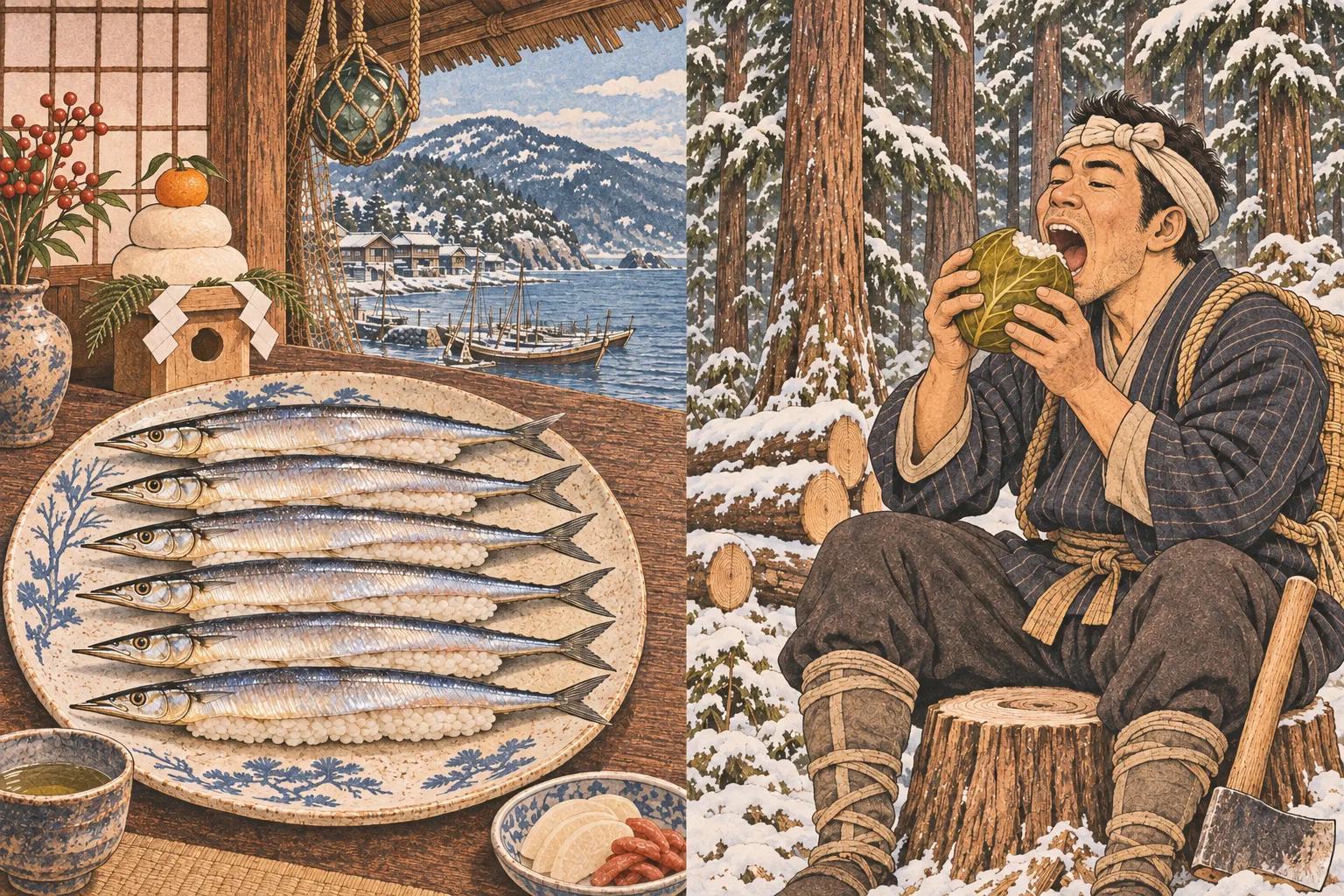
Coast and mountain on the Kii Peninsula. Left: six sanma-zushi, heads and tails on, lined up on a New Year platter in a fishing household. Right: a forester on a tree stump opens wide for a leaf-wrapped mehari-zushi.
Further north, around Arida and Hidaka in central Wakayama, people still make a mackerel nare-zushi, sometimes called haya-nare, "quick-fermented". Salted mackerel is laid on rice, rolled in leaves of a giant reed called ase, packed tightly into a tub under stones and eaten after a few days; in Arida, about four. Compared with the many months, even years, of Lake Biwa’s crucian carp sushi, this short-fermented nama-nare type is a halfway stage between ancient fermented sushi and modern vinegared sushi: the rice is mildly sour but still grain by grain. In Hidaka, making it once began in October as the autumn festival approached, and it was served to guests with sweet amazake; today most people there make a vinegared-rice version instead.
In Yoshino, Nara Prefecture, besides the persimmon-leaf sushi covered in the main article, there is sweetfish sushi with a theatrical history. Since the early Edo period, a shop in Shimoichi on the Yoshino River has packed vinegared sweetfish (ayu) over rice in small wooden buckets shaped like well buckets, hence the name tsurube-zushi. The kabuki and puppet play Yoshitsune Senbon Zakura has a famous act set in one of these shops, where the shop’s assistant Yasuke is really a fugitive Taira general in disguise. After the play opened in 1747 the real shop, whose masters took the name Yasuke generation after generation, became famous, and "Yasuke" became a nickname for sushi itself.
05Wrapped in Leaves: Jōetsu, Hida and Beyond
In the Jōetsu area of Niigata and northern Nagano, sasa-zushi is neither rolled nor pressed. A small mound of vinegared rice, about a mouthful and a half, is flattened on a broad bamboo leaf and left open, then topped with sweet simmered fern shoots, crushed walnuts, shiitake, omelette and red pickled ginger, sometimes salted trout or salmon flakes. Laid out on a table they look like a fleet of little green boats with colourful cargo.
Local legend comes in two versions: that during the Warring States period, when the warlord Uesugi Kenshin was fighting Takeda Shingen deep in the mountains, rice was served on bamboo leaves in place of bowls; or that villagers of Tomikura, in today’s Iiyama in Nagano, presented bamboo-leaf sushi to Kenshin as he set out for the battles of Kawanakajima. Like the Ōmura story, these are tales attached to a famous name long after the fact. But the logic is sound: a bamboo leaf is a plate and a mild preservative at once. Sasa-zushi was made for Obon, festivals and other days when crowds gathered. Some is simply set on a leaf, some on a leaf folded into a boat or a triangle, and some wrapped up and tied with rush like Chinese zongzi; around Myōkō, Jōetsu and Itoigawa the leaf is folded like a winnowing basket and the dish is called mi-zushi.
In Gifu Prefecture, from southern Hida to the Chūnō and Tōnō areas, people make hoba-zushi in early summer, when the leaves of the Japanese big-leaf magnolia (hō) are new and fragrant; May to August is the season. A single leaf can be two or three hands across. Rice goes in the middle with the toppings, and the leaf is folded around it like an envelope. Several are stacked in a tub and pressed. The toppings vary: originally, it is said, just a piece of vinegared salted salmon brought in from the Hokuriku coast; today Tōnō households typically use seven or eight, such as sweet-simmered river fish, vinegared mackerel, omelette and red ginger, while Hida prefers it plain, sometimes only myōga and rice. Hoba-zushi was a treat for breaks during rice planting and a packed lunch for mountain work; in Higashishirakawa it was served at the shared rice-planting days until the mid-Shōwa period. Now, from mid-May to July, it appears in farm stalls throughout the region. Hida people also grill miso on dried magnolia leaves, so the same tree serves the kitchen year-round.
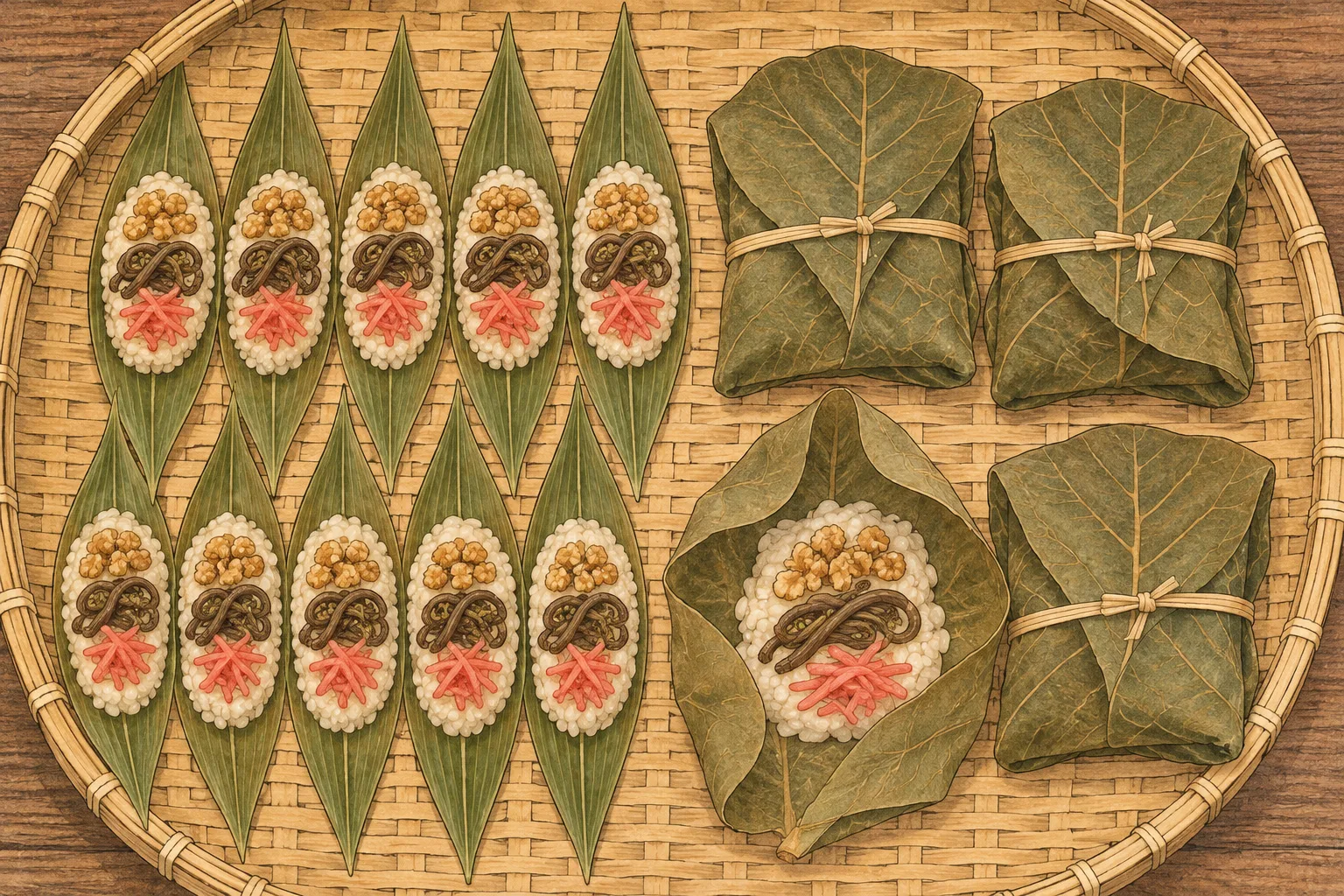
Left: Jōetsu sasa-zushi, rice left open on bamboo leaves and topped with walnuts, fern shoots and red ginger. Right: hoba-zushi folded and tied in much larger magnolia leaves, with one parcel opened to show the rice inside.
06Shikoku and the Southern Islands
Kōchi, on Shikoku’s Pacific coast, has two sushi that are easy to spot. The first is whole mackerel sugata-zushi: a mackerel opened along the back, boned, cured in salt and citrus, stuffed with rice and closed up again, head, eyes and tail in place, then sliced through. It is a fixture of sawachi, Kōchi’s huge banquet platters crowded with sashimi, sushi, simmered dishes and sweets, and is essential at shrine festivals and weddings. The leftover head and tail were once grilled for a small gathering the day after.
The second is inaka-zushi, "country sushi", made entirely from mountain produce: myōga ginger buds, bamboo shoots, taro stems (locally called ryūkyū), konnyaku and shiitake. The vegetables are simmered or pickled and either laid over rice or stuffed with it. The myōga is tinted pink, the konnyaku sits in grey triangles, the shiitake are dark brown. What unites all Kōchi sushi is the rice: it is seasoned with yuzu and other citrus juice, mixed with chopped ginger and sesame, and it smells of citrus. The usual explanation is that yuzu was plentiful in the mountain villages. The name inaka-zushi itself dates only from 1986, when the dish was entered in a national rice-ball contest; before that, each village named it after its topping.
In southern Ehime, on Shikoku’s western side, especially around Uwajima, maru-zushi looks like nigiri but contains no rice. The core is okara, the pulp left from making tofu, seasoned with vinegar and sugar, wrapped in a vinegared fillet of small seasonal fish such as horse mackerel or sardine. The usual explanation is that rice was expensive and okara was nearly free. Around Niihama in north-eastern Ehime the same dish is called izumiya. The local story is that after the Sumitomo family opened the Besshi copper mine in 1691, ordinary people who could not afford the Sumitomo household’s rice sushi imitated it with okara, and named it after Izumiya, the Sumitomo trading name.
Far out in the Pacific, 287 kilometres south of Tokyo, Hachijōjima has shima-zushi, "island sushi". Local fish such as butterfish (medai) or flying fish are sliced and marinated in soy sauce, then laid over small hand-pressed portions of rice made sweet with plenty of sugar. In place of wasabi, which does not grow on the island, there is a smear of yellow mustard. The marinated fish is glossy and darkened at the edges, and the first taste is sweet rice and a sharp hit of mustard.
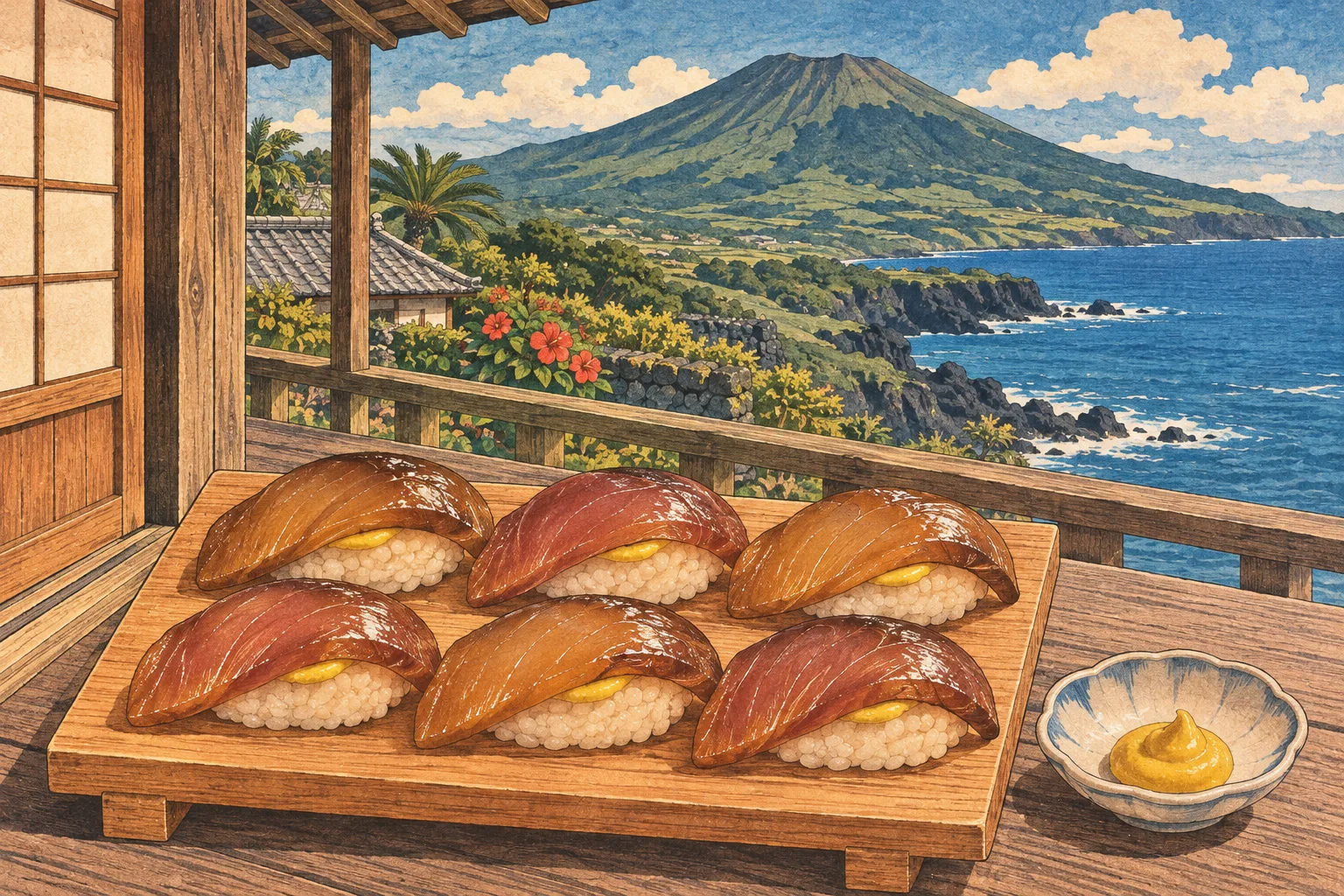
Hachijōjima shima-zushi: glossy soy-marinated fish over sweet rice, and the streak of yellow between the two is mustard, not wasabi.
Island sushi then travelled with Hachijō settlers. In the Meiji period, settlers from Hachijōjima opened up the Daitō Islands far to the south-west and took their sushi with them, and Ogasawara’s version is generally linked to Hachijō settlers as well. In Ogasawara it is still called shima-zushi, made sweet and with mustard, and often with Spanish mackerel; on Minami-Daitō and Kita-Daitō, now part of Okinawa, it became Daitō-zushi, made with Spanish mackerel and similar fish, and a well-known island speciality. One family recipe crossed more than a thousand kilometres of ocean and took root on three separate island groups.
07Chiba’s Picture Rolls
On the Bōsō Peninsula of Chiba, futomaki matsuri-zushi, "festival thick rolls", hide a picture inside. Rice is dyed pink, yellow, green or purple, and combined with omelette, pickled radish, cucumber and fish flakes to make several thin rolls. These are arranged on a large sheet of nori according to a planned design, surrounded with white rice and rolled into one thick log. Slice it and every cut face shows the same image: a camellia, a chrysanthemum, a rose, a written character, a panda’s face.
The hard part is the planning. A camellia needs so many pink petal rolls, a yellow centre, green leaves, and the amount of rice in each has to be just right or the flower comes out lopsided. The finished roll rests, then is cut with a wet knife, and the first slice, when the flower appears, is the moment everyone has been waiting for. Pink usually comes from sweet pink fish flakes or red pickled ginger mixed into the rice, yellow from gardenia, and green mostly from cucumber and leafy vegetables.
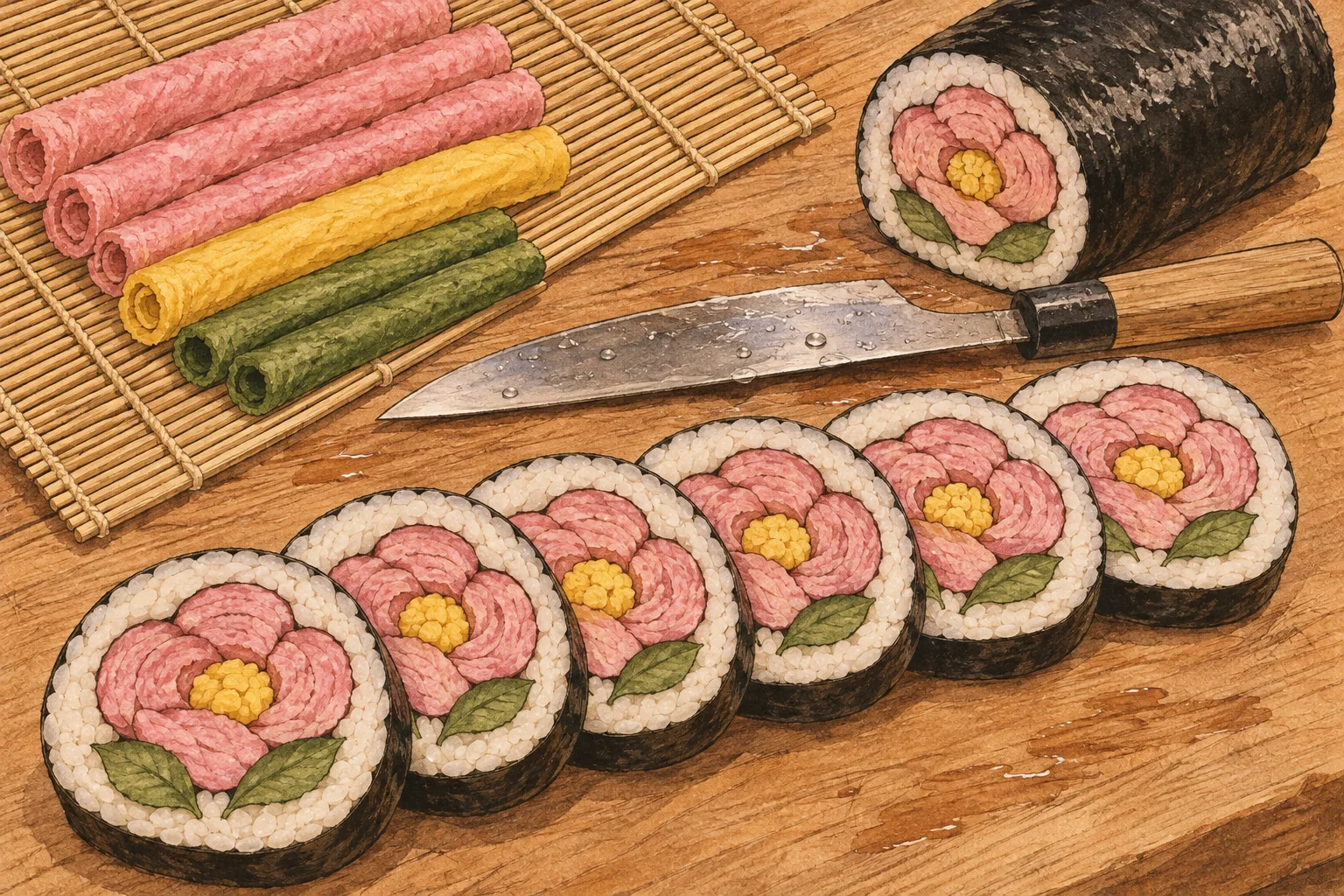
A Chiba festival thick roll, sliced: every cut face shows the same pink camellia, built from thin coloured rolls like those on the mat.
The rolls began around Sanmu, Isumi and Kisarazu and are now made throughout the prefecture. Villagers made them for weddings, funerals, festivals and memorial services, dozens at a time. The work is said to have been done by men until after the war, when women took it over, with designs passed from mother to daughter and mother-in-law to daughter-in-law. Their origins are unclear; one guess is that rice balls turned into rolls around the end of the Edo period and were handed down in farming families. From the mid-1950s a local food researcher visited village households to record the recipes and patterns, then published them and taught classes across the prefecture. Today it is one of Chiba’s best-known local dishes, with more than a hundred designs, classes and even competitions.
08Telling Them Apart
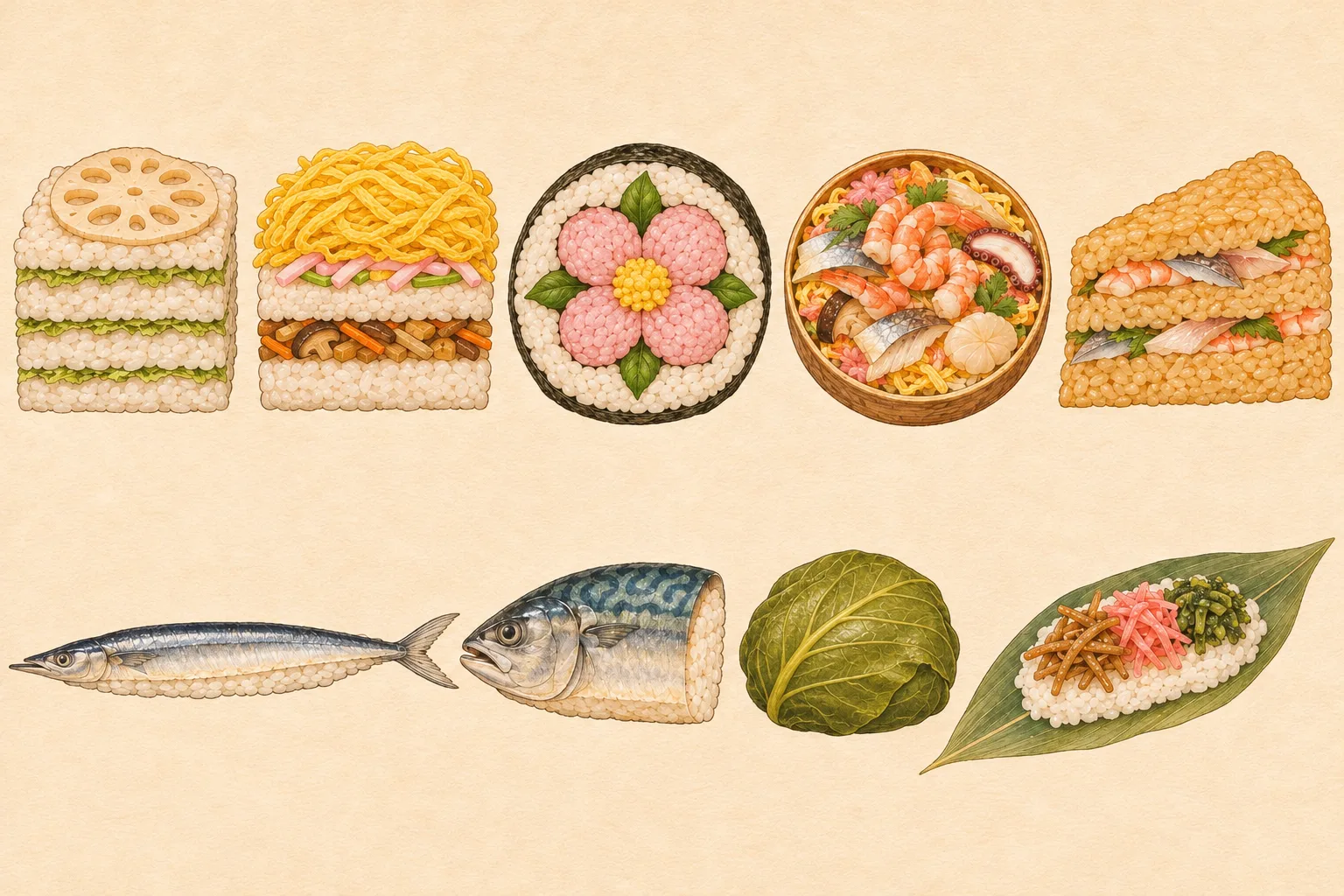
Nine regional sushi compared. Top row, left to right: Iwakuni-zushi (tiers and lotus root), Ōmura-zushi (thick egg topping), a Chiba festival roll (flower in the cut face), Okayama matsuri-zushi, Kagoshima sake-zushi (amber rice). Bottom row, left to right: Kumano sanma-zushi, Kōchi mackerel sugata-zushi, mehari-zushi, Jōetsu sasa-zushi.
Several of these are easy to confuse. Among the layered box sushi, Iwakuni-zushi has three to five tiers, with lettuce between them and lotus root on top; Ōmura-zushi usually has two layers of rice, fish cake and a thick golden blanket of egg on top, and a sweet taste. Both look quite different from Ōsaka’s box sushi or battera, today a pressed mackerel sushi, which is said to have begun at an Ōsaka shop in the mid-Meiji period with vinegared gizzard shad, a half fillet with its tail curled up like a little boat, hence the Portuguese-derived name; mackerel replaced the shad later: those have one layer of rice and one of fish, cut into neat small pieces.
Among leaf-wrapped sushi, Jōetsu sasa-zushi sits open on its leaf, rice facing up; Kanazawa’s pressed sushi comes in blocks divided by leaves, and the sasa-zushi sold there is fully wrapped in bamboo; hoba-zushi uses a much larger magnolia leaf folded like an envelope; mehari-zushi is wrapped in an edible pickled mustard leaf. Nara’s persimmon-leaf sushi, by contrast, uses a smooth rounded leaf you do not eat.
Among tub sushi, Okayama’s festival sushi shows its toppings on the surface, bright with mackerel and prawns; Kagoshima’s sake-zushi is built in layers, lightly weighted and steeped for half a day, the rice amber and fragrant with wine; Ise-Shima’s tekone-zushi is covered with dark red marinated skipjack.
Among whole-fish sushi, Kumano saury is slim and silver and comes in rows; Kōchi mackerel is stout, blue-green-striped and usually presented as a single centrepiece. Kyoto’s mackerel sushi is wrapped in kelp in a log and usually headless.
Among rolls, an ordinary futomaki shows a ring of colourful fillings, each recognisable for what it is; a Chiba festival roll uses many thin coloured rolls to build a single picture, so the cut face shows a camellia or a panda rather than the fillings themselves.
Then there are the seasonings: Kōchi rice smells of yuzu, Kagoshima’s of sake, and Hachijō’s sushi comes with mustard. Ehime’s maru-zushi looks like nigiri but hides okara, and should not be confused with inari, where the wrapper is tofu and the filling is rice.
09Why Regional Sushi Is Pressed, Wrapped and Portable
Lay all of these side by side and almost none is eaten the moment it is made. Tokyo nigiri was city fast food, sold from stalls with fish brought in that morning from Edo Bay. Regional sushi started from different needs.
The first is the festival. In rural Japan, festivals, weddings, funerals and memorial services meant feeding dozens of relatives and neighbours. Women cooked the day before, made a whole tub or frame, pressed it and cut it into portions that held their shape and could be shared out equally. Okayama festival sushi, Iwakuni-zushi, Ōmura-zushi and Chiba’s picture rolls are all banquet sushi, loaded with the fish, eggs and bright colours people did not eat every day.
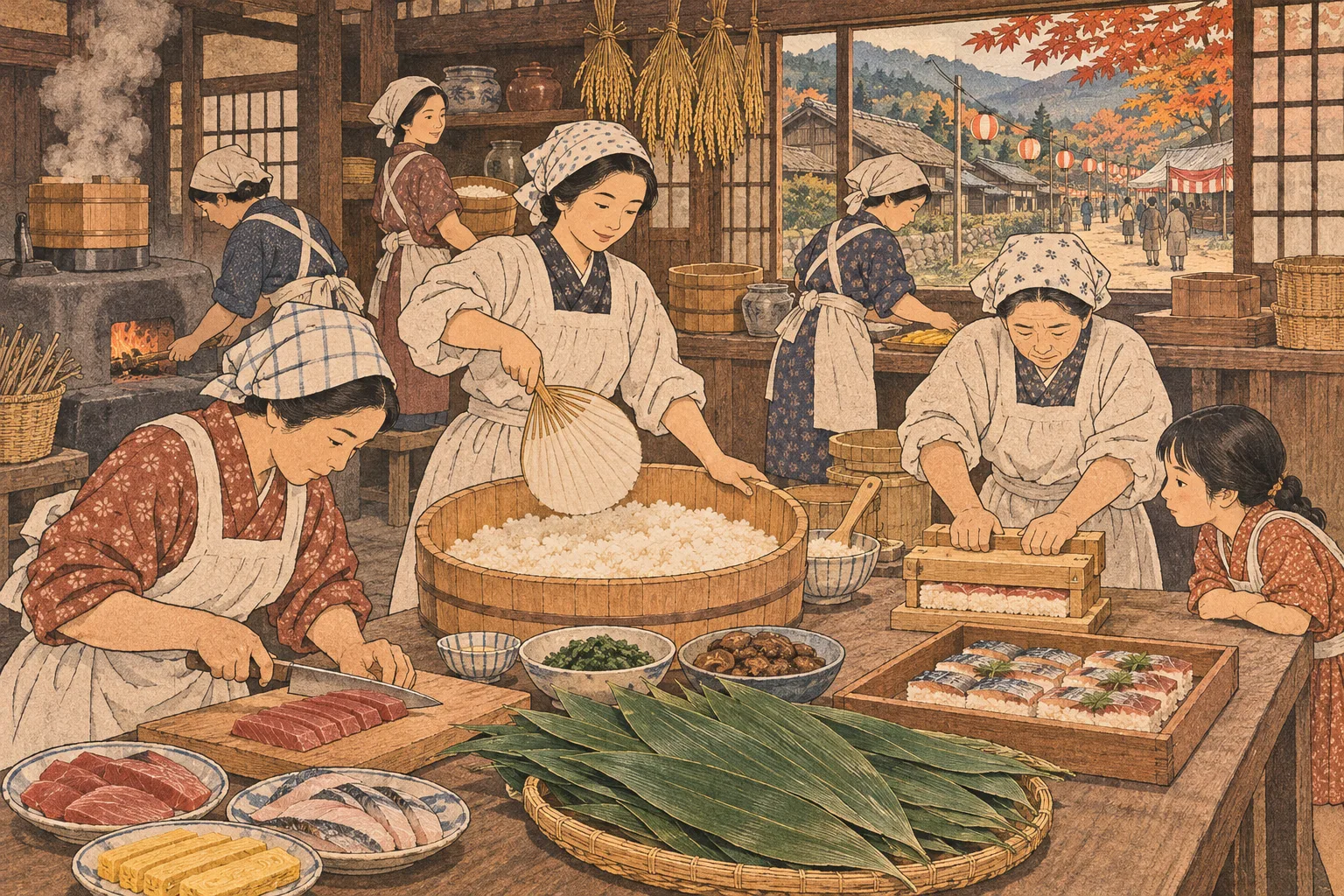
A village kitchen the day before the autumn festival: one woman fans the rice, one slices fish, one presses a wooden frame beside a heap of bamboo leaves, and a girl looks on.
The second is the mountains. Before refrigeration, fish going inland had to be salted and soured and packed with rice. Kyoto’s mackerel sushi, Kumano saury, Yoshino sweetfish and persimmon-leaf sushi all lie on that path from sea to hills. And people working in the mountains needed food they could carry and eat by hand: mehari-zushi, hoba-zushi and sasa-zushi.
The third is preservation. Bamboo, persimmon, magnolia and reed leaves all have some antibacterial effect and double as plates. Vinegar, salt, citrus and sake all extend the life of rice and fish. Sushi began as a way of preserving fish through fermentation, and in this respect regional sushi stays much closer to its ancestors than Tokyo’s counter sushi does.
The fourth is making do. Hachijōjima had no wasabi, so it used mustard. Kōchi’s mountain villages had yuzu to hand, so they used it. Kagoshima had its ash-treated wine, Okayama the fish and shellfish of the Inland Sea, southern Ehime its okara, Chiba gardenia, pink fish flakes and its own vegetable gardens for colour. What makes each regional sushi distinctive is usually a record of what that place had too much or too little of.
Many of these are no longer made in every household. Smaller families, urban life and simplified festivals mean fewer occasions for a frame of sushi big enough for a room. But local preservation groups, school cooking classes, station lunchboxes and farmers’ markets keep them going in new forms. If you come across one of them on a trip, you may well be eating the same sushi local families make on festival day.
More deep dives on this topic
 TunaOrder an omakase in Tokyo and the tuna usually arrives in a sequence: a slice of deep red lean meat, then something pinker and softer, then a pale, marbled piece that seems to…
 HikarimonoSit at a sushi counter in Japan and, somewhere in the middle of the meal, the chef will set down a piece that looks different from the rest.
 Beyond TunaMost first-time visitors walk into a sushi bar thinking about tuna.
 Edomae ShigotoMost visitors arrive at a Tokyo sushi counter expecting raw fish on rice.
 Shari and Its Supporting CastAt a sushi counter your eyes follow the fish.
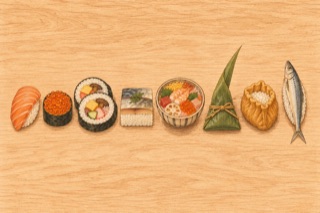 Regional Sushi Beyond TokyoMost visitors meet sushi at a counter: a chef shapes rice in one hand, lays a slice of fish on top and sets it down in front of you, to be eaten within seconds.
 KaitenzushiSit down at a kaitenzushi (conveyor-belt sushi) counter anywhere in Japan and the basic deal is the same.
 Fish MarketsThe piece of sea bream a sushi chef slides across the counter at lunchtime has usually changed hands four or five times since it left the water.
 Words at the Sushi CounterSit at a sushi counter in Japan and the language around you shifts.
 The Sushi ChefFrom a counter seat, a sushi chef looks like a pair of hands and very little else.
- Back to the main article: Sushi →