
From a counter seat, a sushi chef looks like a pair of hands and very little else. Rice comes out of a wooden tub, a slice of fish is laid over it, there is a quick turn of the wrist, and a piece of nigiri lands in front of you. Behind those few seconds sits a career traditionally measured in years: washing dishes, cooking rice, gutting fish, standing at a senior chef’s elbow, and only then taking the central place behind the counter. This piece follows that path. It looks at the stages of apprenticeship, the named ways of shaping nigiri, the knives and wooden tools a chef works with, a chef’s day from the morning delivery to the last stroke on the whetstone, the white clothing, and how sushi schools, women chefs and chefs outside Japan are changing the trade.
01Names for the Person Behind the Counter
The everyday Japanese word for a sushi chef is itamae, literally "in front of the board". The board is the cutting board. In a traditional kitchen the person who held the knife stood at the board, and over time the place became the title. In the Kansai region you also hear itaba, "board place", used in a similar way. A large restaurant may have an itachō, the head of the kitchen, but a sushi bar is usually small enough that the owner simply is the itamae.
Customers addressing the chef often say taishō, roughly "boss" or "chief", a word with a friendly edge. Apprentices call the owner oyakata, a term for the master who takes you in, feeds you and teaches you. In the old pattern the relationship was close to that of a household: young trainees lived in or near the shop, ate the staff meal, and kept the master’s hours.
Above all of this sits a broader word, shokunin, meaning craftsman. Carpenters, lacquerers, blacksmiths and tatami makers are all shokunin. Calling someone a sushi shokunin says that he earns his living through his hands and a judgement built up over years, not through a certificate. Japanese culture holds the shokunin in particular respect and attaches a familiar image to him: quiet, practical, devoted to one thing for life, never quite satisfied. The documentary Jiro Dreams of Sushi, mentioned in the main article, brought that image to audiences abroad.
Part of the image comes from how the craft was taught. A common phrase in Japanese trades is waza o nusumu, "to steal the technique". The master does not explain step by step; the apprentice watches, tries, gets corrected, and works it out. That phrase has become both the most quoted and the most criticised idea in the apprenticeship system.
02The Ladder of Apprenticeship
There was never a written curriculum. Each shop had its own customs and its own pace. What follows is a common sequence rather than a fixed rule, and most of the names are borrowed from the wider Japanese restaurant kitchen.
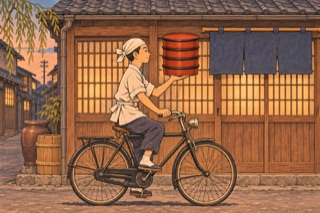
The bottom rung is oimawashi, which means something like "being chased around". New recruits clean the shop, wipe the counter, wash dishes and hand towels, run errands, cook the staff meal and, in the days when sushi shops did a large delivery trade, cycle through the streets balancing stacked lacquered tubs on one hand. This can last months or a year or more. The shop needs the labour, and the master is watching to see whether the newcomer is diligent, observant and willing to stay. Many leave at this stage. Even so, oimawashi is where "stealing the technique" begins: a recruit washing up can watch the counter, hear how the chef talks to customers, and learn where every ingredient is bought.
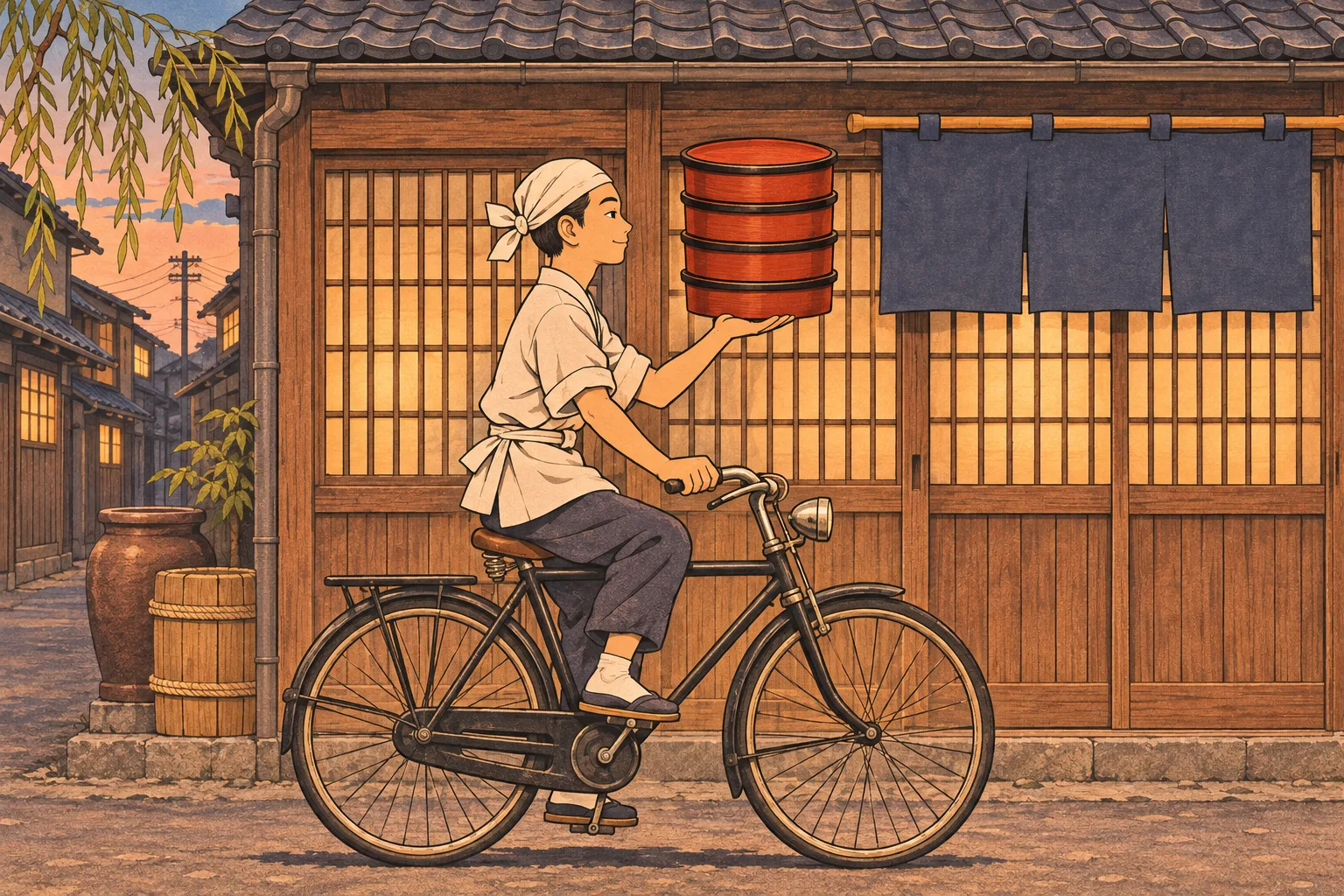
An oimawashi boy on a delivery run, one hand on the handlebar and the other balancing a stack of lacquered sushi tubs (artist’s impression)
The second stage is rice. Sushi rice is considered half of the dish, so a master rarely trusts it to just anyone. The apprentice learns to wash and soak the rice, judge the cooking, tip the hot rice into a wide wooden tub, pour over the seasoned vinegar, and fold it with a paddle while someone fans it cool. Every batch has to match the last. An old saying in the trade, three years for rice and eight years for shaping, is an exaggeration, but it points to how long this stage could last. The rice and vinegar themselves are covered in a separate deep-dive.
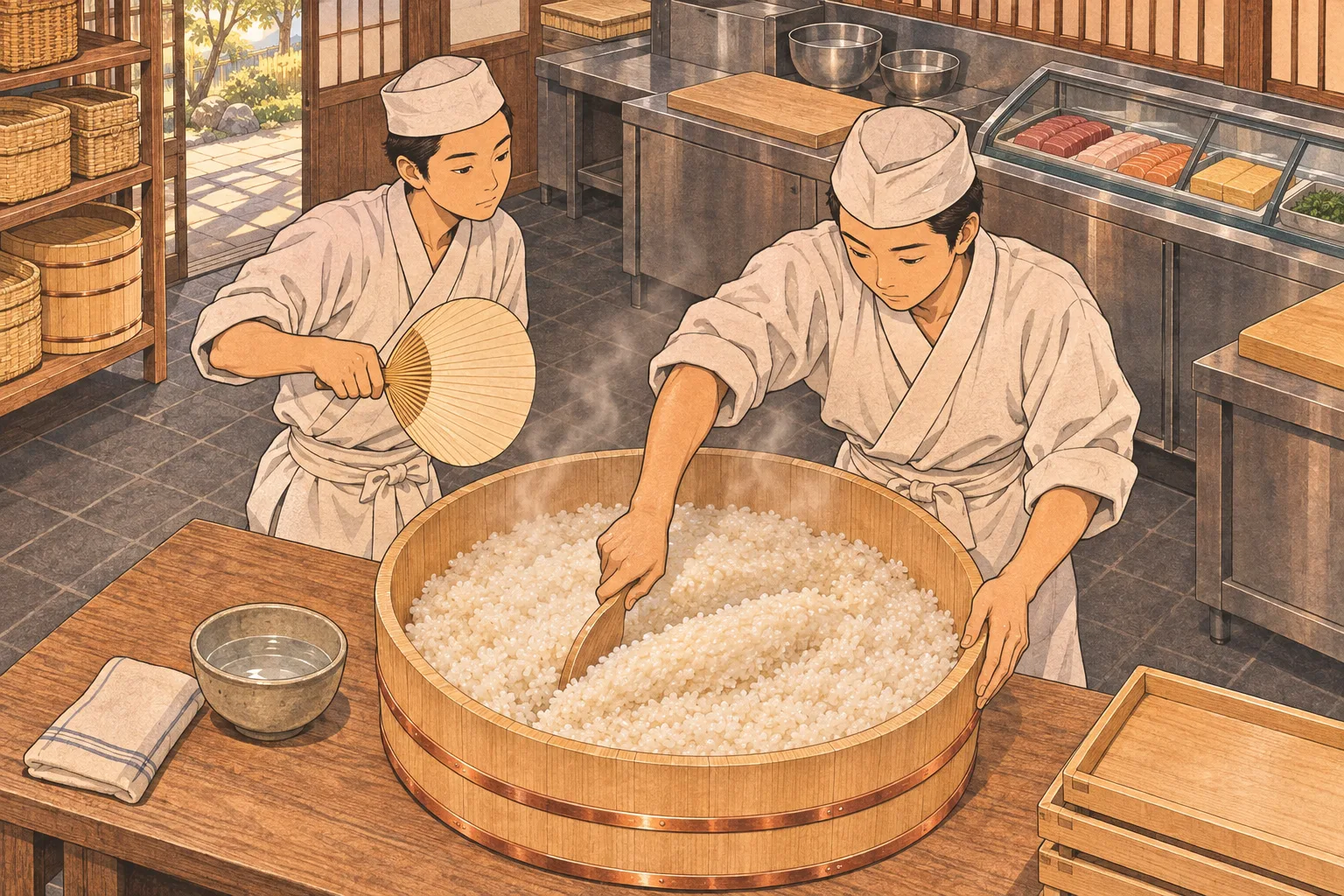
Mixing sushi rice in the kitchen: one apprentice folds the rice with a paddle in the wide, copper-hooped hangiri while another fans it cool
The third stage is fish preparation, called shitagoshirae or shikomi. The apprentice starts handling knives: scaling, gutting, and breaking a fish down into two fillets and a frame, known as sanmai oroshi or "three-piece cut", then trimming fillets into neat blocks for the chef to slice at the counter. This stage also covers the salting, marinating, simmering and grilling that define Edomae sushi, from curing gizzard shad to simmering sea eel and cooking the rolled omelette. Those techniques have their own deep-dive; the point here is that much of Edomae sushi’s work happens out of the customer’s sight, and that is where the apprentice learns it.
The fourth stage is wakiita, "beside the board", the second position behind the counter. The wakiita stands next to the master, slices fish for him, hands things over, watches the rice tub and, on busy nights, starts making sushi for customers, usually rolls and takeaway orders first. Equally important, he learns to read the room: who eats quickly, who is drinking, who wants the next piece now.
Finally comes the tsukeba, the spot behind the counter directly facing the customers, where the nigiri is made and the conversation happens. Standing there means the master considers you able to run the counter yourself. Some chefs stay on as the shop’s second, others leave to open their own place. When a master formally allows a former apprentice to use the shop’s name, this is called noren-wake, "dividing the curtain", after the fabric curtain that hangs at a Japanese shop entrance.
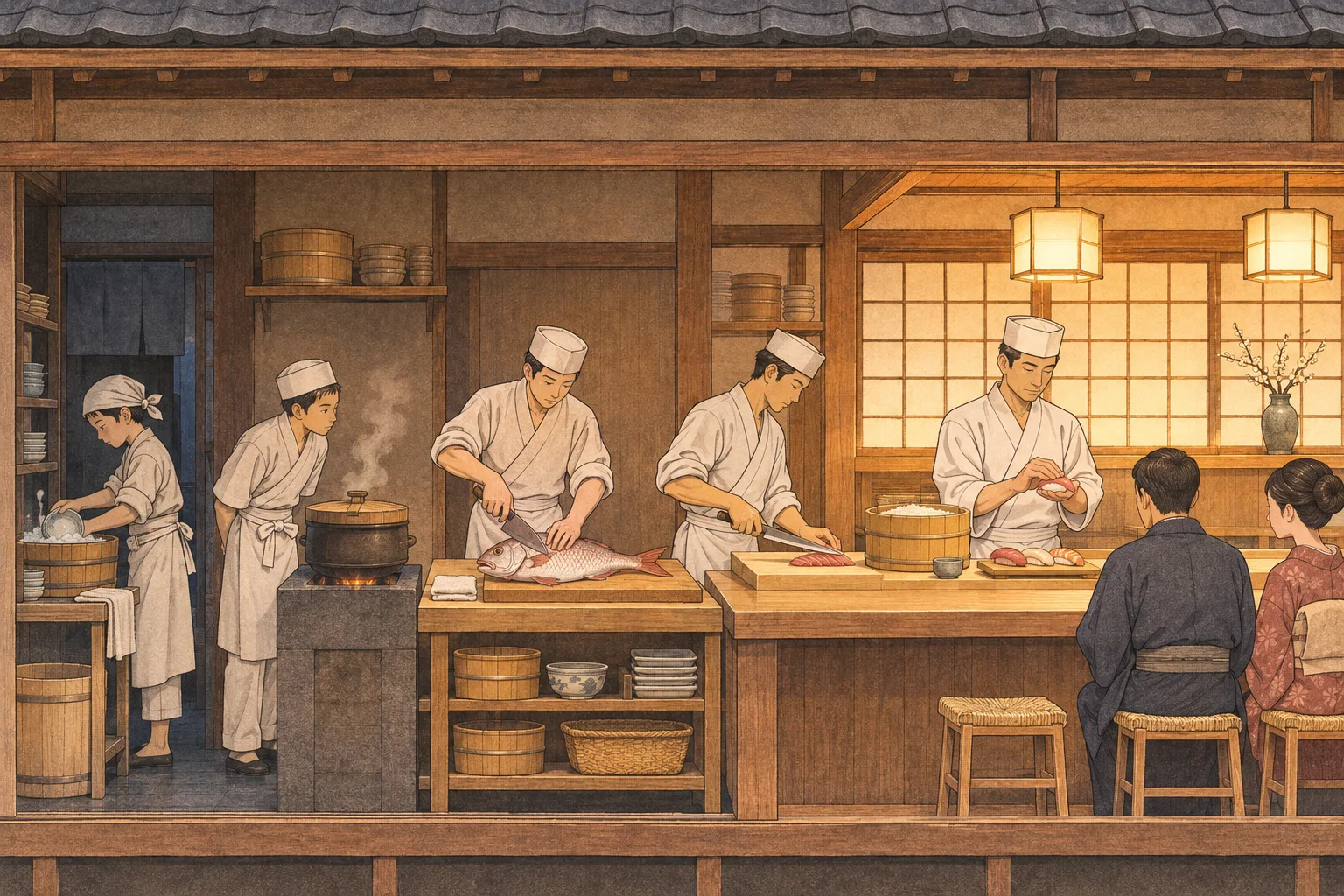
The ladder as five places in one shop. From left: the oimawashi washing dishes, the apprentice minding the rice, the apprentice breaking down a fish with a deba, the wakiita slicing behind the counter, and the master at the tsukeba shaping nigiri for customers
How long does the whole climb take? "Ten years" is the figure most often heard, though people also say seven or eight, or fifteen. The length came partly from waiting for a place to open up above you and partly from a teaching style built on watching, repetition and being scolded.
03Shaping Nigiri: The Named Techniques
The main article describes the basic motion of shaping nigiri. Within the trade, the turning part of that motion is classified into named methods called kaeshi, "turns". Different kaeshi turn the piece in different ways and a different number of times, which slightly changes the final shape and how firmly the rice is packed.
Before any of them, the chef dips his fingertips into a small bowl of water mixed with vinegar, called tezu or "hand vinegar", and spreads it across his palm. This stops the rice sticking. The right hand then takes a portion of rice from the tub and rolls it lightly once or twice. An experienced chef barely looks while doing this, and the portions come out almost identical.
The method regarded as the traditional one is hontegaeshi, "the formal turn". The left hand holds the slice of fish, the right index finger dabs wasabi on it, the rice goes on top, and the left thumb presses a small hollow into the rice. The right fingertips then press one end and lift the piece into the right hand, the left hand covers it, and the two hands turn it over together before returning it to the left hand, fish side up. The other end and the long sides are pressed and the shape is tidied. Compared with the next method, it has an extra change of hands. Its strength is that every face gets attention; its drawback is the number of movements and the time the hands spend on the rice. It is said that Edo-period chefs all once shaped nigiri this way. Few chefs use it exclusively today, though many learned it as apprentices.
The most common method now is kotegaeshi, "the small-hand turn". The start is similar. The difference is the turn itself: the right index and middle fingers roll the piece from the base of the left fingers towards the fingertips while the left hand flips, so the piece turns over in a single movement and ends fish side up in the left palm. The left hand cups into a shallow channel, two right fingers press from above, the thumb nudges the sides, and it is done. Kotegaeshi is compact and fast, a matter of seconds, and keeps contact with the rice to a minimum. Many chefs hold that good nigiri should be loosely packed so the grains fall apart on the tongue, and this method suits that ideal. There is no firm record of when or by whom it was standardised; it is usually described as hontegaeshi without the change of hands, and it later became the norm.
A third method is tategaeshi, "the vertical turn". Instead of rolling the piece sideways across the palm, the chef picks it up upright between right thumb and index finger, turns it end over end and sets it back in the left hand, then firms the four sides as in kotegaeshi. The hand barely touches the surface of the topping, so it is used for toppings that do not cling well to the rice and might slide off in a sideways roll, such as omelette, prawn, abalone or onion sprouts. Some treat it as a variant of kotegaeshi; when it came into use is not settled.
There are also personal variations, and simpler methods where the rice is shaped directly under the fish without a turn at all, common in quick-service shops. Machine-made rice is a different story, covered in the conveyor-belt sushi deep-dive.
Why so many methods, and why the drift from complex to simple? One explanation is that nigiri shrank. The oversized Edo-period pieces described in the main article needed more turns to hold together. As nigiri became a single bite and chefs came to prefer loosely packed rice, fewer turns were needed. Pace mattered too: customers wait at the counter, and the less the hand touches the rice, the better.
04Knives
Most Japanese kitchen knives are single-bevelled. One side is ground to an edge, the other is flat and slightly hollowed. A single-bevel blade cuts with a clean, straight face on one side, which lets it slice fish without crushing it and leaves a glossy cut surface. Three types matter in a sushi bar.
The yanagiba, "willow-leaf blade", also called the sashimi knife, is the slicing knife. It is long and slender with a pointed tip, like a stretched willow leaf. It is used with a single drawing stroke: the heel of the blade meets the fish and the chef pulls the knife towards himself along its full length, finishing the cut without sawing back and forth. The cut surface stays smooth and the flesh is not torn, which changes the texture in the mouth. The blade is long precisely so that one stroke is enough.
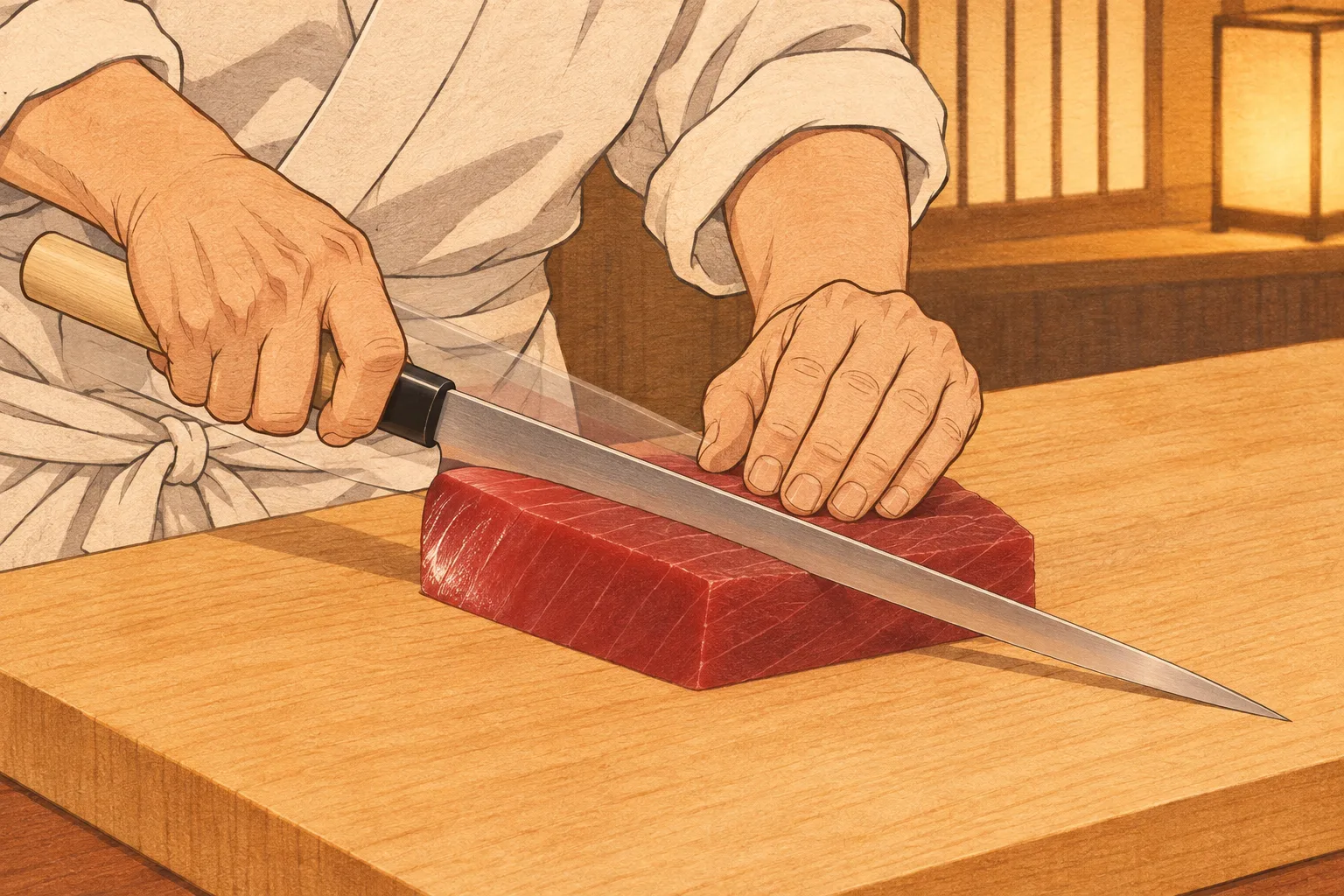
A yanagiba on a block of tuna: the heel of the blade meets the fish first, then the knife is drawn towards the chef along its full length in a single stroke
The Tokyo area has a close relative, the takohiki, "octopus puller", with a square tip and a straighter, thinner blade. A story often told is that Edo chefs preferred the square tip because pointing a sword-like blade at customers while slicing in front of them was thought rude, while Kansai chefs kept the pointed yanagiba. Today the yanagiba is the more common of the two, Tokyo shops included, and the takohiki survives mainly in some older Tokyo shops and in the hands of chefs who prefer it.
The deba is the fish-butchering knife. It is short, broad and heavy, with a thick spine. The heel chops through heads and backbones using the knife’s own weight, while the tip runs along the bones to lift the flesh away. Breaking a whole fish down into fillets is mostly deba work. A shop usually keeps several sizes, small ones for horse mackerel and gizzard shad, larger ones for sea bream or bonito.
The usuba, "thin blade", is the vegetable knife. It is rectangular with a straight edge and a very thin blade. Its showpiece is katsuramuki, turning a length of daikon radish against the blade to peel it into a single translucent sheet, which is then cut into fine threads to garnish sashimi. The Tokyo-style usuba is a plain rectangle with a square end; the type more common in Kansai, called kamagata or "sickle shape", has a spine that curves round at the front like a sickle. A sushi bar uses fewer vegetables than other Japanese kitchens, so the usuba comes out less often, but cucumber for rolls and garnishes are its work.
A chef’s knives are personal. Many buy their first good knife with their own savings or receive it from their master, and keep it for decades. Daily sharpening wears the blade narrower over the years, and an old yanagiba worn visibly narrower than when it was new is a record of a career. Well-known knife-making towns include Sakai near Osaka and Seki in Gifu. In traditional shops, apprentices do not touch the master’s knives.
05The Wooden Tools of the Counter
The hangiri, also called handai, is the wide, shallow wooden tub for mixing sushi rice. It looks like a large basin, bound with copper hoops and usually made of sawara cypress. The wood absorbs excess moisture without drying the rice out, which is why chefs use it instead of metal. After use it is scrubbed and turned upside down to dry, or it will crack and grow mould.
The ohitsu is the smaller, deeper lidded wooden tub that holds seasoned rice at the counter, and it is how a shop keeps the rice at the body temperature the main article describes. Many shops nest the ohitsu inside a woven straw jacket that keeps it warm, so from a counter seat you may see what looks like a round straw basket beside the chef, its lid lifted a crack. The chef refills it from the kitchen in small amounts through the evening.
The makisu is a bamboo rolling mat, roughly the size of a paperback book opened flat, made of thin slats bound with cotton string. To make a roll, the chef lays nori, rice and filling on the mat, lifts the near edge and rolls the whole thing forward, pressing it firm. It must be scrubbed and hung to dry, since rice caught between the slats goes sour quickly.
The tsukedai is the wooden surface in front of each customer where the finished sushi is placed. In some shops it is a raised step on the counter itself; in others it is a separate board or tray, sometimes shaped like a wooden sandal and called a geta. It is usually plain unfinished wood, scrubbed daily until it is almost white.
The neta case is the glass-fronted refrigerated display running along the counter between chef and customer, with the day’s sliced fish laid out in compartments. It is generally thought to have spread with electric refrigeration; before that, fish was kept in wooden boxes. It makes ordering easy and gives the counter a lively look. Some high-end shops do without one and keep their fish in wooden boxes in a refrigerator behind them; the usual reason given is that temperature and humidity are harder to control behind glass and that the fish dries out. Whether a shop has a neta case has become one of the signs of its style.
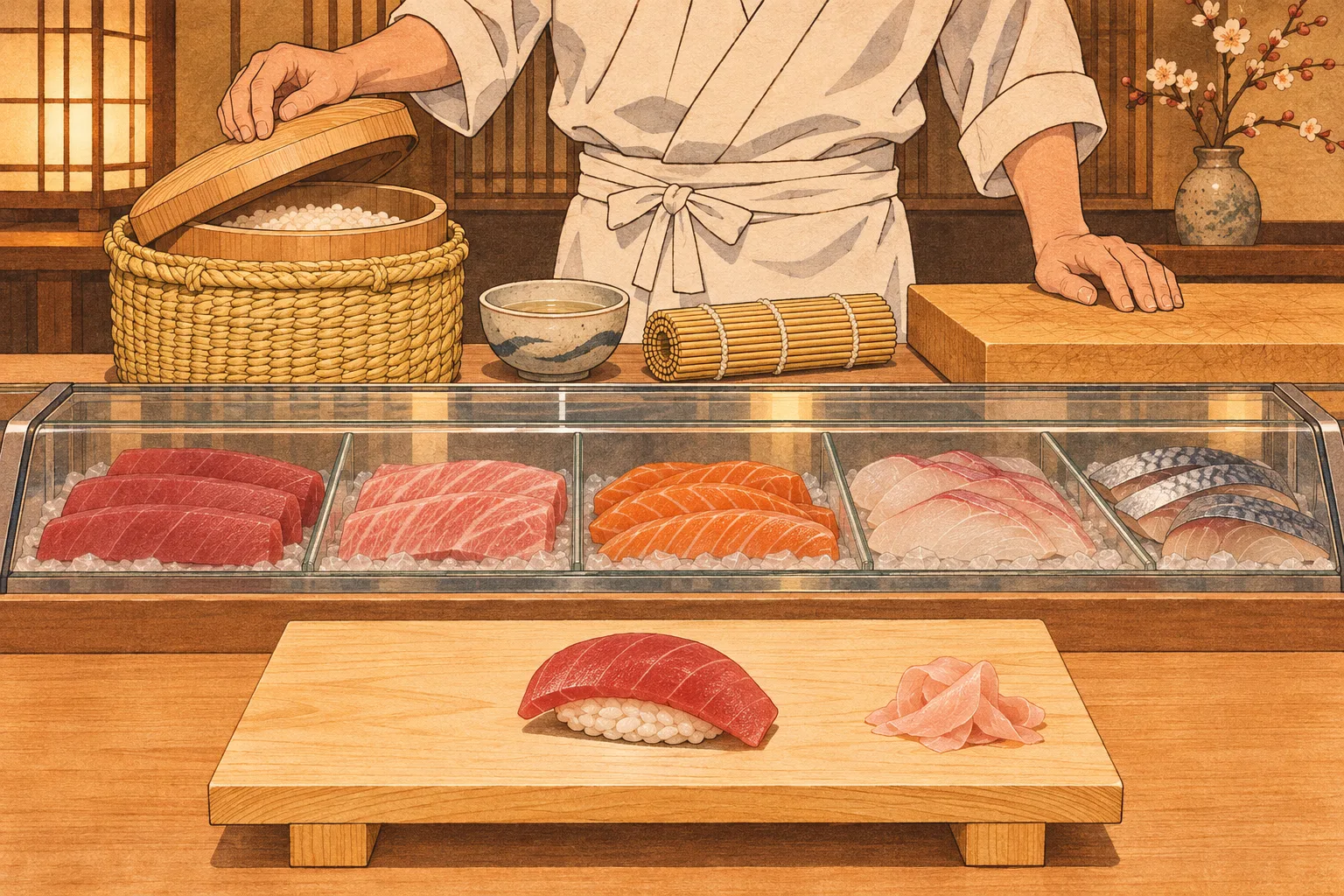
The counter from a customer’s seat. In front, a plain wooden tsukedai with one piece of nigiri and pickled ginger; behind it, the glass neta case; at the back, from left, the ohitsu in its straw jacket with the lid lifted, a bowl of tezu, a rolled makisu and a thick manaita
The manaita, or cutting board, is the centre of the chef’s station. Sushi bars favour thick, heavy wooden boards, typically ginkgo or hinoki cypress, which are kind to the edge and do not let the blade slip. Some shops use synthetic boards for ease of cleaning, but behind the counter, in view of customers, wood is still the norm. A board dips in the middle with use and is periodically planed flat, so an old board slowly gets thinner.
06A Day Behind the Counter
The fish market deep-dive ends with the chef buying fish at dawn. The day continues from there, here in a typical shop that opens mainly in the evening.
The chef is usually back at the shop soon after sunrise, the fish either in his own van or following later from the intermediate wholesaler. The kitchen gets loud: running water, the thunk of a deba through a backbone, pots coming to the boil, scales flicking everywhere. Whole fish are washed, scaled, gutted and broken down. White fish such as sea bream and flounder are cut into blocks, wrapped in cloth and refrigerated, some left for a day or more for the flavour to develop. Silver-skinned fish like horse mackerel and gizzard shad are handled quickly, salted and marinated. Prawns are boiled, sea eel opened and simmered, shellfish shucked and cleaned. Tuna usually arrives already in a section and is trimmed into blocks. Apprentices and the wakiita do most of this, with the chef stepping in for the most valuable fish.
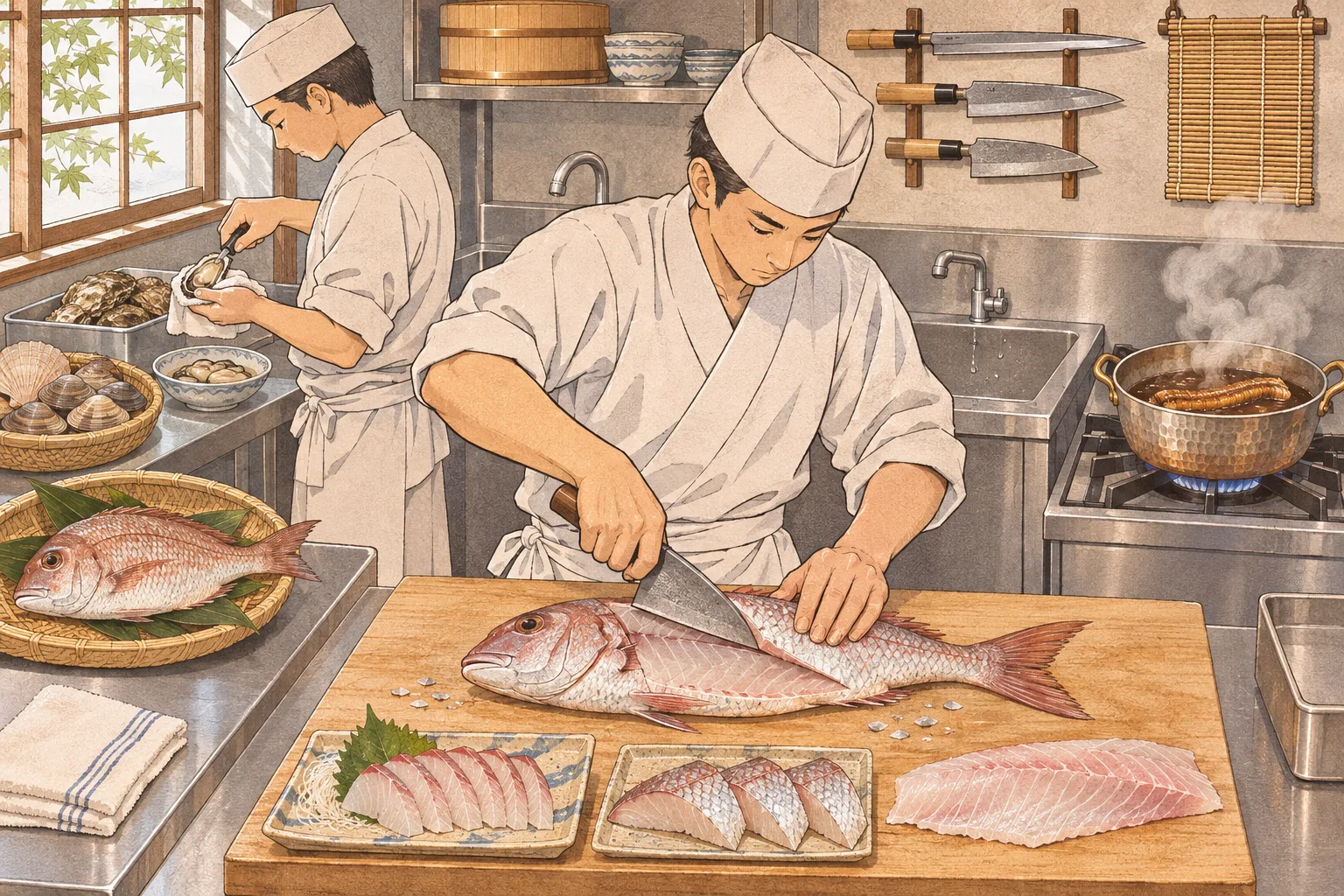
Morning in the kitchen: one apprentice breaks down a sea bream with a deba, scales scattered on the board, while another shucks shellfish and sea eel simmers on the stove; knives and a makisu hang on the wall
Midday and afternoon go to the rest of the preparation: the omelette, the reduction brushed over sea eel, pickled ginger, washed shiso leaves and spring onions. Rice goes on an hour or two before opening so that it is at the right temperature when the first customer sits down, and many shops make several batches through the night. There is a lull in the afternoon when staff eat the makanai, the staff meal, often a rice bowl or soup made from trimmings and often cooked by the youngest apprentice.
Before opening the counter and tsukedai are wiped, the cutting board is dampened, knives are laid out, and the evening’s fish goes into the neta case or wooden boxes. The chef changes into a fresh white jacket and ties on his apron and cap. The noren curtain goes up over the door, which is the signal that the shop is open.
Evening is counter time. Whether guests order omakase or piece by piece, the hard part from behind the counter is pacing seven or eight people at once, some drinking slowly, some eating one piece after another. The chef keeps an eye on every plate so the next piece arrives just as the last one is finished, while answering questions about where today’s sea bream was caught. The wakiita slices, refills the rice and makes rolls; an apprentice washes up and pours tea.
When the last customers leave, often around ten or eleven at night, the cleaning begins. Leftover fish is rewrapped and stored or goes into tomorrow’s staff meal. The hangiri, ohitsu and makisu are scrubbed and dried. The cutting board is scrubbed with a brush and salt, rinsed with hot water and stood on end. The counter is wiped and the floor hosed down.
Then the knives. Many chefs sharpen every night, and it is the quietest part of the day. Whetstones come in coarse, medium and fine grades: the coarse stone removes chips, the medium stone sets the edge, the fine stone polishes it. The chef lays the blade at an angle on the wet stone, presses with his fingertips and pushes it back and forth with a steady rasping sound. With a single-bevel knife, the bevelled face is sharpened first, then the flat back is touched lightly to remove the burr. The blade is wiped dry, wrapped or hung, and ready for the morning.
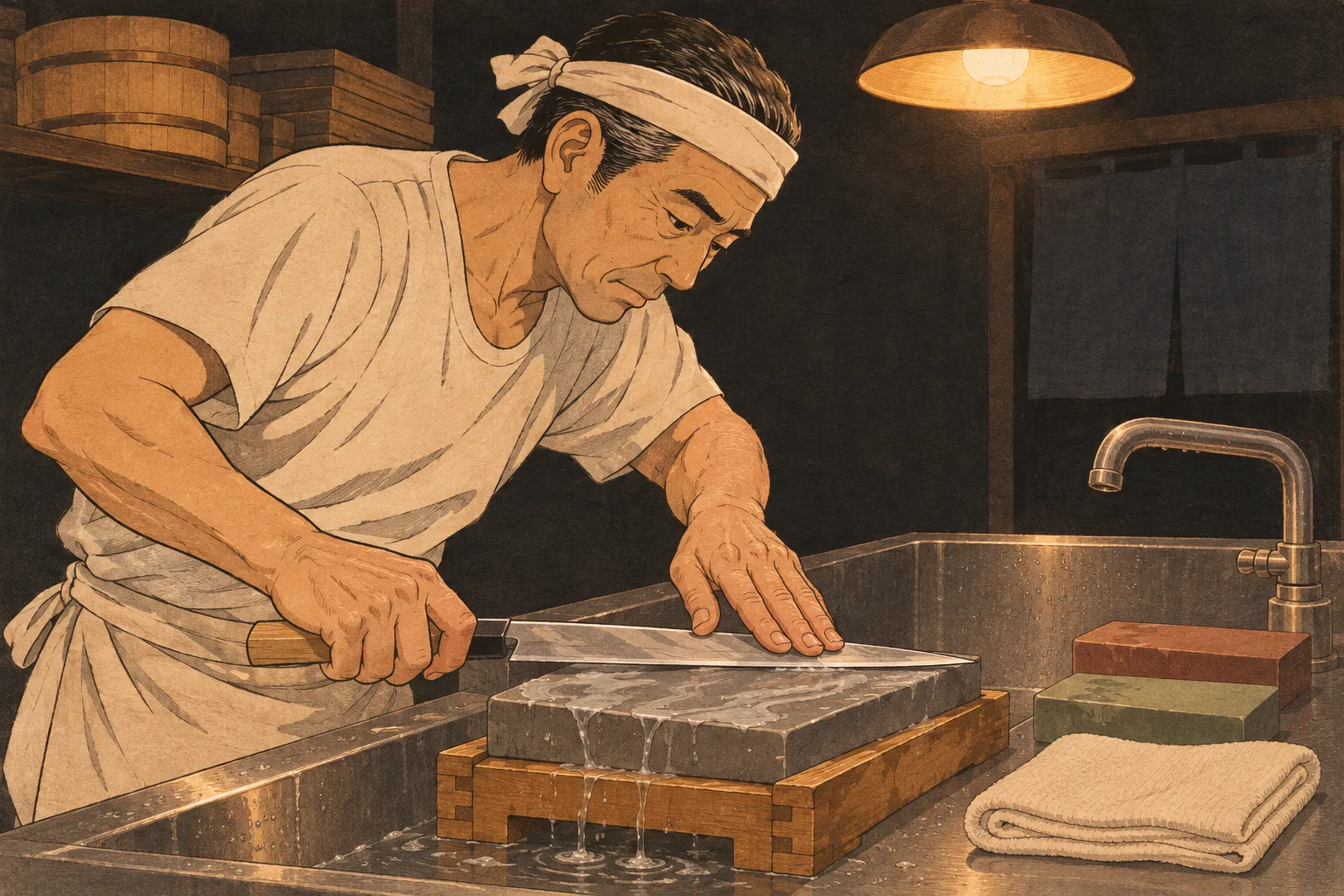
Sharpening after closing: the blade lies at an angle on the wet whetstone, fingertips pressing it down as it is pushed back and forth. Two more stones of different grades and a folded cloth wait beside the sink
07White Jackets and Caps
In Japan, sushi chefs almost always wear white. The standard garment is the hakui, a short white jacket with a stand-up collar or a crossed Japanese-style collar, fastened with buttons or ties. An apron called maekake goes around the waist, white or indigo. On the head is a white wabō, a low cylindrical cap with no brim, or a cloth tied around the head as a hachimaki, sometimes twisted into a rope. Footwear is white rubber boots, kitchen shoes, or in more traditional shops setta sandals.
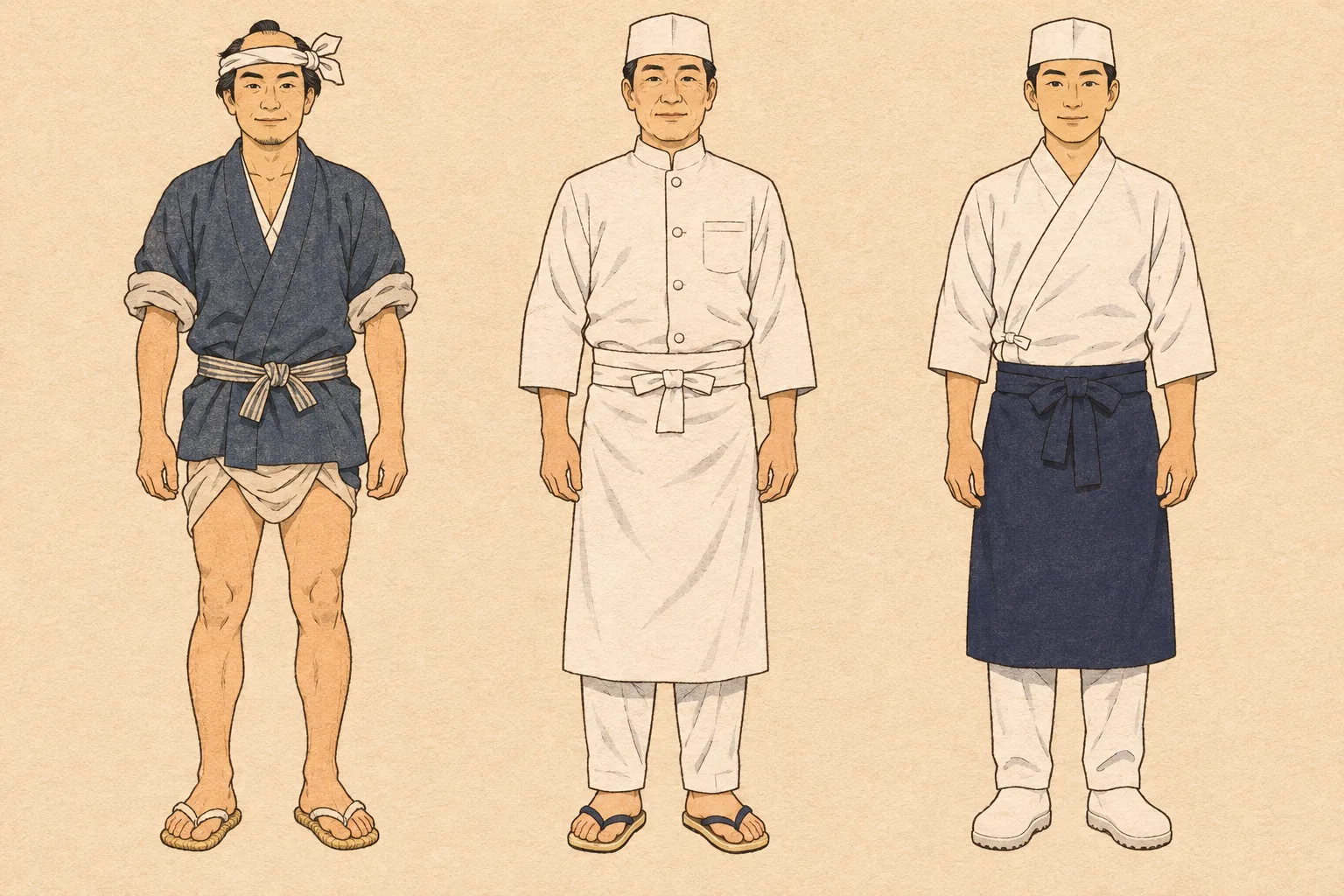
Three outfits, from left: an Edo street-stall sushi seller with headband and rolled sleeves, before the white jacket; a stand-up-collar hakui with white maekake, wabō and setta; a crossed-collar hakui with indigo maekake, wabō and kitchen shoes (artist’s impression)
Why white? The usual answer is cleanliness: white shows every stain, so wearing it tells the customer the chef is ready to be seen as clean, and a jacket marked with blood or soy sauce is changed. Some chefs change several times a day. Another view links the white jacket to Western ideas of hygiene introduced from the Meiji period on, when doctors’ and nurses’ white coats made white a symbol of sanitation that then reached kitchens, though there is little firm record of this. The two explanations sit together comfortably. The cap or headband keeps hair out of the food and catches sweat, and within a shop it can also mark rank. Edo-period prints of street-stall sushi sellers tend to show headbands and rolled sleeves rather than any uniform; the white jacket is generally thought to have become standard in modern times.
Some shops now prefer indigo or black work clothes for a more relaxed look, and some upscale chefs wear kimono-style tops. But for most Japanese, the image of a sushi chef is still white jacket and cap behind a wooden counter.
08Telling Them Apart
The three kaeshi start the same way and differ at the moment of turning. In hontegaeshi the piece moves to the right hand, both hands turn it together and it goes back to the left, an extra change of hands. In kotegaeshi a flick of two right fingers and a flip of the left hand roll it over sideways. In tategaeshi the right hand picks it up upright and turns it end over end, usually for omelette, prawn and other toppings that do not cling to the rice. A quick way to remember: handed over, rolled in the palm, flipped end over end. Kotegaeshi is the one you will see most.
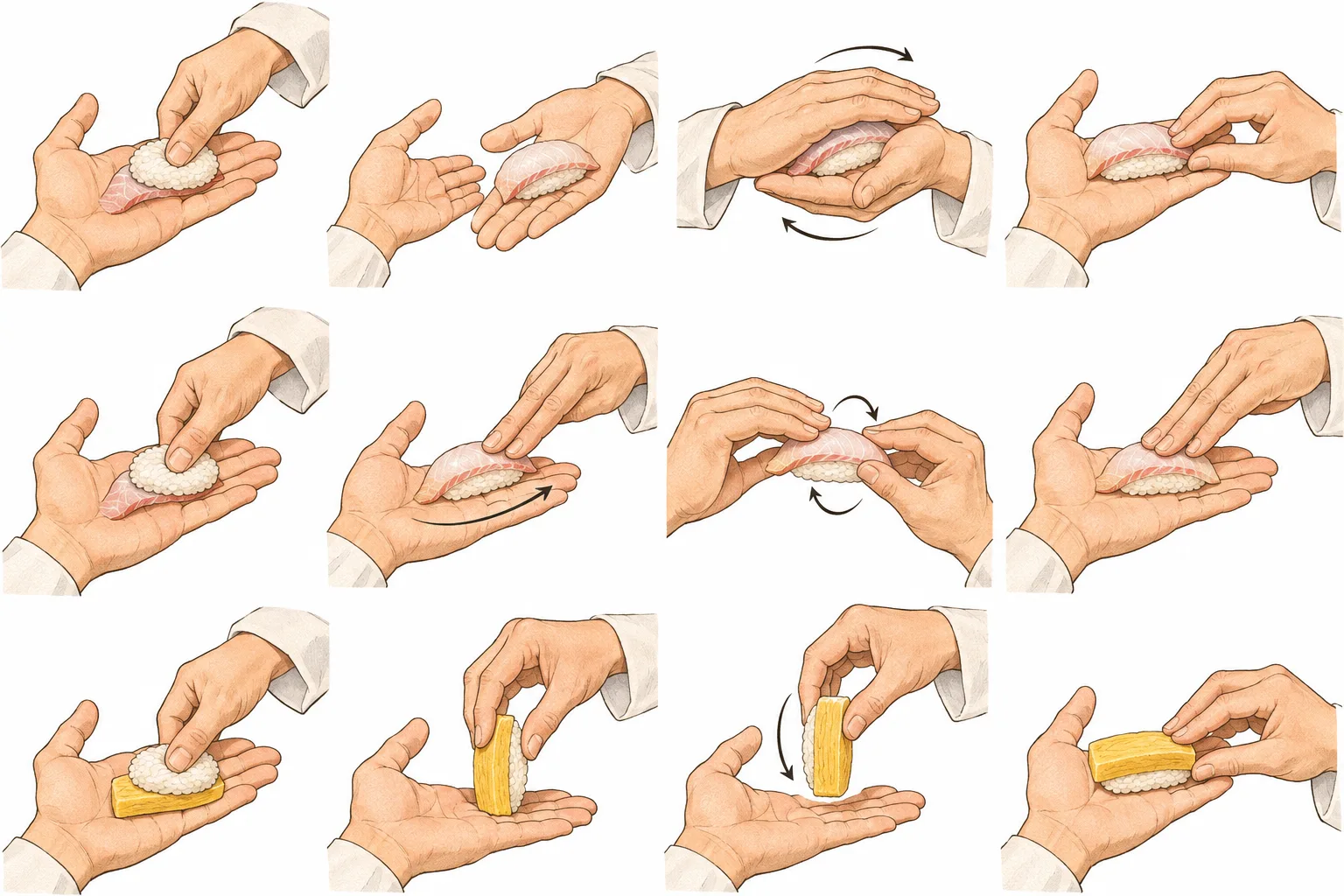
The three kaeshi, each row read left to right in four steps. Top, hontegaeshi: the piece moves to the right hand, both hands turn it, and it returns to the left. Middle, kotegaeshi: two fingers push it towards the fingertips and it rolls over sideways. Bottom, tategaeshi with an omelette topping: picked up upright, turned end over end, set back in the left palm
The knives are easiest to tell apart by outline. The yanagiba is the longest, slim with a pointed tip; a long knife with a square tip is a takohiki. The deba is short with a clearly triangular profile and a visibly thick spine. The usuba is a flat rectangle with a straight edge, the thinnest of the three; the Kansai kamagata version has a sickle-like curve at the front of the spine. Their jobs follow in sequence: the deba takes the fish apart, the yanagiba slices it, the usuba handles the vegetables. From a counter seat you usually only see the yanagiba.
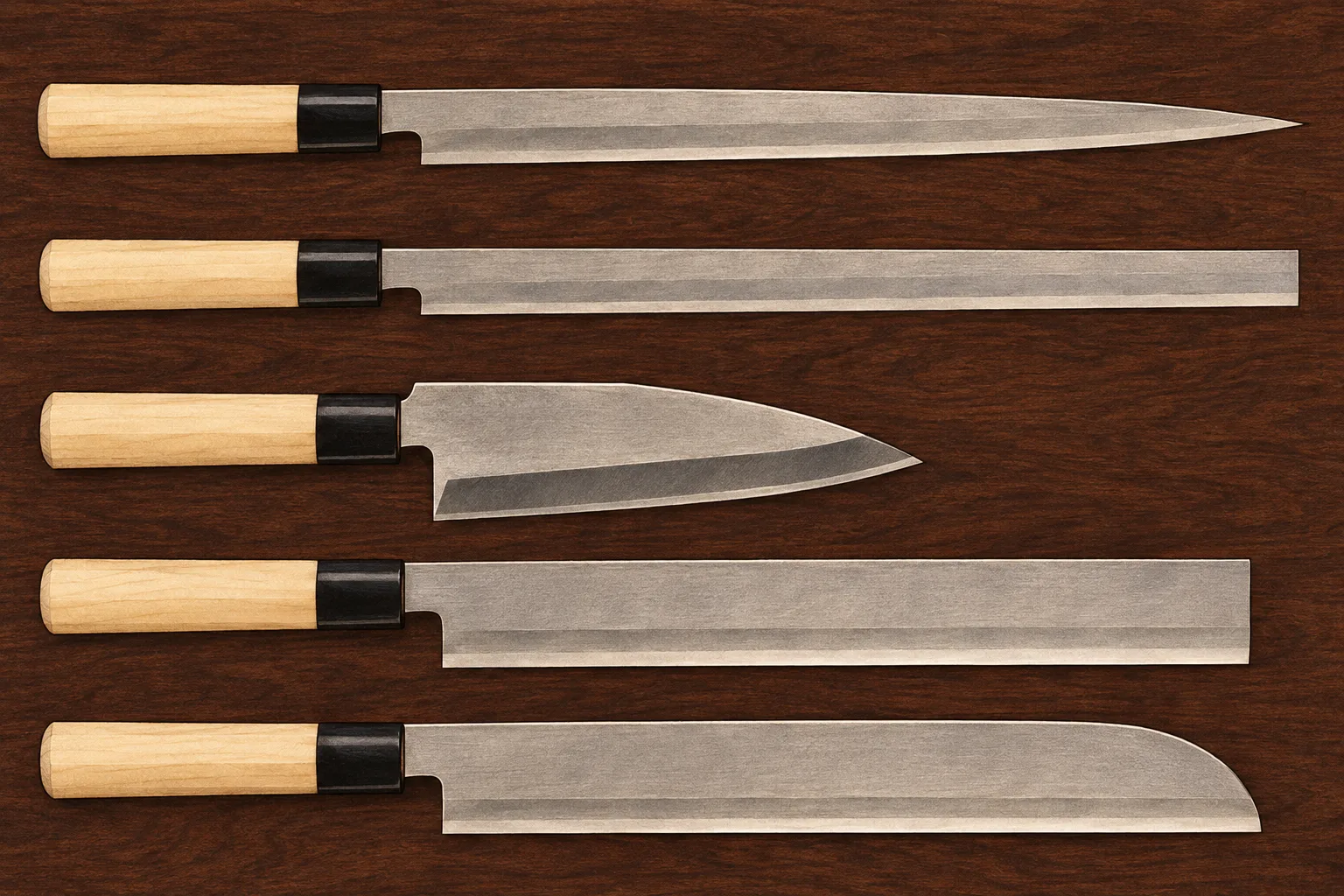
Five knives in profile, top to bottom: yanagiba (long, pointed tip), takohiki (long, square tip), deba (short, broad, thick spine), the square-ended Tokyo-style usuba, and the Kansai kamagata usuba with its spine curving round at the front
The wooden tools sort the same way: the hangiri is wide, shallow, lidless and copper-bound and stays in the kitchen; the ohitsu is small, deep, lidded and often wrapped in straw at the chef’s side.
09A Changing Trade
The old apprenticeship model held through the post-war decades but has faced growing questions since the late twentieth century.
The first change is the sushi school. In 2002 a dedicated school for training sushi chefs opened in Tokyo, with courses as short as about two months covering rice, fish preparation, nigiri and rolls. Similar schools followed elsewhere in Japan and abroad. Students include career changers, people planning to open restaurants overseas and many non-Japanese. The method is the reverse of the old shop: no year of washing dishes first, but each step broken down, demonstrated and drilled.
Whether that is enough became a public argument in Japan. In autumn 2015 a widely shared online debate started when a well-known public figure wrote on social media that smart sushi shops no longer bothered with leisurely apprenticeships, that flair mattered more than years served, and that anyone who needed years to learn it was a fool. One side pointed out that much of a traditional apprenticeship is spent on chores and waiting, and that "stealing the technique" is inefficient and can shade into exploitation. The other replied that the hand movements might be learned quickly, but choosing fish, judging its condition, adjusting through the seasons and reading customers take years in a working shop. At about the same time the 2016 Michelin Guide Kyoto Osaka gave a Bib Gourmand, its good-value category rather than a star, to an Osaka sushi bar less than a year old, staffed by students and graduates of a short-course sushi school, many with about three months of training. It was often brought up in the debate. The debate did not settle anything, but it made clear that there was more than one route in, and some traditional shops began letting apprentices handle fish earlier and explaining more.
The second change concerns women. The sushi counter was long an almost entirely male space, and several explanations circulated for keeping it that way: that women’s hands are warmer and would heat the fish and rice; that makeup and perfume would taint the flavour; that hormonal cycles affect taste. Critics answer that there is no clear medical basis for the claims about warm hands or menstrual cycles, that hand temperature varies from person to person, that male chefs too must avoid warming the rice and fish, which is exactly why speed and a light touch are prized, and that rules on scent can apply to everyone. The practical obstacles were often larger: very early mornings, long hours on one’s feet, heavy fish, live-in apprenticeship and the culture of the kitchen. In 2010 a sushi bar staffed entirely by women chefs, said to be the first in Japan, opened in Tokyo’s Akihabara and drew wide attention, and the number of women running sushi counters has grown since, in Japan and abroad. They remain a minority, and the old explanations are still repeated by some and dismissed by more.
The third change is the chef outside Japan. As sushi spread around the world, demand for chefs far outstripped the number of Japanese who went abroad. In North America, Europe, Australia and Southeast Asia many sushi chefs are Chinese, Korean, Southeast Asian or Latin American, some trained in Japan, some under a Japanese chef locally, some at schools, some on the job. In autumn 2006 Japan’s Ministry of Agriculture, Forestry and Fisheries proposed a certification scheme for Japanese restaurants overseas and convened an expert panel; foreign media nicknamed it the "sushi police", and after criticism it was handed to a private organisation and reshaped into a gentler, promotion-led programme. In 2016 the ministry issued guidelines for certifying the Japanese cooking skills of non-Japanese chefs abroad, with private bodies awarding gold, silver and bronze levels, framed as encouragement rather than enforcement.
Meanwhile, more and more foreigners come to Japan to apprentice in sushi bars, starting at the bottom like anyone else, washing dishes and cooking rice before working their way to the board.
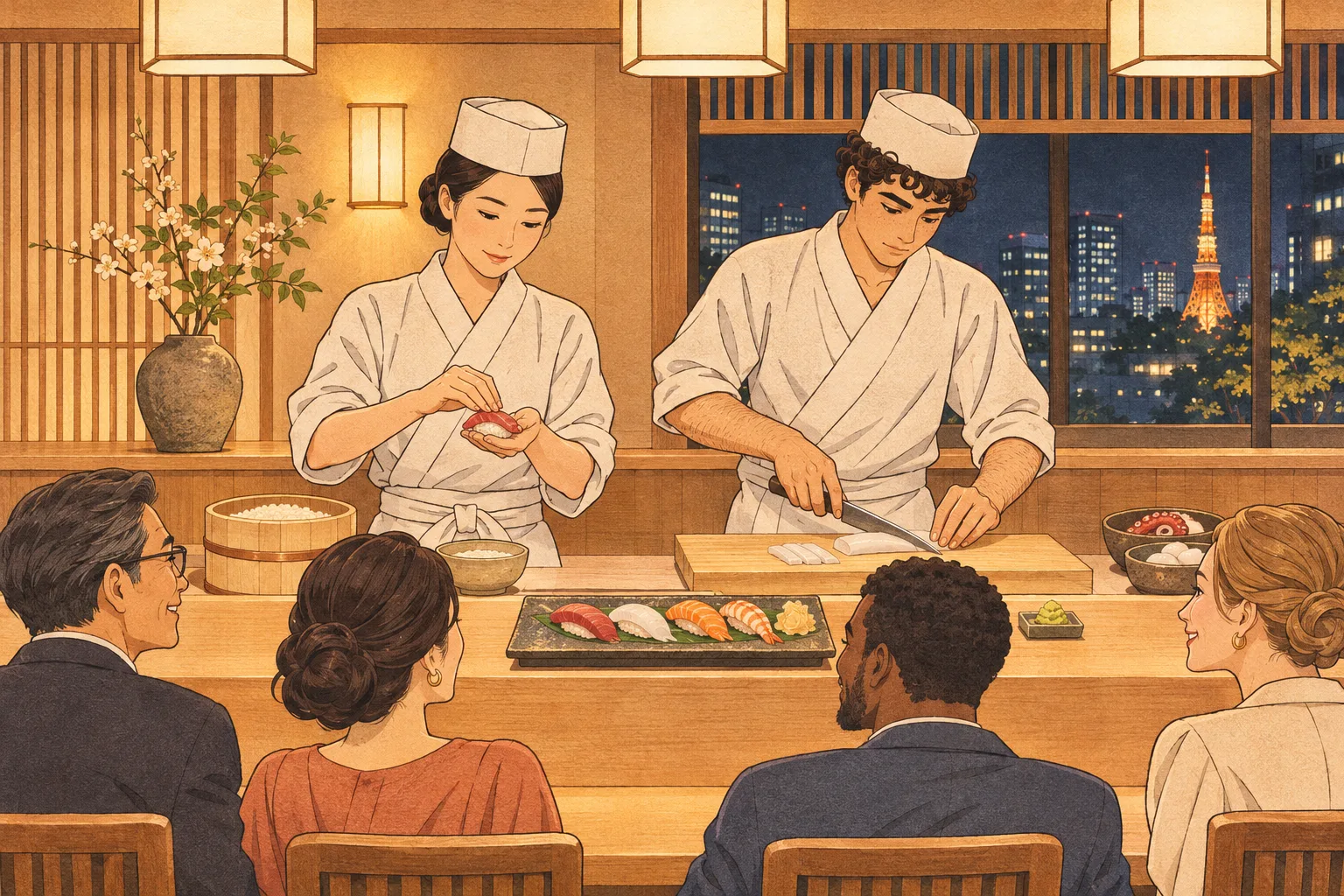
A counter today: a woman chef shapes nigiri while a foreign apprentice slices beside her. The white jackets, caps and hand movements are the old ones; the people behind the counter have changed
More deep dives on this topic
 TunaOrder an omakase in Tokyo and the tuna usually arrives in a sequence: a slice of deep red lean meat, then something pinker and softer, then a pale, marbled piece that seems to…
 HikarimonoSit at a sushi counter in Japan and, somewhere in the middle of the meal, the chef will set down a piece that looks different from the rest.
 Beyond TunaMost first-time visitors walk into a sushi bar thinking about tuna.
 Edomae ShigotoMost visitors arrive at a Tokyo sushi counter expecting raw fish on rice.
 Shari and Its Supporting CastAt a sushi counter your eyes follow the fish.
 Regional Sushi Beyond TokyoMost visitors meet sushi at a counter: a chef shapes rice in one hand, lays a slice of fish on top and sets it down in front of you, to be eaten within seconds.
 KaitenzushiSit down at a kaitenzushi (conveyor-belt sushi) counter anywhere in Japan and the basic deal is the same.
 Fish MarketsThe piece of sea bream a sushi chef slides across the counter at lunchtime has usually changed hands four or five times since it left the water.
 Words at the Sushi CounterSit at a sushi counter in Japan and the language around you shifts.
 The Sushi ChefFrom a counter seat, a sushi chef looks like a pair of hands and very little else.
- Back to the main article: Sushi →