
At a sushi counter your eyes follow the fish. This is a guide to everything else on the plate: the rice, the vinegar, the wasabi, the nori, the ginger and the tea. Your tongue, though, usually meets the rice first, and many chefs will tell you that the rice is what defines a shop. Around the rice and fish sits a small cast of supporting players: a dab of green paste, a sheet of dark seaweed, a mound of pale pink ginger, a heavy cup of scalding tea. Each has its own history, its own grades of quality, and its own cheap imitation. This guide walks through them one by one, so that next time you sit down you can read the plate in front of you.
01The Rice: Not the Best Bowl of Rice, the Right One
Japanese diners usually praise plain rice for being soft, sticky, sweet and fragrant. Koshihikari, the country’s most widely planted variety for decades, is the benchmark for that taste. Sushi chefs want almost the opposite. Rice for sushi has to absorb seasoning without turning to mush, hold together under light pressure, and then fall apart in the mouth. Chefs talk about grains that are firm outside and tender inside, each one distinct from its neighbours.
That is why many traditional Tokyo shops long favoured Sasanishiki, a variety bred in Miyagi Prefecture and released in the 1960s. It is less sticky than Koshihikari, clean-tasting, and keeps its texture as it cools. Through the 1970s and 1980s the two were Japan’s star varieties. Then came the cold summer of 1993, which devastated the northeast. Sasanishiki is sensitive to cold, the harvest collapsed, Japan briefly had to import rice, and farmers afterwards switched in large numbers to hardier varieties. Sasanishiki survives, and some chefs still insist on it, but it has become a rice you have to seek out.
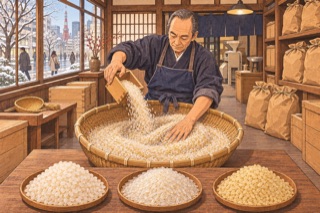
Most shops now work around Koshihikari’s dominance. Some cook it with less water. Others choose less sticky varieties such as Hatsushimo from Gifu, a large, firm grain often described as a "sushi rice". Very often the answer is a blend. A handful of specialist rice dealers in Tokyo supply sushi restaurants and mix two or three varieties, from different regions and harvests, to suit each shop’s vinegar and style. Chefs tend to be cagey about the exact mix and will simply say their rice merchant blends it.
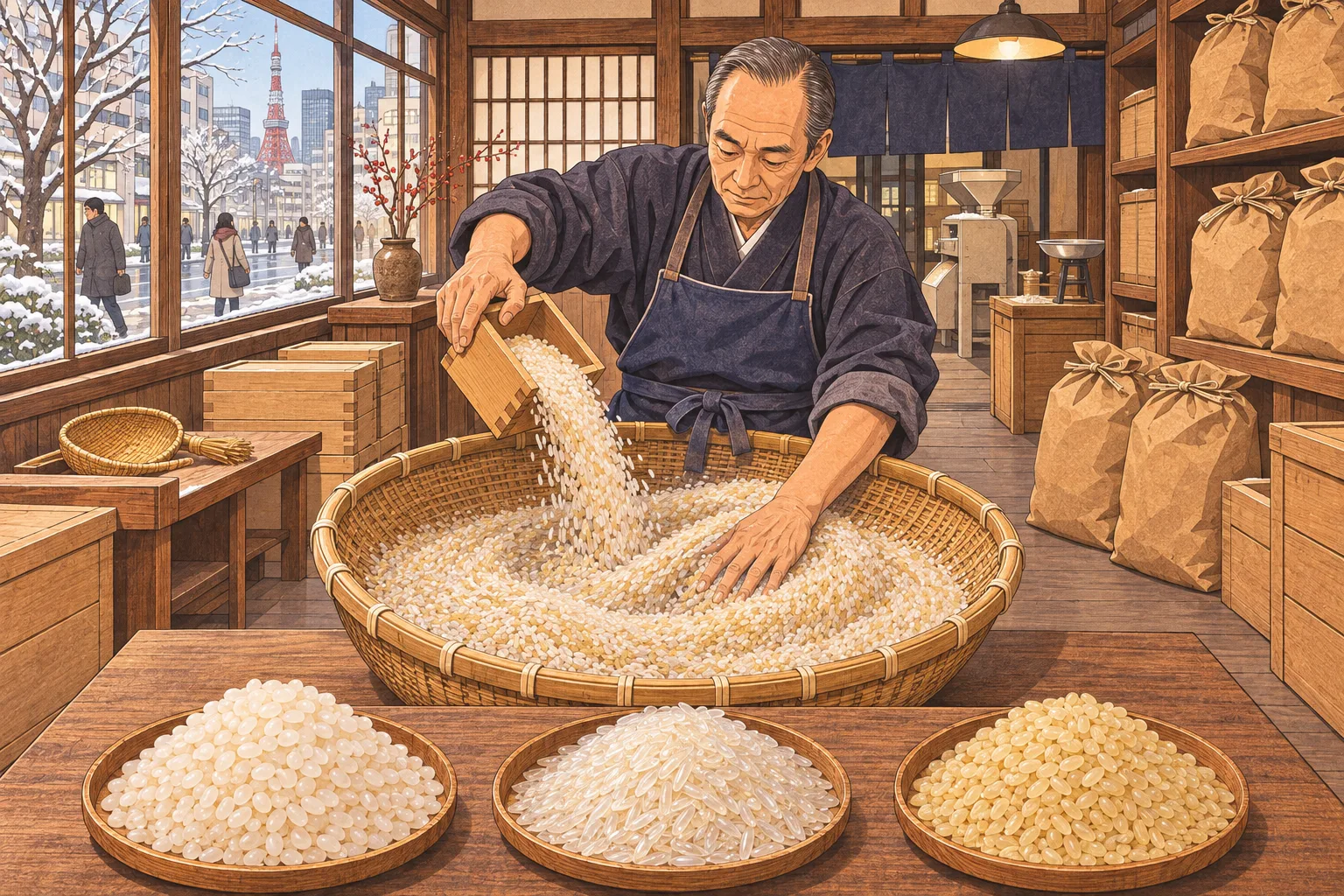
A Tokyo rice dealer blends rice for a sushi shop in a wide bamboo sieve. The three trays in front hold grains of different varieties and harvests.
The most interesting argument is about age. Supermarkets celebrate new-crop rice, shinmai, every autumn. Many sushi chefs prefer komai, rice that has been stored for around a year. New rice is moist and aromatic but cooks up soft and sticky and takes vinegar poorly. Older rice has lost some moisture, absorbs water evenly, and produces firm grains that drink in the vinegar instead of letting it pool on the surface. Some shops age their rice in cold storage for a year; others blend new and old through the winter, raising the share of new rice gradually. Other chefs argue that modern storage makes good sushi rice possible from fresh rice, and that nothing matches its fragrance. The debate has no winner. Some shops re-test every autumn, cooking several blends side by side, seasoning them, pressing them and tasting each with fish before committing for the year.
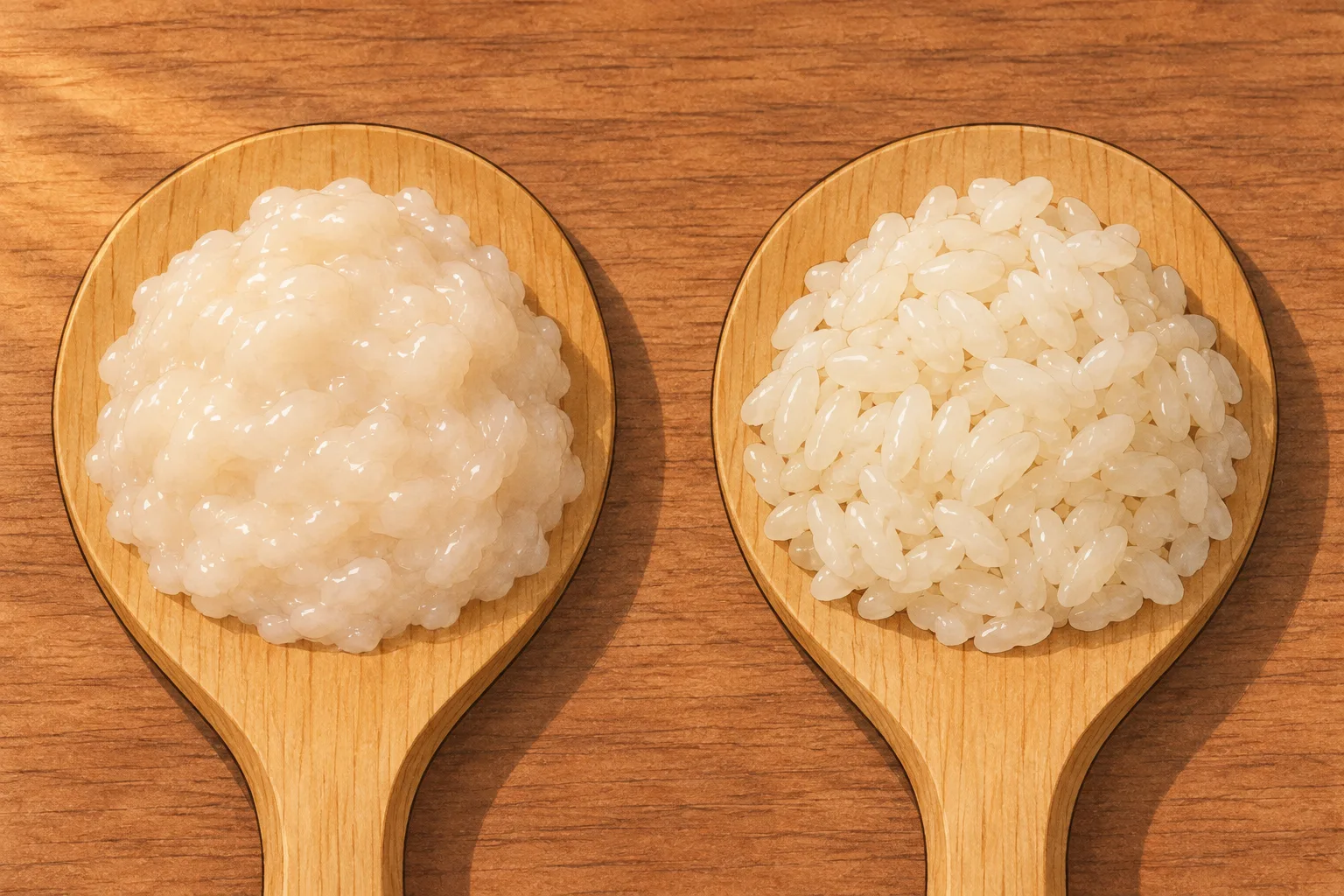
Seasoned rice on two paddles. Left: new-crop rice, soft and clumped together. Right: rice stored for about a year, firm, with every grain distinct.
02The Vinegar: White Shari and Red Shari
Seasoned sushi rice is called shari at the counter. Look at the rice the chef pulls from the wooden tub and you will usually see one of two colours. Rice seasoned with ordinary rice vinegar is white, perhaps faintly cream: this is shiro-shari, "white shari". Rice seasoned with akazu, "red vinegar", ranges from beige to light tan: this is aka-shari, "red shari".
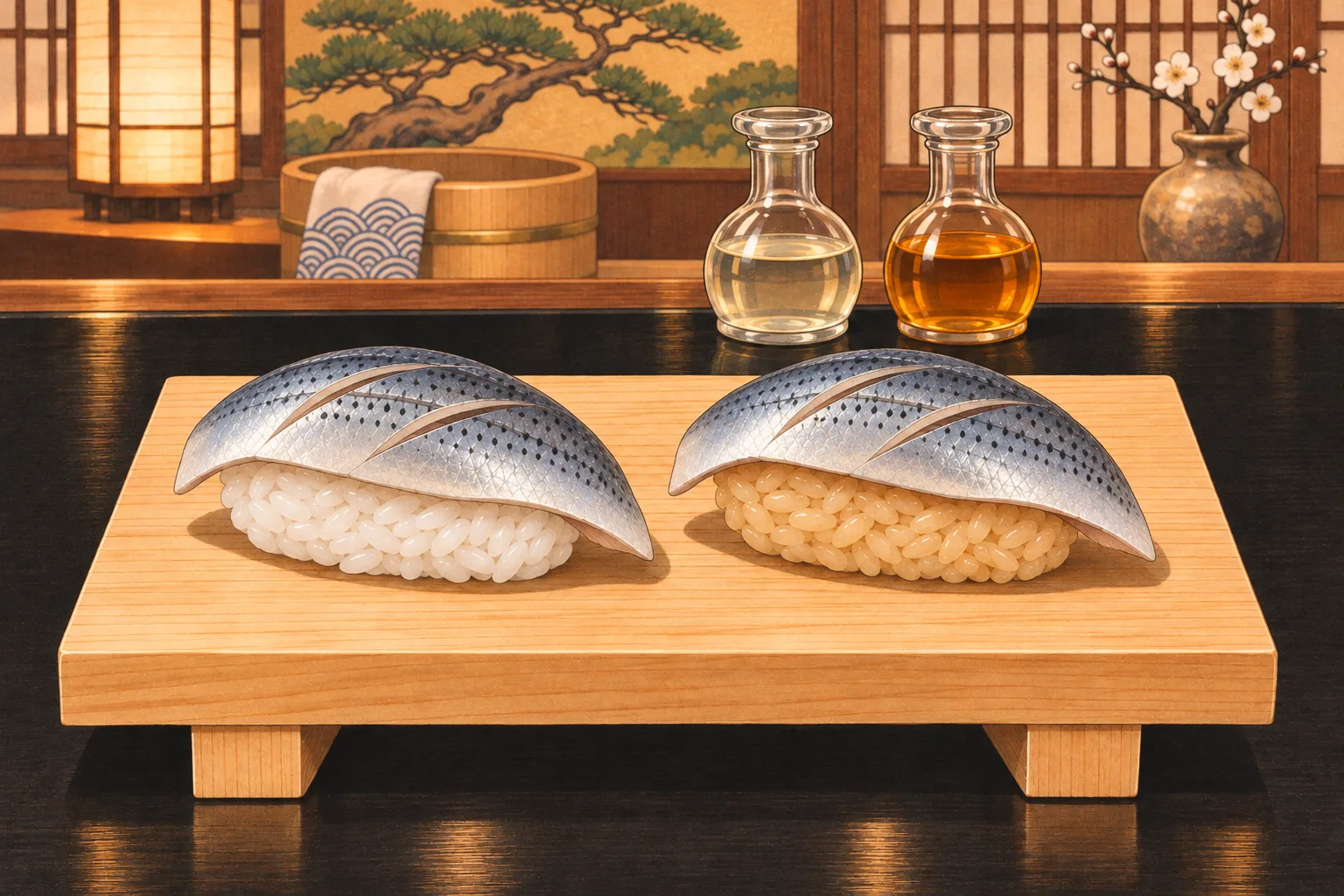
Two pieces of nigiri with the same topping. Left: white shari seasoned with rice vinegar. Right: red shari, light tan from akazu. Behind them, rice vinegar on the left and amber akazu on the right.
Rice vinegar is brewed from rice and koji, first fermented into a kind of sake and then soured by acetic acid bacteria. It is pale and clean-tasting. Akazu starts from something else: sake-kasu, the pressed lees left over from sake brewing. The lees are packed into vats and aged, often for several years, until they turn from white to deep brown with a sweet, malty smell. They are then dissolved in water and fermented into vinegar. The result, also called kasuzu ("lees vinegar"), is amber to reddish-brown, with a rounded acidity and a natural sweetness and savouriness.
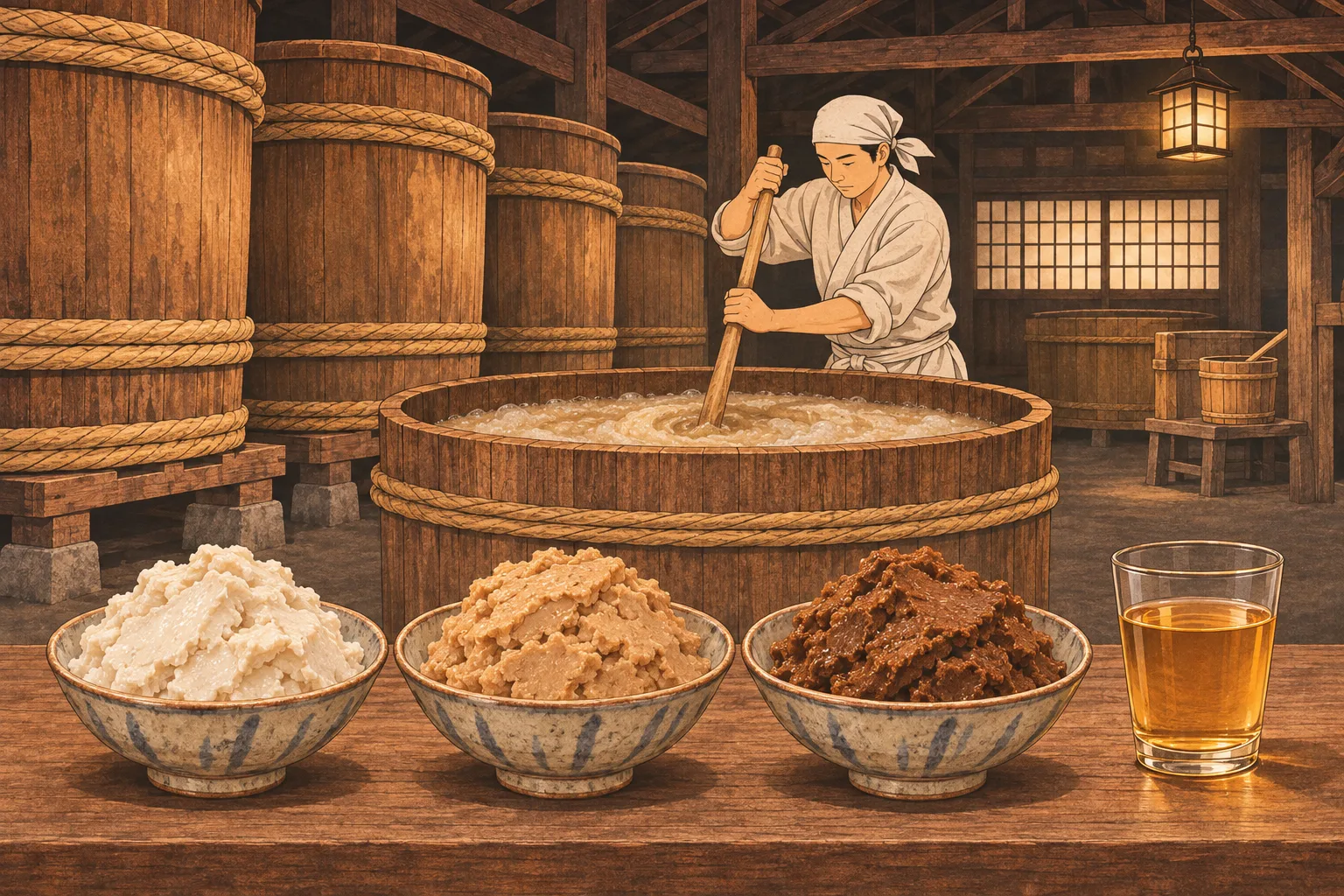
What akazu is made from. Bowls from left: fresh white sake-kasu, lees part-way through ageing, and deep brown lees aged for several years. The glass on the right holds the finished amber vinegar.
Around 1804 Nakano Matazaemon, a sake brewer in Handa near Nagoya, began making lees vinegar and shipping it to Edo for the city’s quick-vinegared sushi, and the rise of hand-pressed nigiri soon afterwards widened his market. Red vinegar suited Edo’s stalls. It was cheaper than rice vinegar, since the lees were a by-product. Its built-in sweetness meant rice could taste good with little or no sugar, at a time when sugar was expensive. And its depth stood up to the cured, simmered and soy-marinated toppings of Edo-style sushi. Edo’s sushi stalls largely used red vinegar and salt, giving a rice that was tan, tart and salty.
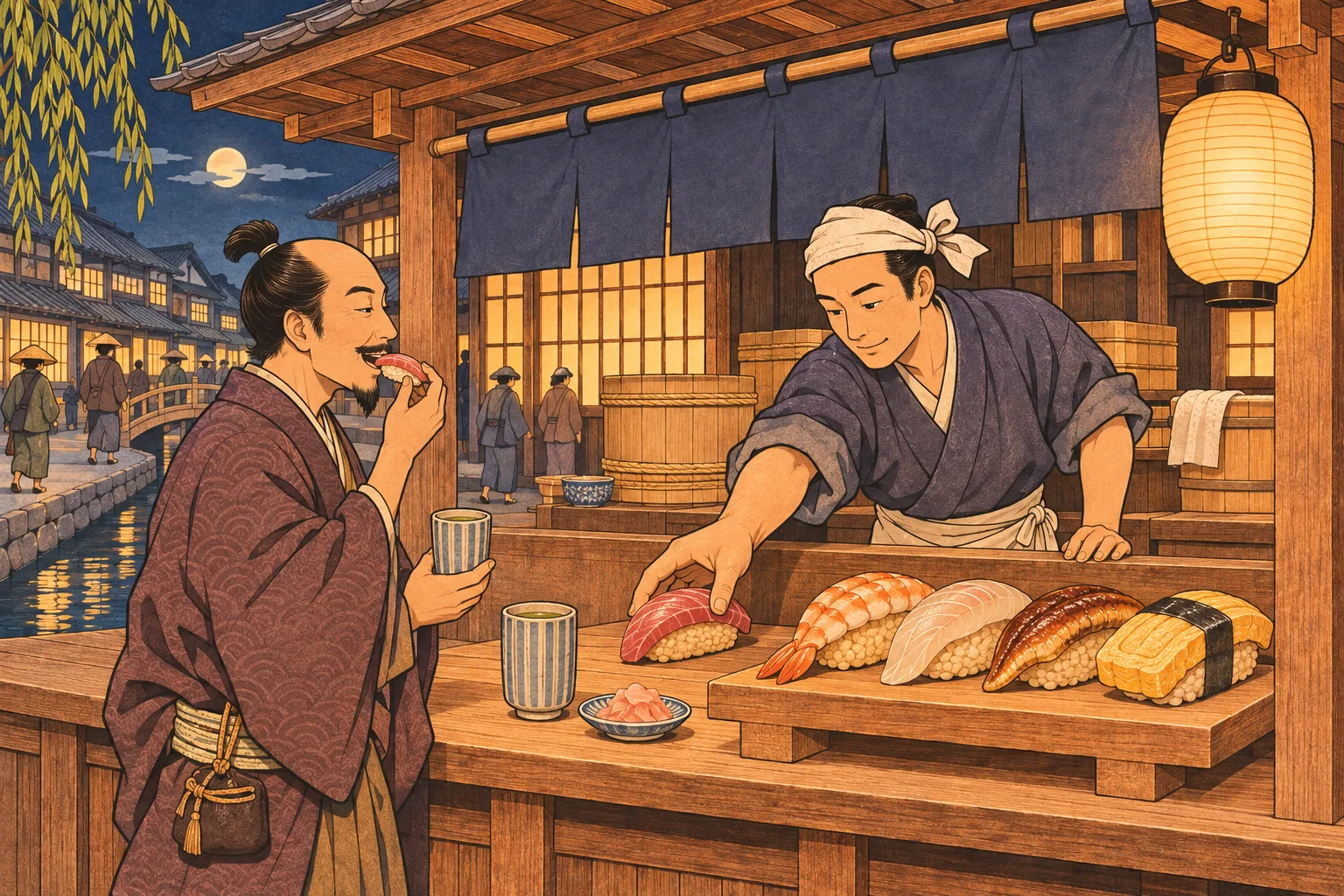
A sushi stall in late Edo at night. The rice under each piece is tan from red vinegar, and a tea cup and a dish of ginger sit on the counter (artist’s impression)
That tradition faded in the mid-twentieth century. During and after the war, it is generally thought, rice and sake were rationed, sake output plunged, and aged lees became scarce. Post-war vinegar production industrialised around clear, consistent, inexpensive rice and grain vinegars. Refrigerated transport also made it easier to serve raw fish, and white rice under fresh, raw toppings looked clean and modern. Some customers came to see brownish rice as stale or dirty, and some worried that coloured vinegar could hide old rice, so shops switched to clear vinegar. Takeaway sushi and, later, conveyor-belt chains needed vast quantities of cheap, standard vinegar. Red vinegar retreated to a few old shops.
From around the late twentieth century, Tokyo chefs who championed Edo-style sushi brought it back, and food writers began treating red shari as a badge of authenticity. A few vinegar makers that had never stopped producing lees vinegar, along with others reviving it, now supply aged red vinegar made specifically for sushi restaurants. Today red shari is common at high-end Tokyo counters, and in recent years even some conveyor-belt chains have offered it. Some shops use only red vinegar; many blend red and white in their own proportions; a few switch between the two in a single meal, pairing red shari with tuna and silver-skinned fish and white shari with delicate white fish and shellfish. Others remain loyal to white shari for its clarity.
Salt and sugar complete the seasoning, and the balance is among a shop’s most closely guarded secrets. Post-war sushi as a whole is generally thought to be sweeter than its pre-war ancestor. Some chefs use only red vinegar and salt, with no sugar at all; some blend two or three vinegars; some adjust by season, a little sharper in summer. Regulars often notice when a shop changes its vinegar, and changing it can take months of trials.
03Wasabi: From Mountain Streams to Sharkskin
True wasabi is a perennial plant of the cabbage family, native to Japan, that grows along cold mountain streams. What you eat is the rhizome, a stubby underground stem perhaps the length of a hand and the thickness of a thumb. It is dull green and covered in ring-like bumps, the scars left as each leaf falls away, with a crown of long-stalked, heart-shaped leaves on top. Inside it is a pale, fresh green. To distinguish it from imitations, Japanese call it hon-wasabi, "real wasabi".
The prized way to grow it is sawa-wasabi, "stream wasabi". Spring water is channelled into terraced beds of gravel where it flows constantly around the roots at a steady, cool temperature. Plants take a year and a half or more to mature, and a flood or a hot summer can wipe out a bed. The reward is a thick rhizome with heat followed by sweetness and a green, fresh aroma. Hatake-wasabi, "field wasabi", is grown in shady soil without running water. Its rhizomes are smaller and coarser, and it is mostly harvested for leaves and stems that go into pickles and processed products.
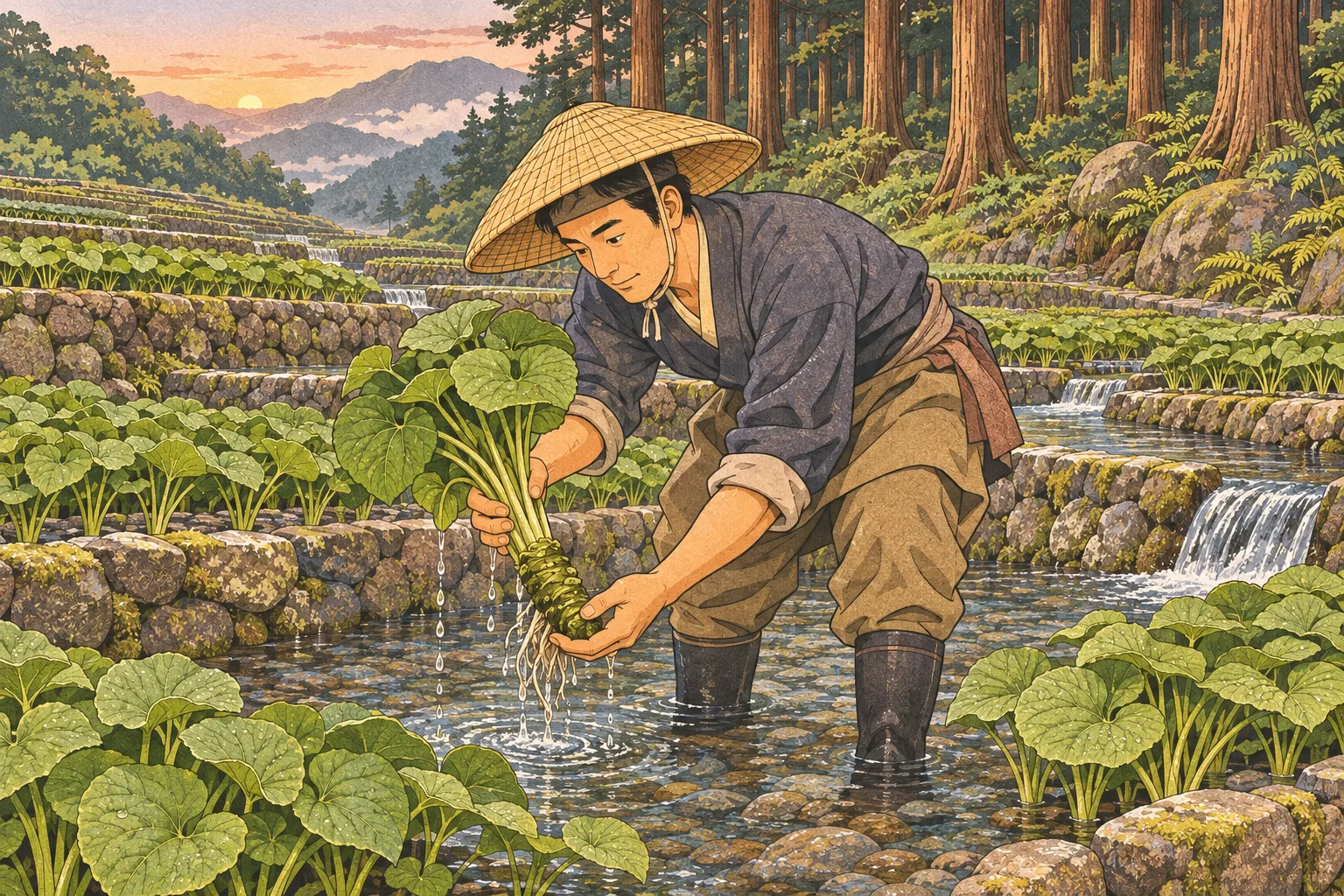
A sawa-wasabi bed: stone-walled terraces of gravel with spring water running through them. The plant being lifted shows heart-shaped leaves above a stubby, dull green rhizome.
Shizuoka and Nagano are the main producers. Utogi, in the mountains above Shizuoka city, is traditionally said to be where wasabi cultivation began in the early Edo period. A popular story holds that villagers presented it to Tokugawa Ieyasu in retirement at nearby Sunpu, that he loved it, and that because its leaves resembled the hollyhock in the Tokugawa crest, its cultivation was restricted; these are later tales rather than documented fact. The Izu Peninsula around Mount Amagi remains a major stream-wasabi area, and Shizuoka’s traditional wasabi cultivation was designated a Globally Important Agricultural Heritage System in 2018. In Azumino, in Nagano, snowmelt from the Northern Alps wells up on flat land, and growers dig long parallel trenches planted with wasabi under black shade cloth.
Behind the counter, chefs grate wasabi on a samegawa oroshi, a small wooden paddle covered with greyish fish skin as fine as sandpaper. The Japanese word for "sharkskin" has long covered both shark and ray skins with this hard, granular surface. The chef trims the bumpy surface, then grates from the leaf end in small, gentle circles. The fine teeth crush the cells completely, producing a moist, smooth, pale green paste that holds together. A metal grater gives a coarser, wetter, harsher result.
Wasabi’s heat is not sitting in the root waiting. The cells hold an odourless compound and, separately, an enzyme; grating brings them together and creates a volatile, sinus-clearing compound. It peaks shortly after grating and is commonly said to fade noticeably within about a quarter of an hour. That is why good shops grate small amounts as needed. If you see a chef rubbing a green stub on a paddle and catch a fresh, grassy scent, you are getting the real thing.
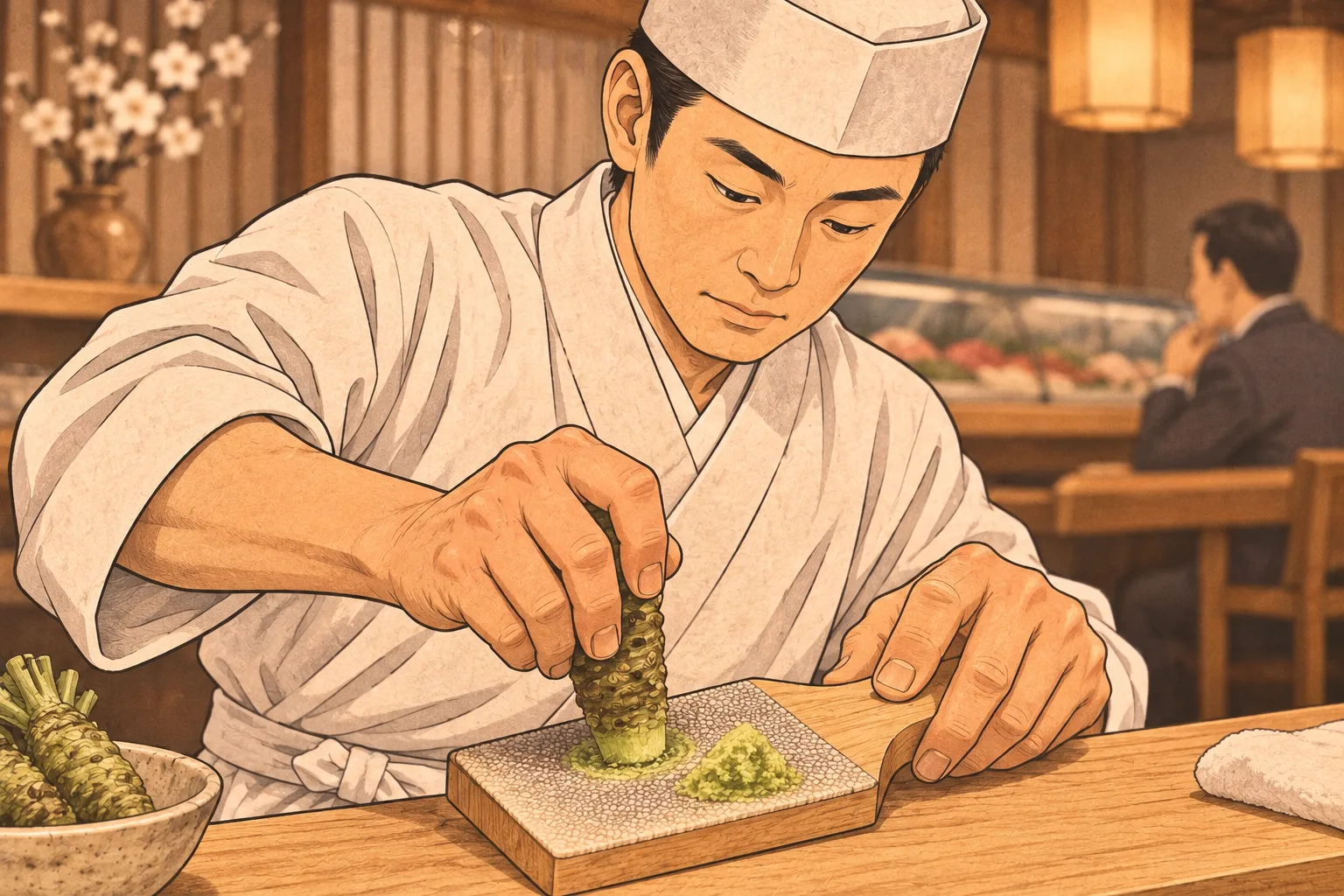
A chef grates a wasabi rhizome in small circles on a samegawa oroshi. The pale green paste gathers on the board.
Most "wasabi" outside top restaurants is horseradish, called seiyō wasabi ("Western wasabi") in Japan. Horseradish is a large, white root whose heat comes from similar compounds but is sharper and lacks wasabi’s sweetness. Tubes and powders are mostly horseradish coloured green, sometimes with a little real wasabi added for aroma. Under common industry labelling practice, products use different wording depending on whether real wasabi makes up at least half of the wasabi content.
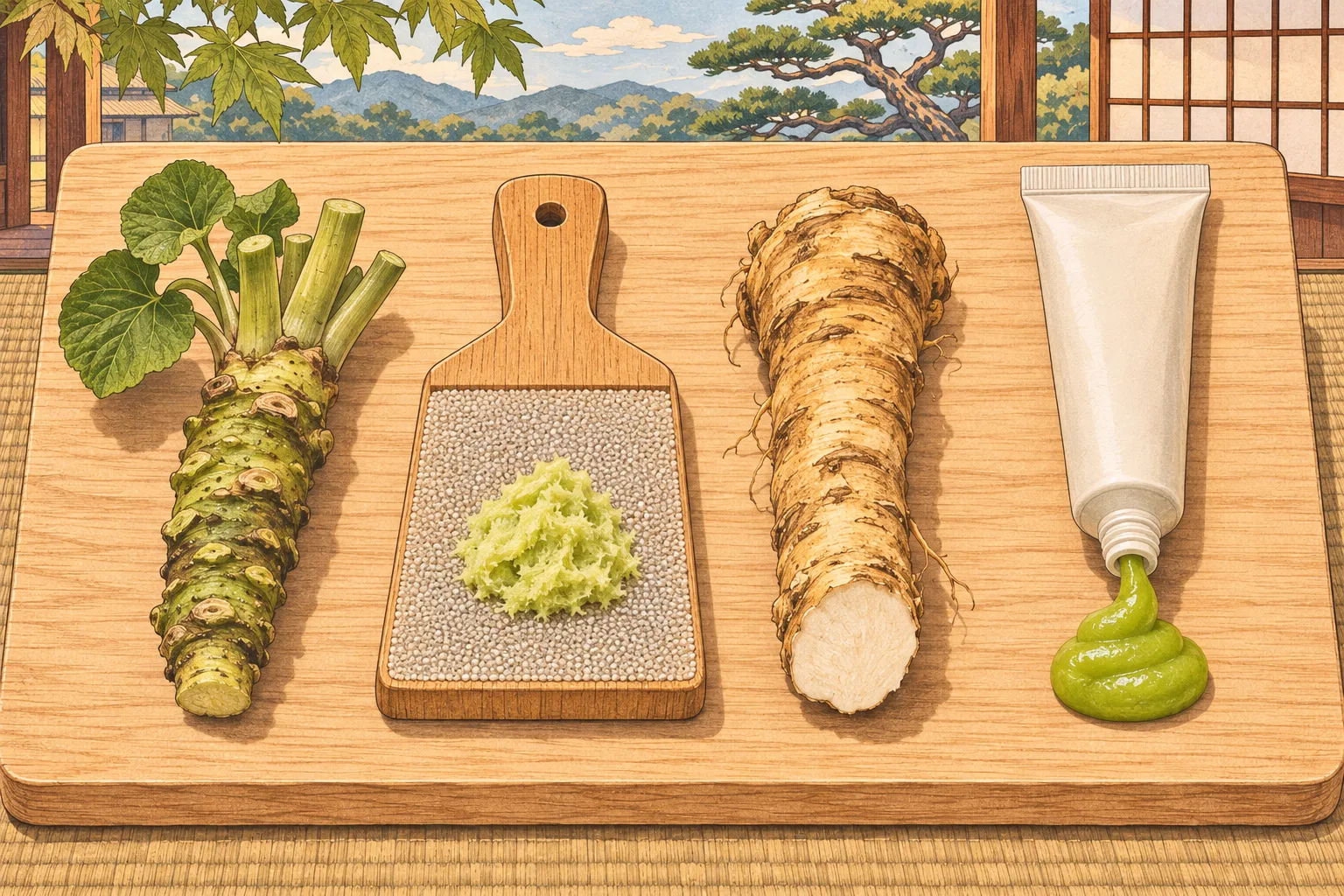
From left: a hon-wasabi rhizome with its leaf stalks and ring-like scars; freshly grated pale green paste on a samegawa oroshi; a horseradish root, white inside; and smooth, uniform green paste squeezed from a tube.
Why is wasabi hidden between rice and fish? One reason given is practical: the thin layer helps the fish cling to the rice. Another is about flavour: tucked inside, the wasabi releases its aroma as you chew, rising through the back of the nose and mingling with the fish’s fat and the vinegar, gentler than licking it directly. It is also said to mask fishiness, and older generations credited it with preserving the fish. Chefs adjust the amount to each topping, using more for fatty tuna and less or none for sweet shrimp, sea urchin, or toppings brushed with sweet sauce. Because the chef has already measured it, stirring extra wasabi into your soy sauce is frowned upon at serious counters.
If you do not want wasabi, ask for sabi-nuki, "without wasabi". Families with children order it all the time. Many conveyor-belt chains now leave wasabi off by default and put sachets or small jars at each seat, and at a traditional counter it is perfectly polite to mention it when you sit down.
04Nori: From Asakusa Paper to Ariake Nets
The dark sheet around a sushi roll is nori, dried laver, a red alga that grows on rocks and posts in the intertidal zone during winter. Japanese have gathered wild laver since ancient times, but for centuries it was dried in clumps rather than pressed into sheets.
The square sheet is an Edo invention. In the mid-Edo period, around the Kyōhō era (1716–1736), fishermen in the shallows of Edo Bay at Ōmori and Shinagawa pushed bundles of bamboo and branches, called hibi, into the mud. Laver spores settled on them and could be harvested in winter. This is generally regarded as the start of nori cultivation in Japan. The harvested laver was chopped, mixed with water and poured onto bamboo screens like paper pulp, then dried in the sun. The product became known as Asakusa nori. Several explanations exist for the name: laver once grew near Asakusa; the method borrowed from Asakusa’s makers of recycled paper; or Asakusa was where it was traded and sold. By the later Edo period Asakusa nori was a famous Edo product, and it made the rolled sushi, and much later the hand roll, possible.
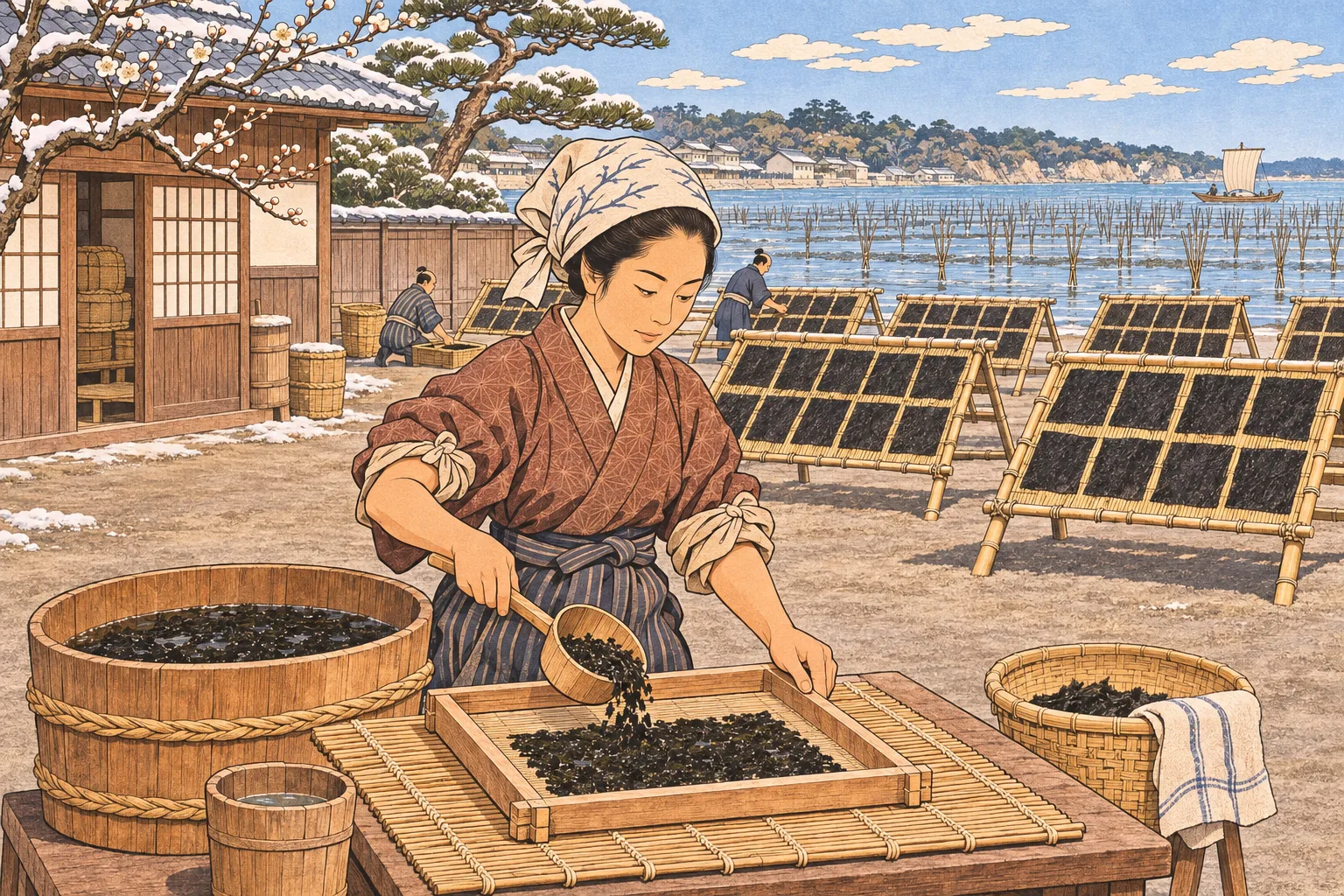
Edo-period nori making on the shore of Edo Bay: chopped laver is ladled into a square frame on a bamboo screen, like paper pulp, then dried on racks in the sun. The hibi stand in rows in the shallows behind (artist’s impression)
"Asakusa nori" is also the name of a species, Pyropia tenera, prized for softness and aroma. It is fragile and low-yielding, and in the wild it is now listed as critically endangered or endangered (Category I) by Japan’s Environment Ministry. Reportedly 95 per cent or more of nori farmed today is a hardier, more productive species, susabi-nori.
Modern nori farming owes a great deal to a British scientist. For centuries no one knew where laver went in summer, so harvests depended on spores arriving by chance. In 1949 the phycologist Kathleen Drew-Baker showed that laver spends the summer as tiny filaments burrowed into shells. Japanese researchers used her discovery to seed nets artificially from cultures grown on oyster shells, and nori became a plannable industry. In Uto, in Kumamoto Prefecture, a monument honours her as the "Mother of the Sea", and local growers hold a ceremony for her every 14 April. The Ariake Sea in Kyushu, bordered by Saga, Fukuoka and Kumamoto, is now the leading producing area, its winter surface striped with rows of nets and poles. The Seto Inland Sea, Chiba and Miyagi are also major sources. Tokyo Bay’s own nori beds disappeared with land reclamation: Ōmori’s fishermen gave up their fishing rights in 1962, and the last harvest came the following spring; a small museum in Ōmori preserves the boats and tools.
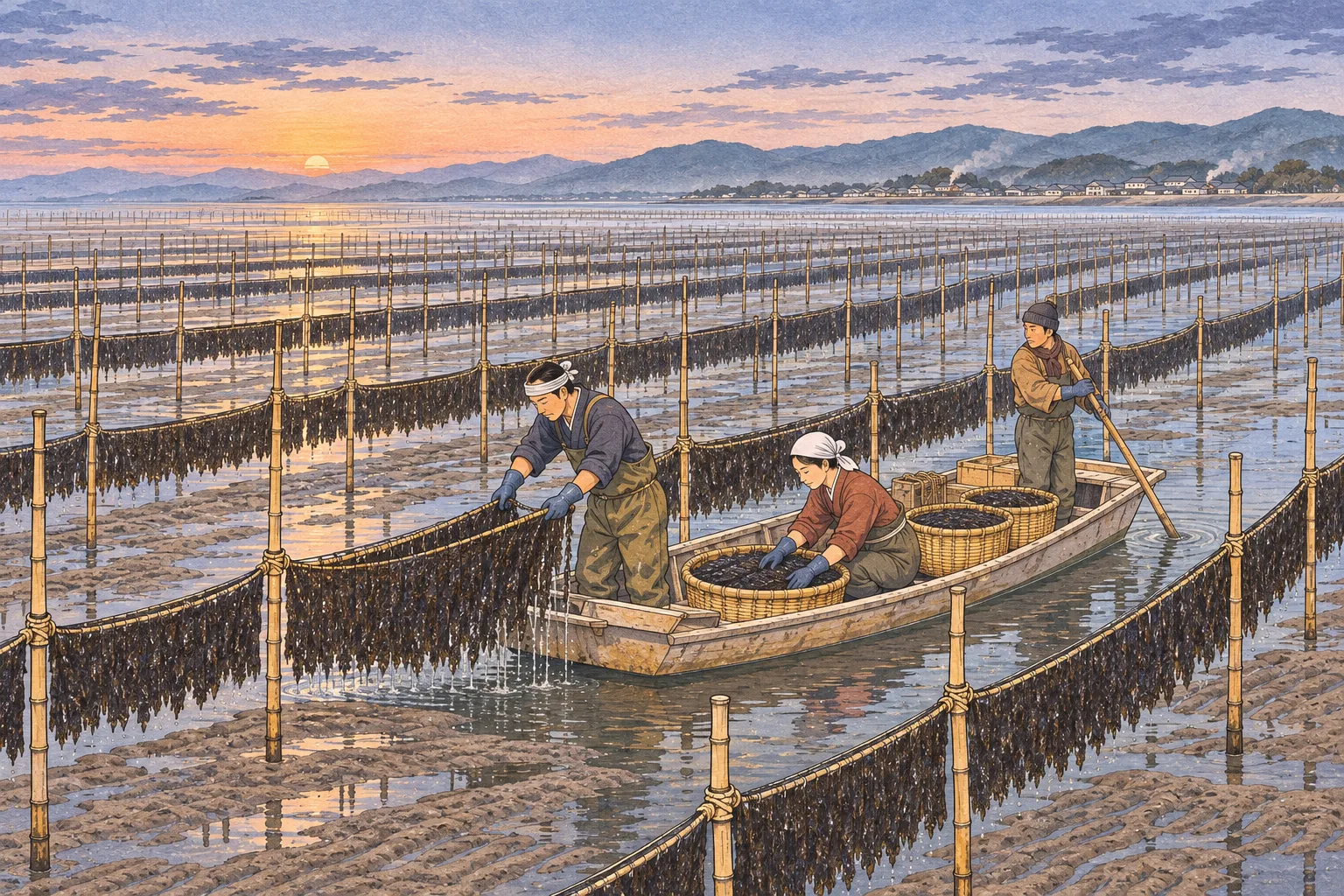
The Ariake Sea in winter, striped with rows of poles and nets. Dark nori hangs from the nets, and growers harvest it from a small boat.
Quality is judged first by colour and sheen. Top nori is black with a green or deep purple cast and a satin gloss; held to the light it is even, thin and free of holes, and it melts on the tongue. The first harvest of early winter is the most tender. Lower grades are reddish, brownish or yellow-green, dull and tough. Nori is inspected and graded at the producing areas, and sushi shops generally buy from specialist nori wholesalers.
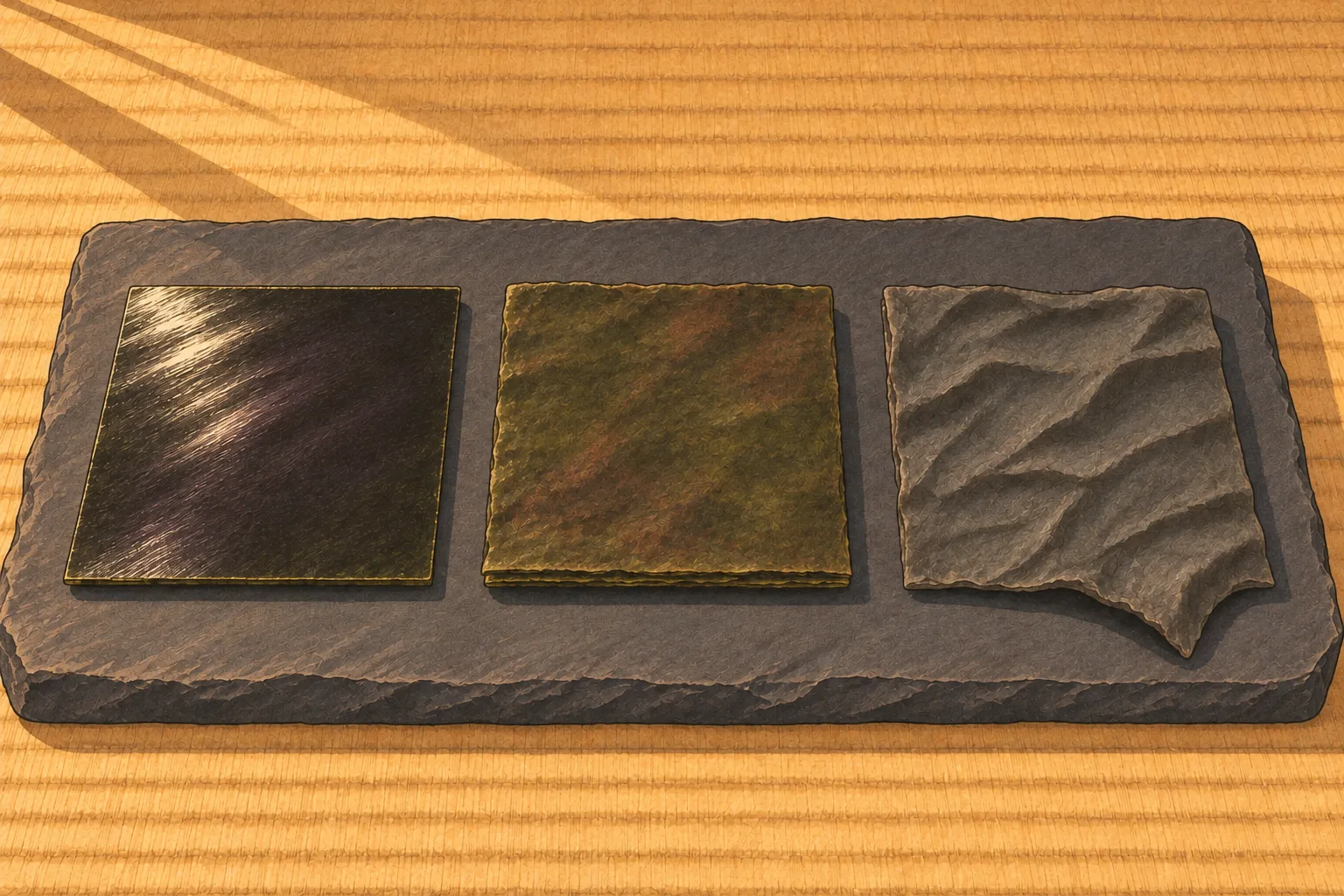
From left: top-grade nori, purple-black with a satin gloss, thin and flat; ordinary nori, greenish-brown to reddish, dull and thicker; damp nori, greyish and matte, wrinkled, with one corner drooping.
Untoasted nori is purplish-black. Pass it over a flame and part of its pigment breaks down, turning it deep green, crisp and fragrant; this is yaki-nori, toasted nori. Careful shops re-toast sheets briefly over charcoal or a burner before use, two sheets back to back, waved quickly over the heat. Nori’s enemy is humidity. Moisture makes it limp, leathery and dull, and kills its aroma. Shops keep it in tins with desiccant. That is why a hand roll should be eaten the moment it is handed over: within a minute or two, steam from the rice softens the nori. Rolled sushi works the other way: some chefs deliberately let a cut roll rest for a moment so that nori and rice settle into one another. And when you buy nori as a souvenir, look for the same things a chef does, a deep, even colour and a gloss you can see when you tilt the packet, and keep it sealed and dry once opened; a sheet that has gone limp can be revived for a few seconds over a gas flame.
05Ginger: Young Roots and a Hint of Pink
The small pile of thin slices at the edge of your plate is ginger pickled in sweet vinegar. Good shops use shin-shōga, young ginger harvested in early summer. Its skin is thin enough to leave on, its flesh is creamy white and tender, and its heat is mild. Many shops pickle a year’s supply during the season: the ginger is sliced paper-thin along the grain, blanched to tame its bite, salted, drained and steeped in vinegar with sugar.
Ginger has a long history in Japan, though not always as food. A third-century Chinese chronicle describing the islands notes that ginger grew there but that people did not use it for flavouring. By the Edo period it was everywhere, and by the late Edo period leaf ginger from Yanaka, on the edge of Edo, was famous: sold in bunches with its long stems, dipped in miso and eaten raw, and reportedly given as a summer gift. How early pickled ginger became a fixture beside nigiri is poorly documented, but by the late Edo and Meiji periods it seems to have been standard at sushi stalls. Sugar was expensive in Edo, so early sushi ginger was probably sharper and less sweet than today’s; one view holds that it grew sweeter as sugar became cheap. Today Kōchi Prefecture on Shikoku grows more ginger than anywhere else in Japan, and by late summer its fields are a sea of tall, narrow, bamboo-like leaves.
How the ginger is cut matters too. Sliced along the grain it stays crisp and snaps audibly; sliced across, it turns soft. Good slices are thin enough to see light through, because a thick slice carries enough heat to drown the next piece of fish. Some regulars claim they can read a shop from its ginger: sweet ginger tends to go with sweeter rice, sharp ginger with rice that has little sugar.
Where the young stems meet the root there is a band of natural pink. That colour comes from anthocyanins, which turn pinker in acid. Slices that include that part blush faintly in the pickling liquid, usually unevenly and only at the edges. Commercial pickled ginger ranges from pale yellow to a uniform, vivid pink, and that bright, even colour usually comes from added colouring. Pale slices with pink edges are a good sign the shop makes its own.
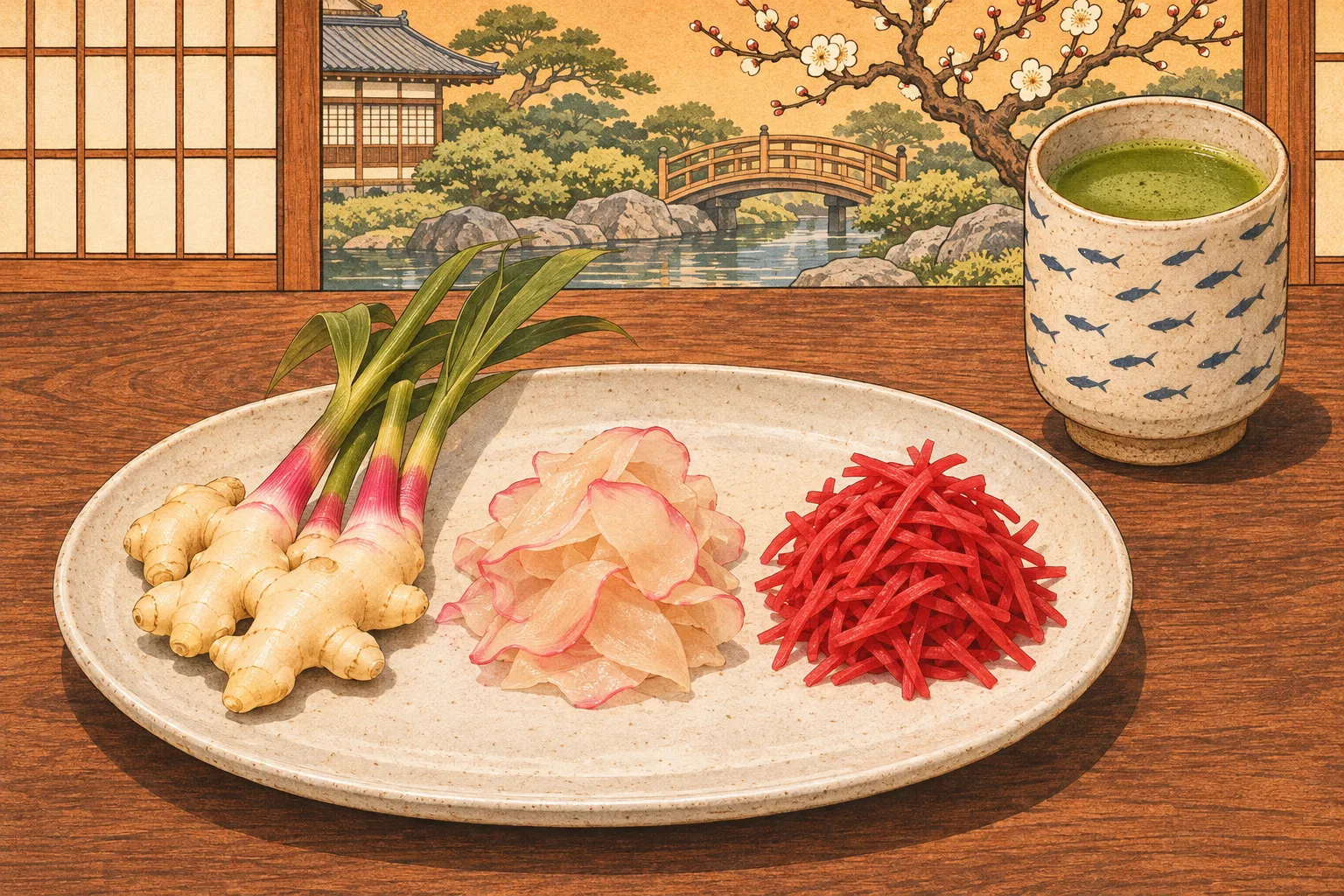
On the plate, from left: shin-shōga with its stems, naturally pink where stem meets root; thin slices of sushi ginger, pink only at the edges; and deep red shredded beni-shōga. Top right, a thick sushi-shop cup of cloudy konacha.
Ginger cleans the palate. A slice after fatty tuna clears the richness so you can taste the next piece of white fish. It is also traditionally credited with countering fishiness and bacteria. It is meant to be taken a slice or two between pieces, not eaten by the mouthful. Do not confuse it with beni-shōga, the deep red shredded ginger pickled in plum vinegar, which is salty, not sweet, and belongs on beef bowls and fried noodles.
06Tea: Powdered Tea in an Oversized Cup
Tea at a sushi shop comes in a tall, thick cup, often covered with kanji that share the "fish" radical, the characters for tuna, sea bream, bonito, mackerel and eel. The tea is cloudy green with fine particles at the bottom and is scalding hot. It is almost always konacha, "powder tea".
Konacha is not matcha. Matcha is shade-grown leaf, steamed, dried and stone-ground into a fine powder, and it is expensive. Konacha is the broken bits and dust sifted out when processing ordinary green tea, a cheap by-product. Pour boiling water over it and it gives strong colour and flavour in seconds, and it does not suffer from steeping too long.
Green tea of this kind is a relatively recent everyday drink. In 1738, by tradition, a tea grower in Ujitawara near Kyoto, Nagatani Sōen, is credited with refining the method of steaming young leaves and rolling them dry over a heated tray, producing the bright green, fresh-smelling sencha that later caught on in Edo. After the Meiji Restoration, large new plantations on the Makinohara plateau and elsewhere made Shizuoka the country’s biggest tea region, a position it held until Kagoshima overtook it in 2024, and the more sencha Japan produced, the more broken leaf and dust it sifted out. That cheap by-product, much of it from Shizuoka and Kagoshima, is what tea merchants sell to restaurants as konacha. When sushi shops adopted it as their standard tea is not clearly recorded, but it is usually linked to the mass production of sencha in the modern era.
Water temperature is part of the logic. Japanese tea lovers let water cool well below boiling before brewing good sencha, to draw out sweetness and savouriness and hold back bitterness. The hotter the water, the more of the astringent compounds come out. A sushi shop does the opposite on purpose, pouring boiling water over powder tea to get maximum astringency.
That suits a sushi shop perfectly. Strong, astringent tea brewed very hot cuts through fish oils and refreshes the mouth, much like the ginger. It warms a palate chilled by cold fish and rice. It is cheap and fast, so shops can refill freely. The oversized cup is often explained as a relic of Edo street stalls, where a single cook had no time for constant refills, or as a way to keep tea hot at an open-air stand; the story is widely told and hard to verify, but the big fish-character cup is now a sushi-shop emblem and a popular souvenir.
At conveyor-belt restaurants, each seat has a hot-water tap and a canister of tea powder. This is usually finely milled green tea that dissolves without straining, not true konacha, though it does the same job. You spoon a little into your cup and press the cup against the tap’s button. The water is very hot, and plenty of first-time visitors discover this the hard way.
07Side by Side: Telling Them Apart
Put two identical pieces of fish side by side, one on white shari and one on red. The white rice is bright and glossy; the red is beige to light tan, depending on how much red vinegar is used. The white smells of clean vinegar; the red carries a mellow, aged note and tastes rounder and slightly sweet. Tan rice is not stale rice.
Real wasabi is a knobbly green rhizome grated into a pale, slightly uneven, faintly fibrous paste whose heat arrives fast, turns sweet, and fades. Tube wasabi is a smooth, uniform, often brighter green paste with a sharp, lingering burn and a bitter finish. Horseradish in its natural state is a fat white root.
Nori can be lined up in three sheets. Top grade is glossy black with a green or purple cast, thin and even. Ordinary nori is duller, thicker, greener-brown or reddish, sometimes blotchy. Damp nori looks greyish and matte, wrinkles, droops when lifted and chews like leather.
Sushi ginger is pale yellow or faintly pink, sliced thin and sweet-sour; beni-shōga is red, shredded and salty. In the cup, konacha is cloudy yellow-green with sediment, matcha is opaque, frothy jade, and ordinary sencha is clear pale green.
More deep dives on this topic
 TunaOrder an omakase in Tokyo and the tuna usually arrives in a sequence: a slice of deep red lean meat, then something pinker and softer, then a pale, marbled piece that seems to…
 HikarimonoSit at a sushi counter in Japan and, somewhere in the middle of the meal, the chef will set down a piece that looks different from the rest.
 Beyond TunaMost first-time visitors walk into a sushi bar thinking about tuna.
 Edomae ShigotoMost visitors arrive at a Tokyo sushi counter expecting raw fish on rice.
 Shari and Its Supporting CastAt a sushi counter your eyes follow the fish.
 Regional Sushi Beyond TokyoMost visitors meet sushi at a counter: a chef shapes rice in one hand, lays a slice of fish on top and sets it down in front of you, to be eaten within seconds.
 KaitenzushiSit down at a kaitenzushi (conveyor-belt sushi) counter anywhere in Japan and the basic deal is the same.
 Fish MarketsThe piece of sea bream a sushi chef slides across the counter at lunchtime has usually changed hands four or five times since it left the water.
 Words at the Sushi CounterSit at a sushi counter in Japan and the language around you shifts.
 The Sushi ChefFrom a counter seat, a sushi chef looks like a pair of hands and very little else.
- Back to the main article: Sushi →