
Sit down at a kaitenzushi (conveyor-belt sushi) counter anywhere in Japan and the basic deal is the same. A slow belt carries small plates past your seat; you lift off whatever looks good, stack the empties, and pay by the plate. The idea came from a standing sushi bar in suburban Ōsaka in 1958, and its inventor, the bar’s owner, was trying to solve a staffing problem, not a culinary one. Since then almost everything riding the belt has changed. Hand-pressed rice gave way to rice shaped by machines. Tuna and silver-skinned fish were joined by torched salmon, hamburger steak and sweet corn in mayonnaise. And the endlessly circling plates are increasingly being replaced by touchscreens and express rails that fire your order straight to your seat. Follow the belt and you can see how sushi went from a craft eaten on special occasions to the most ordinary meal out in Japan.
01A Crowded Counter in Fuse
The headline story is well known: in April 1958 Shiraishi Yoshiaki opened the first Genroku Sushi, then called Mawaru Genroku Sushi, near Kintetsu Fuse Station in what is now Higashiōsaka, reportedly after watching bottles move along a conveyor at Asahi’s Suita brewery. The interesting part is the problem he was trying to solve and the engineering that solved it.
Shiraishi was born in Ehime Prefecture in 1913, moved to Ōsaka in 1947 and opened an eatery in what was then the city of Fuse, later turning it into a small tachigui (stand-up) sushi bar. Stand-up sushi was a cheap, high-volume business. His shop undercut its rivals and was popular enough to choke on its own success. There were only so many hands behind the counter. The chefs could not press sushi fast enough for the crowd, staff could not carry plates fast enough, and wages kept rising.
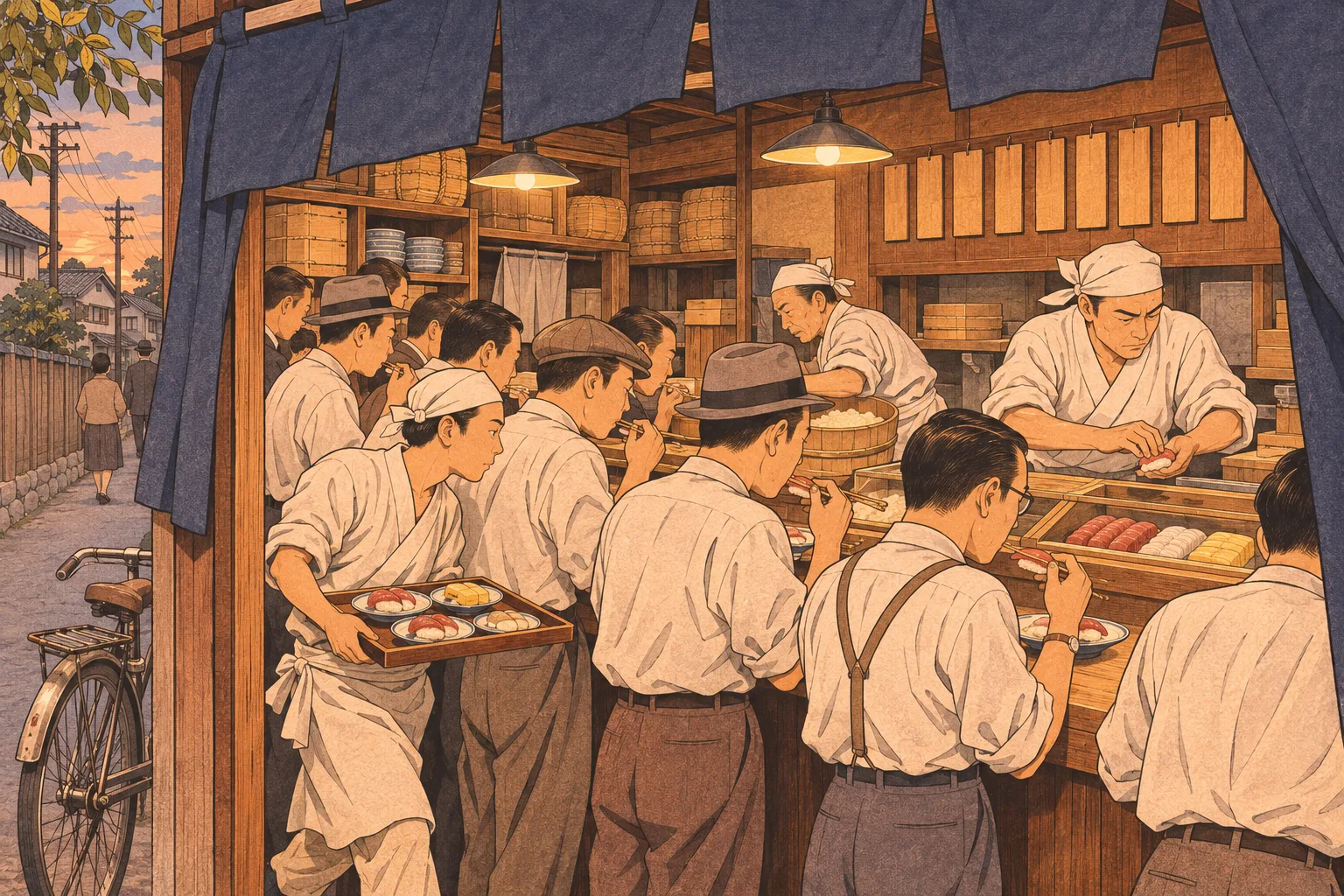
A tachigui sushi bar in Fuse in the 1950s: customers stand packed along a short counter and the staff cannot keep up (artist’s impression)
The brewery visit, as the story is usually told, gave him the picture of food that delivers itself, around 1948. Turning that picture into a working counter took close to a decade of trial and error; the prototype was finished in 1957. Factory conveyors run in straight lines. A sushi counter has to loop, and the plates have to round the corners without sliding off or jamming.
The answer was a chain of small crescent-shaped plates. Instead of one continuous rubber belt, the surface is built from many curved segments that overlap and pivot against each other; the early ones were nicknamed uroko (scales) or mikazuki (crescent moons). On the straights they sit nested together; on a bend they fan out like a folding fan, so the whole surface can turn smoothly while staying flat. Look closely at almost any kaitenzushi belt today and you can still see those arcs of overlapping segments spreading apart at each corner. In 2021 the Japan Society of Mechanical Engineers listed Genroku’s surviving early segments, together with a 1985 conveyor still running in a Genroku branch in Sakai, as Mechanical Engineering Heritage.
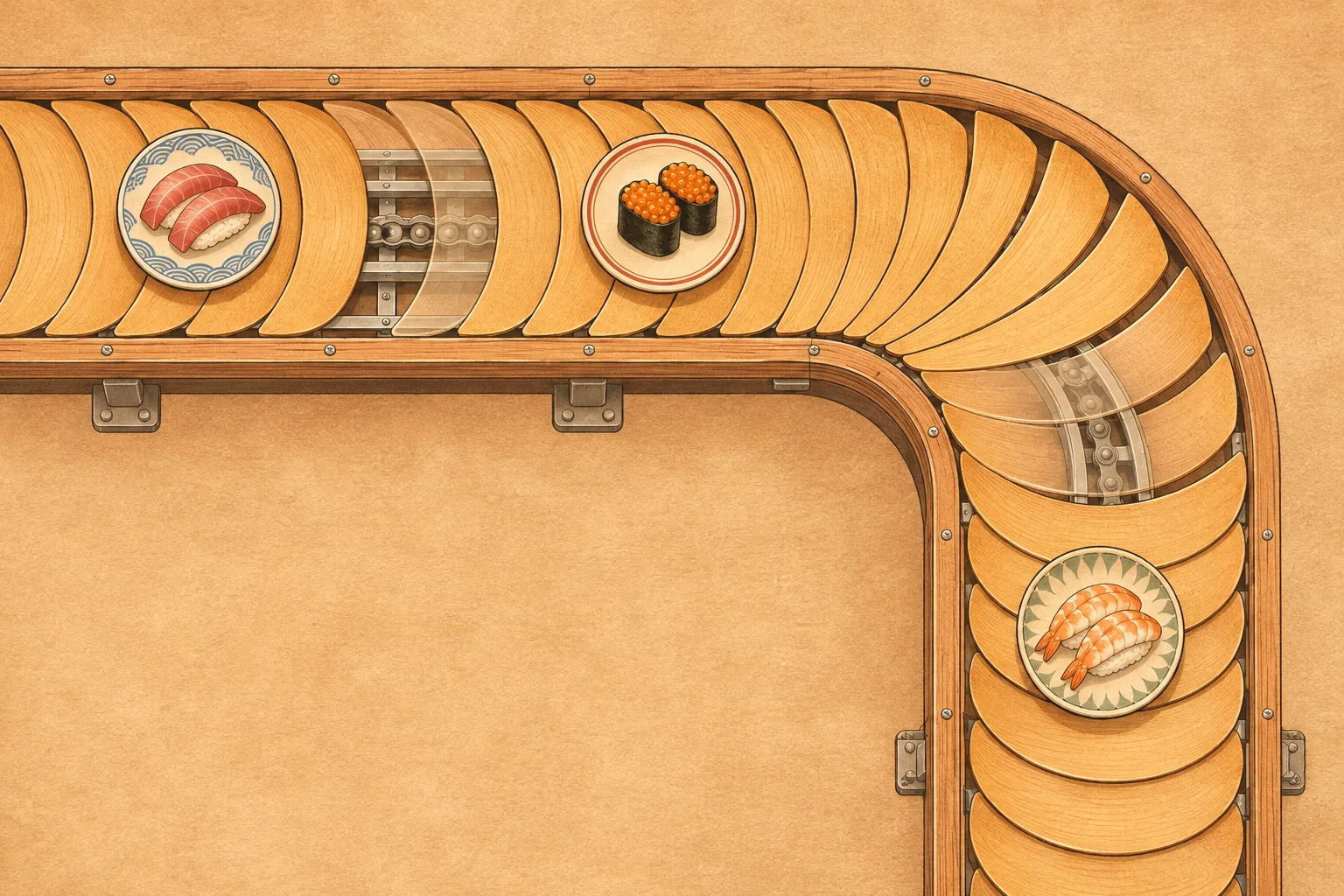
The belt seen from above: crescent-shaped segments sit nested on the straight and fan out on the bend. Two patches are drawn see-through to show the chain underneath
Shiraishi called his prototype a "conveyor rotating dining table" and secured a registered right to the device in 1962; some accounts call it a patent, others a utility model. While that protection lasted, anyone who wanted to run a conveyor sushi bar needed his permission, and many early shops were Genroku franchises. At its peak the chain had about 250 outlets. Its second shop opened on Dōtonbori, in Ōsaka’s Minami district, as early as 1960.
The 1970 Ōsaka World Expo was the turning point. At the fair Genroku ran an outlet near the monorail’s west station, where staff worked from early morning until after midnight, and visitors from every corner of Japan saw sushi circling a counter for the first time and took the idea home. Over the following decade shops spread across the country, and when Shiraishi’s right expired in 1978, equipment makers were free to sell belts to anyone. Several machinery firms in Ishikawa Prefecture, on the Sea of Japan coast, came to build most of the nation’s sushi conveyors; Ishino Seisakusho of Kanazawa began making them in 1974. Genroku is also said to have been the first to fit counters with automatic tea dispensers, and Newsweek later named Shiraishi among the 100 Japanese most respected by the world. The big chains that dominate today took off from the late 1970s: Kura Sushi opened its first shop in Sakai, south of Ōsaka, in 1977; Kappa Sushi opened its first shop in Nagano in 1979; Sushiro started in Ōsaka in 1984; and Hama Sushi, part of a large restaurant group, arrived in 2002. They put big shops beside suburban highways with parking lots and family booths, and grew on bulk buying and uniform pricing. After the bubble economy burst in the early 1990s and people became more careful about eating out, cheap pay-by-the-plate sushi entered its fastest growth and, by most accounts, overtook the traditional neighborhood sushi shop as the place most Japanese go for sushi. The word kaitenzushi entered the Kōjien dictionary in 1991, and in 1997 Genroku, which had held a trademark on "kaiten", opened its use to the rest of the industry.
Genroku still trades in Ōsaka, and a stone monument outside its main shop beside Fuse Station marks the spot as the birthplace of conveyor-belt sushi.
02The Belt: Direction, Speed and Shape
The first thing you might notice is which way the plates move. Most belts in Japan run clockwise, so from your seat the plates arrive from the right and leave to the left. The usual explanation is handedness: a right-handed diner holds chopsticks in the right hand and reaches with the left, which is free to pick up a plate as it passes. Another version links it to most people being right-eye dominant. One account from the trade says Genroku chose clockwise so customers could keep their chopsticks in the right hand. Neither explanation is settled, and counter-clockwise shops exist.
Speed matters too. Too fast and people cannot read the plates or grab them safely; too slow and the rice dries out while customers wait. Shops vary, but all set the belt slow enough to look, hesitate and still reach in time. Watch for a minute and it feels almost absurdly slow.
The shape follows the floor plan. The classic layout is an oval island: the kitchen sits in the middle, chefs stand inside the oval, and the belt runs around them with customers on stools facing in. Japanese call each loop a shima, an island. A chef presses a piece and turns to place it on the belt; if you want something that isn’t passing, you call across to him. Small shops near stations and in shopping arcades still look like this, with perhaps twenty seats.
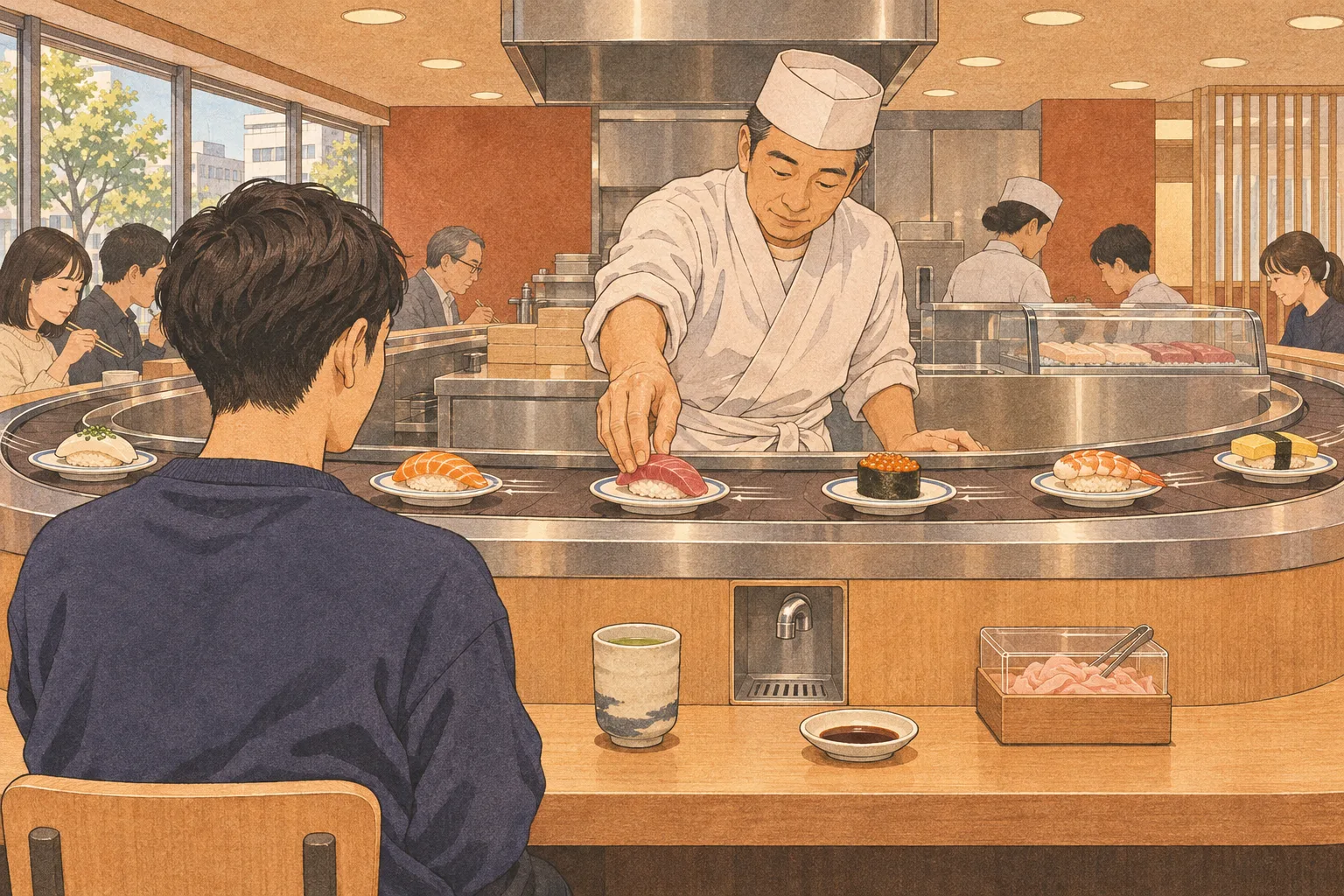
An oval island counter: plates arrive from the right as the chef sets a fresh piece on the belt. Tea cup, hot-water tap and ginger box are within reach
From the 1980s, big roadside restaurants with parking lots arrived, aimed at families who wanted booths for four or five. The belt was stretched into a U, or a comb of several loops, running out of a kitchen hidden behind a wall, down one side of a row of booths and back again. Here you never see a chef, only plates emerging from a hatch in the wall, making their circuit and disappearing again.
A rarer variant is mizu kaiten, where sushi floats past on little wooden boats in a channel of running water. It survives in a few shops as a novelty.
The counter itself is designed for self-service. There is usually a fixed ledge beside the belt for your tea cup, soy-sauce dish and stack of empties. Beneath it, a hot-water tap lets you make your own green tea from powdered green tea kept in a tub at your seat. Pickled ginger sits in a lidded box for you to help yourself. Pouring tea, serving ginger and carrying plates, all once jobs for staff, are handed to the diner.
03Plates: Colors, Chips, Domes and Slots
The plate is the unit of account. In early shops plates came in several colors or patterns, each matching a price tier on a chart on the wall, and staff added up your bill by sorting your stack by color. Every shop had its own scheme, which made the wall chart a fixture of such places. From the 1990s many large chains switched to a single uniform price, which made counting even simpler.
Plates are usually resin: light, hard to break, and able to survive commercial dishwashers. They have a raised foot ring that makes them easy to stack and steady on the belt. A gold or lacquer-patterned plate usually marks the top tier.
From the late 1990s some chains began giving plates machine-readable markings. Kura Sushi built a time-limit system using QR codes in 1997; in the 2000s Sushiro adopted electronic IC tags embedded in the base of each plate, read by sensors along the track on every pass. After a set time or distance the system judges the sushi past its best and removes the plate to be thrown away; Sushiro’s limit was reported as about 350 meters. Its tags replaced an earlier attempt to recognize plates by camera, which misread too many; divider plates carry the name of the topping, and every plate behind a divider is counted as that item. The same data shows which items are snapped up and which circle unloved, so preparation can be adjusted. To the diner, nothing looks different.
What diners did notice was the lid. Kura Sushi began covering its plates with a clear dome, called Sendo-kun ("Mr. Freshness"), to keep off dust and droplets, and had it in every branch by 2011. Diners flip the dome open as they take the plate. Similar covers, round or boxy, are now common, and a busy shop is full of the click of plastic lids opening.
Kura also put a narrow slot at every table, part of a water-channel return and plate-counting system introduced in 1996. Empty plates go in upright and a channel of water carries them back to the kitchen. Every few plates, a screen above the table plays a short animation and a lottery game; win, and a small capsule toy drops out of a dispenser. The game arrived at the end of 2000 and quickly gave children a reason to beg for that particular chain. It also solved a practical problem: plates no longer pile up, and the bill is calculated from what went down the slot.
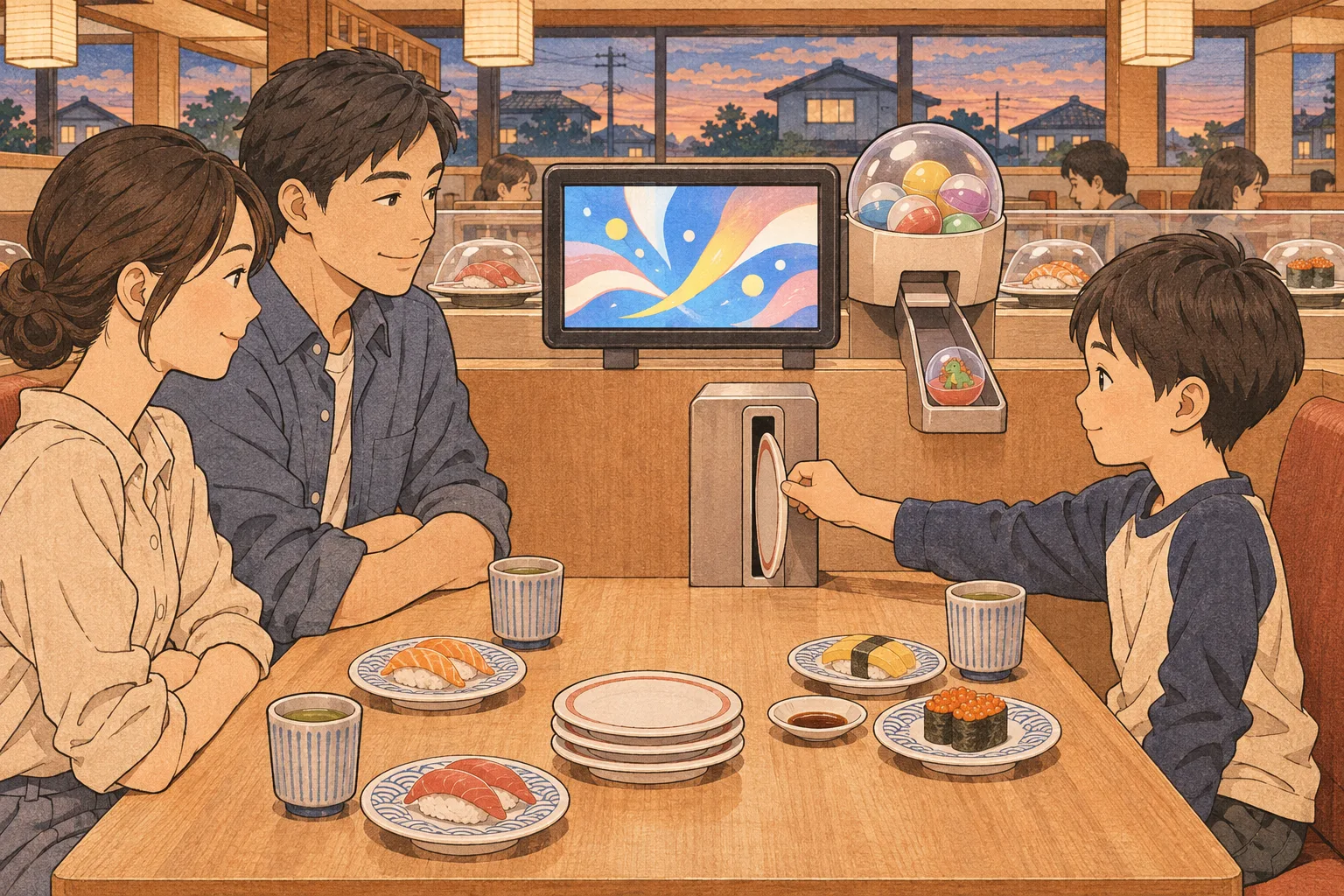
A booth at a roadside chain: a boy feeds an empty plate upright into the table slot, the screen above plays its animation, and a capsule toy rolls out of the dispenser beside it
In early 2023, videos of customers licking shared soy-sauce bottles and cups and smearing saliva on sushi on the belt spread on social media and caused a public outcry. Chains responded by adding or upgrading cameras; Kura’s uses image recognition to flag plates whose domes are opened and then returned to the belt. Some shops put up screens between seats, and some stopped pre-made sushi from circulating at all.
04From Shouting to Express Rails
Even with a belt, the old way of ordering never disappeared. At an island counter you simply call out to the chef and he hands it over or sets it on the belt in front of you. Regulars at such places barely glance at the belt.
Once kitchens moved behind walls, shouting stopped working. Some shops tried intercom phones or paper order slips. From the 2000s, touchscreens spread to the tables, showing a photo of every item; Kura introduced them in 2002. Ordered dishes came round on the main belt on a special marked plate or stand.
Then came the express lane: one or more straight, fast rails running from the kitchen to each row of seats, often stacked above or beside the original loop. Your order rides out on a tray or a little cart, stops in front of you, and goes back to the kitchen once emptied. Some shops shape the carts like shinkansen bullet trains, which children love. Kura introduced such express lanes in 2009. The Genki Sushi group opened a test shop with straight rails and no loop in 2012 and has since converted most of its branches, some with three levels of rail serving different rows at once.
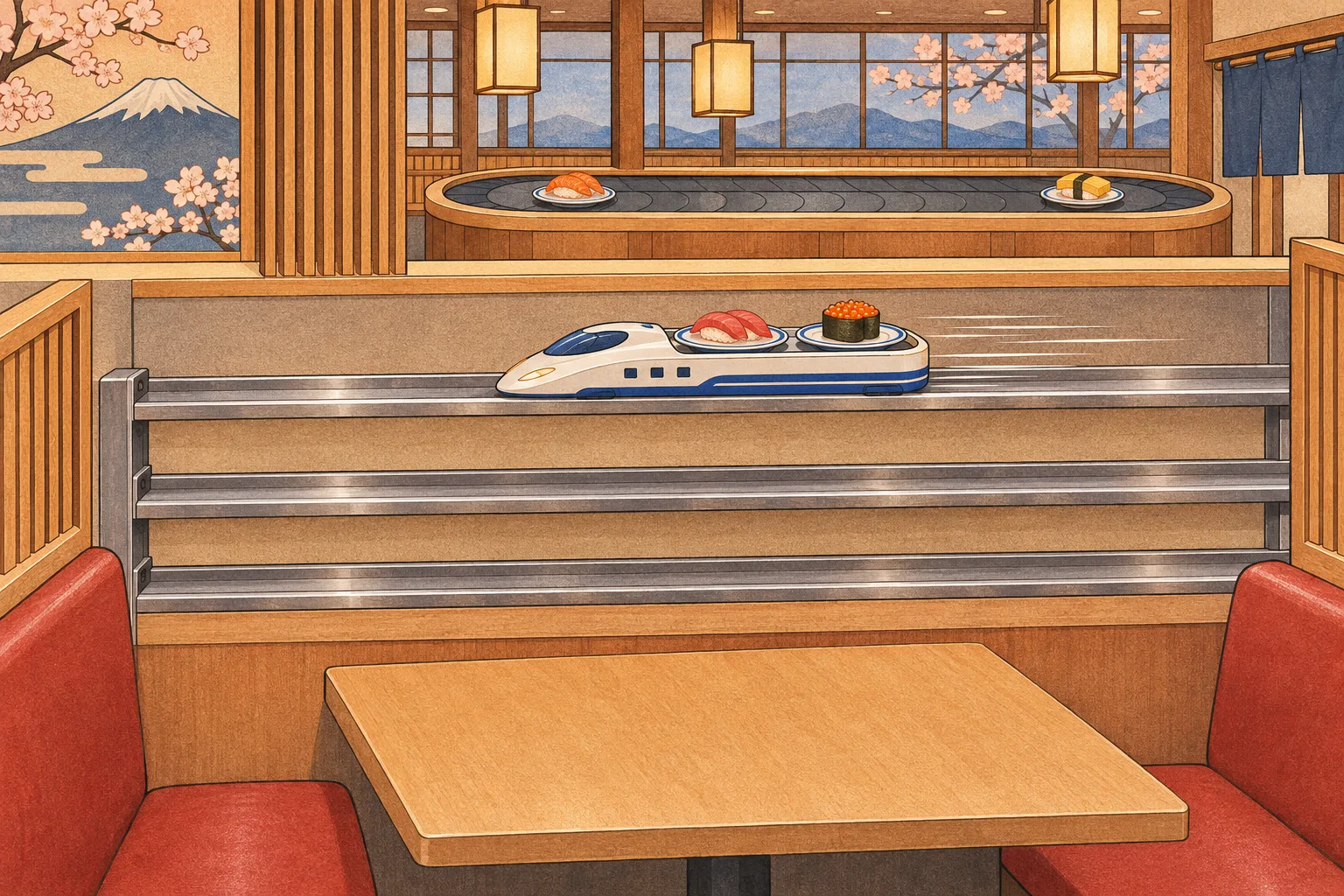
Three levels of express rail: a cart shaped like a shinkansen pulls up with an order, while the loop in the background is almost empty
The result is that belts carry less and less. When diners know a fresh plate will arrive on demand, they are less tempted by one that has done a few laps; restaurants found that much of what circulated was eventually thrown away, and that cooking to order wasted less. Many shops now run the loop with only samples, a few rolls and desserts, or leave it still. Some new branches have no loop at all, only straight rails, a format jokingly called "non-rotating conveyor sushi". The 2023 pranks pushed this further. Long-time fans miss the chance encounters that made the belt fun, and some shops try to keep a little of it by putting daily specials and seasonal items on the loop.
05The Machines You Don’t See
The belt is only half of why conveyor sushi became cheap. The other half is in the kitchen.
The hardest step in nigiri is shaping vinegared rice into pieces of identical size and firmness. A skilled chef can do it all day, but training one takes years. In 1981 a company that had made ice-cream and confectionery machinery brought out a sushi rice robot. Its founder, Suzuki Kisaku, wanted to raise rice consumption at a time when the government was paying farmers to cut back production. The machine works like this: rice goes into a hopper, is measured into portions and pressed gently in two stages into small oval beds, which come out one after another, 1,200 an hour. Its developers studied how chefs shape rice, aiming for pieces that hold together when picked up but loosen in the mouth. Many traditional chefs were dismissive at first, and the machines kept improving. Most chains in Japan now use them. Behind some counters you can see one: a white box with a small spout, rice pieces dropping onto a tray while a worker tops and plates them.
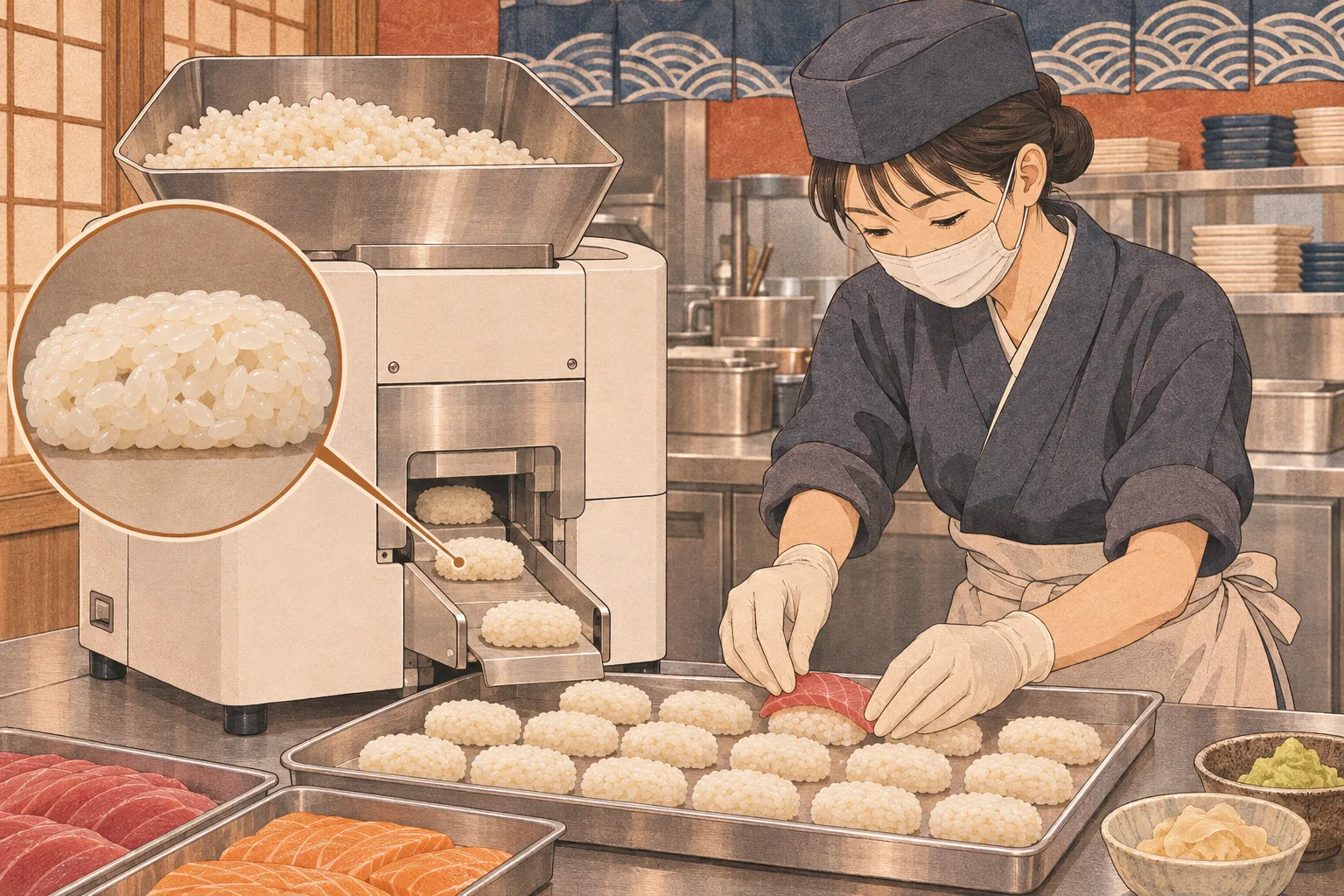
A sushi rice robot: rice goes into the hopper on top and identical pieces come out of the spout one by one for a worker to top with fish. The inset shows one piece enlarged, its grains loosely packed
Rolls have machines too; the same company launched a maki robot in 1984. A maki machine spreads an even layer of rice over a sheet of nori, can flip it for inside-out rolls, rolls the filling tight, and slices the log into equal pieces. Gunkan (battleship rolls) have their own molds that wrap a strip of nori around a rice base, leaving a well on top for roe or salads.
Most fish is not cut in the shop. Big chains run processing centers (Kura opened its first central kitchen in Sakai in 1999) where whole fish are broken down and sliced into uniform pieces, then chilled or frozen and shipped to branches. High-volume items like tuna, salmon, prawn and squid are often cut and frozen near the fishing grounds or the port of import. A chain kitchen barely needs anyone who can handle a sushi knife; part-time students can be trained to plate in a short time.
Critics say this turned sushi into a factory product. The other view is that machines and central kitchens took on the hardest work and made sushi an everyday family meal rather than something for celebrations. Meanwhile high-end counters and regional gourmet shops began advertising "pressed by hand" as a selling point in its own right.
06A Menu Only the Belt Could Invent
Open the menu at a family kaitenzushi chain and much of it would baffle a traditional Edo-style sushi chef. Most of these items appeared from the 1980s onward, as chains tried to win over children, people wary of raw fish, and the young.
The biggest is salmon. Traditional Edo-style sushi had little room for it: wild Japanese salmon can carry parasites and was always salted or cooked. In the 1980s Norway began promoting farmed Atlantic salmon in Japan. Raised in sea pens on feed, it carries little parasite risk, and its orange, fatty, soft flesh suited the conveyor belt perfectly. In a seafood company’s annual survey of conveyor-sushi diners, salmon topped the list of most-eaten items every year from 2012 to 2024, ahead of tuna, and Japan now farms its own, often sold under regional brand names.
Salmon then branched out. The best-loved variation is aburi salmon: a line of mayonnaise piped over the fish and blasted with a blowtorch until it blisters and browns, sometimes finished with green onion or sweet soy. In the same diner survey, torched salmon is the favorite way to eat salmon sushi, chosen by about half of the salmon eaters asked. The technique spread to other fish, and "aburi" became a whole section of the menu.
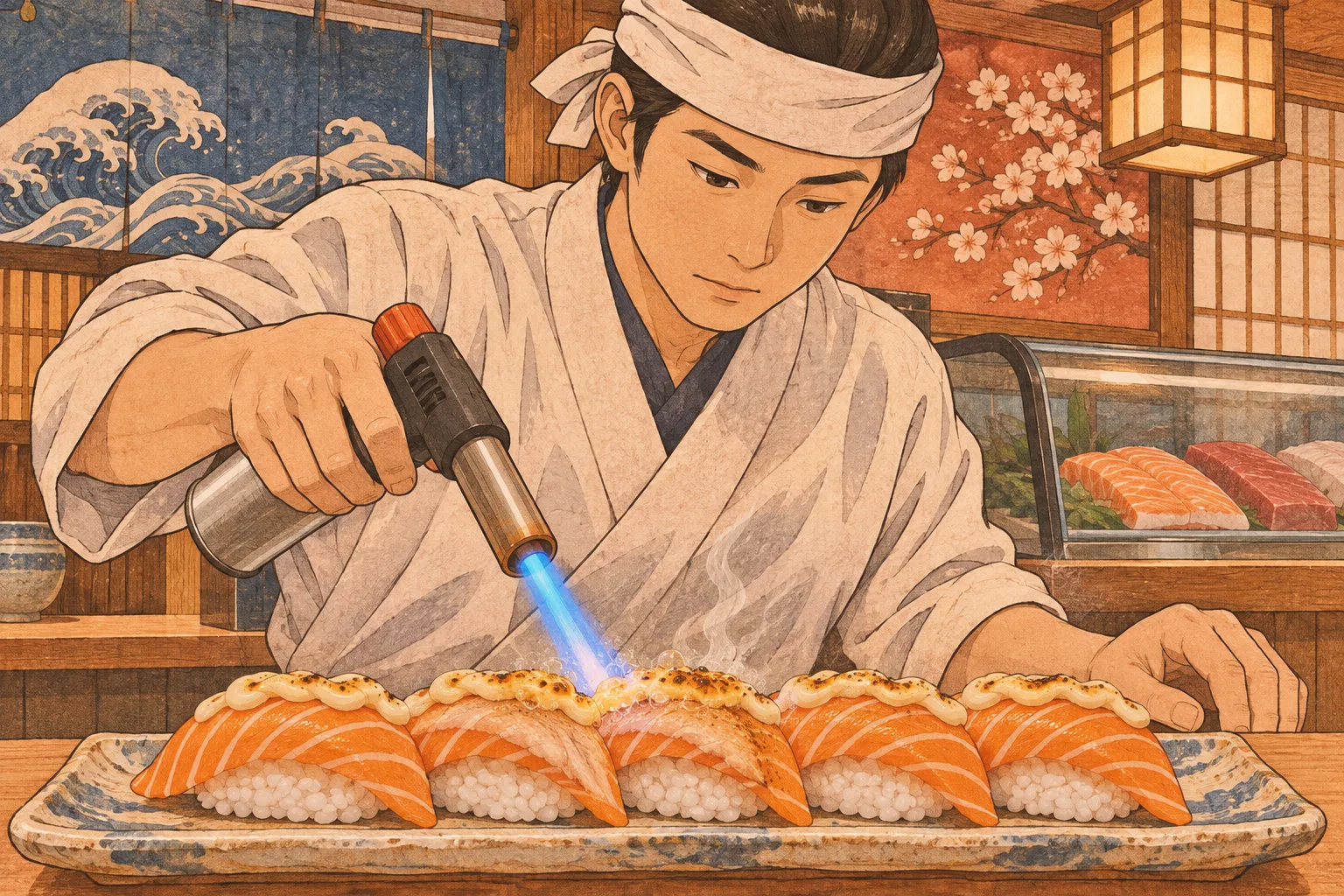
Aburi salmon: a line of mayonnaise piped over each slice, then torched until it blisters and browns
From there it is a short step to sushi with no seafood at all. Hamburger nigiri puts a small grilled patty on rice with a dab of demi-glace. There is roast beef, cured ham, teriyaki chicken, even fried prawn tempura. Corn mayo gunkan, sweet corn bound in mayonnaise piled into a nori ring, is a children’s favorite, alongside tuna-mayo made with canned tuna. The "salad gunkan" is usually shredded crab stick with mayonnaise and cucumber, though the recipe varies from shop to shop. Purists sneer, but these dishes brought a generation of children who would not touch raw fish into sushi restaurants.
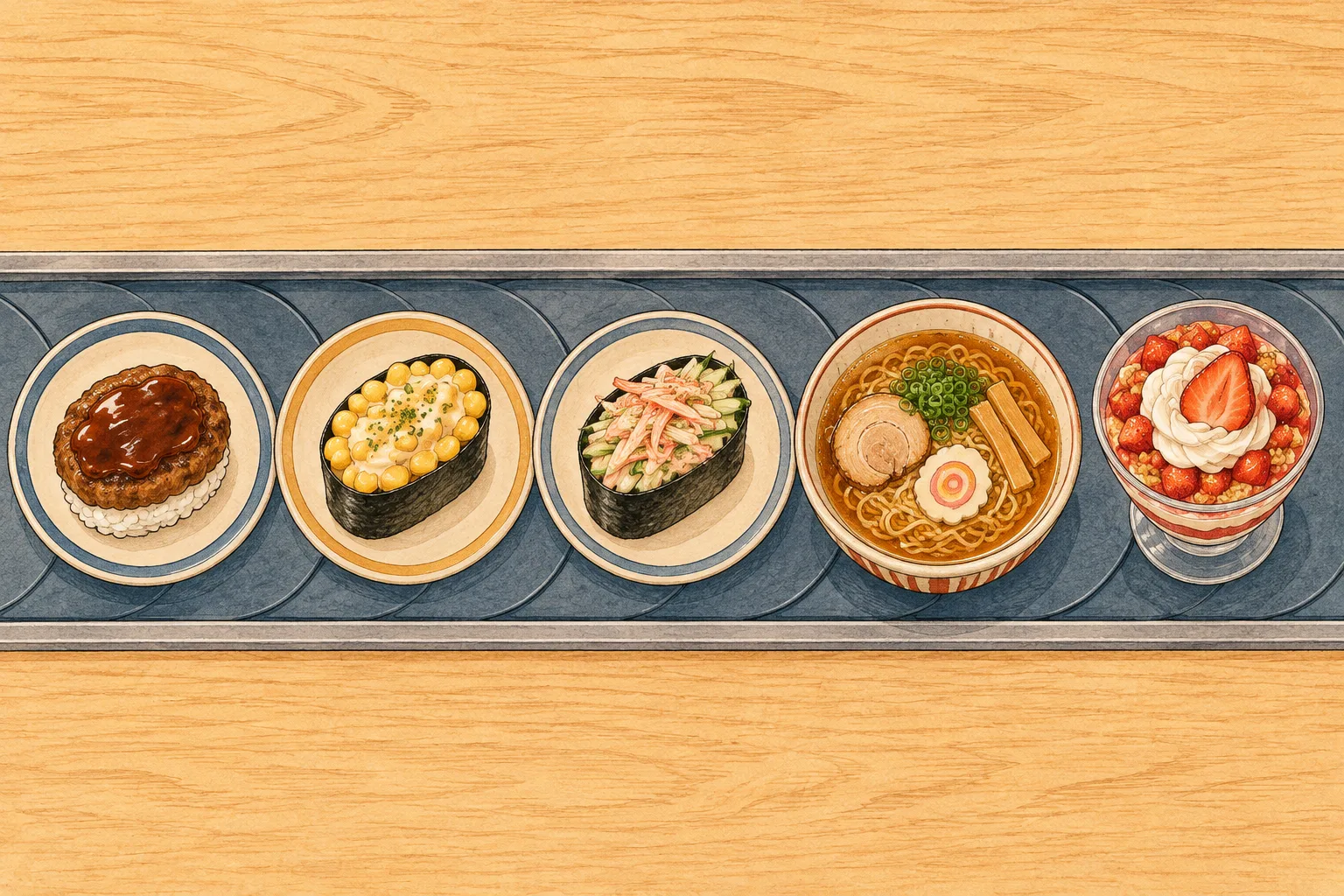
A menu only kaitenzushi offers, from left on the belt: hamburger nigiri, corn mayo gunkan, salad gunkan, a bowl of ramen and a parfait
The edges of the menu keep moving outward. Many chains sell ramen and udon, sometimes with broth made from fish bones, plus fried chicken, fries, chawanmushi (savory egg custard) and miso soup. Desserts are a category of their own: puddings, cakes, ice cream and parfaits, with seasonal tie-ins. A family outing where the parents eat sushi, the children eat corn mayo and fries, and everyone shares dessert is a standard suburban weekend.
07Gourmet Kaitenzushi in the Fishing Regions
Not all conveyor sushi is industrial. In regions with rich catches there is a style called gurume kaitenzushi, gourmet conveyor sushi. These shops borrow the belt and pay-by-plate format but buy fish from local ports and have chefs cut and press it on the spot. They cost more than the family chains but much less than a traditional sushi counter serving similar fish.
Hokkaidō has the highest concentration. Nemuro, Kushiro, Hakodate, Sapporo and Otaru all have well-known shops with several chefs behind the counter and local specialities on the belt: botan shrimp, surf clam, scallop, salmon roe, sea urchin, and fish such as Okhotsk atka mackerel and herring that are rare on Honshū sushi menus. Wooden tags on the wall list the day’s arrivals, sometimes separating the same fish by port or catching method. Here people tend to order directly from the chefs, and the belt works more like a menu you can see.
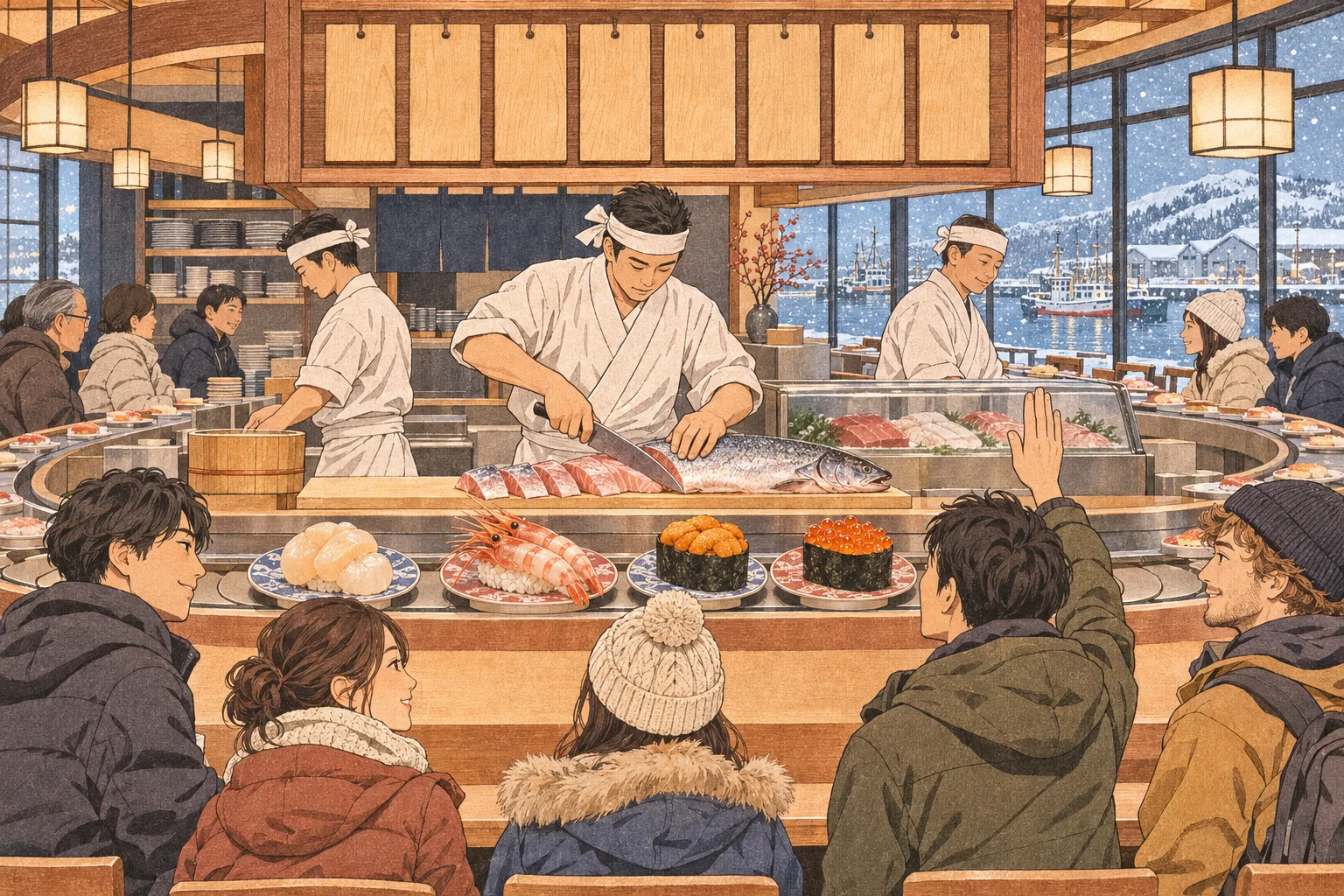
Gourmet kaitenzushi in Hokkaidō: a chef cuts a whole fish behind the counter as a diner raises a hand to order. On the belt, from left: scallop, botan shrimp, sea urchin and salmon roe
Hokuriku, around Kanazawa and Toyama, is the other center. Winter brings snow crab, sweet shrimp and kanburi (winter yellowtail); summer brings rock oysters and Toyama Bay’s tiny white shrimp. Several Kanazawa chains are well known among visitors, and fishing towns such as Himi have their own kaitenzushi shops. Since the same region also builds many of Japan’s sushi conveyors, it has a particular claim on the format.
You can tell a gourmet kaitenzushi shop at a glance: chefs in white with headbands cutting whole fish behind the counter, slices that are thick and irregular rather than machine-uniform, and a menu naming local fish and the ports they came from.
08Side by Side: Layouts and Plates
Conveyor-sushi shops can look so different that it helps to compare the main types directly.
The oval island has one loop around a central kitchen. Customers sit on stools facing inward, looking at the chefs across the belt. There are around twenty seats and few or no booths, and ordering is done by speaking to the chef. This is the layout of small station-front shops and most gourmet kaitenzushi. You know you’re in one when you can see the chefs’ faces and hear them answer orders.
The U-shaped or comb layout runs the belt out from a hidden kitchen and along rows of booths. Every table has a touchscreen, and often a plate slot and game screen. This is the standard roadside chain. You know you’re in one when plates appear from a hatch and vanish back into the wall.
The straight express rail runs beside or above the loop, or replaces it entirely. Nothing arrives unless you order it, and when it comes it comes fast, on a tray or toy train that returns on its own.
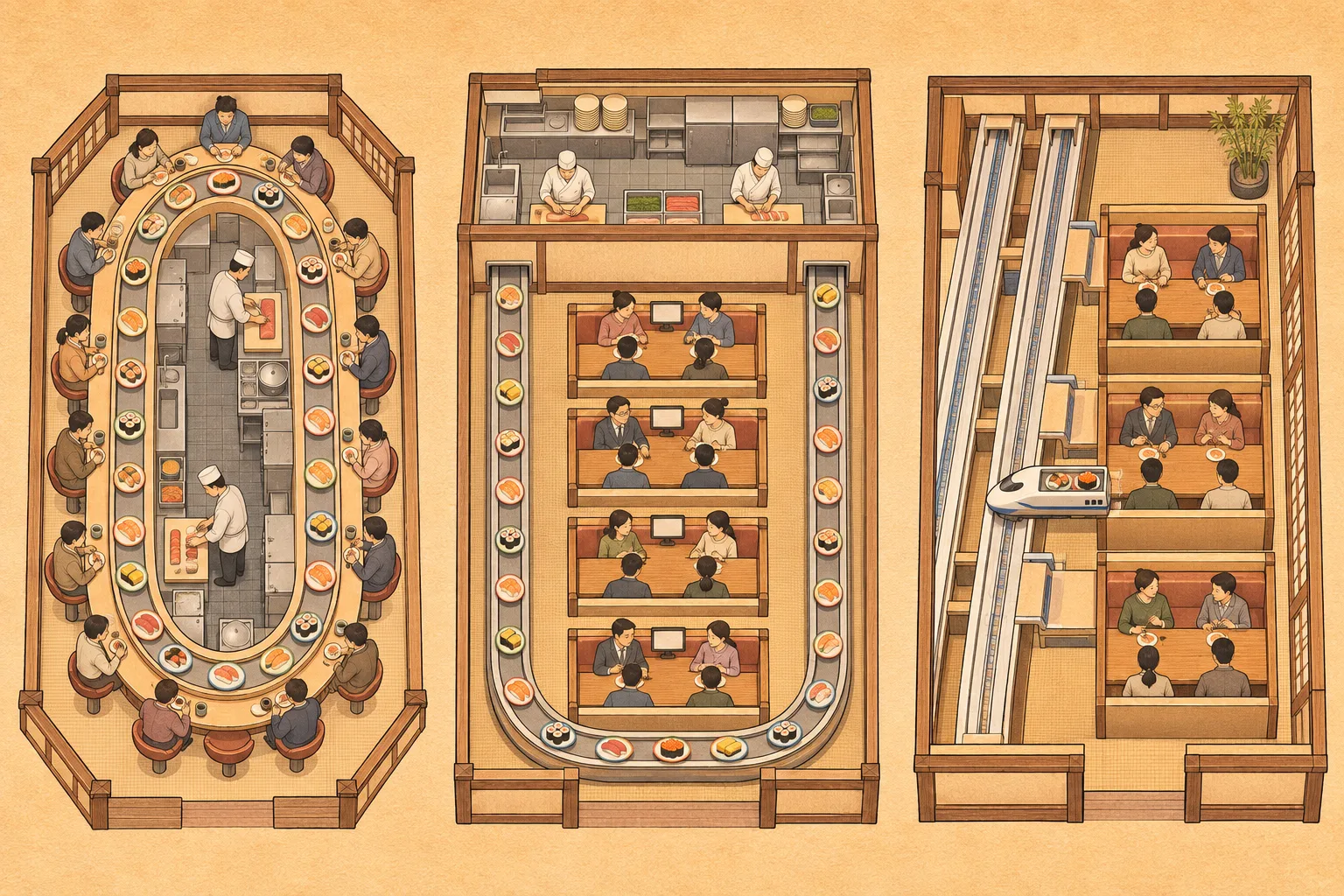
Three layouts seen from above. Left: the oval island, chefs in the middle and customers on stools around them. Center: the U-shaped layout, with the kitchen behind a wall and the belt looping past a row of booths. Right: the straight express rail, with a bullet-train cart stopped at a booth
Plates have their own generations. First came colored and patterned plates carrying uncovered sushi, priced by color from a wall chart. Next came uniform plates, or plates that look the same but hide an electronic tag in the base. Then came plates under clear domes, with a table slot for empties so nothing stacks up. Order trays and table-numbered plates are a separate category: brightly colored, they come only to the person who ordered.
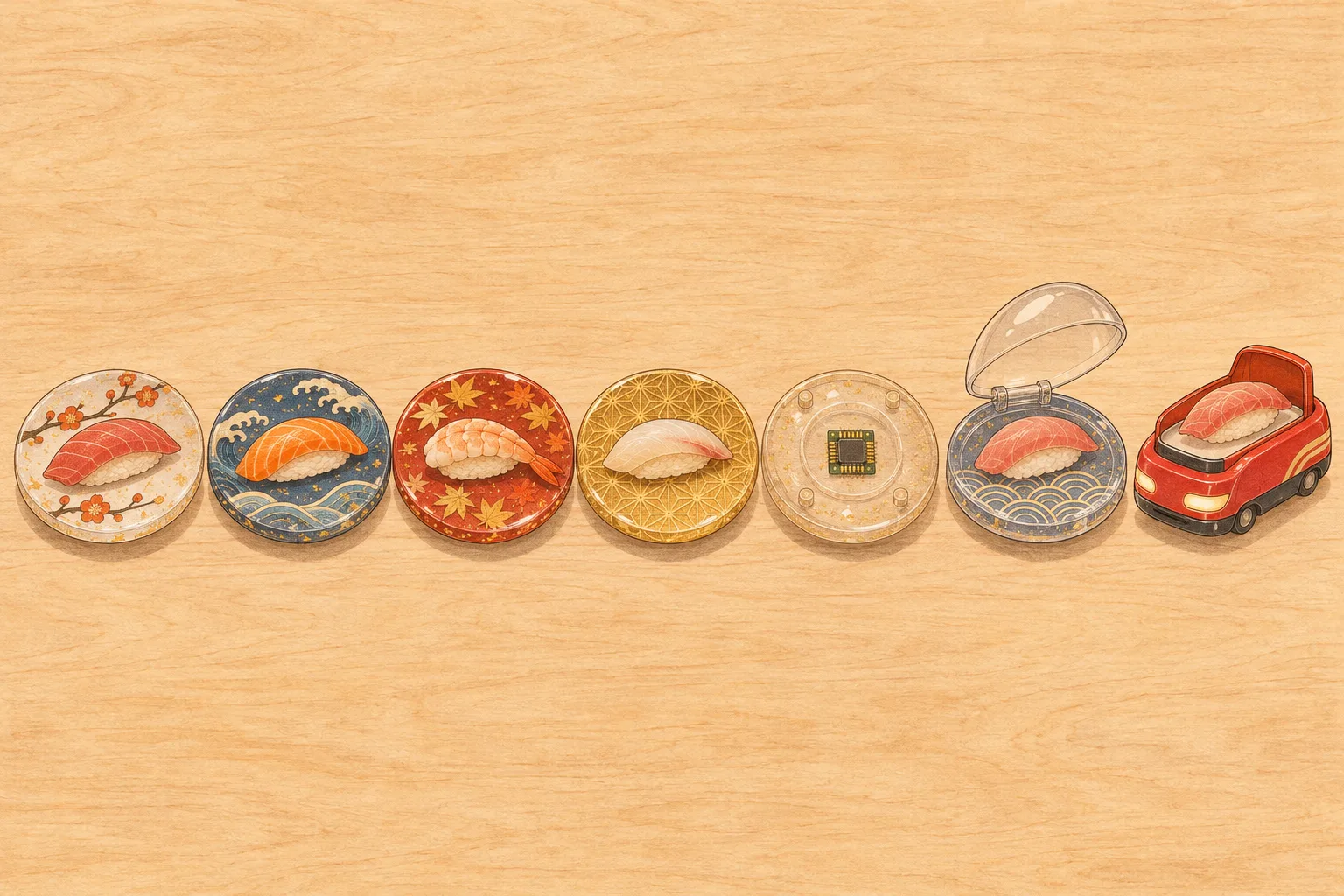
Generations of plates, from left: four old-style plates priced by color and pattern (white, blue, red, gold) carrying uncovered sushi; a plate turned over to show the electronic tag in its base; a plate under a clear dome, half open; and a cart used only for orders
The sushi itself gives clues too. Machine-shaped rice comes out identical, smooth-surfaced and evenly sized, like a row of pieces from one mold; hand-pressed rice varies slightly from piece to piece, the grains visibly textured, and the fish is often larger and thicker, draping over the edges. Chain-shop slices are uniform with straight edges, usually cut at a processing center; at a gourmet kaitenzushi shop the knife marks show and the cut may change from day to day. Watch a few plates go by before you reach for one and you’ll have a fair idea how the kitchen works.
More deep dives on this topic
 TunaOrder an omakase in Tokyo and the tuna usually arrives in a sequence: a slice of deep red lean meat, then something pinker and softer, then a pale, marbled piece that seems to…
 HikarimonoSit at a sushi counter in Japan and, somewhere in the middle of the meal, the chef will set down a piece that looks different from the rest.
 Beyond TunaMost first-time visitors walk into a sushi bar thinking about tuna.
 Edomae ShigotoMost visitors arrive at a Tokyo sushi counter expecting raw fish on rice.
 Shari and Its Supporting CastAt a sushi counter your eyes follow the fish.
 Regional Sushi Beyond TokyoMost visitors meet sushi at a counter: a chef shapes rice in one hand, lays a slice of fish on top and sets it down in front of you, to be eaten within seconds.
 KaitenzushiSit down at a kaitenzushi (conveyor-belt sushi) counter anywhere in Japan and the basic deal is the same.
 Fish MarketsThe piece of sea bream a sushi chef slides across the counter at lunchtime has usually changed hands four or five times since it left the water.
 Words at the Sushi CounterSit at a sushi counter in Japan and the language around you shifts.
 The Sushi ChefFrom a counter seat, a sushi chef looks like a pair of hands and very little else.
- Back to the main article: Sushi →