
Order an omakase in Tokyo and the tuna usually arrives in a sequence: a slice of deep red lean meat, then something pinker and softer, then a pale, marbled piece that seems to dissolve before you have properly bitten it. Two hundred years ago, that last piece would most likely have been thrown away. Tuna was a cheap, slightly disreputable fish in Edo, and its fatty belly was considered fit for nobody, not even the neighbourhood cats. This page explains how a single fish is divided into the cuts you see on a sushi menu, how to tell the five tuna species that reach Japanese tables, how a tuna travels from a hand line off northern Honshu to a sushi counter, and how the fatty belly — now called toro — went from scrap to luxury within about a century.
01A Fish Nobody Wanted
People in the Japanese archipelago have eaten tuna since prehistoric times; tuna bones turn up in Jōmon-period shell mounds, and the old word shibi for tuna appears in eighth-century poetry. Yet for most of Japanese history, tuna had a poor reputation.
One explanation that is often repeated is linguistic. Shibi sounds like shi-bi, "day of death", and samurai households are said to have avoided serving it for that reason. That story may be a later rationalisation. The practical reasons are more convincing. Tuna is a big, bloody, dark-fleshed fish. Before refrigeration, it spoiled quickly on the way from the coast to the city, the red meat turning brown and the smell turning sour. Edo townspeople paid absurd sums for the season’s first bonito, but tuna — another large red-fleshed migratory fish — was classed as gezakana, a "low fish", and was usually simmered in soy sauce or added to stews.
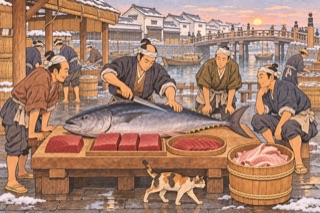
The belly fat had an even worse reputation. Edo taste favoured clean, light flavours, and oily food was considered coarse. Fat also went rancid faster than anything else on the fish. Fishmongers are said to have called the belly meat abu, roughly "fatty bits", and often cut it off and discarded it, or sold it for next to nothing to be simmered with leeks in negima-nabe, a cheap winter hotpot of the Edo backstreets. People later applied the word nekomatagi — "something even a cat would step over" — to such scraps, although the term originally described any unappetising fish.
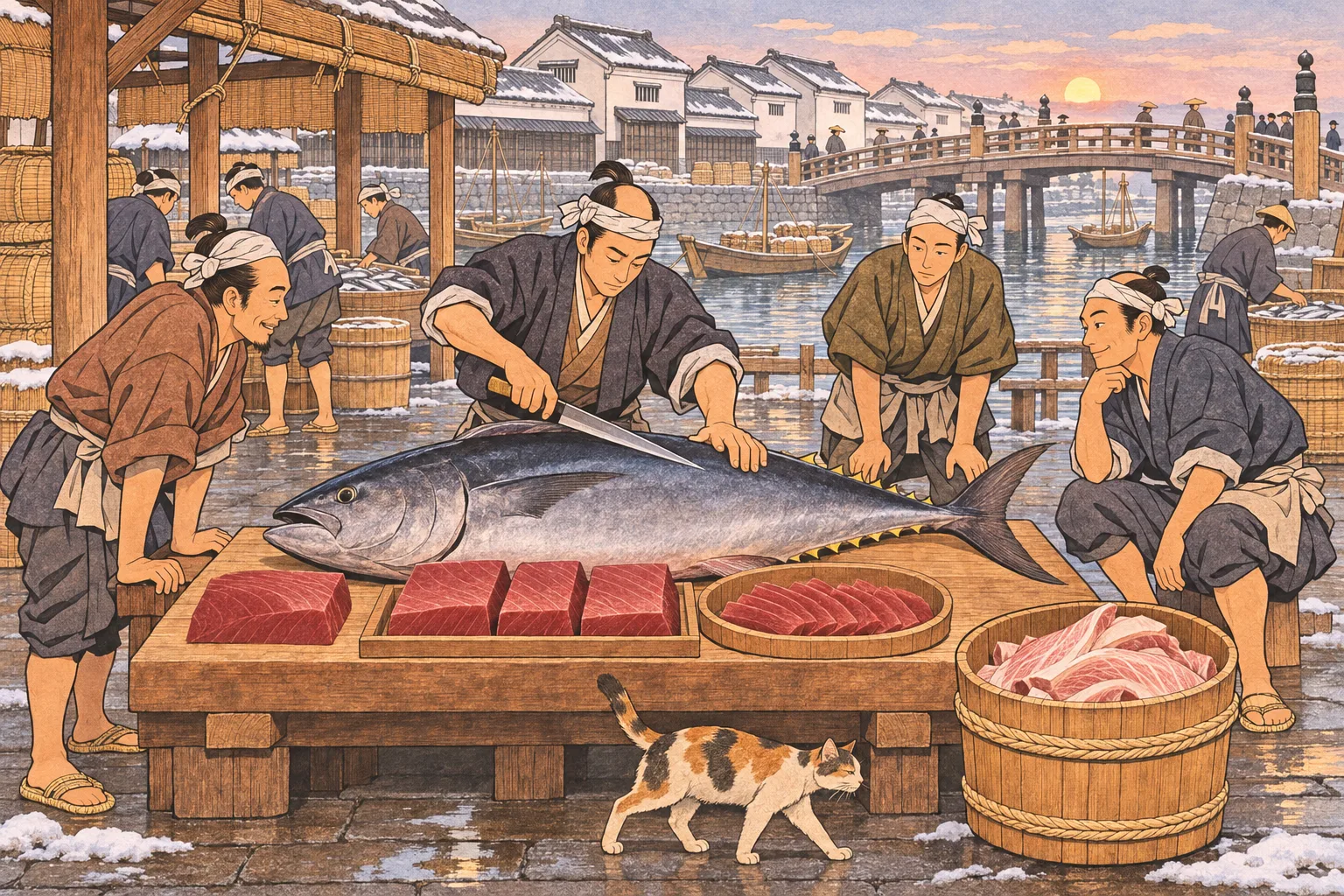
Edo fishmongers cut up a tuna on a winter morning: the red lean meat is laid out for sale, the pale belly fat is tossed in a tub, and the cat walks past (artist’s impression)
Tuna’s first break came with two gluts in the late Edo period: in the winter of 1810–11 unsold tuna was steeped in soy sauce as zuke and caught on, and after another huge catch in 1832 it spread as a raw sushi topping — a bargain ingredient, not a prized one. (The marinating technique belongs to another story in our Edomae series.) For the rest of the Edo period and well into the Meiji era, "tuna sushi" meant lean red meat. The belly was still ignored.
02How "Toro" Got Its Name
Attitudes to fat began to change in the early twentieth century. Railways and commercial ice brought fish to cities faster and in better condition, refrigeration slowly spread, and Japanese diners who had begun eating beef and Western food were growing used to richer flavours.
The name toro belongs to this period. The best-known story comes from Yoshino Sushi Honten, an old shop in Tokyo’s Nihonbashi district, where a regular customer is said to have described the fatty belly as torottoshita, an onomatopoeic word for something that melts or turns syrupy in the mouth. The shop began calling the cut toro, a far more appealing word than abu. Accounts disagree on the exact year and the customer — usually somewhere between the Taishō era and the early Shōwa years — but the word was already in print in a 1930 cookery book, and the Yoshino story is the one almost everyone cites.
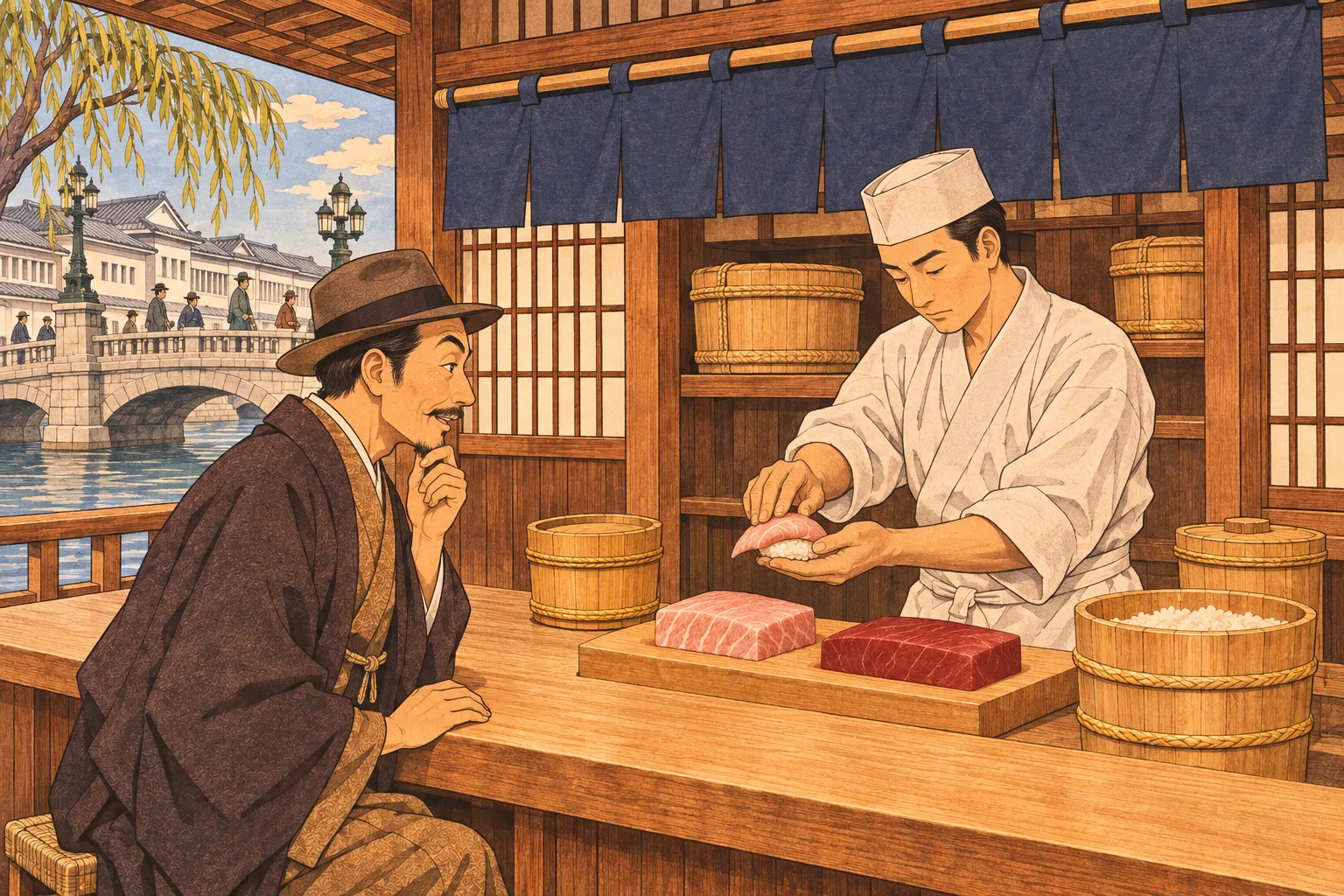
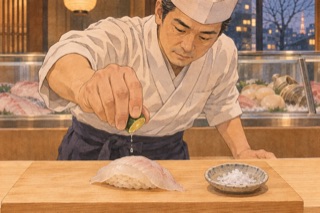
A Tokyo sushi shop between the Taishō era and the early Shōwa years: the chef presses a slice of pale belly meat onto rice; on the board, fatty belly lies on the left and deep red akami on the right (artist’s impression)
A pleasant name did not transform toro overnight. In the early Shōwa years it was still treated as cheap trimmings, and old-school customers preferred lean meat; one account says it first caught on among students from the provinces living in Tokyo. The real reversal came after the Second World War. In the 1960s Japan’s economy grew rapidly; ultra-low-temperature freezing and long-distance fishing fleets brought tuna from every ocean; and a taste for fatty, rich food — often said to owe something to American influence — spread across the country. During and after the high-growth years, toro overtook lean meat to become one of the most coveted pieces of sushi.
Today ōtoro is the most sought-after part of the fish. Many traditional sushi chefs still say that the real test of a shop is its akami, the lean cut: its flavour depends on muscle quality, ageing and knife work, whereas fat can hide small faults.
03Taking a Tuna Apart
A large Pacific bluefin can be three metres long and weigh several hundred kilograms. In profile it looks like a torpedo: dark navy-black on top, silver below, with a crescent tail and a row of small finlets along the back and belly towards the tail.
Once the head and guts are removed, the fish is cut lengthwise along the spine and along the lateral line on each side, giving four long blocks — a method called yotsuwari, "quartering". The two upper blocks are the se (back) and the two lower blocks the hara (belly). Each block is then cut crosswise into three: kami (the head end), naka (the middle) and shimo (the tail end). Sushi chefs and wholesalers combine the terms — hara-kami is the front of the belly, se-naka the middle of the back — and know immediately what kind of meat they are talking about.
Akami (lean meat) makes up most of the fish. It comes mainly from the inner part of the back, close to the spine, and from the inner belly. Good akami is a clear ruby or garnet red with almost no visible fat lines. It has a firm, springy bite, a faintly metallic, iron-rich depth and a hint of acidity. In a sushi course it is usually the first of the tuna pieces, and it is the cut most often turned into zuke.
Chūtoro (medium-fatty tuna) sits between lean and fatty. It is found in the layer just under the skin along the back and in a band surrounding the ōtoro in the belly. It is lighter pink than akami and shot through with fine white streaks, like a haze over the red. Many people consider it the best balance of flavour and richness. Back chūtoro tends to be finer and cleaner; belly chūtoro is richer.
Ōtoro (fattiest tuna) comes from the lower belly, especially the hara-kami and hara-naka. It is pale pink, sometimes almost white, with fat distributed in a net or in stripes. On a cutting board at room temperature it begins to shine with oil. In the mouth it barely needs chewing. It is a small fraction of each fish, which is why it is so prized. There is no fixed line between chūtoro and ōtoro, and shops draw it slightly differently.
Two terms divide ōtoro further. Jabara — the word means bellows or the pleats of an accordion — is the part of the ōtoro — usually said to be the lowest layer of the belly, wrapping the organs — where white connective tissue runs in parallel bands between layers of fat. The look is unmistakable: pink and white stripes like folded pleats. Because of the sinew, chefs slice along or across the bands carefully, or score the surface, so the piece does not turn chewy. Some diners prize the slight texture.
Shimofuri, "frost-fall", is a word borrowed from marbled beef. Applied to tuna, it describes ōtoro where the fat is spread through the meat in fine, even flecks without thick sinews. It melts more uniformly than jabara. Both are ōtoro; the difference lies in the sinew pattern.
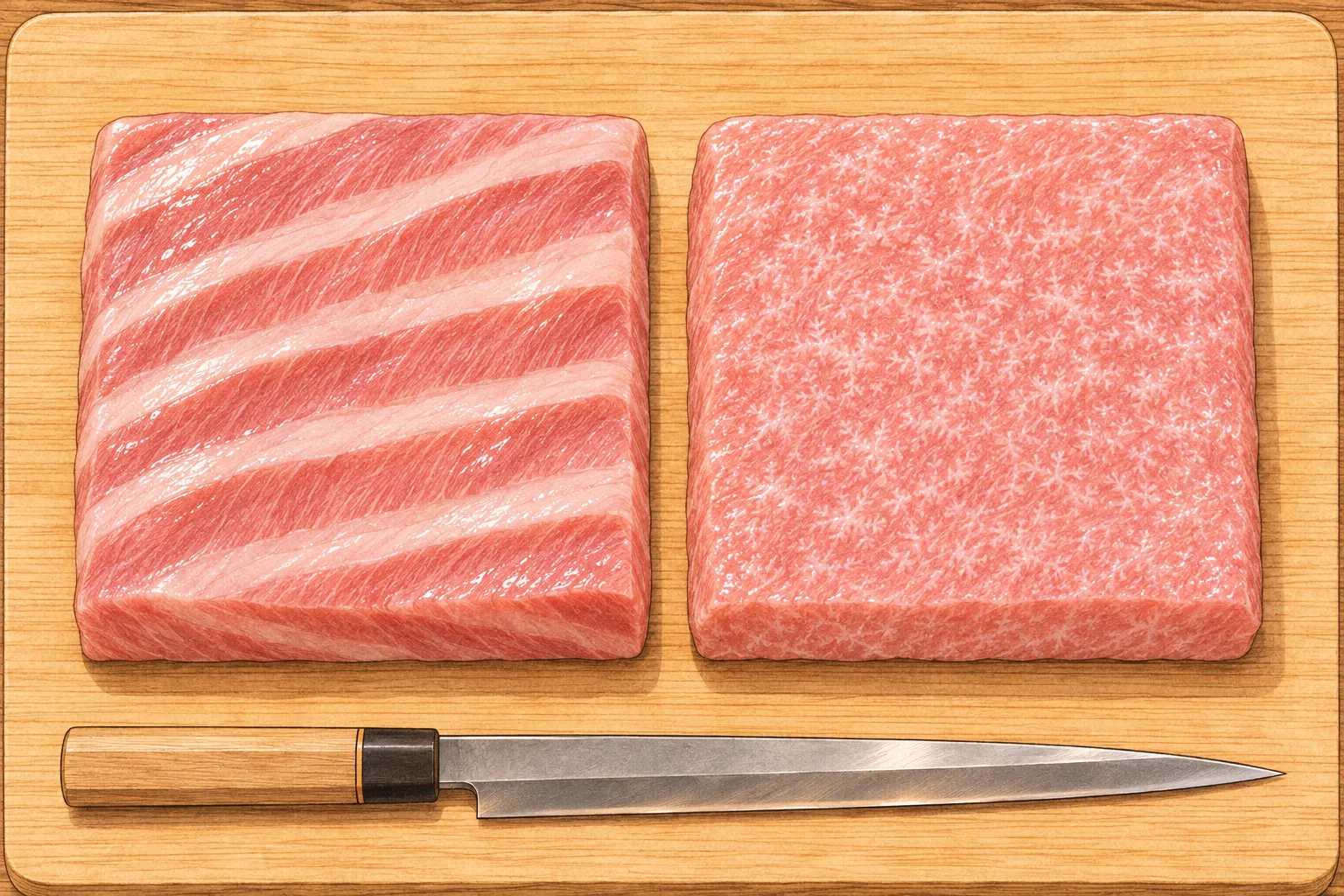
Two blocks of ōtoro. Left: jabara, with white bands running in parallel. Right: shimofuri, the fat spread in fine, even flecks with no thick sinew
Towards the tail, the muscles work harder, the sinews increase and the fat thins out, so the shimo sections mostly supply lean meat or processing grades. The simple rule for a newcomer: the paler the colour and the more white lines, the closer to the belly and to ōtoro.
04The Rare Cuts
Beyond the four main blocks, a tuna yields small cuts that appear on menus only occasionally. Many are eaten near the fishing ports and markets, or reserved for regulars.
Nōten, the "crown of the head", is a strip of muscle on top of the skull behind the eyes. Even a large bluefin yields only a little. The meat is paler than akami, lightly marbled and firmer than ōtoro, combining richness with a springy bite. Names vary by region — atama-niku (head meat), nōten-toro or tsuno-toro.
Kama is the collar: the area behind the gill plate and around the base of the pectoral fin. The name means sickle, from the curved shape of the bone. Each fish has two. A small amount of very fatty raw meat from here is sold as kama-toro, sometimes richer than ōtoro, but the collar is more often grilled whole on the bone as kama-yaki. From a big fish, a grilled collar looks like a bone-in pork chop and is meant to be shared.
Hoho-niku is the cheek meat, from the sides of the head below the eyes — the muscle tuna use to open and close their mouths as they swim. A large fish gives two pieces about the size of a fist. The fibres are coarse and the fat is marbled through the centre, so it is usually cooked: pan-fried like steak, breaded and fried, or simmered with leeks. People often compare it to beef.
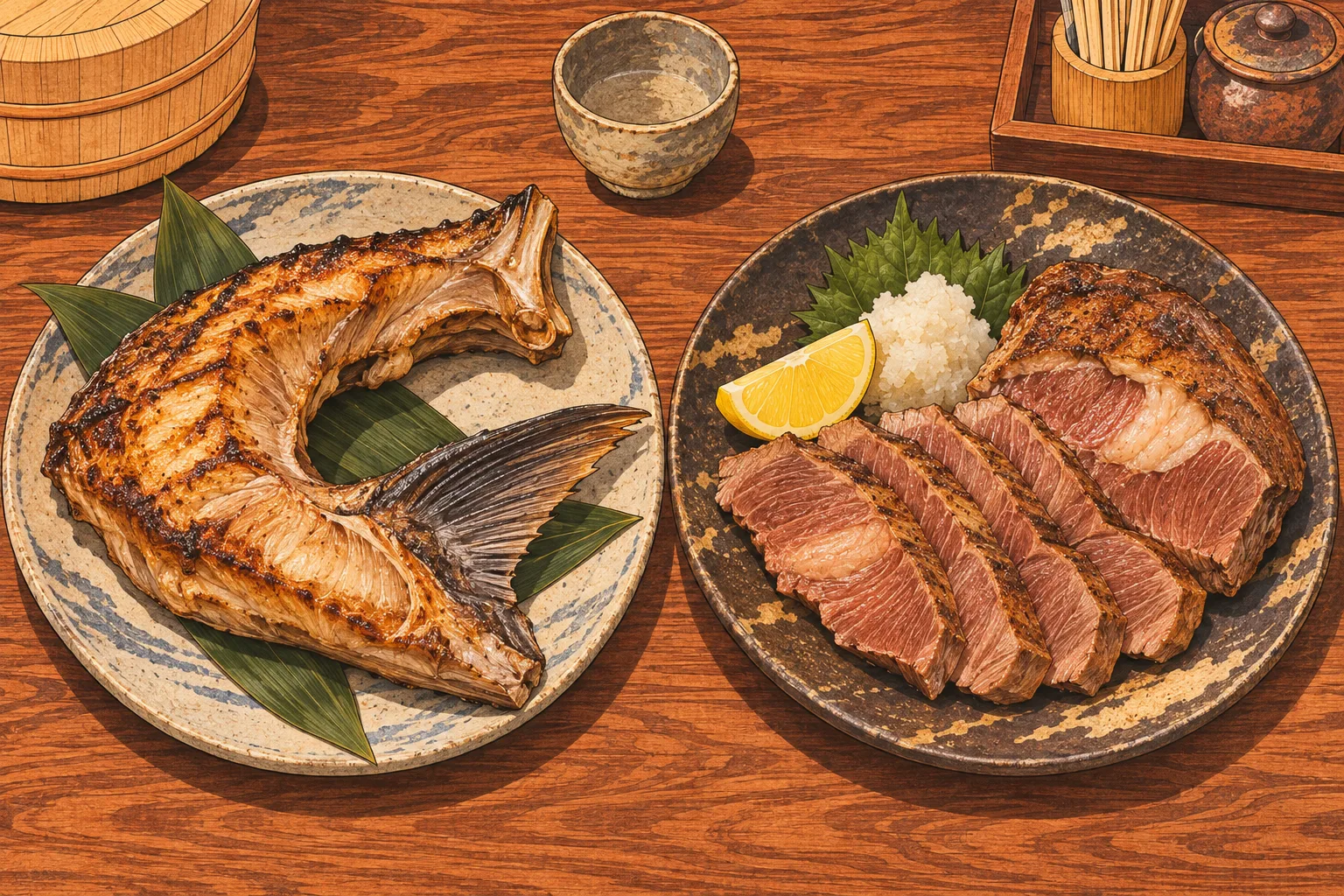
Two cooked cuts. Left: kama-yaki, the collar grilled whole on the bone with the pectoral fin still attached. Right: pan-fried cheek meat, sliced like steak, with grated radish and lemon
Nakaochi is the meat left between the bones after the four blocks have been removed. A tuna backbone looks like an enormous comb, with red flesh lodged between the teeth. The traditional way to recover it is to scrape along the bones with a spoon or a scallop shell. The result is loose, soft and rich, somewhere between akami and chūtoro, with a faint savour from the bone. Some market restaurants serve a section of backbone and hand customers a shell to scrape their own; more commonly the meat is heaped on rice as nakaochi-don.
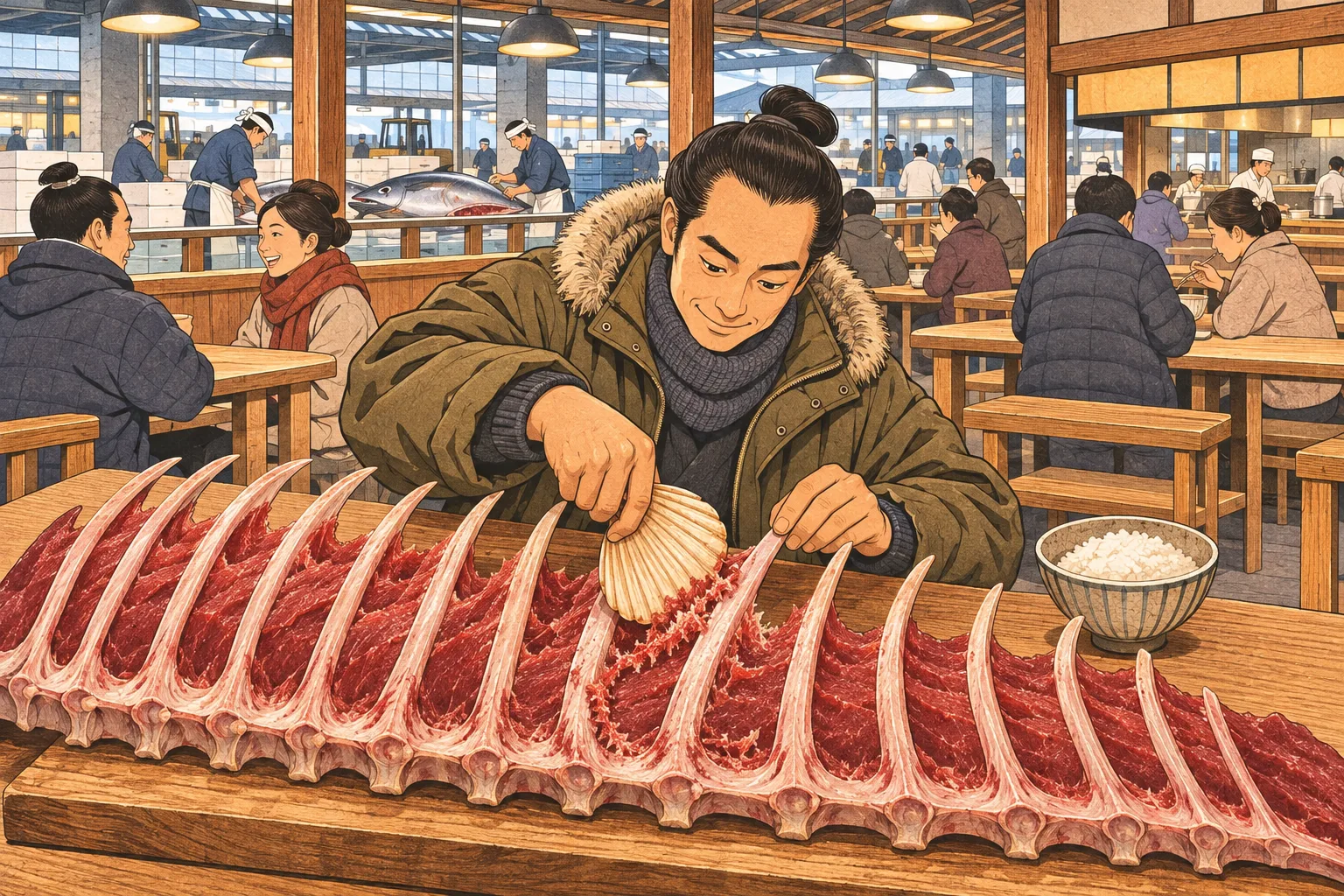
Scraping nakaochi at a market restaurant: a customer works a scallop shell along the backbone to lift out the red meat lodged between the bones, with a bowl of rice waiting
Negitoro, a finely chopped tuna paste mixed with green onion and served on rice or rolled in seaweed, is closely related. Its name has two explanations. One takes it literally: negi (green onion) plus toro. The other says it comes from negitoru, a verb for scraping meat off bones, and that the green onion came along later. It is generally traced to sushi shops in Tokyo’s Asakusa area in the 1960s; one account credits Kintarō Sushi in Asakusa around 1964, naming it as a play on mugitoro, rice with grated yam. Much supermarket and conveyor-belt negitoro today is made from leaner species such as bigeye or yellowfin with added vegetable oil to imitate the texture of toro.
Chiai is the dark band of blood-red meat along the lateral line. This muscle powers the tuna’s constant cruising and is loaded with myoglobin and iron, which makes it dark and strong-smelling, and it turns brown within minutes of exposure to air. It is always trimmed away for sushi and sashimi. Home cooks and cafeterias simmer it with ginger and soy sauce or fry it. A neatly cut piece of tuna sashimi shows no dark stripe at its edge.
05Five Species on the Japanese Table
The Japanese word maguro covers several species of the genus Thunnus. Five matter in Japan, and they differ in size, shape, colour and use.
Kuromaguro (its standard Japanese name), sold as hon-maguro ("true tuna"), is the Pacific bluefin and the largest of the five. It can exceed three metres and 400 kilograms. It is the stockiest of the tunas, with a dark blue-black back, small eyes, short pectoral fins that fall well short of the second dorsal fin, and dark keels on the tail stalk. Pacific bluefin spawn mainly between Taiwan and Japan’s southwestern islands and in the Sea of Japan; some young fish cross the Pacific to grow up off the Americas before returning. A close relative, the Atlantic bluefin, lives in the Atlantic and the Mediterranean and is also sold in Japan as hon-maguro. Bluefin flesh is deep red and the fattiest of all, with good toro throughout the belly and back. Juveniles, which have pale vertical bars on their flanks, are called yokowa; slightly larger young fish are meji.
Minami-maguro ("southern tuna"), also sold as Indo-maguro ("Indian tuna"), is the southern bluefin. It lives only in the cold waters of the southern hemisphere — the Indian Ocean, south of Australia, off South Africa and New Zealand — and spawns south of Indonesia. It looks much like the Pacific bluefin but is smaller, commonly around 1.6 metres, though large fish exceed two metres and 200 kilograms. One reliable sign in adults is the keel on the tail stalk, which is yellow on the southern bluefin and dark on the Pacific bluefin. Its meat is tender, mild and fatty, ranked just below hon-maguro, with notably sweet toro. Most southern bluefin eaten in Japan arrives frozen at sea, and southern Australia fattens large numbers in pens.
Mebachi, the bigeye, takes its name from its eyes, which are strikingly large for its head. It is the deepest-bodied and roundest of the tunas; in large fish the pectoral fins reach to below the second dorsal fin, and in small fish they are longer still, almost as long as an albacore’s. Bigeye feed in deeper, colder water, which gives their flesh some fat. The meat is a bright, clean red — lighter than bluefin, darker than yellowfin — and this is the species most Japanese people eat at home: it fills supermarket sashimi counters and ordinary conveyor-belt sushi. Large bigeye exceed 100 kilograms and yield decent chūtoro.
Kihada, the yellowfin — literally "yellow skin" — has a golden stripe along the flank and bright yellow dorsal and anal fins and finlets, the finlets narrowly edged in black. In large adults the second dorsal and anal fins grow into long, swept-back blades, which makes them easy to recognise. Yellowfin prefer warm tropical waters. Their flesh is pinkish-red, lean and light, with a mild sweetness. It is said to be especially popular in western Japan, Kyushu and Okinawa, and it is widely canned. Tokyo’s traditional sushi shops have rarely prized it, but in regions that favour lighter flavours it is a staple.
Binnaga, the albacore, is often called binchō in Japan. The name means "long sideburns", a reference to its exceptionally long pectoral fins, which stretch past the second dorsal fin — the clearest identification mark of any tuna. It is the smallest of the five, usually around a metre and rarely above 60 kilograms, and its finlets are dark rather than yellow. Its flesh is pale, almost white-pink, which is why it is sold as "white tuna" in the United States and goes into much of Japan’s canned tuna. Albacore was not considered sushi material until improved freezing made its fatty belly pleasant to eat raw. Conveyor-belt shops now serve it as bintoro: rich and mild.
06Side by Side
On one fish. Picture a bluefin lying on its side, head to the left. The spine divides it into back above and belly below. Deep in the back, along the spine, is the large mass of akami. A thin layer under the skin of the back is back chūtoro. In the belly the colour pales as you move downward; the lowest layer is ōtoro, including striped jabara and finely flecked shimofuri, wrapped in a band of belly chūtoro. Towards the tail, fat recedes and sinew increases. The dark stripe running the length of the flank is chiai. On the head, nōten sits above and behind the eyes and the cheeks below them; the kama curves behind the gill plate. After the blocks are removed, nakaochi waits between the bones.
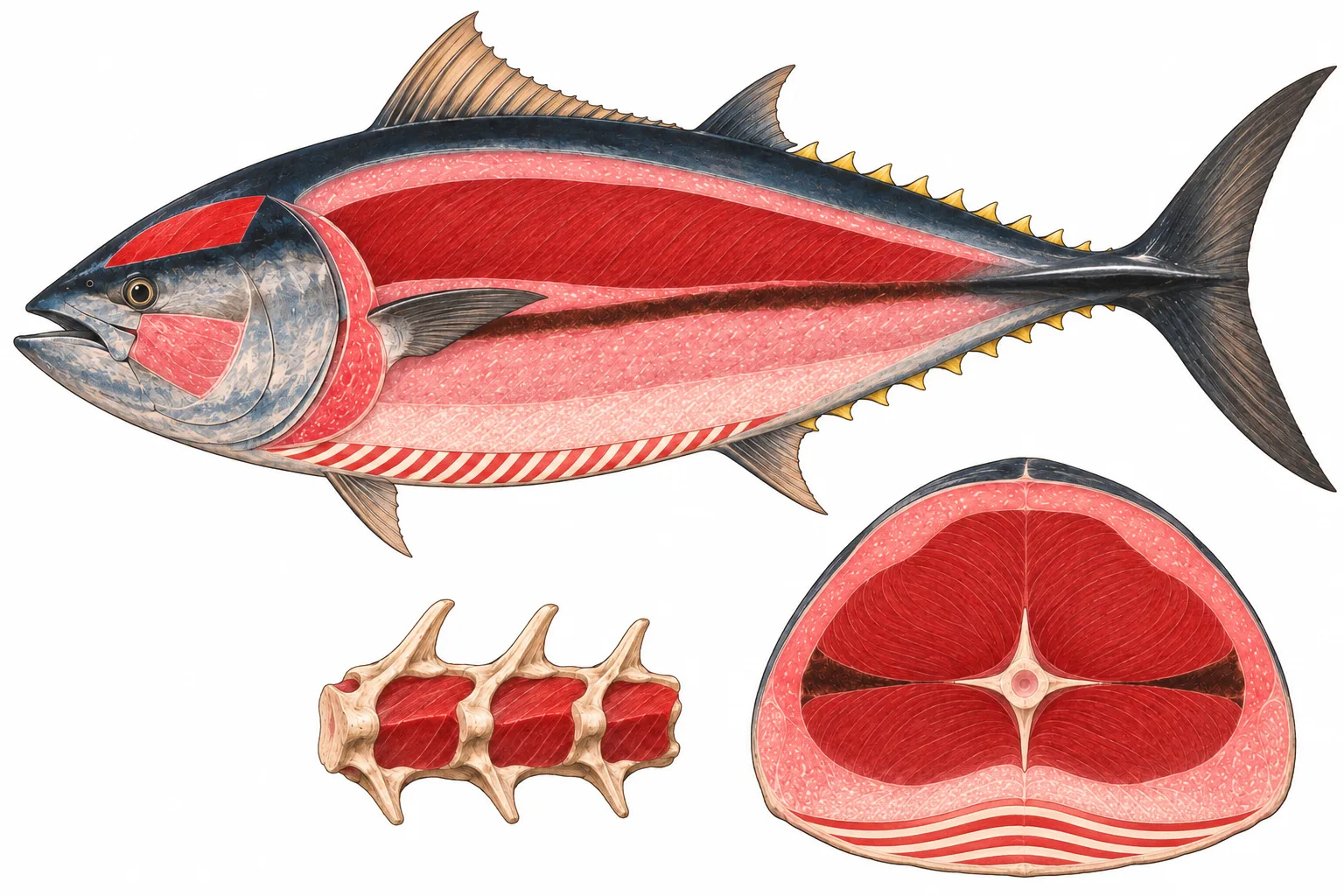
Cuts on one bluefin: deep red akami inside the back, pink chūtoro under the skin, paler ōtoro low in the belly with striped jabara at the very bottom, and the dark chiai band along the midline. On the head, nōten above and behind the eye, cheek below it, kama behind the gill plate. Lower left: nakaochi between the bones. Lower right: a cross-section
The quickest way to read a slice is colour and white lines. Akami: deep red, almost no lines. Chūtoro: pink, fine sparse lines. Ōtoro: pale pink to white, dense lines — thick and parallel in jabara, fine and scattered in shimofuri. Chiai: dark red to brown.
Five species. Look first at size: bluefin is the biggest and bulkiest, followed by southern bluefin and bigeye; yellowfin is slender; albacore is smallest. Then look at the pectoral fin: short on both bluefins, medium on bigeye and yellowfin, very long on albacore — though small bigeye also have long pectorals, so check the eye and body shape too. Then look for colour and special marks: yellowfin’s bright yellow finlets and, on big fish, its long sickle fins; bigeye’s oversized eyes and round body; the adult southern bluefin’s yellow tail keel against the Pacific bluefin’s dark one; albacore’s dark finlets.
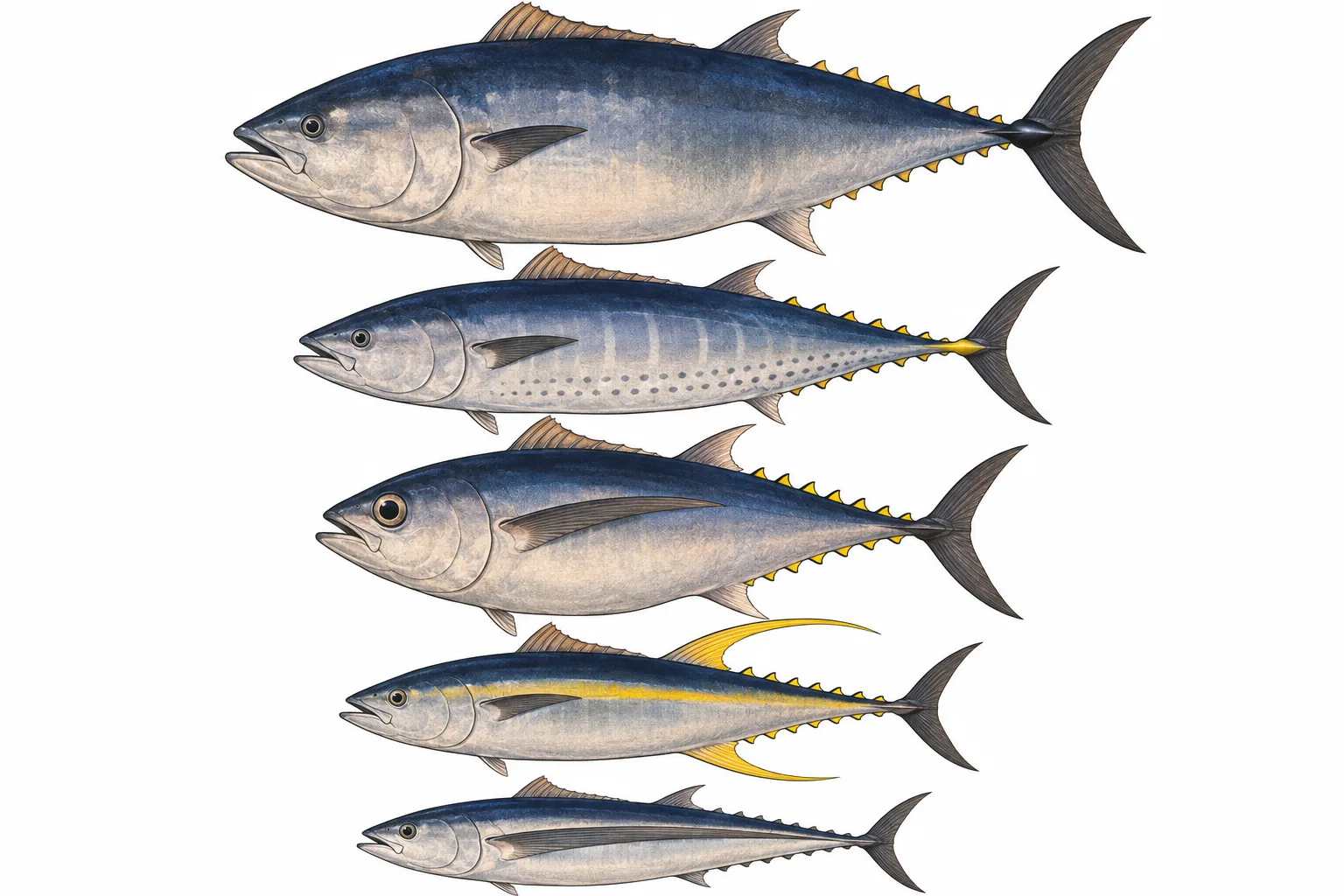
Five tunas, top to bottom: Pacific bluefin, southern bluefin, bigeye, yellowfin, albacore. Compare size and pectoral fin length, then the southern bluefin’s yellow tail keel, the bigeye’s large eye, the yellowfin’s long yellow sickle fins and the albacore’s pectoral fin reaching past the second dorsal fin
As meat, bluefin is deep red with marbling where it is fatty; southern bluefin slightly lighter and finer; bigeye bright red; yellowfin pale pinkish-red; albacore nearly white. Only the two bluefins produce prime toro all over; bigeye gives some chūtoro; yellowfin very little; and albacore’s bintoro is a different, milder thing.
Japan’s detailed vocabulary has practical roots. A single tuna is shared among many buyers, so the trade needed a precise way to say which part of the fish a block came from. And because sushi places a small piece of raw fish directly on rice, every difference in cut and species is obvious in the mouth.
07Catching, Freezing and Farming
How a tuna is caught shapes its quality.
Ōma is a small port at the northern tip of the Shimokita Peninsula in Aomori Prefecture, facing the Tsugaru Strait. From late summer into winter, bluefin follow saury and squid through the strait. Ōma boats use longlines as well as the method that made them famous, ipponzuri, hand-line fishing: small boats, a single line and a single hook with live bait. A fish of several hundred kilograms can fight for a long time. Once it is alongside, many crews stun it, haul it aboard, and immediately bleed it, remove the gills and guts and pack it with ice. Handled one at a time, the fish are less bruised and stressed, and Ōma tuna has become Japan’s most famous name. The record-breaking New Year auctions that make the news belong to our separate market story; here, the point is that Ōma’s reputation rests on the fish, the season and the method.
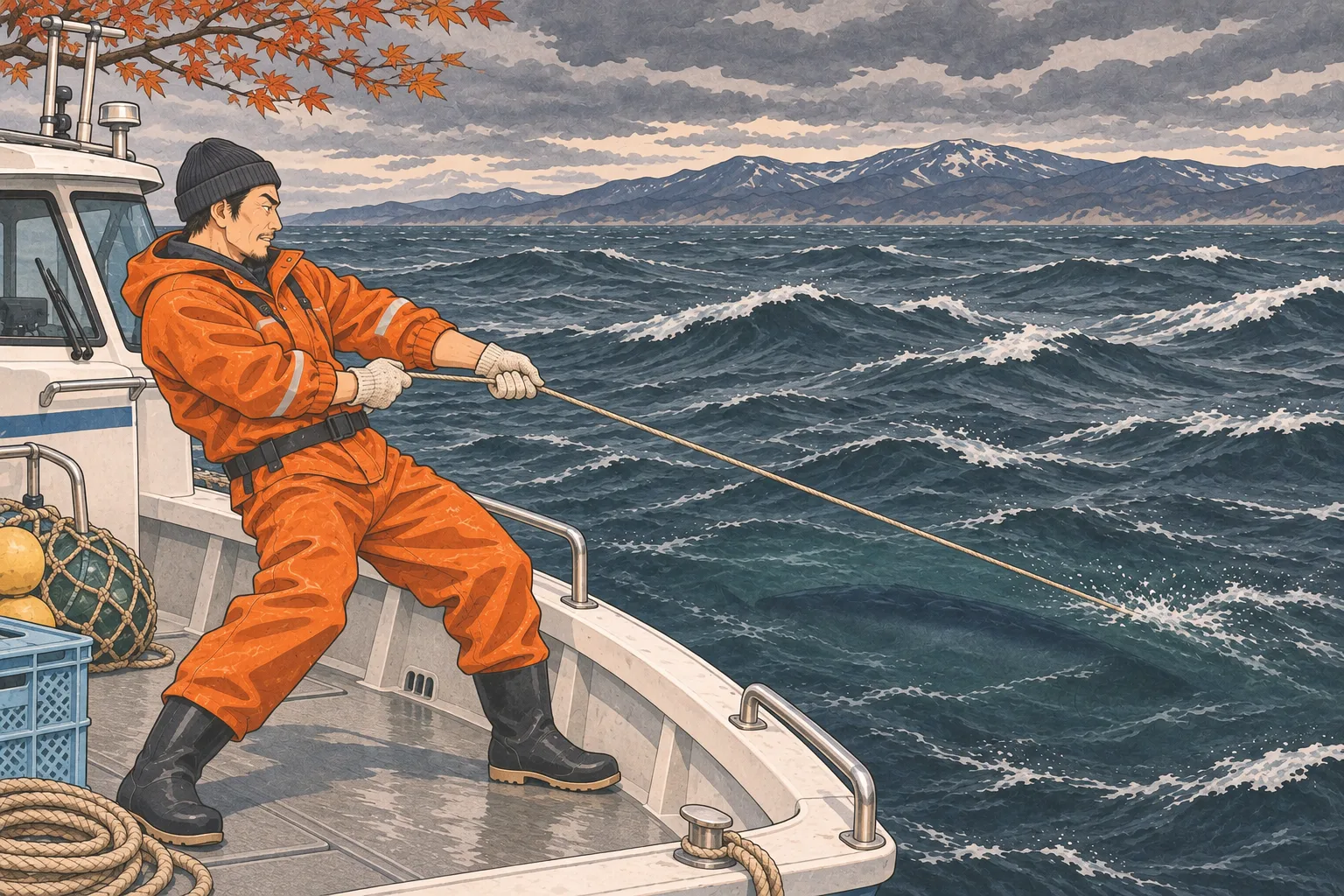
Ipponzuri in the Tsugaru Strait: one man on a small boat leans back against a single line, with a large fish pulling below the surface
Across the strait, Toi near Hakodate in Hokkaido catches bluefin in the same waters with comparable quality but less fame. Other well-known tuna ports include Iki and Tsushima in Nagasaki, Sakaiminato in Tottori, Shiogama in Miyagi and Katsuura in Wakayama. Sakaiminato is generally known for purse-seine landings; Shiogama and Katsuura for fresh, never-frozen tuna.
Longlining (haenawa) sets a very long main line hung with branch lines and hooks — hundreds or thousands on a distant-water vessel — and hauls it in hours later. Distant-water longliners spend months in the Pacific, Indian and Atlantic Oceans, freezing the catch on board. The method is efficient, but fish may struggle on the hook for a long time, so quality varies more than with a hand line. Purse seines, which encircle whole schools with a net, catch fish in volume for processing or for stocking farms.
After capture, tuna follow one of two paths. Nama (fresh) tuna has never been frozen; it is iced and rushed to market and must be sold and eaten within days. The other path is freezing. Early frozen tuna was poor — when thawed, it turned brown — and was looked down on. In the 1960s and 1970s, Japanese distant-water vessels adopted ultra-low-temperature freezing at minus 50 degrees Celsius or below. At those temperatures myoglobin barely oxidises, and properly thawed fish keeps its bright red colour and is difficult to tell from fresh. Most longline-caught southern bluefin and bigeye arrive this way, frozen rock-hard and stored in ultra-low-temperature warehouses. This technology let Japan import tuna from all over the world and put toro within reach of ordinary diners. Thawing is a skill: one common method is a quick rinse in warm salt water, then slow thawing wrapped in paper in the refrigerator, so the meat does not weep.
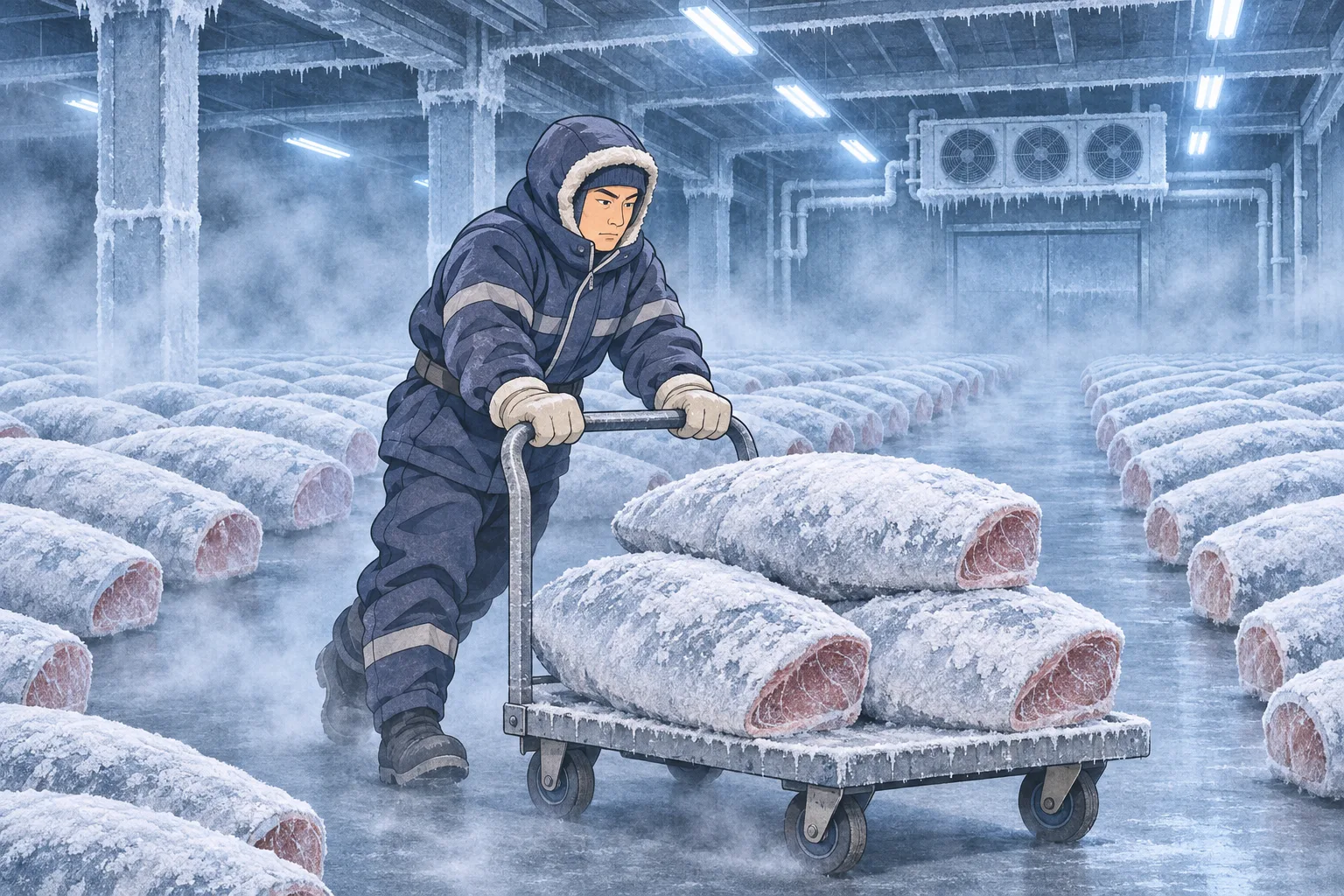
An ultra-low-temperature warehouse: headless, tailless tuna frozen rock-hard and coated in frost, stored in rows at minus 50 degrees Celsius or below
Farming now supplies a large share of the bluefin in Japanese restaurants. Most of it is "ranching": wild juveniles are caught and fattened in sea pens on mackerel and sardines for several years. Pens operate off Nagasaki, Amami in Kagoshima, Kōchi and Wakayama; Spain, Malta and Croatia ranch Atlantic bluefin largely for the Japanese market; southern Australia ranches southern bluefin. Farmed fish are fattier and more consistent, yielding more toro per fish and a steadier supply through the year. Wild fish vary with the season and have more individual character, and connoisseurs prize wild winter bluefin, though many diners cannot tell the difference.
Ranching still depends on wild juveniles, which is why full-cycle farming matters. Kindai University’s Aquaculture Research Institute began bluefin research in 1970 — continuing on its own funds after the original project ended — working mainly at its station on Ōshima, off Kushimoto in Wakayama. Bluefin panic easily and crash into net walls, and larval mortality is enormous. In 1979 fish caught as juveniles in 1974 and raised in pens spawned, the first bluefin eggs obtained in captivity, but the young did not survive. Only in 2002, after 32 years, did bluefin hatched in 1995 and 1996 spawn in turn — the world’s first complete egg-to-egg cycle. The fish have been sold as Kindai maguro since 2004, and in 2013 the university opened restaurants in Osaka and in Ginza, Tokyo. Production remains small and costly, but it shows that bluefin need not depend entirely on the wild.
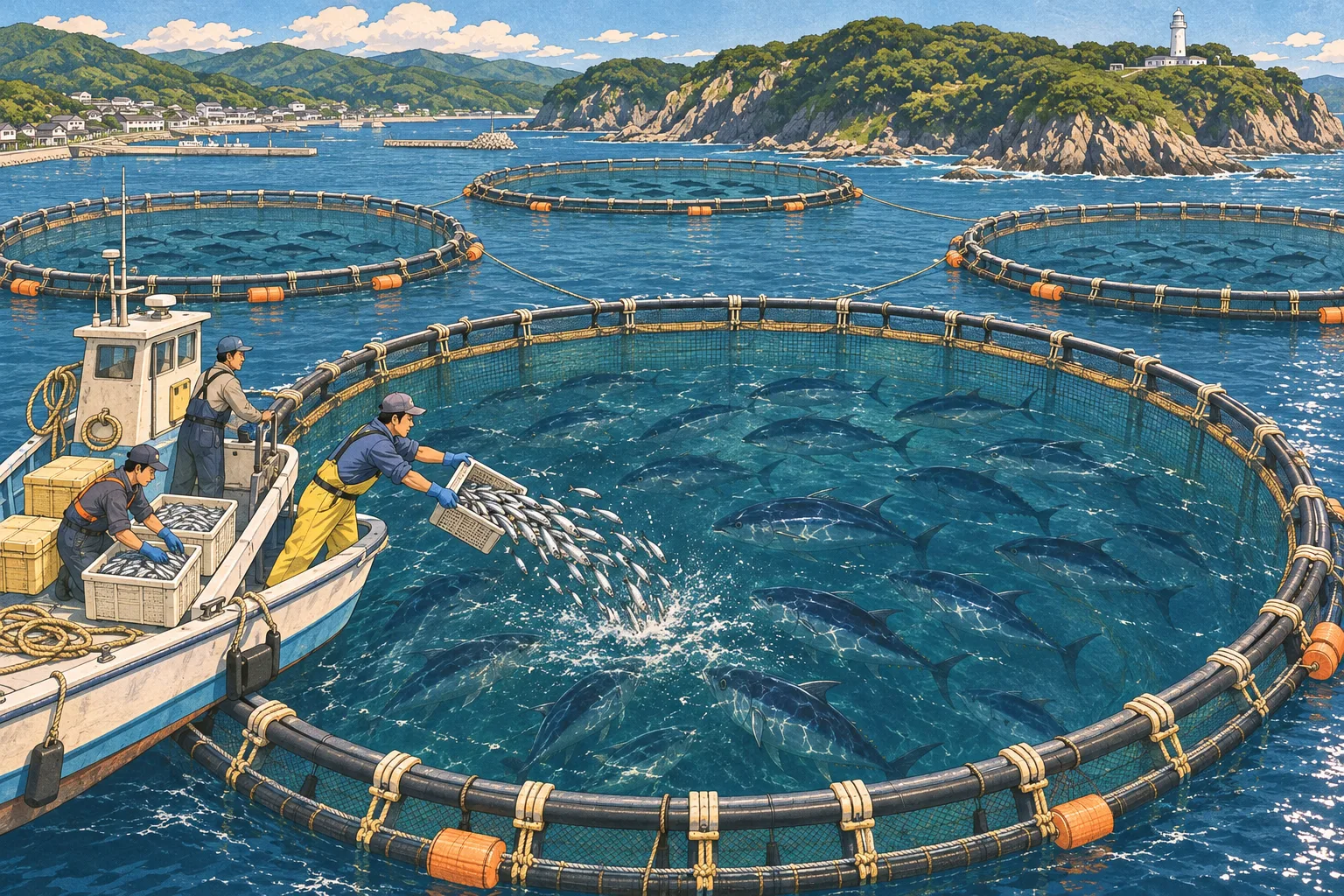
Round sea pens for bluefin: a work boat tips small fish into the net while the tuna circle just below the surface
08From the Tail Cut to the Counter
Before a buyer bids on a tuna, he has to judge the meat inside a fish he cannot open. The answer is the tail.
At a wholesale market such as Toyosu, rows of fresh and frozen tuna lie on the floor with their tails sawn off, exposing a round cross-section. Buyers walk the rows with a flashlight in one hand and a short hook, the tekagi, in the other, bending over each cut. The cross-section is a small map of the fish: spine at the centre, muscle in rings around it. They study the colour and clarity of the red, the thickness of the fat layer under the skin and how far white fat has worked into the muscle. They press the flesh with a finger, rub the oil between finger and thumb, and smell it. Some pick a sliver of meat from the tail or from a small cut near the pectoral fin to examine it closely.
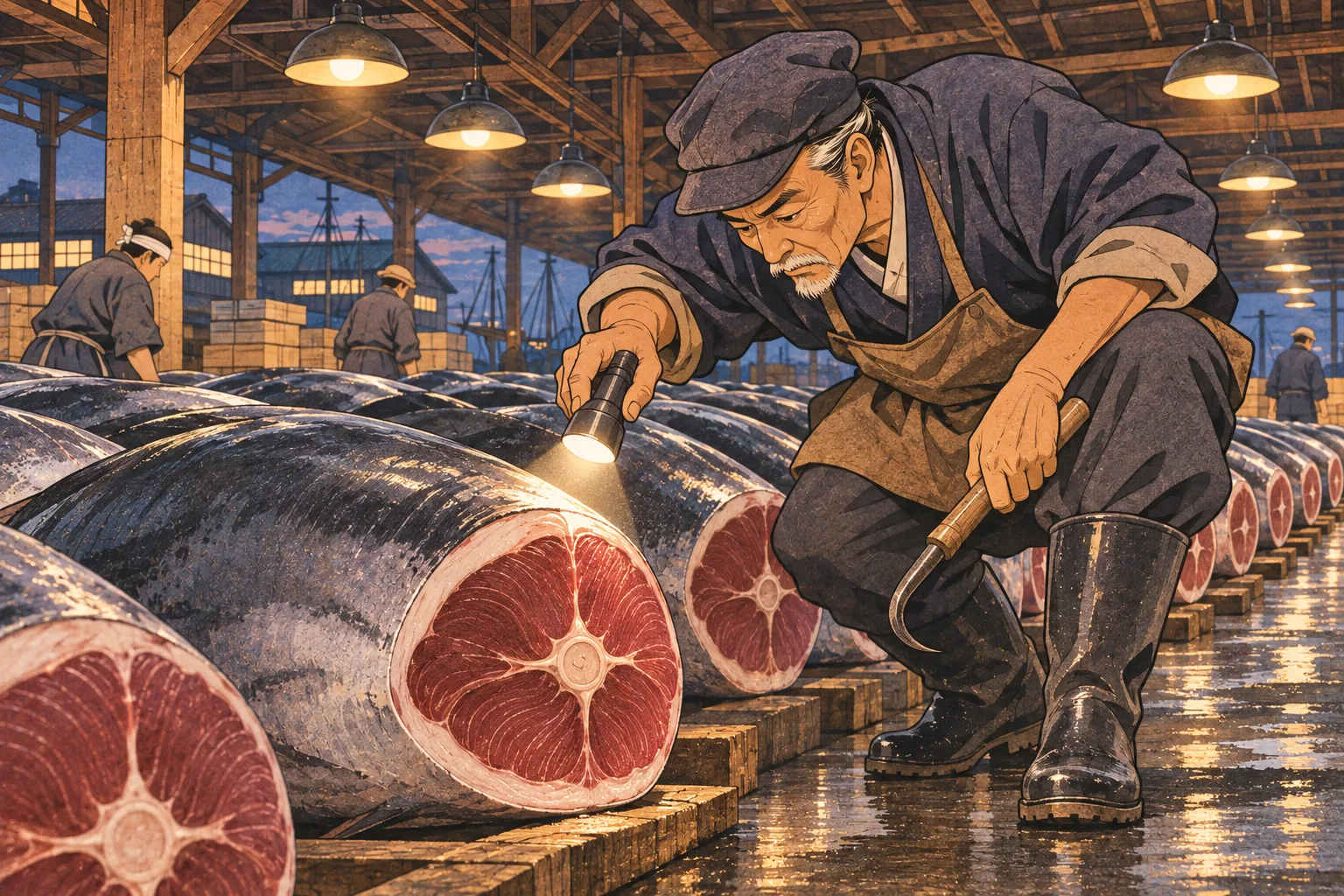
Reading the tail cut: a buyer bends over the cross-section with a flashlight in one hand and a tekagi in the other. The spine sits at the centre, the muscle around it, and a ring of fat under the skin
The tail tells a lot. Fat thickness hints at how much toro the fish will yield. Very pale meat may mean a young fish; dark, dull meat may mean poor bleeding. Pale, soft, sour-smelling flesh at the centre is yake, "burn" — damage caused when a fish fights too long and its body heat cooks the muscle from within. A burned fish is passed over however large it is. On frozen fish, buyers shave away the frost to see the colour beneath. Yet the tail shows only the tail, and how fatty the belly really is remains an inference, which is why tuna buying is often compared to gambling. Auction procedure itself is a separate story; this is the moment that decides it.
Tuna is rarely eaten straight off the boat. Very fresh tuna is firm, mild and slightly sour. Wholesalers and sushi chefs age it — jukusei or nekase — wrapping blocks in absorbent paper and cloth and storing them around freezing point, for several days or, for very large fish, longer, changing the paper as moisture seeps out. Enzymes break proteins down into flavour compounds such as inosinic acid; the flesh softens and its colour deepens. How long to age depends on size, fat and season, and on the shop’s style — some chefs prefer long-aged, dark akami, others a fresher snap. Overdone, the meat turns sticky and off.
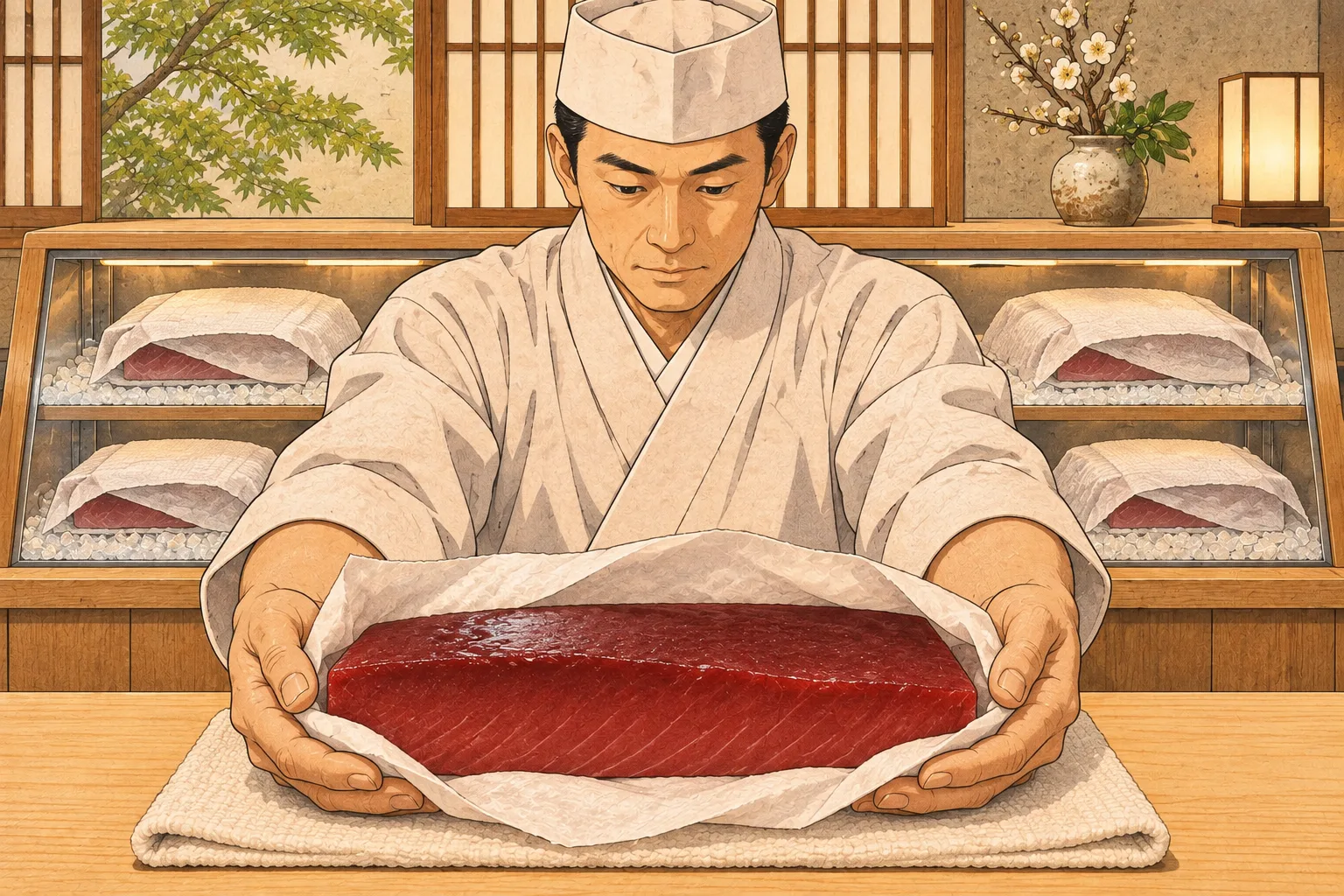
Tuna during ageing: blocks are kept chilled in absorbent paper and cloth; the one the chef has unwrapped is akami, deep red with a moist surface
At the counter, the chef trims aged meat into rectangular blocks called saku and slices from those, cutting akami a little thicker for texture, ōtoro a little thinner or scored, and jabara with or across the sinew.
Behind all this sits a shared resource. Tuna cross the boundaries of many nations, and as Japanese and global demand grew in the late twentieth century, both Pacific and Atlantic bluefin declined steeply. In the 2000s the Atlantic stock was widely feared to be near collapse, and in 2010 Monaco’s proposal to ban its international commercial trade under CITES was voted down. The Pacific bluefin’s spawning stock hit a historic low around 2010, a small fraction of its estimated unfished level. International commissions then halved the juvenile catch from 2015 and capped the catch of large fish, and since 2018 Japan has divided its share among regions and fisheries, so Ōma’s boats work within annual quotas. The spawning stock reached its rebuilding target in 2021, and in 2024 the large-fish limit was raised by half, but management continues. Southern bluefin, governed by its own commission, also fell sharply and is now managed toward rebuilding targets, with catch limits gradually rising. Most diners never see these rules, except when bluefin is suddenly scarce one season, or farmed fish appear on the menu.
More deep dives on this topic
 TunaOrder an omakase in Tokyo and the tuna usually arrives in a sequence: a slice of deep red lean meat, then something pinker and softer, then a pale, marbled piece that seems to…
 HikarimonoSit at a sushi counter in Japan and, somewhere in the middle of the meal, the chef will set down a piece that looks different from the rest.
 Beyond TunaMost first-time visitors walk into a sushi bar thinking about tuna.
 Edomae ShigotoMost visitors arrive at a Tokyo sushi counter expecting raw fish on rice.
 Shari and Its Supporting CastAt a sushi counter your eyes follow the fish.
 Regional Sushi Beyond TokyoMost visitors meet sushi at a counter: a chef shapes rice in one hand, lays a slice of fish on top and sets it down in front of you, to be eaten within seconds.
 KaitenzushiSit down at a kaitenzushi (conveyor-belt sushi) counter anywhere in Japan and the basic deal is the same.
 Fish MarketsThe piece of sea bream a sushi chef slides across the counter at lunchtime has usually changed hands four or five times since it left the water.
 Words at the Sushi CounterSit at a sushi counter in Japan and the language around you shifts.
 The Sushi ChefFrom a counter seat, a sushi chef looks like a pair of hands and very little else.
- Back to the main article: Sushi →