
The piece of sea bream a sushi chef slides across the counter at lunchtime has usually changed hands four or five times since it left the water. A fisherman landed it, a port market sold it, a wholesaler auctioned it in Tokyo before dawn, a middleman cut it to size, and the chef picked it out at the middleman’s stall. Each handover happens at a fixed hour, between people who have often dealt with each other for decades, under rules that go back to the early seventeenth century. Japan’s great fish markets are best understood not as places but as a system: a chain of specialists, each of whom exists because fish is the most perishable and least predictable thing a cook can buy. Tsukiji made that system famous; Toyosu is what it looks like today. This deep-dive follows one fish along the chain and explains why each link is there.
01A Market Founded by Fishermen from Ōsaka
Tokyo’s first fish market stood on the north bank of the Nihonbashi River, right beside the bridge that served as the starting point of every highway in the country. Edo people called it simply the uogashi, "the fish quay." Walk to the north end of Nihonbashi today and you will find a stone monument marking the birthplace of the fish market. Office towers and department stores surround it. For almost three hundred years this riverbank was packed from before dawn with tubs, shoulder poles, flat boats and shouting.
The market’s origin story involves a village of fishermen from Tsukuda, near the mouth of the Yodo River in what is now Ōsaka, whose headman was Mori Magoemon. How the village won Tokugawa Ieyasu’s favour is told in more than one way. One tradition says its fishermen ferried him across the Kanzaki River in 1586, when he was visiting the Tada shrine, and that he rewarded them with privileges and gave the village the name Tsukuda. Another links Mori’s family to Ieyasu’s desperate flight home after the Honnō-ji Incident of 1582, when they are said to have helped him by boat. Either way, after Ieyasu took over Edo in 1590, Mori and some thirty Tsukuda fishermen followed him east and were granted fishing rights in Edo Bay. In return they supplied fresh fish to Edo Castle for the shogun’s table. In 1610, it is generally said, Mori’s son was allowed to sell the surplus to townspeople; the son, Kyūzaemon, opened one of Edo’s first fish wholesale houses, and that surplus trade is counted as the start of the uogashi.
The fishermen were later granted shallows at the mouth of the Sumida River, built an island there, finished in 1645, and named it Tsukudajima after their home village. Their habit of simmering small fish and shellfish, first in salt and later in soy sauce, so they would keep, gave Japan the word tsukudani for that style of preserve. A few old tsukudani shops and a Sumiyoshi shrine still stand on the island.
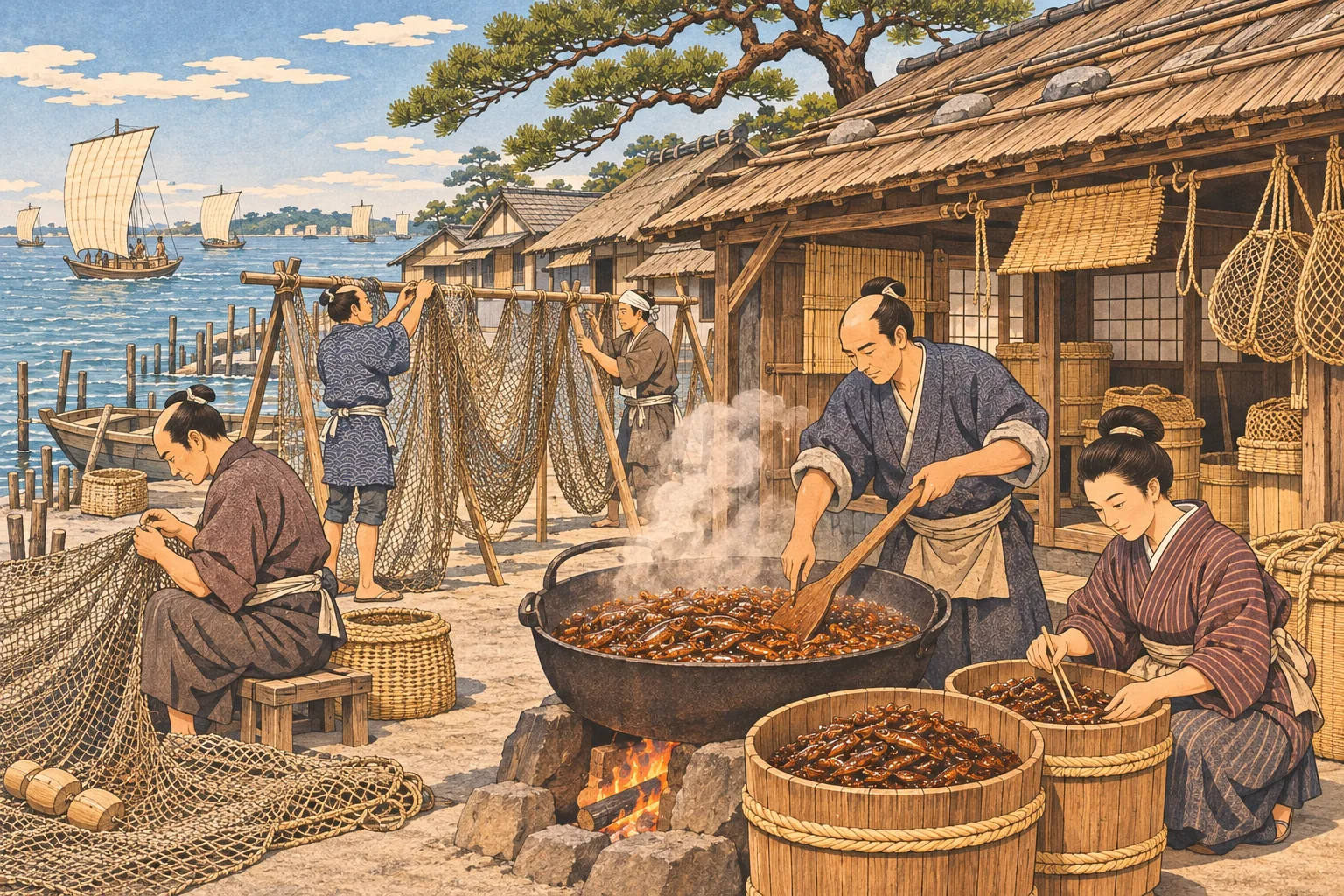
Tsukudajima: nets drying by the shore while small fish simmer in soy sauce in a big pot, and the dark, glossy tsukudani goes into wooden tubs (artist’s impression)
As Edo grew into one of the largest cities in the world, boats from fishing villages all around the bay, from Sagami to the Bōsō Peninsula, brought their catch to Nihonbashi. Wholesale houses called ton’ya took delivery and resold to smaller dealers, the nakagai, who sold to the peddlers who walked the city’s streets with fish baskets. The nakagai laid out their fish on boards of a fixed size that jutted into the street, called itafune, and the right to a board became a kind of share in the market, a valuable property in its own right. When the market moved to Tsukiji, compensation for these rights led to a bribery scandal. A popular saying held that three places in Edo each turned over a thousand gold ryō a day: the fish quay in the morning, the kabuki theatres in the afternoon, and the Yoshiwara pleasure quarter at night.
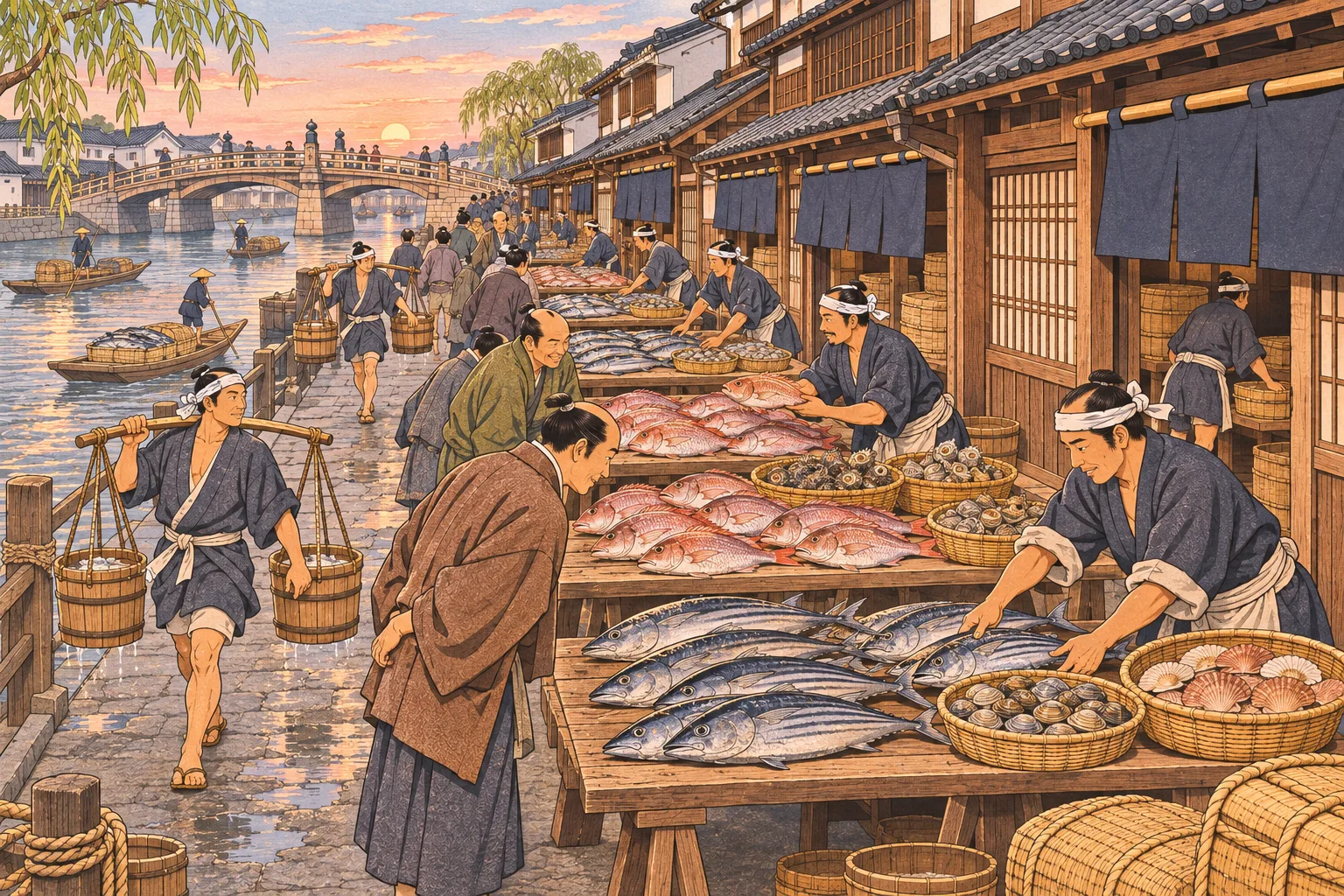
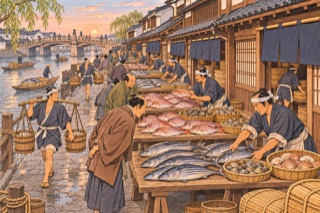
The Nihonbashi uogashi in the late Edo period: nakagai lay out sea bream, bonito and shellfish on itafune boards in front of the ton’ya, with the bridge behind (artist’s impression)
Edo-style sushi grew up within walking distance of this market. Gizzard shad, conger eel, clams and prawns from the bay arrived at dawn and were in the boxes of street sushi stalls by noon. The fish-quay men were known for quick tempers, quick speech and an obsession with face, and it is often said that much of what Japanese people still describe as the Edokko, the true-born Tokyoite, was modelled on them.
02Earthquake, Reform and the Curve at Tsukiji
By the Meiji era the Nihonbashi market was cramped, smelly and unsanitary, and there was steady pressure to move it, but for decades nothing happened. What finally moved the market was the Great Kantō Earthquake of 1 September 1923. The quake and the fires that followed destroyed the whole district, and the wooden wholesale houses vanished in a night. The traders set up a temporary market on reclaimed land at Shibaura. It was cramped and hard to reach, so in December the city borrowed part of a navy site at Tsukiji, on the waterfront south of Ginza, and opened a temporary municipal fish market there.
There was a policy change behind the move. After the Rice Riots of 1918, the government decided that food distribution in big cities could not be left entirely to private wholesalers who set prices behind closed doors. The Central Wholesale Market Act of March 1923 provided for large cities to build publicly run markets with sanitary facilities, where licensed wholesalers would sell by auction and other open methods. The first market under the act opened in Kyōto in 1927. The earthquake gave Tokyo a clean slate.
Tokyo’s municipal Central Wholesale Market opened at Tsukiji in February 1935; its seafood division began with freshwater fish, and salted and fresh sea fish followed later that year. Its main building was a vast arc, shaped from the air like an opened fan. The curve was practical: a freight branch ran into the market from Shiodome station along its outer edge, and the building followed the bend of the track so goods wagons could be unloaded right at its edge, with goods moving from the outside of the fan inwards. Trucks later replaced trains and the siding was closed in 1987, but the curve stayed until the last day of trading in 2018.
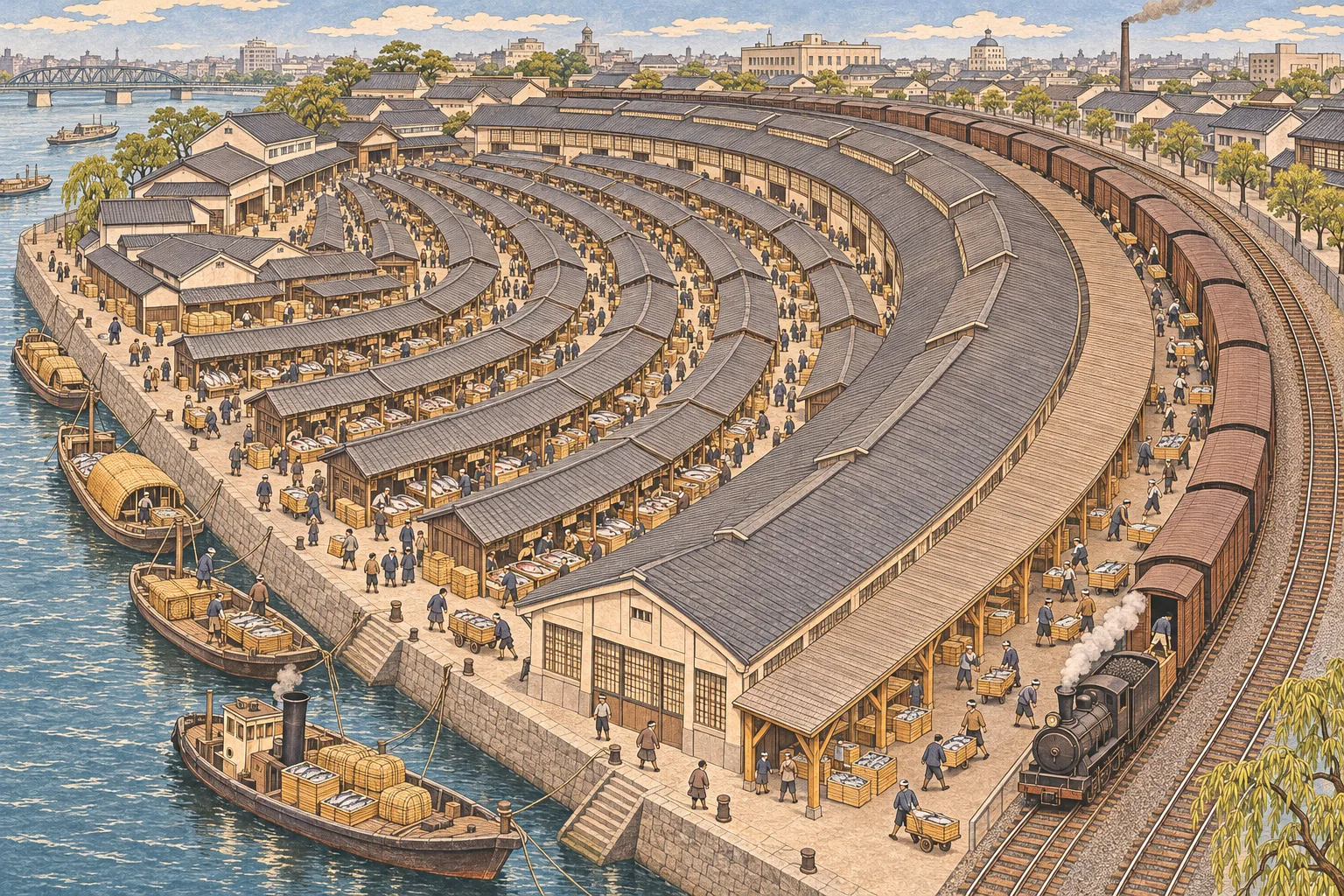
Tsukiji from the air in the 1930s: the fan-shaped main building follows the bend of the freight siding on its outer edge, where wagons are unloaded; rows of stalls fill the inside of the arc (artist’s impression)
Tsukiji also fixed the two-tier structure that every Japanese central market still uses. On the outer side, near the rail and the water, wholesalers held their auctions. Inside the arc, packed in rows, were hundreds of tiny stalls belonging to intermediate wholesalers. Over the twentieth century Tsukiji became the busiest fish market in the world, handling several hundred kinds of seafood, and the image of frozen tuna laid out in rows on its auction floor introduced foreigners to how seriously Japan takes a single fish.
03Who Owns the Fish? The Chain of Hands
To make sense of a Japanese fish market, track who owns the fish at each stage.
It begins at a port. When a boat comes in, the catch goes first to a production-area market (sanchi shijō) on the quay, usually run by the local fishing cooperative. At big ports such as Chōshi, Yaizu, Kesennuma or Sakaiminato, the dockside sale happens early each morning. Crew tip the catch into plastic crates sorted by species and size, and local dealers and processors bid, often by writing prices on slips of paper. Whoever then sends fish onward to the cities is called the ninushi, the shipper or consignor: a cooperative, a port dealer, a fish farm, or an importer. The fish is iced, packed in polystyrene boxes labelled with port and boat, and loaded that evening onto refrigerated trucks or into aircraft holds.
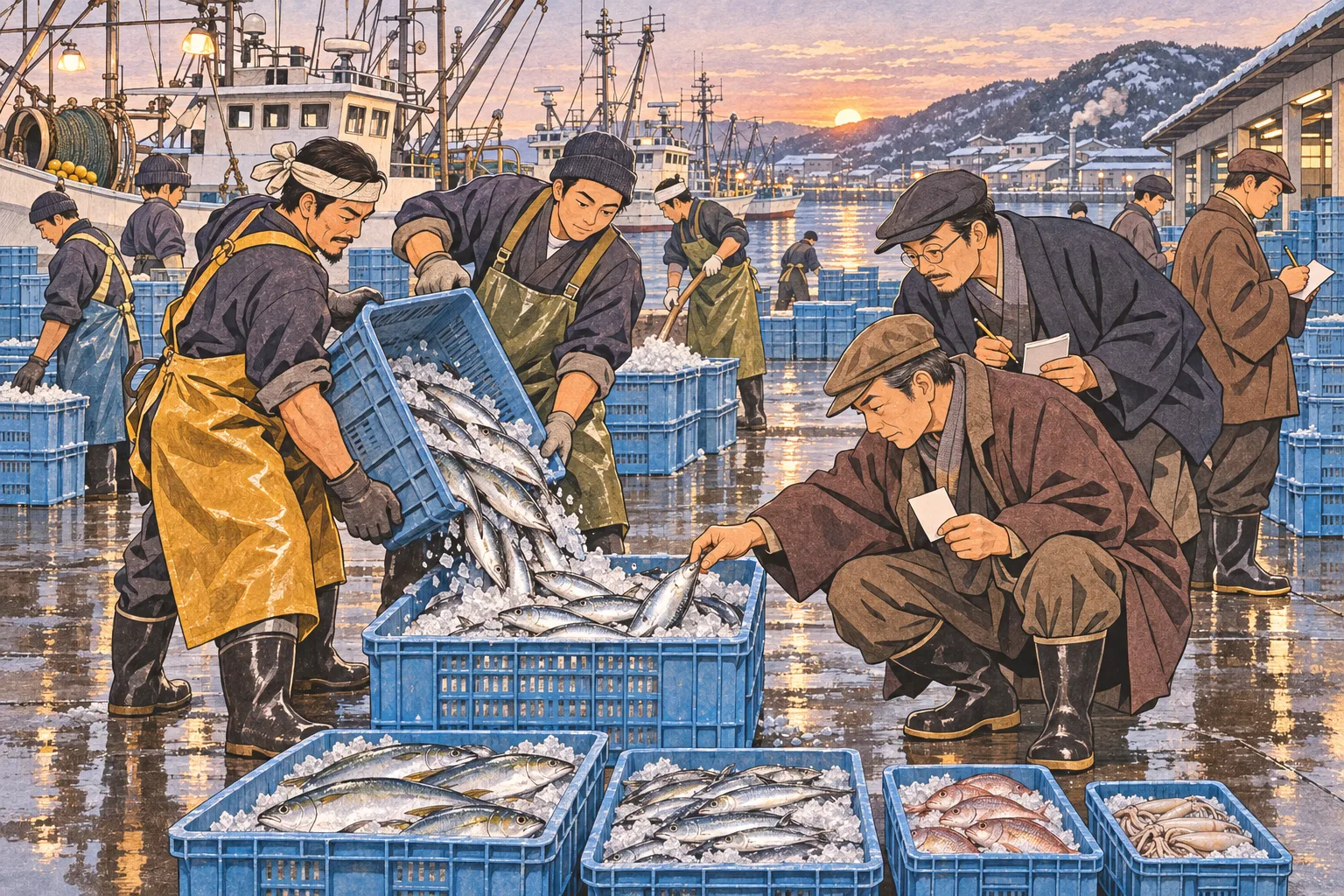
Early morning at a port market: crew tip iced fish into blue plastic crates while local dealers inspect the catch and write their bids on slips of paper
The next stage is the central wholesale market in a city, where the key player is the oroshiuri gyōsha, the licensed wholesaler. There are just seven of these large companies in Toyosu’s seafood division. Traditionally, shippers consign their fish to a wholesaler, who sells it in the market and passes the proceeds back minus a commission; since a 2004 change in the law, wholesalers may also buy fish outright and resell it. On consigned fish, because that commission is a percentage of the selling price, the wholesaler wants the highest price possible. That shared interest between shipper and auctioneer is what keeps the bidding honest.
Third come the nakaoroshi gyōsha, the intermediate wholesalers, usually just called nakaoroshi. Each one rents a stall inside the market, typically a few square metres with a hanging shop sign bearing the house name, a floor stacked with boxes, and a counter of ice. They are the buyers at the auction. They buy whole crates and whole fish, then break them down. No sushi bar can use a 200-kilogram bluefin, so a tuna nakaoroshi splits it into back and belly sections and then into the rectangular blocks called saku that a chef actually wants.
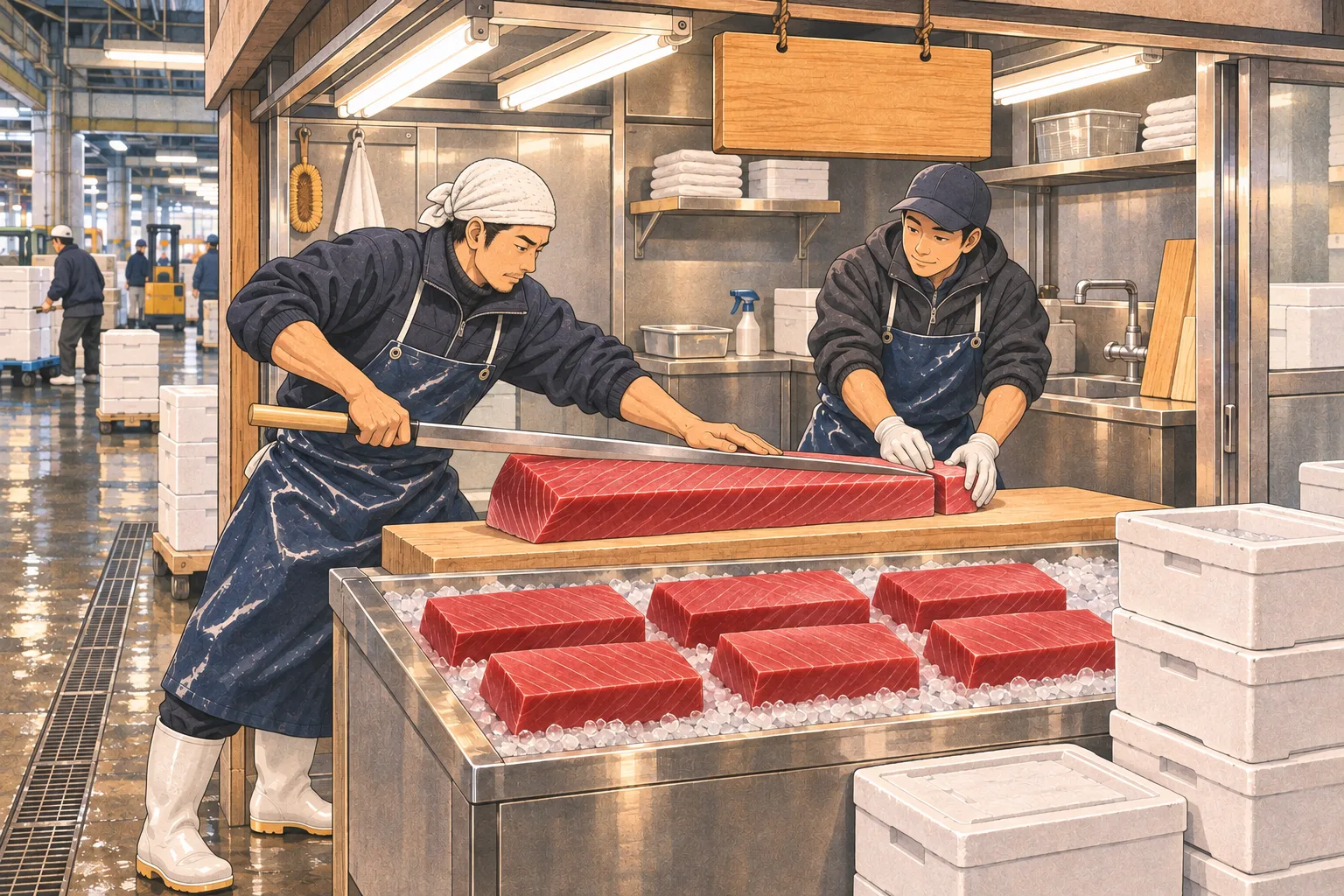
A nakaoroshi stall: two men divide a large block of tuna with a long knife, and the finished rectangular saku sit on the ice counter under the hanging house sign
What a nakaoroshi really sells is judgement. Most specialise narrowly. One deals only in tuna, another in prawns and crab, another in the small Edo-style fish (gizzard shad, conger eel, clams), another in live white-fleshed fish. They inspect the goods before every auction, decide which lots are worth what, and buy with particular customers in mind. An old sushi bar may buy from the same two or three stalls for decades, and the stallholder knows exactly what size of fish and what level of fat its chef likes.
At the end of the chain are the kaidashinin, the buyers who shop at those stalls: chefs and buyers from sushi bars, ryōtei and other Japanese restaurants, retail fishmongers, supermarket buyers and small dealers who supply hotels. They generally cannot bid at the auction themselves. A separate category of authorised buyers (baibai sankasha), large supermarket chains and processors among them, may bid directly.
It looks like too many middlemen, but each link solves a problem. A shipper hundreds of kilometres away cannot find a thousand sushi bars; a sushi bar that needs four blocks of fish a day cannot attend a port auction. The wholesaler gathers fish from the whole country and sets a public price. The nakaoroshi divides it into usable amounts and stakes his reputation on choosing well.
04Bells, Chanting and Fingers: How the Auction Works
The auction, called seri, starts in the small hours and runs to a timetable, with different species sold in different halls at different times. The order is roughly this: display, inspection, auction, delivery. Through the night, trucks back into the loading bays and the goods are laid out by wholesaler and species, lids off, each lot tagged with a card showing origin, weight and often the boat’s name. Nakaoroshi walk the rows with torches and notebooks. They lift a corner of the ice to see an eye or a gill, press the flesh, and jot down which lots to go for.
When a sale begins, the auctioneer, the seri-nin, steps up onto a small raised platform and a hand bell is rung, or an electric one sounds. The bell marks the start of that session. The auctioneer chants the lot and the opening price in a fast, rhythmic patter that outsiders can barely follow. Buyers crowd around in caps bearing their licence numbers. Each lot is decided in a few seconds and the auctioneer moves straight on. Tuna, live fish, shellfish and frozen goods each have their own session and their own start time, staggered so that a buyer can get from one to the next.
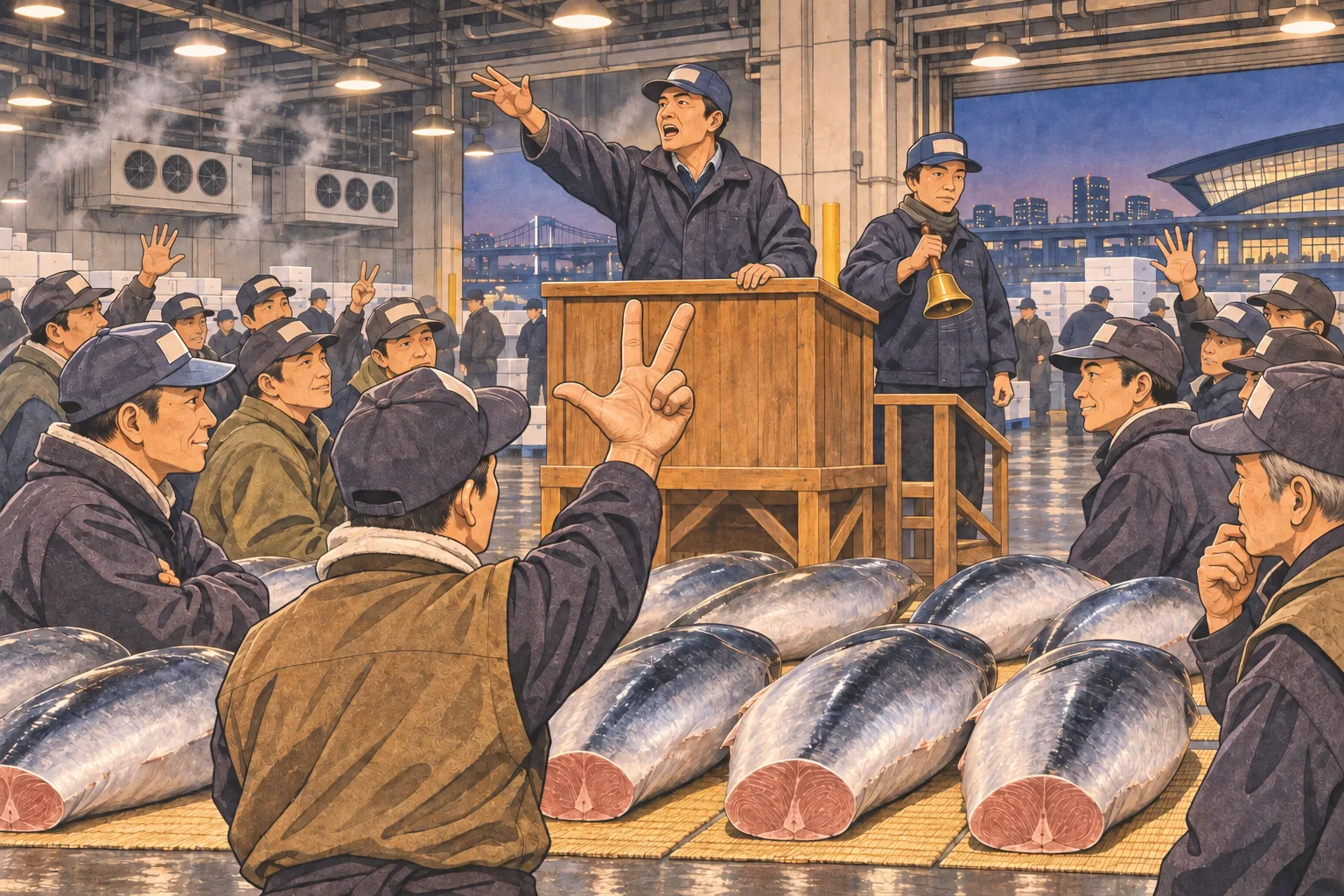
A tuna auction begins: the seri-nin calls from his small platform as the hand bell is rung. The buyer in the foreground shows thumb, index and middle finger, the teyari sign for eight; the tuna on the floor have their tails cut off
Bids are made with the hand, not the voice. The system of finger signs is called teyari. A buyer raises one hand with the fingers formed into a number from one to nine, and the auctioneer reads the highest. One to five are shown more or less as you would expect; from six upwards the thumb leads (eight, for example, is thumb, index and middle finger), and the exact shapes vary somewhat between markets and between trades. Usually only the last digits are signalled, since everyone knows what price range the bidding is in. The auctioneer picks out the winning hand from a ring of raised ones in an instant and calls the buyer’s number. Hands are faster than voices and cannot be drowned out, and an experienced buyer is said to keep his hand low at times so that only the auctioneer sees what he is offering.
Tuna sales are the most famous and involve the most careful inspection. Fresh and frozen tuna lie in rows on the floor, each with its tail cut off to expose a cross-section, and buyers shine torches on the cut and pinch a sliver of flesh taken with a hand hook; on frozen fish, a piece cut from the tail is laid on the body for inspection. How a buyer reads that cut is a subject of its own.
The auction is no longer the main way fish changes hands. Wholesalers and nakaoroshi can also agree price and quantity in advance by private negotiation, aitai torihiki. Since a 1999 revision of the wholesale market law dropped the rule that sales should in principle be by auction or tender, negotiated sales have grown steadily; in many categories they now account for far more of the trade than the auction does. Supermarket chains want guaranteed volumes and prices fixed before dawn; frozen and farmed fish are consistent enough that daily face-to-face bidding adds little; shippers like to know where their fish is going. At Toyosu today the bell rings mainly for tuna, premium live fish and part of the fresh catch. Much of the rest is sold by negotiation from around midnight, quietly, by phone and computer, before the auction starts.
05Tsukiji Outer Market and the Move to Toyosu
The wholesale market at Tsukiji was called the inner market, jōnai. The streets outside its walls became the outer market, jōgai. Nobody planned the outer market; it grew around the inner one. The tens of thousands of buyers who poured into Tsukiji every morning needed more than fish. They needed knives for filleting, wooden boxes and wrapping paper, nori, dried gourd, katsuobushi, kombu, sesame and vinegar for the sushi bar, aprons and tall rubber boots, and breakfast after the shopping was done. Knife shops, dried-goods dealers, kitchenware stores, tamagoyaki makers and small canteens clustered outside the gate, all originally serving the trade.
Tourists came later, first as an add-on to a dawn visit to the tuna auction, and the outer market gradually became a shopping street that serves both visitors and professionals. Today there are queues outside the omelette shops for slices of freshly rolled tamagoyaki, and knife-shop windows hold walls of long slicing knives and heavy-backed filleting blades.
In October 2018 the inner market moved to Toyosu in Kōtō Ward, but the outer market stayed in Tsukiji. Many of its businesses had longstanding ties to the inner market traders, and Chūō Ward built a new facility, Tsukiji Uogashi, aimed mainly at food professionals, so that nearby restaurants could still buy fish without travelling to Toyosu. The result is a strange arrangement: the market at the centre has gone, and the ring of shops that grew up around it remains.
The move had been debated for years. By the 1990s Tsukiji’s buildings were old, open to the weather, and crowded with trucks, carts and pedestrians on the same floor; hygiene and temperature control lagged behind modern standards. In 2001 Tokyo chose a former gasworks site at Toyosu, where soil and groundwater turned out to contain benzene, cyanide and other contaminants, which made the plan deeply controversial. The move was scheduled for 7 November 2016, but in August that year a newly elected governor postponed it, and the discovery in September that the main buildings stood over empty underground spaces instead of the planned layer of clean fill prolonged the delay. Toyosu finally opened on 11 October 2018.
The biggest difference is that Toyosu is enclosed. It is split into separate buildings for the wholesalers’ auction halls, the nakaoroshi stalls and fruit and vegetables, on blocks divided by roads. Trucks dock at sealed bays, and fish moves from refrigerated vehicle to chilled hall without meeting the outside air. Much of Tsukiji’s crowded chaos is gone, but the cold chain is unbroken. The nakaoroshi stall layout largely reproduces Tsukiji’s, and many traders brought their old signboards with them.
The first auction of the year, hatsuseri, held around 5 January, is the market’s biggest media moment. The first tuna is often won by a sushi chain or a high-end restaurant at a price that leads the evening news. Everyone in the trade understands that the figure has little to do with the fish. It is a ritual for luck and a piece of advertising: the buyer gets national coverage, and the port that landed the fish gets its name known. After that morning, prices go back to normal.
06Before Sunrise: A Sushi Chef Goes Shopping
For a serious Tokyo sushi chef, the market is where the working day begins. Many rise around four or five and drive or take the first train to Toyosu, sometimes with an apprentice. By the time they arrive the auctions are under way or over, and the chef does not go to the auction hall at all. He goes to the stalls of the few nakaoroshi he trusts.
There is little haggling. The stallholder has already set aside what suits this shop: a block of tuna, a handful of gizzard shad, a box of live kuruma prawns, a tray of Hokkaidō sea urchin. He says which catch is good today and which is a little off, and may suggest a substitute. The chef looks at the eye, the colour of the gill, the firmness of the flesh, asks about the port or how the fish was caught, and nods. Regulars often settle up monthly rather than discussing prices on the spot. The relationship between a sushi bar and a nakaoroshi house can run across two generations on each side.
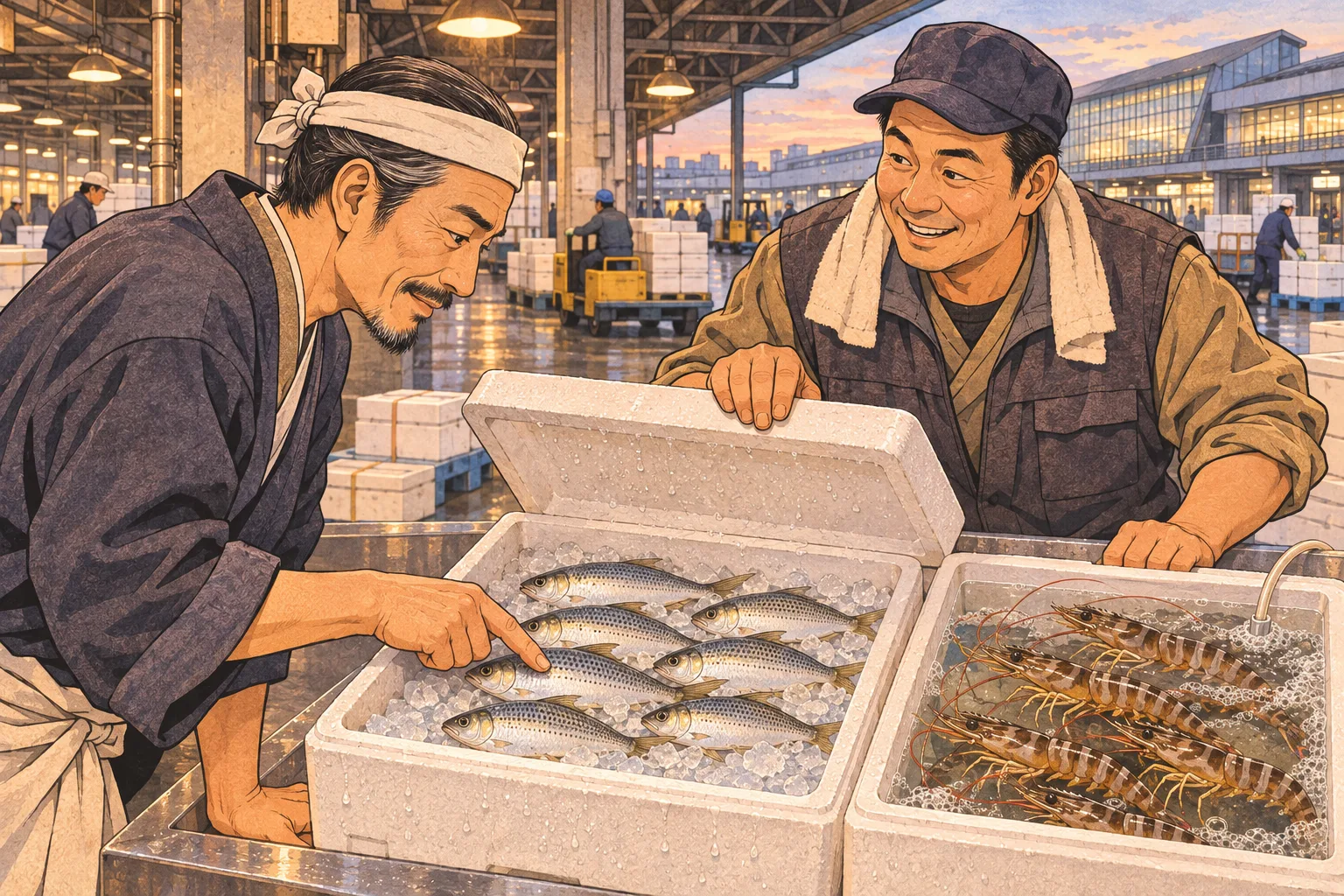
Before sunrise at a nakaoroshi stall: the stallholder lifts the lid on a box of gizzard shad and another of live kuruma prawns, and the sushi chef presses the fish with a fingertip
The chef does not carry the fish himself. The market’s aisles are full of turret trucks, called tāre: small electric carts with a cylindrical drum at the front where the driver stands, pulling a flatbed piled with polystyrene boxes. Purchases are handed to delivery firms that take them to the car park or straight to the shop. At Tsukiji, buyers are also said to have used shops called chaya, "teahouses," where goods bought at different stalls could be collected and held for pickup.
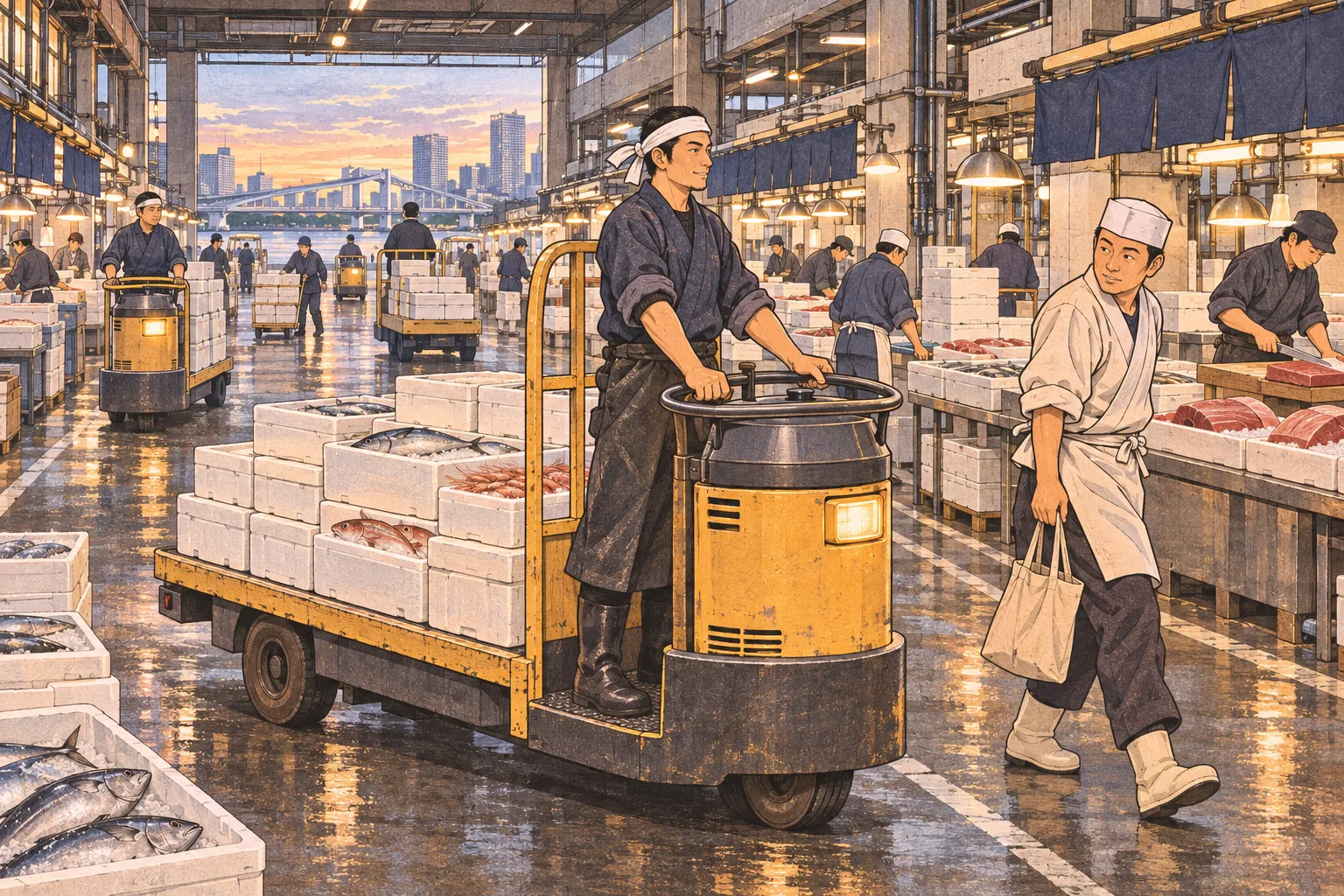
Turret trucks (tāre) in a market aisle: the driver stands at the cylindrical drum and the flatbed behind is piled with polystyrene boxes, while a chef with a bag steps aside
Many chefs stop for dried goods and supplies on the way out and eat breakfast at one of the market canteens. By the time they get back to the shop the sun is coming up, and what happens to the fish from there belongs to another story.
07Beyond Tokyo: Regional Markets and Morning Markets
Every large Japanese city has a central wholesale market built on the same pattern as Toyosu. Many also have retail markets and morning markets (asaichi) open to everyone. What sets them apart is what they sell.
Ōsaka’s main central wholesale market, at Noda in Fukushima Ward, opened in November 1931 as one of the first in Japan, after Kyōto’s in 1927. Ōsaka cooks favour white-fleshed fish from the Inland Sea, especially sea bream, flounder and pike conger (hamo), which is in huge demand in summer. Kuromon Market, near Ōsaka’s own Nipponbashi district, is a retail market nicknamed "Ōsaka’s kitchen," built to supply restaurants and households, and its fugu shops stand out.
In Fukuoka, the wholesale fish trade centres on the Nagahama fish market in Chūō Ward. The city faces the Genkai Sea and the Tsushima Strait; mackerel, sea bream, squid and yellowtail are the local strengths, and Fukuoka’s habit of eating mackerel raw, as goma-saba dressed with sesame, depends on how fast the fish gets from boat to plate. Yanagibashi Rengō Market, nicknamed "Hakata’s kitchen," is the retail counterpart.
Hakodate’s morning market, beside the main railway station, is one of the best known in Hokkaidō. Hakodate is a squid town, and live squid in summer and autumn is the signature: sliced to order, so fresh the tentacles still move. Crab of several kinds, sea urchin and salmon roe fill the other stalls, and many shops serve them heaped on rice.
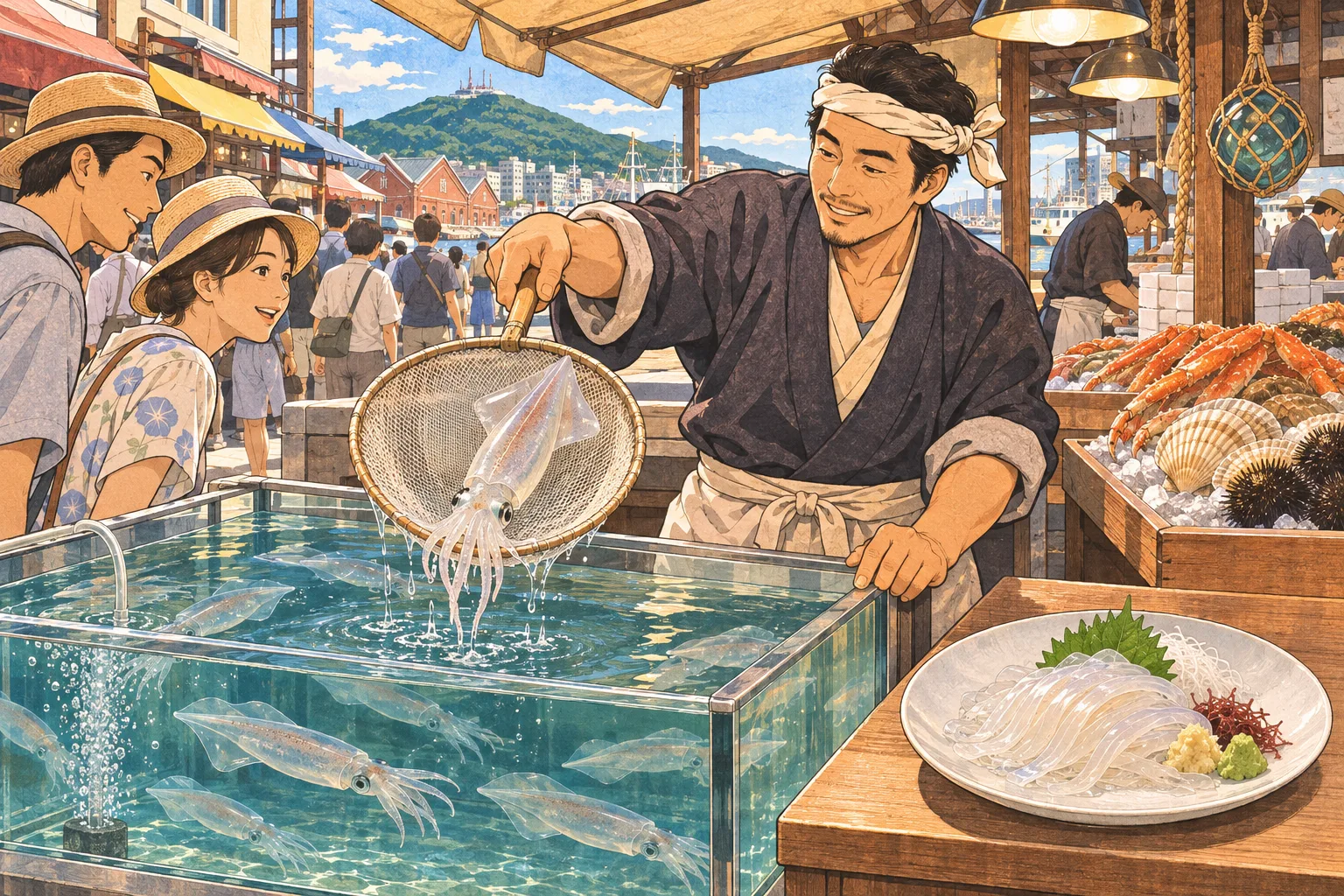
Hakodate’s morning market: a stallholder nets a translucent live squid from the tank, with a plate of freshly sliced squid at right and crab, scallops and sea urchin on ice behind
Ōmichō Market in central Kanazawa has served the city for around three hundred years and is called "Kanazawa’s kitchen." It sells the seafood of the Hokuriku coast: in winter the small female snow crabs called kōbako-gani, packed with roe, along with sweet shrimp, blackthroat seaperch (nodoguro) and winter yellowtail. The Hokuriku Shinkansen brought many more visitors, but it is still where locals shop, and the stallholders’ shouting has a very different rhythm from a Tokyo auction hall.
Karato Market in Shimonoseki sits on the Kanmon Strait, facing Moji across the water. Shimonoseki is Japan’s fugu capital, where the fish is called fuku, a pun on the word for good fortune. The specialist fugu auction, though, takes place at nearby Haedomari market, where auctioneer and buyer put their hands inside a black cloth tube and the buyer bids by gripping the auctioneer’s fingers, unseen by anyone else. This is called fukuro-zeri, the bag auction. Karato itself is a general market, where fish dealers also sell trays of sushi and fried seafood.
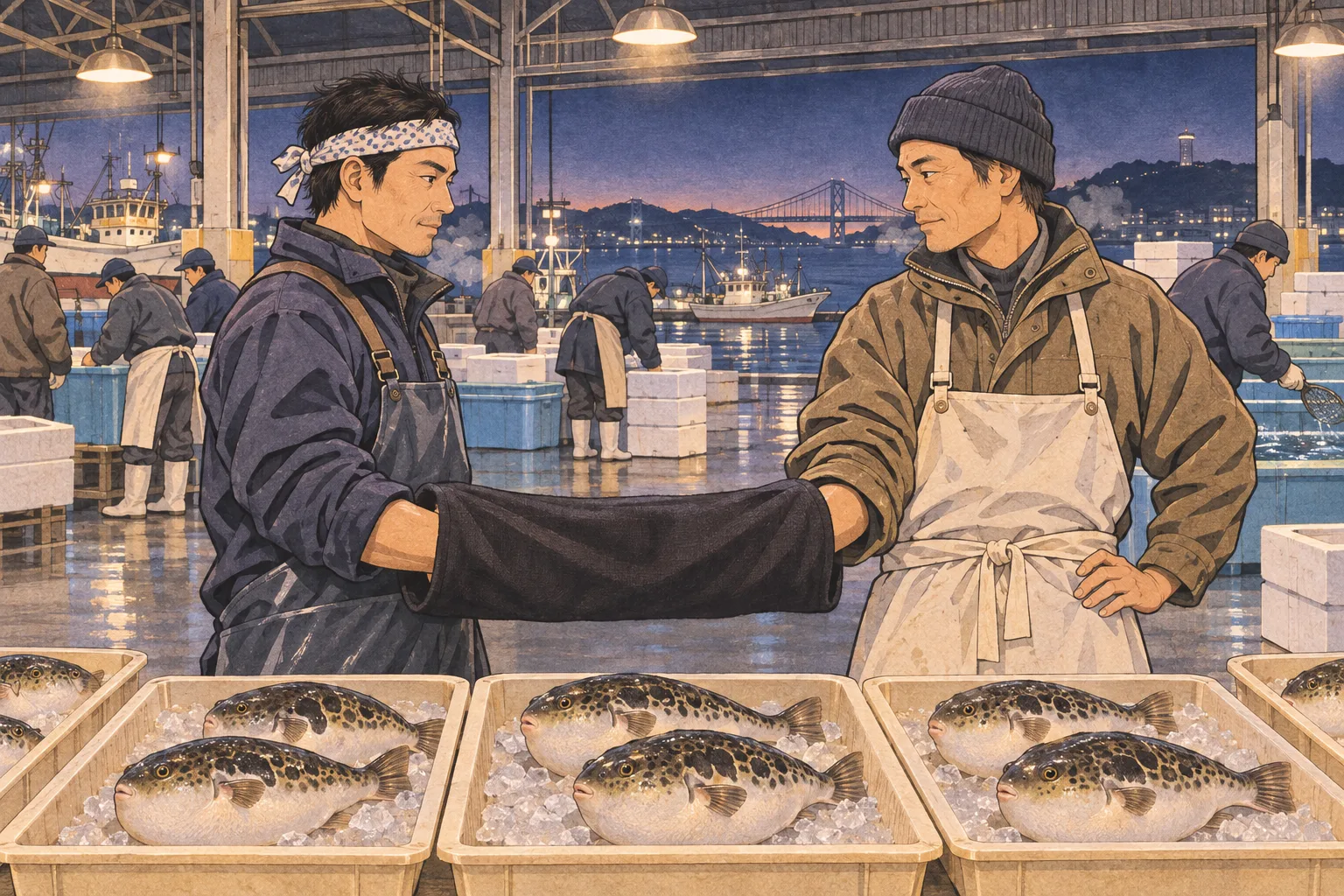
Fukuro-zeri, the bag auction, at Haedomari market in Shimonoseki: auctioneer and buyer each put a hand into one black cloth tube, so the bid is hidden from everyone else. Fugu lie in the trays in front
08Five Stops Side by Side
Laid out next to each other, the five stops on a fish’s journey are easy to tell apart.
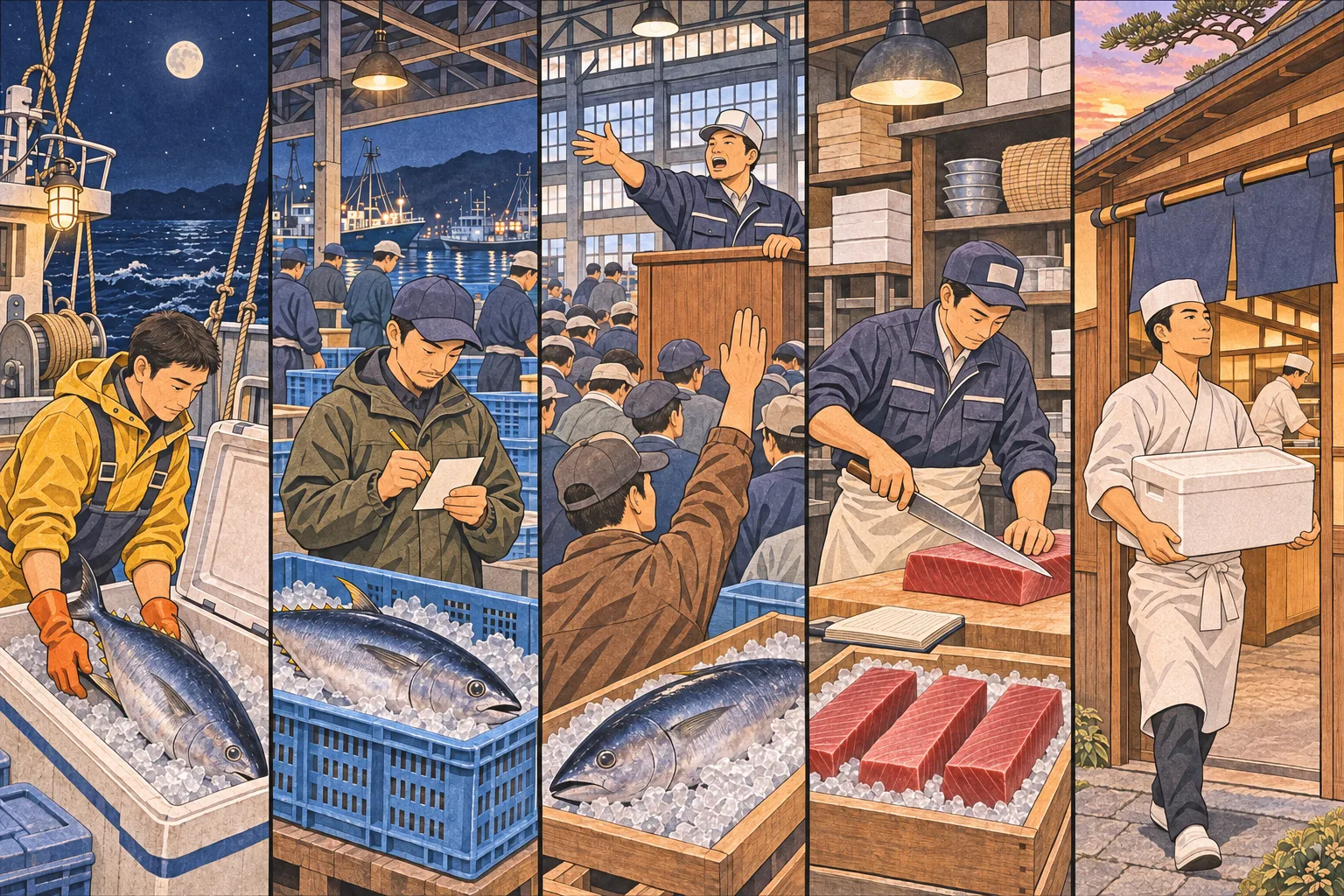
Five stops for one tuna, from left: iced on the boat; the port market, where a dealer writes a bid slip; the city auction, with auctioneer and raised hand; the nakaoroshi stall, where it is cut into saku; the sushi bar, with a chef carrying the box at the shop door
On the boat, the fish belongs to the fisherman or boat owner. The crew sort and ice the catch; premium fish may be killed and bled on the spot by ikejime to keep them fresh. The scene: a deck, crates, ice, crew in rubber aprons.
At the port market, the catch is tipped into crates by species and size, local dealers bid on paper slips, and the fisherman is paid for the first time. Fish here are still mixed in size, and the crates carry the boat’s name. From this point the shipper takes over and the long haul begins.
At the city auction, consigned fish still belongs to the shipper; the wholesaler only sells it for a commission. The markers are the bell, the auctioneer’s platform, raised hands and buyers in numbered caps. Everything is sold by the crate or by the whole fish.
At the nakaoroshi stall, consigned fish passes for the first time into the hands of someone inside the market. Whole fish are broken down, blocks are set out on ice, and the stallholder talks one to one with regular customers. Look for a tiny stall, a house-name sign, a long knife and a floor of boxes.
At the sushi bar, the fish arrives in portions ready to prepare and leaves the market system for the kitchen.
Two pairs are easily confused. The wholesaler is the seller at the auction: few in number, large companies, never splitting a lot. The nakaoroshi is the buyer: many, small, cutting and choosing. If someone stands on a platform calling prices after a bell, he works for a wholesaler; if someone is sawing a tuna in a stall, he is a nakaoroshi. The other pair is the wholesale market versus the outer market or morning market. The first is a trade floor, busiest before dawn; the second is a retail street open in daylight, where anyone can buy and eat. Tsukiji today is only the second kind. Toyosu is the first.
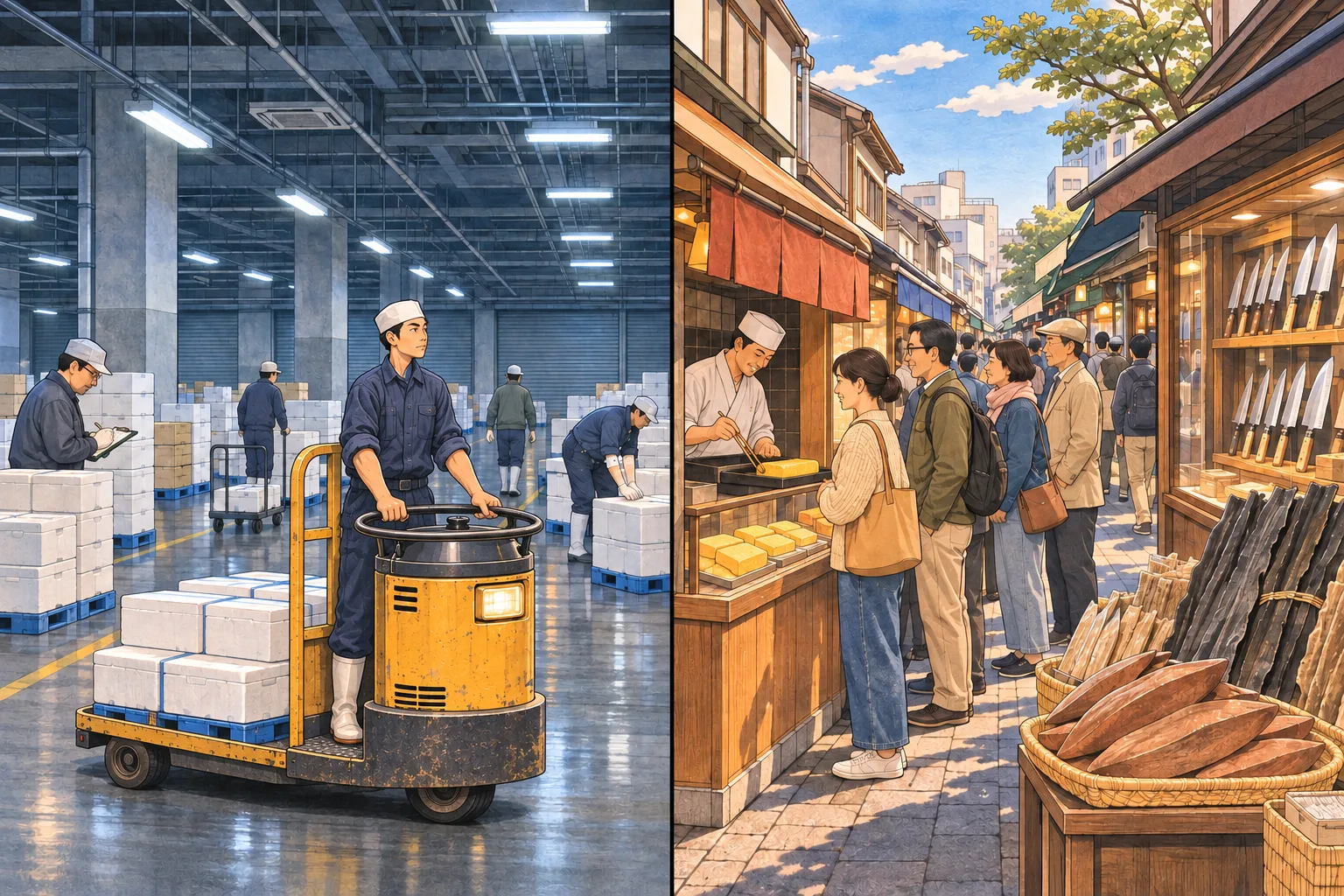
Left: Toyosu’s enclosed wholesale floor, with only trade workers, stacked boxes and a turret truck under cold light. Right: Tsukiji’s outer market in daylight, with visitors queuing for tamagoyaki beside a knife-shop window and a dried-goods stall
The chain is this finely divided because fish is perishable and impossible to standardise. Two tuna of the same species can differ in price tenfold; farmed and wild sea bream from different waters fetch different prices on the same morning. Each extra pair of hands adds a specialist checking quality for the next one. A Tokyo sushi counter may offer twenty or thirty kinds of seasonal fish on a single day, from ports between Hokkaidō and Kyūshū, and each of them has made this five-stop journey.
More deep dives on this topic
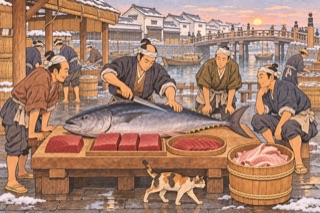 TunaOrder an omakase in Tokyo and the tuna usually arrives in a sequence: a slice of deep red lean meat, then something pinker and softer, then a pale, marbled piece that seems to…
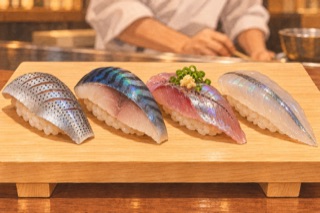 HikarimonoSit at a sushi counter in Japan and, somewhere in the middle of the meal, the chef will set down a piece that looks different from the rest.
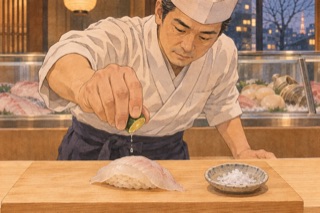 Beyond TunaMost first-time visitors walk into a sushi bar thinking about tuna.
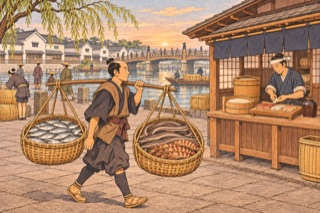 Edomae ShigotoMost visitors arrive at a Tokyo sushi counter expecting raw fish on rice.
 Shari and Its Supporting CastAt a sushi counter your eyes follow the fish.
 Regional Sushi Beyond TokyoMost visitors meet sushi at a counter: a chef shapes rice in one hand, lays a slice of fish on top and sets it down in front of you, to be eaten within seconds.
 KaitenzushiSit down at a kaitenzushi (conveyor-belt sushi) counter anywhere in Japan and the basic deal is the same.
 Fish MarketsThe piece of sea bream a sushi chef slides across the counter at lunchtime has usually changed hands four or five times since it left the water.
 Words at the Sushi CounterSit at a sushi counter in Japan and the language around you shifts.
 The Sushi ChefFrom a counter seat, a sushi chef looks like a pair of hands and very little else.
- Back to the main article: Sushi →