
Most visitors arrive at a Tokyo sushi counter expecting raw fish on rice. What an old-school Edomae chef serves is often something else: fish that has been salted, rinsed in vinegar, pressed between sheets of kelp, soaked in soy sauce, simmered for hours, flashed with boiling water or seared over charcoal, sometimes days before it reaches the counter. Sushi chefs call this preparatory work shigoto, simply "the job" or "the work", and in Tokyo a shop is judged as much by its shigoto as by the quality of its tuna. This piece goes through the main techniques one by one: what the chef does, why, and how you can recognise the result when the piece is set down in front of you.
01Why Edomae Fish Is "Worked"
Nigiri took shape on the street stalls of early nineteenth-century Edo, before refrigeration, as our main sushi article explains. In practical terms: fish came off boats in Edo Bay, at Shibaura, Shinagawa and Fukagawa, went to the fish market at Nihonbashi, and was then carried to stalls across the city. Several hours, sometimes a day, could pass between the catch and the customer, through long, humid summers.
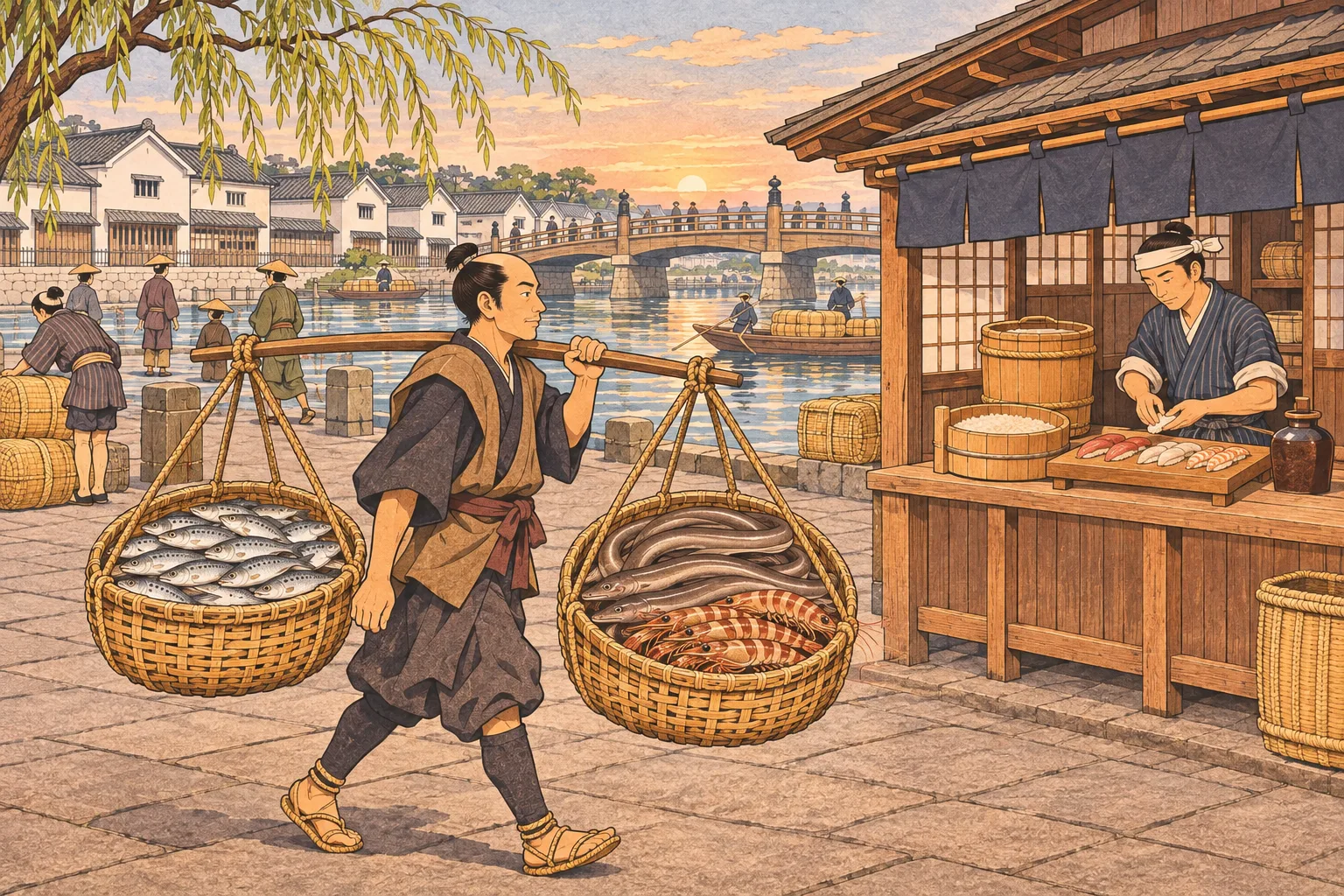
Early morning in late Edo: a porter carries one basket of kohada and another of anago and kuruma prawns from the waterfront toward a street sushi stall, which has a rice tub and a soy jar but nothing to keep fish cold (artist’s impression)
So stallholders used a set of methods, most of them older than nigiri itself, to stabilise the fish. Salt draws out water and the smell that comes with it, and firms the flesh. Vinegar whitens and tightens the surface and slows bacteria. Soy sauce seasons and coats. Long simmering makes clams, conger eel and octopus tender and flavoured. A thick, sweet glaze brushed on at the end meant the customer didn’t need a dipping bowl at all.
A list compiled in the late Edo period by the writer Kitagawa Morisada gives a sense of what the stalls sold: egg omelette, kuruma prawn, shrimp floss, icefish (shirauo), tuna sashimi, gizzard shad, and conger eel simmered whole. Most of it was cooked, cured or marinated in some way.
Refrigeration removed the original necessity, yet the techniques survived because they make fish taste better, not just keep longer. Salt and vinegar sharpen the oil in a gizzard shad. Kelp gives a mild flounder a savoury depth it never had. A few days’ rest brings out sweetness in sea bream. In Japanese food writing you’ll often see a contrast drawn between sushi that wins on freshness, where the ideal is a perfect fish sliced as is, and sushi that wins on shigoto, where the chef’s skill lies in knowing exactly how far to take each fish. "Edomae", in the sense chefs use it today, usually means the second.
Almost all of this happens out of sight, in the kitchen before service. What you see at the counter is the last flourish: a brush stroke across the fish, or a torch passed over the skin. The rest you have to read from the fish itself.
02Salt and Vinegar: Kohada, Saba and Kasugo
Fish cured with salt and vinegar are called shimemono, from shimeru, "to tighten". The most prized is kohada, young gizzard shad, a small silver fish with dark spots. Many chefs regard it as the signature of their shop. (Its name changes as it grows, and its seasons are a story of their own, covered in our piece on silver-skinned fish.)
Preparation starts in the morning. Each fish, only a hand-span or so long, is scaled, headed and gutted, then split open along the back or belly and laid flat, with the backbone and belly bones cut away. The flesh is thin and soft and tears easily, and a busy shop may split dozens or hundreds in a session.
Next comes salt. The chef scatters it from a height so it falls evenly across trays of split fish laid skin-down; some shops use brine instead. How much and for how long depends on the fish that day: its size, its fat, even the weather. Lean summer fish need little. Fat winter fish need more. Chefs judge by pressing the flesh with a fingertip, and most will tell you the call is different every day.
The salt is then rinsed off quickly and the fish patted dry. Vinegar comes next, often in two stages: a quick pass through used vinegar to carry away residual moisture and smell, then a soak in fresh vinegar. As it soaks, the flesh turns from translucent to opaque white, working inward from the edges. When to lift it out decides the character of the finished fish. A light cure, asajime, leaves a blush of pink at the centre and a clear fish flavour. A deeper cure turns it white throughout, firmer, with the acid and oil fully merged.
Then the fish rests, usually at least overnight, so salt and vinegar can even out. Many shops serve kohada prepared the day before, some longer.
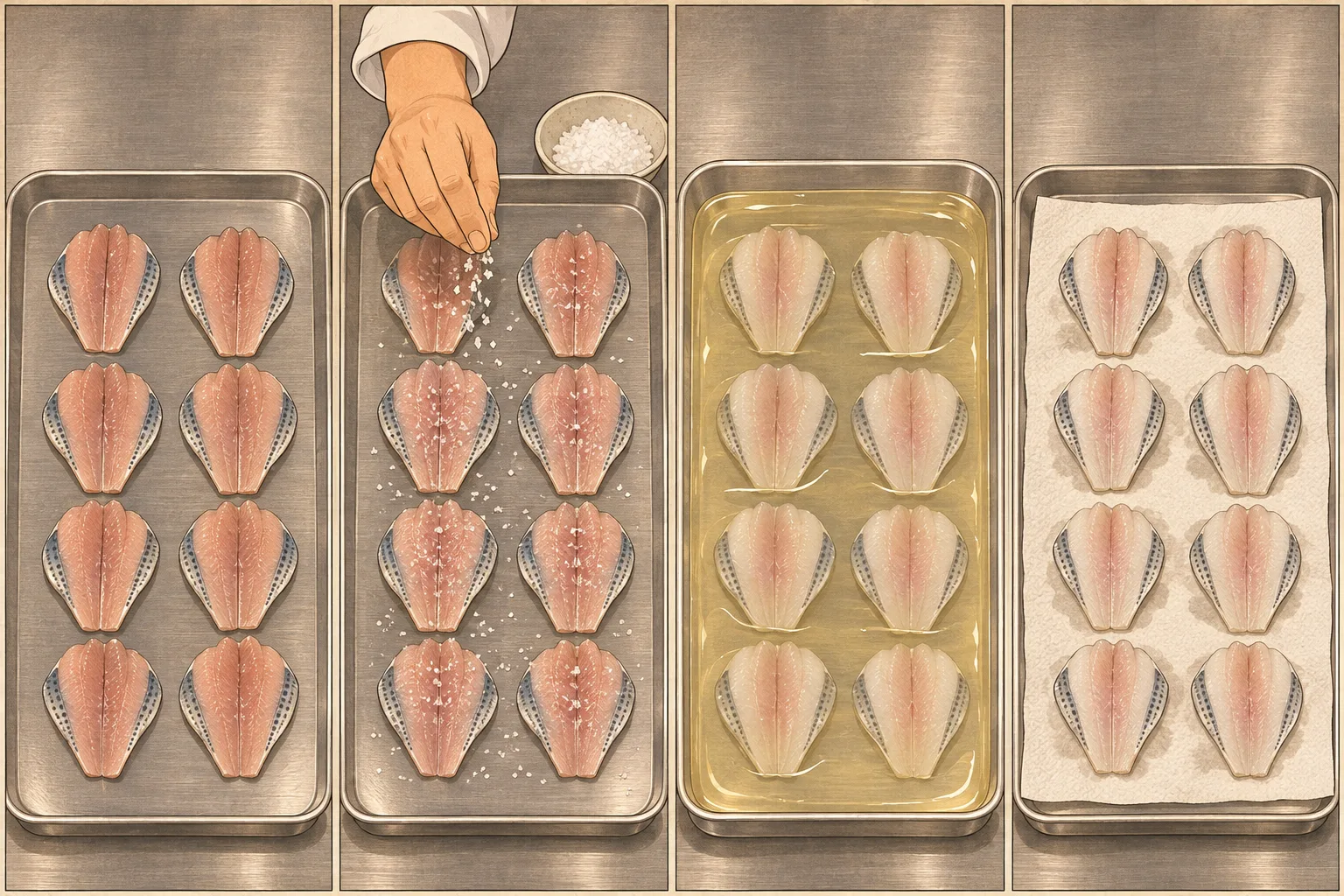
Curing kohada in four steps, left to right: split and laid flat on a tray; salt scattered from above; soaking in vinegar as the flesh turns from translucent to white; resting on paper until the next day
Just before serving, the chef scores the silver skin with fine parallel cuts or a crosshatch. This is practical: kohada skin is slightly tough, and the cuts make it easy to bite through and help the fillet drape over the rice. Small fish go on two or three to a piece. The tiny first-of-season shinko in summer may be stacked four or five deep. In traditional shops you may find a thin layer of oboro, a pale pink, sweet floss of pounded shrimp or white fish, tucked between kohada and rice, its sweetness balancing the vinegar.
Mackerel, saba, is the other classic. A Japanese saying holds that mackerel "rots while still alive"; it spoils fast, and traditional sushi shops almost never serve it raw. It is salted much more heavily than kohada and for longer, then soaked in vinegar. Before serving, the chef peels away a transparent outer membrane to reveal the bright silver and blue-black stripes beneath. Cut through, shime-saba shows a distinctive cross-section: an outer ring turned white by the vinegar around a deep pink centre. Kyoto and Osaka press the same cured mackerel into long blocks of bōzushi and battera; that belongs to the pressed-sushi tradition rather than Edomae nigiri, but the cure is the same.
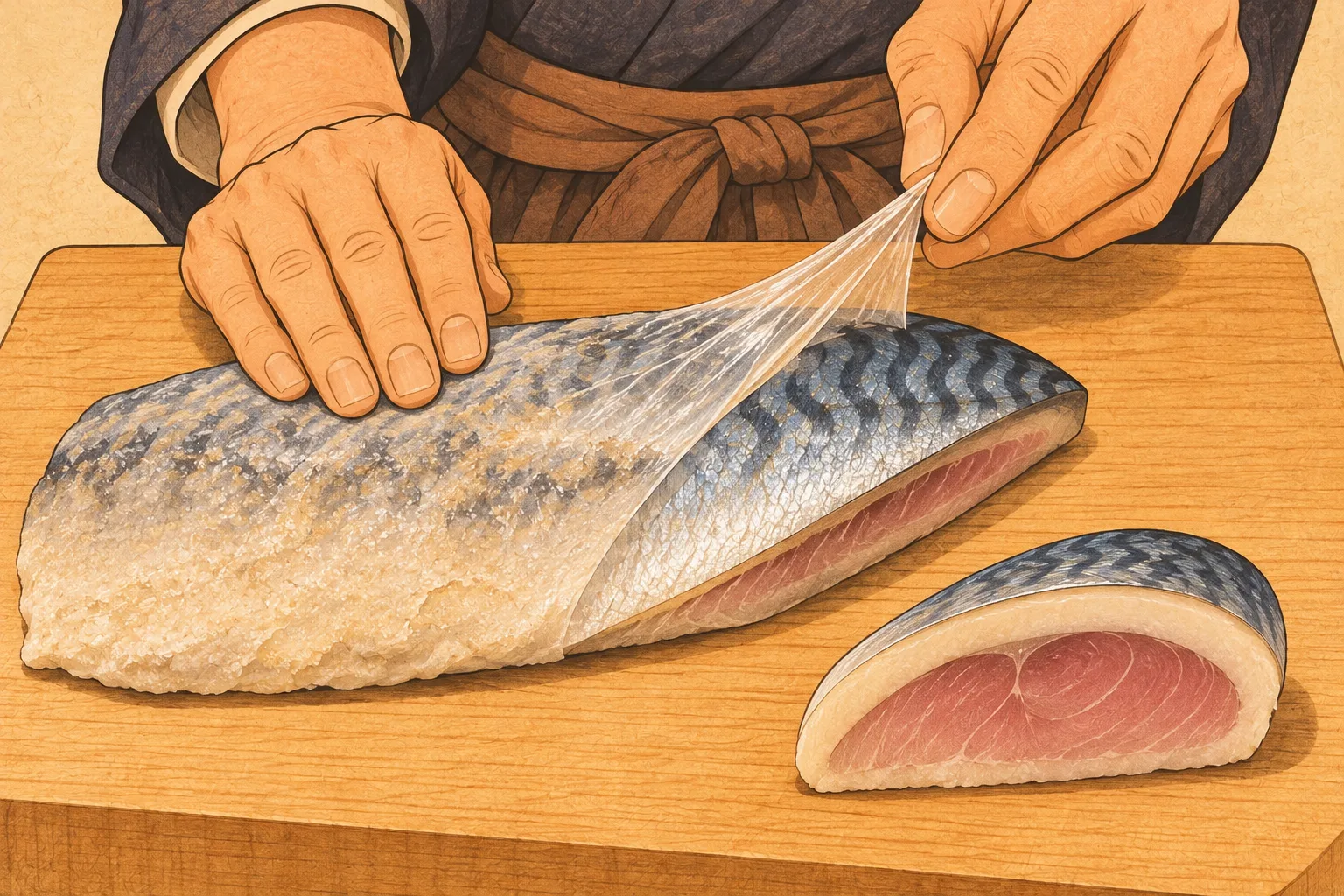
Shime-saba before serving: the transparent outer membrane is peeled away to show the silver and blue-black stripes. The cut piece on the right has the telltale white ring around a deep pink centre
Kasugo is a juvenile of the sea bream family, palm-sized and available in spring. Its skin is a faint cherry-blossom pink over fine white flesh. It is salted and vinegared like kohada but more gently, since the flesh is even more delicate, and is often paired with oboro so that a pink fillet sits over a hint of pink floss. It is one of the short seasonal markers of the Edomae year.
Other silver-skinned fish, such as sardine, halfbeak and horse mackerel, get salt and vinegar to varying degrees. To read a cured fish, look at the cut edge: a narrow white border around a glassy centre means a light cure; white all the way through means a deep one. Neither is "correct". It is the shop’s style.
03Kelp and Time: Kobujime and Aging
White-fleshed fish such as flounder (hirame) and sea bream (tai) are firm and springy when freshly killed but mild in flavour. Edomae chefs have two ways to give them more: kelp, and patience.
For kobujime, the fish is skinned, cut into a block or thin slices and lightly salted. Sheets of dried kelp (konbu) are wiped with a cloth dampened with sake or vinegar to soften them. The fish is laid on one sheet, covered with another, wrapped tightly and refrigerated for anywhere from a few hours to a day or two.
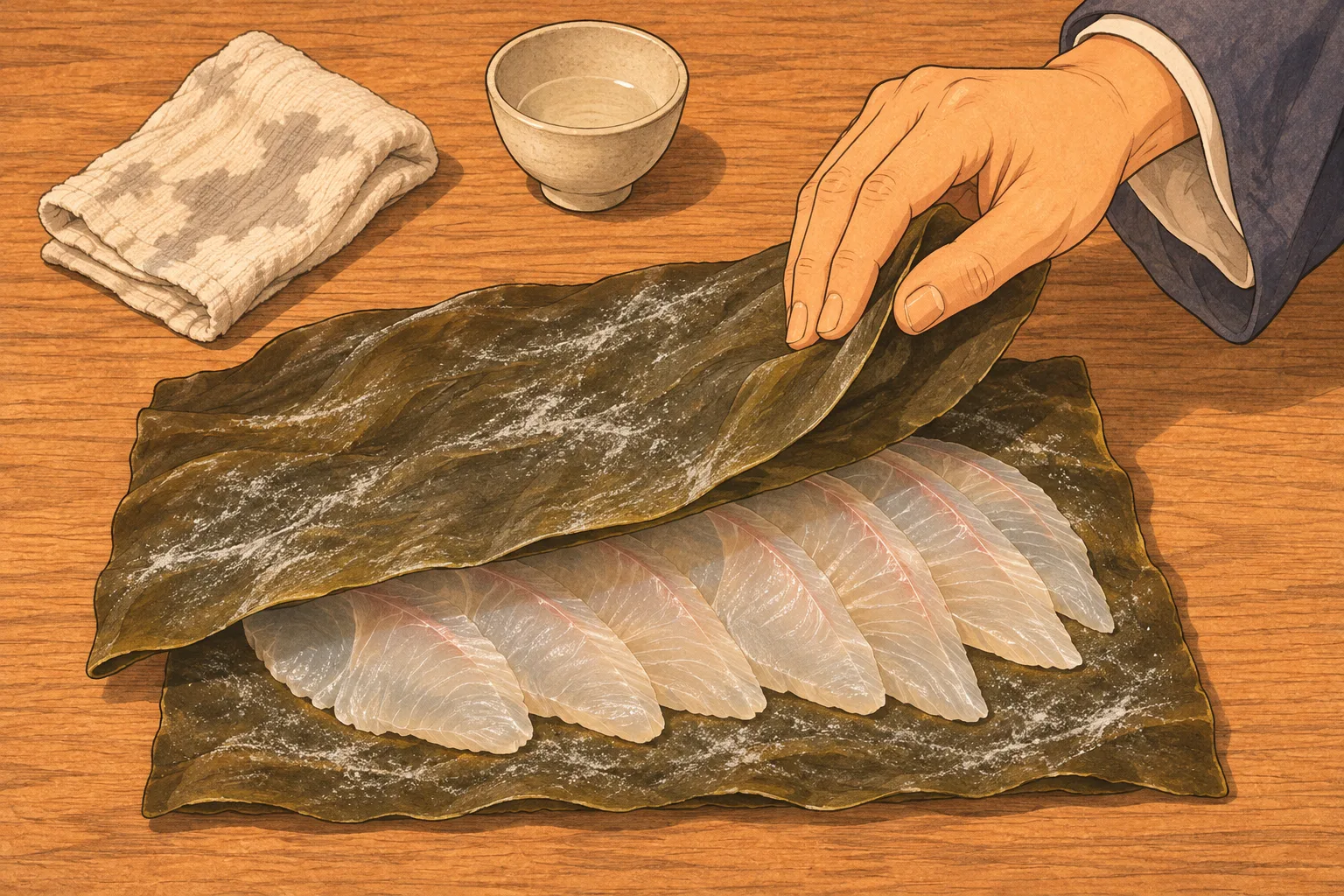
Kobujime: flounder slices are laid on one sheet of kelp and covered with a second. Beside them are the damp cloth used to wipe the kelp and a small cup of sake
Three things change. The colour shifts from translucent milk-white to a pale amber, deeper at the edges, with a waxy sheen. The texture tightens as the kelp draws out water, and the surface turns slightly tacky, giving a distinctive silky feel in the mouth. And the flavour deepens as glutamates from the kelp move into the flesh. Left too long, the kelp overwhelms the fish, so timing is the skill.
Kobujime is usually traced to Toyama, on the Sea of Japan coast, where kelp shipped from Hokkaido on Edo-period coastal freighters became an everyday ingredient. When it entered Tokyo sushi shops is not recorded. Today it is among the most common treatments of white fish in Edomae sushi, used on flounder, sea bream, halfbeak, kasugo, white shrimp and more.
At the counter, look for that amber gloss and darker rim, sometimes with faint lines pressed in by the kelp. Chefs often skip soy entirely on kobujime and finish it with a pinch of salt or a few drops of citrus.
The second method is aging, often described as letting the fish "sleep" (nekaseru). After death, a fish’s muscle stiffens in rigor and then slowly relaxes. Along the way, energy compounds in the muscle break down into inosinic acid, one of the sources of savoury taste. A flounder still in rigor is crunchy, what the Japanese call korikori, a texture some diners love. After a day or two it is softer, sweeter and more savoury.
Aging well depends on several things. Top shops use fish killed by ikejime, a quick spike to the brain and a cut to bleed it while still alive, and sometimes shinkei-jime, where a thin wire is run down the spinal canal to destroy the nerve and delay rigor. Thorough bleeding prevents off-flavours. The fish is then wrapped in absorbent paper and film and held at a steady low temperature, with the paper changed daily. The chef checks it every day by colour, smell and touch.
None of this is entirely new: before refrigeration, Edo fish were never eaten straight off the boat, and large fish such as tuna were always broken down and rested before use. What is new, over the past couple of decades, is extended aging pushed to a week or two for white fish and longer for tuna, promoted as a shop’s speciality. It is debated in Japan. Supporters praise the depth of flavour; critics say over-aged fish loses its character and picks up a cheesy note. Most traditional shops sit in between.
You can’t see aging, only taste it: softer, stickier flesh, slightly deeper colour, a longer finish. Asking the chef how many days a fish has rested is a normal counter conversation in Japan.
04Soy Sauce Two Ways: Zuke and Nikiri
At an Edomae counter, soy sauce is less a dip than a tool, used in two main ways: as a marinade, zuke, and as a glaze brushed on at the last moment, nikiri.
Zuke means "soaked", and its classic subject is akami, the lean red meat of tuna. Tuna was a lowly fish in Edo times (a story told in our piece on tuna), and for a stallholder a large block of red meat that would darken by evening was best preserved in soy. It is generally said that soy-marinated zuke caught on after a glut of tuna in the winter of 1810–11, and that tuna spread as a sushi topping after a second glut in 1832. For a time, "zuke" was sushi-counter slang for tuna itself.
In the classic method, a whole block of akami is set on a bamboo tray and doused with boiling water, which instantly turns the surface grey-white. It goes straight into ice water. This shimofuri, "frost-falling", seals the surface so soy won’t penetrate too far and removes any surface smell. The block is then soaked in soy sauce, or soy cooked with sake and mirin, then patted dry and sliced. A quicker version skips the hot water and briefly marinates the slices.
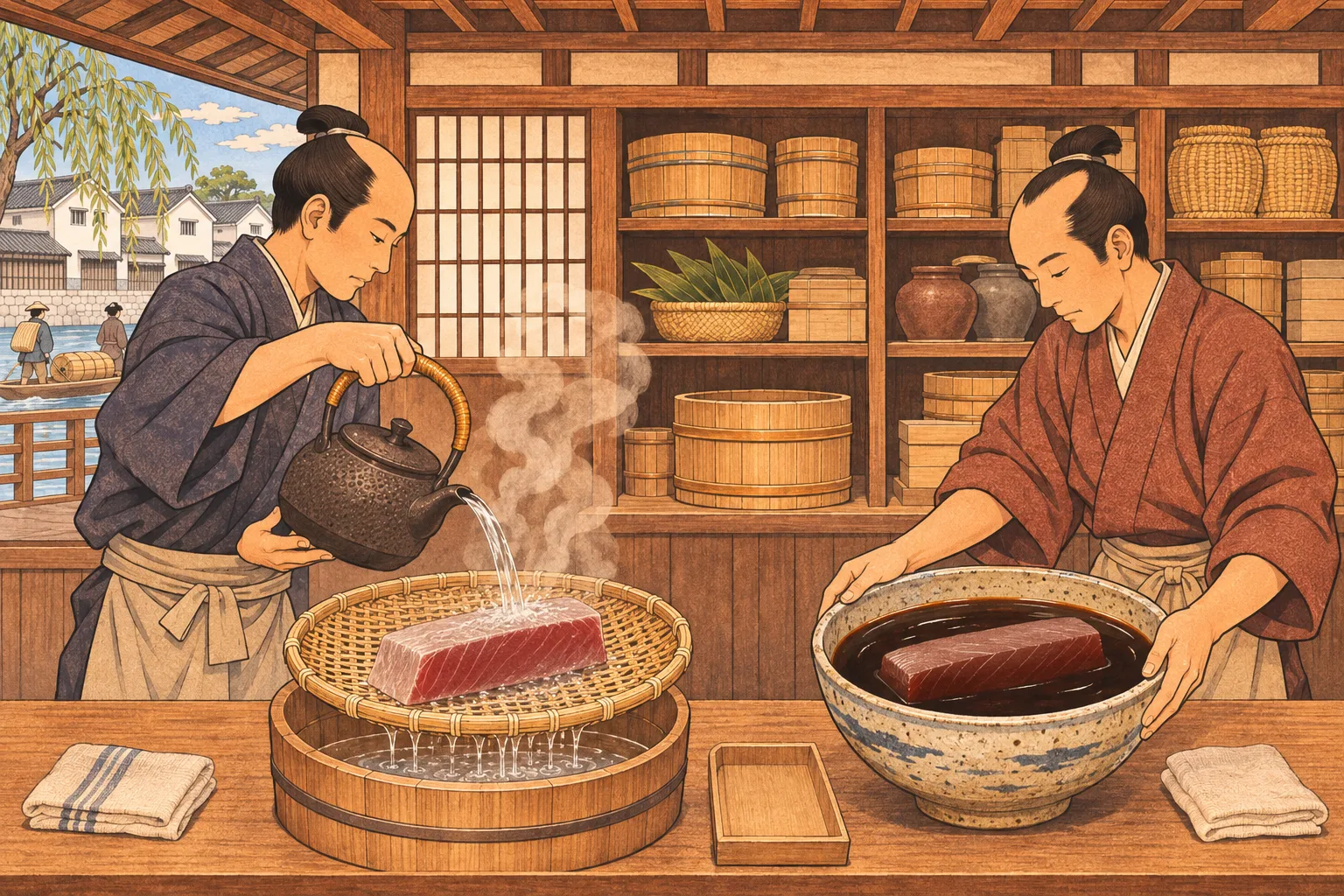
Two steps of zuke. Left: boiling water is poured over a block of akami on a bamboo tray, turning the surface grey-white, the step called shimofuri. Right: the block soaks in soy sauce (artist’s impression)
Zuke tuna is easy to spot. The cut face shows a gradient: a deep reddish-brown rim, close to the colour of red wine, fading to the bright ruby of raw tuna at the centre. If it was blanched first, there is a hairline of grey at the very edge. The surface is glossy, slightly tacky. The soy and the iron-rich tuna meld into something rounder than raw akami dipped in soy. Many shops apply the same method to bonito, yellowtail and other red-fleshed fish.
Nikiri, from nikiru, "to boil off", is the brushed soy used by nearly every serious sushi shop today. Sake and mirin are brought to the boil to drive off the alcohol; some chefs ignite it, sending a flicker of blue flame across the pan. Soy sauce is added, sometimes with a little dashi, and the mixture is simmered briefly and cooled. The result is a touch thinner and lighter than plain soy, gentler, faintly sweet. Each shop guards its own proportions.
The chef forms the piece, then, in the last motion before setting it down, sweeps a small flat brush of nikiri across the fish. The surface gains a thin shine. The message is that this piece is seasoned; eat it as it is.
There are three reasons. Control: each fish wants a different amount, white fish very little, tuna more, some none at all, and diners dipping for themselves tend to drown the fish. Structure: dipping a hand-held piece of nigiri into soy often makes the rice fall apart. And history, though the details are hazy. Today’s nikiri is built on the dark Kantō soy sauce that dominated late-Edo Tokyo. When brushing began is disputed: one account holds that stallholders already daubed soy on each piece to avoid setting out saucers; another that stall customers mostly dipped into the stall’s own soy, and that only as pieces shrank and shops grew more refined did chefs take the seasoning into their own hands and make the brush standard at high-end counters.
Nikiri isn’t the only finish. White fish, kelp-cured fish and seared fish often get a pinch of salt and a squeeze of sudachi or yuzu instead. Watching whether the chef reaches for the brush or the salt tells you how he reads each piece.
05The Simmering Pot: Anago, Tsume, Clams, Octopus, Squid and Abalone
A whole family of Edomae sushi is simmered before it is ever placed on rice: nimono, or simmered items. These pieces are warm, soft and glazed in something dark and shining, and nothing marks Edomae sushi off from other styles more clearly.
Start with conger eel, anago. Tokyo Bay, especially the waters off Haneda, was famous for it. The word "Edomae" was first applied in the Edo period to eel caught close to the city, then to fish from the nearby sea, and later became the badge of nigiri. Anago is coated in thick slime, which is removed by rubbing hard with salt, or by pouring hot water over it to set the slime and scraping it off with the back of a knife, revealing grey-brown skin dotted with a line of white spots. The eel is split, boned and laid out in long strips.
It is simmered gently in a mixture of sake, sugar, soy and water, with a paper or wooden drop-lid on top so the strips float without tumbling. Finished anago is so tender it breaks if you lift it with chopsticks, so chefs lift it out on a wide spatula or a mesh tray. Good anago melts on the tongue; the Japanese word is fuwafuwa, fluffy.
Before serving, the anago is often warmed over charcoal or seared lightly on the skin side. On the rice it overhangs both ends and droops softly. Then comes a stroke of thick dark sauce: tsume. Some chefs serve one piece with salt and one with tsume for comparison. In western Japan anago is more often grilled, as in the anago rice of Miyajima near Hiroshima; in Tokyo, simmered is the orthodox style.
Tsume, from nitsumeru, "to boil down", is made from the anago simmering liquid, enriched with eel heads and bones, soy, sugar and mirin, and reduced for hours until thick enough to coat a spoon and slide off slowly. It is near-black, glossy like lacquer, sweet and salty with the savour of eel. Many shops keep a running pot, adding each new batch to the old.
Tsume and nikiri are the easiest contrast at the counter to learn. Nikiri is thin and clear and leaves only a sheen on raw fish. Tsume is thick and dark, sits visibly on the surface, and may bead at the edge. Tsume goes on simmered items, anago, clams, mantis shrimp, simmered squid and octopus, and almost never on raw fish.
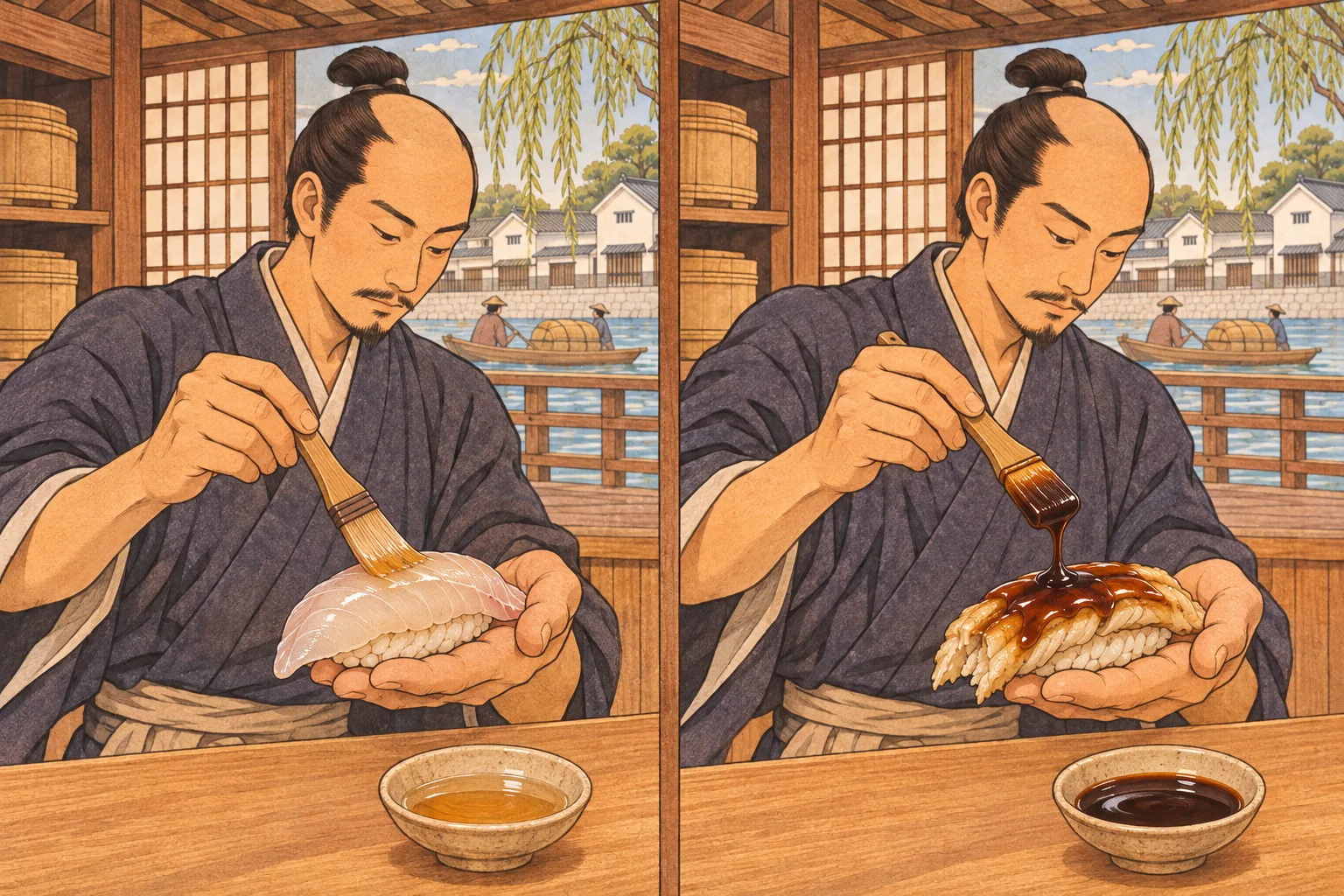
Left: nikiri is thin and clear, leaving only a sheen on white fish. Right: tsume is thick and dark, clings to the brush and covers simmered anago in a deep brown glaze (artist’s impression)
Simmered clam, nihamaguri, is a classic old-style Edomae item. The Edo Bay shallows teemed with clams, and they were ordinary stall fare. Today they mark a shop that keeps the old ways, because they are laborious. Large clams are opened in hot water, the meat removed, split and cleaned of grit, simmered very briefly in a seasoned broth, then returned to the cooled broth to soak overnight. Cook too long and the clam shrinks and toughens, so the rule is "short simmer, long soak". On the rice, the split clam opens symmetrically like a butterfly’s wings over the rice, pale brown and glistening with tsume.
Octopus, tako, comes two ways. For boiled octopus, it is massaged with salt or grated daikon to remove slime and tenderise it, then plunged whole into boiling water, the tentacles curling as they hit. The skin turns a vivid purple-red over pure white flesh, sliced thin and pleasantly springy. For sakuni, "cherry simmer", the octopus is simmered for a long time with sake, sugar and soy, each shop with its own additions, until it is deep reddish-brown and soft enough to cut with chopsticks. The first gets salt or a touch of nikiri; the second gets tsume.
Squid, ika, is mostly eaten raw today, scored and glassy white. The Edomae simmered version uses small squid, cleaned, simmered whole, and stuffed with sushi rice, then sliced into rounds. This is inrōzume, generally said to be named after the inrō, the small segmented case Edo samurai hung from the sash. Each slice shows a brown ring of squid around white rice, brushed with tsume like a small wheel. Few shops still make it.
Finally, abalone, awabi. Raw, it is crunchy enough to crack between your teeth, served in summer in iced water as mizugai. Edomae sushi prefers it simmered or steamed. The abalone is heavily salted in the shell and scrubbed with a brush until the black slime comes away and the muscle contracts. It is then removed from the shell and simmered in sake and water, sometimes with daikon, kelp or a little soy, at the barest simmer for several hours. The collagen softens into a texture like thick jelly that still springs back. The colour shifts from slate grey-blue to a pale beige or tan; thick slices show a smooth, slightly translucent cut face. Many shops reduce the liver into a thick, grey-green sauce, bittersweet, served alongside. Many chefs treat a piece of simmered abalone as one of the high points of the meal.
06Hot Water and Flame: Kuruma Prawns, Kawashimo and Aburi
Beyond long simmering, Edomae sushi uses faster heat: a brief boil, a pour of hot water, or a pass of flame, each changing only the outside of the fish.
The kuruma prawn, kuruma-ebi, is the classic Edomae shrimp, banded so that, cooked, it shows vivid red-and-white stripes. Prawns arrive alive, packed in sawdust. Each is skewered lengthwise along the belly, kushiuchi, so it stays straight when cooked instead of curling, then dropped into salted boiling water just long enough to cook through. It is peeled, headed, split along the belly and opened flat like a small fan, red stripes on top, white beneath, the vein removed. Careful shops cook prawns to order, so the piece reaches you still warm and at its sweetest. It is one of the few bits of shigoto you can watch: a live prawn lifted from the tank, and minutes later it’s on rice.
The counterpart is odori, "dancing" prawn: peeled alive and served raw on rice, sometimes still twitching. The raw flesh is translucent grey-white and slightly sticky, with a more direct sweetness. The head is usually grilled or fried and served afterward. Not every shop offers it, and not every diner wants it.
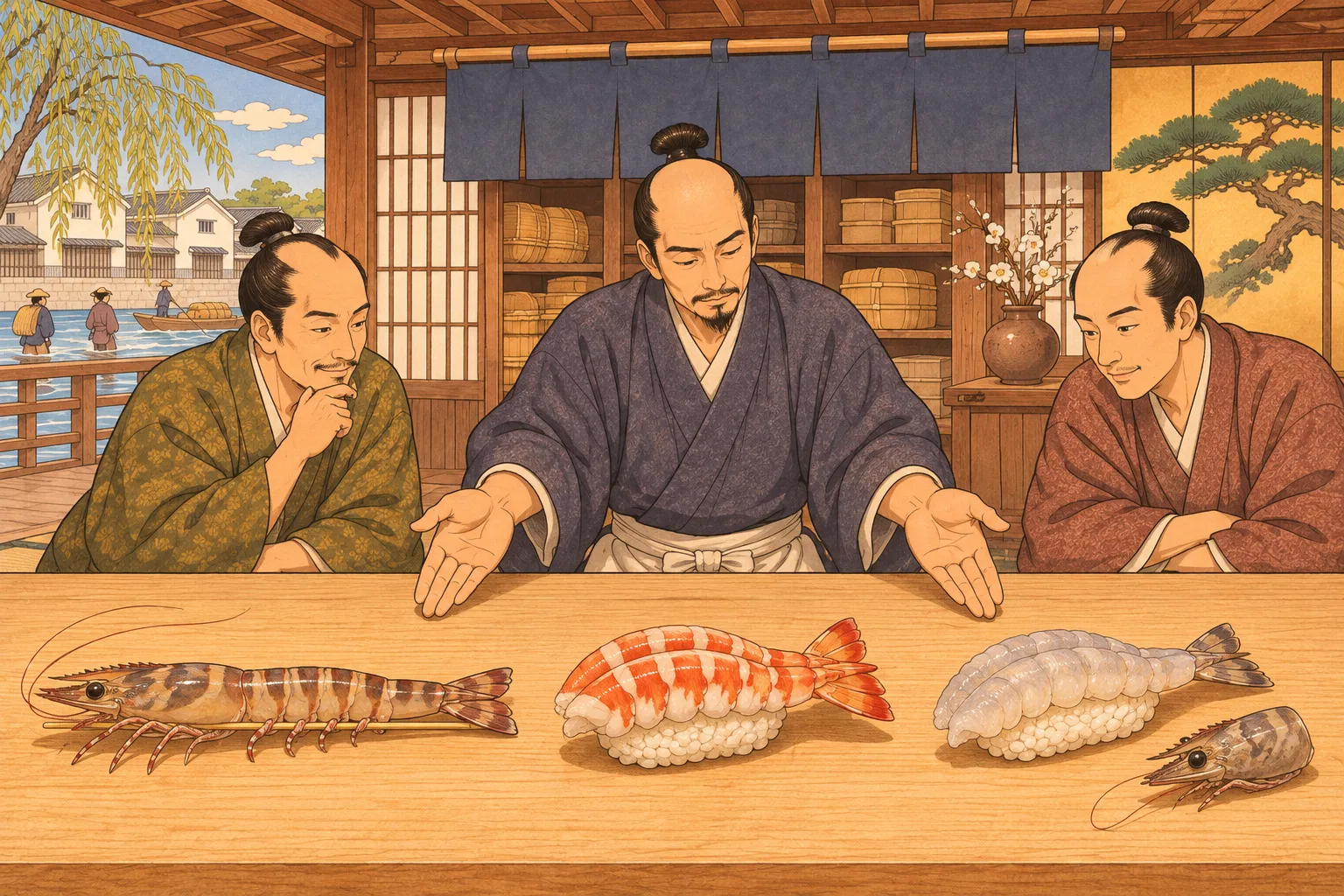
One kuruma prawn, three states, left to right: a live prawn skewered along the belly (kushiuchi); boiled and opened flat on rice, striped red and white; and raw odori, translucent grey-white, with its head set beside it (artist’s impression)
Kawashimo, "skin frost", is the treatment for white fish with skin, above all sea bream. Bream skin is too tough to eat raw, but the fat just beneath it is the best part of the fish. So the fillet is placed skin-up on a bamboo tray under a cloth and doused with boiling water. The skin contracts and wrinkles at once, and the fish goes straight into ice water to stop the heat. The skin becomes tender, the fat beneath softens, and the flesh stays raw. The puckered skin resembles pine bark, hence its other name, matsukawa-zukuri. At the counter, look for wrinkled, moist, grey-pink skin over raw flesh, with a hairline of white where the heat touched.
Aburi does the same with fire. Traditionally, fish on metal skewers is passed over charcoal (yakishimo), then chilled. Modern shops more often use a small gas torch directly on the finished piece, blistering the skin until the fat sizzles and gives off a smoky aroma. Favourites are fatty-skinned fish such as Spanish mackerel, splendid alfonsino, blackthroat seaperch, cutlassfish and yellowtail, and fatty tuna belly. The torch is a relatively recent arrival, thought to have spread only in the last few decades and made ubiquitous by conveyor-belt chains; some traditional chefs avoid it, believing gas leaves a taint, and stick to charcoal. Seared pieces show dry, blistered, golden skin, sometimes with dark flecks, and arrive smelling of smoke.
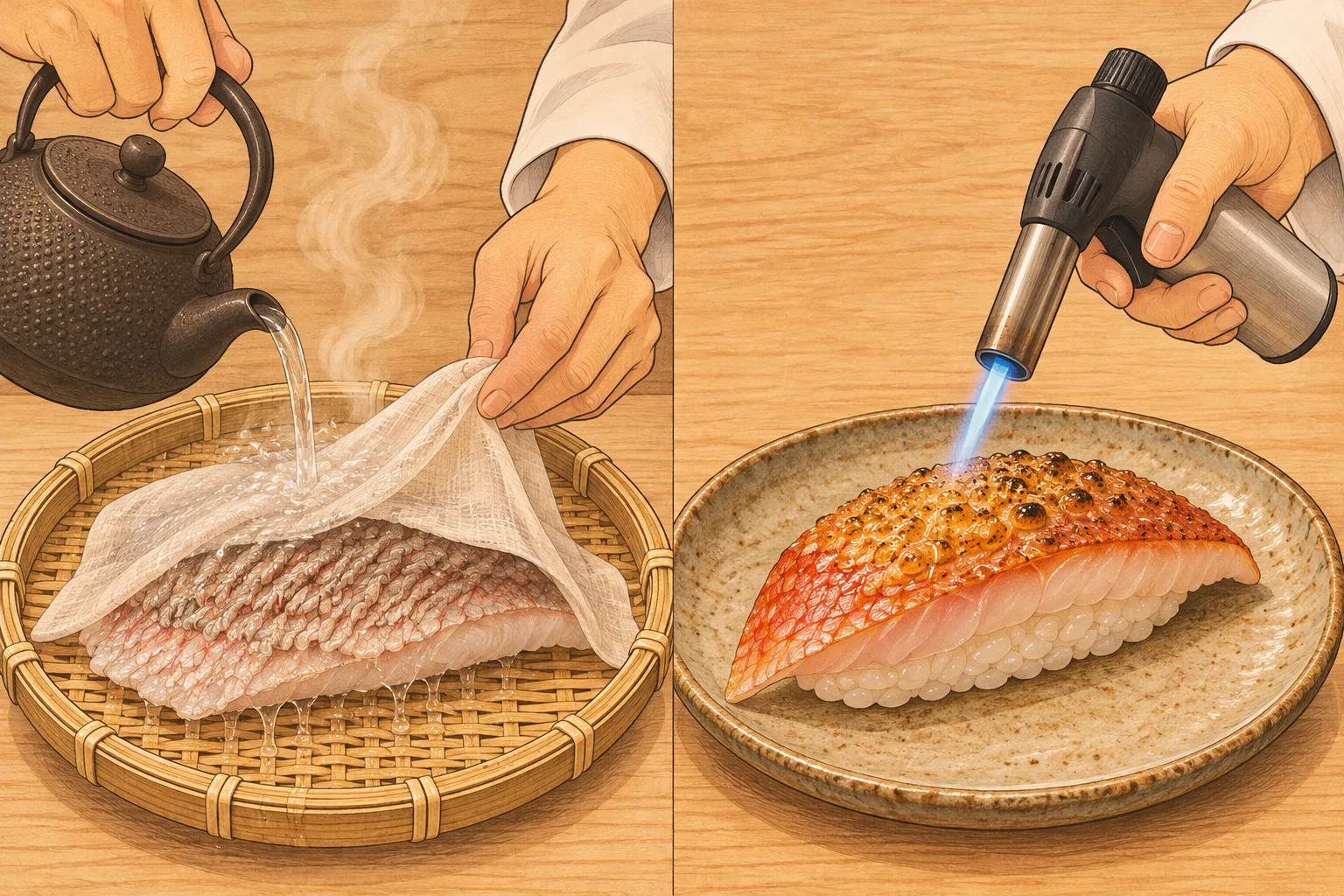
Left: kawashimo, boiling water poured through a cloth onto skin-on sea bream on a bamboo tray, so the skin contracts and wrinkles. Right: aburi, a gas torch on a finished piece of splendid alfonsino, blistering the skin golden with dark flecks
07Tamagoyaki: The Egg That Tests the Shop
Toward the end of a meal, the chef often sets down a slab of tamagoyaki. It looks like sweet omelette, but in Edomae sushi it is a craft of its own. There is an old saying, impossible to verify, that you should judge a sushi shop by its egg first.
There are two quite different styles (counter slang calls egg of any kind gyoku). The Edo style resembles a cake. Eggs are blended with a fine paste of shiba-ebi, a small Tokyo Bay shrimp, or puréed white fish, sometimes with grated mountain yam, plus sugar, mirin and a little soy, into a batter much thicker than ordinary omelette mix. It is poured into a square copper pan set over gentle heat, covered with a lid and cooked slowly for a long time; in the old method, it is said, live coals were set on the lid so it cooked from above and below. Midway it is turned out onto a board and flipped whole.
The finished block can be three or four centimetres thick, evenly deep golden-brown on both faces, the cut face a uniform pale yellow with no layers. It is fine-textured, moist and springy, something between sponge cake and custard, with a sweetness carried by shrimp or fish. People compare it to kasutera, the Nagasaki sponge cake. Making one can take an hour or two, and many chefs start the egg first thing in the morning.
The other style is the rolled omelette familiar from convenience stores and izakaya. Batter is poured into a rectangular pan in thin layers; each is rolled up as it sets, pushed aside, and the next poured beneath, building a rectangular log. The cut face shows concentric layers like tree rings. Made with plenty of dashi, it becomes the soft, juicy dashimaki of western Japan; with more sugar, it is the sweeter, darker Kanto-style thick omelette.
Both appear in sushi shops. Traditional Edomae shops lean toward the cake style, which shows off the shrimp paste, the heat control and the time. Many others use the rolled kind, which is quicker and lighter. To tell them apart, look at the cut face: rings mean rolled; uniform means cake-style.
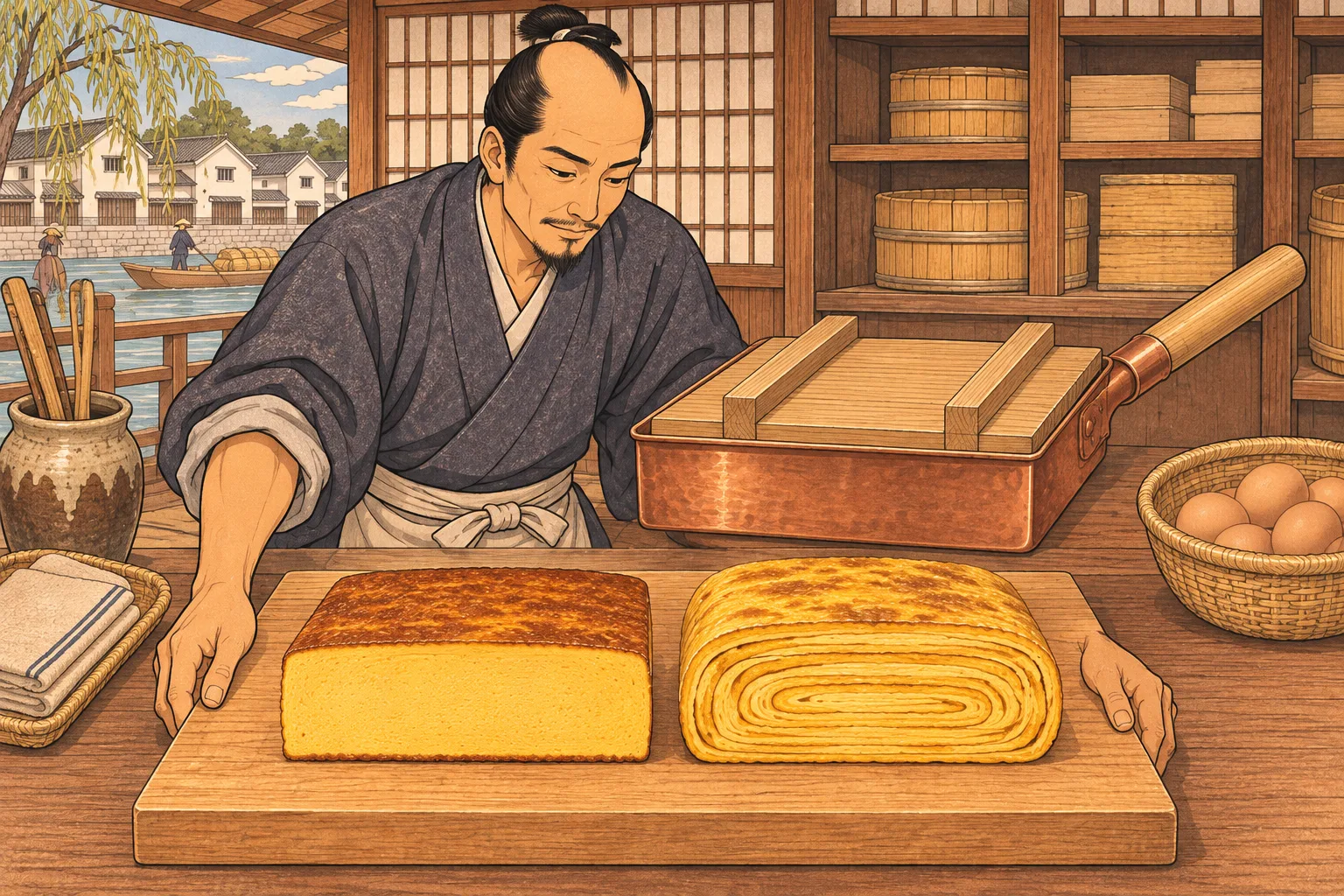
Two kinds of tamagoyaki, cut open. Left: the cake style, deep golden-brown top and bottom, the cut face an even pale yellow with no layers. Right: the rolled omelette, ringed like a tree. Behind them is the square copper pan with its wooden lid (artist’s impression)
Egg may be served on its own as a thick slice, almost a dessert; cut with a pocket and filled with rice; or laid thin over rice and tied with a strip of nori. Shops often serve it last because its sweetness would blunt the fish that follows.
08Side by Side: Reading What Was Done
Most shigoto happens out of sight, but it leaves marks on colour, gloss, cross-section and temperature.
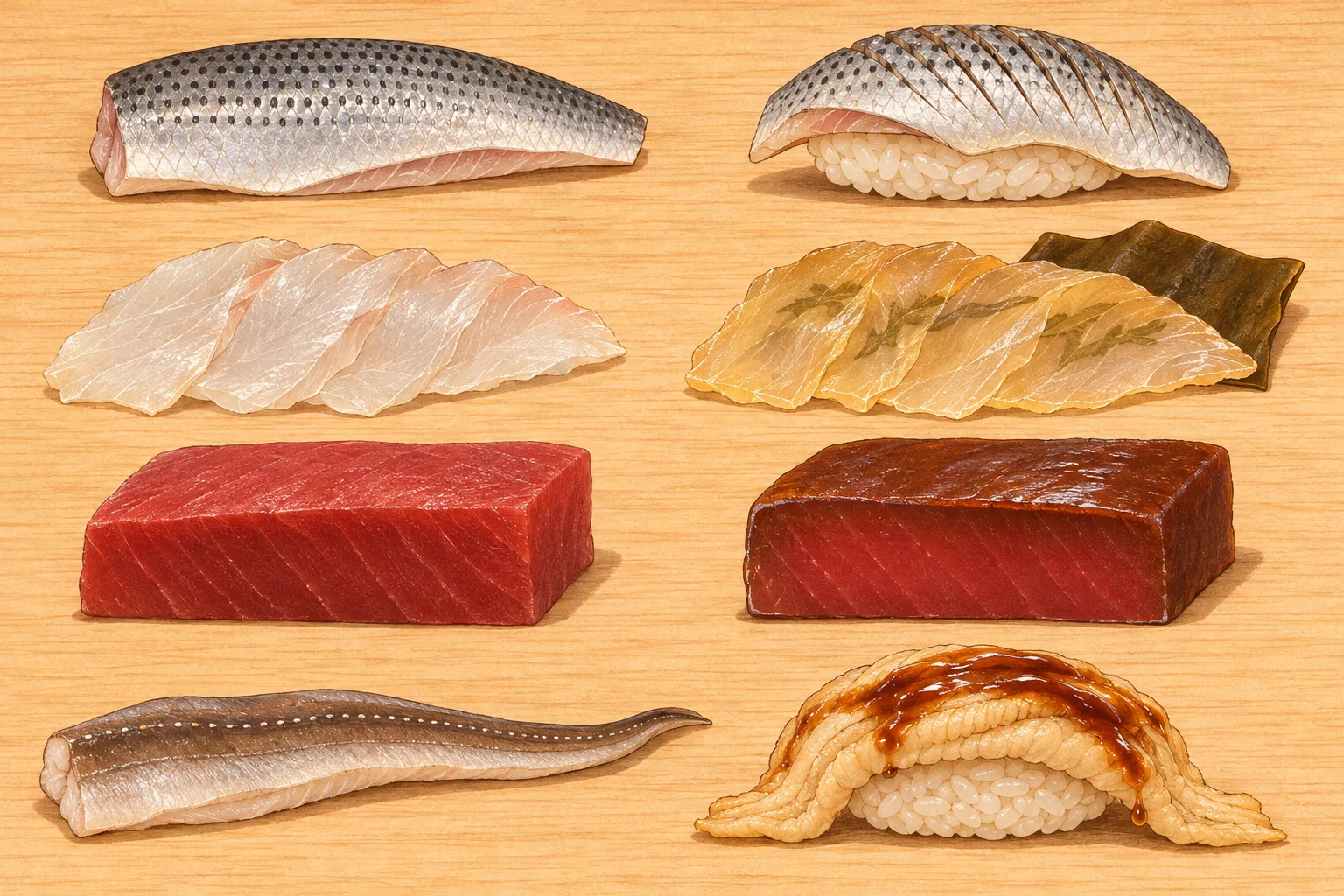
Before and after, raw on the left and worked on the right. Top to bottom: raw kohada and cured kohada nigiri with its scored skin; raw flounder slices and kobujime flounder, with a sheet of kelp behind; raw tuna akami and zuke akami; raw anago and simmered anago nigiri glazed with tsume
Kohada: raw, the flesh is translucent pinkish-grey and the silver skin cool and soft. Cured, the flesh turns opaque, white at the edges with perhaps a blush of pink inside, the skin brighter and scored with fine cuts.
Flounder: raw, it is translucent milk-white, thin slices almost see-through. Kelp-cured, it turns pale amber, darker at the rim, waxy, less translucent, sometimes faintly lined.
Tuna akami: raw, it is uniform ruby throughout. Marinated, it shows a reddish-brown rim fading inward, a glossier surface and, if blanched, a grey hairline at the edge.
Anago: raw, it is a grey-brown strip with a line of white dots and pinkish, translucent flesh. Simmered, the flesh turns white and fluffy and the strip droops; glazed with tsume, it carries a dark lacquer shine that beads at the edge.
Other pairs worth learning: nikiri leaves a thin shine with the fish’s own colour clear beneath; tsume covers the surface in dark sauce and appears only on cooked items. Kawashimo skin is moist, wrinkled and pale, without char; aburi skin is dry, blistered, golden and flecked, and smells of smoke. Boiled kuruma prawn is opaque and striped red; odori is translucent grey without red.
Temperature helps too. Anago, freshly boiled prawn and seared fish arrive warm. Cured, kelp-pressed and marinated fish are at about room temperature or slightly cool. Uniformly fridge-cold pieces usually mean the fish came straight from the chiller.
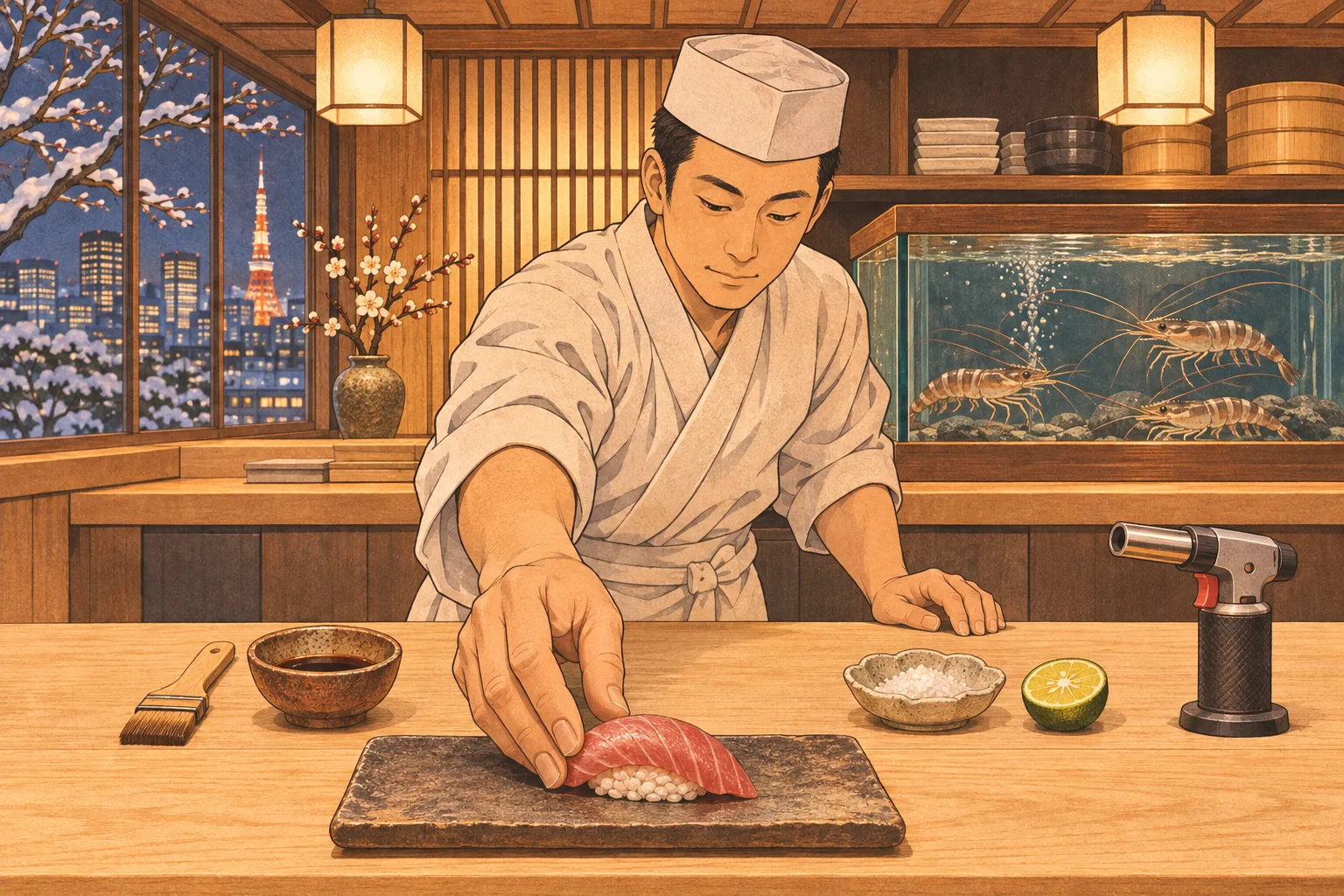
What sits at the chef’s hand tells you what was done to the piece, left to right: a brush and a bowl of nikiri, salt and half a sudachi, a torch, and behind him the tank of live kuruma prawns. A piece has just been set down on the counter
And watch the chef’s hands. A brush means nikiri or tsume. Salt and citrus mean he thinks the piece needs no soy. A torch means aburi. A hand in the prawn tank means kuruma-ebi is next.
More deep dives on this topic
 TunaOrder an omakase in Tokyo and the tuna usually arrives in a sequence: a slice of deep red lean meat, then something pinker and softer, then a pale, marbled piece that seems to…
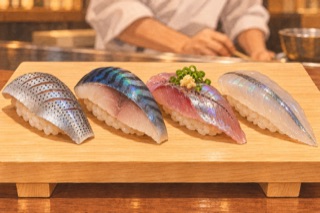 HikarimonoSit at a sushi counter in Japan and, somewhere in the middle of the meal, the chef will set down a piece that looks different from the rest.
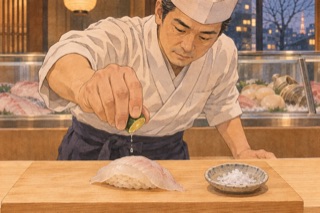 Beyond TunaMost first-time visitors walk into a sushi bar thinking about tuna.
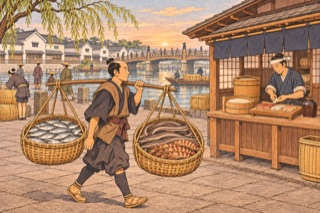 Edomae ShigotoMost visitors arrive at a Tokyo sushi counter expecting raw fish on rice.
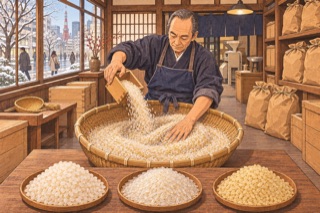 Shari and Its Supporting CastAt a sushi counter your eyes follow the fish.
 Regional Sushi Beyond TokyoMost visitors meet sushi at a counter: a chef shapes rice in one hand, lays a slice of fish on top and sets it down in front of you, to be eaten within seconds.
 KaitenzushiSit down at a kaitenzushi (conveyor-belt sushi) counter anywhere in Japan and the basic deal is the same.
 Fish MarketsThe piece of sea bream a sushi chef slides across the counter at lunchtime has usually changed hands four or five times since it left the water.
 Words at the Sushi CounterSit at a sushi counter in Japan and the language around you shifts.
 The Sushi ChefFrom a counter seat, a sushi chef looks like a pair of hands and very little else.
- Back to the main article: Sushi →