
Sit at a sushi counter in Japan and the language around you shifts. The chef calls for shari, the server sets down a tall cup and says "agari desu", a regular at the end of the bar raises a hand and murmurs "oaiso". Above the counter hangs a row of pale wooden tags brushed with black characters, and the cup in your hand is covered in kanji that all share the same fish-shaped radical. Most of this belongs to the people behind the counter. It is their working language, and as a guest you are not expected to use it. Asking for o-cha (tea) and o-kaikei (the bill) is perfectly polite, and many chefs prefer it. This piece is a guide to understanding what you hear and read, not a script for sounding like an insider.
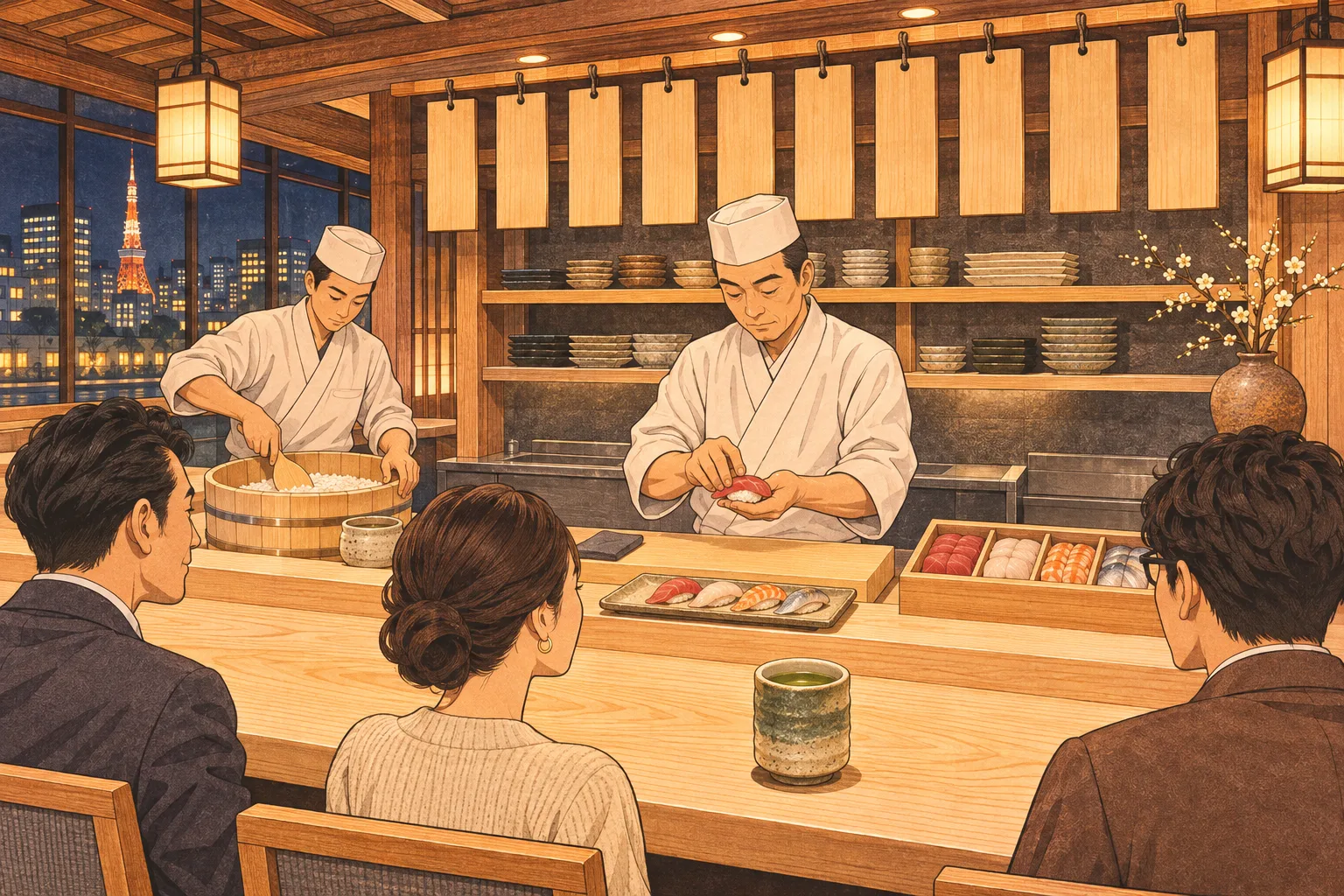
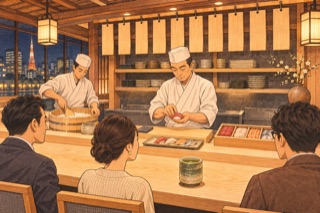
The counter of an old-style Tokyo sushi shop: the chef shapes nigiri, an apprentice works the rice tub, wooden tags hang overhead and a thick teacup stands in front of the guests.
01A Trade Language, Not a Password
Almost every traditional trade in Japan had its own vocabulary: carpenters, fish-market auctioneers, kabuki stagehands, the geisha districts. Sushi cooks call theirs fuchō (trade code) or ingo (hidden words). The reasons were practical. Short words are quicker to shout across a busy kitchen. Some information was not meant for guests to follow, such as how old a piece of fish was or what a party’s bill came to. And some words existed to avoid saying something unlucky.
The vocabulary has roughly three sources. Some terms simply name ingredients and tools in the kitchen. Some were borrowed from the pleasure quarters of Edo (old Tokyo), where taboo words were carefully avoided. And a set of number codes was used to quote prices and keep accounts in front of customers; similar codes are said to have circulated among market traders and old merchant houses.
These words drifted into customers’ mouths mostly in the twentieth century. After the Second World War, sushi moved from street stalls and expensive restaurants into neighbourhood shops that office workers could afford, and magazines, manga and television loved to explain the "connoisseur’s" way of eating. Words like agari and murasaki became badges of the tsū, the person in the know. Japanese culture has always had a counterweight to this. Edo townspeople prized iki, an unforced, offhand stylishness, and mocked yabo, clumsy trying-too-hard. A customer flaunting kitchen slang is a textbook case of yabo, and there is even a word for the half-informed show-off: hankatsū. The main sushi article makes the same point, and this piece follows it.
02Rice, Topping and Ginger
Shari is sushi rice, and by extension cooked rice generally. It is written 舎利, a Buddhist word for the relics left after the Buddha’s cremation, the tiny white fragments enshrined in stupas. Dictionaries give a visual explanation: small, white, separate grains look like relics. Some scholars also suspect a mix-up between two similar-sounding Sanskrit words, one meaning body or relics and one meaning rice. Outside sushi shops the word survives in gin-shari, "silver shari", a name for plain white rice that was especially current in the hungry years during and after the war. In the kitchen, shari-kiri is the job of turning freshly cooked rice into a wooden tub, folding in the vinegar and fanning it cool, traditionally an apprentice’s task.
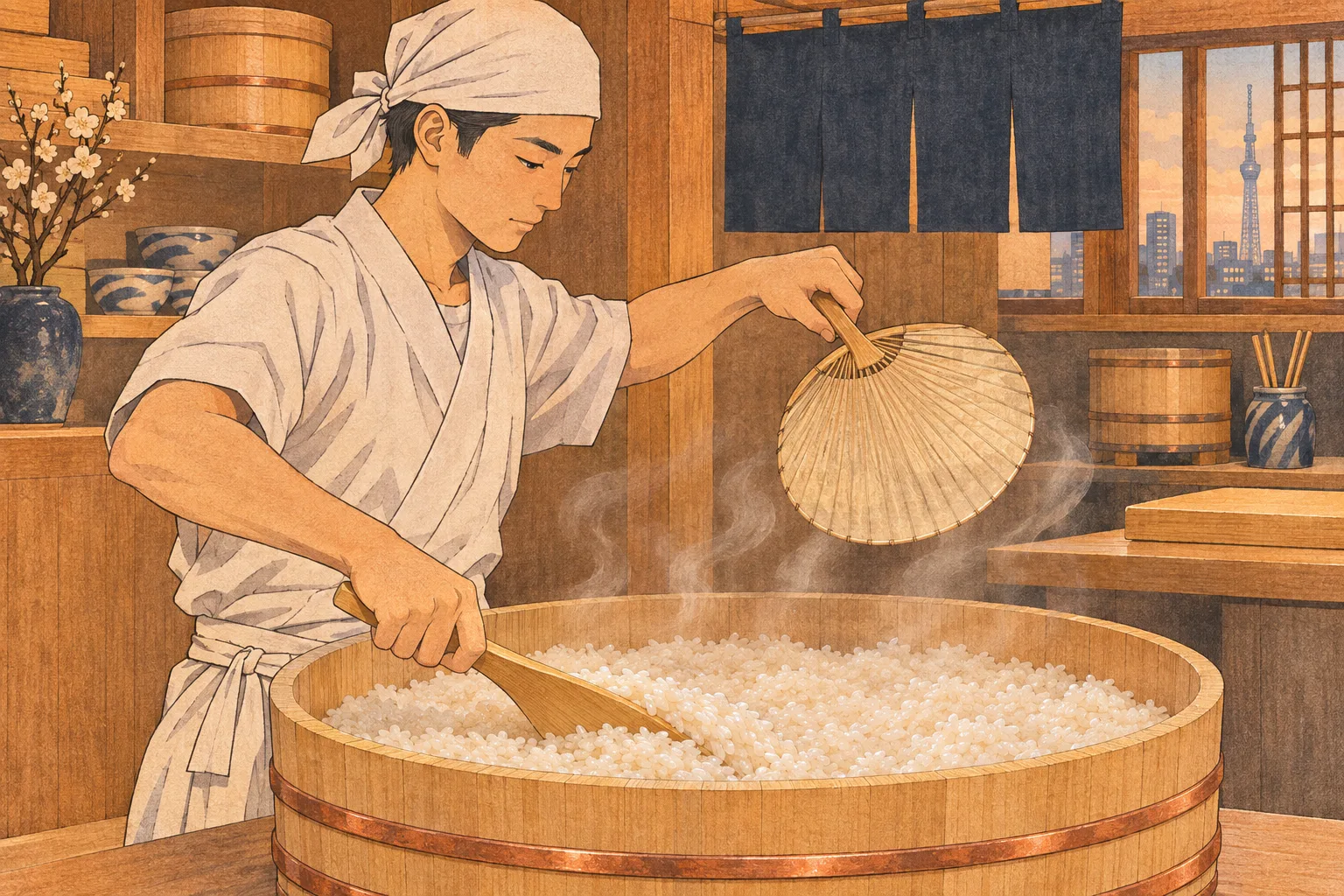
Shari-kiri: an apprentice cuts through the vinegared rice in the wooden tub with a paddle while fanning it cool with the other hand.
Neta is the topping on a piece of nigiri. It is tane (種, "seed", hence "raw material") read backwards. Flipping syllables was a favourite trick of Edo entertainers and tradesmen, and the habit survives in words like shoba for basho (place). Neta has since escaped the sushi shop entirely and now means a news item, a comedian’s bit or a topic of conversation. Ironically, more formal sushi restaurants often say tane on their menus, leaving neta as counter talk.
Gari is the thin, sweet-vinegared ginger on your plate. The name is usually explained as onomatopoeia, either the crunch of chewing it or the sound of the knife shaving the root. (What the ginger is for, and how it is pickled, belongs to the piece on sushi rice and its companions.) Don’t confuse it with hajikami, the old word for ginger that now names the pink pickled ginger shoot laid beside grilled fish.
Gyoku is the slab of sweet omelette (tamago). It is just the Sino-Japanese reading of the first character of 玉子, clipped down to one crisp syllable. In old-style Edomae shops the omelette is thick and cake-like, often bound with pounded shrimp or fish and cooked slowly over low heat. An old saying claims you can judge a shop by its tamago; nobody knows where it started, and today it is more a talking point among customers than a rule.
Namida, "tears", is wasabi, for what it does to your sinuses. The more common kitchen word is sabi, simply wasabi with the head cut off. Sabi-nuki, "without wasabi", is the one piece of counter vocabulary that has become ordinary customer language; it is printed on conveyor-belt menus and used by parents ordering for children.
Tsume is the thick, glossy, sweet-salty sauce brushed onto cooked toppings like conger eel (anago), mantis shrimp and simmered clam. The word is short for nitsume, "boiled down". Its partner is nikiri, soy sauce simmered with sake and mirin, which the chef brushes onto raw fish. How each is made is a story for the piece on Edomae techniques. For now: dark and syrupy on eel is tsume, thin and shiny on raw fish is nikiri.
Otemoto means chopsticks. You have seen it many times, printed in kana on paper chopstick sleeves: おてもと. It means "what is at your hand", a soft, courteous way for restaurants to avoid the plain word hashi.
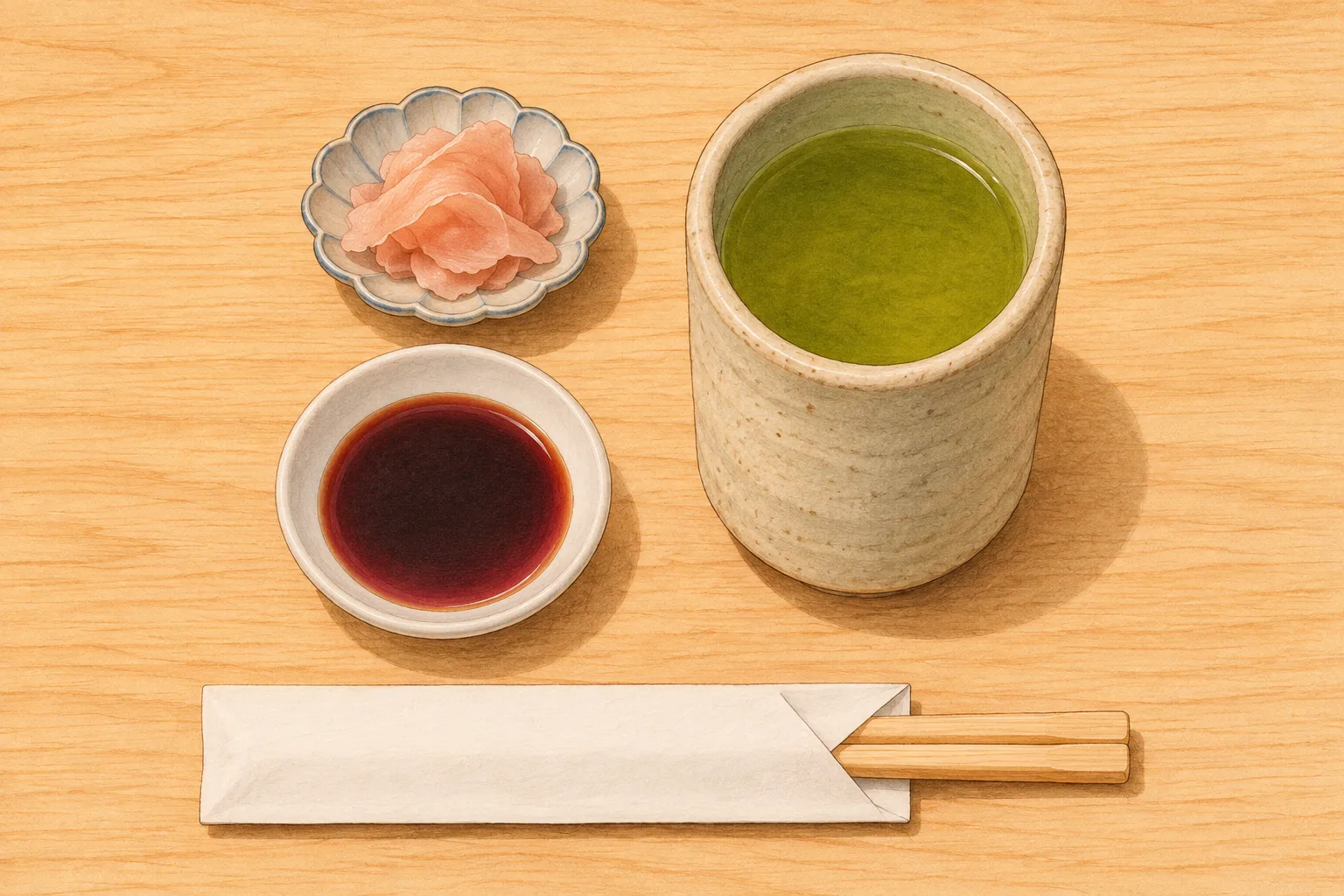
Four counter words in one place setting. Top left: the ginger, gari. Right: the tea, agari. Lower left: soy sauce in a white dish, murasaki. Bottom: chopsticks in their paper sleeve, otemoto.
03Tea, Soy Sauce and the Bill
Three words are the ones customers hear most and imitate most. Their origins explain why the imitation can land awkwardly.
Agari is tea, short for agari-bana, which dictionaries define as freshly brewed tea at a restaurant, or tea in general. The word is usually traced to the pleasure quarters. A courtesan with no clients was given menial work grinding tea leaves, so o-cha o hiku, "to grind tea", came to mean "to have no customers", and the word for tea became unlucky. Why agari replaced it is disputed. One explanation is the lucky phrase kyaku ga agaru, "a customer comes up"; another says the first cup was called debana, "the emerging flower", and the last agari-bana, "the finishing flower". Agari also means "finish"; reaching the goal in a traditional board game is agari. Today any cup of tea at a sushi counter is agari.
Murasaki, "purple", is soy sauce. Held in a white dish, soy sauce is a deep reddish brown with a violet edge; that is the usual explanation. A second explanation points out that soy sauce was once costly, and purple was the colour of rank, so the name flattered it. Both are later interpretations.
Oaiso means the bill. Written お愛想, aiso means friendliness or hospitality. Two explanations circulate. In one, it began as the shop’s apology when presenting the bill: o-aiso ga nakute sumimasen, roughly "forgive our poor hospitality" — sorry to bother you with money. In the other, it is short for aiso-zukashi, from aiso o tsukasu, "to be fed up with someone", so a customer saying oaiso is announcing he has had enough of the place. Japan’s largest dictionary records this second view and notes that the word began in the Kansai region. Either way, the word started on the shop’s side of the counter. A guest who uses it is either speaking the host’s apology for him or, on the second reading, saying something faintly rude. Many chefs would rather hear o-kaikei onegaishimasu or o-kanjō onegaishimasu.
All three share one feature. They are the staff’s names for things, not polite words addressed to guests. A server saying "agari desu" is natural. A guest asking for agari is like using a family’s private nickname for their own kitchen.
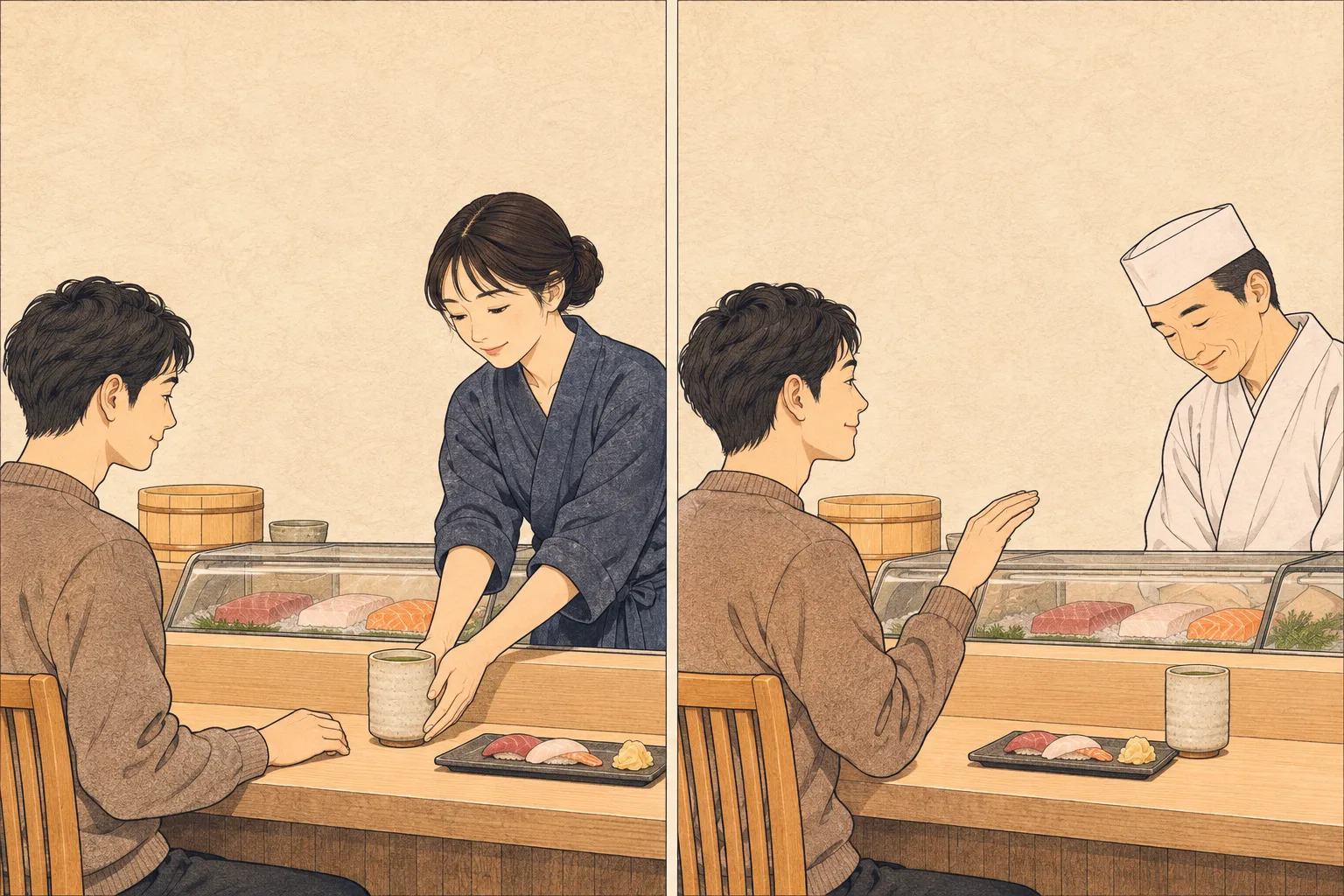
Left: a server sets down the tea, and for her "agari desu" is natural. Right: a guest raises a hand for the bill, and "o-kaikei onegaishimasu" is all he needs.
04Strange Names on the Menu
Some menu items have names that seem to have nothing to do with the food.
Kappa-maki is a thin cucumber roll. The kappa is a river creature of folklore, with a water-filled dish on top of its head and a shell on its back, and it is said to love cucumbers above all things. Dictionaries add that cucumbers themselves were called kappa in the trade. Some connect the name to offerings of cucumbers to water deities, who blurred with kappa in popular belief. The cucumber-loving kappa is the version most people know.
Tekka-maki is a thin roll of red tuna. One explanation points to the tekkaba, a gambling den: gamblers who didn’t want to leave the table ate neat seaweed-wrapped rolls that kept their fingers clean, a story that echoes the sandwich legend, and which some dictionaries place in the mid-Meiji period. The other explanation is colour: red tuna glows like iron heated in a forge (tekka), and wasabi adds the heat. Tekka also describes a fiery, spirited temperament, which helps both stories along.
Teppō-maki, "musket roll", is a thin roll of sweet-simmered gourd strips (kanpyō). In Edomae tradition this, not tuna, is the classic seaweed roll, and many old Tokyo shops end a meal with it. Dictionaries say the long thin roll looks like a gun barrel; some add that the brown core in the cut end looks like the muzzle.
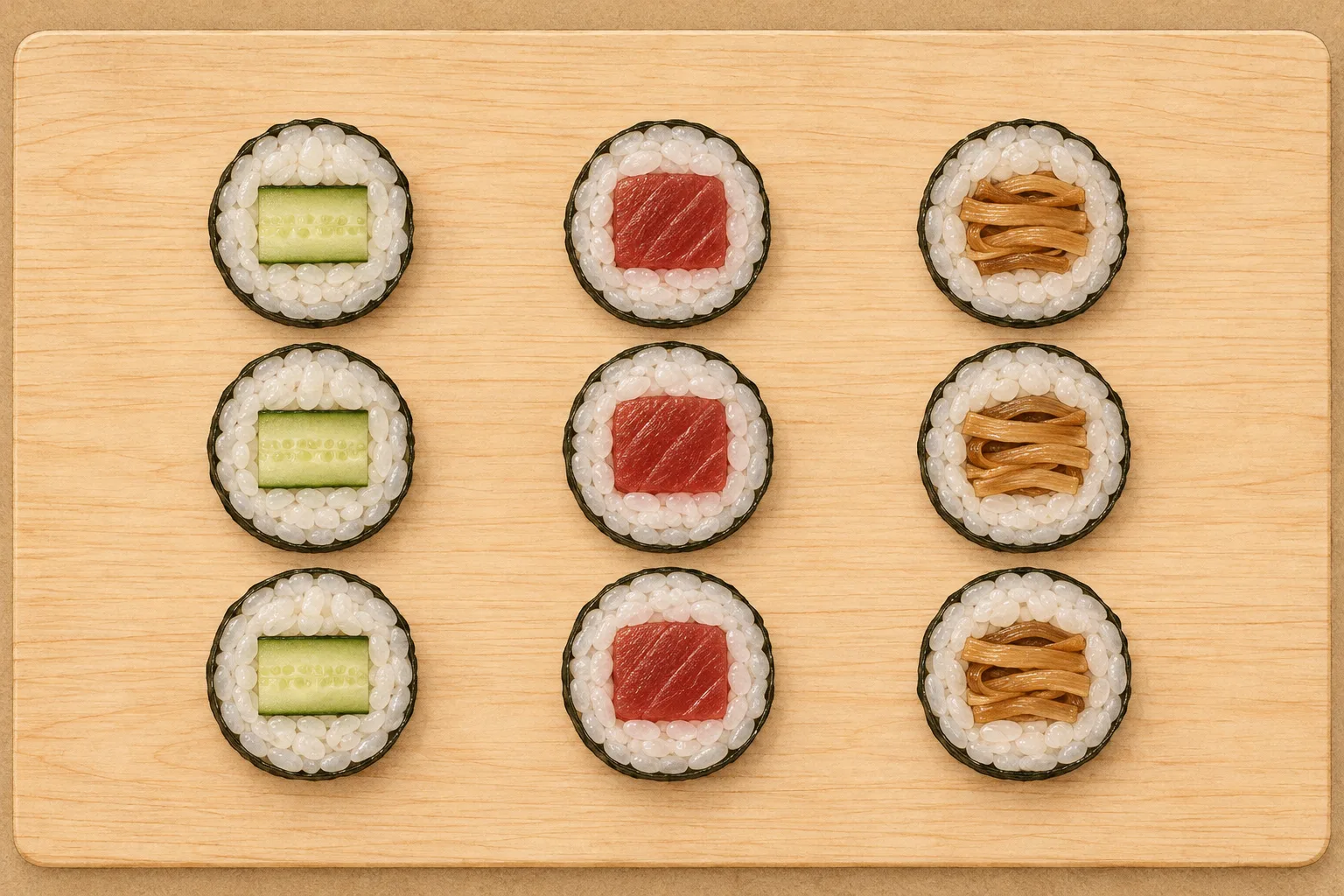
Three thin rolls in cross-section. Left column: kappa-maki with cucumber; middle: tekka-maki with red tuna; right: teppō-maki with simmered gourd strips (kanpyō).
Geso is squid tentacles. It is written 下足, originally the footwear guests removed at the door of a bathhouse, theatre or restaurant, minded by an attendant called the gesoban. Squid tentacles are its "feet", feet led to footwear, and the name stuck. Pub menus now list geso-ten and geso-age, fried tentacles, as everyday dishes.
Engawa is the band of muscle at the base of the fins of flounder and halibut. A flatfish’s fins run all around its edge, and the long strip of meat at their root sits where a Japanese house has its engawa, the narrow wooden veranda running along the outside. The muscle works every time the fin moves, so it is chewy and rich in fat. One fish yields only four strips, so it is scarce. At conveyor-belt shops the cheap engawa usually comes from larger flatfish species, the same name for a different source.
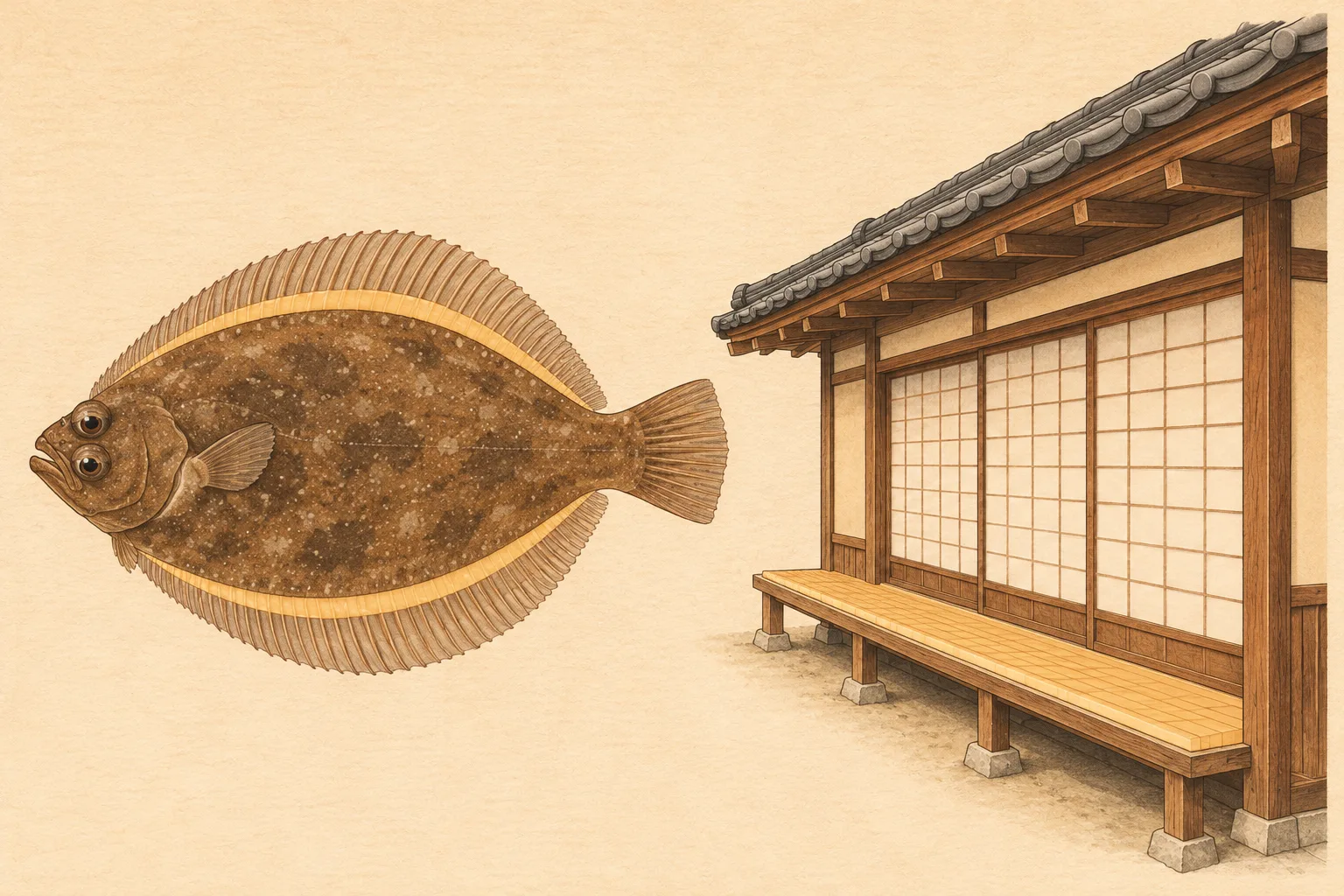
The pale bands along the fin bases of the flounder are the engawa, named after the narrow wooden veranda, also engawa, that runs along the outside of the house on the right.
Hikarimono, "shiny things", are silver-skinned, blue-backed fish such as gizzard shad (kohada), horse mackerel, sardine, halfbeak and mackerel. The word describes the way their skin flashes under the counter lights rather than any scientific grouping. The fish themselves have their own deep-dive.
A few more you may catch. Toro, whose naming story the main article tells, is said to have been called abu before that, short for abura, "fat". Zuke is tuna marinated in soy, from tsuke, "to soak", a technique of the pre-refrigeration era. Yama, "mountain", means sold out. And aniki and otōto, "big brother" and "little brother", are older and newer stock; big brother gets used first. That pair is exactly the kind of thing the code was invented to keep from the customer.
05Counting in Code, and the Mystery of Kan
Sushi chefs and market traders once used number codes to call out quantities and prices across a room. Every shop and every market had its own, passed down without any standard. One commonly cited set runs:
1 pin, 2 ryan, 3 geta, 4 dari, 5 menoji, 6 ronji, 7 seinan, 8 bando, 9 kiwa, with 10 most often given as pinkoro, koro being zero, though shops vary.
Some of the origins are easy to guess, others are not. Pin comes from Portuguese pinta, "dot", which entered Japanese through playing cards and dice in the late sixteenth century and survives in the phrase pin kara kiri made, "from the top to the bottom". Ryan is Chinese liǎng, "two", the same word used in mahjong. Geta, the wooden sandal, is three because the sandal has three holes for its thong. Menoji is five because the character 目 is written in five strokes. Kiwa, "edge", is nine, the brink of ten. For dari, ronji, seinan and bando there are competing stories and no agreement. At the fish auctions, meanwhile, buyers bid with a separate system of hand signals.
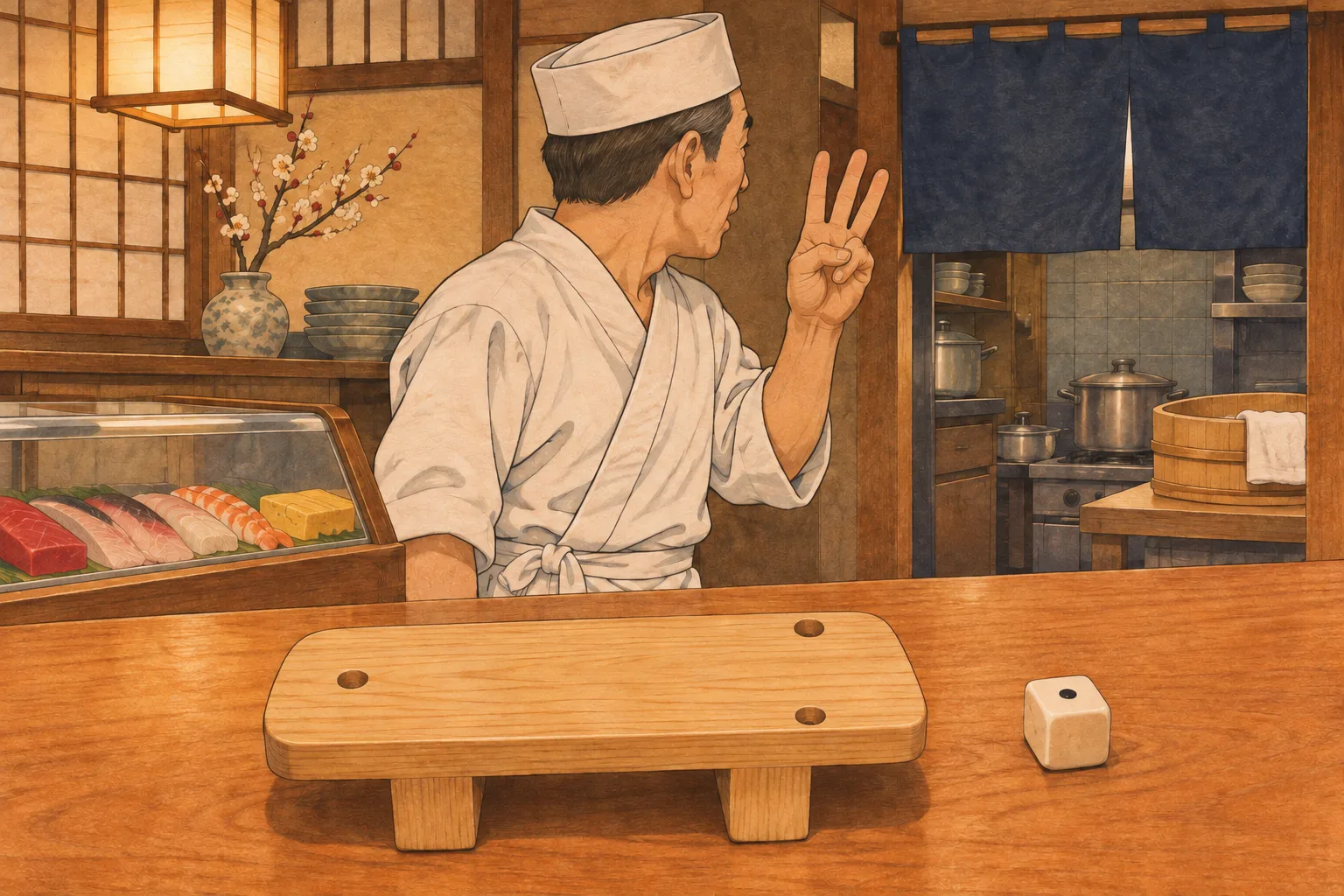
A chef signals three to the kitchen. On the counter, a wooden sandal with its three thong holes stands for geta, three, and a die showing one pip for pin, one.
You are unlikely to hear these at the counter today, since bills are printed by machine. But in an old shop, a chef might still call "geta" to the back, and he may mean nothing more than "three of those".
Then there is the counter word for sushi itself: kan (貫). Order "nigiri ni-kan" and you get two pieces of nigiri. Why kan? There are many explanations and none has won. These come up most often.
The first involves money. Edo-period copper coins had square holes and were strung on cords; a thousand coins made one kan. In one version, early nigiri was far larger than today’s and looked like a bundle of coins. In another, a string of a hundred coins was about the length and thickness of a sushi roll. Critics point out that a full kan of coins is far too big and heavy to match a piece of sushi.
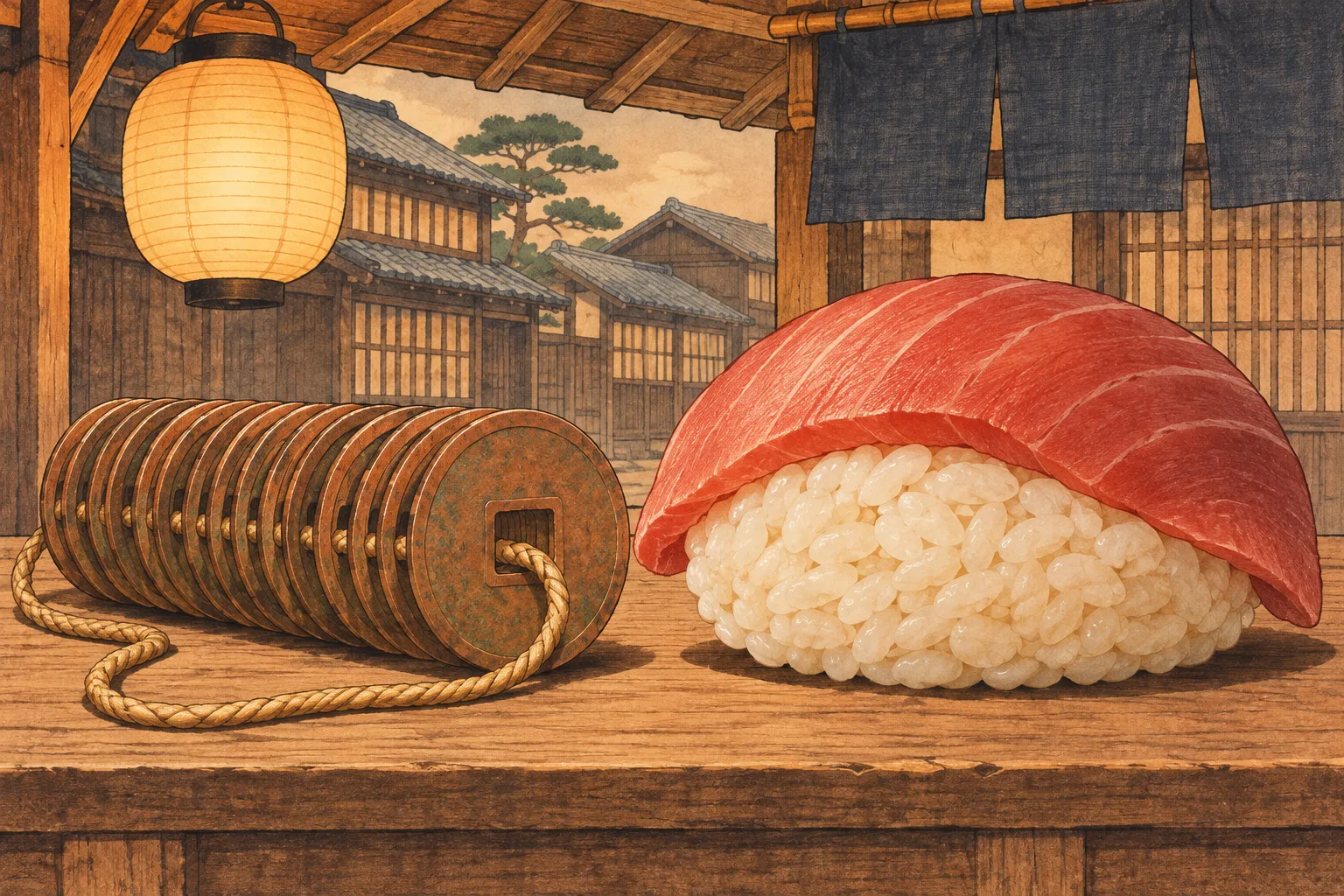
On an Edo stall counter, a string of square-holed copper coins beside a piece of nigiri far larger than today’s. The coin-string story is only one of several explanations for kan (artist’s impression).
The second involves weight. Kan was also a unit of weight, about 3.75 kilograms. One version says sushi was once large and firmly packed enough to borrow the unit; one chef recalls being taught to press rice as solidly as a kan of ice. To modern eyes these seem far-fetched.
The third says kan had nothing to do with 貫 at all. A Japanese dictionary of counters notes that Edo books count nigiri as hitotsu or ikko, that nothing changed in the Meiji and Taishō periods, and that Shiga Naoya’s story "The Shop Boy’s God" still says hitotsu. On this view kan appeared in sushi shops only in the Shōwa period, perhaps as a softened form of ka (個, piece) or from cooks’ talk of serving two portions together as ni-kan mori, and the character 貫 is simply borrowed for the sound. The word then spread through food magazines during the gourmet boom of the 1990s.
There is also the question of whether one kan is one piece or two. From the late Edo period nigiri was often served in pairs, perhaps because an originally large piece was cut in half, and in some places a pair was called one kan. Dictionaries and most shops today count one piece as one kan, but some shops and older speakers differ. If in doubt, just say hitotsu, futatsu.
06The Fish on Your Teacup
The heavy, tall teacup at a sushi bar is a yunomi, sometimes called a sushi-yunomi. Its sides are often printed edge to edge with fish kanji in black or indigo, like a chart. These cups sell in souvenir shops and airports and travel home in a great many suitcases. Why so big? The usual explanation is that a large cup needs fewer refills on a busy night and thick walls keep the tea hot. Nobody knows exactly how the fish kanji started; the usual explanation is a bit of fun and a boast about the range of fish on offer, which hardened into the standard look.
Every character on the cup has the fish radical 魚 on the left. The right-hand part often hints at the meaning or the sound, and the characters fall into three groups: those borrowed from China with the same meaning; those borrowed from China but assigned in Japan to a different fish; and kokuji, characters invented in Japan.
鯛 tai, sea bream. The red, deep-bodied fish of every Japanese celebration. The right side, 周, is explained as "everywhere", for a fish found along every coast, or simply as a sound element. Modern Chinese uses the character for sea bream too, but the oldest Chinese dictionary, the Shuowen, glosses it as "brittle ends of bones", not as a fish name. The pun with medetai, "auspicious", is a Japanese wordplay rather than the origin of the character.
鮪 maguro, tuna. In classical Chinese this character meant a large sturgeon-like fish, not tuna. Japan reassigned it. The name maguro is explained as makkuro, "jet black", for the dark back, or meguro, "black eye"; both are folk etymologies.
鰤 buri, yellowtail. The winter fish par excellence. The right side, 師, is linked to Shiwasu, the old name for the twelfth month, when yellowtail is at its fattest, or to the sense of "elder", since buri is a shusse-uo, a "promotion fish" whose name changes as it grows, reaching buri only at full size.
鯖 saba, mackerel. Fish plus 青, "blue-green", for the back. In old Chinese the same character also named a stew of fish and meat.
鰯 iwashi, sardine. A kokuji: fish plus 弱, "weak", because sardines die almost as soon as they leave the water and spoil fast. A story that Murasaki Shikibu secretly ate this "low" fish and was caught by her husband has no known early source and is generally treated as a later legend.
鮃 hirame and 鰈 karei, flounder and flatfish. 平 means "flat". 枼 means a thin leaf. Both characters exist in Chinese for flatfish, though Chinese does not split them as sharply as Japanese does.
鰆 sawara, Spanish mackerel. Fish plus 春, "spring", when the fish moves inshore to spawn in the Inland Sea. Often counted as a kokuji in Japan, though the same character appears in the Kangxi Dictionary, so its status is disputed.
鱚 kisu, sillago. Slender and silver, beloved for tempura. Fish plus 喜, "joy", for luck. A kokuji.
鰻 unagi, freshwater eel. 曼 suggests "long, stretched". Same meaning in Chinese. Note that sushi’s usual eel, conger, is written 穴子 with no fish radical at all.
鯵 aji, horse mackerel. Popular explanations say it tastes good (aji also means flavour) or is best in the third month (参 can mean three); both are folk stories. The standard form 鰺 was a variant of a character meaning "fishy smell" in classical Chinese.
鮭 sake, salmon. In classical Chinese this character meant pufferfish. Japan used it for salmon early on, and modern Chinese uses it for salmon too.
Two more characters, not always on the cup, show the gap between Chinese and Japanese most vividly. 鮎 is ayu, the sweetfish of clear summer rivers, in Japan; in Chinese it is catfish. Japan’s oldest chronicles tell of Empress Jingū fishing in a river to divine the outcome of a campaign and landing an ayu, and later writers used the story to explain why the character is fish plus 占, "divine". The character, though, already appears in the Shuowen with the catfish meaning; one dictionary suggests Japan borrowed it for ayu because it sounds like 年, from the fish’s old name nengyo, "year fish". Japanese writes catfish as 鯰 instead, a character Japan counts as its own coinage, though a Tang-dynasty Chinese herbal already uses the same form. As for sushi’s own three spellings, 鮨, 鮓 and 寿司, the main article explains their origins. One detail is worth adding: in the earliest Chinese dictionaries, 鮨 meant a fish paste or sauce, while 鮓 was fish preserved by fermenting it with salt and rice. By the third and fourth centuries Chinese commentators were already treating 鮨 as a kind of 鮓, so the two had merged before they reached Japan. On the street, notice that many old Tokyo shops put 鮨 on their curtains, while everyday shops tend to write 寿司, though that is a tendency, not a rule.
07Telling Them Apart
The cup and the counter throw up a few predictable confusions.
Look-alike fish. 鮃 and 鰈 are both flatfish. The Japanese mnemonic is hidari hirame, migi karei: lay the fish eyed side up with its belly towards you, and if the eyes are on the left it is hirame, on the right, karei. On cups they often sit side by side. 鰆, 鰤 and 鱈 (cod, fish plus "snow") all carry a season or time: spring, the twelfth month, snowfall. 鯖, 鯵 and 鰯, three shiny fish, are often printed in a row; read the right side — blue, three, weak.
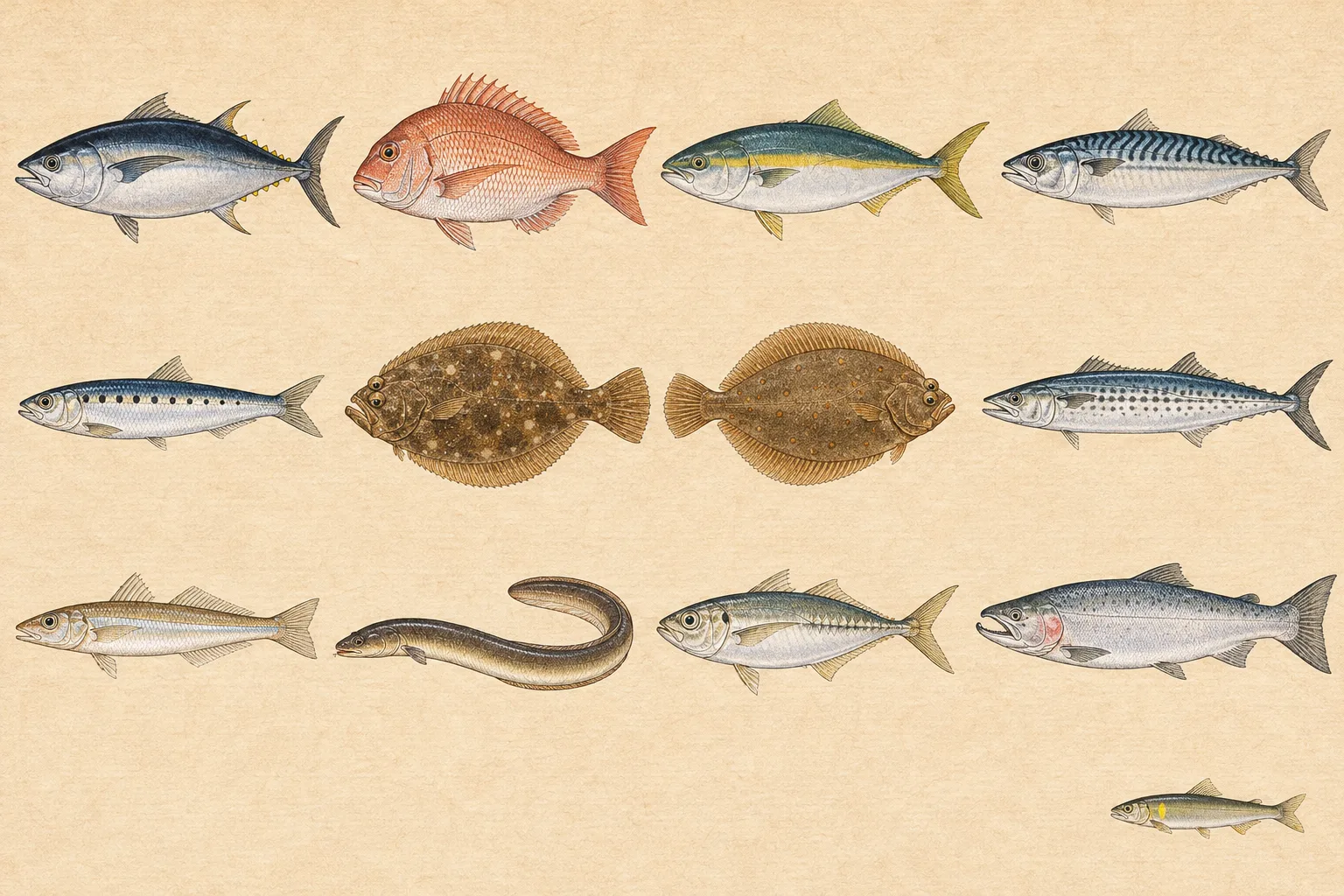
The fish on the cup. Top row, from left: tuna (maguro), sea bream (tai), yellowtail (buri), mackerel (saba). Middle row: sardine (iwashi), hirame, karei, Spanish mackerel (sawara). Bottom row: sillago (kisu), freshwater eel (unagi), horse mackerel (aji), salmon (sake). Bottom right corner: ayu. In the middle row the hirame faces left and the karei faces right, as in the mnemonic hidari hirame, migi karei.
Same character, different fish. 鮎 is sweetfish in Japan, catfish in China. 鮪 is tuna in Japan, a sturgeon-like fish in classical Chinese. 鮭 is salmon in Japan, pufferfish in classical Chinese. Readers of Chinese should switch off their instincts.
Japanese-made versus Chinese. Japanese dictionaries class 鰯, 鱚 and 鱈 as kokuji; 鰆 is often added, though disputed. 鯛, 鰻, 鯖, 鰈 and 鮃 came from China, even if, like 鯛, their oldest Chinese sense was not today’s fish. A right-hand part that spells out a season, a quality or a wish often hints at a Japanese coinage, but that is a rule of thumb, not a law.
Words that sound related but aren’t. Tsume and nikiri are both brushed on: thick and dark on cooked toppings, thin on raw. Gari and hajikami are both ginger: shaved slices with sushi, a pink shoot with grilled fish. Tekka-maki and teppō-maki differ by a syllable: tuna and gourd. Neta and tane are the same word, backwards and forwards.
Kitchen word versus guest word. Agari / o-cha. Murasaki / o-shōyu. Oaiso / o-kaikei or o-kanjō. Gyoku / tamago. Sabi / wasabi. Use the right-hand word. The single exception is sabi-nuki, which customers say all the time.
08Wooden Tags and "Market Price"
In many traditional shops, a row of narrow wooden tags hangs above the counter, each brushed vertically with the name of one topping: 鮪, 中とろ, 小鰭, 穴子, 赤貝. This is the shinagaki, or o-shinagaki, the menu. The tags are usually unpainted hinoki cypress or cedar, the ink dense black, the brushwork bold and rounded, sometimes in the fat, crowded lettering associated with theatre posters and sumo programmes, made to read clearly from across the room. Many tags hang from a nail and can be lifted off or flipped. When a fish runs out, the tag comes down or turns to its blank side; that is yama made visible.
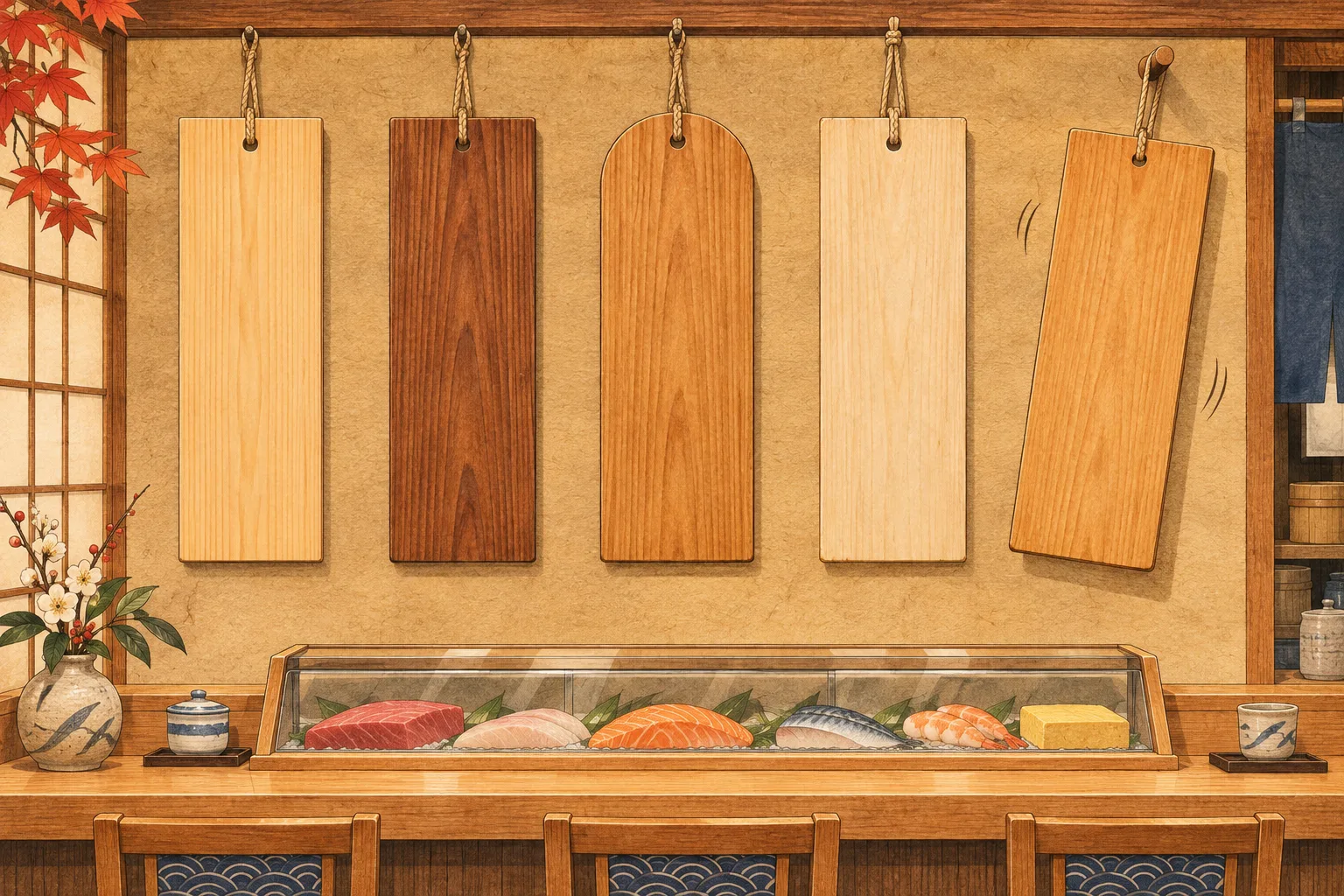
Shinagaki tags. From left: pale unpainted wood, dark wood, a round-topped tag, a tag flipped to its blank side, and one still swinging on its nail. When a topping runs out, its tag is flipped or taken down.
The tags give the name and usually nothing else. Where you might expect a price, some shops write two characters: 時価, jika, "current price". It means the cost depends on that day’s purchase. Sushi toppings are fish and shellfish, and what they cost moves with the catch, the weather and the morning’s auction, especially for tuna, sea urchin and abalone. From the shop’s side, jika is the honest answer: today’s fish costs what it costs. From a stranger’s side, it can be unnerving. Many shops now offer fixed-price courses or have the chef quote before serving, and asking "kore wa ikura desu ka?" (how much is this?) before you order is entirely normal in Japan.
Alongside the wooden tags you may see a blackboard or handwritten slip of honjitsu no osusume, today’s recommendations. Some high-end shops hang no menu at all and serve only a set course. Conveyor-belt chains went another way, pricing by plate colour and later by touchscreen, which leaves the wooden tag as decoration.
The main article covers the ways to order: omakase, leaving it to the chef; okonomi, ordering piece by piece; okimari, a set assortment, often in grades such as nami, jō and tokujō, or pine, bamboo and plum; and tsumami, sashimi and small plates to go with a drink before the nigiri. When ordering okonomi, the wooden tags are your best friend: read off the names in plain Japanese.
So, a summary for the counter. Listen for shari, neta and gari; read the fish on your cup; watch for tags flipping as the evening goes on. When it is your turn to speak, o-cha, o-shōyu and o-kaikei are all you need. The trade language belongs to the people behind the counter, and they will be quite happy to hear you not use it.
More deep dives on this topic
 TunaOrder an omakase in Tokyo and the tuna usually arrives in a sequence: a slice of deep red lean meat, then something pinker and softer, then a pale, marbled piece that seems to…
 HikarimonoSit at a sushi counter in Japan and, somewhere in the middle of the meal, the chef will set down a piece that looks different from the rest.
 Beyond TunaMost first-time visitors walk into a sushi bar thinking about tuna.
 Edomae ShigotoMost visitors arrive at a Tokyo sushi counter expecting raw fish on rice.
 Shari and Its Supporting CastAt a sushi counter your eyes follow the fish.
 Regional Sushi Beyond TokyoMost visitors meet sushi at a counter: a chef shapes rice in one hand, lays a slice of fish on top and sets it down in front of you, to be eaten within seconds.
 KaitenzushiSit down at a kaitenzushi (conveyor-belt sushi) counter anywhere in Japan and the basic deal is the same.
 Fish MarketsThe piece of sea bream a sushi chef slides across the counter at lunchtime has usually changed hands four or five times since it left the water.
 Words at the Sushi CounterSit at a sushi counter in Japan and the language around you shifts.
 The Sushi ChefFrom a counter seat, a sushi chef looks like a pair of hands and very little else.
- Back to the main article: Sushi →